---
title: "Psoriasis as a Dashboard: When Your Skin Reads the Operating System First"
description: "Psoriasis isn't cosmetics — it's systemic inflammation with a UI. A journey through the biomes of one disease: the bathroom at 3 a.m., the checkout line full of free dermatologists, $23,838 a dose, the Dead Sea, the dark forest of the mind. A scalpel without anesthesia. No conclusions."
author: "Дністер"
published: 2026-06-04T03:01:44.000Z
language: en
url: https://neurodrift.org/en/blog/psoriaz-yak-dashboard/
tags: ["psoriasis", "skin", "inflammation", "chronic-illness", "mind", "body"]
---
# Psoriasis as a Dashboard: When Your Skin Reads the Operating System First
> "Illness is the night-side of life, a more onerous citizenship. Everyone who is born holds dual citizenship, in the kingdom of the well and in the kingdom of the sick. Although we all prefer to use only the good passport, sooner or later each of us is obliged, at least for a spell, to identify ourselves as citizens of that other place." — Susan Sontag, *Illness as Metaphor*, 1978.
At six in the morning the bathroom mirror doesn't show a face. It shows an elbow. On it — a new red patch with a silvery scale that wasn't there yesterday, or was so small you let yourself not notice. Your hand pulls the sleeve down on its own. Your head is already rewinding: the launch, the move, the sleepless nights, that call on Thursday. The skin, it seems, "reacted." In fact it did something colder: it filed its quarterly report.
Here's the first uncomfortable number this journey starts from. Healthy skin renews itself completely in about **28 days**. Psoriatic skin — in **3 to 5**. It's a body that races every week to hit a monthly deadline over a long weekend, and does it for years, no vacation, no option to fire whoever's responsible. Cells get shoved to the surface before they've matured, and that unshed pile of half-finished cells is the very "plaque" everyone tells you to buy a cream for.
This is not a "what is psoriasis" article. It's a journey. We'll walk through the biomes of one disease — like different lands on a single map: the bathroom at three in the morning, the mirror, antiquity, the supermarket line, the bedroom, the office, the city and the salt sea, the dark forest of the mind, the pharmacy with its bill. In each biome the same disease looks different and costs differently. And one more warning from Sontag we'll keep as a compass the whole way: the most dangerous thing you can do with a bodily state is turn it into a moral verdict. We pass through the metaphors in order to look at them, not to believe them.
## I. Biome Zero: skin is not a shop window, it's an interface
Before setting out, you have to understand the terrain. The word "psoriasis" comes from the Greek *psora* — "itch." Hippocrates, two and a half thousand years ago, lumped it together with *lepra*, and that confusion held until the 19th century (we'll come back to that biome). But the modern name hides the main truth: this is not a disease of the skin. It's **systemic immune-mediated inflammation** that simply keeps its most insolent communications department right there on the skin.
Under the visible plaque a specific circuit runs. Dendritic cells throw out the signaling protein **IL-23**, which activates T-cells (Th17), which pump out **IL-17** — the chief executor that, together with **TNF-alpha**, orders the keratinocytes to multiply as if the building were on fire. This is the "IL-23 / IL-17 / TNF axis," and it works not only in the skin but all over the body. Modern biologics are antibodies that cut precisely these wires. Remember this schematic: the entire pharma revolution we'll reach in the last biome is the story of how medicine learned to hit not all of immunity with a shovel but one specific wire with a screwdriver.
And here's the proof that the skin really is a dashboard, not a random irritation. When 25 patients were given a drug blocking IL-12/23, inflammation measurably dropped not only in the skin — but in the liver, the spleen, and the arteries. Clear skin reflected and tracked how the fire inside was settling. The plaque is a gauge on the panel, wired to an engine you can't see.
**The skin is the UI. The backend burns below.** This phrase will keep returning, because it's the load-bearing wall of the whole text.
Why is this worth talking about right now? Because 2026 is the year the physics of this biome changed for the first time in half a century. In March the US approved **icotrokinra** — the first targeted peptide pill that blocks the IL-23 receptor. What used to require injections, a tablet can now do. In parallel came fresh data showing that even a city's air statistically raises the risk of falling ill. The map of psoriasis has been redrawn over the past two years — which is exactly why it's worth walking again.
Who gets it? Not the "anxious," not the "dirty," not "sinners with too much sugar." In the US it's about **3.2% of adults** (over 8 million people); worldwide the World Psoriasis Day consortium cites **around 125 million** — though the WHO's own report gives closer to ~100 million, and epidemiological models give even less. So even the number of patients is a range, not a sacred figure. Keep that habit with numbers: we'll be separating the hard from the pretty the entire way.
## II. The bathroom biome: the everyday no one sees
The first biome is the most mundane and therefore the most honest. Psoriasis doesn't live at conferences about autoimmune disease. It lives at three in the morning.
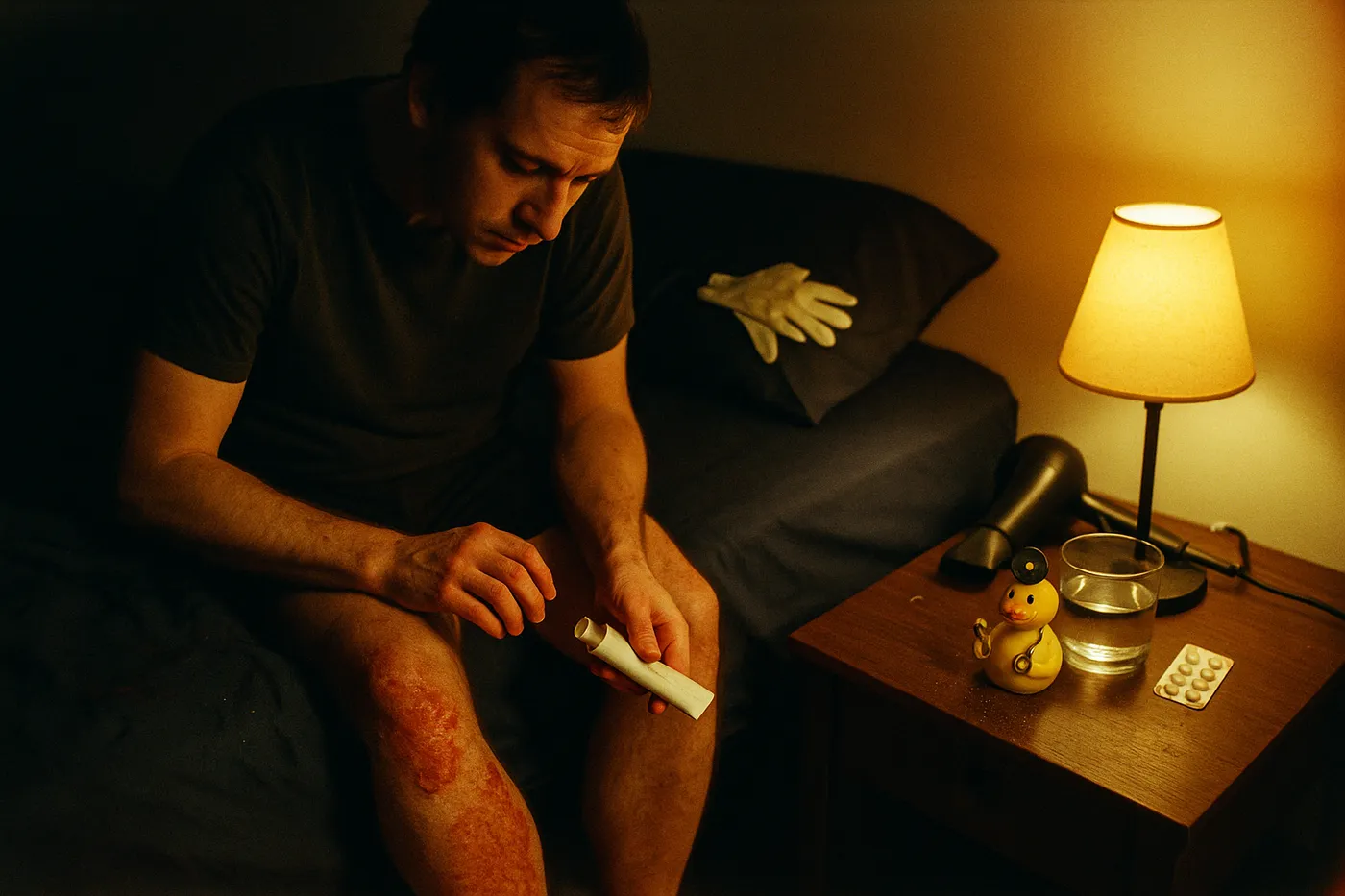
A scene that repeats in hundreds of patient diaries almost word for word: a person wakes up because they've scratched their skin in their sleep and finds small traces of blood on the sheet. Hence a quiet domestic ritual no one posts on Instagram: a separate set of **dark sheets kept specifically for when guests stay over**, so neither the flakes nor the blood show. Some sleep in **cotton gloves** so they don't tear themselves apart at night. Some get up at three to coat the skin and take a painkiller before they can fall asleep. Night is a work shift.
The itch here isn't an "inconvenience." One woman who's lived with psoriasis since she was eleven describes spending **hours** going limb by limb in search of a relief that isn't there. The itch eats whole evenings. And the flakes from the scalp fall onto a dark shirt like snow — and the morning lifehack sounds absurd and exact: blow-dry your head with a **hairdryer** over the bed to shake the snow off before the day begins.
Then there's the smell. The old heavy therapy is coal tar that "smells like roofing work," and dithranol — a white paste a nurse calmly tells a patient will "burn the scale off." Tar stays on the sheets, the pajamas, the towels. The year's calendar here is marked not by holidays but by skin: many fall into anxiety not in winter but in **spring** — because for everyone else the season of shorts and dresses begins, while for you the season when you could hide ends.
123
The immune system's night-shift DevOps never clocked in. Production deployed onto a leg — and the clean sheets, it turns out, are kept only for guests.
The plaque on the leg, coated at night — the one thing outsiders ever see.
White cotton gloves on dark sheets — so you don't claw the skin bloody in your sleep.
The auditor duck with a clock: the shift is running, the invoice unissued.
The dark joke of this biome is that it's the most expensive disease with the cheapest public image. From the outside — "a bit of dry skin, rub some cream on." On the inside — a night shift, the bookkeeping of flakes, and a separate set of linens in case anyone stays over.
## III. The mirror biome: the economics of flawless skin
The next biome is the mirror. And here the disease collides with an entire industry whose only promise is flawlessness.
The most repeated concrete fact in the whole corpus of patient stories: people who **didn't wear shorts for nearly ten years, even on the hottest days**. A full summer uniform of camouflage: long sleeves, trousers, **socks under sandals** because the feet are flaring — dressing for January in the middle of July. Someone went to a tanning bed before their honeymoon to risk wearing shorts. The morning ritual is the "mirror audit": scan the skin to learn whether today is a **"good skin day,"** and on that answer hang the clothes, the confidence, sometimes whether plans get cancelled.
And now the numbers from the other side of the glass. The global skincare market in 2024 is roughly **$164–185 billion** (estimates vary). Analysts themselves name "clean beauty" and the cult of flawlessness as the growth driver. Which means **the "clean girl" aesthetic is literally the business thesis of a hundreds-of-billions industry**. And here's the direct collision: the industry sells the erasure of a single pore while ~125 million people shed skin in whole plaques. The "clean face" is the secular descendant of a very old word — "clean" — which we'll reach in a moment.
This biome strikes unevenly. About **60% of people with psoriasis** call it "a large problem in everyday life," and the burden is heavier in women and in the young — exactly those the culture of filters covers most tightly. One woman recalls being taught as a child to hide not just her skin but her own natural openness: masking became a character trait. The disease didn't take a spot. It took the cardigan out of the status of clothing and turned it into armor.
## IV. The antiquity biome: when skin was a sentence
Now — the time-machine biome, because without it you can't understand why, in the line, they still fear you. For almost all of written history, scaly skin was not a symptom but a **verdict**.
In the Middle Ages a person with scale (and psoriasis was not then distinguished from leprosy) was declared an outcast. They were forced to carry a **bell or a clapper** to warn of their approach, forbidden to touch the healthy or eat with them at one table, dressed in special clothing, and sometimes the Church declared them **dead** while alive — with a funeral service. In 1313 the French king Philip IV ordered "lepers" burned at the stake; since psoriasis wasn't separated from leprosy, people with our perfectly non-contagious scale fell under the same sentence. (Precision matters here: this is the persecution of lepers in general, into which psoriatics were swept by resemblance, not a separate program of executions "for psoriasis.")
The root reaches deeper still — into the biblical *tzaraath* (Leviticus 13–14): a ritually unclean state of skin (and also of clothing and houses) that, importantly, is **not** the modern Hansen's disease. The afflicted person was separated "to prevent moral contagion," and the condition itself was read as "a metaphorical embodiment of sin." Here is the textual source of the whole habit of reading skin as a verdict on the soul. Right up to the 19th century: Robert Willan in 1809 gave skin diseases a rational classification but still wrote "lepra vulgaris"; and only Ferdinand von Hebra finally severed "leprosy" from psoriasis as separate diseases.
And here our compass speaks. Susan Sontag, dying of cancer, wrote the most important warning about disease in general:
Sontag showed the mechanism with tuberculosis and cancer: first the disease is assigned a character, then it's claimed that the character **caused** it — because it "failed to express itself." Her prescription: strip the metaphor from the disease, leave the biology and the treatment. We do the opposite on purpose — we enter every metaphor — but precisely in order to lay them down at the end, not to bow to them. **Not contagious. But everyone acts as if it's a sentence.**
## V. The line biome: everyone's a bit of a dermatologist
From antiquity straight into the supermarket, because the distance between them is shorter than it seems. This is the biome that yielded the harshest material.
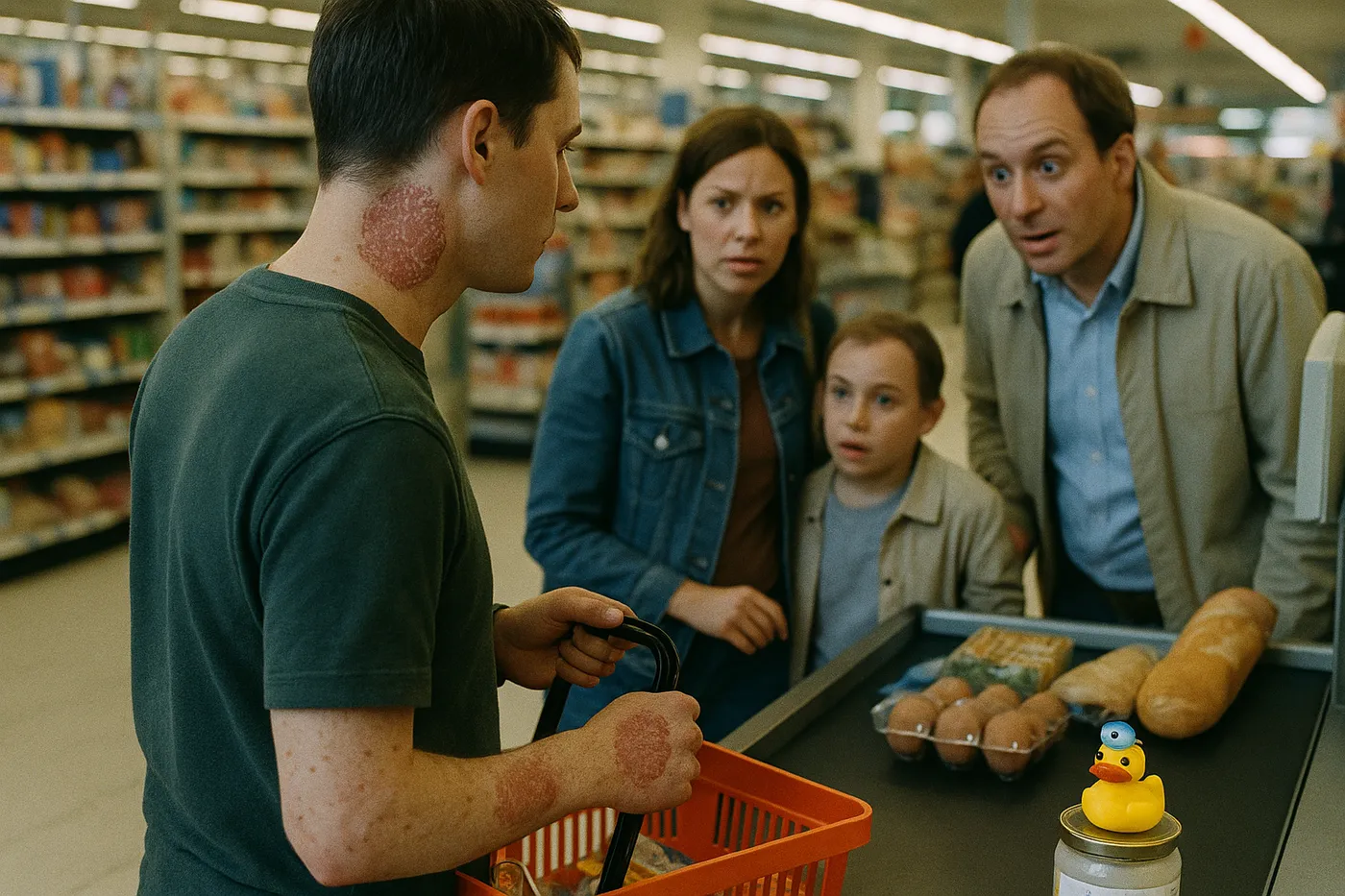
Real scenes recorded by patients. A stranger by the mini-market asks whether it's **leprosy**. A twelve-year-old child is asked whether it's **AIDS**. A woman is compared, to her face, to the **"Elephant Man."** Colleagues ask "is it contagious?" — and **touch** the skin to get a better look, treating an adult human like a specimen. And then — a mother tells her daughter: **"lose weight and it'll go away."** The advice comes not only from strangers.
And over all of it — the most universal phenomenon: **everyone suddenly becomes a dermatologist**. A shop assistant mid-shift gets a "free consultation" from a customer who noticed a spot on her neck and prescribes oatmeal baths and coconut oil. The standard menu of advice from outsiders: "drink more water," "cut out sugar," "exercise," "try holistic," "go plant-based." In response people develop defensive rituals — warning the hairdresser about their skin **before** they're asked — and they hone armor-jokes: "it's just a glitch in my immune system" or "scratched myself falling off a bike."
123
The medieval leper's bell never disappeared. It just got digitized: now it asks "have you tried coconut oil?" — and rings in every line where there's light.
The plaque on neck and hand — what the gaze slides onto instead of the face.
The eyes of strangers: humanity can't cure autoimmune disease, but it instantly diagnoses someone else's.
The consultant duck sits on a jar of coconut oil — the folk "cure" advised most confidently and working least.
Coconut oil deserves its own word, because it's the perfect exhibit of this biome. It's both the thing strangers most often advise **and** the thing patients actually try. The verdict of the evidence: at best a moisturizing add-on, never a standalone treatment; a trial a decade ago already showed it doesn't clear plaques. The gap between **how confidently** it's advised and **how little** it does is the plot. The leper's bell didn't vanish. It just became free advice.
## VI. The bedroom biome: intimacy with the lights on
The quietest biome. Here the disease turns off the light — literally.
The most cinematic single story in the corpus: a woman who for years had sex in **stockings and a buttoned long-sleeved shirt, with the lights off**; her partner didn't see her bare skin for **ten years** — until she finally posted a photo on Facebook. Her core feeling: even when therapy completely clears the skin, the sense of being "not good enough" doesn't go anywhere. The fear underneath it all — that people "see your condition before they see you," that you're desired **despite** the skin, not **because of** it.
The partner here is a separate fork. What this woman valued most about her ex-husband: during fights he **never once** mentioned her psoriasis — never used the disease as ammunition. The dark version sits beside it: a husband who waved off his wife's insecurity by simply calling her "hung up about it," after which she was afraid to raise the subject at all. The one who doesn't support you doesn't shout. He **dismisses**. And the bright version — a partner who, in response to a confession, says not "but you're beautiful" but "thank you for trusting me with this." About a third of people with psoriasis say it complicates intimacy regardless of location; and for those with genital involvement the silence is hardest — you can't hide that plaque under a cardigan or explain it with a joke.
**The question isn't the spots. The question is the word "forever."** It will ring louder in the dark biome ahead.
## VII. The office biome: the handshake you avoid
The work biome. Here the disease takes not a payment but a career — quietly, from behind the scenes.
People describe going to an interview with hands **completely covered in plaques**, terrified it would cost them the offer, physically trying to hide their palms. And it's not paranoia: it's documented that skin lesions **pull the interviewer's gaze away from the candidate's eyes** — and lost eye contact measurably hurts an interview. The plaque sits in the room as a third participant. Food-service workers carry a separate fear: a flake falling into a customer's plate. In medicine the stigma flips: patients flinch from a nurse's hands, assuming it's contagious — the one who cares for you is feared as a source of infection.
And the harshest move: people **turn down jobs** because a new insurance plan doesn't guarantee coverage of their biologic. The disease quietly vetoes career decisions from behind the scenes. About **23%** say psoriasis influenced their career choice, ~17% report a psychological effect at work. And on a Zoom call, while the team discusses unit economics, one part of the brain holds another dashboard: is the spot visible, will they ask about it now. This isn't vanity. It's a background process eating CPU.
Let's count this biome cold. Psoriasis isn't just the price of drugs; it's lost hours.
| What psoriasis charges | How much (US, year) | Detail |
|---|---|---|
| Total disease burden | ≈ $35.2 B | estimate of aggregate US costs |
| — direct medical | $12.2 B (35%) | drugs, visits, hospitalizations |
| — loss of quality of life | $11.8 B (34%) | what money doesn't treat |
| — **productivity loss** | $11.2 B (32%) | nearly a third is work, not pharmacy |
| Indirect costs: mild | ≈ $4,095 per person | mostly presenteeism, not absence |
| Indirect costs: severe | ≈ $16,252 per person | the severely ill lose ~551 work hours a year |
Presenteeism — "sick at the desk" — hits harder here than absenteeism. The most expensive thing in this biome isn't sick leave. The most expensive thing is the hours when a person is present but half their processor is holding a dashboard on their wrist.
## VIII. The biome of the city and the salt sea: the air you took for background
The biggest biome — environment. Because the body reacts not only to genes and coffee but to the air you breathe without noticing it.
In 2024 *JAMA Network Open* published a study on the UK Biobank: **474,055 people, 4,031 new cases** of psoriasis over nearly 12 years of follow-up. Long-term air pollution was linked to higher risk: for PM10 the highest quartile versus the lowest gave **HR 2.21** (95% CI 2.02–2.43); for PM2.5 — 2.01; and the combination of dirty air with high genetic predisposition — around 4.11. This is **association, not proven causation** (a cohort, exposure estimated by place of residence), but the conclusion is firm: air is not décor. It's another quiet co-founder of your inflammation that can't be fired.
The city adds smog, the commute, screens, sleep loss, alcohol loops — and at the same time better access to dermatologists, phototherapy, and biologics. The countryside isn't automatically a sanatorium: less megacity smog, but more stove smoke, cold stress, chemicals, trauma, and — crucially — farther to a specialist. The body isn't a romantic: it doesn't care whether you suffer under chestnut trees or beside a shopping mall.
And now the most beautiful part of the biome: people literally **migrate into specific ecosystems** in search of remission. And here you have to hold the facts level, because the marketing runs ahead of the evidence.
123
The city quietly enters the lungs, sleep, and cortisol. Sun with salt, for four weeks, douses what the city burns every day. Only the resort's active ingredient is mostly ultraviolet in nice scenery.
The grey smog haze of the city — a quiet co-founder of inflammation, HR 2.21 for PM10.
Plaques subsiding in salt water under the sun: −81.5% in four weeks.
The duck in sunglasses — a deadpan lifeguard watching over the "miracle."
| Resort biome | What it supposedly does | Evidence | Honest verdict |
|---|---|---|---|
| Dead Sea | attenuated UV + mineral baths | strong: PASI −81.5% in 4 weeks, remission ~3.3 months, confirmed by histology | real effect, but temporary |
| Blue Lagoon (Iceland) | silica (135–140 mg/kg) + geothermal water | moderate, partly commercial | recognized adjuvant, not a miracle |
| "Doctor fish" of Kangal (Turkey) | fish nibble the scale in a hot spring | weak: small case reports, confounded with UV/baths | charming, but it's most likely the sun working |
The shared active ingredient of all three biomes is, most likely, **the sun**. UV phototherapy is established dermatology; the resort works mainly as a delivery system for sun and salt, wrapped in a travel destination. Grown adults fly to be nibbled by fish — and it's funny right up to the moment you remember that for many it's the first remission in years.
## IX. The founder biome: the trigger machine you called ambition
This biome is a mirror for those who build. Founder life is a perfect trigger machine: chronic uncertainty, conflict load, sleep debt, financial turbulence, calls across time zones, "one more launch" as a socially acceptable form of self-harm. It seems obvious: stress → spot. And here the most important counter-strike of the whole text is needed, because this is exactly the place where the text could become the thing it criticizes.
Stress is sold as the on/off switch of psoriasis. The data say something subtler. A large review (Snast et al., 2018, *British Journal of Dermatology*, 39 studies, over 32,000 patients) shows: **46%** consider their disease stress-reactive, **54%** recall a stressful event before a flare, and the odds ratio for "stress before onset" is 3.4. But this is **self-report and retrospection**, which always inflate the link. When you look more strictly — the single prospective cohort found a correlation of stress with flares ~4 weeks later of only **r = 0.28** (modest). And where a **documented** diagnosis of a stress disorder was used, there was no excess of psoriasis at all (OR 1.2). The honest position: stress is noticeably associated with flares in some people — but it's a personal, lagged log that you have to test on yourself, not a new god with a dermatology degree.
Sleep in this biome is not a wellness tip but an infrastructure requirement. Itch and pain destroy sleep; bad sleep wrecks mood and, it seems, feeds inflammation; sleep debt here looks at once like a trigger and a consequence. Sleep is the immune system's night-shift DevOps. If it doesn't show up three nights running, don't be surprised that production is burning on the elbows. A founder rarely says "I'm wrecking my stress axis." He says "we're having a strong quarter." The body hears that like an accountant who's already seen the empty till.
## X. The dark-forest biome: the same fire that's on the skin
The darkest biome. We enter carefully, because here it's easy to slip into exploiting someone else's pain. We'll hold Sontag's compass: show the burden without turning it into dramatic blackmail.
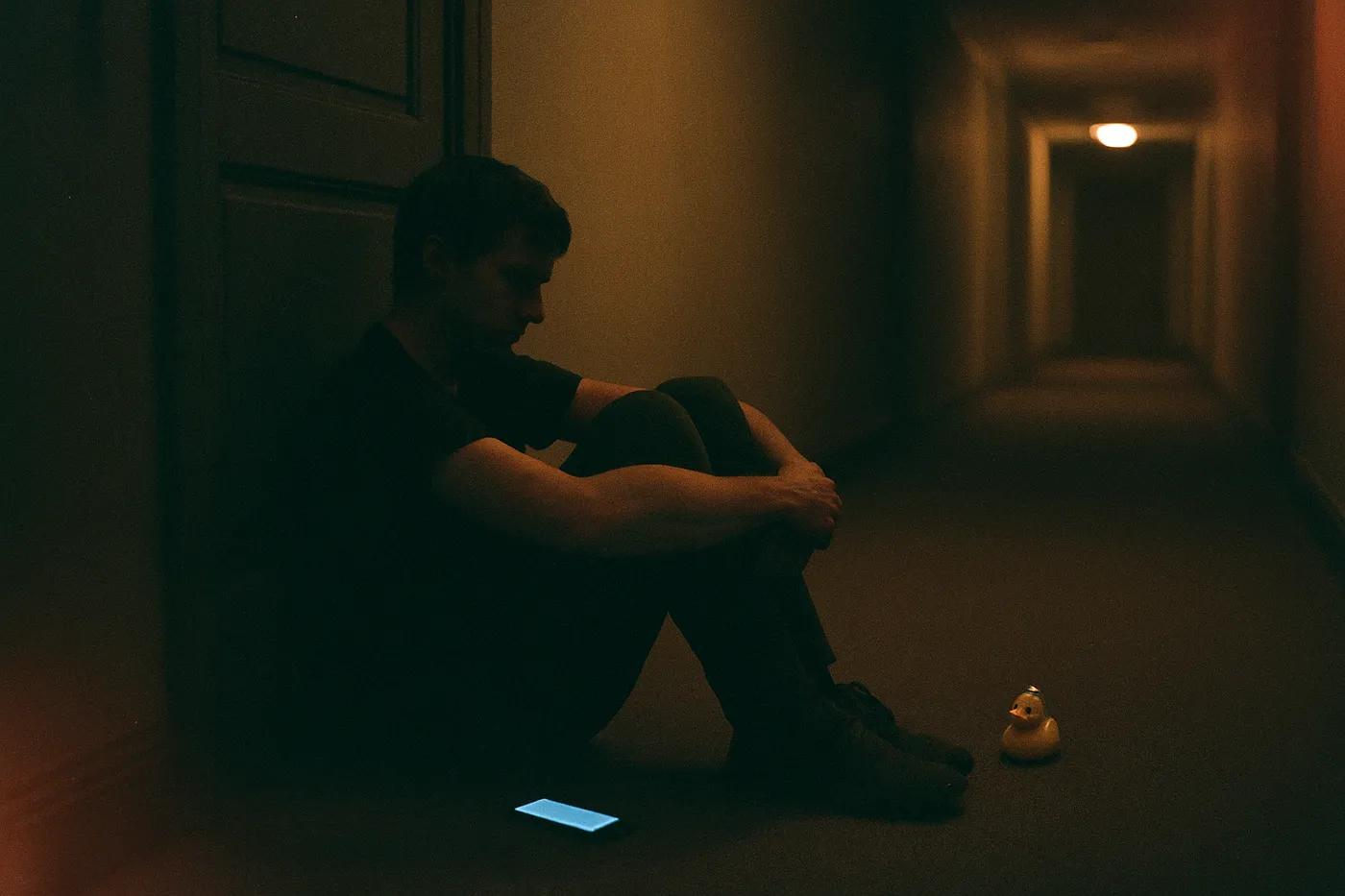
The most consistent finding across all the stories: what wounds deepest isn't the spot but the word. The question "**is it forever?**" lands heavier than any symptom — it turns the present into a sentence. The disease also recruits the patient into self-blame: one woman's first thought on being hospitalized wasn't fear but **guilt** — that she'd "driven her own skin to this." A man named Howard kept an entry from his teenage diary after a UV treatment burned his skin: "*It all feels so hopeless… The problem is it will never go away. I need a break.*" Decades later, in his worst period, he describes sobbing with his face in his hands, not knowing whether he could live the rest of his life with **95% body coverage**. As a child he was branded early: a teacher **announced his condition in front of the class**, his own brother called him "tar-boy" at home. Adults then often make self-chosen exile their strategy: they stop going out, decline invitations — on purpose, to lower the chance the skin gets seen.
12
Self-chosen exile isn't accidental loneliness — it's a strategy to lower the risk of being seen. The hardest word here isn't "it hurts," it's "forever."
The unanswered phone with notifications: invitations it's easier not to reply to.
The auditor duck with the clipboard closed — the one who finally stopped recording and just stayed nearby.
Now the numbers — level, with a tension you can't smooth over. The raised risk of **depression** in psoriasis is stable: a meta-analysis of 16 cohorts (over a million patients) gives a pooled RR of **1.43**; roughly one in five has comorbid depression; in Kurd's classic study (2010) the adjusted HR for depression is 1.39, for anxiety 1.31. But **suicidality is a field where the evidence argues with itself**, and the honest move is to show exactly that argument. A 2017 meta-analysis (18 studies, over 1.7 million participants) found raised risk: suicidal ideation OR 2.05, attempts 1.32, completed suicides 1.20, with a stronger signal in the younger and the more severe. But a stricter 2023 prospective meta-analysis found **no** significant rise in suicidal ideation (RR 1.25, confidence interval crossing one). So: depression — confidently raised; suicidality — significant in some syntheses and vanishing in others; the signal strongest in the young with severe disease. This is grounds for screening, not material for a scare.
And here's the mechanism that links this biome to all the others at all. Depression here is not only a reaction to shame in the mirror. The same cytokines that flake the skin (IL-17, TNF, IL-6) disrupt the blood–brain barrier, cause neuroinflammation, and shift tryptophan metabolism down the **IDO → kynurenine** path, diverting it from serotonin. Part of this depression is **systemic**, "inflammatory," not "weakness of character." This is Sontag's verdict confirmed by immunology: there's nothing to moralize here — it's biology.
If it's so hard for you right now that the thoughts go to that place — that's a signal not to a cream but to a person. In Ukraine a support line runs around the clock (including **7333**), internationally — **findahelpline.com**, in the US — **988**. The skin is a UI; but this biome is the case where, for the backend, you don't read the dashboard — you call an engineer.
## XI. The pharmacy-and-lab biome: the bill for clean skin
The last big biome — to where the disease is finally treated. And where they bill you for the treatment.
The old world looked like putting out a fire with a blanket: topical steroids, vitamin-D analogues, phototherapy, methotrexate, cyclosporine — broad suppression of immunity. Then came the biologics revolution — not "magic shots" but the targeting of specific pathways: secukinumab (the first anti-IL-17A, approved in the US on January 21, 2015) and then risankizumab, whose data were striking — **PASI 90 in ~82% / 81%** at week 52. And then the oral era: deucravacitinib (a TYK2-inhibitor tablet, approved for psoriasis in 2022, and in **March 2026** — for psoriatic arthritis too), and the culmination — **icotrokinra**, approved by the FDA on **March 18, 2026**: the first targeted **oral peptide** blocking the **IL-23 receptor**, for adults and adolescents from age 12. A pill once a day, on an empty stomach. It's not "a pill that cures psoriasis forever," but it's a change of UX: a treatment that doesn't remind you with an injection each time that you're ill. 2026 is altogether the year of the **oral wave**: alongside it run zasocitinib (another oral TYK2, in phase 3 — over 50% reached PASI 90) and four-year data on bimekizumab, where ~2/3 of patients held **complete clearance**.
And here's why this isn't a dry pharma chronicle but a human scene. The most charged "after" in all the stories sounds almost religious: "*Biologics changed my life. I never thought my skin would be clear. That I'd look like a normal person.*" For many it's the first remission in decades — the skin clears "in a few weeks." It's a shift of identity, almost a resurrection.
123
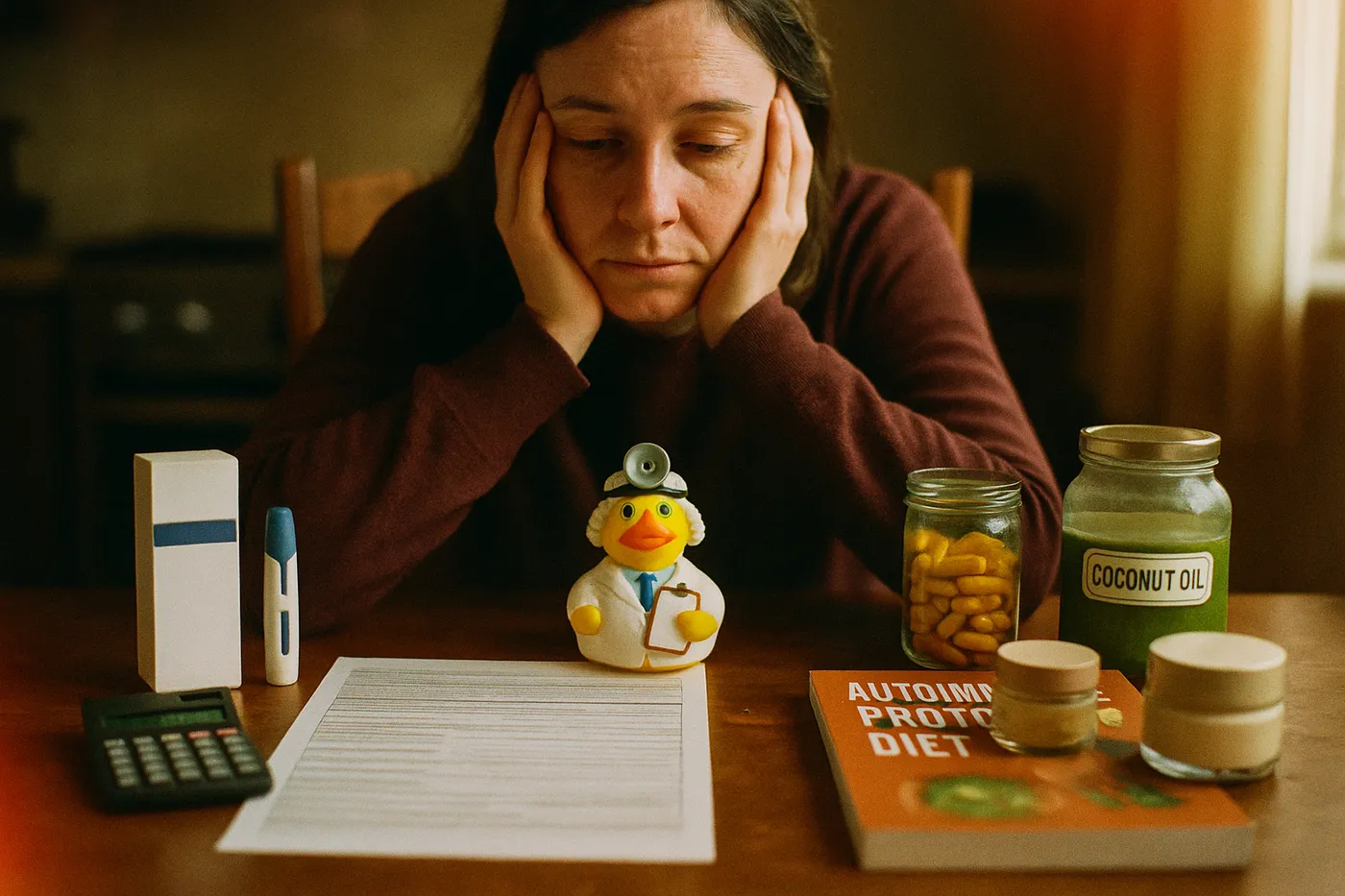
On the right — a $150-billion market of hope selling the story of inflammation. On the left — an engineering intervention at $23,838 a dose. The auditor duck ignores the smoothie and stamps the seal.
The auto-injector and the insurance form: clean skin, written out in your name and someone else's budget.
The shelf of hope — coconut oil, turmeric, "detox," the AIP diet: it sells a cause, not evidence.
The duck in robe and judge's wig presides over the hearing of the body.
But the resurrection is conditional, because the bill arrives. One dose of a leading biologic (Skyrizi) at list price — **$23,838** (that's WAC, the "sticker," not what people usually pay after discounts and coupons); a year comes to about $95,000. Cosentyx alone cost the US healthcare system **$7.7 billion in 2024**. Humira held $80–90k a year for years, until biosimilars knocked it down by −81%. And between the patient and the drug stands insurance with its "step therapy": fail first on cheaper drugs, then we'll pay. A woman named Alisha faced a **$5,000** copay, leaned on an assistance program — and it **ran out of funds** mid-treatment, forcing her to find another. The fear here isn't only that the disease will return. The fear is that a paper form will decide whether it returns.
| Treatment ladder | What it is | Status-2026 |
|---|---|---|
| Topicals + phototherapy | steroids, D-analogues, UVB | the starting base, works |
| Old systemics | methotrexate, cyclosporine | pre-biologic, under supervision |
| IL-17 / IL-23 biologics | secukinumab, risankizumab, etc. | core of the breakthrough, PASI 90 is the norm |
| Oral small molecules | deucravacitinib (TYK2) | 2022 skin, 2026 joints too |
| **Oral peptide** | **icotrokinra (IL-23 receptor)** | **first in class, FDA 03.2026** |
And alongside — another price list, cheaper and more honest only on the surface. The supplement market is around $150 billion; turmeric alone ~$1.6 billion, sold under the banner of "anti-inflammatory." The standard dietary pilgrimage patients walk in ascending order: gluten-free → dairy-free → sugar-free → the full AIP protocol. And the most useful testimony here is **failure**: people who held out for over a year without gluten, dairy, and sugar and watched psoriasis **get worse**. But beside them there's always the one who "cleared in three weeks" — and that split is the engine of the whole rabbit hole: enough success stories that everyone else keeps paying and hoping.
| Death certificate | |
|---|---|
| Deceased | The myth "cure psoriasis with the right diet / oil" |
| Cause of death | A face-to-face meeting with systemic inflammation |
| Time of death | A month of strict AIP with not a single effect |
| Bequeathed | $1.6 billion of turmeric and a sense of guilt for "insufficient discipline" |
| Signed by | The auditor duck, without looking up from the smoothie |
A second counter-strike is needed here, so we don't slip into the cheap wisdom that "drugs mask, nature cures the root." A biologic that quenches inflammation is **not the masking of a symptom**. It's an engineering intervention in the wiring. And if sleep or weight reduction (where there's excess weight) lowers someone's flare frequency — that too is an intervention, not "spirituality." The root isn't single: it's a borscht of genetics, immunity, the city, weight, sleep, and that Thursday call. **The skin is the UI. The backend burns below** — and at last there are tools that reach the backend, not just repaint the screen.
And one more bill the body issues somewhere other than where you're looking. Psoriasis is multisystem: it takes a cut from the joints, the heart, the metabolism.
| The body bills | Where | How much (association, not verdict) |
|---|---|---|
| Joints | psoriatic arthritis | ~30% (NPF) / ~20% by stricter reviews |
| Heart (young + severe) | myocardial infarction | relative risk ~3.1 at age 30 (Gelfand 2006) |
| Vessels in PsA | cardiovascular disease overall | roughly +55% vs controls |
| Metabolism | diabetes / blood pressure / weight | up to +70% / +90% / +40% risk |
A relative risk of 3.1 in a thirty-year-old sounds frightening — but precisely because their baseline absolute risk of infarction is small; it's grounds for screening, not panic. The point of the biome is the same: if you treat only the spots, you can win the face and lose the backend.
## XII. A quiet log by the roadside
There will be no protocol here, no rules, no "do this." I'll leave one tool by the roadside — in case you ever want neither to believe the log nor to pray to it, but simply to **look at it**. Psoriasis doesn't prove causation in one person. But sometimes it shows a pattern — if for four weeks running you honestly record not "mood" but events.
| Week | Conflicts / load | Sleep (avg) | Alcohol | Infection / illness | Skin trauma | New / worse plaques | Notes |
|---|---|---|---|---|---|---|---|
| 1 | | | | | | | |
| 2 | | | | | | | |
| 3 | | | | | | | |
| 4 | | | | | | | |
If you drop this log in the third week — that's data too. Not about psoriasis. About how easy it is to call a system a system right up to the moment you have to enter the fourth row.
## XIII. Instead of a conclusion: we walked the biomes to lay the metaphors down
We've walked the lands of one disease. The bathroom at three in the morning with dark sheets. The mirror and the $170-billion industry selling the erasure of a pore. Antiquity with its bell and its stake. The line where everyone's a bit of a dermatologist. The bedroom with the lights off for ten years. The office with the handshake you avoid. The city quietly burning in the lungs, and the salt sea that lends the sun. The trigger machine someone calls ambition. The dark forest where the same fire reaches the thoughts. And the pharmacy, where clean skin is written out in your name and someone else's budget.
In each biome the temptation is the same: to give the disease a meaning. That it's punishment for stress. That it's a failure of discipline. That it's a character that "failed to express itself." Sontag warned about exactly this — and we entered every metaphor not to settle in it, but to look at it and put it back in place.
So there remains a person at the mirror at six in the morning, sleeve rolled halfway up. The dashboard glows. **The skin is the UI. The backend burns below.** **Not contagious — but everyone acts as if it's a sentence.** **The question isn't the spots. The question is the word "forever."** The report is already printed to the surface; you can see it even from here.
One thing stays open — and we deliberately don't close it for you. Not "what to do." But whether you're even ready to read this dashboard as a signal and not as a sentence. And who, in the end, stands on the other side of the mirror — the patient, the operator, the defendant? The auditor duck has already set down the clipboard. The sleeve is still rolled up. What happens next — the frame doesn't show.
 1
2
3
1
2
3
 1
2
3
1
2
3
 1
2
3
1
2
3
 1
2
1
2
 1
2
3
1
2
3