Back then, with the sour dumplings and the psoriasis on my elbows, everything hurt. And everything was alive. These two facts didn't argue with each other — they were one and the same fact. Money came and pried them apart. And it turned out that prying apart "it hurt" and "it was alive" meant losing the second along with the first, because there's only one switch.
The metro. The turnstile. I knew where you could slip through behind the crowd — where the outflow came toward you and the mechanism lagged by a second. It cost two hryvnias I didn't have. Or rather — they existed, but they had to be saved. Saving two hryvnias is a profession too, just without a diploma and without days off.
The minibus: I'd board from the rear platform while the driver wasn't looking. Passing the money forward once you're already seated — that's visible, that's now safer not to do. From the train my mother would send dumplings. They traveled frozen and slowly thawed over a day on the road — so they'd arrive slightly sour. I'd tip them onto a frying pan, add a little water, sprinkle ketchup, salt. I'd cook them over until the smell of sour became just the smell of frying. I ate slowly — hurrying is for when you have somewhere to hurry to.
Don't rush to file this under the genre of "poverty toughens you." Because there was another half to the night. At night came fear — not anxiety, but a concrete, tangible, arithmetic fear: the money will run out. I'd lie there and count in my head what there was and what would be, and when it didn't add up — I'd just keep lying there and wait for circumstances to settle the count for me. This is not a spiritual practice. In engineering terms it's a bandwidth tax — a brain running a survival calculator as a background process has no resource left for anything else. Poverty is not a spiritual school. Poverty is Excel with no right to close the tab.
And here's the first honest thesis, which we have to start from so the rest isn't a lie: this friction is bad. Hunger, fear, humiliation, the inability to get treatment, the dignity that wouldn't let me take a laborer's job because it was terrifying to become a person without a project — this is not material for the soul. It's a tax. Money lawfully cancels it and cancels it rightly. Anyone who romanticizes sour dumplings from the safe distance of the well-fed is selling you beautiful crap in gift wrap — and charging for delivery on top.
The problem is elsewhere. That same evening, with those same dumplings, life touched me — and touched me the way it hasn't in a long time. When money came and switched off the bad friction, it quietly, without announcement, switched that off too. Control over reality came through a single panel — and on it was one switch for two bulbs.
Intuition suggests a simple picture: got rich, talk to people less, shut yourself in, became a snob. Intuition here is almost right, but it misses on the most important thing. In 2016 Suzanne Bianchi and Kathleen Vohs took two nationally representative samples of Americans — 118 026 people in total (the General Social Survey for 1974–2012 and the American Time Use Survey for 2002–2011) — and looked at what income does to socializing. The result is subtler than "less."
Higher income doesn't switch off sociality — it rewrites its composition. More money means less time with family and neighbors (weak, obligatory, unchosen ties) — but more time with friends you chose yourself. The specifics: for every standard deviation of income upward, there are roughly 10 fewer evenings a year with neighbors, 6 fewer with family — and 6–7 more with chosen friends; plus a bit more time alone. All of this — after adjusting for working hours, age, family composition, race.
Read this slowly, because the whole mechanism is here. Money doesn't make you lonely. Wealth doesn't kill sociality — it turns it into a private subscription: you traded random people for convenient ones and called it freedom. The neighbor you didn't choose; the woman at the market the algorithm didn't scroll past for you; the passenger who spoke up without your permission — all of that goes first. What remains is a curated circle: your own people, by income, language, aesthetics, and ROI. The world doesn't vanish. It gets de-randomized — becomes predictable, smooth, and a little dead. You didn't become lonely. You just outsourced everyone.
Give it a name, because without a name it stays a whine in the feed rather than a mechanism you can work with. Let's call it the Service Cocoon — not a mood but an operating system. A state in which so many paid interfaces stand between you and the world that you no longer touch the city, chance, or a stranger. The cocoon isn't evil. It's convenient. It's spun thread by thread, and each thread on its own is rational. The service cocoon is when life became SaaS and you forgot that a person is not an API.
The cocoon has layers, like a thermal suit — or, more precisely, like an insulation stack, where each successive layer removes one more type of contact. Physical: climate control, the car, delivery — the body no longer gets cold, no longer carries, no longer waits. Logistical: apps remove the need to orient yourself, to ask, to negotiate — the city becomes not an environment but an overlay on a map, a blue dotted line over a living street. Social: you interact with people through a role — customer, client, employer, payer — almost never simply as a human among humans. Class: you see more and more of those at your level or those serving you. Narrative: life becomes more successful but less narratable — fewer scenes, more "paid, did, closed."
And here we have to loudly refuse the lazy reading. This is not a "poverty is holy, wealth is rotten" text. I'll say it plainly, because otherwise half the readers will finish in their heads not my text but their own: I refuse to write "poverty is holy." Poverty is mostly fear and narrowing; we already agreed on that in the first section, and I'm not taking back a word. The cocoon isn't the enemy either: it saves you from bad friction, gives you sleep, treatment, time with your child, quiet for work. Plenty is not the problem. The problem is when plenty becomes bubble wrap for everything alive. The enemy is not money and not comfort. The enemy is seamlessness by default: when every evening the most convenient option automatically wins, and the most convenient option is almost never the most alive.
There's one professional group that drives into the cocoon faster than anyone, because it has a trained reflex arc: the founder. In business, friction is the enemy. Every second of delay at checkout, every extra click, every "inconvenience" in the funnel is lost money, and you spend years learning to shave it off. The brain gets rewritten under one commandment: remove friction wherever you find it.
Then that same brain comes home and applies the same optimization to its own life — and doesn't notice that some of life's friction isn't a funnel bug but the bloodstream. In business friction is the enemy. In life some friction is what gets the blood moving. And the founder confuses alive with optimized: builds himself a perfectly automated coffin where the calendar breathes, the CRM sings, delivery arrives exactly in its slot, the assistant intercepted the small stuff — and the person inside is somehow not great. Everything green on the dashboard. Not a single incident. Uptime 99.9%. The CRM works flawlessly. The soul has been in Pending Review status for three quarters now, and no one assigned a reviewer.
The less money, the more life. I didn't formulate it that way back then. But now, looking back: it's true.
When I had no money — I hitchhiked. And hitchhiking is always a conversation. You ask, you thank, you explain where to and why. The driver explains too — where he's headed, why this road, what's going on at home, what's wrong with the country. I was given rides by: priests, Baptists, evangelicals from Dnipropetrovsk, ex-cons, long-haul truckers, an old man who stayed silent the whole way and said at parting, "God sees you, boy" — and shut the door. A person who gives a stranger a ride isn't obligated to do it — and it's that very arbitrariness that makes them more real than any service you ordered and paid for. Glovo has almost everything. But the old man from the roadside who says "God sees you, boy" isn't there yet. Maybe in the 2028 premium subscription, with priority delivery of a blessing.
Money takes all of this away. You buy a ticket — and you ride in silence among strangers who don't need to know you. You order delivery — and you don't go to the market, where the woman behind the counter remembers you and asks how you're doing and actually waits for an answer. And here's the swap that's easy to miss: plenty doesn't give you freedom from people. It gives you the ability not to notice them. These are entirely different things — and the second is very easy to confuse with the first. "Freedom from people" quietly becomes "freedom without people" within a week, and you don't even remember when you signed off on the downgrade. The courier brings everything except the world.
Here it's worth knocking down one illusion of my own industry. Luxury doesn't sell comfort. Luxury sells control over WHO gets the right to touch you — physically, socially, by chance. List premium offerings one after another and you'll see a single hidden product: a private transfer (no strangers' bodies in transport), private dining (no strangers' tables nearby), a gated community (no strangers' neighborhoods out the window), a concierge (no strangers' queues), the airport VIP zone (no shared waiting), private medicine (no reception desk full of people), a home gym (no locker room with strangers). All of it is sold as "comfort." What's bought is a filter on incoming contact.
And here's where the time bomb hides. Status removes not just inconvenience — it removes chance. Less chance — less of the unforeseen — less material for memory. Memory feeds precisely on script breakdowns: a strange face, an odd conversation, a road that went wrong. Luxury sells you a life in which nothing goes wrong — and is surprised that a year later there's nothing to remember. Architecturally it even has a name: a bunker that calls itself wellness. The walls are thick, the coffee good, the light warm. There are no windows. And the courtyard, where strangers' children, strangers' noise, and strangers' smell might have caught at you, was paved over with parking.
This is the text's turning point, so I'll say it in the middle rather than save it for dessert, because it's exactly here that the smart reader is ready to object: all of this sounds like a poor man's envy of luxury. No. Luxury really does solve real problems — pain, fatigue, danger. I'm not against walls. I'm against walls without windows. A membrane that protects a cell also has to let things through — otherwise it's not protection but a sarcophagus. A biologist will put it more precisely than any coach: a membrane that has become impermeable is not a strong cell. It's a dead cell with a nice shell.
The abstraction is swelling — let's drop it into the body. The cocoon drains aliveness not in general but through five concrete channels, and each has a dull peer-reviewed number that births a scene.
Channel 1. Weak ties. The barista, the driver, the neighbor, the shop assistant, the person in the queue. In 2014 Gillian Sandstrom and Elizabeth Dunn showed in a diary study: on days when a person interacted more than usual even with weak ties, they felt happier and more of a sense of belonging. Not with friends — with mere acquaintances. The cocoon cuts out exactly this layer: when everything is delivered, booked, and paid for contactlessly, the barista simply never arises. Imagine a morning without a single "the usual?" — technically flawless, humanly sterile.
Channel 2. Strangers on the road. The worst part is that the convenient default also seems more pleasant, though it isn't. Epley and Schroeder (2014), in a field experiment on commuter trains, asked some passengers to talk to a stranger and others to enjoy solitude. Those who talked had a noticeably more pleasant trip (d≈0.63) — and no less productive. And a separate group, asked in advance, predicted the exact opposite. The error is that we systematically underestimate how ready others are for contact — so we never find out what we'd have liked. The cocoon removes precisely those structural nudges — transport, queues, shared waiting — that once corrected this error by force.
Channel 3. Body and effort. Here it would be tempting to say that effort in itself makes life meaningful — but the science is more careful. The "effort paradox" (Inzlicht et al.) says: effort can add value and is sometimes chosen precisely because it's hard — but only up to a limit. Past the overload threshold it devalues. And the value of effort holds only when it is voluntary. This is not a justification of suffering — it's an engineering spec: friction has to be chosen and dosed, not maximal. Remember this limit — we'll need it again, when the well-off start buying themselves discomfort by the crate.
Channel 4. A class not your own. The most expensive thing the cocoon cuts out is contact with people not of your stratum. And this isn't sentiment: a study by Raj Chetty and colleagues (Nature, 2022) on ~21 billion Facebook friendship ties showed that the main predictor of upward mobility isn't community density or volunteering, but precisely economic connectedness: the share of upper-class friends among lower-class people (county-level correlation ~0.65; whereas civic engagement — only ~0.06). The same data show brutal homophily right at the top: the wealthier the person, the disproportionately more of the same wealthy people among their friends. A cocoon that narrows you down to "your own kind" removes not just diversity of impressions. It removes the bridge. And here Bong Joon-ho's Parasite lands more precisely than any article: the rich hostess keeps wrinkling her nose — the driver, the "basement" people smell off, and she can't name what it is. The rich built their world so diligently to not know how someone else's reality smells that the smell itself became a class boundary you can't cross with money in a single day.
Channel 5. Reciprocity. Recall that dignity that once wouldn't let you ask — in poverty asking was a humiliation, but it was exactly that which wove you into other people's lives. An anthropologist would put it simply: society holds together not on closed balances but on unclosed ones — "I helped you," "you remember me," a debt better left not fully paid, because it's exactly that which holds the thread. Xuan Zhao and Epley (Psychological Science, 2022) showed a stark asymmetry of perception: we systematically underestimate how willing others are to help, underestimate how good the helpers themselves feel, and overestimate how much it burdens them. Wealth gives you the ability to never have to ask again — to close any problem with money. Convenient. But a request, a thank-you, a small mutual favor — that is the very fabric of mutual need. When everything can be bought, you stop being needed by anyone — and no one is needed by you. That's not freedom. It's disconnection from the network that held you for something other than money.
People have always loved comfort. But in 2018–2026 the cocoon stopped being the privilege of a few rich people and became infrastructure by default. Patrick Sharkey (2024) analyzed the American Time Use Survey and found: the average American adult in 2022 spent 99 minutes a day more at home than in 2003 — roughly +10%, and it's a trend that began before covid, only accelerated by it. Home quietly mutated. First it became a command center: work, delivery, streaming, payments, taxis, AI — all from here. Then a bunker. Then a cell with very good Wi-Fi, where the door opens only for the courier.
And here's what such a day looks like from the inside. Woke up. Ordered coffee. Worked. Replied on Telegram. Watched something. Made two transfers. Went to sleep. Everything's fine. Not a single tragedy. And six months later this day doesn't exist. It didn't become a memory, because there was no entrance into another world in it, no unplanned person, no physical resistance, no road. Let's call this state of the cocoon by its true name: the Teflon life — smooth, warm, with nothing sticking to it. The Teflon life: nothing burns on, but nothing stays either. Not a biography but a system log: 12:24 — ate, 12:40 — back to the laptop. A flawless server log that one day can be exported to CSV and buried with honors, in UTF-8.
Here the operating system offers a precise metaphor. Poverty is life without a cache: every request hits the painful database directly, every trifle drags an expensive transaction, the system constantly stalls under load. Plenty puts a cache, a CDN, and a polite API between you and reality: responses come instantly, smoothly, without latency. Only one day you notice that everything is cached — and you haven't seen the live server of reality in many years, only its fast, warm, slightly stale copy.
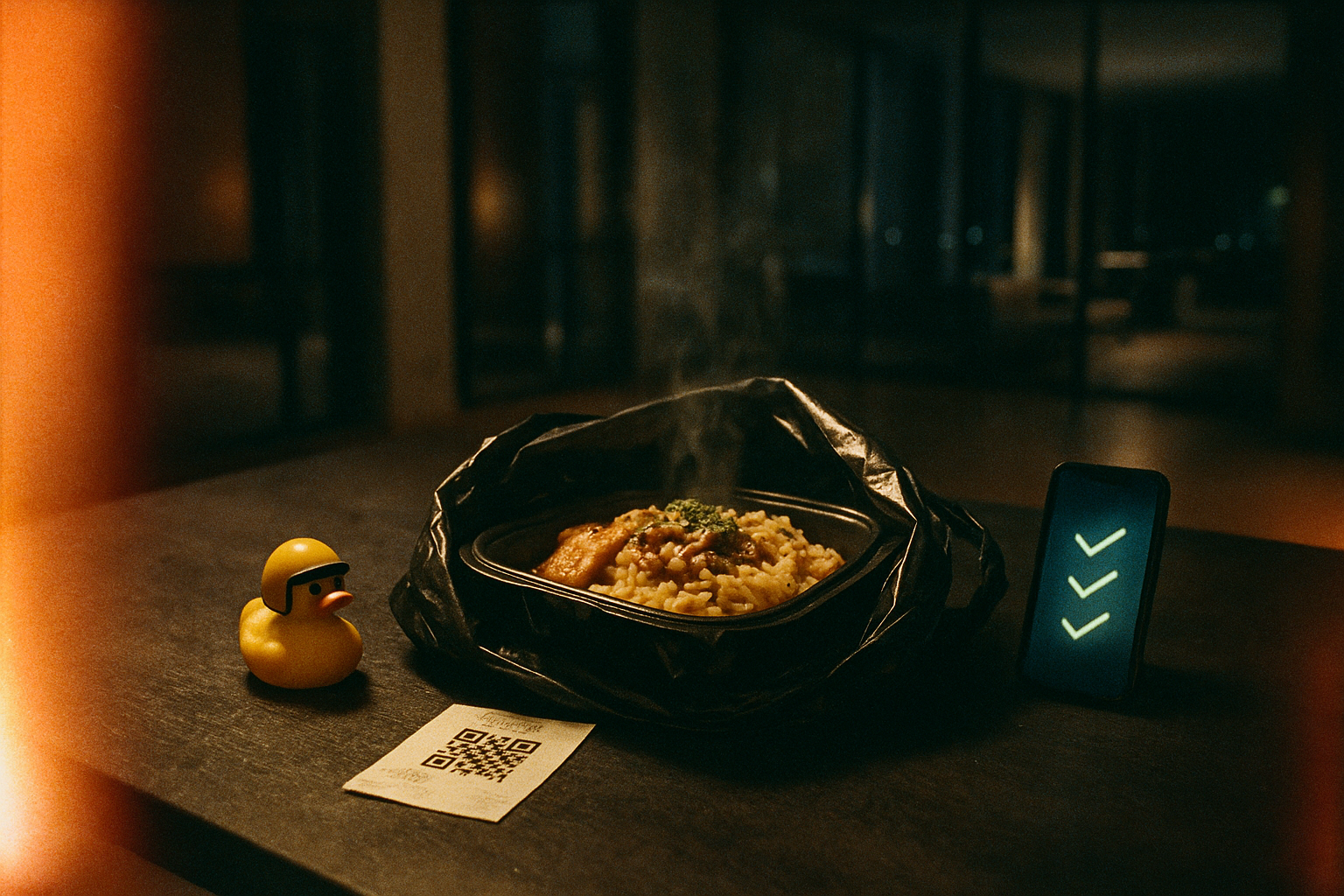
And here it's worth unfolding the scene the convenience economy sells as the pinnacle of service, when it's actually the final frame. In WALL-E, the people of the future lie in flying chairs: everything is delivered through a straw, a screen in front of the face, the legs long since decorative because there's nowhere and no reason to walk. They're not in pain. They feel good. Their bodies simply no longer have a shape fit for reality. This is not a dystopia about machines. It's the logical endpoint of an economy where every friction is an eliminated inconvenience, and every inconvenience is someone's income. The QR dinner on the cold table is that same frame, just at an early stage, when the chair doesn't fly yet.
Before going further, one scene that holds the whole section on the limits of luxury better than any diagram. In Triangle of Sadness, a lavish yacht for the ultra-rich hits a storm right during the captain's dinner: caviar, crystal, flawless service — and suddenly all of it is floating in vomit while the guests slide helplessly across the deck. Service paid for down to the last cent simply stops working the moment plain biology switches on. Under the caviar there was, the whole time, the same vulnerable animal that gets sick from the rocking. Luxury can postpone the moment the body reminds you who's in charge here. It can't cancel it. And that's good news, because it means the living animal under the cocoon is still alive — it just hasn't spoken up in a long time.
There's a more refined version of the same trap — when the elite tries to buy back the very thing the cocoon took from them: authenticity, contact, "reality." In The Menu, a star chef prepares a dinner for rich guests where every dish is a conceptual gesture, and the finale is their own death, served as the last course of the tasting menu. The guests are so used to buying a "unique experience" that they buy their own sentence too — and praise the presentation, no less. This is the final stage of the cocoon: when even authenticity becomes a service, and life a tasting set where you don't eat but rate the plating, and you no longer remember the taste of a single dish, because you were busy photographing.
Here the text has to stop and give the floor to its strongest opponent — otherwise it becomes an end-of-the-world cult for the well-fed, where the preacher eats oysters.
First, money really does make life better — and this is finally proven without asterisks. The famous "$75,000 happiness ceiling," past which money supposedly adds no joy, fell in 2023: Killingsworth, Kahneman, and Mellers, in a joint (adversarial) study, showed that for the happier ~80% of people, experienced happiness rises with the logarithm of income with no ceiling at all, and for the happiest it even accelerates; a plateau remained only for the unhappiest 15–20% somewhere around $100k. The conclusion is uncomfortable for romantics of poverty: money is not a diminishing-returns chart for the soul. And therefore — here's the key — the flatness of a rich life is not a ceiling of money. It's a design choice. The cocoon is not a verdict but a default setting that can be changed.
But there's a second bottom, and it's the sharpest thing in the whole text. Killingsworth calculated through what money makes you happy: roughly three quarters of the income→happiness link runs not through consumption but through a sense of control over your own life. Now connect that to the rest. Control is exactly what the cocoon is woven from: I'm in charge, no one dictates, nothing catches me off guard. It turns out that the very mechanism that makes wealth pleasant is precisely what seals you off from chance. Money didn't betray you — it gave you exactly what you asked for. You just didn't notice that in the column marked "control" the fine print read "walls." In financial terms: money buys downside protection beautifully — protection against the fall. It's just that the living part of life lives not in the protected downside but in the volatility that the same protection removes.
Second, comfort's apocalyptics regularly exaggerate. Psychological richness (Oishi and Westgate established it as a third, separate dimension of the good life alongside happiness and meaning) does indeed suffer most from a predictable, smooth life. But the temptation to say "therefore richness requires suffering and discomfort" is debunked: friction is one of the paths to novelty and variety, not a mandatory ingredient. You can enliven life with a journey, a difficult book, a new craft — without any sour dumplings.
And an honest counter-counterthesis, so as not to cheat in the other direction: the upsides of wealth (higher salaries, cheaper time, treatment) are real and enormous — but they don't solve the problem of embodiment automatically. Money solves the problem of survival. The problem of presence in the living world it doesn't solve — that has to be built separately, by hand. Which is exactly why what comes next is not a moral but tools.
There's a quiet moment when all of life imperceptibly shrinks to logistics. List your main tasks of the week honestly: move the body (taxi, flight), feed the body (delivery), restore the body (sleep, gym, massage), monetize the brain (work), defend the calendar (assistant, filters, "I have no slot"). All rational. All optimized. And between two verbs — optimize and delegate — the third, most important one vanished somewhere: to be.
Here Up in the Air offers a cold, precise scene. George Clooney's character has almost no home: he lives in planes and hotels, his true religion is frequent-flyer status, a million bonus miles as his main life goal. He didn't overcome loneliness — he reformatted it into a loyalty program and called it freedom. He confuses a business-class upgrade with a life upgrade. The cocoon does exactly this: it turns the absence of living contact into a nicely formatted service status, where you're thanked for your loyalty but no one remembers your name — only your card number.
Before fixing anything, ask: who benefits from the cocoon staying invisible? Because "seamlessness" is not a law of nature but a business model. A whole convenience economy lives off the fact that you pass through interfaces rather than through people: every eliminated "inconvenience" is someone's income and one more cut thread of contact for you. You're not being robbed — you're being sold silence, sliced into monthly subscriptions.
There's a subtler lever too — inside your own head. The moment you start measuring time in money, the psyche switches into a mode where almost everything is assessed by return: studies show that people who value time over money are happier, while those who count time as money more often sacrifice socializing and volunteering for efficiency. The cocoon adores this mode. A ten-minute conversation with the barista, in such accounting, is a pure loss: no KPI, no closeable loop, zero ROI. And you cut it. Rationally, every evening, down to zero. And then you wonder why a week is made up of perfectly closed tasks and not a single memorable moment.
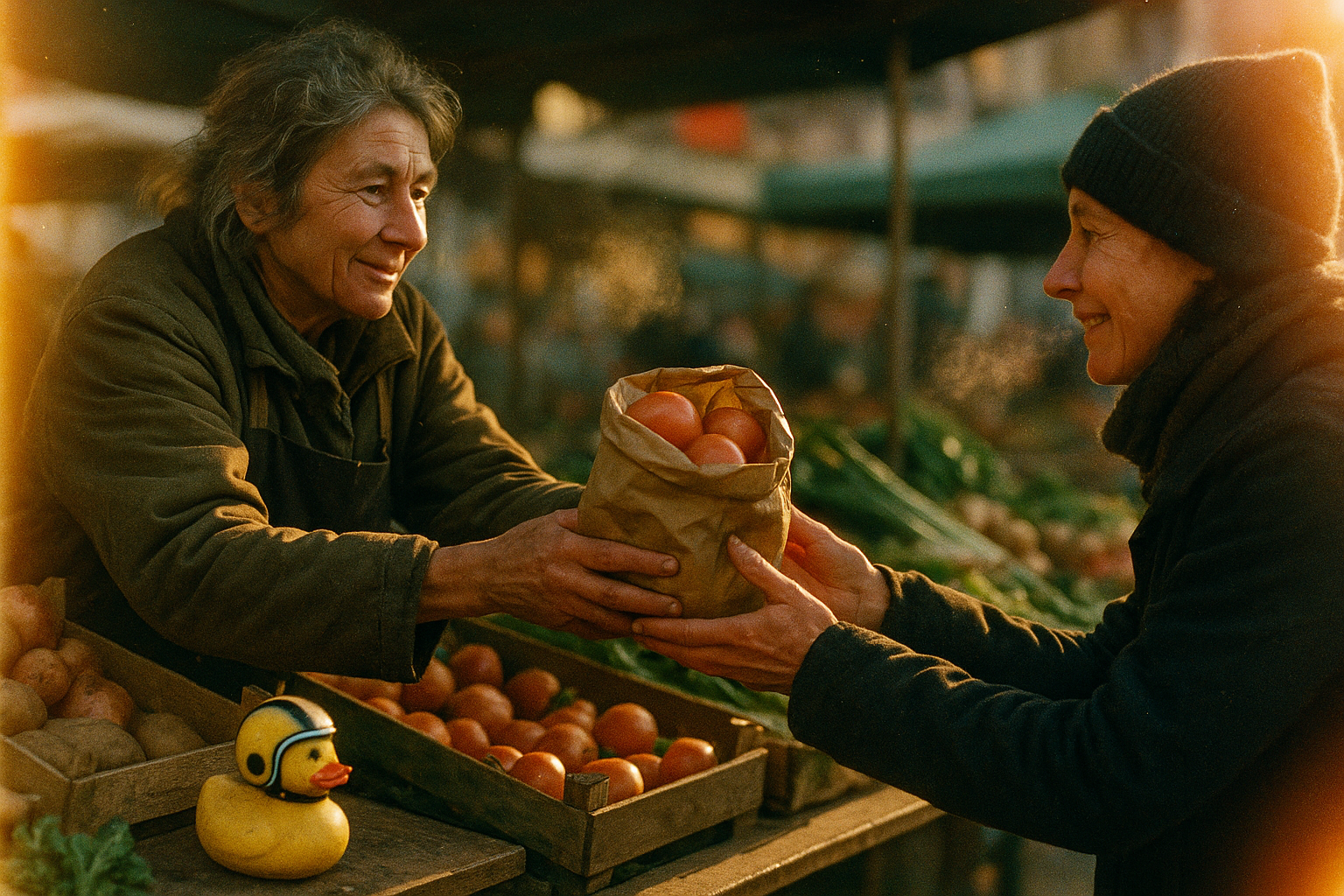
And here the anthropologist David Graeber offers a sharper blade than all of pop psychology. He distinguished the gift from commodity exchange by what the transaction establishes: a gift is about a relationship between people, commodity exchange is about equivalence between things. The woman at the market who set aside the better tomatoes for you and asked about your child — that's a remnant of the "human economy," where exchange rewrites a relationship. Delivery is pure commodity equivalence: money against calories, zero relationship. The cocoon doesn't just remove people. It converts every possible relationship into a transaction between things — and wonders why it's gotten empty all around. The world's doctor seconds this with statistics: in 2023 the US Surgeon General declared a lack of social connection a mortality risk he equated to smoking up to 15 cigarettes a day (29% higher risk of heart disease, 32% — of stroke). An honest caveat: the author of that meta-data herself, Holt-Lunstad, later wrote that "15 cigarettes" is a simplification that risks reducing a structural problem to a personal life hack. Let's keep that in mind: the cocoon is not only your personal flaw. It's also how the city, delivery, and your calendar are built.
The cocooned rich man's temptation is to fix loneliness with quantity. More guests, more events, more networking. But social density isn't aliveness, and The Great Gatsby shows it in a single frame. A vast mansion, an orchestra, hundreds of guests, champagne flowing like a river — and the host stands apart, looking at the green light across the bay, just as alone amid all that glitter. The hall is full. Contact is zero. More people in the room doesn't mean more person in the room.
That's how the luxury network works: you can be in a hall with two hundred important faces and not catch on a single one. Because everyone came in the same roles, with the same positions, with the same calculated exchange of business cards. That's not contact — it's a market with better lighting. And Lost in Translation adds the final touch of loneliness within luxury: two people in an expensive Tokyo hotel, beyond the panoramic glass an electric city of millions hums, neon, alive, gigantic — and it doesn't come inside a single centimeter. The glass is transparent. The city glows. The room is hermetic. You can be at the epicenter of the most alive city on the planet and stay in your own cocoon, because between you and the city there's paid glass.
Good news: you're not the first well-off person to feel suffocated by your own comfort. There's already a body of practice — and it's not about returning to poverty but about engineered friction (designed friction): deliberately reintroduced doses of resistance, contact, and chance. Calibrated, voluntary, not maximal — we remember the limit from the section on the effort paradox. An immunologist would explain the logic exactly: a sterile life is an immune system without antigens. It doesn't get stronger from cleanliness. It becomes hysterical — and panics at the first real contact, because it never trained for it.
Voluntary discomfort. Michael Easter, in The Comfort Crisis (2021), gathered this into a movement: rucking (walking with a weighted backpack), cold immersions, intermittent fasting, multi-day immersion in nature (his "misogi," the "20-5-3" rule). The point isn't suffering but returning to the body the resistance civilization removed. The same is done by Stoic practitioners with "premeditatio malorum" — deliberately and in measured doses touching the uncomfortable, so it stops ruling from the shadows. A caveat right away, so as not to fool yourself: the biohacker in an ice bath is sometimes just reproducing poverty with a subscription — and charging more for it than real hardship once cost.
Status-flat physical groups. It's no accident that Silicon Valley founders and execs went en masse into Brazilian jiu-jitsu (a documented trend, not an anecdote): on the mat your funding round means nothing, you're being choked by a guy who couldn't care less how much is in your account, and for the first time in a week you're fully in your body, not in the screen. The body on the mat is the most honest auditor of status: the sleeve on your neck isn't interested in your LinkedIn. The same is given by running clubs, climbing, Hyrox — regular places where status and money matter less than repetitions and shared sweat. Fight Club said it before any researchers: the hero fights not because he loves pain but because he bought so many things and services that he no longer had to be someone in the real world — and a fist against a cheekbone was the only thing that brought him back into the body. The mat is that same blow, just without the psychosis and with health insurance.
Regular places where they recognize you. Ray Oldenburg called these "third places" — beyond home and work, where the main activity is conversation and strangers greet one another. But there's a trap here, shown by that same Chetty: not all third places are equal. The gap in cross-class friendship is half explained by "exposure" (whether you're even in the same place) and half by "friending bias" (the tendency to befriend your own kind even alongside others). And this bias is lowest in religious communities and highest in residential neighborhoods by zip code. That is, an expensive club like Soho House will get you exposure — and zero cross-class: an aquarium for identical fish with better wine. An airport premium lounge is a purgatory with a better coffee machine: the same tired people in the same roles, only the silence is pricier. What works is something else: a gym in an ordinary neighborhood, a parish, a volunteer team, your kid's sports section.
The shared table. The cheapest and most underrated ritual. The World Happiness Report 2025 showed that regular shared meals are strongly linked to higher life evaluation, positive affect, and social capital — while the share of those who eat alone steadily rises worldwide. The point isn't dinner as an event but dinner as regular, self-interested-free presence beside people: the table is a third place that fits in a kitchen. The cocoon washes this one out first, because delivery for one is the smoothest operation of all.
There's one filter that cuts more precisely than any metric, because a child can't lie about what was alive. Ask yourself: what from my "optimized" life will a child actually remember in twenty years?
Not a perfectly assembled calendar. Not seamless logistics. Not the fact that delivery always came on time. They'll remember the ice cream that ran down the arm faster than they could lick it. The sea, and the way they went into it for the first time, shrieking. A dumb joke you laughed at yourself. Carrying them, asleep, in your arms, and them still managing to mumble something nonsensical. The smell of a dinner someone actually cooked — not unpacked, but chopped, fried, burned on the pan. Everything a child keeps is scenes with friction: hot, wet, awkward, unplanned, bodily. Not a single contactless delivery slot is on that list, and never will be.
The cocoon doesn't need to be burned down. It needs breathing holes drilled into it — deliberately, one at a time. Here's a framework you can run as a system (because you love systems, and the most convenient option will beat intention every evening without a system).
| Cocoon layer | What to remove with money (bad friction) | What to return by hand (fertile friction) |
|---|---|---|
| Body | exhaustion, sleep deprivation, domestic ruin | 4 physical practices/wk; sometimes walk 40 min instead of a taxi; 1 status-flat group (BJJ, running, climbing) |
| City | hours in bureaucracy and dummy queues | 3 outings/wk not "on business"; 1 new route; a market where they recognize you |
| People | the humiliation of asking out of need | 20 weak contacts/wk; 1 request for help you could have bought; sometimes speak first |
| Table | — | 1 shared meal/wk with rotating guests (not delivery for one) |
| Class | — | 1 cross-class environment/mo (a section, a parish, volunteering), not a "safari" |
| Memory | chaos in which nothing can be made sense of | 3 living scenes in a journal/wk; 2 evenings without delivery |
And one filter for every purchase, worth the whole section: am I buying freedom right now — or isolation? If freedom (time, sleep, treatment, focus) — take it without hesitation. If isolation (the absence of people, road, body, chance) — either don't buy it, or immediately pay it back with friction elsewhere. A nanny, delivery, a taxi, an assistant, AI — each of them either removes bad friction or quietly cuts out the living; the difference is not in the tool but in the side effect, which you either control or don't.
Before you go off to buy a rucking backpack and a jiu-jitsu membership — one last, most unpleasant check. Engineered friction very easily turns into one more thread of the cocoon, just with better storytelling. The well-off person who "immerses himself in real life" risks sliding into what researchers of slum tourism call voyeurism on an unequal power balance: poverty as a spectacle, not as a problem. A cold shower filmed for the stories feed is not contact with the world, it's content about yourself. The biohacker optimizing his own immortality while calling it discipline is not an exit from the cocoon, it's its most expensive upgrade.
The line here is thin but clear: friction works when it puts you in a position where your status doesn't apply — and fails when it puts that status on display. The mat, where a stranger is choking you, works. Photogenic fasting doesn't. The right mode is not "observe people as material" but "let their worlds breach your model of reality." If, after your "immersion," your model of the world hasn't shifted a millimeter — you weren't in contact, you were on an excursion, and bought a fridge magnet on top.
Poverty made me permeable by force. Through a leaky vessel the world came in whether I wanted it or not: sour dumplings, strangers' confessions in strangers' cars, the old man with his "God sees you, boy." Plenty made the vessel stronger — and that's good. I don't miss hunger for a second: hunger is bad friction, and cancelling it was the right thing. But a strong vessel doesn't have to be hermetic. The same shell that holds in the heat holds the world out — and here's where it's my work now, not money's merit.
I miss something else: that back then the world wasn't a service. It was a creature you had to approach, talk to, ask, get angry at, feel ashamed before, touch. And the grown-up formula isn't "when I was poor, life was more real." The grown-up formula is this: when I was poor, life touched me by force; now I have to drill the holes myself, through which the world can come in again — without humiliation, but also without sterility.
Maturity is not naked before the world, as in poverty, nor sealed shut, as in comfortable success. Maturity is a porous vessel: strong enough to hold its shape, leaky enough that something flows through it. The cocoon will remain — it's warm, and that's normal. There's only one question, and it's worth asking yourself every Sunday while it still frightens you: how many scenes will I remember in six months? If none — the cocoon has sealed up, the vessel has gone hermetic, and Teflon has won. Get the drill.