Parenting toddlers — adoration and crushing boredom
What actually goes on in a toddler parent's head? A condensed take on Tim Urban's essay — the brightest quotes, main theses, toddler cruelty, genius, funny lines and the honest truth about life with a small child.
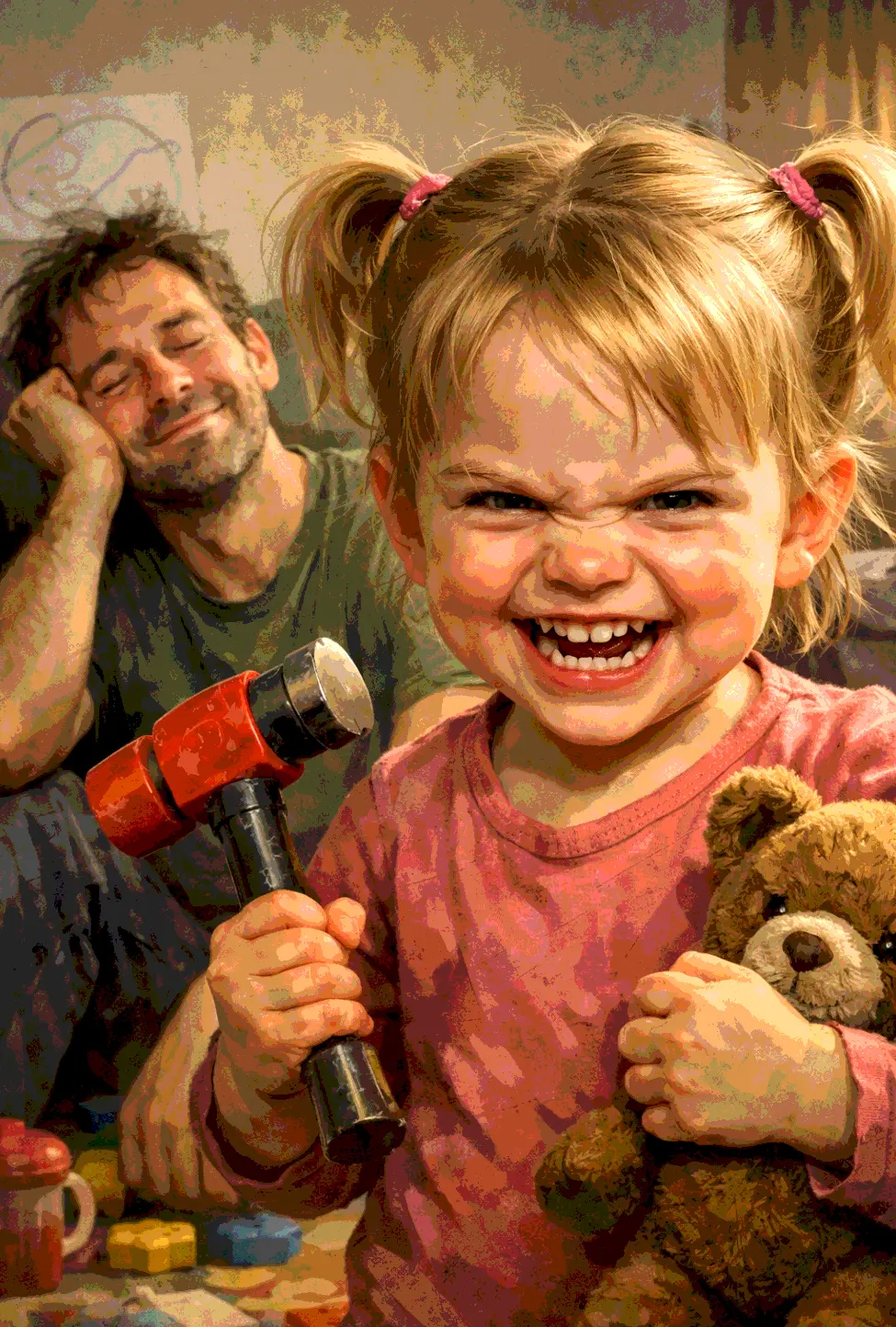
Here is a detailed condensation of Tim Urban’s essay “Tales from Toddlerhood”.
It is not a “factual” article but an observational, ironic and very precise text about the experience of parenting a small child — focused on contradictions, comedy, exhaustion, tenderness and the distorted optics of an adult living next to a toddler.
The general gist
The main idea of the text: toddlers are not meaningless “little kids” but already full-fledged little people, with personalities, logic, whims, egocentrism, linguistic quirks and an uncanny ability to simultaneously melt your heart, irritate you, make you laugh and exhaust you.
The author describes toddler parenthood as a state where:
- the child becomes the center of the parents’ emotional world,
- while also being terribly boring, exhausting and absurd,
- parents constantly oscillate between adoration, irritation, guilt, laughter and bewilderment,
- and any “theory of upbringing” quickly shatters on reality.
The tone of the text: self-irony + love + honesty without varnish.
Context and frame of the text
Tim Urban briefly reminds the reader at the start:
- in 2023 he wrote about the experience of becoming a first-time parent;
- later he had a second child;
- the second child, he says, is already “easier” than the first;
- but the center of this piece is not the newborn but the depths of life with a toddler, that is, a child roughly two years old.
An important frame: the author admits that he used to underestimate two-year-olds and thought of them almost as “unconscious blobs,” but now realizes they are real people you can get to know.
Key theses of the article
1. A small child can simultaneously be your most beloved and most unbearably boring person
One of the strongest nerves of the text — the paradox of love and boredom.
The author describes how his daughter walks into his office, hugs him — and it is “the best part of the day.” Her smile, her voice, her presence trigger in him pure love and happiness.
But then comes the honest counterpoint:
spending five minutes with a toddler — wonderful,
spending several hours straight — quite a different thing.
The core of the thought:
- a toddler is emotionally priceless,
- but cognitively the interaction is very monotonous,
- the parent finds himself next to a being who is, for him, simultaneously everything — and yet has very little to offer in conversation or intellectually.
A vivid formulation:
“You can be simultaneously completely obsessed with and dramatically bored by the same person.”
Another strong quote:
“I feel the purest possible love for her. It’s just that I also find her groundbreakingly boring.”
This is one of the text’s main virtues — it voices the taboo ambivalence of parenthood:
to love does not mean not to be bored.
2. Toddlers are not just cute, they are also pretty harsh
The second strong thesis: small children can be openly rude, egocentric and unceremonious.
The author does not reduce this only to tantrums or “dictatorial” behavior. He highlights the subtler forms of toddler cruelty:
- when his daughter essentially tells him to get lost and let her play alone;
- when he prepares food for her with care, and she demonstratively refuses even to try it;
- when she tells him dozens of times that he is 43, triggering existential discomfort in him.
The core of the thought:
- a toddler does not yet have empathic filtering;
- he does not soften the truth;
- he places his own desire at the center of the universe;
- because of this the child often behaves like a tiny narcissistic monarch.
Vivid quotes:
“Toddlers are dicks.”
“Daddy needs to work in his office?”
a polite mask for: leave me alone.
“Daddy is 43.”
and repeating it “about 30 times a day” as a form of mini-existential terror.
A nuance: the author does not condemn the child but shows that toddler harshness is not a moral flaw but an early form of egocentrism and unformed social sensitivity.
3. Parenthood distorts perception: your child is interesting to you, but almost no one else
One of the socially sharpest theses in the article.
The author writes that toddler parenthood is a reality distortion zone in which parents start thinking their child is fascinating to everyone around.
In reality:
- most people find someone else’s child barely interesting;
- video of someone else’s toddler is mostly a burden;
- the exception is parents of children the same age, because they pay the same “cohort tax.”
The core of the thought:
- parents live in an environment of high emotional significance;
- the outside world does not share that significance;
- hence the comic gap between the inner value of the experience and outer indifference.
A vivid quote:
“No one wants to see videos of someone else’s toddler.”
Another precise line:
“Toddler parenthood is a reality distortion zone…”
A strong nuance: the author admits he is guilty of this himself.
So the text is not “about other stupid parents” but about a universal parental cognitive trap.
4. Someone else’s toddler can radically affect your life
In the text this point is delivered almost aphoristically:
“Someone else’s toddler can ruin your week.”
A short formula, but with a lot of meaning packed in.
What this implies:
- other people’s small children can derail plans;
- exhaust the social space;
- make a trip, meeting or shared activity hard;
- in general, turn someone else’s child into a strong source of external friction.
This is one of those theses where humor functions as condensed truth without elaboration.
5. Toddlers are geniuses and very dumb at the same time
One of the central intellectual nerves of the essay. The author shows that a small child has an asymmetric intellectual profile:
On one hand — striking abilities:
- language learning is almost “magical”;
- memory can be phenomenal;
- the child grasps structures of the world without formal instruction.
Example:
if the author lived in China for a year, he would come back with six words of Mandarin; the toddler would come back fluent.
Another example:
his daughter memorized a book on a single reading and noticed when he skipped a word.
On the other hand — obvious cognitive imperfection:
- she misuses pronouns;
- she may spend a long time looking for a character on a page who is literally in front of her;
- brilliance in complex things sits next to helplessness in simple ones.
A vivid quote:
“Toddlers are geniuses who are also very dumb.”
The essence of this thesis:
- a toddler is not “a less smart adult”;
- his mind develops unevenly;
- he is already super-powerful in some pattern-matching or language tasks,
- but still very weak in logical stability, orientation and conceptual structure.
A very precise observation: a child’s intelligence is not lower on a single scale, but strangely tilted.
6. Toddlers have a very inaccurate picture of reality
Another big theme: a toddler lives in a world that poorly reflects reality.
Example, the library:
during reading time, the girl simply sits in the librarian’s lap — because she has not yet absorbed that the world doesn’t exist specifically for her.
The core of the thought:
- a toddler is born into a setting where everyone smiles at him, helps him and adapts to him;
- so he naturally overestimates his own centrality;
- only gradually does the child discover that the world is wider, more indifferent and not organized around her.
The author extends this thought:
toddlers know almost nothing about fundamental things:
- death,
- money,
- history,
- sex,
- the Big Bang,
- the basic structure of the world.
And it does not surprise them at all.
A strong idea:
the child simply “showed up in the world and started being,” without questioning what is happening.
The brightest image:
the flying-elephant test.
If an elephant descends from the sky, hovers, speaks in a cartoon voice and flies away, and you are simply like “well, I guess that happens” — you have no idea what is really going on in the world.
An important quote:
“They don’t know about death, or money, or history, or sex, or the Big Bang, or basically anything about reality.”
This is one of the strongest philosophical lines of the text:
toddlers live in a world almost without metaphysical wonder, even though objectively they should be the most shocked by the very fact of existence.
7. Toddlers can simultaneously be the funniest and the least funny people
The author introduces another duality.
Unfunny side:
a child can roar with laughter at absolutely primitive things, like “kerplunk,” and repeat them endlessly.
A dumb, low-resolution humor.
But:
when a toddler is not trying to be funny, he often generates pure comedy.
Examples:
- “Can you get out of space?” — instead of “move away.”
- “I am so perfectly sad.” — after a band-aid was ripped off.
These lines are beautiful because they are:
- syntactically almost correct,
- emotionally very precise,
- and completely unexpected.
A vivid thesis:
“Toddlers are both the funniest and least funny possible people.”
Another important detail:
the author describes a “hack” — a toddler can be taught to say anything, and that itself becomes a tiny theater.
For example, they taught their daughter to say “mamma mia” when she falls.
This shows another facet of toddlerhood:
- the child is not just a source of difficulties,
- but also a generator of unpredictable linguistic poetry and family folklore.
8. Toddler parents have very strong opinions — and constantly judge each other
In the finale the author moves from observing the child to observing the parental environment.
His thesis:
in the parenting world there are, on almost any question, two strong, opposing doctrines:
- routine vs natural rhythms,
- strict supervision vs freedom,
- treats vs restraint,
- structure vs spontaneity.
Main conclusion:
parenting advice is contradictory,
judgment is strong,
there is no single correct system.
The author’s answer is humility and pragmatism:
he accepts that he is wrong about many things, and primarily tries to maintain good live contact with his child.
The author’s practical “philosophy of upbringing”
One of the most important blocks of the article. After all the humor, Tim Urban gives his short but substantive parenting framework.
His principles:
1. Spend a lot of time with your child without a phone
Not just “be near,” but actually be present.
2. Show that the world is interesting and engaging
Don’t lock the child into a mechanical “food-sleep-rules” loop, but open reality up as something interesting.
3. Encourage thinking from first principles
That is, don’t just teach rules; help him reason on his own.
4. Don’t interrupt when the child is focused or daydreaming
Let her learn to be occupied by her own inner world.
5. Don’t multiply small rules
Less senseless control.
6. But once a rule exists — be firm
Not chaotic softness, but selective firmness.
7. Build problem-solving confidence
Raise a person who thinks:
“I want to figure out the directions”
rather than:
“let’s just ask someone”
This is a very important fragment. Suddenly you see that the text is not only humorous — it carries a serious educational and character program:
- independence,
- an inner footing,
- curiosity,
- thinking,
- tolerance for focused attention,
- a non-infantile engagement with the world.
The deeper meaning of the text
Beneath the humor lie several serious thoughts.
1. Parenthood is a school of ambivalence
You can:
- love deeply,
- be terribly tired,
- sometimes be bored,
- sometimes be furious,
- and all of it at the same time.
The text normalizes this complexity.
2. A small child is not “a half-finished adult” but a separate form of consciousness
The author shows toddlerhood as a state:
- with a distorted model of the world,
- with incredible plasticity,
- with strange linguistic creativity,
- with strong egocentrism,
- with partial genius.
3. Parenting is often more about accompaniment than construction
One of the strongest concluding lines:
“Rather than try to shape our little two-foot-tall companions, we should help guide them to become the best version of who they already are.”
This is the author’s key philosophical position:
- the child does not need to be “molded” from scratch;
- she already has a core;
- the parents’ task is not to break it, not to drown it in noise, not to overload it with control,
- but to help it unfold well.
4. Parenting matters less than parents think
Another important counterpoint to parental anxiety:
the author believes parents often overestimate the degree of their control over the outcome.
This is not a call to indifference.
It is more of an antidote to over-control, guilt and neurotic perfectionism.
The brightest quotes and formulations
A selection of the strongest lines with short notes.
On the ambivalence of parenthood
“You can be simultaneously completely obsessed with and dramatically bored by the same person.”
The best formulation in the entire text.
The essence of toddler parenthood in one phrase.
On love and boredom
“I feel the purest possible love for her. It’s just that I also find her groundbreakingly boring.”
An honest, strong admission that makes the text alive.
On toddler ego
“Toddlers are dicks.”
Crude, but very precise — a comic compression of the whole egocentrism-and-rudeness theme.
On parental distorted optics
“Toddler parenthood is a reality distortion zone…”
A precise definition of how parents lose a sense of scale about their own child.
On other people’s children
“No one wants to see videos of someone else’s toddler.”
Socially merciless, but true.
On child intelligence
“Toddlers are geniuses who are also very dumb.”
The best formulation of the asymmetry of the toddler mind.
On their picture of the world
“They don’t know about death, or money, or history, or sex, or the Big Bang, or basically anything about reality.”
A strong, almost philosophical reminder of how raw a child’s view of the world is.
On the comic language of a toddler
“Can you get out of space?”
“I am so perfectly sad.”
These are already ready-made family aphorisms.
On the parenting approach
“Rather than try to shape our little two-foot-tall companions, we should help guide them to become the best version of who they already are.”
The article’s main concluding principle.
Nuances and details that are easy to miss
1. The text is not about a toddler being “bad”
On the contrary. The author describes a toddler as a strange, funny, still-unassembled form of humanity.
2. The humor here is not decorative
Through humor the author says things that would otherwise sound harsh:
- about boredom,
- about irritation,
- about the indifference of other people,
- about social judgment of parents.
3. The article works very precisely at the level of micro-scenes
It is not built on abstractions but on short everyday episodes:
- Lego,
- the library,
- books,
- a band-aid,
- repeating his age,
- videos of other kids,
- the word “kerplunk.”
That is what makes the text alive.
4. There is anti-dogmatism beneath the surface
The author is not selling a system of upbringing.
He is rather saying:
everyone is too sure, everyone judges someone, and reality is more complicated.
A short summary in 10 theses
- Toddlers are already full-fledged little people, not just “babies plus.”
- Parents can simultaneously love a child without limit and be terribly bored next to her.
- Small children are egocentric, harsh and often unceremonious.
- Parenthood distorts perception — your own child seems much more interesting to others than she really is.
- Toddlers learn astonishingly fast — especially language — yet fail at elementary things.
- Their model of the world is very inaccurate: they don’t yet understand basic things about reality.
- They simultaneously generate primitive humor and accidental flashes of brilliance.
- Among parents there is a lot of judgment and mutually exclusive advice.
- The best approach is less neurosis, more presence, more curiosity, and firmness on what really matters.
- Parenthood is more about accompanying an already-existing personality than constructing one.
The shortest essence of the article in one paragraph
This is a witty and very honest essay about how life with a toddler is a mix of pure love, boredom, chaos, laughter, irritation and constant surprise. Tim Urban shows that a small child is already a distinct person with her own strange logic: at once a genius and helpless, funny and unfunny, gentle and harsh. And the author’s main conclusion is this: parents should try less to “sculpt” their child into an ideal and more to be present, to give her the world, room to think, and to help her unfold the best version of who she already is.