Which AI model to choose for your task? A practical guide to GPT-4o, o1, Claude 3.7 and Gemini 2.5 Pro
A detailed comparison of the main 2025 AI models — GPT-4o, o1, Claude 3.7 and Gemini 2.5 Pro. Find out which model fits your task — from programming to creative writing and business analytics.
Over the past decade, AI has substantially reshaped the business landscape, making it possible to solve complex tasks across many domains. But the variety of available models can leave users facing a dilemma: which model do you actually choose for a specific task? Picking the AI model that fits your needs can significantly improve productivity and optimize compute costs. This article goes deep on the main types of AI models in 2025, their characteristics, and ideal use cases.
General-purpose language models (LLMs): comparing the flagships
Key types:
- Edge AI: models optimized to run on edge devices 18
- Multimodal AI: handling different data types (text, image, audio, video) 18
- Generative AI: producing new content from training data 18
- Explainable AI (XAI): systems with a transparent decision-making process
GPT-4o: a universal multimodal assistant
GPT-4o is one of OpenAI’s latest models. It is multimodal — able to work not only with text but with audio, images and video. That makes it especially useful for content creation where you need to handle several data types at once.
Key characteristics:
- Context window: 128K tokens (significantly larger than previous versions).
- Speed: 109 tokens per second.
- Cost: $5 per million input tokens, $15 per million output.
- Multimodality: handles text, image, audio and video.
Ideal use cases:
- Content creation and copywriting for ads and marketing.
- Documentation development and training materials where multimedia support is needed.
- Customer support: chatbots and automation systems for fast responses.
- Multimedia applications that need to handle different data types in parallel.
Limitations:
- Can lose to specialized models in narrow tasks like complex technical calculations or legal analysis.
- Less effective on long multi-step reasoning, such as complex programming algorithms.
o1: the deep-reasoning expert
OpenAI’s o1 series specializes in complex tasks: mathematical computation, programming and scientific research. It uses chain-of-thought, which lets the model continue reasoning between steps.
Key characteristics:
- Cost: $15 per million input tokens, $60 per million output (higher than alternatives).
- Specialization: complex reasoning, mathematics, science, programming.
- Performance: 89th percentile on competitive programming.
Ideal use cases:
- Complex math and science problems in physics, chemistry and biology.
- Software development, algorithm design, debugging complex systems.
- Legal document analysis and the preparation of detailed legal reports.
- Financial analysis: forecasting and complex calculations across many parameters.
Limitations:
- High cost and slower processing because of the reasoning overhead.
- Overkill for simple tasks.
Claude 3.7 Sonnet: balance between precision and speed
Anthropic’s Claude is less well-known but highly effective, distinguished by its transparency under the Constitutional AI approach.
Key characteristics:
- Context window: 200K tokens.
- Specialization: coding, factual content, reasoning.
- Performance: 90.5% on knowledge tests, 70.3% on coding tests.
Ideal use cases:
- Software development, especially frontend projects where high coding precision is needed.
- Processing and generating code from diagrams, screenshots and technical documentation.
- Enterprise applications where ethics and transparency of AI work matter.
Limitations:
- Less effective for creative tasks than GPT-4o.
- More limited integration with other services compared to Gemini.
Gemini 2.5 Pro: integration with the Google ecosystem
Google DeepMind’s Gemini stands out for integration with Google products, which makes it ideal for analyzing large volumes of data and for research projects.
Key characteristics:
- Context window: up to 1 million tokens.
- Performance: 89.8% on knowledge tests, 84.0% on reasoning.
- Cost: $1.25 per million input tokens, $10 per million output.
Ideal use cases:
- Research projects requiring large-text processing and complex reasoning.
- Integration with Google services (Gmail, Docs, Android), optimal for businesses already in that ecosystem.
- Tasks that need a balance between performance and cost.
Limitations:
- Not always effective outside the Google ecosystem; other models may be better in some domains.
Specialized models for specific tasks
AI models can be specialized for specific tasks — programming, creative writing, medical analysis.
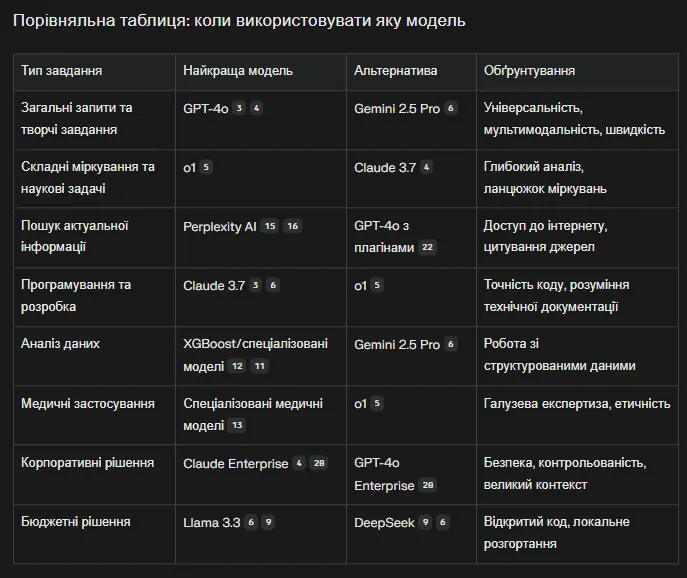
Programming and development: for complex multi-component projects the best choice is Claude 3.7 Sonnet or o1, both with high coding-test scores. For fast prototyping you can use GPT-4o or Gemini 2.5.
Creative writing and content: GPT-4o is the best option for generating marketing content or copywriting thanks to its creativity and speed. For technical writing, Claude 3.7 is a better fit; for local apps, you can use Llama 3.3.
Data analysis and business analytics: for predictive analytics and structured data, XGBoost or specialized models suit best, while for more complex business analysis you can use o1 or Gemini 2.5 Pro.
Models for research and academic tasks
Research work demands models with access to current information and an ability to perform deep analysis.
Most effective models:
- Perplexity AI: the best choice for searching and synthesizing up-to-date information from the internet
- o1: ideal for complex scientific reasoning and analysis
- Claude: effective for processing academic texts and literature
Recommendations for selection:
- For a literature review and source search: Perplexity AI
- For developing research ideas and hypotheses: o1 or Claude
- For analyzing research data: specialized statistical models or XGBoost
- For writing academic texts: GPT-4o, with subsequent fact-checking via Perplexity
Conclusion: a strategy for choosing an AI model
When choosing an AI model for specific tasks, what matters is not only technical specs but the specifics of your tasks. The optimal model depends on several factors:
- Task complexity (from simple jobs to complex multi-step processes).
- The need to process specific data types (multimedia, structured, textual).
- Cost and available resources.
It is recommended to test several models on real tasks before settling on one, to assess their effectiveness and performance in your context.
The AI landscape continues to shift fast, so it is important to revisit your model choices regularly and adapt to new technologies.