War After the Tank: Madyar and the Birth of an Army of Drone Cycles
Ukraine's drone war proves the future of warfare belongs not to whoever has more armor, but to whoever can see, strike, count, learn and scale faster.
On this page
- War No Longer Looks Like a Parade
- Madyar as a Symptom of a New Era
- The End of the Lightning War
- The New Formula of Power: Not the Platform, the Cycle
- 2% of the Army, 35% of the Effect
- Why Madyar Will Not Burn Drones on Symbols
- Russian Oil as the Bloodstream of the War
- Russia’s Economy Is Already in War-Compression Mode
- Video as the New Military Accounting
- Air Defense as the Empire’s Scarce Nerve
- Russia Adapts. And That Is the Main Risk
- Madyar as a Commander of the Post-Platform Era
- NATO Has Not Yet Fully Understood What Happened
- But Drones Do Not Make War “Clean”
- Can This Break Russia?
- Madyar’s Formula for the Future War
- War After the Human? No. War After the Illusions
- Sources
Madyar, the Unmanned Systems Forces, and Ukraine’s drone war as a model of the future: how cheap sensors, video proof, E-Points, strikes against oil infrastructure, and the economics of attrition are reshaping the logic of war.
War No Longer Looks Like a Parade
In May 2026, for the first time in nearly two decades, Red Square’s main ritual element — tanks and missiles — was missing from the Russian imperial set piece. Formally, the parade still happened. Symbolically, it did not. The Russian state, which spent decades constructing its image of strength through choreographed steel, suddenly chose not to roll that steel onto the country’s central square.
The Guardian explained it bluntly: the Kremlin was afraid of a Ukrainian strike. In the same profile, the outlet named Robert “Madyar” Brovdi as one of the principal figures who forced Moscow to change its behavior. His 414th Brigade — the Madyar’s Birds — has, in recent months, struck Russian ports, oil refineries, military objects and air-defense systems deep inside Russia. [1]
This is not just a pretty news beat. It is a symptom of a deeper mutation of war.
A tank on parade used to be a demonstration of state power. Now a tank on parade can become a public target for a cheaper, smaller, faster and smarter system. Steel no longer guarantees dominance. Mass no longer guarantees safety. Military power no longer lives in armor, caliber and tonnage alone.
It lives in the cycle.
See. Strike. Record. Count. Learn. Order more. Repeat faster.
That is the new war.
Madyar as a Symptom of a New Era
Madyar matters not only as the commander of a successful drone unit. Ukraine has many such commanders. His significance is wider: he has become one of the figures through whom you can see the transition of war from the industrial logic to the logic of sensor networks, cheap platforms, data and constant adaptation.
Ukraine’s Ministry of Defence officially lists Robert Brovdi as the commander of the Unmanned Systems Forces of the Armed Forces of Ukraine. This branch is described as the world’s first dedicated military branch integrating aerial UAVs, ground robotic systems, and surface and underwater naval drones. Its mandate is not merely to “have more drones” but to integrate reconnaissance, strike and defense into a new asymmetric war system. [2]
That is the key difference.
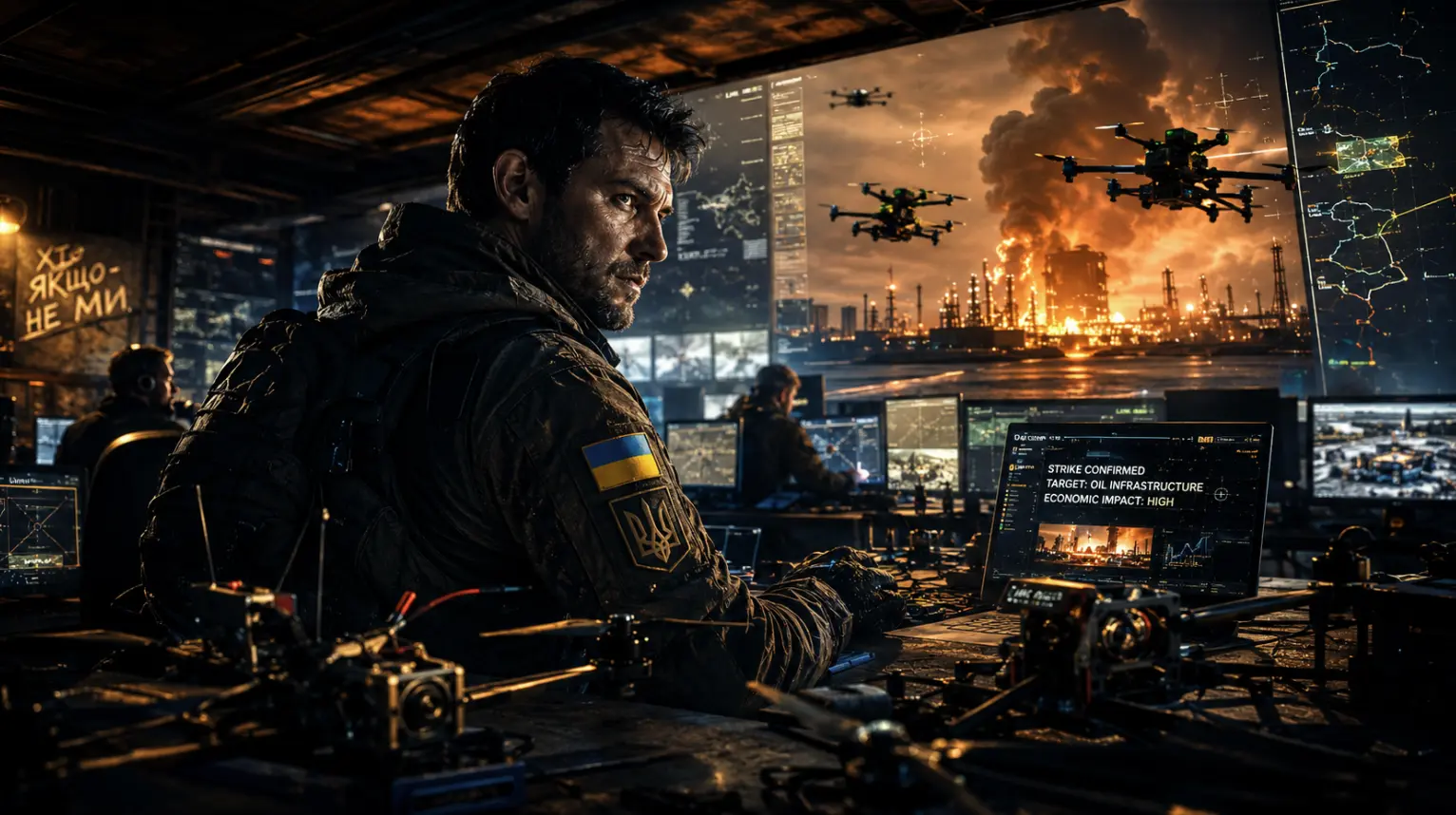
In the old logic, a drone was an "auxiliary tool": watch a tree line, correct artillery, drop a munition, transmit video. In the new logic, the drone becomes an element of a combat operating system. It does not just fly. It connects the front line, command, production, statistics, training, procurement and the information effect.Madyar is one of the people who personifies this shift.
His image does not resemble the classical industrial-era general. He is not a commander who thinks of the front only as a map, divisions and lines. He is more an operator of a high-frequency military system, where video, spreadsheets, live feeds, operators, EW, industrial drone batches and verified kills compose a single loop.
That is why the phrase “Madyar commands drones” is imprecise. More accurately: Madyar commands cycles.
The End of the Lightning War
One of Madyar’s strongest theses sounds almost apocalyptic: if Russia ever again tried to seize Kyiv with large tank masses, those tanks would be swarmed by millions of drones. His conclusion is short: blitzkrieg is no longer possible.
This sentence should not be taken as a literal military formula. It matters as a doctrinal signal.
Blitzkrieg was possible where the speed of a mechanized mass outpaced the defender’s ability to see, coordinate and strike. A tank column pushed forward while the opposing staff was still trying to understand what was happening. Movement was faster than information.
Drones inverted that ratio.
Now movement is often slower than observation. The column has not yet left the tree line and it is already seen. The truck has not yet delivered ammunition and the route is already under watch. The infantry group has not yet reached the front edge and a camera is already escorting it. The repair team has not yet arrived at the damaged equipment and a second strike may already be incoming.
War is turning space into a transparent zone.
Not fully. Not always. Not everywhere. But enough that large mechanized masses have lost part of their magic.
The tank does not disappear. Artillery does not disappear. Infantry does not disappear. But all of it now exists under a permanent layer of cheap eyes and cheap strikes. In this new reality, armor without sensor protection becomes not a symbol of strength but an expensive thermal contrast on a screen.
The New Formula of Power: Not the Platform, the Cycle
The old war thought in platforms.
Tank. Aircraft. Ship. Missile. Gun. Brigade. Division.
The new war thinks in cycles.
sensor
  → detection
  → data transmission
  → decision
  → strike
  → video proof
  → verification
  → reward / supply
  → training
  → repeat
This looks less heroic than a tank breakthrough. But it is far closer to the reality of modern war.
In January 2026, President Zelensky described that, over the previous year, drones had struck nearly 820,000 targets, and that each strike is recorded for verification. The same system is tied to electronic points: units can exchange E-Points for drones, EW kits, equipment and gear through Brave1 Market. [3]
This is not just a bureaucratic detail.
It is one of the most important innovations of the war.
The army acquires an internal performance marketplace. Combat result turns into proof. Proof turns into a digital metric. The metric turns into a resource. The resource turns into the next combat result.
Traditional procurement in Western armies often takes years: requirement, tender, development, certification, purchase, logistics, training. Ukraine’s drone war compresses that cycle into weeks, days, sometimes hours. A need from the front rapidly moves into prototype, test, video proof, a new production batch, a new modification.
This is war that increasingly resembles a software loop.
Not because it has become less bloody. The opposite. But because victory in it is, more and more, decided not by a single great product, but by speed of iteration.
2% of the Army, 35% of the Effect
One of the most telling facts about the Unmanned Systems Forces is their leverage.
In November 2025, Ukraine’s Office of the President reported that the Unmanned Systems Forces account for roughly 2% of the AFU but are responsible for 35% of the destruction and damage inflicted on enemy personnel and other targets. [4]
This figure is not only about drone effectiveness. It is about a shift in the structure of military value.
In business this would be called 80/20. In war it means: a small, technologically dense, well-organized system can create an effect that previously required a much larger mass of people, metal and ammunition.It is important not to fall into romanticism here. Drones do not replace the army. They do not eliminate infantry, artillery, medicine, engineers, logistics, air defense, mobilization. But they do change the ratio.
An army without a drone layer is going blind.
An army with a drone layer gains a new nervous circuit.
Why Madyar Will Not Burn Drones on Symbols
The most interesting trait of Madyar is not aggression — it is economy of thought.
The Guardian quotes his reasoning on a potential strike against Red Square: a symbolic attack would make plenty of noise, but why spend drones on “the big wall” when the best strikes are on energy or military objects where defenses are weaker. [1]
This is a very important moment.
In political imagination, hitting a symbol seems the strongest move. The Kremlin. Red Square. A parade. A palace. A TV tower. Anything that looks beautiful in a headline.
But in a war of attrition, the most important targets are often the ugliest. They are terminals, pumping stations, reservoirs, refineries, logistics hubs, air defense, repair facilities, warehouses, ports.
A symbol creates noise. A node creates consequences.
Madyar’s logic: strike not where it is loudest, but where each drone produces the maximum systemic damage.
This is not parade-thinking. This is operator-thinking. It does not ask “What will the world see?” It asks “What will reduce Russia’s ability to fight tomorrow, next week, next month?”
Russian Oil as the Bloodstream of the War
Russia’s war is not financed by an abstract “state.” It is financed by the budget, taxes, oil, gas, debt, inflation, regional payouts, military plants, and the Kremlin’s ability to turn the economy into a war machine.
That is why strikes on oil infrastructure are not just “strikes on energy.” They are attempts to hit the bloodstream of the war.
KSE Institute estimated that Ukrainian strikes on Russian oil infrastructure reduced Russia’s oil export revenue by roughly $1.76 billion over the two weeks from 23 March to 5 April 2026, relative to a no-strike counterfactual. In the same assessment, KSE notes that Primorsk, Ust-Luga and Novorossiysk together account for approximately 59% of Russia’s seaborne oil exports. [5]
This is no longer tactics. It is financial war.
When a refinery or port terminal burns, the damage is not limited to the metal that burned. The chain is longer:
strike
  → fire / damage
  → downtime
  → reduced throughput
  → delayed export
  → less hard-currency revenue
  → tighter budget pressure
  → more expensive war financing
  → harder to sustain offensive tempo
In May 2026 Reuters compiled a list of Russian energy facilities that have been struck or taken offline. It includes the Perm refinery, Tuapse, Syzran, Novokuibyshevsk, NORSI, Kirishi, Ust-Luga, Ufa, Saratov, Volgograd, Ukhta, the Afipsky refinery, and port infrastructure. In the same overview, Reuters notes that Ukraine has intensified attacks on Russian energy facilities in recent months as negotiations failed to make progress. [6]
Separately, Reuters reported that Primorsk and Ust-Luga are Russia’s two largest western oil-export hubs. After strikes, both have at various points suspended crude and product exports, with Primorsk capable of shipping more than one million barrels per day. [7]
That is why Madyar talks about ports as a path to victory.
Not because a single strike will “topple Russia” — that would be an exaggeration. Russia is large, adaptive and willing to pay a horrific price. But regular strikes against energy nodes shift the math of the war. They do not necessarily break the system in one blow. They raise its marginal cost.
- Every month of war becomes more expensive.
- Every barrel that is harder to export becomes a political and budget factor.
- Every air-defense system redirected to a refinery is not standing somewhere else.
- Every repair resource thrown at a terminal is not going to another node.
Russia’s Economy Is Already in War-Compression Mode
Russia is still capable of fighting. That has to be said plainly. Its system is not in instant collapse. It has a repressive reserve, a military-industrial base, a large human resource pool, political indifference to losses, and the ability to push the costs of war onto society.
But that does not mean there is no pressure.
Reuters reported that Russia’s 2026 draft budget allocates 13 trillion rubles to defense, and 16.8 trillion rubles to defense and national security combined — roughly 38% of total spending, and about 7% of GDP. Reuters also notes that 84% of defense spending remains classified, and actual military outlays may exceed plan. [8]
At the same time, oil-and-gas revenues remain critical to the budget. In January 2026, Reuters wrote that oil-and-gas revenues account for roughly a quarter of Russia’s federal budget receipts and are a vital part of financing the Kremlin’s military campaign in Ukraine. [9]
This means Ukraine’s strategy of striking energy nodes is not arbitrary. It hits the intersection of three systems:
- military logistics;
- export revenue;
- budget stability.
Also in May 2026, Reuters reported that Russia downgraded its 2026 GDP growth forecast from 1.3% to 0.4%, and that the economy contracted by 0.3% in the first quarter — the first quarterly contraction since early 2023. [10]
That is not “economic death.” But it is no longer the image of limitless durability either.
Russia can keep fighting. But the cost of continuing is rising.
Video as the New Military Accounting
One of the most underrated phenomena of this war is the transformation of video into military accounting.
A combat report used to be text. The commander wrote: so many destroyed, so many hit, the enemy retreated, losses are such-and-such. Part of that was truth. Part was fog of war. Part was the staff’s preference for the picture it needed.
Drone war created a different format.
Now a strike often has video. The video has a timestamp. The video can be verified. It can be used for training. It can be shown to command. It can be used for E-Points. It can be released into the public space. It can be turned into proof of a unit’s effectiveness.
This changes the culture of war.
In the old army, authority often came from the top: rank, position, order, vertical hierarchy.
In drone war, authority is increasingly reinforced by demonstrated effectiveness: video, statistics, kills, speed of adaptation.
This is not always a good thing. Metrics can distort behavior. Units may start optimizing for what is easiest to confirm rather than what is strategically more important. Video can incentivize unwanted publicity where silence is needed. War can turn death into a clip.
But as a tool for managing reality, video has been a revolution.
This is a very Neurodrift moment: the battlefield as a data lake.Air Defense as the Empire’s Scarce Nerve
A separate layer of Madyar’s logic is the strikes on air defense.
Air defense is not just a defensive system. It is a node that determines which other nodes get to live. If air defense is parked near a refinery, it is not parked near the front. If it is defending a port, it is not defending an airbase. If it is redeployed to Moscow, someone else becomes more vulnerable.
Long-range drones present Russia with a simple but painful dilemma: defending everything is impossible.
A choice has to be made.
The front? Moscow? Ports? Plants? Palaces? Oil pipelines? Airfields? Warehouses? Power stations?
Each Ukrainian deep strike forces Russia not only to repair what was damaged but to rethink the map of protection. This is a war of stretching the defender thin.
In its profile of Madyar, The Guardian wrote that his units have struck objects up to 2,000 km from the front, and that the 414th Brigade has been taking out Russian air-defense systems faster than Moscow can restore them. [1]
Even taking this as a claim from a Ukrainian commander, the logic is clear: if cheaper strike systems force a more expensive defense to constantly relocate, expend itself and patch new gaps, then the drone fulfills not only the role of a weapon. It becomes an instrument of strategic stretching.
Russia Adapts. And That Is the Main Risk
You cannot end this story with a romantic conclusion: Ukraine invented drone war, Russia is helpless.
No.
Russia is adapting. Slower in some things, faster in others. It copies, scales, saturates the front with EW, develops its own FPV programs, deploys Shahed-type systems, looks for ways to bypass Ukrainian innovations. In war, technological superiority rarely stays stable. Every solution begets a countermeasure.
This is an arms race.
- FPV creates EW.
- EW creates fiber-optic drones.
- Fiber-optic drones create new physical interception techniques.
- Mass Shahed-type attacks create demand for cheap interceptor drones.
- Interceptor drones create new requirements for autonomy, sensors and recognition.
There is no final technology. There is only the tempo of adaptation.
And this is where Ukraine’s edge must be — not in one specific drone, but in a culture of fast learning.
Victory does not go to whoever invents a solution first. Victory goes to whoever moves faster through the cycle:
problem
  → prototype
  → front-line test
  → video proof
  → scale-up
  → next problem
Madyar as a Commander of the Post-Platform Era
Madyar’s legacy is not that he became a “legendary drone guy.” That would be too narrow.
His legacy is that he illustrates a change in military culture itself.
He represents an army where:
- an operator can be strategically more important than the crew of an expensive platform;
- video can carry the weight of a combat document;
- a cheap drone can destroy an expensive asset;
- a small unit can produce a disproportionate effect;
- a unit’s public brand can support recruiting and morale;
- production should be not perfect but fast;
- data becomes part of command;
- war is measured not only in territory but in the degradation of the enemy’s systems.
In that sense, Madyar is not just a commander. He is one of the architects of a new military operating model.
Not “after tanks” in a literal sense. Tanks will still exist. Artillery will still exist. Aviation will still exist. Humans, unfortunately, will still be at the center of war.
But this is no longer a war in which a big platform is, by itself, the king of the battlefield. It is a war in which a platform without sensors, data, EW, drone escort, adaptive procurement and fast production becomes an expensive target.
NATO Has Not Yet Fully Understood What Happened
One of Madyar’s most important messages is directed not at Russia but at the West.
NATO armies have, for decades, been built around expensive platforms, long procurement cycles, complex certification, large defense contractors, and the assumption that Western technological superiority is almost a natural state.
Ukraine has shown this is a dangerous illusion.
A future army must have not simply “drones in stock.” It must have:
- millions of cheap unmanned systems;
- distinct career tracks for operators;
- EW at lower levels of command;
- cheap counter-drone defense;
- interceptor drones;
- battlefield data infrastructure;
- fast procurement;
- short production cycles;
- an industrial base capable of swapping the product to fit the front;
- a doctrine of sensor war.
The official Unmanned Systems Forces site explicitly describes itself as a systemic force for modern warfare, and the recruiting structure already lists dozens of roles, from FPV operators to ground robotic systems and non-combat roles within units. [11]
This is significant.
The army of the future is not just a soldier with a rifle or a pilot in a cockpit. It is an operator, an engineer, a video analyst, an EW specialist, a technician, a project manager, a producer, an integrator, an instructor, a data operator.
War becomes interdisciplinary.
A country that does not rebuild its military culture around this risks coming to the next war with the army of the past.
But Drones Do Not Make War “Clean”
There is a dangerous trap in talking about technological war: it starts to sound almost sterile.
Sensors. Systems. Cycles. Metrics. Economics. ROI. EW. Industrial scaling.
But behind all of that stands death.
Drone war does not make war less brutal. It makes brutality more precise, more documented, and more remote for the operator. It can reduce the risk to one’s own soldiers, but it does not abolish the human catastrophe. On the contrary, it often turns death into a video file that can be rewound, analyzed, classified and used for the next strike.
This is one of the darkest elements of the new war.
- A person becomes both target and data point.
- A unit becomes both a combat structure and a content producer.
- A battlefield becomes both a territory of death and a training dataset.
That is not a reason to abandon technological advantage. Ukraine does not have that choice. When the enemy is an empire with a bigger population, a bigger budget and a willingness to erase cities, asymmetry is not an aesthetic choice — it is a condition of survival.
But it has to be named honestly.
The future war will not be more humane just because it has more robots in it. It can be faster, more transparent, cheaper per strike — and more terrifying in the density of its observation.
Can This Break Russia?
The most important question: can Madyar’s logic of strikes against oil ports, refineries, air defense and military nodes actually break the Russian war machine?
The answer: not automatically.
This is not a button. Not one strike. Not one campaign. Not a magical “economic knockout.”
Russia can adapt its routes, repair facilities, hide losses, redeploy air defense, subsidize industries, raise taxes, squeeze the civilian economy, mobilize regions and pay higher bonuses to contractors. It can continue the war even in a bad economic situation, because an authoritarian state does not ask society whether it is willing to pay.
Citing IISS, The Guardian wrote that, despite economic and personnel challenges, Russia is likely capable of continuing the war throughout 2026. [12]
So the correct thesis is not: “Madyar’s drones will quickly bring down Russia.”
The correct thesis is:
That is a different logic.Not collapse. Compounding pressure.
Not one strike at the heart. But thousands of strikes against vessels, nerves, logistics, revenue, air defense, repair capacity, tempo, morale and confidence.
In a war of attrition, that may be decisive.
Madyar’s Formula for the Future War
If you compress everything into a single formula, the Madyar model looks like this:
drone advantage =
    cheap mass strike
  + permanent observation
  + video verification
  + fast production
  + EW / counter-EW
  + digital accounting of results
  + strikes on economic nodes
  + constant adaptation
This is not just a set of technologies. It is a new organizational culture.
Within it, victory comes not from the single best drone, but from the ability to move through the cycle faster. Not from the most expensive system, but from the best interaction of cheap systems. Not from the loudest strike, but from the best strike against a node. Not from parade-grade power, but from the ability to force the adversary to spend more and more for less and less.
Madyar matters precisely because he illustrates this shift in concentrated form.
He doesn’t merely command a unit. He has become a symbol of an army learning to convert technological asymmetry into strategic pressure.
War After the Human? No. War After the Illusions
It is easy to say drones are leading us toward “war without humans.” That is not true.
Humans remain everywhere.
Humans design drones. Humans assemble them. Humans launch them. Humans make decisions. Humans sit in trenches. Humans die. Humans watch strike videos. Humans learn how not to break after thousands of hours of death on a screen. Humans repair. Humans donate. Humans make political decisions. Humans make mistakes.
Drone war is not war after the human. It is war after old illusions.
- After the illusion that a tank mass guarantees a breakthrough.
- After the illusion that the deep rear inside Russia is unreachable.
- After the illusion that military power is measured only in the count of big platforms.
- After the illusion that the West can certify the future for years while the front line shifts every week.
- After the illusion that technology is an add-on to war and not its nervous system.
Madyar is one of the symbols of this transition.
Not because he, alone, invented drone war. He didn’t. This is a collective product of the Ukrainian army, volunteers, engineers, entrepreneurs, operators, commanders, manufacturers, state programs and frontline desperation.
But through him, the essence is visible.
## Final ThesisA parade without tanks on Red Square is not just an episode. It is a metaphor.
An empire that for decades demonstrated power through metal has begun to fear small machines that fly out of the dark, carry cheap explosive math, and turn the symbols of power into potential targets.
Madyar’s war is not about “drones instead of an army.” It is about:
- an army that became a network;
- a front that became a dataset;
- a strike that became a unit of accounting;
- a video that became proof;
- an oil terminal that became a battlefield;
- an air-defense system that became the empire’s bottleneck;
- a human still at the center of war, but now fighting inside a machine loop.
War used to belong to those who had more steel. Now, increasingly, it belongs to those who have a faster cycle.
That is why Madyar is not just a drone commander.
He is one of the first public commanders of war after the tank.
Frequently asked
Who is Madyar and why does he matter for the future of war?
Robert «Madyar» Brovdi commands Ukraine's Unmanned Systems Forces, the world's first dedicated branch integrating aerial, ground and naval drones. His significance is bigger than one unit: through him you can see war shifting from the logic of armor and caliber to the logic of sensor cycles — see, strike, log, learn, repeat faster.
Why is blitzkrieg no longer possible?
Because drones inverted the ratio of movement to observation: armor mass used to move faster than the defense could see, but now a column is spotted before it even leaves the treeline. Space has become transparent, and armor without sensor cover turns from a symbol of strength into an expensive thermal contrast on a screen.
How effective are the Unmanned Systems Forces?
Per Ukraine's Presidential Office, in November 2025 drones made up about 2% of the armed forces but accounted for roughly 35% of enemy losses — a classic 80/20 leverage. Over the prior year drones struck nearly 820,000 targets, with each hit recorded on video for verification.
Can strikes on oil and air defense actually break Russia?
Not automatically — there's no button and no single knockout. The logic is not collapse but compounding pressure: KSE estimated strikes on oil infrastructure cut Russian export revenue by ~$1.76 billion in two weeks, and Russia downgraded its 2026 GDP growth forecast from 1.3% to 0.4%. Every additional month of war gets more expensive.
Why is this a lesson for NATO and the West?
Because NATO armies were built around expensive platforms, long procurement cycles and heavy certification — while the front changes weekly. A future army needs millions of cheap unmanned systems, electronic warfare at lower command levels, fast procurement and a doctrine of sensor war; warfare has become interdisciplinary.
Comments
Signed-in readers only — to keep it human, not a bot swamp.