A secular spiritual system
Tim Urban's essay on truth, wisdom, the fog, the Higher Being, and how to grow inwardly without dogma — but not without depth.
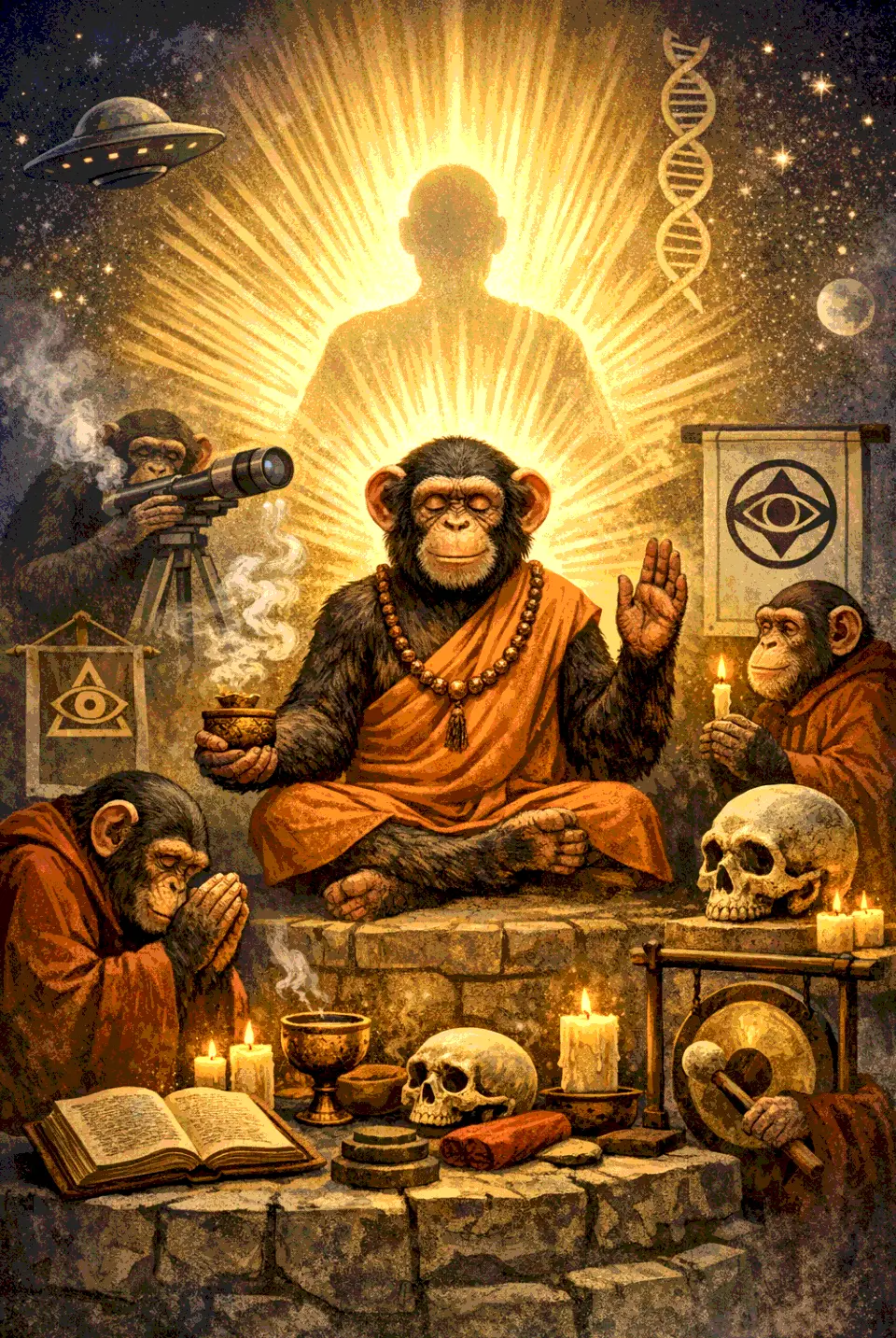
Here is a deep distillation and retelling of Religion for the Nonreligious.
What this text is
This is one of Tim Urban’s most important and personal articles.
Not just an essay about religion or atheism, but an attempt to build his own system of inner growth for a person who does not believe in traditional religion but does not want to live shallowly, chaotically and without spiritual discipline.
In essence, the text answers the question:
How does a person without religious belief work seriously on wisdom, clarity and inner evolution?
Urban says: atheism by itself is not a growth model.
It negates something, but does not provide a system.
So he tries to create his own framework — Truthism.
Essence in one paragraph
The main idea is this:
- the goal of human life at the level of inner development is wisdom;
- the path to wisdom is maximum proximity to the truth;
- the chief obstacle is fog, that is, a mix of primitive fears, instincts, ego, short-sightedness and unconsciousness;
- inner growth consists in stepping out of this fog more and more often, seeing the wider context, experiencing moments of existential clarity, and remembering the enormous unknown.
The main problem from which the article begins
Urban opens strongly:
a person can do all the “right” life things:
- study,
- work,
- earn,
- buy,
- improve daily life,
- close tasks,
- become functionally more successful,
and yet it is by no means certain that they:
- become wiser,
- become happier,
- really grow as a human being.
This is the central blow of the text:
external progress does not equal inner growth.
And he says that modern society barely helps in this area:
- the social environment is focused on the surface;
- religions often put divinity and salvation at the center, not work on the quality of consciousness;
- philosophy, psychology, art and self-help are scattered, fragmented, peripheral.
As a result, inner growth becomes not the foundation of life but a “hobby,” an optional extracurricular.
His answer: a person needs a growth framework
Urban says: if a business needs
- a mission,
- a strategy,
- metrics,
then a person who wants to grow seriously also needs:
- to define a goal,
- to understand the path,
- to see the obstacles,
- to develop a practice.
And the rest of the article is the construction of such a framework.
1. The goal: Wisdom
Why wisdom specifically?
Urban states plainly:
his primary goal is wisdom.
Not just knowledge.
Not just morality.
Not just success.
Not just nice rituals.
But wisdom — the capacity to see more clearly, more deeply, more broadly, and to live by that sight.
At the end he formulates a very strong idea:
the goal of growth is to obtain “deathbed clarity” while still alive
That is, not to live into old age and only then realize:
- you should have worked less,
- loved more,
- told the truth more,
- lived more,
- made the important changes earlier,
but to come to this clarity now, while the course can still be changed.
This is one of the strongest lines in the text.
2. The path: be conscious of truth
Urban defines the path very simply:
wisdom comes through awareness of truth
And here is the important part:
he does not mean a “mystical truth.”
By truth he means:
- what we actually know about reality;
- and what we don’t know.
So truth =
awareness of both the known and the unknown.
This is important intellectual honesty:
wisdom is not “having answers to everything” but clearly seeing:
- what is a fact,
- where there is context,
- where the limit of understanding lies,
- where the unknown is.
3. The main obstacle: The Fog
Here the article’s main metaphor begins.
What is fog?
Fog is a force that:
- blinds,
- deafens,
- distorts priorities,
- prevents you from reaching a level of higher clarity.
It is not a single emotion.
It is a whole mixture:
- fear,
- ego,
- envy,
- pettiness,
- tribalism,
- instant gratification,
- short-sightedness,
- vanity,
- self-absorption,
- greed,
- neurotic reactivity.
Urban interprets fog as the result of two forces coexisting in us:
a) ancient animal impulses
b) the new Higher Being
4. Urban’s inner anthropology: Higher Being vs Animals
This is the central psychological model of the text.
The human brain is not a single, coherent, wise system
It is a strange cohabitation:
Animals
Old evolutionary systems:
- self-preservation,
- reproduction,
- fear,
- impulse,
- territoriality,
- social anxiety,
- jealousy,
- aggression,
- greed.
Higher Being
Our newer part:
- big-picture thinking,
- rationality,
- perspective,
- love,
- compassion,
- deeper morality,
- awareness,
- the capacity to see context and truth.
A human, per Urban, is not just “a rational creature.”
It is a chaotic hybrid:
old animal systems and a new level of consciousness.
Hence the main internal war:
core human struggle = battle of the Higher Being against the animals
That is:
- the Higher Being wants clarity, scale, love, truth;
- the animals pull toward fear, inertia, reactivity, petty ego.
Fog is when the animals block access to the Higher Being.
5. Why the fog is so strong
Urban introduces another deep idea:
when human consciousness became developed enough to grasp the fact:
WE’RE GOING TO DIE
it threw the brain’s animal systems into panic.
Because they were not “designed” for that information.
Our primitive brain hardware is not built to calmly hold the existential knowledge of mortality.
And this chaos thickens the fog further.
A very strong thought:
part of our daily short-sightedness, neurosis and self-deception is a byproduct of the fact that the animal architecture of the brain must live with too much knowledge of death for it to handle.
6. The main inner conflict
Urban sums it up almost as a diagnosis:
The battle of the Higher Being against the animals — of trying to see through the fog to clarity — is the core internal human struggle.
This is the heart of the whole text.
The rest of his system is not just metaphysics but training to rise above the fog.
7. The four stairs of consciousness
Here he gives his main map.
Step 1 — Life in the Fog
Step 2 — Thinning the Fog / Context
Step 3 — Shocking Reality / Whoa
Step 4 — The Great Unknown
This is, effectively, an inner map of the development of consciousness.
STEP 1 — Life in the fog
The default state of most people most of the time.
What characterizes Step 1?
1. Small-mindedness
At this level we are run by animal states:
- pettiness,
- envy,
- self-absorption,
- anxiety,
- greed,
- harshness,
- tribalism,
- schadenfreude,
- narcissism.
2. Short-sightedness
The fog hangs 15 cm in front of your face.
A person doesn’t see the bigger perspective:
- doesn’t value parents while they are alive;
- lies or cuts corners for petty gain;
- saves pennies at the cost of human generosity;
- damages a marriage or career through short impulses;
- stays for years in the wrong relationship, job, city;
- lives under the dictate of “what will people think,” even though no one cares.
3. Stupidity
Urban is very harsh:
at Step 1 a person is not just emotional but very dumb.
The main example:
we believe again and again that the next “carrot” will make us steadily happy:
- a thing,
- a status,
- an achievement,
- the next stage.
But we always return to baseline.
He introduces the hedonic treadmill here and says:
while a person is in the fog, they are trying to get happier by standing in the shower with the water on and trying to dry themselves with a towel.
The strongest idea of this block
Step 1 is not just a “non-ideal state.”
It is a state in which a person:
- confuses impulse with truth,
- the petty with the important,
- fear with reality,
- short-term winning with a good life.
STEP 2 — Thinning the fog and seeing context
This is where real growth begins.
What is Step 2?
A state when the fog thins enough that the voice of the Higher Being becomes audible.
A person begins to see not just an object or event but the context around it.
The key word of Step 2:
context
For instance:
- a rude cashier is not “the enemy” but a person with an unknown day, history, pain;
- a bad event is not the end of the world, but a small part of a larger picture;
- a good result is not the final victory;
- night-time anxiety is often just the perspective distorted by a tired brain.
How to reach Step 2
Urban names several tools:
- education, experience, travel;
- active reflection;
- a journal;
- therapy;
- meditation, yoga, exercise;
- special “fog goggles” questions:
- what would I do if money didn’t matter?
- what would I advise someone else?
- will I regret this at 80?
But most importantly:
simply remember that the fog exists, and learn to notice it.
A very strong operational thought:
you don’t need to become “enlightened” right away.
First, you have to learn to catch the moment when fog floods you.
What Step 2 changes
- less reactivity;
- more calm;
- more empathy;
- more humility;
- less fear where the threat isn’t real;
- the animals in your head no longer feel all-powerful — they look a little silly.
Limitation
Urban honestly says:
it is easy to enter Step 2, but very hard to stay there for long.
Because the fog makes a person unconscious exactly when it is densest.
STEP 3 — Shocking Reality / Whoa Moments
Here the text moves from psychology into existential philosophy.
What is Step 3?
A state where a person not only sees the context of the human situation but truly touches shocking reality:
- the scale of the cosmos,
- the length of time,
- the fragility and miraculousness of life,
- the atomic nature of matter,
- the fact that “I” is a brief configuration of atoms in infinity.
Urban calls such states:
Whoa moments
Not just knowing a fact, but existentially grasping a fact.
For example:
- to know that the Universe is 13.8 billion years old is one thing;
- to truly feel it for a moment is another.
The emotional effect of Step 3
- awe
- wonder
- humility
- sadness
- elation
- spiritual feeling
A very important moment:
Step 3, in his system, is the source of true non-religious spirituality
It is here he says:
in moments of Whoa, words like
- awe,
- worship,
- miracle,
- eternal connection
suddenly make sense.
A very important layer of the article:
he does not bring religion back, but wants to preserve the depth of spiritual experience — only rooted in science, reality and humility.
The moral effect of Step 3
At this level:
- pride,
- petty offense,
- hatred,
- petty status games
look small and ridiculous.
He even says:
if at Step 1 he is annoyed by a rude cashier, at Step 3 the only possible emotion is love.
Probably one of the strongest moral insights of the article:
when the scale of reality truly enters consciousness, petty malice becomes non-functional.
Why Step 3 is so important
Not because people can live there permanently — Urban directly says they cannot.
But because such moments:
- humble the animals in your head;
- reduce their future power;
- make the Step 1 vs Step 2 battle easier.
So Step 3 is not a permanent dwelling, but a strong cleansing blow against the fog.
A very important line
Step 3 is, for him, the answer to those who think atheism leads to immorality or nihilism.
He says:
on the contrary, it is precisely the scientifically revealed world that gives him a sense of:
- miracle,
- love,
- gratitude,
- spiritual uplift.
That is why he quotes Sagan:
science is not only compatible with spirituality; it is a profound source of spirituality.
STEP 4 — The Great Unknown
The top layer of the system.
If Step 3 is “seeing grand known reality”
then Step 4 is:
seeing the scale of the unknown
Urban depicts this as a large purple blob taking up almost all of the space of reality.
The point:
however much we know,
almost everything still lies beyond our understanding.
The main idea of Step 4
Any picture of reality that does not include the radical unknown is a delusion.
People, he says, very much dislike admitting this.
So:
- religions fill the unknown with myths;
- people pass invented things off as certainty;
- science too sometimes falls into arrogance, as if “now almost everything is understood.”
He cites Lord Kelvin in 1900, who thought physics was nearly complete — just before relativity and quantum mechanics.
The main message
We are ridiculous when we pretend we have figured a lot out.
Because we don’t know:
- what the Universe really is,
- what was “before” the Big Bang,
- what dark matter is,
- whether there’s a multiverse,
- whether life exists elsewhere,
- whether string theory is right,
- and maybe almost everything most important lies entirely outside our cognitive accessibility.
The strongest thought
We may be, to a higher consciousness, roughly what a monkey or an ant is to us.
And then almost all of the “purple blob” is simply unliftable for our kind of mind.
So Urban arrives at a very strong form of:
- atheism with respect to human religions,
- and radical agnosticism with respect to the nature of reality.
He even says:
could there exist an extraordinarily advanced force / being / simulation-like creator?
Of course there could.
Who are we to say “no” categorically?
An important point:
he does not go back into dogma, but arrives at a humble “I don’t know.”
The practical effect of Step 4
- even deeper humility;
- more hope;
- less need for certainty;
- it’s easier to “take your hand off the wheel”;
- more presence;
- less tribalism.
Urban directly says:
certainty is primitive
And further:
- certainty triggers us-vs-them;
- certainty divides and goes to war;
- united uncertainty is better than divided fabricated certainty.
One of the strongest social ideas in the text.
8. Why wisdom is the umbrella goal
At the end he brings it all together.
Wisdom = access to what the Higher Being already knows
So wisdom does not necessarily have to be “invented” or “fetched from outside.”
It is already partly inside, but the fog covers it.
When the fog thins:
- wisdom shows up as a by-product.
A very strong thought:
growing old or tall is not the same as growing up
Being a grownup, per Urban, is not age.
It is:
- a level of wisdom;
- a scale of consciousness;
- the amount of time you spend on the higher steps rather than in the fog.
He says directly:
some people grow wiser with age, and some — the opposite:
the fog hardens, certainty grows, consciousness coarsens.
9. Critique of traditional religion
Urban is quite tough here.
He doesn’t say religion has no:
- good people,
- good values,
- useful practices.
But he thinks that this often happens in spite of religion, not because of its core.
His charges:
- religions often appeal to fog through fear;
- treat people like children;
- build us-vs-them;
- resist social evolution;
- put ancient scripture above the living search for truth;
- impose certainty where humility is needed.
Separately he calls out politics as an even worse place of fog-based existence.
10. Truthism — what it is
Here he takes the final step.
Since “atheist” is only what he doesn’t do, not a growth strategy, he invents his own identity:
Truthist
In Truthism:
- worship = truth
- goal = wisdom
- obstacle = fog
- daily strategy = notice fog and see wider truth
- long-term metric = more time at Step 2, less at Step 1
- deeper practice = invoke Step 3 moments and remember Step 4
In essence, a secular spiritual discipline.
He even creates a symbol-logo for himself — like a mantra, a reminder, a WWJD-equivalent.
The most valuable ideas in the text
1. Atheism is not a growth model
A very strong observation.
It cuts off the lazy intellectual position “I’m not religious, therefore I’m already advanced enough.”
2. Inner growth requires the same kind of systematic approach as business or career
A very operator-minded and powerful framing:
- a goal,
- a framework,
- practice,
- metrics.
3. Fog as the central model
The strongest explanatory metaphor of the text.
It captures well:
- self-deception,
- pettiness,
- reactivity,
- impulsiveness,
- loss of scale.
4. Higher Being vs Animals
Also a strong, though simplified, model.
It is practical: it helps see in oneself not “I am bad” but “different architectures are at war in me.”
5. Context as a moral practice
Step 2 is valuable precisely because it requires no metaphysics — only the skill of restoring the wider context each time.
6. Step 3 — secular spirituality via science
One of the most beautiful ideas in the text.
Science does not kill spiritual depth — it can be its source.
7. Step 4 — humility before the unknown
A very mature intellectual position:
falling neither into dogma nor into cynicism, but holding strong humility.
8. Deathbed clarity as a design objective
Probably one of the most useful practical ideas in the whole text.
Where the text is especially strong
1. It offers not just reflections but a map
It is not a chaotic essay but almost a manual:
- goal,
- path,
- enemy,
- levels,
- practice.
2. It combines psychology, existential philosophy and secular spirituality
In a language that is accessible but not primitive.
3. It really works as a lens for life
After this text it is easy to start catching yourself in:
- Step 1 behavior,
- fog spikes,
- missing context,
- craving certainty,
- small-minded reactions.
Where the text simplifies, or where it has weak spots
To see it soberly:
1. The Higher Being vs Animals model is very useful but crude
The real psyche is more complex.
Not all “animal” reactions are bad, and not everything rational is automatically higher.
2. He has a strong tilt toward cognitive clarity as the source of good
This is often true, but not always:
- people can see clearly and still act badly;
- moral formation is more complex than merely thinning the fog.
3. The critique of religion is one-sided in places
He underestimates what religion historically has provided:
- ritual,
- community,
- discipline,
- moral practice,
- a symbolic language for Step 3/4 experience.
4. Truthism is good as an individual scheme but thin as an institution
It is a strong personal framework, but it is not clear how to turn it into stable collective practice without disintegrating into “it just seems that way to me.”
The strongest formulas and phrases
The core of the article in short formulas:
- Goal: wisdom
- Path: awareness of truth
- Obstacle: the fog
- Core struggle: Higher Being vs animals
- Step 1: fog
- Step 2: context
- Step 3: Whoa
- Step 4: the Great Unknown
- Certainty is primitive
- The goal is deathbed clarity while life is still happening
The shortest summary
Religion for the Nonreligious is an attempt to build a secular spiritual system for inner growth. Urban says it is not enough for a person merely to disbelieve religion or merely to live functionally. You need a framework that helps you become wiser.
In his model:
- wisdom is the goal;
- truth is the path;
- fog is the main obstacle;
- growth consists in stepping out of the fog more and more often, into context, awe and humility before the unknown.
If you boil it down to one main conclusion:
the article’s most valuable idea is that inner growth requires as serious an architecture as any important project, and the path to wisdom lies through the disciplined reduction of the fog of fear, ego and unconsciousness for the sake of truth, context and humility.