Death With No Owner: Why Europe Makes You Earn Coolness With a Diagnosis
In Geneva, an air conditioner in your own bedroom long required proof of a legitimate need — a medical certificate, for instance. In Portofino, a unit on a facade can cost you €43,000. Meanwhile Europe buried roughly 181,000 heat deaths across three summers, 85% of them people over 65. An anatomy of the mechanism: how a state with no malicious intent builds a system where coolness costs agencies money and a dead pensioner costs nothing.

On this page
In Portofino, an unapproved air-conditioning unit on your facade can cost you up to €43,000. That is two and a half years of the average EU old-age pension — €17,300 per beneficiary per year. The fine is not for noise, not for a refrigerant leak, not for a fire hazard. It is for the fact that a white box spoils the view.
Between January and May 2024, Portofino's municipal police found 22 illegal installations. In June, when it got seriously hot, another 15 in a single month. The Italian press described a war between neighbours: people quietly photographing each other's outdoor units over dinner and reporting them. Some repainted their unit to match the facade so it would vanish from the committee's eye. The mayor explained that the aim was not to punish anyone, but to preserve the view.
That same summer, Europe buried tens of thousands of people killed by heat. More than 85% of them were over 65. No committee photographed a single one of them.
This is not a text about a conspiracy. There is no conspiracy. There is something worse: a structure in which a conspiracy is unnecessary.
I spent years treating air conditioning as a luxury myself. A fan, a window open at night, a wet towel — and a quiet pride in managing without. That is not asceticism. It is the same prejudice, just running inside my own head. It cost me nothing for exactly one reason: I am not seventy yet.
A silent killer with a perfect alibi
Heat is the only mass killer that leaves no signature. The death certificate says "cardiac failure" or "stroke." It does not say "three weeks at 35°C in an attic under a tin roof." A heat death becomes visible only a year later, inside a statistical model, with a confidence interval where the face should be.
Hold on to that detail. It explains everything that follows.
The peer-reviewed numbers look like this.
| Period | Heat deaths in Europe | What it changed |
|---|---|---|
| Summer 2003 | over 70,000 excess | Europe started counting at all |
| Summer 2022 | ≈67,900 (2025 revision) | Italy 18,010, Spain 11,324 |
| Summer 2023 | ≈50,800 | cooler summer, same housing stock |
| Summer 2024 | 62,775 | Italy alone over 19,000 |
| Summer 2025 | 24,400 in 854 cities only | 68% attributed to climate change |
Across the three summers of 2022–2024 that is roughly 181,000 people. Across the wider European Region, the WHO counts more than 175,000 heat deaths a year, a figure up by about a third over two decades.
The European average in 2022 was 114 deaths per million. Italy: 295. Greece: 280. Spain: 237. Portugal: 211. In 2024 Greece broke the record at 574 per million, with Bulgaria at 530.
And one number almost nobody quotes. Heat mortality among women was 63% higher than among men: 35,406 against 21,667. The gap is widest in the 80-plus group. So the portrait of a typical European heat victim is not an abstract "elderly European." It is a widow in her own flat, alone, on the top floor.
An air conditioner is medical equipment
It sounds like an overstatement. Look at the data.
The economist Alan Barreca and colleagues took apart American mortality across the whole twentieth century. The risk of dying on a very hot day fell by roughly 75%. Almost all of that decline happened after 1960. Not medicine. Not ambulances. Not early-warning systems. Air conditioning.
The Lancet Countdown computed the global effect: in 2019, access to air conditioning averted around 195,000 deaths among people 65 and over. Compared with 2002, the number of averted deaths had tripled.
By lives saved, in other words, a domestic air conditioner sits in the same row as basic cardiac drugs. The difference is that nobody bans you from hanging statins on a facade.
Now the coverage.
| Country / region | Households with air conditioning |
|---|---|
| United States | around 90% |
| Europe overall | around 20% |
| Italy | roughly half |
| France, Germany | well under a quarter |
| Switzerland | around 5% |
Set that against the mortality table above and you will notice it is the same table, simply inverted.
But the most interesting line in it is France. In 2022 France had the largest temperature anomaly in Europe: +2.43°C above average. And it still did not make the mortality leaderboard — 4,807 deaths across 68 million people. Italy, with a less extreme anomaly, produced 18,010.
The difference is not the weather. The difference is that France already took its hit in 2003: about 15,000 deaths in two weeks of August, the resignation of the head of public health, a national trauma. What followed was the plan canicule — a warning system, registries of isolated elderly people, mandatory cooled rooms in care homes. Adaptation works. It is simply that we usually buy it posthumously, in cash, with the price already cut into the headstones.
The architecture of the ban
Formally, air conditioners are banned nowhere in Europe. In practice they are out of reach across a large share of the housing stock. Not one prohibition but a sediment of small rules, each of which looks reasonable on its own.
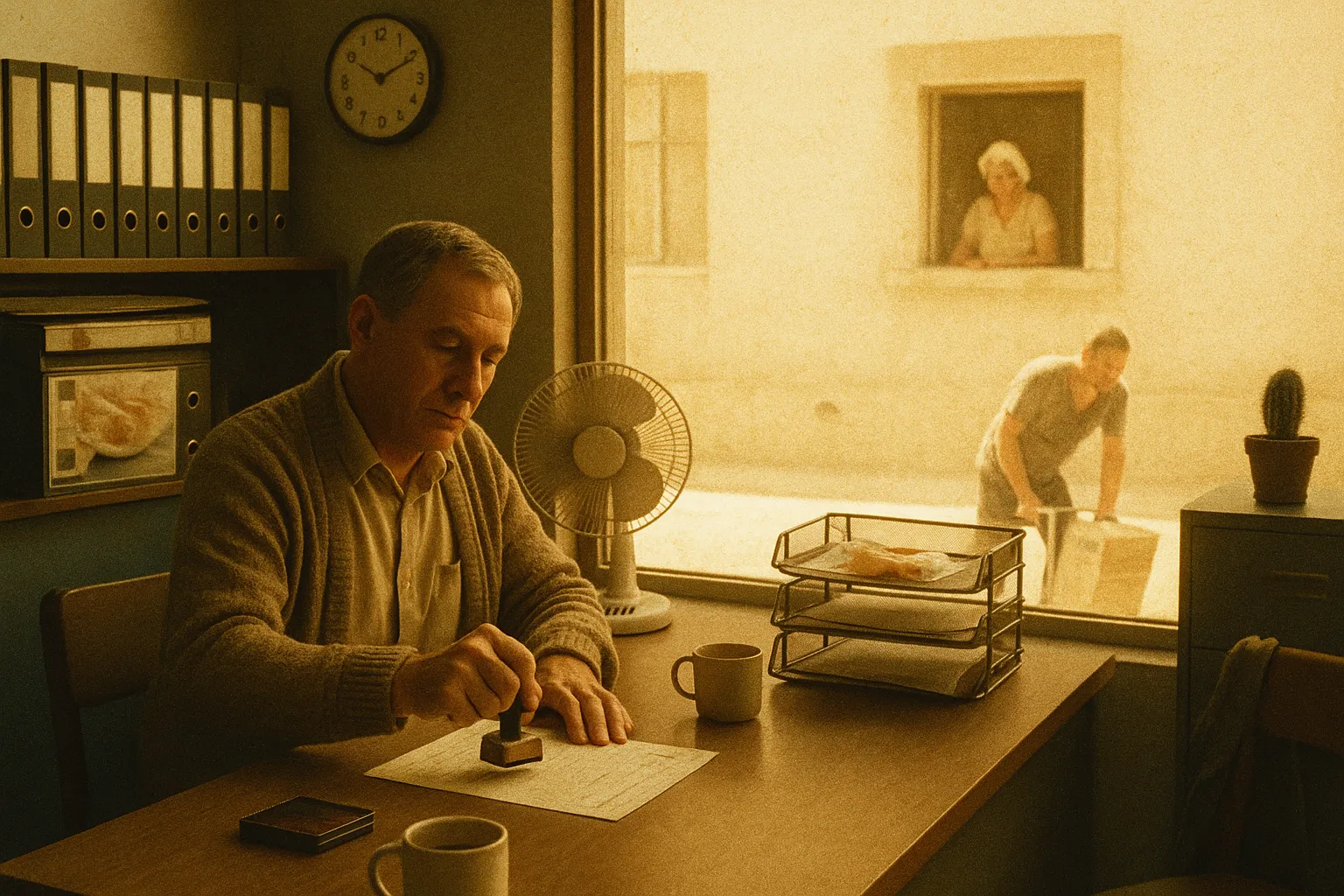
Geneva. An air conditioner requires an energy authorisation inside a building-permit application. To get one, you must demonstrate a legitimate need — a medical certificate, for instance. Being comfortable in your own home does not qualify as a legitimate need. The state was, quite literally, demanding a piece of paper certifying that you are ill enough to have the right not to overheat.
Portofino. Fines up to €43,000, police counting units on facades, neighbours photographing neighbours. The rules have been partly relaxed: a unit is allowed if it is authorised and cannot be seen.
Paris and Vienna. An outdoor unit on a facade is a change to the appearance of the building. So you need the co-owners' consent, and inside heritage zones a separate approval on top. Refused? Go to court and prove a "substantial interest." Summer lasts three months. Court lasts longer.
And now the secondary effect, which is the reason to read this carefully. When a split system is out of reach, people do not give up on cooling. They buy a portable single-hose monobloc — the worst technology on the market. Loud, power-hungry, two to three times less efficient, because it dumps hot air out of the window and thereby sucks fresh hot air in through every gap in the flat. In Geneva, sales of these units grew 50% in a year.
A regulation invented in the name of energy efficiency pushed people en masse into the least energy-efficient option available. That is not a malfunction. That is a rule working exactly as written, and exactly against what it was written for.
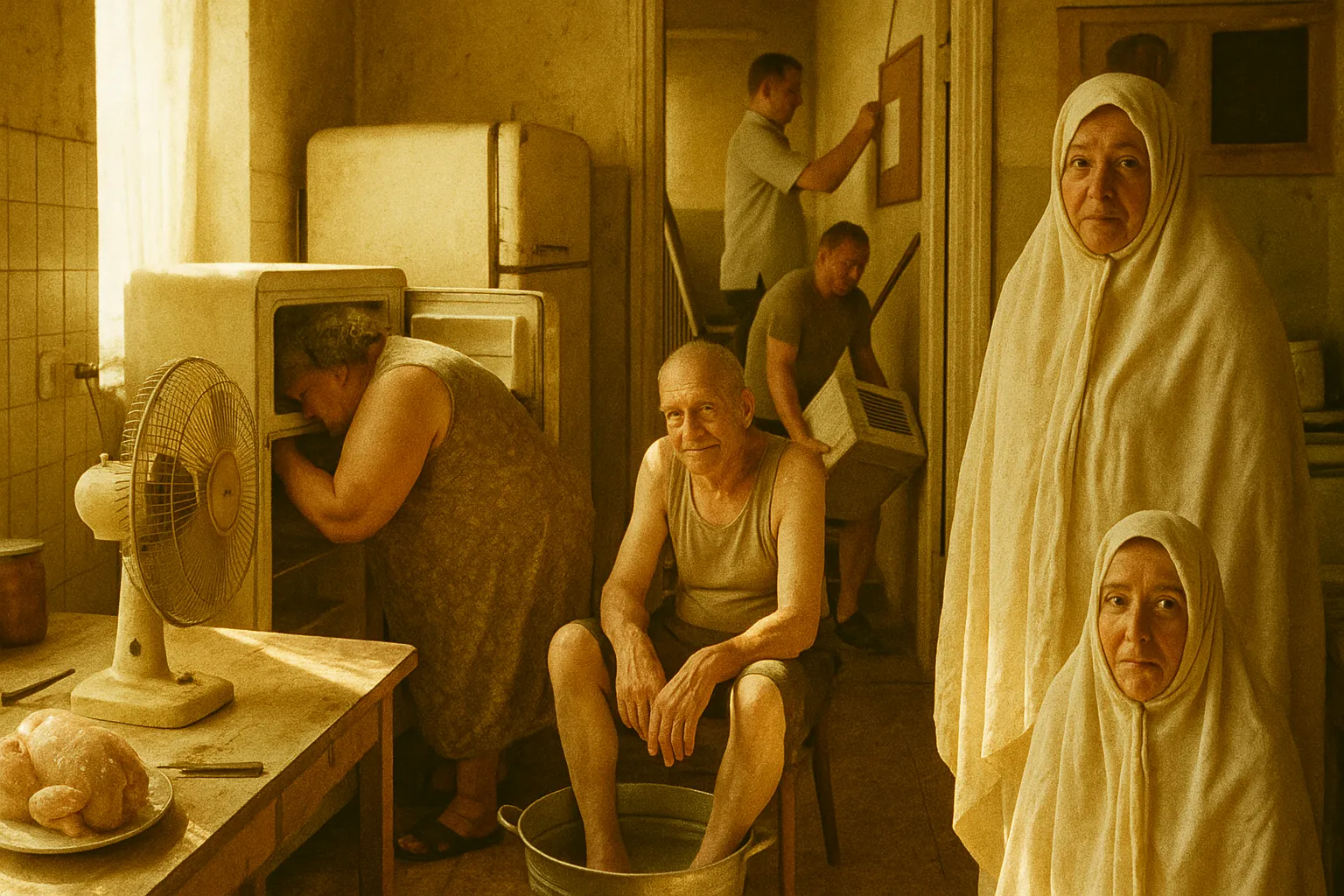
And the social gradient, without which the picture is incomplete. The wealthy find a way around: an inner courtyard, a roof, a lawyer, new-build outside the heritage zone. A pensioner in social housing or a rented flat in a historic centre has none of those instruments. The regulatory barrier lands precisely on the group with the highest mortality. Not because anyone designed it that way. Because a barrier costs money, and not everyone has money.
The cynical hypothesis: bring the calculator
Now the uncomfortable part, the reason this text exists at all.
For a state budget, the death of a pensioner is the termination of three expenditure streams: pension, healthcare, long-term care. So: is regulatory indifference to elderly heat mortality a hidden fiscal optimisation?
The question is repulsive. But this accounting is not a conspiracy theorist's invention. It has already been done once, on paper, with a consulting firm's stamp on it.
In 2001 the Czech arm of Philip Morris commissioned Arthur D. Little to produce a study for the Czech government. The document calculated that the premature deaths of smokers saved the budget money on healthcare, pensions and housing for the elderly, and that together with excise revenue the net fiscal effect of smoking exceeded £100 million — around $140 million a year. The report leaked in July 2001. The scandal detonated. The company disowned it and apologised for a "terrible mistake."
Note precisely what the apology was for. They refuted the ethics. Not the arithmetic.
Since then this accounting has been taboo. Let us run it out loud once, to close the question.
Inputs. A bad year: roughly 60,000 deaths, about 90% of them pensioners — some 54,000 people. Years of life lost is the main uncertainty: part of heat mortality is "harvesting," a displacement of weeks for someone already dying. The estimates in the literature are scattered very widely; take an honest range of 1–5 years. Average EU old-age pension expenditure is €17,300 per beneficiary per year.
54,000 × (1…5 years) × €17,300 ≈ €0.9–4.7 billion of "saved" pension outlays. Add healthcare and long-term care, which for the 80-plus cohort are comparable to the pension or larger. Ceiling, on maximally cynical assumptions: around €10 billion a year.
And now the denominator. Total EU pension expenditure is €1,971 billion a year, 12.2% of GDP.
| Item | Per year | Share of EU pension budget |
|---|---|---|
| "Savings" on pensions from deaths in a worst summer | €0.9–4.7bn | 0.05–0.24% |
| Ceiling including healthcare and care | ≈€10bn | ≈0.5% |
| EU pension expenditure | €1,971bn | 100% |
A rounding error. A single indexation decision in one large country costs more than this entire continental "optimisation." If this is a conspiracy, it is a conspiracy that yields less than an accountant's Thursday typo.
Why the intent hypothesis collapses
Three reasons, each sufficient on its own.
One: the motive does not carry. No bureaucracy takes an existential political risk for 0.1% of a budget. The asymmetry is absurd: the upside is a statistical crumb, the downside is the end of a career.
Two: dead pensioners are not a saving, they are a political bomb. France, August 2003. Fifteen thousand deaths in two weeks. The director-general of public health resigned. A national trauma that still shapes French heat policy. Pensioners are Europe's most disciplined electorate. They turn out to vote even when they no longer turn out anywhere else.
Three: systems behave in the opposite way after the hit. Where the political price actually materialised, the state genuinely spent: the plan canicule, registries of the isolated, cooled rooms. And it got the largest anomaly in Europe with disproportionately small mortality. A system that "wants" deaths does not behave like that.
There is no conspiracy. Question closed.
But the text does not end here — because the outcome has not gone anywhere.
Death with no owner
Here is the mechanism the arithmetic was for.
The system does not need to want you dead — it only needs to not count you.
Call it death with no owner: harm that is real, mass and measurable, but belongs to no budget line. Nobody pays for it, so nobody optimises it away. Five details that add up to a result indistinguishable from malice.
1. The attribution gap. The certificate says "heart attack," not "absence of cooling." No attribution means no culprit means no line in an estimate. A death that cannot be pinned to a specific decision generates no feedback. And a system without feedback does not learn. It simply repeats.
2. Budget silos. Deaths are paid for by the health ministry. Facade rules are written by heritage protection. Energy permits are issued by the energy authority. Climate targets are counted by a fourth party. None of them owns the question "how many people died because I said no." The Geneva official who did not sign the permit will never see the invoice for that decision. He will see a met energy target and a clean facade.
3. The asymmetry of warmth and coolness. Energy poverty in European law has historically meant "I cannot heat my home." The right to warmth is written down, winter subsidies exist, a frozen grandmother is a scandal. Coolness is still filed under "comfort." Which is exactly why Geneva demanded the certificate: warmth is a right, coolness is a privilege you earn with a diagnosis.
4. The organised against the dead. Facade aesthetics has a lobby: committees, building managers, heritage officers, climate campaigners, and the neighbour with a phone and an appetite for other people's balconies. The heat dead have nothing. They become statistics a year later, with a confidence interval instead of a face. At the hearing, one side is represented by lawyers and the other by a spreadsheet.
5. The taboo on the accounting. After Philip Morris, computing the fiscal effect of deaths out loud is forbidden. The paradox is that the taboo does not switch off the incentive — it switches off its audit. What cannot be counted publicly cannot be presented to the system as a bill.
The result is measured in obituaries, not intentions. And by result, Europe held for decades a regulatory regime that statistically killed tens of thousands of its oldest citizens a year — because their deaths had no owner.
Who wins, who pays
The winner is whoever's costs are visible — and whose benefits are visible too.
The owner of a flat in a historic centre wins: a clean facade holds the property price. The municipality wins: the view is tourist revenue, and it is easy to count. The energy authority wins: an unapproved air conditioner is kilowatts subtracted from a report, and the report is filed annually. The politician wins who can show a consumption chart rather than a mortality chart with a one-year lag.
The payer is an 82-year-old widow on the top floor of a building with no lift, windows facing south, in a flat she rents. She is not a member of the co-ownership, so she does not vote on the facade. She has no lawyer. She has no roof to put a unit on. She has a fan blowing hot air at her, and advice to close the shutters during the day.
That is the distribution: the view is paid for by the people who no longer look at it.

The break has already started
The good news is that the structure is cracking. And it is cracking in unexpected places.
The category has officially changed. At COP30 in Belém (November 2025) a Communiqué on Extreme Heat was adopted that recognises cooling as essential infrastructure — alongside water, energy and sanitation. That is not a slogan, it is a reclassification: from comfort to infrastructure. What is infrastructure eventually gets a budget line. And a budget line is precisely an owner.
Switzerland is softening. In June 2026 Geneva was publicly discussing simplified permits for private homes. In July 2026 Swiss parliamentarians began talking about easing the rules, using the phrase "new reality." The canton that demanded a certificate is now looking for a way not to demand it.
The market votes faster than parliaments. In the first half of 2026, Chinese air-conditioner exports to the EU reached $3.76 billion — up 43.2% year on year and an all-time record. In June alone, exports to Europe rose 72.8%. The Chinese brands' share of the European market climbed from 27% in 2023 to 41%.
But the most eloquent detail is not a figure, it is the product itself. The hit was a split system that requires no hole drilled through the wall: a design built specifically for European facade prohibitions and for tenants who are allowed to change nothing. It sold out in Germany and France, and on the secondary market it went for several times retail.
Read that slowly. Over twenty years Europe's heritage committees wrote a body of rules so specific that a dedicated product was engineered on the other side of the world to fit through it — and made billions. Regulation did not stop the cooling. It merely transferred the margin on it to Guangdong.
Politicians are already counting the votes. Pensioners are Europe's most disciplined electorate. Whoever promises them coolness takes their votes. Every flank has worked this out by now, and the first to do so were not the ones usually filed as friends of the climate.
The forecast is simple: within the next five to seven years the "right to coolness" will enter the European social contract the way heating once did. The only question is how many August statistical reports it still costs.
What to do about it before the end of August
Do not wait for a budget line to be opened under your mother. Here is a table you can show your parents today.
| Situation | What to do | Why exactly this |
|---|---|---|
| A split system is permitted | Install it. At least in the bedroom | One cooled room for sleeping delivers most of the effect |
| Protected facade / tenant | A portable dual-hose unit | A single-hose unit expels air outside and pulls hot air in through every gap |
| No money for equipment | Shutters and curtains by day, ventilation at night, fan plus bottles of ice | Cuts the peak but fails during sustained hot nights — a buffer, not a solution |
| Person lives alone, 80+ | Agree on a daily phone call during heatwaves | Isolation is the main risk multiplier; the French registries work exactly this way |
| Care home | Ask whether there is a cooled room | Since 2003 in France that is an obligation of the facility, not a service |
Three things to carry out of here.
One. In Europe an air conditioner is medical equipment with proven effectiveness on the level of basic drugs, regulated as an aesthetic whim.
Two. The state does not kill pensioners to save money: the arithmetic makes that motive senseless. But it built a system in which their deaths cost nobody anything, while their survival costs specific agencies specific money and specific conflicts. That is enough. No intent required.
Three. If your parents are over seventy and live in Europe, an air conditioner in the bedroom cuts their risk of dying more than half of what their family doctor prescribes them. It is the cheapest life insurance currently available on the continent.
Geneva demanded a certificate stating that you are ill enough to have the right not to overheat. It is about to be scrapped.
But consider what that document actually was. Not a medical finding. It was an application for the right to be counted. And tens of thousands of people died every summer simply because nobody filed it in time.
Frequently asked
How many people die of heat in Europe?
Per ISGlobal estimates in Nature Medicine, summer 2022 caused roughly 67,900 deaths, 2023 about 50,800, and 2024 exactly 62,775. That is around 181,000 across three summers. The WHO puts heat mortality across the wider European Region at more than 175,000 people a year. Over 85% of the dead are people older than 65.
Does air conditioning really save lives?
Yes, on a scale comparable to basic medication. Barreca and colleagues showed that the risk of dying on a very hot day in the US fell by roughly 75% over the twentieth century, and almost all of that decline came after 1960, when households got air conditioning. The Lancet Countdown estimated that in 2019 access to air conditioning averted around 195,000 deaths among people aged 65 and over.
Why does Europe have so little air conditioning?
Per the IEA, about 20% of European households have air conditioning, against roughly 90% in the US. The causes are cooler historical summers, old housing stock, energy targets, and heritage rules that forbid outdoor units on the facades of historic buildings.
What should I do if my parents are over 70 and live in Europe?
At minimum, one cooled room — the one they sleep in. A split system is better, but where it will never be permitted, the working compromise is a portable dual-hose unit: it is about twice as efficient as a single-hose one and does not create the negative pressure that drags hot air back into the flat.
Comments
Signed-in readers only — to keep it human, not a bot swamp.