Anyone Can Generate It Now. You Get Paid for Knowing Where to Look
In five years the cost of a million tokens fell from $60 to roughly $0.05 — somewhere between 280x and 1,200x. When generating options is nearly free, the only scarcity left is attention: where you look and what you actually finish. The bottleneck moved from production to judgment.

On this page
- I. The scene: a button that costs less than a coffee
- II. Numbers that didn’t fit the old intuition
- III. The framework: the Cost-Collapse Attention Economy (four axes)
- IV. Axis #1: Generation — how an asset became a commodity in a single season
- V. Axis #2: Judgment — when everything is defensible, defensible isn’t a criterion
- VI. Axis #3: Direction — the fastest generation in the wrong direction is the costliest mistake
- VII. Axis #4: Closure — what’s generated doesn’t exist until someone carries it to the end
- VIII. Who wins, who pays (the distributional lens)
- IX. Full counter-pressure: “what if generation stays an asset after all?”
- X. The tool: an Attention P&L — where your most expensive currency actually went
- XI. Re-plating: attention as the only asset a button can’t scale
- XII. Hard kicker
"This week I generated three landing pages, a bot, a quarterly content plan and two business models." — a person who, in that same week, shipped none of them, because he never decided which one. Production now costs about as much as tap water. The bill isn't for the water. It's for forgetting to turn off the tap.
I. The scene: a button that costs less than a coffee
02:10. A room, a lamp on one side, cold blue laptop light on the other. The table is buried in fresh printouts: three landing-page variants, two bot architectures, a content plan, a rough pitch deck. All of it done in one evening. The operator holds a mug, looks at the stacks, and feels something very close to pride. In a single session he produced what a team of three used to ship in two weeks back in 2022. The cursor rests over a green “Generate” button. Pressing it costs less than a sip of espresso.
And this is exactly where the event no dashboard will ever log takes place. He reaches for the button again — not because he’s short on variants, but because generating a fourth is easier than choosing among the three he has. Choosing hurts: you have to kill two landing pages you just made, look the better one in the eye, and own the call. Generating feels good: a dopamine spark, a sense of motion, a clean checkmark in the “done” column. By 02:40 there are seven landing pages on the table. None of them shipped. The tap is open, the sink is overflowing, and the man keeps pouring, because pouring is cheaper than closing.
This is not new productivity. It’s old procrastination wearing a factory worker’s overalls. In 2026 the most dangerous form of doing nothing looks like record output. And the worst part: on the surface the scene is flawless. I’m not on the couch, I’m building. Seven landing pages overnight. Find me the person in 2021 who’d have called that a problem.
II. Numbers that didn’t fit the old intuition
The most important figure in this piece isn’t “40% of enterprise apps with agents by end of 2026” or “$450 billion market by 2035.” It’s 280. That’s how far the inference cost for a GPT-3.5-class system fell, per Stanford HAI’s AI Index 2025 — from about $20 per million tokens in November 2022 to roughly $0.07 by October 2024. Eighteen months. Stretch the horizon and Epoch AI puts the median inference-price decline at ~50x per year (with a spread of 9x to 900x depending on the benchmark). And the cost of reaching top frontier quality fell, by various estimates, from $60 per million tokens in 2020 to ~$0.05 in 2025 — three orders of magnitude.
Now the applied arithmetic, because this is where the old intuition breaks an ankle. For decades, the cost of “making one good thing” — a line of code, a paragraph, a design variant — was the floor of the entire decision economy. You didn’t generate ten landing-page variants not because you lacked taste, but because each one cost a designer-day. The scarcity of production did half your filtering for you. You were forced to choose before producing — because producing everything was impossible.
Remove that floor, and the whole edifice of decisions settles one storey lower. When generating the tenth variant costs cents and seconds, the natural filter that used to stand at the entrance simply vanishes. Economists call it induced demand: widen the road and it fills with cars; cheapen the production of options and you drown in options. The bottleneck doesn’t disappear. It moves up the conveyor belt — from “make it” to “decide what to do with it.”
“Why now?” — the question The Economist demands in the first third. Here’s the dated answer. In August 2025, MIT’s Project NANDA published “The GenAI Divide: State of AI in Business 2025”: across 300-plus enterprise deployments, 52 case studies and 153 leadership surveys, 95% of generative-AI pilots produced no measurable financial return. Not because the models are weak — the models are good to the point of indecency. But because organizations can’t bolt them into their own decisions, flows and closures. Production soared; the capacity to judge, to steer, and to finish stayed human, slow and rare. The gap between those two curves is the story of 2026.
III. The framework: the Cost-Collapse Attention Economy (four axes)
Name the mechanism properly, or it stays background noise. The Cost-Collapse Attention Economy is the state in which the cost of generating options has collapsed to zero, leaving as scarce only the things a button can’t scale: where you look, what you cut, which way you steer, and what you carry to closure. Scarcity didn’t vanish. It migrated — from hands into the head.
Four axes along which this new economy decomposes:
- Generation (cost → 0). Once a load-bearing column, now a background utility, like electricity in the wall. What used to be an asset (“I can make it”) became a commodity. Whoever builds their value on the mere fact of production is selling ice to Eskimos in the winter of 2026.
- Judgment (the new floor). The ability to tell “technically correct” from “actually right.” When all ten variants are defensible, defensible stops being a criterion. What’s left is taste, and you can’t prompt your way to it.
- Direction (the highest leverage). Where is it even worth looking? The fastest generation in the wrong direction is just a more expensive way to be wrong. Direction multiplies — or zeroes — everything below it.
- Closure (where value becomes real). What’s generated doesn’t exist economically until someone has chosen, finished and shipped it. Seven unlaunched landing pages are worth exactly as much as zero landing pages — minus one night of your life.
I’ll unpack each axis through a scene, a number, a mechanism and an honest counterargument. With no academic distance — because I’m the one reaching for variant eight at 02:40.
IV. Axis #1: Generation — how an asset became a commodity in a single season
A scene from another era, to feel the drop. 1995, an ad agency, the night before a pitch. The art director stands over a scanner, because one layout variant means hours of manual paste-up and film costs money. He’ll do three. Five at most. And it was precisely the physical expense of each variant that forced him to think before clicking. Scarcity wasn’t a flaw. It was an unconscious disciplinary mechanism — it wouldn’t let him defer the choice, because deferring meant not finishing at all.
Now the same role in 2026. The same brief is twenty variants in ten minutes, each one “not bad.” The scarcity that used to think on the human’s behalf is gone. And here’s the first counterintuitive blow: what they once hired you to do is now handed out free at the register. If your professional identity rested on “I can generate it” — code, copy, design, a business plan — then in 2026 you own an ice factory that just heard about refrigerators.
| Former scarcity (the asset) | What happened to it by 2026 | Where value moved |
|---|---|---|
| Write clean, fit-for-purpose code | Copilot/agents generate by the stream; PR volume +98% | Who reads it, understands it, lets it into prod |
| Produce competent copy / a landing page | 20 variants in 10 min, all "not bad" | Who picks one and kills the other nineteen |
| Generate strategic options | Any number of scenarios per prompt | Who says which way to look at all |
Counter-pressure mini: “but there are skill tiers — generating really well still isn’t something everyone can do.” Fair — for now. The best prompters and architects do squeeze more out of the models. But that edge melts with every release — what takes a master today, the next model does from a default prompt. The durable advantage isn’t in how well you press the button, but in which button is worth pressing at all. Generation skill amortizes. The quality of your aim does not.
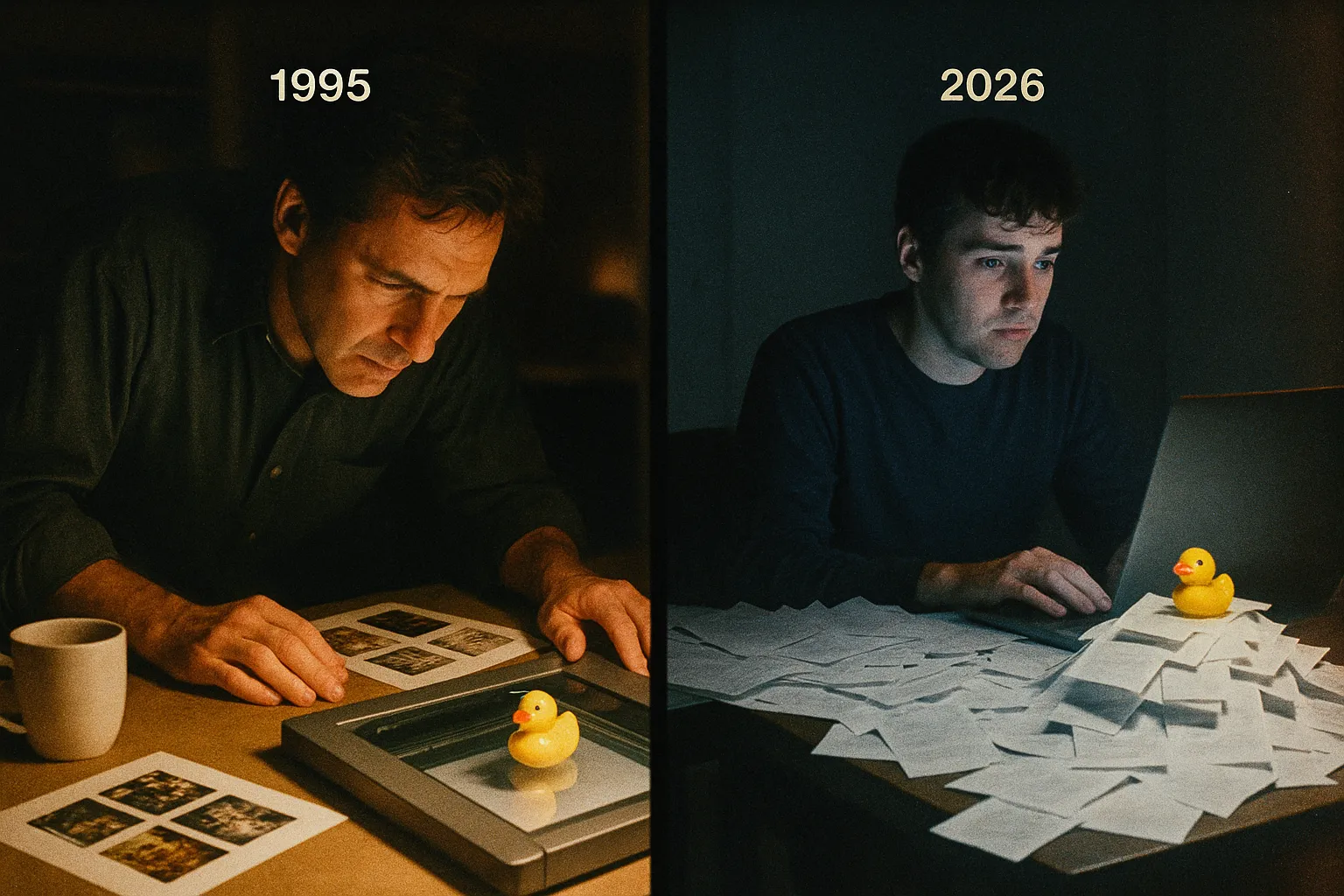
Same brief, thirty years apart. On the left, scarcity did the thinking for the human. On the right, the thinking falls to you — and it turns out that was the whole job all along. The yellow duck on the scanner survived both eras; it’s the only one that never produced anything, and so never panicked.
V. Axis #2: Judgment — when everything is defensible, defensible isn’t a criterion
A scene. A developer opens a pull request from an agent: 1,400 lines, tidy, commented, tests green. Looks flawless. And here comes — not joy, but a faint nausea: because “looks flawless” no longer means anything. In 2026, generated code looks exactly as confident when it’s right as when it’s quietly wrong. There are no external tells of doubt. The model doesn’t sweat.
The numbers are hard. Faros AI, analyzing data from 10,000-plus developers: in high-AI-adoption teams, pull-request volume rose 98%, while time spent reviewing them rose 91%. A 2025 CodeRabbit study: generated code surfaces 1.7x more issues than human-written code. A Qodo survey: 68% of seniors say AI improved quality, but only 26% would ship generated code without review. Translation: the machine produces ten times faster — and dumps the entire surplus onto the one node that doesn’t scale, because it’s a human who has to understand what was written.
This is the judgment axis. When all ten variants are technically valid, telling “right” from “actually right” can no longer be done by metric — only by taste. And taste isn’t what a model outputs; it’s what a person accrues over years of friction against the consequences of their own decisions. The venture crowd has already rebranded it the “taste economy”: when creation is cheap, curation becomes expensive — knowing what to keep, what to cut, what to ignore. The most functional definition of taste I’ve seen: the judgment that switches on precisely when every option is technically viable, data-backed and defensible. Because as long as one option is objectively better, you don’t need taste — you need arithmetic. Taste begins where arithmetic gives up.
Counter-pressure mini: “but agents check themselves, review is automating too.” Partly true — GitHub reports 60 million Copilot reviews by March 2026, 10x in a year. But watch the loop: automated review generates yet more signals that someone, again, has to weigh. Automate the production of evidence and the scarcity just moves to whoever decides which evidence to trust. You don’t exit the judgment game. You just play one level up — where the stakes are higher and there is no “Generate” button anymore.
VI. Axis #3: Direction — the fastest generation in the wrong direction is the costliest mistake
A scene. A founder, a week into an agentic marathon: automated onboarding, generated three new features, rewrote the docs, assembled an analytics dashboard. Production metrics — record-breaking. And at week’s end the key client writes that he’s leaving, because no one answered his integration request — the very one that drowned somewhere between the third feature and the dashboard. The factory roared at full tilt. It just made the wrong thing.
This is the most expensive axis, because the error here multiplies by all the speed beneath it. Generating faster in the wrong direction only means arriving at the wrong place sooner. Sam Altman put it sharply, before the agentic era: it doesn’t matter how fast you move if it’s in a worthless direction; picking the right thing to work on is the most important and most ignored element of productivity. In 2026 this stopped being productivity advice and became a conservation law: when production speed is free and infinite, the only variable left under your control is the vector.
And from here follows the central thesis of this piece, now with figures under it.
Your hourly rate is no longer the volume of what you produced, but the quality of the direction you’re looking in. When anyone can generate, the money goes not to whoever made the most, but to whoever knows where to look — and has the nerve to look nowhere else.
This is why MIT NANDA found 95% of failures not in the models but in integration: companies bought the world’s fastest generator and aimed it at nothing — automating what was visible and convenient, not what was important and uncomfortable. The worst investment of 2026 isn’t “failing to adopt AI.” It’s adopting it perfectly in a direction that’s worthless, and getting a record dashboard over a company that’s quietly dying.

Dream infrastructure built the wrong way. Each lane is another agentic workflow, each one impeccable. The yellow duck stands on the shoulder as a sign no one posted: “are you sure you want to go that way?”
VII. Axis #4: Closure — what’s generated doesn’t exist until someone carries it to the end
Back to the scene from § I. Seven landing pages on the table at 02:40. How many brought even one client? Zero. Because what’s generated carries no economic weight until someone does the least pleasant, least scalable thing in the whole chain: picks one, finishes it, and ships it under their own name. Generation is potential. Closure is when potential becomes money. Between them lies a chasm no prompt can jump.
And here the old, very apt psychology enters. When the cost of opening a new loop drops to zero, people open them without end — and each unclosed one drags them back. The Ovsiankina effect (robust, unlike the wobbly Zeigarnik): an interrupted task gravitates, tugging “let’s just take another look.” Seven open landing pages aren’t seven assets. They’re seven little black holes shaped like “what if this one’s better,” each stealing a slice of attention daily and returning nothing. Masicampo & Baumeister (2011) showed the antidote: intrusive thoughts about the unfinished are relieved not by completion but by a concrete plan to close — when, how, by what date. But in a world where opening is cheaper than closing, a closure plan requires what the machine won’t give you: the decision to kill the rest.
| Old economy (production expensive) | Cost-collapse economy (production ≈ 0) | Where value now lives |
|---|---|---|
| Bottleneck: MAKE IT | Making it costs cents and seconds | — |
| Scarcity did part of the choosing | The filter vanished — you drown in options | Judgment + taste |
| Direction set by what you could finish | You finish everything → direction must be chosen | Strategic clarity |
| Shipped, because there was nothing else | There's always another variant → nothing closes | Discipline of closure |
Counter-pressure mini: “generate a lot, then choose — more variants is better.” Sometimes, yes — for cheap, reversible decisions a spread of options helps. But there’s a threshold past which each new variant doesn’t add choice, it subtracts the ability to choose: classic overload paralysis. In a cost-collapse world you punch through that threshold in the first five minutes. After it, “I’ll generate one more” isn’t exploring the decision space. It’s fleeing the need to close. The most pleasant procrastination of 2026 is pressing “Generate” again, because it offers the illusion of motion without the pain of choosing.

Closure isn’t completion — it’s the nerve to shut off the tap. Each un-sunk boat is a variant you made and never shipped. The yellow duck is the only one still afloat among them — because it decides nothing, it just watches you flood the kitchen with record productivity.
VIII. Who wins, who pays (the distributional lens)
The cost-collapse economy doesn’t hit everyone equally. Three structural positions see three different pictures.
Who wins. People and teams whose value was always in judgment and direction, not production: editors, curators, decision architects, the seniors who can say “this isn’t it, redo it the other way.” For them, the collapse of generation is an amplifier — the machine stripped away the grind, leaving exactly the layer they were prized for. Their hourly-rate arrow points up. What used to drown in production hours is now visible, clean.
Who pays the most. Juniors, and anyone who built a career on the mere fact of production. The old first rung — “I can generate a working result” — went underwater: that rung is now handed out free. The cruel paradox: to have valuable judgment you need years of friction against production — and the very production on which that friction accrued is what the machine took first. We risk a generation asked for taste without being let into the kitchen where taste is raised. The man who spent thirty years editing other people’s copy is winning. The woman who just learned to write it is on the shoulder of that same motorway.
Who’s structurally vulnerable from within. Curious-magpie founders — the broad-appetite people who see opportunities where others don’t. In a world of expensive production, that gift was rationed by budget: you couldn’t try everything. In a cost-collapse world the rationing is gone — and the gift of “seeing opportunities” without an off-switch becomes the chief saboteur. Every new agentic release is, for them, not a tool but a temptation to open one more loop. The machine handed them an unlimited tap — and took away their last excuse to keep it shut.
This is the systemic diagnosis, with no moralizing: the problem isn’t that people are lazy or dumb. The problem is that the economy just made the most pleasant action (generate one more) cheaper than the most valuable one (choose and close) — and relies on human willpower where it needs architecture. The winner isn’t whoever has more native discipline. It’s whoever wired judgment, direction and closure into a system, instead of holding them in their head next to the “Generate” button.
IX. Full counter-pressure: “what if generation stays an asset after all?”
Time to walk honestly into the strongest argument against this whole essay. What if I’m burying my head in the sand, and the ability to generate stays scarce — just at a higher level of complexity?
The argument has real force in two places. First: the frontier keeps moving, and there will always be a layer of tasks where generating really well is still hard — complex systems, rare domains, work at the edge of what models can do today. There, production is still scarce. Second: inference cost may not fall forever — Epoch AI explicitly warns that the fastest price drops happened in the last year and may not persist; and the companies producing this intelligence are burning cash (OpenAI ran roughly $5 billion past its revenue in 2024). If prices reverse, generation could turn expensive again.
But neither caveat rescues the old position — it only delays it. The layer where generation is still scarce thins every year: what took a master last year, this year’s default agent does. Building a career on that layer is running up a down escalator that’s accelerating. As for prices: even if inference doubles or triples, it stays three orders of magnitude below 2020. The floor that vanished doesn’t return on a 200% price hike — it returns only on a 280x one, and that’s not the world we live in. The old intuition — “production is expensive, therefore production is my value” — is dead not because the price is exactly zero, but because it’s permanently below the cost of one hour of your attention. Whatever happens to tokens, the bottleneck has already moved into the head — and it isn’t moving back.
What would prove this thesis wrong? If, in 2027–2028, data showed that the teams with the highest generative productivity consistently win the market without an edge in judgment and closure — then I’m wrong. So far the data points the other way: NANDA’s 95% failure rate, the +91% review time, the taste-economy discourse. Two signals to watch through 2026: whether the premium for “AI curators/editors” rises against “AI operators,” and whether the share of agentic projects cancelled for “unclear value” grows (Gartner forecasts >40% by 2027). Both are about scarcity having moved, for good, from the hands to the head.
X. The tool: an Attention P&L — where your most expensive currency actually went
Before treating it, count it — same as money. Most operators keep financial books to the cent and zero books on attention, even though in a cost-collapse economy attention is dearer than cash. The first exercise — end of day, five minutes, in a journal, not in your head. Break the day across the four axes and look honestly at where the currency flowed.
| Axis | Question to yourself | Red flag | Action |
|---|---|---|---|
| Generation | How long did I just generate variants today? | >40% of the day in "one more" mode | Set a variant cap BEFORE starting (e.g. 3), not after |
| Judgment | What did I consciously choose — and what did I kill? | Nothing killed all day | Rule: one choice = at least one explicit "no" |
| Direction | Did this move the main bottleneck — or just the most convenient thing? | Did the visible and pleasant, not the important and uncomfortable | Hardest important task first, then generation |
| Closure | What did I carry to a real end today (shipped / decided)? | Much opened, zero closed | Closed < opened three days running = stop, audit |
The scoring rule is simple: if over a week the “Generation” column is fat and “Closure” is empty, you’re not productive — you’re in the most expensive procrastination of your life, because it disguises itself as record output. And add one if-then reflex that strips tomorrow’s you of the right to reopen what’s already decided: IF my hand reaches to generate one more variant, THEN I first ask — am I short on variants, or short on the nerve to choose among the ones I have? Nine times out of ten it’s the second.
XI. Re-plating: attention as the only asset a button can’t scale
Back to the table in § I. The green “Generate” button, seven landing pages, the mug. I was that operator at 02:40. And I stopped being him not because I got more disciplined — on the contrary, the cheaper generation gets, the harder it is not to press the button. I stopped because I counted which asset is actually mine.
The geometry is simple and merciless. Everything that can be generated now costs roughly zero — and therefore can’t be your durable value, because durable value is never free for everyone at once. What’s left is exactly what a press can’t scale: your capacity to look at ten equally defensible variants and know which one is alive; to choose a direction when every road is open; and to close nine loops without shame so you can carry one to the end. That’s the four axes. And all four are one currency under different names: attention. Where you aim it, what you filter with it, where you put the full stop.
The machine made you infinitely productive at production — and for exactly that reason handed the whole question of your worth back to a single one: can you look. Not faster. Not more. More precisely.
XII. Hard kicker
Cost-collapse is neither a privilege nor a curse. It’s a revaluation, quiet and merciless, like a currency repriced overnight. Until 2026 you were paid for what you could make. Now anyone, and anything, can make it — and you’re paid for what you look at while the rest generate. The bottleneck moved from the hands to the head, and they don’t sell return tickets.
Generating one more variant is buying yourself a minute of the feeling of motion with the currency that just became the most expensive on the planet. Each unclosed loop is a storey you built in one click and will pay for in attention all your life, never once setting foot inside. In the end the winner isn’t whoever’s factory roared loudest. It’s whoever, amid the endless free noise, managed to look in exactly one direction — and had the nerve to look nowhere else. Because when everything can be generated, the one thing you can’t fake is a gaze that knows where. And the hardest thing about the seven unlaunched landing pages on the table: not one of them says why it never fired. But the inscription would be the same nine times in ten — “died because it was never chosen.”
Frequently asked
What is cost-collapse attention economy, and how is it different from AI just getting cheaper?
Cost-collapse attention economy is the state in which generating options (text, code, strategies) has dropped below the cost of the human hour it takes to decide anything. Cheap AI is the condition. The attention economy is what that creates downstream: scarcity migrates from production to judgment, direction, and closure — the three things no prompt can automate.
If generation is now a commodity, what actually determines your hourly rate?
The quality of where you look: which direction you choose when all roads are open, what you cut from an endless stream of defensible options, and what you actually ship. Volume of output is no longer a signal of value — it became noise that masks the absence of a decision.
More options lead to better choices — is it not rational to generate as much as possible?
For cheap, reversible decisions, yes, up to a threshold. In a cost-collapse environment that threshold is crossed within the first few minutes of work. Masicampo and Baumeister (2011) showed that open loops do not fade quietly — they pull attention back continuously. Seven unlaunched landing pages are worth exactly as much as zero landing pages, minus one night of your life.
95% of AI pilots with no measurable financial return — does that mean AI does not work?
It means organizations learned to generate but not to close. MIT NANDA found the failure not in the models but in integration: companies automated what was visible and convenient, not what moved the real bottleneck. The worst AI investment of 2026 is a perfectly implemented system pointed in a direction that produces nothing.
What is the one concrete thing to do today to avoid drowning in your own output?
Run an Attention P&L at the end of each day: five minutes, four lines — how much time went to generating, what was explicitly killed, whether the work moved the main bottleneck or just the comfortable one, and what was actually closed and shipped. Add one pre-commitment rule: set a variant limit before you start generating, not after. Three days in a row with more opened than closed means stop and audit, not another prompt.
Comments
Signed-in readers only — to keep it human, not a bot swamp.