Tim Urban on how to pick your life partner
What actually makes a marriage happy? A breakdown of Wait But Why's strong essay on choosing a partner, love, compatibility, fear, romanticization and the real foundations of a long union.
On this page
- The main idea of the whole text
- Part 1 — Why people so often choose badly
- 1. The illusion of singleness and marriage
- 2. How big a decision this really is
- 3. Why so many smart people get it wrong
- Block 1 — People often don’t know what they actually want
- Block 2 — Society gives terrible advice
- 4. Society stigmatizes rational expansion of the search
- 5. Society also rushes you into the decision
- Block 3 — Biology isn’t on your side either
- 6. Biology is not designed for 50 years of deep partnership
- 7. The biological clock also complicates everything
- 8. General conclusion of Part 1
- Types of people who often end up in unhappy unions
- 9. Overly Romantic Ronald
- 10. Fear-Driven Frida
- 11. Externally-Influenced Ed
- 12. Shallow Sharon
- 13. Selfish Stanley
- Summary of Part 1
- Part 2 — What actually makes a happy union
- Three main ingredients of a happy long partnership
- 1. An Epic Friendship
- 2. A Feeling of Home
- 3. A Determination to be Good at Marriage
- Summary of Part 2
- 1. Epic Friendship
- 2. Feeling of Home
- 3. Determination to be Good at Marriage
- A very important final conclusion of the author
- The strongest quotes from the article
- The main ideas in compressed form
- 1.
- 2.
- 3.
- 4.
- 5.
- 6.
- 7.
- 8.
- My short conclusion on the article
- How to choose a life partner — and not break your future
- The main mistake most people make
- How big this decision really is
- Why even smart people so often miss
- The most typical reasons people end up in the wrong place
Here is a substantive retelling and distillation of this article — without heavy abridgement, but already in packaged form.
The main idea of the whole text
Tim Urban sets a very simple but tough frame:
choosing a life partner is probably the most important decision in your life, but most people approach it irrationally, shallowly, in a hurry, and under the influence of forces that push them toward error.
The article’s key turn is this:
- the problem is not that people are too picky;
- the problem is more often that they do not think clearly enough about what a long happy union actually is;
- and they confuse love, chemistry, fear, external image or time pressure with the real conditions of a good marriage.
The entire article is built in two parts:
- Part 1 — why people so often choose badly;
- Part 2 — what actually makes a long union good.
Part 1 — Why people so often choose badly
1. The illusion of singleness and marriage
The article opens by unpacking a very common feeling of a single person: as if they are on the lowest rung and marriage will automatically lift them much higher.
But Urban says this is a simplified picture.
Yes, studies often show that married people are, on average, happier than single people, and single people happier than divorced ones. But once you split marriages into good and bad marriages, the picture shifts sharply:
- people in happy marriages are very happy;
- people in bad marriages are often not just less happy but noticeably unhappier than the single.
So a single person who hasn’t yet found a partner is not in a hopeless position. They are rather in a neutral and still promising point. Because all they need is one thing:
1) find a good union.
A person in an unhappy relationship, on the other hand, has a more complicated route:
1) survive a painful breakup
2) recover
3) then find a good union
This is a strong reframing. Urban is effectively saying:
being single is not as scary as being with the wrong person.
A strong quote:
“A single person who would like to find a great relationship is one step away from it.”
2. How big a decision this really is
The author then deliberately amplifies the sense of scale of this choice.
He offers a simple mental calculation:
- take 90,
- subtract your current age,
- and you get an approximate number of years you will spend with this partner.
His main thought here:
you are choosing not just a romantic object but a person with whom almost the rest of your one life will be spent.
And you are choosing many things at once in a single package:
- a co-parent of your future children,
- a person who will profoundly affect those children,
- a companion for roughly 20,000 meals,
- a partner for roughly 100 vacations,
- your main friend for leisure and old age,
- a “career therapist,”
- a person whose day you’ll listen to about 18,000 times.
So marriage is not “we love each other.”
It is the architecture of almost an entire life.
A strong quote:
“And when you choose a life partner, you’re choosing a lot of things…”
Another strong quote:
“Intense shit.”
3. Why so many smart people get it wrong
After this, Urban poses the central question of Part 1:
how do normal, intelligent, logical people so often choose a union that later makes them unhappy?
His answer — several systems work against us at once:
- we ourselves don’t understand what we need;
- society offers bad rules of the game;
- biology pushes us in the wrong direction.
Block 1 — People often don’t know what they actually want
Urban references studies showing that people in the single state are often bad predictors of what they really need in a relationship.
The idea is this:
- while you are single, you can fantasize about desired traits;
- but real relational preferences show up only in the dynamic of real relationships;
- and most people don’t have enough experience for that.
His logic here is very sober:
- in almost any area, a person starts to understand something well only after repetitions;
- but most people have very few serious relationships;
- so people approach the most important decision in their life without enough practice and clarity.
An important thought:
“I know who I want” is often an illusion.
Block 2 — Society gives terrible advice
One of the strongest parts of Part 1.
Urban says: in business, in a career, in any important domain, we consider it normal to:
- learn,
- plan,
- analyze,
- take a systematic approach to choice.
But in dating and marriage, the culture for some reason pushes the opposite:
- “don’t think too much,”
- “follow your feelings,”
- “fate will tell you,”
- “just feel it.”
His thesis is simple:
society romanticizes intellectual unseriousness in the single most important decision in life.
He even points out the irony: if a businessman ran a company the way society advises people to approach relationships, he would almost certainly fail.
A strong thesis:
society encourages people:
- to be uninformed about relationships,
- to under-analyze,
- and to rely on luck.
4. Society stigmatizes rational expansion of the search
Another strong thought: people often choose not from the best possible pool but simply from whoever happened to be nearby.
Urban refers to speed-dating data and says:
- real dating choices are very strongly determined not by stable “eternal preferences” but by what options are currently available;
- people often choose from a local micro-market, not from a broader real field.
So the logical conclusion would be:
- it is sensible to broadly and systematically increase the candidate pool;
- to use online dating, speed events, other tools to widen the choice.
But society has long looked at this askance. As if the “right” way to meet a partner is by accident, through romantic luck.
His message here is:
chance is too romanticized, and systematic search is too underrated.
5. Society also rushes you into the decision
Another harmful social force is time pressure.
Urban says many cultures have a hidden rule:
- you have to marry “not too late”;
- and the line for “too late” often sits somewhere between 25 and 35.
But this is a stupid rule.
Because what matters far more than “marrying on time” is not marrying the wrong person.
His strong contrast:
- a 37-year-old single person — socially “suspect”;
- a 37-year-old in an unhappy marriage with children — socially “normal.”
That, in his view, is total absurdity.
Here is one of the central ideas of the whole text:
the fear of being late often pushes people into a much worse trap — a union with the wrong person.
Block 3 — Biology isn’t on your side either
Urban adds one more layer: even if society were ideal, biology would still get in the way.
6. Biology is not designed for 50 years of deep partnership
His thought:
- human biology did not evolve for the modern model of a long, reflective, egalitarian partnership over decades;
- a bit of chemistry is enough to switch on a cascade:
- lust,
- honeymoon phase,
- attachment.
And this chemistry can push people through a gray zone where it would be more correct to move on, not to cement the union.
So:
emotional and hormonal inertia is often taken for fate.
7. The biological clock also complicates everything
Here he speaks separately about women who want biological children, and acknowledges the real time pressure.
He doesn’t romanticize this part and says directly:
- it objectively complicates the choice,
- and adds stress load to an already complex process.
But at the same time he formulates his priority sharply:
better to adopt children with the right person than to have biological children with the wrong one.
One of the boldest theses of the first part.
8. General conclusion of Part 1
After all these layers, Urban assembles the formula for the mistake.
You take:
- people who don’t really understand their needs;
- a society that says “don’t think too much, don’t be picky, hurry”;
- a biology that chemically pushes you into attachment;
- plus fears and external pressure;
and you get:
“A frenzy of big decisions for bad reasons.”
This is one of the key phrases of the whole text.
A strong quote:
“A frenzy of big decisions for bad reasons…”
Types of people who often end up in unhappy unions
After the systemic block, Urban moves to a typology of bad choices.
This is not a scientific typology but rather clear caricature archetypes.
9. Overly Romantic Ronald
A person who believes that love is by itself a sufficient reason for marriage.
His mistake:
- he adores the very idea of a soul mate;
- once a strong romantic story arrives, he stops asking questions;
- he ignores real signals of trouble:
- constant fighting,
- worsening well-being,
- doubts,
- incompatibility.
He soothes himself with phrases like:
- “everything happens for a reason,”
- “we couldn’t have met by accident,”
- “I’m in love, therefore that’s enough.”
The main idea:
romance is an important part — but not the foundation — of marriage.
10. Fear-Driven Frida
One of the most important figures in the article.
A person driven by fear:
- of being the last single one among her friends,
- of being a “late” mother or father,
- of being socially judged,
- of looking “unsuccessful.”
The irony, says Urban, is that such a person considers herself risk-averse but is actually taking the biggest risk of all — spending most of her life with the wrong person.
A very strong thesis:
the only truly rational fear here is the fear of spending two-thirds of life unhappy with the wrong person.
11. Externally-Influenced Ed
A person who lets external voices into the decision too much:
- family,
- friends,
- social expectations,
- reputational considerations.
Urban is very radical here:
- the choice of a partner is deeply personal;
- it is so complex and inward that almost no one outside can really judge what’s right for you;
- the exception is only explicit abuse, violence, severe mistreatment.
He shows two scenarios:
- a person breaks off a relationship with the right partner because the family disapproves;
- or, conversely, marries because “everyone likes the couple,” even though, inside, it’s not great.
The main thought:
external approval is a very weak criterion for this kind of decision.
12. Shallow Sharon
A person too focused on “boxes checked”:
- height,
- status,
- money,
- prestige,
- achievements,
- an “interesting” profile,
- exoticness,
- talent,
- the external description of a partner.
Urban does not say external criteria don’t matter at all.
He says the problem starts when the résumé matters more than living inner compatibility.
Here he introduces one of his most famous terms:
“scan-tron boyfriend / wife” — a partner chosen because they “filled in the right bubbles” on the form.
A witty but accurate idea:
checkbox-checking does not equal the quality of shared life.
13. Selfish Stanley
Three subtypes of selfish partner.
13.1. “My Way or the Highway”
This person:
- cannot stand compromise;
- considers their needs more important;
- doesn’t want a real partnership but wants to keep, essentially, a single-life plus someone next to them.
The result:
- either a too-accommodating partner,
- or a person with low self-esteem,
- but definitely not a team of equals.
13.2. The Main Character
A self-absorbed person.
They want:
- a therapist,
- a fan,
- emotional service,
- but don’t want to return it symmetrically.
The typical pattern:
- 90% of the conversation is about her day, her world, her problems.
The problem is that such a union becomes not a partnership but a main character + sidekick dynamic.
13.3. The Needs-Driven
A person who chooses a partner mainly by functions:
- she cooks well,
- he’ll be a good father,
- she’s organized,
- he’s rich,
- she’s good at home,
- he’s good in bed.
All of this can be a pleasant bonus, but if it is the main reason for choosing, then after the novelty fades you often find no real deep union there.
Summary of Part 1
All these types make one deep mistake:
their choice is driven by a force that does not take into account the real nature of a long happy union.
That is, they choose from the perspective not of:
- 20,000 ordinary days,
- a long shared daily life,
- the quality of friendship,
- inner peace,
- partnership skills,
but from the perspective of:
- romance,
- fear,
- external image,
- pressure,
- benefit,
- ego.
And Part 2 answers the main question:
so what actually makes a union good?
Part 2 — What actually makes a happy union
Here Urban makes the key turn:
a great happy marriage is not a pretty film, but thousands of very ordinary days.
Not the honeymoon.
Not Valentine’s Day.
Not the closing on the first house.
Not romantic peaks.
The real essence of marriage, per Urban, is:
The article’s most famous formula:
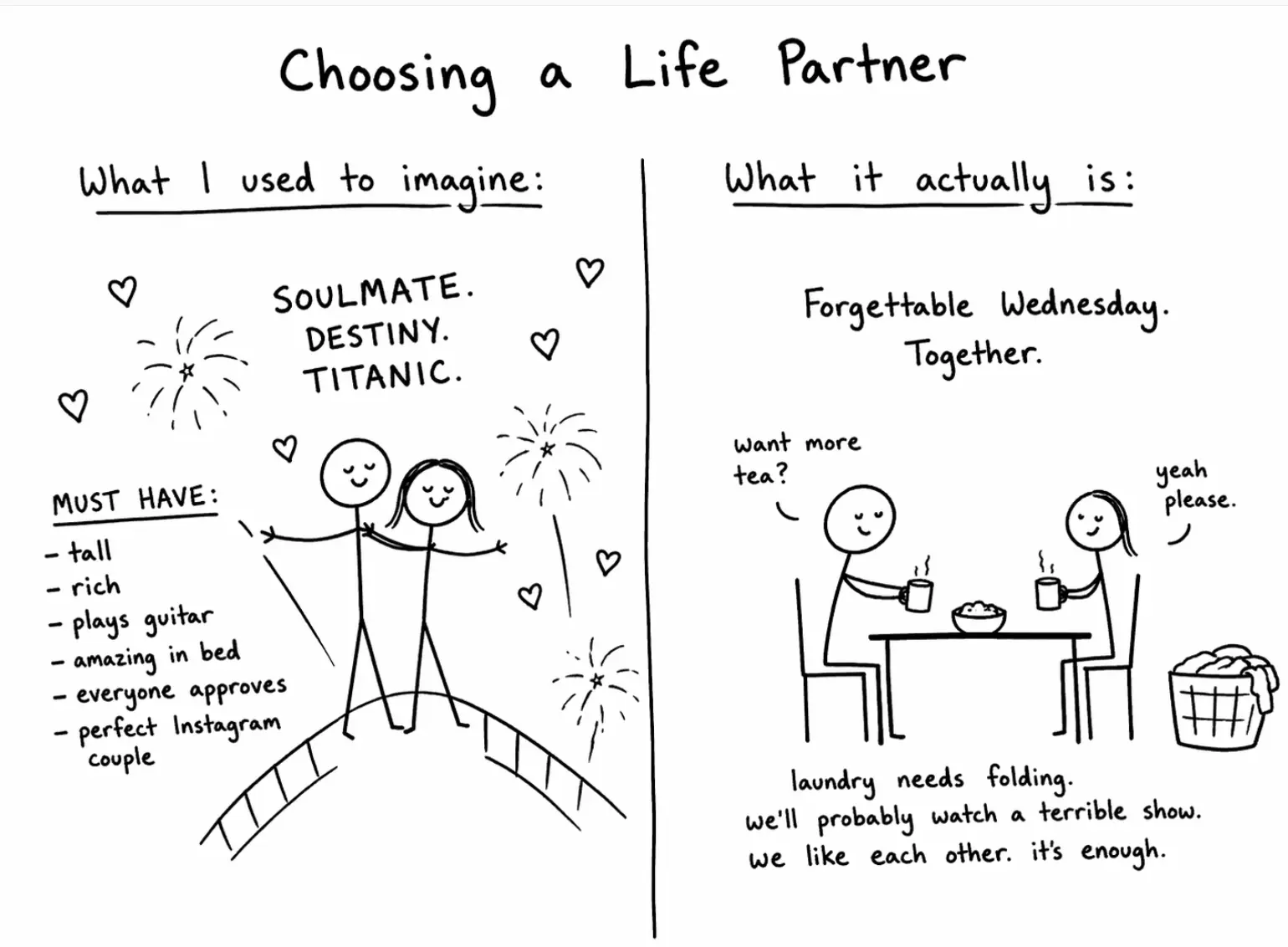
“Marriage is Forgettable Wednesday. Together.”
Probably the main phrase of the whole text.
His thesis:
- life is not lived in big summaries;
- it’s lived “up close”;
- happiness is defined not by a grand plot but by ordinary days;
- therefore a good union is one in which an ordinary weekday together is good.
Three main ingredients of a happy long partnership
1. An Epic Friendship
The first big pillar — epic friendship.
Urban says: with many friends it is pleasant, but with some, the quality of time is so high that they pass the Traffic Test.
The Traffic Test
If at the end of a meeting you’re driving somewhere together, and you catch yourself hoping for traffic, because it’s so good to be with this person — that’s a strong signal.
The idea here is very deep:
- it isn’t just “OK” with the person;
- it isn’t boring;
- it’s interesting;
- you are fed by the interaction;
- you don’t tire of their presence.
Urban says it directly:
almost nothing is more critical when choosing a partner than finding a person who passes the Traffic Test.
Because if there are people with whom you feel really alive and well, it would be a huge loss to spend 95% of the rest of your life with someone who doesn’t give you that.
What goes into an Epic Friendship
a) Humor click
A solid humor click.
No one wants to spend 50 years fake-laughing.
b) Fun
The ability to have fun not only in great conditions but also to pull fun out of imperfect situations:
- delays,
- roads,
- household errands,
- routine moments.
c) Respect for each other’s brains
A very strong point.
A partner is also your daily life / career therapist.
If you don’t respect the way a person thinks, you won’t want to share your work, doubts, ideas, inner movements — because you won’t care what they think.
d) Shared interests and people-preferences
You need at least a decent number of shared interests, activities, favorite kinds of leisure, even shared people.
Otherwise, a large part of your “I” will shrink in life over time, and a free Saturday becomes harder to spend together with enjoyment.
e) Potential for deepening
A real friendship of this kind doesn’t deplete over time — it grows richer.
2. A Feeling of Home
The second big ingredient is the feeling of home.
Urban gives a very apt analogy:
if you are forced to sit in one chair for 12 hours, you want to sit as comfortably as possible, because even a small discomfort, over time, turns into pain.
The same in marriage:
- light, persistent discomfort,
- slight tension,
- tightness,
- anxiety,
- unnaturalness,
do not disappear over the years — they accumulate and torment you.
So a partner has to give a feeling of:
- safety,
- naturalness,
- warmth,
- permission to be yourself.
What goes into “home”
a) Trust and security
Secrets are poison.
They create an invisible wall inside a union and make people lonely already within the relationship.
Suspicion is directly incompatible with the feeling of home.
That is why infidelity is, for him, one of the most short-sighted and self-destructive things you can do in a good marriage.
b) Natural chemistry
Communication should feel natural.
Energies should be at least roughly in the same zone.
You should feel like you are on a similar wavelength.
When the waves are too different, the interaction becomes exhausting.
c) Acceptance of human flaws
A very important block.
You are deeply imperfect.
And your partner is too.
To be human is to come with a set of flaws.
So one of the worst scenarios is to live with a person who systematically criticizes you for your basic imperfections.
Of course, growth is needed. But the healthy stance in a union sounds like:
“Yes, this person has a set of imperfections. They are part of the package I consciously chose.”
d) Generally positive vibe
The general atmosphere in a union should be more positive than negative.
Because it is your atmosphere “forever.”
It cannot be steadily negative and healthy at the same time.
Here he references John Gottman:
- if the ratio of positive to negative interactions is below 5:1, the union is heading for breakdown.
3. A Determination to be Good at Marriage
The third pillar is not chemistry and not friendship, but the determination to be good at marriage.
Another very mature thought of the article.
Urban says directly:
- relationships are hard;
- expecting a strong union without ongoing work is like expecting a great career without effort;
- it’s hard for modern people because we are used to freedom and autonomy, and here we have to become half of a whole and learn to compromise.
So a good marriage is not only “we suit each other” but also:
both have to want and be able to be good partners.
What skills this requires
a) Communication
Communication is so basic it’s almost embarrassing to name — like oxygen for health.
And yet it is precisely communication that takes down a huge number of couples.
Urban emphasizes:
- good communication doesn’t happen by itself;
- it often has to be built systematically;
- sometimes via agreed-upon mechanics or therapy.
b) Maintaining equality
You have to protect equality in the union.
Relationships slide very easily into asymmetry, where:
- one person’s mood always sets the mood of the room,
- one person’s needs are consistently more important,
- one side allows themselves what they would not tolerate from the other.
That is already a warning sign.
c) Fighting well
Fights are inevitable.
The question is not whether you fight but how you fight.
A good pair:
- de-escalates,
- can use humor,
- really listens,
- doesn’t become cruel, personally destructive or defensively deaf.
Urban refers to Gottman again:
- about 69% of conflicts in a typical couple are perpetual — tied to base differences and not “solved” once and for all;
- a good pair understands this and doesn’t keep re-entering the same endless fight.
One of the most mature theses of the whole text:
not all conflicts need to be won — some need to be wisely not stoked.
Summary of Part 2
A good long union therefore rests on three things:
1. Epic Friendship
- interesting together,
- funny together,
- never boring together,
- respect for each other’s thinking,
- the feeling that time together is quality time.
2. Feeling of Home
- safety,
- trust,
- naturalness,
- a warm wave,
- acceptance of imperfections,
- a positive base vibe.
3. Determination to be Good at Marriage
- the ability to talk,
- equality,
- the ability to fight well,
- willingness to work on the union.
A very important final conclusion of the author
After the big list of criteria, Urban makes another strong practical conclusion:
since it is hard enough to find a union that is good on these basic things, don’t make the task harder with extra checkboxes, most of which will barely affect happiness during “dinner #4,386.”
His logic:
- if you have already found a person with whom things are good on friendship, home and partnership,
- then insisting on a pile of decorative must-haves is often just unwise.
A very pointed final thesis:
it would be nice if he played the guitar —
but take it off the list of must-haves.
The strongest quotes from the article
A selection of the best lines:
“Marriage is Forgettable Wednesday. Together.”
“What a whopping shame it would be to spend 95% of the rest of your life with someone who doesn’t [pass the Traffic Test].”
“Fear is one of the worst possible decision-makers when it comes to picking the right life partner.”
“A frenzy of big decisions for bad reasons.”
“Society encourages us to stay uneducated and let romance be our guide.”
“The rule should be ‘whatever you do, don’t marry the wrong person.’”
“I’d rather adopt children with the right life partner than have biological children with the wrong one.”
“No one wants to spend 50 years fake laughing.”
“Secrets are poison to a relationship.”
“It would be nice if he played the guitar, but take it off the list of must-haves.”
The main ideas in compressed form
1.
Loneliness is not the worst position.
Far worse is the wrong long union.
2.
Choosing a partner is not “who do I like,” but “with whom will I really live almost my whole life.”
3.
Love, romance and chemistry are important — but alone are not enough.
4.
Society gives bad dating rules:
- don’t think too much,
- don’t widen the search aggressively,
- hurry.
5.
Biology pushes you into attachment faster than the mind can honestly evaluate compatibility.
6.
Bad marriages often arise not because of “evil,” but because of:
- fear,
- romantic blindness,
- external influence,
- shallow criteria,
- selfishness.
7.
A good union is not a grand romantic plot, but the quality of 20,000 ordinary days.
8.
For happy partnership three things are needed:
- an epic friendship,
- a feeling of home,
- the ability to be good at marriage.
My short conclusion on the article
This is a very strong text, not because it is “about love,” but because it lifts the romantic fog and transfers the topic into adult territory:
you choose a partner not at the peak of emotion, but with an eye to the architecture of shared life.
His main criterion is not “is there a spark,” but:
- is there friendship,
- is there a home,
- is there the ability to walk the daily life together.
Honestly, one of the most valuable frames in all of Wait But Why.
Here is a ready longread for the blog — in a more publishable format, not as a synopsis but as a coherent piece.
How to choose a life partner — and not break your future
The essence and distillation of one of Wait But Why’s strongest pieces
There are decisions that affect particular years of life. And there are decisions that shape almost all of life. Choosing a partner is in the second category.
We are used to talking about relationships in the language of romance, chemistry, fate, “the spark,” signs and strong feelings. But if you look soberly, marriage or a long union is not just a love story. It is a shared architecture of the future. It is a person with whom you will likely spend decades, share thousands of dinners, hundreds of weekends, vacations, crises, routine Wednesdays and not-best days.
That is why Tim Urban’s text How to Pick Your Life Partner is so strong. It does not offer pop advice and does not sell a pretty fairy tale. It does something more important — it lifts the romantic fog and returns the topic of partner choice to the territory of thinking, compatibility, daily life, time and psychological maturity.
His main message is very simple:
choosing a partner is not the question “did I fall in love.” It is the question “do I want to live with this person for almost all my life — and will that life be good?”
The main mistake most people make
At the start, Urban dismantles a very common illusion. Many single people feel they are standing at a bad point and that marriage will automatically transport them to a better one. As if there were a single ladder: singlehood at the bottom, marriage on top.
But reality is more complicated. Because there is not one type of marriage but at least two — good and bad. And that’s a fundamental difference.
A good union can really lift the quality of life significantly. But a bad one — on the contrary — can make a person much unhappier than they would be on their own. And here arrives one of the strongest turns of the whole text: singlehood is often not a bad position. Far more dangerous is the wrong union.
A single person who wants a good relationship is, in a sense, a single step away from it: they need to find the right partner. A person in a bad relationship has a longer and more painful path: first survive a breakup, then recover, and only then build something healthy.
A sober but very important thought. Society often scares people with singlehood. It much more rarely scares them with what should actually be scary — decades of poor-quality life next to the wrong person.
How big this decision really is
To restore weight to the topic, Urban offers a very simple calculation. Take 90 years and subtract your current age. That’s roughly how many years, if you live long, you’ll spend with your present or future partner.
And that isn’t all. When you choose a partner, you are choosing not only a romantic object. You are choosing:
- the future co-parent of your children;
- a person who will deeply influence those children;
- a companion for roughly 20,000 meals;
- a companion for dozens of vacations;
- the main interlocutor of your weekdays;
- the closest witness of your life;
- the person with whom you will grow old.
So this decision is not “are we OK together now.” It is the decision of what the environment of most of your life will be like.
And here most people do something strange. In business, career, investing or health, they recognize the importance of analysis, strategy, discipline and deliberation. But in the topic of relationships, society seems to suggest the opposite: don’t think too much, don’t complicate it, don’t be “too rational,” just follow your feelings.
Urban rightly highlights the absurdity of this norm. We romanticize intellectual unseriousness exactly where the price of error is among the highest.
Why even smart people so often miss
One of the strongest parts of the text — the explanation of why there are so many systemic errors in this area. Urban shows that several forces work against us at once.
First — we often poorly understand what we really need in relationships. In the single state, people are often confident they know what they want. But real needs in a long partnership often become visible only inside the relationship. Things that seem important “on paper” often turn out to be secondary in life. And, conversely, things that don’t make it into romantic fantasies prove critical for daily happiness.
The second force is society. It not only presses but also gives bad rules of the game. It seems to say at once:
“You must find a partner,”
“It’s weird to approach this too seriously,”
“It’s shameful to search too long,”
“It’s normal to hurry.”
Especially toxic is the idea that “time is running out,” and therefore some union is better than none. Urban very aptly turns this around. The main rule should not be “marry by a certain age” but “don’t marry the wrong person.”
The third force is biology. The human brain and body don’t always operate in the logic of long, conscious partnership over 40–50 years. They more readily operate in the logic of attraction, attachment, hormonal chemistry and the desire to bond. And that’s why strong feelings alone guarantee nothing. They can be part of a good union — but they can also push someone into a very mediocre or bad one.
The most typical reasons people end up in the wrong place
Separately, Urban very well describes the archetypes of people who often pick a partner badly. These types are valuable not because they’re “about other people” but because almost everyone can spot a slice of themselves here.
The first type — the romantic who believes love by itself will justify everything. If there is strong feeling, “then this is it.” Such a person ignores signals of incompatibility, conflict, the worsening of their own state, because the idea of fated love is more important to them than reality.
The second type — a person driven by fear. The fear of being the last single one among friends. The fear of being late for children. The fear of looking “off” in the eyes of family or community. The irony here is that a person who wants to be cautious often makes the most dangerous move — agreeing to a union that does not hold up over a long horizon.
The third type — a person too dependent on external approval. Their decisions are shaped by parental expectations, religious norms, the opinion of acquaintances, reputational pressure. Urban points out very precisely: choosing a partner is so personal and inward that external voices here are almost always too coarse and inaccurate. Absent explicit violence or abuse, other people can rarely really know what’s right for you.
The fourth type — the person who picks a résumé rather than a person. Status, height, prestige, money, image, a set of “right” characteristics. Urban even jokes about the “scan-tron spouse” — a partner picked because they filled in the right bubbles on the test. Funny — but very on point. Because checkboxes can please the ego but do not guarantee the quality of shared life.
The fifth type — the egocentric partner. A person who is not looking for a team of equals but for either a service, a mirror, or an accessory to their own life where they are the main character. Such a union can last for a while but on the long horizon almost always becomes exhausting.
All these archetypes are united by one thing: they are driven by a force that has no direct connection to a long, quality life together.
Frequently asked
How do you choose a life partner?
First think clearly about what a happy long union actually is — and don't confuse it with love, chemistry, fear, outward image or time pressure. Choosing a partner is probably life's most important decision, yet most approach it hastily and superficially.
Is the problem that people are too picky?
The opposite. Per Urban, the problem is usually not excessive pickiness but not thinking clearly enough about the real conditions of a good marriage — and choosing under forces that push toward error.
What actually makes a marriage happy?
Not romanticization and chemistry, but compatibility in everyday life over decades: a shared worldview, the ability to be best friends, calm instead of anxiety. Part 2 of the essay lays out these real foundations.
Which forces push people toward a bad choice?
The illusion that marriage will automatically «lift» a lonely person; the fear of being alone; biology and time pressure; society's bad advice. Each substitutes for a sober read of compatibility.
Comments
Signed-in readers only — to keep it human, not a bot swamp.