Anatomy of a Label: How Adult-Content Categorization Actually Works
An analytical manual on how adult content is categorized — taxonomy versus folksonomy, Ranganathan's faceted model, Zipf's law, recommendation engines, academic sexology, and trust-and-safety. Why a label is not reality.
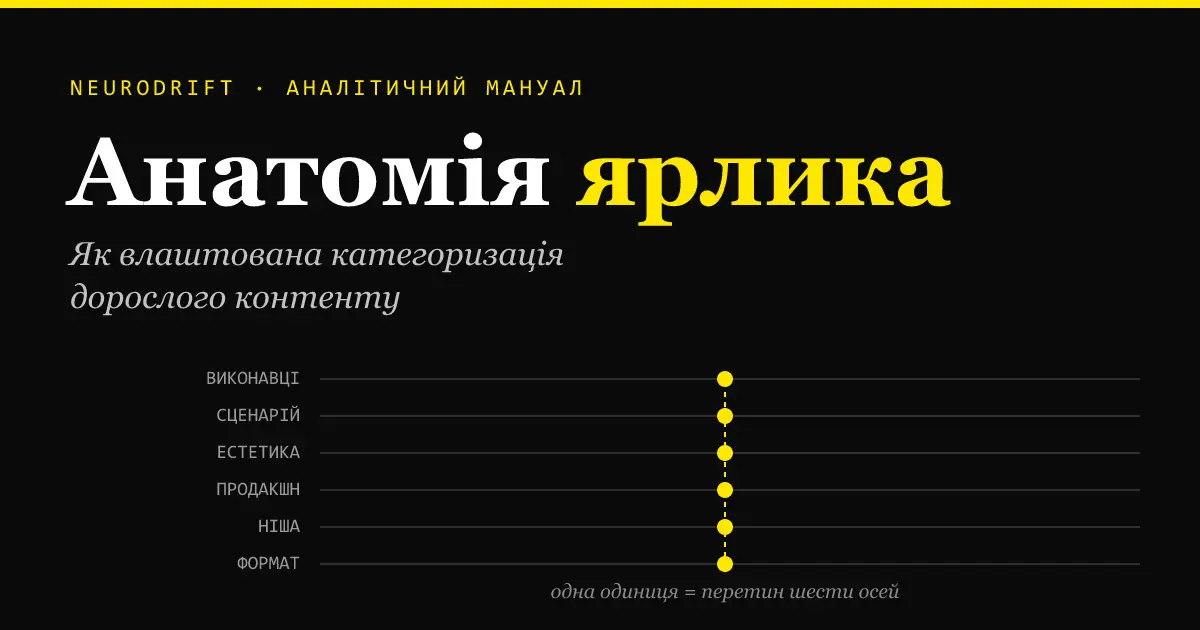
On this page
- 1. Why this matters: categorization as the hidden infrastructure of desire
- 1.1 Scale as an argument: a natural experiment in information science
- 1.2 Two levels of classificatory logic
- 1.3 The dual optics of this guide
- 1.4 What this guide does — and does not do
- 1.5 Four practical reasons to understand this
- 1.6 The iceberg as a structural metaphor
- 2. The methodological frame: two paradigms of Knowledge Organization
- 2.1 Taxonomy: order imposed from above
- 2.2 Folksonomy: order that emerges from below
- 2.3 Three operational problems of free tagging
- 2.4 Faceted classification: the third paradigm as the architectural basis of the hybrid
- 2.5 Why neither paradigm wins on its own
- 2.6 Practice is a hybrid: the mechanism of crystallization
- 2.7 Methodological summary
- 3. Ranganathan’s faceted classification: why platforms de facto build PMEST
- From tree to console: a paradigm shift
- The five basic PMEST facets
- The naturalness of the faceted approach for multidimensional content
- Platforms implement the faceted model without naming it
- Concept diagram: the “mixing console”
- The trade-off: standardization within each axis
- From filter to matrix: the transition to the core of the guide
- 4. The master matrix of axes (the core, part I): six facets of categorization
- Axis 1 — Demographics and performer identity
- Axis 2 — Scenario and narrative
- Axis 3 — Aesthetics and genre
- Axis 4 — Production style
- DOCA (UZH) as academic validation
- The principle of multi-axial intersection
- Axes 5–6: announcement
- 5. The master matrix of axes (the core, part II): niche, format, and two meta-dimensions
- Axis 5 — Niche / specific interest
- Axis 6 — Platform / format / duration
- Meta-dimension A — The type of classificatory system
- Meta-dimension B — Label ≠ reality: four systemic gaps
- The mechanics of intersection: the niche as a point in a six-dimensional space
- Summary: the matrix as an analytical instrument
- 6. Head and long tail: why Zipf’s law structures the taxonomy
- 6.1 The empirical distribution of demand: what “head” and “tail” mean
- 6.2 The “broad versus narrow” dilemma and its two-level resolution
- 6.3 Crystallization: how a tag becomes a category
- 6.4 The dynamics of the vocabulary: not stabilization, but slowed growth
- 6.5 Why Zipf’s law is structural, not editorial
- 7. Search, query logs, and autocomplete as a de facto map of interests
- Query logs as a bottom-up taxonomy: methodology and findings
- Autocomplete: de facto canonization of the vocabulary
- The datafication loop: the concept and its critique
- The hybrid model: editorial framework + algorithmic updating
- Search infrastructure as an active taxonomic actor
- 8. The industrial architecture: three levels of taxonomy on tube platforms
- 8.1. The three-level hierarchy: from editorial framework to semantic network
- 8.2. The scale of tags and the 80% problem: why the surplus is structural, not accidental
- 8.3. Vertical integration: Aylo as the architect of industry standards
- 8.4. Channel/Studio pages: a conversion funnel within a single ecosystem
- 8.5. Deep Tags: taxonomy as a semantic network, not a hierarchical tree
- 8.6. Geographic variability and the lifecycle of categories
- Summary: architecture as power
- 9. SEO and recommender engines: when a category becomes a product
- The category page as a first-order SEO asset
- Recommender engines: logic by analogy
- The category as hidden classification: what the algorithm ranks becomes the norm
- Summary: the category as a triune product
- 10. The lifecycle of a category: birth from trends, crystallization, regulatory shock
- 10.1 The four phases of the lifecycle
- 10.2 Memes as spike categories: viral emergence and trend-embodied niches
- 10.3 Geographic differentiation: categories as linguistic-cultural constructs
- 10.4 Regulatory shock as a forced contraction of the taxonomy
- 10.5 Resilience to shocks: content migration and the offshore ecosystem
- 10.6 The lifecycle as an analytical frame
- 11. Academic sexology: typologies of patterns and three levels — behavior, orientation, identity
- 11.1. The three levels of analysis: why they are not interchangeable
- 11.2. Most “unusual” fantasies are statistically common
- 11.3. The factor-analytic structure of fantasies
- 11.4. Sexual Configurations Theory: a multidimensional alternative to binary orientation
- 11.5. Community folksonomy as an identitarian taxonomy: FetLife
- 11.6. A content category ≠ identity: a systemic distinction
- 11.7. What an academic typology provides that platform categories lack
- 12. DSM-5 and the clinical boundary: paraphilia versus paraphilic disorder
- 12.1 The two-level structure: what a paraphilia is and what a disorder is
- 12.2 Consequences for taxonomic logic
- 12.3 A forensic-psychiatric warning: Michael First (2014)
- 12.4 Rejected DSM-5 proposals: paraphilic coercive disorder and hebephilia
- 12.5 Consensual BDSM: what DSM-5 actually changed
- 12.6 The legal consequences of the distinction
- 12.7 Summary: where the real boundary runs
- 13. Community folksonomy: FetLife and self-categorization from the bottom up
- What FetLife is and why it is a telling case
- Network analysis: what the data showed
- Identitarian logic versus behavioral: the fundamental difference
- A folk taxonomy: structure without an editor
- The bias of community data: what FetLife cannot tell
- Contrast with platform taxonomies: a summary of differences
- 14. Trust & Safety: a three-level negative taxonomy and two boundaries — law and consent
- 14.1 The three-level negative taxonomy
- 14.2 The absolute ceiling: criminal law, not the platform
- 14.3 Consent as the second principle-forming construct
- 14.4 A two-level operational standard: hosting vs. advertising
- 14.5 A structural gap: AI-generated content
- 14.6 Collateral censorship as a systemic risk of overbroad regulation
- Key theses of the section
- 15. The regulatory map and collateral censorship: the boundaries of categorization as politics
- Age verification: from self-declaration to zero-knowledge proof
- Key regulatory acts: a chronology 2018–2027
- Payment systems as private regulators
- The regulatory map: a matrix of jurisdictions
- Collateral censorship: over-enforcement as a systemic effect
- Taxonomic labels under regulatory pressure
- The regulatory map as a moving target
- 16. The history of categorization: from the printed shelf to algorithmic ranking
- 16.1 The print era (1950s–1980s): a vertical editorial scale
- 16.2 The video-rental era (VHS/DVD, 1976–2000s): the distributor as classifier
- 16.3 The early web (1988–2004): the first user-driven taxonomic experiment
- 16.4 The tube revolution (2006–2015): a dual taxonomy and the reproduction of hierarchies
- 16.5 The algorithmic era (2015 — present): the label as an axiological position
- 16.6 Synthesis: from the shelf to the rank — and to identity
- 17. Cross-cultural differences: the Japanese AV system and regulatory regimes as genre generators
- 17.1 The Japanese identification system: the logic of a code, not a genre
- 17.2 Article 175: a censorship norm as a generator of unique genres
- 17.3 Language, taboo, and the recoding of labels between cultures
- 17.4 Regulatory variability: regimes of permission and prohibition
- 17.5 Synthesis: the regulatory frame as a structural determinant of genre
- 18. Synthesis and the future: AI-generative content and the crisis of ontological axes
- 18.1. The classificatory crisis: a broken underlying ontological axis
- 18.2. The structural gap in detection
- 18.3. The technical response: provenance as a new classificatory axis
- 18.4. A critique of technical governance: detection does not solve the problem
- 18.5. Closing the thesis: categorization as a mirror and as a loop
- 18.6. The future: a struggle for ontological transparency
1. Why this matters: categorization as the hidden infrastructure of desire
Before going any further, let us fix the register of this guide. This is not about content — it is about the architecture through which content becomes visible, findable, and measurable. A category is not a neutral storage box: it determines what exists, what is popular, what is marginal, what even has a name at all. There is the same reason to understand this architecture that there is for a markets specialist to understand the quotation system, or for a UX researcher to understand an app’s navigation structure: because this is precisely where the mechanism that governs behavior is hidden.
1.1 Scale as an argument: a natural experiment in information science
Adult video platforms are one of the largest natural experiments in distributed classification ever to arise organically. No editorial board designed the system in advance. Billions of queries, tens of millions of uploads, terabytes of metadata — and out of all this, stable, recognizable categorical structures spontaneously grow. This is a textbook object for information science: a system in which order is emergent rather than imposed.
The contrast in scale is telling. A large mainstream video host makes do with a comparatively small number of top-level editorial categories — on the order of a dozen or two (the exact figures are private, but the order of magnitude is known). A single adult tube platform operates tens of thousands of tags simultaneously: a study analyzing the xHamster dataset records thousands of active categorical units across millions of videos (per the “YouTube of Porn” paper, Social Network Analysis and Mining, 2020). The difference is not in the volume of content but in the logic of classification: where the mainstream builds a narrow editorial vocabulary, adult platforms grow a sprawling hybrid taxonomy.
Why does this matter for information science? Because it is a unique opportunity to observe how two competing paradigmatic approaches to classification — top-down taxonomy and bottom-up folksonomy — interact in a real industrial environment at extreme scale and without academic sterility.
1.2 Two levels of classificatory logic
The classical theory of Knowledge Organization (KO) describes two poles:
- Top-down taxonomy — hierarchical, controlled, editorial. Categories are defined in advance and imposed on the content. Library systems (DDC, LCSH) are the archetype.
- Bottom-up folksonomy — emergent, distributed, via free tagging. The term “folksonomy” was coined by Thomas Vander Wal in 2004 to denote collaborative classification through user tags. Adam Mathes’s academic paper (a GSLIS course paper, University of Illinois, 2004 — widely cited but not peer-reviewed in a journal) captured the key property: tags form a horizontal structure with no enforced hierarchical relations between nodes.
Neither pole works on its own in this domain. A controlled vocabulary cannot keep pace with the rate at which new niches emerge. Pure folksonomy generates a chaos of synonymy and polysemy: the same type of content is described by seven different spellings, and the same label is applied with different intent by different uploaders.
Platform practice is a hybrid: an editorial layer normalizes the most frequent tags into formal categories with their own URLs and SEO traffic, while the long tail remains in the free tagged space. Researchers Mazières, Trachman, Quanten et al. (“Deep Tags,” Porn Studies, 2014) empirically confirmed that the two systems overlap semantically but do not coincide: folksonomy adds bodily attributes and aesthetic micro-styles that are absent from the fixed categories.
The theoretical ancestor of this hybrid architecture is Ranganathan’s faceted classification (Colon Classification, 1933): instead of a monolithic tree — a set of independent axes (facets) that combine for a specific object. Platforms de facto implement the faceted model — search filters by performer, genre, duration, production style — though they rarely call it by that name.
1.3 The dual optics of this guide
This system can be viewed through two independent but complementary lenses:
Lens 1 — Information science. How is the system built? By what algorithmic and editorial mechanisms are tags transformed into categories? What is “label crystallization” — the transition from a chaotic folksonomic unit to an official category with its own page? How does the Zipf distribution (power law) structure the taxonomy independently of editorial will, concentrating 80% of queries in ~20 key clusters and scattering the rest across thousands of micro-niche tails? (These figures are described in Ogas & Gaddam, “A Billion Wicked Thoughts,” Dutton, 2011 — a work of popular science, methodologically criticized by the academic community, but unique as the first large-scale attempt at a quantitative analysis of search queries.)
Lens 2 — A mirror of culture. What does this system say about norms, the market, and power? Researcher Rebecca Saunders (Cardiff University) in her article “Big Data on Pornhub Insights” (Convergence, 2025) describes a feedback mechanism: query analytics is published in annual reports → media pick up the labels → a discourse forms about what is “normal” or “trending” → this influences subsequent queries. The categorical system does not merely reflect demand — it shapes it. This is the “datafication loop”: the platform is simultaneously a mirror and a spotlight.
1.4 What this guide does — and does not do
The guide describes the STRUCTURE and PRINCIPLES of classificatory systems:
- taxonomic levels (editorial categories, tags, performer pages)
- the axes of faceted organization (demographics, scenario, genre, production style, niche, format)
- the mechanisms of category lifecycle (emergence, crystallization, merging, dying off)
- regulatory and moderation boundaries as a “negative taxonomy”
The guide does NOT do the following:
- it does not describe scenes, acts, or any explicit content
- it does not eroticize any material
- it is not a guide to finding content
As for absolute limits: any content involving minors is a federal crime in the United States (18 U.S.C. § 2257, PROTECT Act 2003) and is criminally prosecuted in every developed jurisdiction. All licensed platforms use automatic detection of known illegal material (hash-matching via infrastructures such as PhotoDNA) and block it at the upload level. In this guide, this boundary is mentioned only where it is relevant as a structural element of moderation architecture — and nowhere else.
1.5 Four practical reasons to understand this
An understanding of the classificatory architecture of this domain has direct applied value in four fields:
| Field | What understanding the taxonomy provides |
|---|---|
| SEO / product architecture | Category pages are the core SEO assets; naming conventions and URL structure directly determine search traffic; automatic metadata generation across thousands of pages requires knowing the principles of the hierarchy |
| Recommender systems | ”Related videos,” collaborative filtering, the cold-start problem — all of these are built on tags and categories as atomic units; understanding tag overlap is a precondition for designing a recommendation loop |
| Trust & Safety / compliance | Moderation systems, age verification, consent documentation, NCII detection — all of these operate on categorical constructs; regulatory requirements (UK Online Safety Act 2023, EU DSA 2024, TAKE IT DOWN Act 2025) effectively codify platforms’ taxonomic obligations |
| Consumer media literacy | Categorical labels are marketing constructs, not neutral descriptors of reality; understanding the “label ≠ reality” gap is a basic skill of critical media consumption |
1.6 The iceberg as a structural metaphor
The visible part of the system — the labels and categories on the surface of the interface — is only the tip of a much deeper construction. Below the surface lie the layers that are the subject of this guide:
- Folksonomy — the chaotic but functional layer of free tags from uploaders and users
- Query logs — the anonymous mass of search queries that is a de facto map of real demand and, simultaneously, an instrument of taxonomic governance
- Embeddings / the algorithmic layer — latent spaces in which the semantic proximity between content units is detected automatically, outside any explicit labels
- The regulatory boundary — the “negative taxonomy” of prohibited categories, which defines the absolute ceiling of the system through criminal law and platform terms of service
It is precisely this hidden infrastructure that determines what becomes visible, what remains niche, what crystallizes into an official category, and what disappears under the pressure of moderation or regulatory shock. To understand the domain is to understand not the labels but the mechanism that produces them.
Next: Section 2 — The taxonomic architecture: how the levels of classification are built.
2. The methodological frame: two paradigms of Knowledge Organization
Before analyzing specific classification axes or the industrial practice of platforms, we must lay a theoretical foundation. Information science has produced two fundamentally different answers to the question “who assigns labels to knowledge, and how?” Both answers are implemented in existing systems, both have documented advantages and failures — and neither wins on its own.
2.1 Taxonomy: order imposed from above
Classical taxonomy is a hierarchical, top-down system of knowledge organization. It presupposes a central authority: an editorial commission, a curatorial team, or a scholarly society that defines the categorical framework in advance, establishes terms, and regulates their relations. The most illustrative examples in library science are the Library of Congress Subject Headings (LCSH) and Medical Subject Headings (MeSH).
The key property of taxonomic logic: each concept has exactly one canonical form. In a controlled vocabulary (CV), synonyms do not coexist as equal designations — they are linked by “Use” / “Use For” references: if MeSH has decided that the correct term is “Myocardial Infarction,” then “heart attack,” “cardiac arrest,” and “MI” are merely “entries” into that single authorized form. This ensures consistency: anyone searching for any synonym lands on one page, with one set of results.
Such a vocabulary is built over years of editorial work. LCSH comprises more than 300,000 authorized headings; each addition passes through a documented review process. This is the price paid for predictability and semantic precision.
Advantages of the taxonomic model:
- High consistency — one term, one meaning
- Control over synonymy and polysemy
- Conformity with regulatory and legal requirements (important for domains with a strict normative frame)
- The ability to build formal hierarchies (broader term / narrower term / related term)
Systemic drawback: taxonomy reacts slowly. When a new phenomenon appears — a new genre, a new technology, a new subculture — the editorial machine needs time to decide on inclusion and the form of the term. In dynamic domains this lag is fatal.
2.2 Folksonomy: order that emerges from below
The opposite pole is folksonomy. The term was introduced by Thomas Vander Wal in 2004 to denote the practice of classification through free tagging by ordinary users. The academic theorization of the phenomenon was carried out by Adam Mathes in his paper “Folksonomies: Cooperative Classification and Communication Through Shared Metadata” (2004) — it is important to attribute this work correctly: it is a course paper for the LIS590CMC program at the GSLIS of the University of Illinois, not a peer-reviewed journal article, although it is widely cited in the academic literature.
Mathes captured a fundamental property of folksonomic systems: tags form a non-fixed, horizontal structure with no enforced hierarchical relations between nodes. This contrasts sharply with library classifications, where each document is assigned a single place in the tree. In a folksonomy, a single content unit can simultaneously carry any number of labels, from any vocabulary, without a single editorial decision.
The principal advantage of this model is its instant reaction to new phenomena. When search queries related to the pandemic lockdown surged in 2020, the tagging system registered this within hours, not over months of editorial review. New subcultures, jargon, meme trends — all of this enters the folksonomic space organically, without central permission.
2.3 Three operational problems of free tagging
The academic literature in information science has documented three types of systemic failures in folksonomies:
1. Synonymy — different labels for one class of objects. The same type of content may be tagged with 7–15 spelling variants: abbreviations, slang, transliteration, the official term, the colloquial equivalent. A search for any single variant will return an incomplete result.
2. Polysemy — the same label is applied by different taggers with different intent. A word that means a genre to one person means a specific act to another and a regional association to a third. One label, different semantic objects.
3. Homonymy — literally identical strings with different contextual meaning in different subcultural fields. This is an acute form of polysemy: not merely blurring, but complete semantic divergence despite coincidence of form.
These three problems are precisely the central operational challenges for any domain that relies on user-generated tags. In medical informatics they are solved by years of work on MeSH; in dynamic digital platforms, by partial automated normalization.
2.4 Faceted classification: the third paradigm as the architectural basis of the hybrid
Between rigid taxonomy and chaotic folksonomy there is yet another theoretical frame, one that is often not singled out as independent but that is the practical architecture of most real systems. This is faceted classification, proposed by the Indian library scientist Shiyali Ranganathan (S. R. Ranganathan) in “Colon Classification” (1933).
The key idea: instead of a monolithic hierarchy — a set of independent analytical axes (facets), each describing a separate dimension of the object. Any content unit receives a value from each facet, and it is precisely the intersection of these values that forms a precise descriptor. Ranganathan’s five basic facets (PMEST: Personality, Matter, Energy, Space, Time) are the conceptual prototype of how modern platforms build search filters: a facet by subject, a facet by genre, a facet by format, a facet by duration.
The academic analysis by Hedden Information Management notes: the faceted model allows narrowing the selection along several independent axes simultaneously, without the conflict of “where in the tree to place a unit with multiple attributes.” This is precisely the mechanics of search filters.
2.5 Why neither paradigm wins on its own
| Criterion | Taxonomy (top-down) | Folksonomy (bottom-up) |
|---|---|---|
| Source of authority | Editorial commission, curator | Distributed users |
| Speed of reaction | Slow (months–years) | Instant |
| Consistency | High (one term = one meaning) | Low (synonyms, polysemy) |
| Synonymy | Controlled explicitly | Proliferates uncontrolled |
| Example | LCSH, MeSH, BBFC R18 | Tags on tube platforms, del.icio.us |
The table demonstrates: the advantages of one system are the drawbacks of the other. A controlled vocabulary cannot keep pace with the speed at which new niches appear. Each cycle of editorial review in MeSH takes months; for a domain where new subcultural labels appear every week, this is an unacceptable delay.
On the other hand, pure folksonomy without any normalizing layer is unmanageable. A study by Cattuto et al. (arXiv:0704.3316, 2007), which analyzed the tagging system of del.icio.us, showed: the vocabulary of tags grows according to a sub-linear power law — quickly at first, then slowing, but never stopping. Convergence to a stable canonical set does not happen on its own. The synonymic chaos does not resolve itself.
The distribution of demand across topics obeys the classical power law / Zipf distribution: a small number of categories accumulate the overwhelming majority of search traffic, while an infinitely long “tail” of niche queries is distributed across thousands of rare labels. This generates a methodological dilemma: broad categories are convenient for navigation but blur specificity; narrow niches are precise but fragment the taxonomy to an unmanageable size.
2.6 Practice is a hybrid: the mechanism of crystallization
Real large-scale platforms resolve this conflict through a hybrid architecture:
The upper layer — editorial taxonomy. A relatively small (50–200 positions) controlled set of official categories, each of which has its own page, URL, and SEO weight. This layer defines the platform-controlled framework, satisfies regulatory requirements, and sets the normative vocabulary.
The lower layer — the folksonomic space. An unlimited or barely limited tagged space into which the entire “long tail” falls: niche variants, novelty, regional slang, meme neologisms. The xHamster study recorded thousands of tags against a relatively small library of official categories — this is the folksonomic layer in its pure form.
The mechanism of crystallization — movement between the layers. When the frequency of a given tag crosses an established threshold, the editorial team or an algorithm “promotes” it to the level of an official category: the tag receives its own page, enters the navigation menu, and is indexed separately. The general concept of this transition — from folksonomic to taxonomic — is grounded in the corpus of folksonomy literature, which describes how emergent tags acquire institutional status.
Verbeke et al. (arXiv:0903.1788, 2009) showed that tag-suggestion systems (autocomplete) significantly accelerate convergence toward a shared vocabulary: if the system suggests variant A instead of variant B, A receives more applications, reaches the crystallization threshold sooner, and more quickly becomes part of the de facto controlled vocabulary. Autocomplete is not merely an interface convenience; it is an active instrument of taxonomic governance.
In parallel, as Rebecca Saunders (Cardiff University) analyzes in her work “Big Data on Pornhub Insights” (Convergence, 2025), search-query analytics forms a feedback loop: data on popular categories becomes public or is passed on to content producers, which stimulates production targeted at these categories, which further strengthens their position in the taxonomy. Classification ceases to be a passive description of reality — it actively shapes the very reality it describes.
2.7 Methodological summary
A domain in which the speed at which new phenomena appear exceeds the throughput of editorial review cannot rely exclusively on a controlled vocabulary. A domain where the scale of tagging reaches billions of units cannot function under conditions of unmanaged folksonomy. The practical solution is a faceted hybrid architecture: an editorial framework at the upper level, a folksonomic space at the lower, and an algorithmically governed mechanism of crystallization between them.
This theoretical vocabulary — taxonomy, folksonomy, controlled vocabulary, synonymy, polysemy, faceted classification, crystallization — is the operational frame for all subsequent analysis. The following sections examine how exactly this architecture is implemented in specific classification axes, industrial practice, and the regulatory frame.
3. Ranganathan’s faceted classification: why platforms de facto build PMEST
From tree to console: a paradigm shift
Classical library classification is a tree. A document is assigned a single place in the hierarchy: from the general to the specific, from genus to species. The Dewey Decimal system (DDC), the Library of Congress (LC), the Universal Decimal Classification (UDC) — all of them share one ontological premise: every object has a single correct address in the space of knowledge.
This premise functions well when objects are monothematic. A monograph on the geology of the Carpathians falls unambiguously under “geology” → “Central Europe.” But what is to be done with a document that is simultaneously about a specific subject, a specific action, a specific physical attribute, a specific geographic or situational context, and a specific format? Where in the tree do you place a unit that belongs equally legitimately to five different branches?
It is precisely here that, in 1933, Shiyali Ramamrita Ranganathan proposed a radically different approach — analytico-synthetic classification — in his “Colon Classification” (CC). Instead of forcing a document to choose a single branch of the tree, Ranganathan decomposed it into independent dimensions — facets — and allowed the object to be described as a combination of values from each dimension simultaneously.
The name “Colon Classification” is explained simply: the colon serves as the separator between facets in the notation. A document received not a single address but a structured record of the form “Dimension₁:Dimension₂:Dimension₃…”.
The five basic PMEST facets
Ranganathan singled out five basic categorical axes, known as PMEST:
- Personality (Personality/Subject) — the central subject or theme, what the document is “about” in the deepest sense
- Matter (Matter/Substance) — the material, substance, or property the document touches upon
- Energy (Energy/Action/Process) — the operation, process, or relation between elements
- Space (Space/Place) — the geographic or locational context
- Time (Time) — the chronological context or temporal dimension
An important note on chronology: the acronym PMEST and its full theoretical elaboration did not appear in finished form in the first edition of CC in 1933. The system evolved through several editions — the third (1950), fourth (1952), fifth (1957), and seventh (1987, posthumous). Each iteration refined both the list of facets and the rules for their ordering (the so-called “sequence of facets”). This is why it is correct to say that PMEST is the result of Ranganathan’s prolonged theoretical work, not a one-off revelation.
The principal novelty of the approach was that the facets are mutually independent. A value on the “Time” axis does not determine a value on the “Space” axis, and “Subject” does not dictate “Action.” An object is described as the Cartesian product of values from all axes simultaneously — and this is a description without the “where in the tree” conflict.
The naturalness of the faceted approach for multidimensional content
Imagine a unit of multimedia content. It is simultaneously characterized by:
- Who — the demographics and identity of the participating subjects
- What — the specific action or type of interaction
- How — the aesthetic style and production mode
- In what context — the narrative frame or situational scenario
- In what format — duration, technical standard, platform model
In any hierarchical scheme, this unit generates an insoluble conflict: where to place it? If “Who” is on the first level, then “What” and “How” become secondary subheadings, losing search completeness. If “What” is on the first level, then a search by “Who” requires traversing the entire tree.
The faceted architecture removes this conflict structurally. The object receives a value on each axis independently, and any combination of axes is an equally valid search query. Researchers of multidimensional content (in particular the academic analysis in Mazières et al., “Deep Tags,” Porn Studies, 2014, where a quantitative analysis of tagging systems was carried out) empirically confirm: a content unit does not gravitate toward a single classificatory island — it is a node in a dense network, where each axis opens its own navigational path.
Platforms implement the faceted model without naming it
Hedden (Heather Hedden, Hedden Information Management) in her work “Faceted Classification and Faceted Taxonomies” states directly: the search filters on modern web platforms are facets in the precise sense of Ranganathan. Filters allow narrowing the selection along several independent axes simultaneously, without imposing a hierarchical ordering. This is precisely the mechanics of faceted search.
Berkeley Pressbooks and other educational materials in information science confirm this conclusion: faceted classification is not archival theory but an active infrastructure of modern search systems, online stores, library catalogs, and media platforms.
Consider a typical platform with a large video archive. Its search filters form roughly the following structure:
| Facet in PMEST terms | Platform filter | Example values |
|---|---|---|
| Personality — subject | Participant demographics | Sex, age category, identity |
| Energy — process/action | Type of scenario or act | Genre, type of interaction, narrative frame |
| Matter — attribute/property | Physical or aesthetic characteristics | Bodily traits, production style |
| Space — context | Situational or geographic context | Location, cultural specificity |
| Time — temporal dimension | Duration, era of production | Running time, vintage vs. modern |
The platform does not know Ranganathan’s terminology. Its developers have not read Colon Classification. But the architecture of the filters, which emerged organically from the needs of navigating a content space numbering in the millions, is a de facto implementation of the faceted model.
This is no accidental coincidence. The faceted architecture is the natural response to the problem of multidimensional description. Any platform that tries to give the user full navigational control over a complex content space, sooner or later, approaches it — independently of the theoretical apparatus.
Concept diagram: the “mixing console”
Caption for the visual: Imagine a mixing console where each independent slider is a separate facet (an axis of classification), and each slider has its own scale of possible values. One specific content unit is one specific position of all the sliders simultaneously. Changing the position of any single slider (changing the value on one axis) does not affect the others. Faceted search is the selection of all units in which the indicated sliders are within specified ranges. Unlike a tree, where the choice on the first level constrains all subsequent ones, in a faceted system all sliders are equal.
The trade-off: standardization within each axis
The faceted architecture solves the problem of the multidimensional conflict, but it generates its own: each facet is itself a potential source of chaos if the values on the axis are not standardized.
Let us return to the classic problem of folksonomies (the term is Thomas Vander Wal’s, 2004): a tagging system without a controlled vocabulary inevitably generates synonymy (different labels for one concept) and polysemy (one label applied with different intent by different taggers). The academic work “Folksonomies: (Un)Controlled Vocabulary?” (ResearchGate, 2005) documents three types of these problems as a systemic characteristic of any free tagging system.
Applied to the faceted model: if the “demographics” axis simultaneously contains dozens of spelling variants, abbreviations, slang designations, and proper names for the same concept — this axis degrades from a clear facet into its own chaos of synonyms. It retains its structural place in the scheme but loses functional value.
The solution that large platforms arrived at is the hybrid approach: an editorial layer standardizes the values on each axis for the most frequent concepts (forming a de facto controlled vocabulary for the “head” of the distribution), while the long tail remains in the free tagged space. The study “Automatic Taxonomy Extraction from Query Logs” (Romero et al., arXiv 1510.00618, 2015) shows how analysis of search logs can automatically identify candidates for canonization — that is, dynamically maintain standardization in real time.
Cattuto et al. (arXiv:0704.3316, 2007), analyzing the dynamics of the tag vocabulary on del.icio.us, found sub-linear growth of the active vocabulary: the vocabulary does not stabilize in a hard sense, but the rate at which new concepts appear slows — frequent tags converge to a limited stable core. It is precisely this core that is the material for the standardized values on the faceted axes.
From filter to matrix: the transition to the core of the guide
If we accept the argument of this section — that search filters are facets — then the full picture of a platform’s classificatory architecture takes on a clear form: a matrix of independent axes, where each axis is an autonomous facet with a standardized (or partially standardized) set of values.
This matrix is not a metaphor. It describes a real operational structure:
- Each axis corresponds to one dimension of description (demographics, scenario, aesthetics, production style, specific interest, platform format).
- Each value on an axis is a label that may be part of a controlled vocabulary or of the folksonomic space.
- Each content unit is a point in this multidimensional space — a combination of values from all axes.
- Each search query or navigational filter is a projection of this space onto a subspace under the given constraints.
The academic analysis of DOCA (Database of Variables for Content Analysis, UZH, 2024) singles out eight analytical dimensions for the research coding of video content. The industrial taxonomy of large platforms, despite a marketing rather than scientific genesis, structurally corresponds to a similar multi-axis logic.
Sections 4 and 5 of this guide unfold this matrix — axis by axis. But before turning to the specific axes, we must fix the methodological conclusion of the current section:
Ranganathan’s faceted model describes not an ancient library curiosity but a general principle for organizing any multidimensional content space. Platforms implement this principle independently of the theoretical frame — simply because the alternative (a monolithic tree) is functionally incapable of handling objects that simultaneously belong to many categorical dimensions. Understanding this principle transforms a “set of filters” into a coherent classificatory architecture — and opens the path to a systematic analysis of each axis.
4. The master matrix of axes (the core, part I): six facets of categorization
Any unit of adult video content is not a point on a one-dimensional scale but a vector in a six-dimensional space. This is not a metaphor — it is the technical reality of faceted classification. Platforms de facto implement the principle that Shiyali Ramamrita Ranganathan formalized in 1933 in “Colon Classification”: instead of a single place in a hierarchical tree — a set of independent axes (facets) that combine for any specific unit. The study by Mazières et al. (“Deep Tags,” Porn Studies, 2014) empirically confirmed this principle on real platform data: tags do not form isolated clusters but a dense semantic graph, where a unique niche arises at the intersection of values from several axes simultaneously.
Below are the first four axes of the matrix, unfolded as a system with internal substructure.
Axis 1 — Demographics and performer identity
This is the most ramified axis of the matrix. It describes the people in front of the camera, but through industrial labels — constructs of marketing, not descriptors of identity.
A. Age styling as an industry label
Age categories in the industrial taxonomy are not assertions about real age — they are stylistic signals addressed to a specific psychographic segment of the audience. The label “teen” denotes performers aged 18+ styled in the image of early adulthood. This is a critically important legal and taxonomic boundary: any real participation of minors is a federal crime (18 U.S.C. § 2257, PROTECT Act 2003) and is blocked by moderation on all licensed platforms — the topic arises in this guide exclusively to mark the absolute prohibition.
The age scale in the industrial taxonomy spans four stylistic zones:
| Label | Stylistic register | Note |
|---|---|---|
| teen / barely legal | early adulthood, 18–19 | industry label, not age |
| college-age | 18–24, student context | situational narrative |
| MILF / cougar | 30–45+, maturity as an attractor | acronym “Mother I’d Like to…“ |
| mature / granny | 45+, mature age as a genre |
B. Gender configuration
This sub-axis describes the composition and configuration of performers by gender:
- Solo female / solo male
- M/F (heterosexual couple)
- F/F (girl-girl)
- M/M
- MFM / FMF (a threesome with different configurations of leadership)
- Gangbang (multiple performers)
- Trans / transgender (the term “TS” is outdated, giving way to “transgender”)
C. Racial-ethnic marking
Categories such as ebony, latina, asian, interracial function as marketing segments, not as performers’ self-identification. Academic critique within feminist media studies documents that these labels often commercialize racial stereotypes. For taxonomic analysis what matters fundamentally is: the label describes an audience query, not a person’s identity.
D. Bodily morphology
This sub-axis records habitual bodily traits as search attributes: BBW (big beautiful woman), petite, busty, muscular, curvy, natural. The “Deep Tags” study (Mazières et al., 2014) established that user-generated tags of bodily traits are semantically more developed than editorial categories — folksonomy here adds a resolution that platform taxonomies lack.
E. Orientation
Straight, gay, lesbian, bisexual — this sub-axis intersects with gender configuration but is conceptually distinct. Academic sexology (Sexual Configurations Theory, van Anders, Archives of Sexual Behavior, 2015) emphasizes: a genre label reflects only one point in a much broader space of sexual configuration — identity, orientation, and behavior do not reduce to one another.
Axis 2 — Scenario and narrative
The theoretical basis of this axis is provided by Sexual Script Theory (Gagnon & Simon, “Sexual Conduct,” Aldine, 1973): each content unit encodes a cultural script — a predefined sequence of roles, social context, and expected outcome.
The three levels of scripts according to Gagnon and Simon:
- Cultural scenarios — society-wide narratives about “how it happens” in a given culture. The industrial taxonomy directly reflects these scenarios in its categories.
- Interpersonal scenarios — the dynamics of a specific interaction between participants: roles, status differential, relationship context.
- Intrapsychic scenarios — the inner fantasy level, which in content is read through narrative cues rather than directly.
Industrial categories of axis 2:
- Romantic / couples — partners in a relationship, an emotional tone, soft lighting
- Stranger / pickup — strangers, situational acquaintance, the absence of prior history
- Transactional — an implicit or explicit exchange of resources (escort, sugarbaby — as a narrative)
- Power-differential — boss/employee, teacher/student, landlord/tenant: labels of hierarchical relationships
- Family-fantasy (step-) — the most discussed category, which requires a clear declaration: this is purely a narrative convention of role-play between unrelated adult performers. Labels such as “stepmom,” “stepsister,” and so on have no connection whatsoever to real familial relationships. The academic database DOCA (UZH, 2024) codes this axis as “relational context of sex” and “consent communication.” The rapid growth of this category from the mid-2010s is a documented phenomenon of platform analytics, but it should be read as a genre convention, analogous to “detective mystery” in fiction.
- Group / party — orgy, swinging, relational networks
- CNC / roleplay — consensual non-consent as a fantasy scenario, a genre convention
Axis 3 — Aesthetics and genre
This axis corresponds to film-studies categories adapted to the specifics of adult production. It describes the artistic language and atmosphere, not the scenario.
Feature / narrative — the golden age as archetype
Full-length films with a constructed plot, dialogue, acting, and cinematic production. The archetype of the genre is the “golden age” of the 1970s (1972 is conventionally taken as the starting point, with the release of “Deep Throat” and “Behind the Green Door”): in this period the adult film claimed the status of a cinematic artifact, was shown in commercial cinemas, and was regarded as part of the sexual revolution. This tradition set the genre grammar from which gonzo would later push off as its antithesis.
Gonzo — a four-dimensional stylistic model
Gonzo pornography abandons narrative distance: the camera enters into the action, and the script is absent or minimal. An academic article in Porn Studies (vol. 3, no. 4, 2016) describes gonzo through four dimensions:
| Dimension | Characteristic |
|---|---|
| Representational / performative | emphasis on capturing the act rather than directing it |
| Technical / expressive | handheld camera, natural lighting |
| Enunciative / communicative | the performer addresses the camera / viewer |
| Semio-pragmatic | signals of “reality” and “presence” |
POV (point-of-view) is a subtype of gonzo: the camera is held by one of the performers, creating a subjective perspective.
Other aesthetic genres:
- Glamour / softcore — implicit or symbolic showing, an emphasis on the aesthetics of the body and lighting
- Arthouse / erotic — an approach to auteur cinema, minimal explicitness, narrative priority
- Vintage / retro — classification by era of production (1960s–1990s), nostalgic aesthetics
- Reality / documentary — an imitation of documentary form, a supposed glimpse of real events
- Compilation — a thematic montage of fragments; a specific format without its own narrative
Axis 4 — Production style
A technical-production axis, conceptually distinct from aesthetic genre (gonzo can be shot both by amateurs and by a studio). It describes the infrastructure of production.
Seven subtypes:
| Style | Characteristic |
|---|---|
| Studio / professional | film set, lighting, post-production, IMDb-credited performers |
| Prosumer / indie | small studios, a single producer-operator, full responsibility |
| Amateur / UGC | user-generated content without technical personnel; by industry estimates, UGC makes up the majority of uploads on tube platforms (data private) |
| POV | subjective camera held by a performer; its own semiotics of presence |
| VR-360 | stereoscopic 360° video or full 3D simulation; the PMC study (PMC9684871, 2022) describes the specific psychological effects of a sense of presence |
| Webcam / live-stream | real-time streaming (OnlyFans, Chaturbate models) or asynchronous recorded video |
| Animated / hentai / CGI | 2D anime (japan-originated), 3D CGI, stop-motion; classified separately from live-action because of legal and technical particularities |
Critical note: amateur as an aesthetic signal
“Amateur” in the industrial taxonomy denotes neither the legal status of the performer nor the absence of payment — it is an aesthetic signal of authenticity. Performers in this category may be fully paid and work with a producer; the camera is set up for an “effect of rawness.” The academic base confirms: the category reflects audience demand for a sense of reality, not production reality.
DOCA (UZH) as academic validation
The Database of Variables for Content Analysis (DOCA, University of Zurich, 2024) provides eight analytical dimensions for content analysis in academic research: violence, degradation, sexual acts, performer demographics, bodily appearance, safe-sex practice, relational context, and consent communication.
A comparison of DOCA with the industrial matrix:
| DOCA axis | Corresponding industrial axis |
|---|---|
| Performer demographics | Axis 1 (demographics) |
| Bodily appearance | Axis 1 sub-axis D (morphology) |
| Relational context / consent communication | Axis 2 (scenario) |
| Violence / degradation | Axis 5 (niche/kink — announced in the next section) |
| Sexual acts | Axis 5 (niche) |
| Safe-sex practice | Axis 6 (platform/format — announced) |
The structural correspondence is not accidental: the industrial taxonomy and academic coding solve one and the same task — the multiaxial description of a content unit — but from different normative positions. DOCA provides academic legitimation for the very fact that faceted classification is a valid instrument for this domain.
The principle of multi-axial intersection
The key conclusion of this section: no label is a category in itself — a category arises at the intersection of values. A content unit simultaneously carries a tag from each axis. For example:
[Axis 1: MILF + interracial] × [Axis 2: stranger/pickup] × [Axis 3: gonzo] × [Axis 4: amateur/POV]
— and it is precisely this intersection that forms the specific niche the platform algorithm serves up as a recommendation. Mazières et al. (2014) established that such intersections form not clear clusters but a dense graph with “bridges” between blurred categories — a structure that a naive flat taxonomy is unable to represent.
Axes 5–6: announcement
The matrix has two more axes, unfolded in the next section:
- Axis 5 — Niche / specific interest: the BDSM umbrella, fetish families, body-specific categories, alternative relational structures (more than 500 paraphilic categories per the appendix in Aggrawal, CRC Press, 2009)
- Axis 6 — Platform / format / duration: tube-site vs. subscription, duration, resolution, monetization model, regulatory jurisdiction
Suggested visual: A large matrix table of 6 rows × several columns. Rows = axes 1–6; columns = (1) axis name, (2) sub-dimensions / internal substructure, (3) examples of labels, (4) theoretical base. Axes 1–4 are filled in completely; rows 5–6 are marked ”→ Section 5” as an announcement of the continuation. The table makes plain that each axis is not a flat list but a structure with its own internal logic.
5. The master matrix of axes (the core, part II): niche, format, and two meta-dimensions
Up to this point the matrix has described four axes — performer demographics, scenario context, aesthetic genre, and production style. Together they outline who and how appears on screen and in what production mode. But the matrix would remain incomplete without two axes that answer the questions of what exactly attracts the viewer and through what channel the content unit reaches them. It is precisely these dimensions — the axis of specific interest and the axis of platform/format — that form the fifth and sixth coordinates of the system. Overlaid on all six axes are two meta-dimensions: the type of classificatory system and the gap between label and reality. Together they transform a flat register of categories into an operationally complete analytical frame.
Axis 5 — Niche / specific interest
If the first four axes describe context and form, the fifth answers the question of the content of the attraction — the specific attractor for the sake of which the viewer chooses this particular unit and not any other. By number of labels it is the broadest axis of the matrix; this is precisely where most of the “long tail” of demand is concentrated.
The BDSM umbrella unites three conceptually related but separate practices: Bondage & Discipline, Dominance & Submission, and Sadism & Masochism. Each segment branches further: bondage covers rope rigging / shibari, leather restraints; dominance — femdom and maledom as two polar configurations of roles. The unifying principle is not a specific action but a dominant-submissive dynamic between participants.
Fetish families are structured by the object of attention: foot fetish, latex/leather, voyeurism/exhibitionism, lingerie. The common denominator is the transfer of the key arousal from genital contact to a specific object, material, or situation.
Body-specific niches denote a specific physiological or sexual act as the central attractor of the content unit (squirting, creampie, facial). Here the classificatory unit is neither a genre nor a role but the culminating element of the scene.
Alternative-relational niches (cuckolding, swinging, polyamory) classify by relational structure rather than by a single action: the emphasis is on the dynamic between more than two people or on the presence of a third party.
Finally, hentai-specific subgenres (tentacle erotica, futanari, and others) are a niche within the already niche animated branch: they have no equivalent in live-action and obey their own internal taxonomic logic.
DSM-5 and the boundary between paraphilia and pathology
Clinical sexology provides the conceptual framework for the fifth axis. DSM-5 (APA, 2013) introduced a fundamental distinction: a paraphilia — an intense, persistent (more than six months) atypical sexual interest — is not in itself a diagnosis. A paraphilic disorder is diagnosed only in the presence of clinically significant distress, impairment of functioning, or the involvement of non-consenting persons. The practical significance for content taxonomy: the existence of a topic in a search query or a platform category implies no clinical status of the user whatsoever. As Michael First (JAAPL, 2014) notes, forensic practice for decades used “paraphilia” as a synonym for pathology — the new DSM-5 terminology does not automatically eliminate this confusion, but it does provide a correct conceptual point of reference.
Consensual BDSM without distress does not meet the criteria for a disorder after the DSM-5 revision — this is not an “exemption” of BDSM as such, but a reformulation of the general criteria such that the key factor is not the content of the interest but its psychosocial impact.
The scale of the categorical space
The forensic-medical researcher Anil Aggrawal (“Forensic and Medico-Legal Aspects of Sexual Crimes and Unusual Sexual Practices,” CRC Press, 2009) cataloged more than 500 discrete paraphilic categories (per the book’s appendix; the exact figure varies in secondary sources). This number illustrates well the scale of the fifth axis: it is not a set of ten or twenty positions but a potentially boundless space, most of which lives in the “long tail” of the Zipf distribution — rarely searched but really existing.
Axis 6 — Platform / format / duration
The sixth axis is distributive: it describes not the content of the unit but the method of its delivery and its structural parameters.
| Sub-dimension | Main values |
|---|---|
| Platform type | tube-site (free, ad-supported), subscription/paywall (OnlyFans, ManyVids), studio-owned vault |
| Duration | clip/scene (5–20 min), full-length feature (60–120+ min), trailer (<3 min), series/episode |
| Format / quality | SD / HD / 4K / VR-360 equirectangular |
| Interactivity | passive viewing, choose-your-own-scene, cam-to-cam (two-way streaming) |
| Monetization model | SVOD, TVOD, AVOD, creator-direct paywall |
The monetization model on this axis has direct taxonomic weight: subscription platforms, where the author is verified before publication, pass a stricter entry control than open UGC tube sites. This means that the same content unit by content may fall into different moderation categories depending on exactly where it is hosted.
The regulatory context is also tied to the sixth axis: the EU AVMS Directive (2018/2020) and the U.S. Supreme Court’s decision in Free Speech Coalition v. Paxton (2025) regarding Texas HB 1181 form requirements for age verification at the platform level, not at the level of an individual content category. That is, the availability of the same niche (axis 5) may differ depending on which platform type (axis 6) distributes it and in which jurisdiction.
Meta-dimension A — The type of classificatory system
The six axes of the matrix describe what is classified. Meta-dimension A answers the question by whom and in what way. Three types of systems exist simultaneously and partly overlap, but do not coincide.
Editorial taxonomy — a hierarchical system established by the platform team. The upper level (50–200 official categories) is stable and fixed: each category has its own URL, editorial description, and SEO value. This system adapts slowly to new phenomena and reflects, above all, the platform’s commercial and regulatory priorities.
Folksonomy — collaborative tagging without a controlled vocabulary. Uploaders, users, and studios freely assign tags; the xHamster study recorded tens of thousands of unique tags against millions of videos. As Mazières et al. (“Deep Tags,” Porn Studies, 2014) showed on data from real platforms, folksonomy adds semantic layers — bodily attributes, micro-aesthetic styles, niche practices — that are absent from the fixed editorial categories. At the same time it reproduces the racial and gender hierarchies of the dominant culture and suffers from chronic synonymy (the same niche labeled with 7–15 spelling variants). A special role is played by “supertaggers” — a small cohort of hyperactive taggers who disproportionately shape the folksonomic vocabulary (Lorince, Zorowitz, Murdock & Todd, arXiv:1502.02777, 2015 — a study on Last.fm and Flickr data, but the principle is general for any tagging systems).
Algorithmic embedding — a latent space in which the semantic proximity of content units is detected automatically through vector representations of tags, watch history, and engagement signals. This is a hidden classificatory system: it does not present the user with explicit categories, but it determines what appears in “Related videos” and “Because you watched.” The algorithm may bring together units that editorially belong to different categories, and conversely separate identically tagged materials if their engagement profile differs.
The three systems overlap but do not coincide. Editorial taxonomy sets the frame; folksonomy fills in the details and grows the long tail; algorithmic embedding re-cuts the space in accordance with behavioral signals. The practical implication for moderation: a system trained exclusively on editorial categories systematically misses new patterns in the folksonomy that have not yet crystallized into official labels.
Meta-dimension B — Label ≠ reality: four systemic gaps
The industrial taxonomy is a marketing construct, not a direct descriptor of reality. The academic and legal position records four principal gaps between the label and what it actually denotes.
1. Styling ≠ age. The “teen” category denotes adult performers stylistically corresponding to the image of early adulthood. Any participation of minors is a federal crime (18 U.S.C. § 2257; PROTECT Act, 2003) and is blocked at the upload level by all licensed platforms through hash-matching infrastructure. The label is a purely aesthetic signal, not a legal descriptor.
2. Racial tags ≠ self-identification. Categories such as “ebony,” “latina,” “asian” are marketing segments that often reproduce and commercialize racial stereotypes. They reflect how the platform or uploader classifies the performer, not how the performer identifies. The study by Rama, Bainotti, Gandini et al. (“The platformization of gender and sexual identities,” Porn Studies, Vol. 10, No. 2, 2022) showed that the platform’s algorithmic recommendations reproduce heteronormative patterns independently of the user’s declared preferences.
3. Family-fantasy ≠ relationships. “Step-” labels (stepmom, stepsister, and so on) are a purely narrative convention of role-play between unrelated adults. Legally and morally these labels have no connection whatsoever to real familial relations. This is a scenario code (per the Sexual Script Theory of Gagnon and Simon, 1973), not a descriptor of a biographical fact.
4. Amateur ≠ unpaid. “Amateur” as a category is an aesthetic signal of authenticity — the effect of the absence of studio lighting, post-production, and a script — and not a legal status of the performer. By industry estimates, a significant portion of the content under this label is planned and paid for by a production that deliberately imitates an amateur aesthetic.
These four gaps have direct significance for moderation: an algorithm or moderator that reacts exclusively to the label will systematically err — either through over-blocking of legal content or through missing problematic content.
The mechanics of intersection: the niche as a point in a six-dimensional space
The key conclusion of the faceted architecture is that a niche is not a separate label but an intersection. One content unit simultaneously carries one value from each axis, and it is precisely the combination of all six values that determines its unique place in the classificatory space.
Example: a unit may be described as [Axis 1: MILF + interracial] × [Axis 2: power-differential] × [Axis 3: gonzo] × [Axis 4: amateur/POV] × [Axis 5: bondage-lite] × [Axis 6: tube-clip 15 min / 4K]. None of these attributes alone determines the niche: the niche is exclusively their intersection.
Mazières et al. (2014) empirically confirmed that the tag structure on real platforms forms not clear isolated clusters but a dense network with multiple semantic bridges between blurred categories. In other words, the taxonomy is not a tree, where each branch is separate, but a hypergraph, where tag-nodes from different axes are connected by edges through shared content units.
This has two practical consequences:
-
For recommender systems: each tag is a node of the hypergraph; the algorithm moves along the edges, finding semantically close content through shared attributes in different axes. This explains why the recommended next clip may not coincide with any of the editorial categories of the source — but may be semantically close through a combination of three or four attributes.
-
For moderation: a problematic unit is rarely problematic because of one isolated label. It becomes problematic through the intersection: a certain combination of axes may be a trigger even when each individual attribute is entirely legal. Moderation systems trained to react to isolated labels systematically miss problematic combinations. This is precisely why effective moderation in this domain requires evaluation of the intersection, not of a list.
Summary: the matrix as an analytical instrument
Six axes and two meta-dimensions form a complete analytical frame. Editorial taxonomy sets the frame of visibility; folksonomy fills in the details; algorithmic embedding re-cuts the space behaviorally. Labels are marketing constructs with four documented gaps relative to reality. And the central classificatory unit is neither a label nor a category, but a point of intersection in a six-dimensional space, which the academic tradition from Ranganathan (1933) to Mazières et al. (2014) describes as faceted synthesis: analysis → axes → combination → niche.
6. Head and long tail: why Zipf’s law structures the taxonomy
Any classification system that grows from the bottom up — through search queries, assigned tags, views — inevitably takes on one and the same shape: a sharply descending curve, where a few units accumulate a disproportionately large volume of traffic, while the overwhelming majority remains in the “tail” with negligible but nonzero frequencies. This is not an artifact of editorial decisions and not a coincidence — it is a manifestation of the power law, known in linguistics and information science as the Zipf distribution.
6.1 The empirical distribution of demand: what “head” and “tail” mean
Ogi Ogas and Sai Gaddam, in their monograph “A Billion Wicked Thoughts” (Dutton, 2011), analyzed roughly 400 million search queries via the Dogpile aggregator — a large cross-section of real preferences without social desirability. The key quantitative conclusion concerns the concentration of demand: approximately 80% of erotic queries gravitate to about 20 thematic clusters of interest, and 90% are covered by approximately 35 clusters. The remaining 10% of demand is scattered across thousands of niche sub-queries.
An important caveat: these clusters are interests (psychological attractors that organize search behavior), not platform categories in the direct sense. Ogas and Gaddam apply an evolutionary-psychology frame that has received methodological criticism from academic reviewers. Their data did not pass standard peer review, and the monograph itself is positioned as popular science. These numbers should be read as a quantitative intuition of orders of magnitude — an illustration of a regularity, not the result of a statistical test.
The regularity, however, is reproducible. The power-law distribution is a property recorded independently of the subject area: in the frequency of words in texts (the classical Zipf, 1949), in the distribution of web-page traffic, in the popularity of music tracks. The principle is one: in any large system of free choice, the “head” — a small number of elements with extremely high frequency — coexists with the “tail” — a vast number of elements with low but nonzero frequency. For content taxonomy this means: a few dozen broad categories serve mass demand, while thousands of niche labels serve real but rare interests.
The xHamster study (“YouTube of Porn,” Social Network Analysis and Mining, 2020) recorded more than 56,000 unique tags against several million videos. Industry SEO analysts estimate that 80% of these tags have either negligible traffic or are synonymic duplicates of effectively a few hundred key concepts. This is Zipf in pure form.
6.2 The “broad versus narrow” dilemma and its two-level resolution
The power-law distribution of demand generates a fundamental taxonomic dilemma. On the one hand, broad categories are convenient for navigation: a page like “Amateur” or “MILF” on a large platform accumulates hundreds of thousands of units, receives stable SEO traffic, and forms a recognizable navigational landmark. On the other hand, a broad category blurs specificity: it does not allow distinguishing, say, a specific narrative type from a specific aesthetic style within a single general label.
Narrow categories solve the problem of precision but generate another: they become unmanageable in number. The taxonomy fragments, navigation loses its logic, and search engines do not know which page to consider authoritative for a specific query.
The industry’s practical answer is a two-level architecture:
| Level | Type | Scale | Function |
|---|---|---|---|
| Core taxonomy | Editorial categories | 50–200 URL pages | SEO landing, navigational support |
| Tagged space | Folksonomy (free tags) | Thousands–tens of thousands | Detailing, long tail, search index |
The core taxonomy — the upper level — is defined by the platform’s editorial decision: each category receives its own URL, a page template, and acts as an autonomous SEO asset. The tagged space is not limited in size: uploaders and users assign labels freely, without a controlled vocabulary. This space covers the long tail of demand — niches where, by the Zipf metaphor, frequency is low, but in aggregate they form a significant volume.
In parallel, between the two levels there exists a third, informal one — an “intermediate taxonomy” generated by search autocomplete. The study by Verbeke et al. (arXiv:0903.1788, 2009) showed that tag-suggestion systems substantially increase convergence toward a shared vocabulary: when a platform suggests a specific spelling variant, users choose it instead of their own neologism. Autocomplete is thus an instrument of de facto canonization without a formal editorial decision.
6.3 Crystallization: how a tag becomes a category
Between the levels of folksonomy and editorial taxonomy a dynamic process takes place that may be called crystallization — the transition of a tag from the free space to the status of an official category. The mechanism is as follows:
- A new practice, image, or subcultural phenomenon begins to accumulate tags in the free space — at first with different spellings, frequencies, and variations.
- An algorithm or editorial team tracks a threshold frequency: how many times a label appears, how much traffic it generates, how stable its growth is.
- A tag that has crossed the threshold is “promoted”: it receives a dedicated category page with its own URL, enters the navigation menu, and its synonyms are reduced to a canonical form.
The general logic of this process is documented in the broader corpus of folksonomy literature. The study by Cattuto et al. (arXiv:0704.3316, 2007) on data from the del.icio.us platform recorded a characteristic dynamic of tagging systems: the vocabulary does not “stabilize” in the sense of halting growth — it exhibits sub-linear growth following a power law. New tags continue to appear, but the rate of increase slows: the most frequent labels converge to a stable core, while novelty concentrates in the tail. This is precisely the physics of crystallization: the core densifies, the tail remains mobile.
The trade-off of the crystallization threshold is operationally critical:
- Too low a threshold → every minor niche receives its own category page → a proliferation of categories, navigational noise, cannibalization of search traffic between synonymic pages. The taxonomy becomes impassable for a new visitor.
- Too high a threshold → legitimate niche interests remain invisible in the official structure → content “exists” but has no accumulator page of its own → reduced discoverability → reduced demand, even though the real interest is present.
Platforms resolve this trade-off differently: some introduce explicit numerical thresholds (N videos per tag, M search queries per month), others — subjective editorial judgment supported by analytics. No decision is neutral: the choice of threshold determines which interests receive symbolic visibility in the form of a category page and which remain in the nameless tail.
6.4 The dynamics of the vocabulary: not stabilization, but slowed growth
A common simplified version of the thesis about tagging systems goes like this: “the tag vocabulary eventually stabilizes.” The data of Cattuto et al. refine this picture. On del.icio.us they observed that the frequency distribution of tags obeys a power law and remains stable in its form — but the vocabulary itself continues to grow, only more slowly. This is a sub-linear dependence: the size of the vocabulary increases as a power-law root of the volume of taggings, not linearly.
The practical conclusion for taxonomy: an editorial team can never consider the vocabulary “closed.” New phenomena — technological (VR, AI-generated content), cultural (meme waves, viral trends), demographic (new audience segments) — continuously produce new labels in the tail. Some of them will disappear, some will begin to grow. The crystallization filter must be a continuous process, not a one-off taxonomic operation.
Pornhub Insights — annual reports with aggregated statistics on searches and categories — is a direct illustration of this dynamic at industrial scale. The researcher Rebecca Saunders (Convergence, 2025) analyzes how these reports themselves become a mechanism of taxonomic governance: the publication of trends influences the production decisions of studios, which, in turn, strengthens the positions of the corresponding categories in the next cycle. That is, demand analytics does not merely reflect the distribution — it actively shapes it through a feedback loop.
6.5 Why Zipf’s law is structural, not editorial
The key theoretical point of this section: the power-law distribution arises not because an editorial team decided to structure the taxonomy that way — it is a structural consequence of the decentralized choice of millions of users. Regardless of how many categories are officially approved, search traffic is distributed along one and the same curve.
This means that any taxonomy is doomed to be asymmetric: a few categories will be “fat” (head) and will compete with one another for the audience of mass demand, while thousands of labels in the tail will serve real but small audience segments. An attempt to “level out” this asymmetry by editorial means — for example, by artificially limiting the “head” categories — leads only to a redistribution of traffic within the same curve but does not change its shape.
The practical consequence for designing a taxonomic system: the head and the tail require different instruments. The head categories require careful SEO architecture, internal interlinking, and a controlled vocabulary to avoid cannibalization. The tail requires a flexible folksonomic infrastructure that allows labels to accumulate organically — and a mechanism of crystallization that pulls the most stable of them up to the next level of visibility in a timely manner.
Concept of the visual for the section
The classical long-tail curve (Zipf distribution): the X axis — categories and tags ordered by rank of popularity (from the most popular to the rarest); the Y axis — relative frequency (search queries / views). The curve descends sharply from left to right. The left zone (the “head,” the first 20–35 positions) is filled with a saturated color and marked with the caption “Editorial categories with their own URLs.” The right zone (the “tail,” the rest) is lighter, captioned “Folksonomic tagged space.” Between the zones — a vertical dashed line with the caption “Crystallization threshold: tag → category.” An upward arrow above the threshold shows the direction of “promotion” of a tag.
7. Search, query logs, and autocomplete as a de facto map of interests
The search infrastructure of large media platforms — and of adult-content platforms in particular — has long moved beyond a purely service function. Today it is simultaneously a mirror of demand and a mechanism for shaping it: query logs reveal interests sooner than the editors manage to record them, and autocomplete quietly canonizes the vocabulary with which users describe their own searches. This dual role — of a passive registrar and an active manager — forms what researchers designate as the datafication loop: a recursive mechanism in which analytics shapes visibility, visibility shapes demand, and demand generates new analytics.
Query logs as a bottom-up taxonomy: methodology and findings
Traditional editorial work with taxonomies moves from the top down: a team of curators decides which categories will exist and assigns content to them. The problem with this approach is delay. New cultural phenomena reflected in search behavior may take months to enter the official rubricator, until the editors “notice” them.
Query logs solve this problem through clustering from below. The academic work by Romero et al. (arXiv:1510.00618, 2015) “Automatic Taxonomy Extraction from Query Logs with No Additional Data” demonstrates the technical methodology: search queries are grouped into thematic clusters first at the upper level, then recursively into subcategories — without the participation of an editor. Related research from ScienceDirect on taxonomy extraction from search engine logs (“Enriching Web Taxonomies Through Subject Categorization of Query Terms From Search Engine Logs”) confirms: the hierarchy revealed in this way reflects the real structure of demand, not an a priori conceptual model.
For large platforms this means a concrete operational advantage: an algorithm detects the growth of a new niche (for example, a heightened interest in a certain genre or performer) through an increase in the frequency of the corresponding queries — and signals a potential new category long before the editorial team considers the matter formally. Search logs become, in essence, a continuously updated draft of the taxonomy.
An empirical example of such a shift: in Pornhub Year in Review 2021, the “Hentai” genre (animated content of Japanese origin) reached first place by number of search queries globally for the first time — a position it has held for the fourth year running according to the 2024 report. From the standpoint of taxonomic management, this means a shift of the “head” of the distribution: a category that for years was niche in the long tail rose to the top. Tracking such year-over-year shifts in the top queries allows platforms to revise the priorities of their navigation structure, recommendation algorithms, and production signals to partner studios in a timely manner.
Autocomplete: de facto canonization of the vocabulary
If query logs reveal demand, autocomplete transforms it. The mechanics are simple: when the system suggests a specific phrasing of a query before the user has finished it, it effectively makes a choice — which variant among synonyms and variations will receive the traffic.
Verbeke et al. (arXiv:0903.1788, 2009) in their work on the role of tag suggestion in folksonomies showed: systems that offer ready-made designations significantly raise convergence toward a shared vocabulary. Users choose the suggested one rather than inventing their own — and this is not merely a convenience but a taxonomic effect. Applied to the autocomplete of search queries, this observation means the following: if the system suggests variant A at the third entered character and variant B only after the fifth, variant A receives disproportionately more clicks — and hence a larger flow of queries, more content associated with this label, and a faster path to the threshold of “crystallization” into a full-fledged official category.
This is precisely de facto canonization: without any editorial decision, autocomplete quietly decides which of several synonymic designations becomes dominant. The cumulative effect of such a mechanism over thousands of queries a day is a more powerful taxonomic instrument than most deliberate editorial decisions.
The datafication loop: the concept and its critique
Rebecca Saunders (Cardiff University) in her article “Big Data on Pornhub Insights: Datafication and the Making of a New Sexual Culture” (Convergence, 2025) formalizes this process into the concept of the datafication loop. Its structure is four connected nodes that form a closed ring:
- Queries — users search for content, generating a mass of search data.
- Analytics / Insights — the platform aggregates queries, detects trends, and publishes reporting (for example, the annual Pornhub Year in Review).
- Visibility of categories — the public discourse around the analytics heightens attention to certain categories: media reprint the rankings, studios receive demand signals, algorithms raise the visibility of trending rubrics.
- Demand — the increased visibility forms new expectations and search patterns, which returns to the initial node.
A critically important detail: Saunders does not merely record this loop — she casts doubt on the reliability of the data on which it is based. Pornhub Insights does not publish absolute numbers — only percentage changes without base values, which makes independent verification impossible. The Google Analytics data on which the analytics is based is the result of probabilistic sampling, not direct measurement. Geographic representativeness is distorted: about 40% of the platform’s traffic is generated by the United States, while the reporting is presented as “global.” All of this means that the datafication loop functions not only as a descriptive mechanism (“here is what is popular”) but also as a prescriptive one: the taxonomy that Insights presents as “natural” is in fact a construct with built-in methodological limitations.
In other words, Saunders describes not merely a cycle of “data reflects culture” — she shows that data constructs culture, and does so through an instrument with an opaque methodology.
The hybrid model: editorial framework + algorithmic updating
Neither of the two extreme logics — purely top-down editorial or purely bottom-up algorithmic — works on its own. Editorial taxonomy reacts slowly and cannot keep pace with the dynamics of new niches; pure algorithmic clustering without a normalizing layer produces excessive synonym noise.
The practical hybrid model traceable in the work of large platforms looks like this:
| Level | Method | Function |
|---|---|---|
| Upper (50–200 categories) | Editorial decision | Navigational framework, legal compliance, SEO architecture |
| Middle (tags with autocomplete) | Algorithm + editorial normalization | Dynamic “intermediate taxonomy,” canonization of synonyms |
| Lower (long tail of tags) | User-generated folksonomy | Niche specificity, detection of new clusters |
The editorial layer resolves the fundamental question that an algorithm cannot resolve autonomously: “category” or “tag”? This is not a technical but a conceptual decision — whether it is justified to grant a phenomenon its own landing page with a URL, an editorial description, and a place in the navigation menu, or whether presence in the tagged space is sufficient. The algorithm can signal: “this cluster of queries has crossed the traffic threshold.” But the decision on promotion is the prerogative of the editors.
The algorithmic layer, in turn, provides what the editors physically cannot: continuous monitoring of the lower level of the taxonomy in real time. The studies by Romero et al. show that hierarchical classification of queries allows automatically detecting new thematic groupings — and this is the principal mechanism through which platforms track the appearance of new genre niches long before their editorial recognition.
Search infrastructure as an active taxonomic actor
Reducing the described mechanisms to a single thesis: search infrastructure — query logs, the ranking algorithm, autocomplete, analytical reports — is not a passive reflection of demand. Each component actively shapes the taxonomic reality:
- Query logs reveal new categorical clusters sooner than the editors do — but the very act of tracking and aggregating is already an act of classification.
- Autocomplete quietly standardizes the vocabulary — turning one of several synonymic designations into the “canonical” one without any announced decision.
- The ranking algorithm decides which categories are “popular” — and since popularity in a closed system is partly a consequence of visibility, the ranking performs a normative function.
- Analytical reports (such as Pornhub Insights) transform aggregated search data into a public cultural document — closing the datafication loop and making the platform’s taxonomic structure part of a broader public discourse.
It is Saunders who points to the subtlest paradox: a system that supposedly only “measures” interests in fact configures them — through what it decides to show and what not to show, what to count as a “trend” and on what base numbers. The datafication loop is not a neutral technical mechanism but an infrastructure of power over what becomes visible in the taxonomic space.
Concept for the visual: A cyclical SVG diagram with four equidistant nodes around a circle, connected by clockwise arrows: “User queries” → “Analytics / Insights” → “Visibility of categories” → “Demand” → and back to “Queries.” The arrows are thicker in the direction of movement, each node highlighted in a separate color. Next to the “Analytics / Insights” node — a small warning icon (⚠) marking Saunders’s methodological caveats about the reliability of the data itself. Caption: “The datafication loop (after Saunders, 2025): analytics not only records demand — it constructs it.”
8. The industrial architecture: three levels of taxonomy on tube platforms
The theory of faceted classification and the dynamics of folksonomies are an analytical toolkit. But where does it meet industrial reality on the scale of billions of views? The answer is on tube platforms, where the abstract principles of Knowledge Organization have become operational infrastructure that simultaneously serves discovery, retention, and monetization.
8.1. The three-level hierarchy: from editorial framework to semantic network
Modern tube platforms implement three organizational levels that function in parallel and mutually reinforce one another.
Level 1: Editorial categories (50–200 units). This is the upper layer, controlled by the platform team. Each category receives a canonical URL (platform.com/category/[keyword-slug]), acts as an SEO landing page for its own keyword cluster, and is displayed in the navigation menu. The number of categories varies from roughly 50 to 200 — enough to cover the “head” of the Zipf distribution (the top 20 clusters that absorb the lion’s share of traffic), but not so many as to fragment navigation. Updating this level happens rarely and is always a deliberate editorial decision: when the search traffic of a given tag crosses an internal threshold, the tag “crystallizes” into a full-fledged category page with its own meta-description. This mechanism — the transition of frequent tags to official categorical status — is documented in the broader folksonomy literature as a fundamental property of hybrid classification systems.
Level 2: Tags-folksonomy (tens of thousands of units). If the editorial level is a normalized vocabulary, the tag folksonomy is its living shadow. Content uploaders assign tags freely, without a controlled vocabulary, which generates a scale incommensurate with the editorial layer. The xHamster study, published in the journal Social Network Analysis and Mining (Springer, 2020) and based on a corpus of about 4 million videos, recorded thousands of unique tags — and the same line of research (the academic analysis ASONAM 2019 of the same service, 2.9 million videos) confirms an order of scale in the tens of thousands of tag units. Industry SEO practitioners estimate that, among this mass, about 80% are synonymic variants of one concept — different spellings, regional slang, abbreviations. This is the classic problem, recorded as far back as the work “Folksonomies: (Un)Controlled Vocabulary?” (ResearchGate, 2005): without canonization, folksonomy degenerates into a chaos of synonymy and polysemy. This is precisely why autocomplete is not merely an interface convenience — it is an instrument of de facto canonization. As the research group Verbeke et al. (arXiv:0903.1788, 2009) showed, tag-suggestion systems significantly increase convergence toward a shared vocabulary: if the system suggests variant A instead of B, then A gathers critical mass faster and advances toward crystallization into a category.
Level 3: Performer pages as an organizational axis. The third level — often underrated in academic analyses of taxonomies — is performer pages. Functionally they are a full-fledged third organizational axis, parallel to and independent of categories and tags. A performer page aggregates all content associated with a specific person, forms branded search traffic (a query for a performer’s name as a keyword), accumulates backlinks from fan communities, and acts as a natural “cluster of interest” for the recommender engine. From the standpoint of information architecture, this is the faceted axis “performer” in full deployment — with its own URLs, sorting, and metadata.
These three levels are not isolated. Any content unit is simultaneously indexed in all three: it belongs to 1–3 editorial categories, carries 5–30 tags, and is tied to a performer page. The intersection of all three axes determines its unique position in the platform’s information space.
8.2. The scale of tags and the 80% problem: why the surplus is structural, not accidental
The figure “tens of thousands of tags” against a comparatively modest number of editorial categories looks like a dysfunction. In fact it is a constructive redundancy.
The nature of demand sets this scale: the Zipf distribution, documented in detail by Ogas and Gaddam (“A Billion Wicked Thoughts,” Dutton, 2011; an analysis of about 400 million search queries via Dogpile) — and supported academically in the folksonomy literature (Cattuto et al., arXiv:0704.3316, 2007) — shows that the “tail” of thematic queries is boundless. 80% of traffic is concentrated in roughly 20 key clusters; the remaining 20% of demand is scattered across thousands of niche micro-interests. Editorial categories cover the head; the tag folksonomy covers the tail.
Where they intersect methodologically is where the problems arise. The tag “stepmom,” the tag “step mom,” and the tag “step-mother” denote an absolutely identical narrative concept — and all three may exist simultaneously in the tagged space of a large platform. The search algorithm normalizes them in the search index, but in the displayed interface they remain three separate tags. This is precisely why SEO-architecture practitioners speak of 80% semantic duplication: most of the tag space is a rephrasing of a narrow vocabulary of concepts.
The mechanism of crystallization (the transition of a tag to the status of an official category) is the answer to this problem: it canonizes the “winner” among the synonyms without destroying the competitors in the search index.
8.3. Vertical integration: Aylo as the architect of industry standards
The industrial taxonomy of tube platforms is not the result of a neutral evolution of demand. It is to a significant degree determined by the structure of ownership in the industry.
The company Aylo (until August 2023 — MindGeek) is the largest operator of adult content in the world. It simultaneously controls the distribution layer (the tube platforms Pornhub, RedTube, YouPorn, Tube8, and others) and the production layer (the studios Brazzers, Reality Kings, Digital Playground). According to Wikipedia, Aylo operates three of the ten most visited adult sites in the world. This vertical integration — distribution plus production in one set of hands — is a structural factor that sets de facto standards of categorization for the rest of the industry.
The logic of the mechanism is this: Pornhub Insights (annual reports since 2013, which Rebecca Saunders studies at Cardiff University, Convergence, 2025) accumulate statistics on search queries and categorical views. This data is passed on to partner studios as demand signals. Studios (including Aylo’s own studios — Brazzers and Reality Kings) produce content targeted at the detected trends. The content is uploaded to Aylo’s tube platforms, reinforces the same categorical signal — and the loop closes. Saunders characterizes this mechanism as a structural feature of the platformization of the cultural industry: demand analytics does not merely reflect culture but recursively constructs it.
Important for academic analysis: Saunders also documents the methodological limitations of Pornhub Insights themselves — the absence of absolute numbers (only percentages without base values), the opacity of the categories/subcategories/tags hierarchy, the dependence on the predictive sampling of Google Analytics. That is, Pornhub Insights is simultaneously a primary source of industry trends and a corporate product with its own rhetoric.
8.4. Channel/Studio pages: a conversion funnel within a single ecosystem
A separate taxonomic innovation of tube platforms is the channel pages of studios. A Brazzers channel on Pornhub is, literally, the promotional channel of a paid subscription (brazzers.com) embedded into a free platform.
Architecturally this means: a studio places preview fragments on the tube site (trailer clips, scenes in abridged format), each of which links to the full version behind a paywall. The tube site receives content and traffic; the studio receives conversions from free to paid. For taxonomy this is significant: channel pages are a third organizational axis alongside performer pages — they aggregate content by producer brand rather than by topic or performer identity.
Within Aylo’s vertically integrated ecosystem this scheme takes on a closed character: Pornhub generates traffic to the Brazzers channel, Brazzers converts it into subscriptions, Aylo receives revenue from both ends of the funnel. This is the classic freemium tunnel, implemented not between different companies but between different floors of a single corporate architecture.
8.5. Deep Tags: taxonomy as a semantic network, not a hierarchical tree
The most important academic contribution to understanding the tag architecture of tube platforms was made by a group of researchers led by Antoine Mazières — the work “Deep Tags: Toward a Quantitative Analysis of Online Pornography” (Porn Studies, vol. 1, 2014; the full author collective: Mazières, Trachman, Cointet, Coulmont, Prieur). Analyzing real tag data from platforms, they established a fundamental fact: tags do not form isolated clusters — they form a dense semantic network with numerous connections between niches.
This means the end of the illusion of a “tree of categories.” In a classical tree classifier, each node has one parent and may have several descendants; any unit occupies a single position. In a semantic network, nodes (tags) are connected to one another through shared content units — and these connections form “bridges” between categories that appear thematically distant. Tags do not describe separate isolated niches; they describe unique intersections of several axes simultaneously.
This corresponds directly to Ranganathan’s faceted logic: if each content unit simultaneously carries tags from the “demographics” axis, the “scenario” axis, the “production style” axis, and the “specific interest” axis, then each intersection of these tags is a separate “node” in the network. And the number of such intersections is theoretically infinite. Hence thousands of tags against a few dozen editorial categories: the editorial level fixes the nodal points of the network with the highest density of connections; the tag folksonomy describes the entire space between them.
The practical consequence for recommendation systems: proximity in the tagged space is a measure of semantic closeness — and it is precisely on this that “related videos” algorithms are built. For moderation: checking isolated tags is insufficient — violations are often detected only at the level of the intersection of several tags.
8.6. Geographic variability and the lifecycle of categories
Taxonomy is not a static artifact — it lives in a constant dynamic of emergence, growth, consolidation, and dying off of categories.
Geographic differentiation: the categorical space varies by region. Mazières et al. (2014) recorded that certain categories are top searches in specific linguistic areas but practically do not exist outside them (the French slang term for women of Arab origin is an example of a regionally specific tag that does not translate between cultures). This means that the “global” taxonomy of large platforms is in fact an aggregate of regionally differentiated subsystems.
Lifecycle: categories may emerge from viral cultural moments — Pornhub Year in Review 2024 records an explosive growth of queries related to TikTok trends and reality shows (“tradwife” +72%, “Mormon wife” +71%). They may also disappear or sharply contract under regulatory pressure: the removal of about 10.5 million videos from Pornhub in December 2020 (following a New York Times journalistic investigation and the disconnection of the Mastercard and Visa payment systems) effectively destroyed an entire layer of categories of unverified content overnight — the most radical forced taxonomic shock in the platform’s history.
Summary: architecture as power
The three-level taxonomy of tube platforms — editorial categories, tag folksonomy, performer/channel/studio pages — is not merely a navigational instrument. It is a system for distributing visibility: what enters an editorial category receives traffic; what remains in the tagged “long tail” exists but is not recommended.
Aylo’s vertical integration turns this architecture into a closed mechanism of industry normalization: data on search demand → a production signal to studios → new content targeted at existing categories → reinforcement of the same categorical signals. The semantic network of tags (per Mazières et al.) is the infrastructure on which this mechanism functions — and which simultaneously reflects cultural patterns and actively shapes them.
Idea for the visual: A three-layer architectural diagram in the form of horizontal slabs. The upper slab (narrow, clear) — editorial categories: 50–200 category rectangles with example labels, each connected to a URL string below. The middle slab (broad, noisy) — the tag folksonomy: a cloud of thousands of nodes of varying size (size = frequency), connected by a web — a semantic network, not a tree; at the top a marker “80% synonymic duplication.” The lower slab — performer/channel/studio pages: horizontal rows with avatars and studio logos, each labeled with its URL model. Vertical dashed arrows between the slabs show: “tag crystallization → category” (from bottom to top) and “category decomposes into tags” (from top to bottom). To the side — a separate block “Aylo’s vertical integration”: on the left a column of tube platforms (Pornhub, RedTube, YouPorn, Tube8), on the right — studios (Brazzers, Reality Kings, Digital Playground), between them a bidirectional arrow “demand data ↔ production signal.”
9. SEO and recommender engines: when a category becomes a product
A category on a tube platform is not merely a label in the navigation menu. It is simultaneously an SEO asset, a recommendation node, and a hidden normative regulator. To understand why platforms design the taxonomy so carefully, one must trace three separate but interconnected logics: search optimization, the recommendation algorithm, and the cultural effect of ranking.
The category page as a first-order SEO asset
The central unit of a tube platform’s search strategy is not an individual video but the category page. Each category page receives a separate URL, built on the template platform.com/category/[keyword-slug], and targets its own keyword cluster. For example, the slug /milf/ corresponds to a search cluster with dozens of query variants around a single concept. This URL architecture is not accidental: it implements the principle “one page — one cluster,” which minimizes the internal cannibalization of queries.
Programmatic metadata generation automatically forms the title and meta-description for thousands of such pages from a combination of three variables: category slug + platform name + a template phrase. For platforms on the scale of 5–50 million pages, manual editing is impossible — the entire SEO layer is generated algorithmically. Industry practitioners (SEO Francisco Adult SEO Industry Guide, 2026 — a practitioner-level source, not peer-reviewed) estimate the impact of a properly formed metadata strategy on CTR in the range of +15–40%. These estimates should be treated as marketing claims, not verified research data: they have no independent academic confirmation.
A separate SEO axis is performer pages. A performer page functions as a long-term SEO asset for several reasons:
- Branded search: the performer’s name generates its own branded-search traffic, independent of genre queries. Popular names can have tens of thousands of search queries per month.
- Accumulation of backlinks: fan sites, forums, and reviews naturally link to performer pages — this is an organic build-up of link equity, which over the years turns the page into an authoritative node in the search network.
- Aggregation effect: a performer page aggregates all videos by a person, forming site depth and internal interlinking.
The xHamster study (Measurement and Analysis of an Adult Video Streaming Service, ACM ASONAM 2019; and the subsequent work in Social Network Analysis and Mining, 2020) recorded tens of thousands of tags against millions of videos. By practitioners’ estimates, about 80% of these tags are synonymic variants of the same concepts — a direct consequence of unmanaged folksonomy without a controlled vocabulary.
The taxonomy hierarchy for SEO looks roughly like this:
| Level | Type | SEO function |
|---|---|---|
| Category pages | Editorial taxonomy | Targeting keyword clusters, core SEO traffic |
| Tag pages | Folksonomy | Long-tail queries, large scale |
| Performer pages | Personal axis | Branded search, backlink accumulation |
| Channel/Studio pages | Distributive axis | Partners’ brand traffic |
Recommender engines: logic by analogy
An important caveat that must be made explicit: the internal architecture of the recommendation engines of no adult platform is publicly disclosed. What is described below is an inference by analogy with the documented architectures of YouTube and Netflix, not confirmed technical specifications of Pornhub or Aylo.
With this caveat in mind — the two-stage recommendation architecture documented for large video platforms (YouTube “Deep Neural Networks for YouTube Recommendations,” 2016; Netflix research publications) is the most methodologically plausible analog:
Stage 1 — Retrieval (candidate selection): the system uses Approximate Nearest Neighbor (ANN) search in the embedding space to select several hundred candidates from millions of videos. The query vector is built on the basis of watch history, categories, tags, and possibly demographic signals.
Stage 2 — Ranking: a neural network re-ranks the candidates by engagement signals — primarily watch time and completion rate. A video that holds attention longer receives a higher rank.
This pipeline corresponds to the two observable types of recommendation on platforms:
- Related videos (similar videos): formed through the intersection of tag sets (content-based filtering). If two videos share 7 tags out of 10, they are semantically close in the tagged space.
- Because you watched (based on your history): implements collaborative filtering — users with similar watch history form an implicit “neighborhood,” and their preferences are projected back.
Cold start (new users without history) is the classic problem of recommender systems. The default solution: popularity within a category plus a geolocation signal. Pornhub has publicly confirmed tracking geolocation for personalization (Aylo/MindGeek business model documentation). The Pornhub 2025 Year in Review data records an average session of 9 minutes 33 seconds — a key metric for optimizing the recommendation loop.
The study by Rama, Bainotti, Gandini et al. (“The platformization of gender and sexual identities: an algorithmic analysis of Pornhub,” Porn Studies, Vol. 10, No. 2, 2022) showed that Pornhub’s algorithmic recommendations reproduce heteronormative patterns independently of the user’s declared preferences — that is, the algorithm has its own “stereotypical gravity” that pulls recommendations toward mainstream categories even when explicit behavior signals niche interests.
The category as hidden classification: what the algorithm ranks becomes the norm
Here we arrive at the deepest level of analysis. Ranking in the recommendation algorithm is a hidden act of classification: a video with a higher rank becomes more visible, receives more views, which generates still more engagement signals, which raises the rank even further. This is a positive feedback loop between algorithmic salience and actual popularity.
The researcher Rebecca Saunders (Cardiff University) in the article “Big data on Pornhub Insights: Datafication and the making of a new sexual culture” (Convergence, 2025, DOI: 10.1177/13548565251363693) documents this mechanism as the datafication loop: category analytics is published (the annual Pornhub Insights since 2013), media pick it up as a reflection of the “norm,” which shapes public discourse, which, in turn, influences subsequent search queries. An outside observer sees “what people search for,” while the internal mechanism largely determines what is brought to the top — and is therefore searched.
Two consequences for understanding the category as a product:
-
The category as a de facto norm: what the algorithm promotes acquires the status of the “typical” or “normal” within the genre. Niche categories, even with real demand, remain invisible if they have not reached the traffic threshold for entry into the recommendation cycle. Thus algorithmic salience is a hidden regulator of normativity.
-
Production feedback: Saunders records that Pornhub Insights function as a demand signal for production studios — Aylo passes trend analytics to partners, and they orient their production plan toward the categories with the highest growth in searches. Aylo’s vertical integration (distribution platforms + production studios Brazzers, Reality Kings, Digital Playground) closes the cycle within a single corporate structure: taxonomy → analytics → production → taxonomy.
This loop is fundamentally different from editorial logic: here it is not an editor who decides what is a genre — it is the aggregated behavior of millions of users, filtered and amplified by the algorithm.
Summary: the category as a triune product
A modern category page on a tube platform simultaneously performs three functions:
- An SEO landing page for a keyword cluster with programmatically generated metadata
- A recommendation node in the two-stage retrieval → ranking pipeline
- A normative construct that, through the datafication loop between analytics and production, determines what is considered “popular” and “typical” within a genre
Performer pages add a fourth dimension — brand equity — turning a person’s name into an SEO asset and a recommendation cluster at the same time.
Concept of the visual: a two-panel diagram. The left panel — the SEO funnel from top to bottom: search query → category page URL (platform.com/category/[slug]) → internal links to performer/tag pages → position in the SERP. The right panel — the two-stage recommendation pipeline: watch history + tags → ANN retrieval (hundreds of candidates) → neural-network ranking by engagement signals → the final feed of recommendations. Between the panels — an arrow captioned “datafication loop”: category analytics → media discourse → search behavior → category analytics.
10. The lifecycle of a category: birth from trends, crystallization, regulatory shock
A category on an adult-video platform is not a static label. It is a dynamic object with its own birth, growth, peak, and possible death. Understanding this cycle allows one to see taxonomy not as a cartographic snapshot but as a living process — where search queries, cultural memes, editorial decisions, and legal pressure continuously rebuild the architecture of categories.
10.1 The four phases of the lifecycle
Academic and industrial analytics allow one to single out four stages in the existence of a category:
1. Emergence. At this stage the future category has no page of its own — it exists only as a diffuse cluster of search queries and uploader tags. The autocomplete algorithm registers the growing frequency of a certain phrase; the query log shows that the query regularly “fails to fit” any existing category — that is, it has an anomalously low click-through rate. The editorial team or an automated system tracks these signals. The critical mechanism here is the autocomplete effect described by Verbeke et al. (arXiv:0903.1788, 2009): if the system suggests a certain spelling of a query, it accumulates more clicks, reaches the threshold faster, and accelerates its own crystallization.
2. Promotion. A tag that has crossed the traffic threshold is “promoted” to an official category: it receives a dedicated URL page, an editorial description, and enters the navigation menu. This transition — from folksonomic chaos to controlled taxonomy — corresponds to the mechanism that in the academic literature on folksonomies is described as sub-linear growth of the vocabulary (Cattuto et al., arXiv:0704.3316, 2007): at a certain stage, frequent tags stabilize and converge toward a limited canonical set. The decision on promotion is editorial, but it is dictated by data.
3. Growth / Peak. The category consolidates its SEO positions, accumulates internal links, and enters recommendation blocks. At its peak it may enter the top 20 or top 50 by views and become a point of reference for production studios, which receive analytics on search trends from platforms — this feedback loop Rebecca Saunders (Cardiff University, Convergence, 2025) describes as the datafication loop mechanism: query analytics is published, picked up by media, influences demand, and demand returns to the category in amplified form.
4. Consolidation or Decline. Niche categories merge under “umbrella” meta-categories or gradually lose traffic to competing labels. Some categories die off not because of a fall in demand but because of regulatory pressure — on which more below.
10.2 Memes as spike categories: viral emergence and trend-embodied niches
A separate class of categories is born not organically but through a sharp cultural impulse from the outside — from social media, reality shows, or a viral moment. These objects have a characteristic spike shape of the curve: an almost vertical rise, a short peak, and then a sharp decline or stabilization at a lower plateau.
The most striking documented example of 2024 is the effect of a viral audio clip that circulated on social networks under the name “Hawk Tuah”: according to Pornhub Year in Review 2024, the associated search cluster gathered about 10 million queries over the year, which allowed it to enter the annual ranking despite the absence of any content basis prior to the viral moment. Characteristically, spike categories rarely reach the promotion stage: most of them fade before the editors manage to make a decision on a dedicated page.
Another class of trend categories forms under the pressure of social media and reality shows — and, unlike meme spikes, demonstrates sustained growth. According to Pornhub Year in Review 2024, the search label “tradwife” (traditional wife) grew by 72% year over year, and “Mormon wife” by 71%. Both labels correspond directly to cultural discussions on TikTok and in Netflix documentaries of the same year — which confirms how mainstream media discourse materializes in platform taxonomy.
This mechanism has methodological significance: search data is not a neutral mirror of preferences. It reflects what received cultural visibility at one moment or another. A category “appears” not because interest arose suddenly but because the interest received a public name.
10.3 Geographic differentiation: categories as linguistic-cultural constructs
Not all categories are transcultural. Certain labels exist exclusively in a specific linguistic-cultural context and have no functional analog in other regions.
A textbook example is the French label Beurette, a colloquial word denoting a woman of Arab origin born or raised in France. In the analysis by Mazières, Trachman, Cointet et al. (“Deep Tags,” Porn Studies, 2014) the geographic variability of tags figures as a structural characteristic of folksonomy: tags that are frequent in one linguistic zone simply have no semantic equivalent in another. The label Beurette is a top category in the French-language segment but remains semantically opaque outside the francophone space — and therefore receives no promotion at the global level.
This phenomenon has an important theoretical implication: platform taxonomies that present themselves as “global” in fact reflect the predominant share of traffic from dominant markets. Saunders (2025) recorded that about 40% of Pornhub’s traffic is generated by the United States, which structurally distorts the “global” rankings of categories in favor of English-language labels. A category that occupies first place in Japan or Brazil may be entirely invisible in the aggregated top 20.
Regional differentiation is also expressed in the fact that some categories receive promotion only in linguistic-regional versions of the platform — and never enter the global navigation menu. This indicates that the lifecycle of a category is not a single but a multiregional process, where the same niche may be in the emergence phase in one context and in the peak phase in another.
10.4 Regulatory shock as a forced contraction of the taxonomy
If the ordinary lifecycle of a category is a slowly rising and slowly fading process, then a regulatory shock is a sudden external rupture that simultaneously removes entire segments of the taxonomy.
The best-documented example in the modern history of platforms is December 2020. Nicholas Kristof’s journalistic investigation in the New York Times (“The Children of Pornhub,” December 4, 2020) described the systemic failures of Pornhub’s moderation: a platform operating on a reactive model — content is published, removed upon complaint — contained materials of unverified origin, including testimony regarding materials involving minors and recordings without consent. Within a few days of publication, Mastercard and Visa blocked payment transactions for the platform.
The reaction was unprecedented in scale: Pornhub removed approximately 10 million videos — shrinking the library from about 13.5 million to approximately 3 million content units. All content uploaded by unverified users was removed. From a taxonomic standpoint, this meant that entire segments of categories — above all those fed by UGC uploads without verification — were cut off overnight. Categories that had traffic but no verified content filling effectively emptied out.
The structural consequence: the platform shifted from an open UGC model to a closed one — uploading became available only to verified participants of the program. The taxonomy did not disappear, but its lower layers — where niche, amateur, and unverified categories were concentrated — were forcibly compressed. This is an example of what in the theory of taxonomies may be called regulatory pruning: the forced removal of branches not through a semantic decision but through external legal or financial pressure.
10.5 Resilience to shocks: content migration and the offshore ecosystem
A regulatory shock does not destroy demand — it redirects it. This is a fundamental limitation of any approach that tries to contract the taxonomy through pressure on an individual platform or payment infrastructure.
The study by Cuevas & Horta Ribeiro (arXiv:2602.02754, 2025) on the ecosystem of deepfake content documents this mechanism quantitatively: after regulatory pressure on the main platforms, content migrates to smaller, offshore, extra-jurisdictional sites, where moderation is absent or minimal. This migration reproduces the category structure of the original platform — but already beyond regulatory reach.
The migration mechanism has several dimensions:
- Geographic arbitrage: platforms registered in jurisdictions with weak or absent legislation on adult content do not fall under the U.S. FOSTA-SESTA, the British Online Safety Act, or EU norms.
- Technical arbitrage: decentralized or peer-to-peer content distribution networks have no single point to which payment pressure or a court injunction can be applied.
- Taxonomic transfer: categories displaced from the main platform are reproduced on peripheral sites in an often cruder, unverified form — without moderation, without metadata standards, without hash-matching.
The deepfake ecosystem is the extreme expression of this resilience: according to Sensity AI (2019 report, an analysis of 14,678 videos), about 96% of deepfake video materials online are non-consensual sexual images. Each new AI-generated file has a unique hash, which makes detection via PhotoDNA impossible. The regulatory response (US TAKE IT DOWN Act 2025, EU directive 2024/1385) criminalizes distribution, but the technical gap between the capabilities of production and detection remains open.
10.6 The lifecycle as an analytical frame
To summarize, a category in platform taxonomy travels a path from a diffuse cluster of search queries, through the crystallization threshold, to official status — and may be destroyed or compressed by a sudden external shock. This cycle is not isolated from the cultural context: it is synchronized with the pace of social media, journalistic investigations, the decisions of payment systems, and the geopolitics of jurisdictions.
Key parameters that determine the lifecycle:
| Parameter | Effect on the lifecycle |
|---|---|
| Speed of query accumulation | Determines the pace of the transition emergence → promotion |
| Cultural visibility of the label (memes, media) | Can shorten emergence to weeks instead of months |
| Regional concentration of traffic | Determines whether a category receives global vs. local promotion |
| Verification status of content | A key factor of resilience to regulatory shock |
| Geographic jurisdiction of the platform | Determines susceptibility to forced pruning |
The regulatory shock of December 2020 remains the largest one-off contraction of a taxonomy in the documented history of platforms. But it also showed: taxonomy as a system is more resilient than any individual platform. Categories do not die together with the content on one host — they migrate, adapt, and reproduce where the regulatory hand cannot reach.
Illustrative concept for the visual: A sparkline curve on a time axis (2006–2025) with the marked phases emergence → promotion → peak → consolidation. In parallel — a separate curve “total taxonomy volume” that breaks off sharply in December 2020 (a vertical “cliff” with an arrow-caption “regulatory shock: –10 million videos / –70% of the library”). Below the main curve — a dashed line “offshore migration” that continues growing already beyond the main platform. A separate spike element at 2024 marks meme categories (tradwife +72%, viral cluster ~10 million queries).
11. Academic sexology: typologies of patterns and three levels — behavior, orientation, identity
Platform categories and search clusters describe what people search for at a specific moment in time. But academic sexology long ago established: between what a person searches for, what they are persistently drawn to, and who they consider themselves to be, there are three fundamentally different levels of analysis. Conflating these levels is a chronic methodological problem of the field and a source of most erroneous interpretations of data.
11.1. The three levels of analysis: why they are not interchangeable
The academic tradition distinguishes at least three levels of describing sexuality:
Behavior — what a person actually does or searches for: specific actions, search queries, content viewed. This is the operationalized, measurable level, closest to empirical data.
Orientation — a persistent, recurring pattern of attraction or arousal that is preserved over time independently of specific behavioral acts. DSM-5 uses a criterion of a duration of at least 6 months for paraphilias precisely because persistence is a diagnostically significant feature.
Identity — self-attribution: how a person describes themselves and which community they assign themselves to. Identity may correspond to orientation, or it may differ substantially from it. Homosexual behavior without a homosexual identity is a well-documented phenomenon in cross-cultural research.
A systematic scoping review of the BDSM literature (master’s thesis by Kalafatis-Russell, University of North Florida, 2021), which covered 60 academic articles, recorded: 52 of 60 articles use behavioral formulations, 55 of 60 — orientation formulations, 42 of 60 — identitarian ones, and in the overwhelming majority of cases these three registers are used interchangeably. This is not editorial carelessness — it is a systemic problem: the field has not produced an operationalized consensus on which variable a specific instrument is actually measuring.
The practical consequence: when a researcher says “X% of people have a BDSM orientation” without specifying the method of measurement, this assertion may mean any of three things: the share of those who have practiced BDSM at least once (behavior), the share of those who are persistently aroused by the corresponding stimuli (orientation), or the share of those who identify with the BDSM community (identity). The difference between these figures may be fivefold.
Illustrative concept for the visual: A three-dimensional axis diagram with three orthogonal axes — Behavior / Orientation / Identity. Conditional scales are marked on the axes. A projection point in the space demonstrates: a person with a certain search cluster occupies a specific coordinate only on the Behavior axis. Where the two other coordinates lie is unknown without additional measurement. A content category = one point, not the whole space.
11.2. Most “unusual” fantasies are statistically common
One of the most methodologically reliable counterarguments to the pathologizing approach remains the study by Joyal, Cossette & Lapierre (2015, Journal of Sexual Medicine), which surveyed 1,516 adult Canadians regarding 55 sexual fantasies.
The key result: 30 of 55 types of fantasies are “common” for at least one sex (common for one or both genders). By a broader criterion — more than 50% endorsement across the whole sample overall — 39 of 55 fantasies turned out to be endorsed by more than half of the participants. Fantasies with a distinctly dominant or submissive component, an explicit role-play scenario, or a non-standard context entered the list of the statistically ordinary.
The authors’ position: any hasty labeling of a specific content of a fantasy as “abnormal” or “deviant” requires a far higher evidentiary threshold than the mere fact of unusualness. Rarity by prevalence and pathology are not synonyms.
This echoes the operationalization of DSM-5 (APA, 2013): a paraphilia — an intense, persistent atypical sexual interest — is in itself not a diagnosis. A paraphilic disorder is diagnosed only in the presence of (a) clinically significant distress or impairment of functioning, or (b) the realization of the interest with non-consenting persons. Michael First (2014, Journal of the American Academy of Psychiatry and the Law) warned: for three decades forensic practice used “paraphilia” as a synonym for pathology, and the new terminology did not automatically change this. But the fundamental shift of the frame is recorded: the content of a fantasy is not in itself a classificatory criterion.
11.3. The factor-analytic structure of fantasies
If the broad genre labels of platforms are marketing constructs, academic sexology offers an alternative: factor analysis — a method for detecting the latent dimensions underlying the correlations between specific responses.
The replication study by Schippers et al. (2024, Sexual Abuse, SAGE), conducted on a sample of 256 adult Dutch men, reproduced a five-factor structure of fantasies:
| Factor | Characteristic |
|---|---|
| Submission / masochism | Fantasies of submission, pain, humiliation in the role of the passive partner |
| Forbidden activities | Contexts that violate social or situational norms |
| Dominance / sadism | Control, domination, infliction of pain on the partner |
| Mysophilia | Fantasies associated with the “dirty,” unclean, taboo in the sense of hygiene |
| Fetishism | Persistent focus on atypical objects, materials, body parts |
A critical caveat regarding this study: the sample included exclusively men, without a female cohort. An assertion about the gender comparability of this structure requires a separate source — Schippers et al. (2024) did not conduct such a comparison. The study is a replication, not an original investigation, and is based on a limited sample, which requires caution in generalization.
At the same time, the five-factor model itself is methodologically valuable precisely for what it is not: it does not reproduce the hierarchy of genre categories of any platform. The “forbidden activities” factor aggregates what on a platform may be placed in fundamentally different categories. The “submission/masochism” factor coincides neither with BDSM as a category nor with any specific search cluster. The latent structure of fantasies and the taxonomy of distribution platforms are different objects of description.
11.4. Sexual Configurations Theory: a multidimensional alternative to binary orientation
The binary model of sexual orientation (hetero-/homosexual) is operationally convenient but fundamentally simplified. Sari van Anders in the article “Beyond Sexual Orientation” (Archives of Sexual Behavior, 2015, Distinguished Publication Award) proposed Sexual Configurations Theory (SCT) — a multidimensional frame that focuses primarily on the parameters of partner sexuality: the sex/gender of potential partners and their number (one / multiple).
SCT is not a general taxonomy of all aspects of sexuality, but it expands the discussion in several important directions:
- Sexual and romantic attractions may be directed at different groups (an asexual person with romantic attraction is a valid configuration, not a “zero point”).
- The parameter “number of partners” (one / multiple) is an independent dimension, not derivative of the sex of the partners.
- Identity and orientation may not coincide: a person may have a certain configuration of attractions and at the same time not identify with the corresponding community, or vice versa.
For the purposes of taxonomic analysis, SCT emphasizes: any classification system that operates on a single “orientation” axis (or, all the more, a single search-cluster label) systematically simplifies a space that is in fact at least two-dimensional by the parameters of partner sexuality alone.
11.5. Community folksonomy as an identitarian taxonomy: FetLife
Unlike platform categories (top-down, set by the system) and academic factors (derived from sample data), the community platform FetLife forms its own bottom-up identitarian taxonomy: each user independently chooses a role (dominant, submissive, switch, and so on), indicates an orientation, and adds lists of specific interests from an open vocabulary.
The study by Fay, Haddadi, Seto, Wang, and Kling (arXiv 1511.01436, 2015) analyzed more than 504,000 nodes and more than 1.9 million connections in the European-user segment of the platform. The structure detected: homophily by role and orientation is statistically pronounced (gay men have ~32% gay friends against approximately 1.5% of their share in the sample); communities are organized primarily along the axes of sex/orientation/role rather than by specific practices.
The fundamental difference from adult-content platforms: the FetLife taxonomy is identitarian (who I am), not behavioral (what I search for). A person who has indicated a certain role or practice in a FetLife profile declares an identity; a person who enters the same term into the search field of a tube site performs a behavioral act. These data are not interchangeable for building population-level conclusions: the FetLife community is a self-selected, actively identitarian sample, not representative of everyone who has the corresponding interests.
11.6. A content category ≠ identity: a systemic distinction
Returning to the three-dimensional diagram from subsection 11.1: a search cluster or a platform category fixes one coordinate on the Behavior axis at a specific moment in time. This is not equivalent to orientation and all the more not equivalent to identity.
Several reasons why search data systematically cannot replace the measurement of the two other levels:
-
Search does not distinguish curiosity-driven from preference-driven queries. A person who searches for a certain type of content for the first time out of curiosity, and a person with a persistent preferential pattern, produce an identical search signal.
-
The recommendation algorithm circularly shapes the “popular.” The study by Rama, Bainotti, Gandini et al. (“The platformization of gender and sexual identities,” Porn Studies, 2022) showed: the platform’s algorithmic recommendations reproduce heteronormative patterns independently of the user’s declared preferences. What is “popular” in the platform’s data is partly an artifact of the recommendation system.
-
The category is set by the platform, not the user. A person does not choose which category content falls under; they search or view. Aggregation by platform labels is aggregation by someone else’s classification system.
-
The context of rejection is missing. Search registers a positive signal (entered a query, clicked) but does not register a skip, aversion, or neutral reaction to content imposed by the algorithm.
-
The digital divide and WEIRD bias. Search data reflects people with access to the network, in specific jurisdictions, with specific linguistic patterns of search. Conclusions drawn on the basis of Dogpile or Pornhub data are not population-representative for humanity.
Saunders (“Big Data on Pornhub Insights,” Convergence, 2025) documents yet another problem: Pornhub Insights publishes percentages without absolute base values, does not disclose its own categorical hierarchy, and functions prescriptively — normalizing some categories and marginalizing others through the very logic of public visibility. Demand analytics here is not a neutral mirror: it actively shapes the notion of what is “normal” to search for.
11.7. What an academic typology provides that platform categories lack
Generalizing: academic sexology offers three instruments absent from platform taxonomy.
First, the distinction between levels of analysis (behavior / orientation / identity) allows posing more precise questions and avoiding erroneous conclusions of the form “if a person searches for X, they are X-oriented or X-identified.”
Second, the factor-analytic structure (submission/masochism, forbidden activities, dominance/sadism, mysophilia, fetishism) describes latent dimensions that cut across the genre categories of platforms. One and the same factor may manifest in dozens of different platform categories; one platform category may contain material relevant to several different factors.
Third, multidimensional frames such as van Anders’s SCT remind us: “orientation” is not the only axis, “sex/gender” is not the only parameter, and any binary classification captures only a part of the space.
No search cluster, no platform category describes a person — they describe a moment of interaction between a person, an algorithm, and the taxonomic system of a specific platform. Academic sexology reminds us that these three things are fundamentally different objects.
12. DSM-5 and the clinical boundary: paraphilia versus paraphilic disorder
Perhaps no other psychiatric distinction has such direct operational significance for the theory of content taxonomy as the two-level structure of DSM-5, introduced in 2013. This structure changed not only the clinical vocabulary but the very logic of the correspondence between “the presence of an interest” and “pathological status” — and this is precisely why it deserves a separate, detailed analysis in any serious study of categorization systems.
12.1 The two-level structure: what a paraphilia is and what a disorder is
DSM-5 (APA, 2013) for the first time formally distinguished two concepts that were previously often used as synonyms:
A paraphilia — an intense, persistent (lasting at least six months) atypical sexual interest or arousal. A paraphilia in itself is not a psychiatric diagnosis. This is a descriptive term — a characteristic of a pattern, not a clinical label.
A paraphilic disorder — a diagnosis is made only in the presence of at least one of two conditions:
- The interest causes clinically significant personal distress or substantial impairment of functioning in the social, occupational, or other important sphere.
- The satisfaction of the interest involves the engagement of non-consenting persons — that is, people who have not given voluntary, informed consent.
Schematically, this logic can be imagined as a “gate system” with two filters: an existing atypical interest passes through the first filter (distress / impairment of functioning) and through the second (the context of consent). If neither condition is met — the person remains in the “paraphilia” zone, which is not a diagnostic category. If at least one is met — it becomes grounds for considering the diagnosis of “paraphilic disorder.”
This architectural decision has far-reaching consequences: the content of a fantasy or a search query is not in itself a clinical marker. The classificatory label of a category — whether in a platform’s taxonomy or in a search cluster — does not and cannot correspond to a person’s psychiatric status.
12.2 Consequences for taxonomic logic
The DSM-5 distinction directly undermines the simplified logic by which “the presence of a topic in search = pathology.” The academic consensus in sexology has long recorded the gap between three levels of analysis: behavior (what a person does or searches for), orientation (a persistent pattern of attraction), identity (self-attribution and community belonging). The study by Joyal, Cossette & Lapierre (Journal of Sexual Medicine, 2015), which covered a sample of 1,516 adult Canadians and 55 types of sexual fantasies, showed: most of the tested types of fantasies are statistically common among the general population. The authors warned directly against the hasty labeling of any specific content as “abnormal.”
For content taxonomy, this conclusion translates as follows:
| Level | What it records | What it does NOT record |
|---|---|---|
| Search cluster | The intent to find content on a certain topic | Identity, distress, clinical status |
| Platform category | A marketing-navigational construct | The psychological profile of the viewer |
| Paraphilia (DSM-5) | A persistent atypical interest | Pathology |
| Paraphilic disorder (DSM-5) | Distress / impairment / non-consent | — |
A taxonomic label describes the structure of content and the behavior of a platform — but not the state of the subject. Confusing these levels is a methodological error that has real legal consequences.
12.3 A forensic-psychiatric warning: Michael First (2014)
A critical analysis of the forensic-psychiatric consequences of the new terminology was carried out by Michael First in the article “DSM-5 and Paraphilic Disorders” (Journal of the American Academy of Psychiatry and the Law, JAAPL, 2014). His warning is one of the most precise in all of the post-revision literature.
First pointed out: three decades of forensic practice used the word “paraphilia” effectively as a synonym for pathology. In criminal cases related to sexual offenses, the diagnosis of “paraphilia” was often used as grounds for the civil commitment of an offender after serving a sentence. The new DSM-5 nomenclature (the distinction paraphilia / paraphilic disorder) does not automatically eliminate these habits: forensic psychiatrists and prosecutors accustomed to the old vocabulary may continue the pathologizing logic, simply translating it into new terms.
This methodological warning is fundamentally important: a change in terminology in itself does not change practice unless it is accompanied by a change in the frame of interpretation. In the context of content taxonomy, this means that even a correct academic vocabulary may be deformed when applied in legal or administrative procedures, where the habit of equating an “unusual interest” with “pathology” remains institutionally entrenched.
12.4 Rejected DSM-5 proposals: paraphilic coercive disorder and hebephilia
A telling confirmation of the logic of DSM-5 is precisely what was excluded from it. During the preparation of the fifth edition, two additional categories were considered:
Paraphilic coercive disorder — would have posited that a portion of sexual offenders have an autonomous psychiatric disorder. The proposal was rejected for several reasons at once: problems of construct validity, weak reproducibility of results between research groups, and — most importantly — the risk of reclassifying criminally prosecuted behavior as a psychiatric disorder. The inclusion of this category would have opened the way to abuses in forensic practice, where a criminal act could be reconceived as a symptom of an illness with all the consequences for the question of culpability and civil commitment.
Hebephilia (sexual attraction to persons of pubertal age) — the proposal relied predominantly on the research of a single Canadian group, which was assessed as an insufficient evidentiary base. The risk of forensic-psychiatric abuse here too turned out to be the decisive argument against it: the category could have been used to justify the civil commitment of persons convicted of sexual offenses against minors on the basis of a “psychiatric disorder” without sufficient clinical grounding.
Both rejection decisions demonstrate one and the same institutional logic: a new category in psychiatric nomenclature must pass a double check — not only for scientific validity but also for the possibility of abuse in the legal system, where psychiatric labels have direct legal consequences.
12.5 Consensual BDSM: what DSM-5 actually changed
One of the most frequent erroneous formulations is the assertion that “DSM-5 excluded BDSM” from the pathological categories. This is an inaccurate simplification that requires correction.
DSM-5 did not exclude BDSM as a category explicitly. It reformulated the general criteria in such a way that a consensual BDSM practice without personal distress ceased to meet the threshold for a diagnosis. More specifically: a person who practices sexual masochism or sadism in a voluntary context with informed adult partners and experiences no distress of their own and does not impair functioning remains in the “paraphilia” zone — and does not receive the diagnosis of “paraphilic disorder.”
Thus the change did not consist in the removal of a certain type of practice from the vocabulary — it consisted in the clarification of the conditions under which a practice becomes clinically significant. This is a subtle but critically important difference: DSM-5 did not say “BDSM is normal” in the normative sense — it said that the absence of distress and a consensual context preclude pathologization.
An academic commentary in Psychiatric Times (Moser & Kleinplatz et al.) recorded: this decision reflects a long discussion among activists of BDSM communities, clinical sexologists, and psychiatrists that lasted from as far back as DSM-III. The key argument became the principle: harm, not deviation from a norm, is the grounds for clinical intervention.
12.6 The legal consequences of the distinction
The operational significance of the boundary paraphilia / paraphilic disorder is especially manifest in three legal contexts:
Civil commitment after a sentence (sexually violent predator laws, SVP). In a number of U.S. states, SVP laws require a psychiatric diagnosis as a condition of civil commitment. If “paraphilia” in itself remained a diagnosis, any non-standard sexual interest could theoretically become grounds for an SVP procedure. The new terminology complicates this logic — but, as First (2014) emphasizes, does not make it impossible as long as the old practice persists.
Criminal culpability. The presence of a psychiatric disorder may influence the question of culpability. If a paraphilia is not a disorder, it cannot serve as grounds for a reduction in culpability.
Platform liability and content classification. Although DSM is not a regulatory document of direct effect, its categories indirectly influence legal arguments regarding the “harmfulness” of certain types of content. A clear distinction between an “atypical interest” and a “disorder” weakens the arguments in favor of banning content solely on the basis of its subject matter — without evidence of harm.
12.7 Summary: where the real boundary runs
DSM-5 made an operational bet on the functional criterion rather than the criterion of conformity to normative standards. This decision may seem purely technical, but it carries a deep conceptual logic: pathology is defined through harm — one’s own or inflicted on others without their consent — rather than through deviation from a statistical or cultural norm.
For the analysis of content categorization systems, this means: no tag, search cluster, platform category, or view frequency can serve as proof of clinical status — neither for an individual person, nor for a group, nor for a cultural phenomenon as a whole. A label describes an information structure. A diagnosis describes a person in interaction with their psychosocial context. These two levels of analysis are conceptually incompatible, and their conflation — regardless of whether it occurs in an academic text, a courtroom, or a public discussion — is a methodological error with real legal consequences.
Visual concept (caption for the diagram): A “gate” diagram in the form of a two-step filter. The entrance — an arrow labeled “atypical sexual interest, persistent ≥6 months” (paraphilia). The first filter — a diamond with the question: “Is there clinically significant distress or impairment of functioning?” — the “no” arrow goes down to the second filter. The second filter — a diamond: “Does it involve the engagement of non-consenting persons?” — the “no” arrow leads to the block: “Paraphilia — NOT a diagnosis (DSM-5).” The “yes” arrows from both filters lead to the block “Paraphilic disorder — grounds for a diagnosis.” Beneath the diagram — a note: “Consensual BDSM without distress → remains to the left of the gate.”
13. Community folksonomy: FetLife and self-categorization from the bottom up
If tube platforms impose categories from above — through editorial rubrics, SEO-optimized labels, and recommendation algorithms — then FetLife demonstrates a radically opposite logic: here categories arise from below, from the participants themselves, and describe not what a person searches for but who they are. It is precisely this difference — between behavioral and identitarian taxonomies — that is the theoretical core of this section.
What FetLife is and why it is a telling case
FetLife is the world’s largest social network for BDSM and kink communities, founded in 2008. Fundamentally: the platform positions itself not as a content search site but as a social network with profiles, groups, and feeds. This architectural decision has a direct taxonomic consequence: the key unit of classification here is not a video or an image but a person’s profile.
Upon registration, the user independently chooses:
- Role — dominant, submissive, switch, fetishist, vanilla, and dozens of variants between them;
- Orientation — heterosexual, homosexual, bisexual, pansexual, asexual, and so on;
- Interests — an open vocabulary, where each participant adds labels from a free field themselves: bondage, shibari, femdom, wax play, impact play, and any other concept they consider relevant to their identity.
None of these categories is mandatory to fill in, none is fixed by the platform as the “correct” one. This is the classic folksonomy in the sense of Thomas Vander Wal (2004): classification through free annotation, where the vocabulary is formed not by editors but by the participants themselves.
Network analysis: what the data showed
In 2015 a collective of researchers — Damien Fay, Hamed Haddadi, Michael C. Seto, Han Wang, and Christophe Carl Kling — published a network analysis of FetLife under the title “An Exploration of Fetish Social Networks and Communities” (arXiv:1511.01436). The full author collective here is fundamentally important: the presence of Michael C. Seto, one of the leading researchers of sexual deviance and paraphilias, sets a rigorous research context and distinguishes the work from purely technical network surveys.
The scale of the dataset: 504,416 nodes (user profiles) and 1,912,196 connections (links between them). A limitation: the sample covers predominantly the European audience of the platform, so generalization to the global FetLife requires a caveat.
Key structural findings:
1. A low clustering coefficient (~0.15). For comparison: in Facebook and Twitter the clustering coefficient is substantially higher, reflecting dense, closed circles of friends. FetLife, by contrast, resembles a market with sparse triangles — that is, a user’s friends are mostly not friends with one another. This indicates that the platform functions rather as a market for finding partners or connections than as a closed community with strong internal ties.
2. Pronounced homophily by orientation and role. Homophily — the tendency to connect with those similar to oneself — is one of the most stable phenomena of social networks. In FetLife it is expressed extremely vividly: gay men have about 32% gay friends, while their share in the platform’s general population is only ~1.5%. That is, the coefficient of homophily in this group exceeds the proportional one by almost 20 times. Analogous patterns are observed by role (dominants gravitate to dominants in certain types of connections, submissives to their own circles) and by orientation in other segments.
3. Approximately 12 “supercommunities.” Algorithmic community detection identified about twelve large clusters, organized predominantly by the intersection of three axes: sex × orientation × role. The exact parameters of the clustering (in particular the total number of declared groups — the researchers recorded tens of thousands of them) require verification against the full PDF of the article, access to which is limited; therefore I provide these figures with the marking “confirmed per abstract and secondary descriptions.”
Identitarian logic versus behavioral: the fundamental difference
To understand how the FetLife folksonomy differs from the taxonomy of tube platforms, it is useful to clearly distinguish three levels that are chronically conflated in the BDSM literature.
| Level | Question | Example label on FetLife | Example label on a tube platform |
|---|---|---|---|
| Behavior | What does a person do or search for? | impact play (in the interests profile) | “flogging videos” (content tag) |
| Orientation | A persistent pattern of attraction | dominant, submissive | — (the platform does not record) |
| Identity | Who am I in the community? | leather daddy, little, rigger | — (the platform does not record) |
A systematic review of the academic literature on BDSM (the thesis by Kalafatis-Russell, University of North Florida, 2021) established: of 60 analyzed scholarly articles, 52 use the language of behavior, 55 — the language of orientation, 42 — the language of identity, often interchangeably. FetLife as a platform de facto insists that all three levels be indicated explicitly — precisely through the structure of the profile.
On a tube platform the tag “bondage” describes what happens in the video. On FetLife the tag “bondage” in a profile means: this is part of who I am. Both labels are formally identical, but their ontological status is different.
This difference is important for understanding why the network analysis revealed precisely such supercommunities: they arise not around shared content but around shared identity.
A folk taxonomy: structure without an editor
From the standpoint of classification science, FetLife implements a pure folksonomic model with several characteristic features.
An open vocabulary of interests means that any participant can enter any label — there is no authorized list, no mandatory hierarchy. This generates the problems familiar to folksonomy: synonymy (rope bondage, shibari, kinbaku — different labels for overlapping practices), polysemy (the label “discipline” may mean different things depending on context), and the absence of a controlled vocabulary. Yet the platform does not try to fix this — the variability here is a feature, not an error, because it reflects the real diversity of self-definitions.
Crystallization through groups. In parallel with individual profiles there is a system of groups (tens of thousands, according to the researchers). Popular groups de facto play the role of taxonomic nodes: joining the group “Leather Families” or “Pet Play” is a stronger identitarian signal than the mere presence of the corresponding tag in a profile.
Homophily as a taxonomic mechanism. Since a person builds their network from those similar to themselves, the structure of connections itself becomes a classificatory artifact: a user’s network position (which cluster they belong to) carries more information about their identity than any individual label.
The bias of community data: what FetLife cannot tell
The network structure of FetLife is a valuable source, but its limitations must be named directly.
First, a sample of active affiliates. FetLife is people who consciously chose to participate in an identitarian-oriented community, registered, filled in a profile, and actively interact. This is fundamentally different from, for example, anonymous viewers of tube platforms or people who have the corresponding interests but do not identify with the kink community. The researchers (Fay et al., 2015) themselves acknowledge this bias: the FetLife population is not a representative sample of people with the corresponding sexual interests but a subset of those willing to publicly and identitarily affiliate with them.
Second, self-report and social desirability. Labels in a profile reflect who a person wants to be perceived as in the community, not necessarily a behavioral fact. The identity “dominant” on FetLife is a social assertion, not a clinical descriptor.
Third, geographic unevenness. The Fay et al. dataset covers predominantly the European audience; the authors themselves do not claim global representativeness.
Therefore, generalizing FetLife data to the broader population of people with kink interests is methodologically incorrect. FetLife tells us how an identitarian community organizes itself — but not how interests are distributed in the population as a whole.
Contrast with platform taxonomies: a summary of differences
| Parameter | Tube platforms (top-down) | FetLife (bottom-up) |
|---|---|---|
| Who assigns the categories | Editors + algorithms | The participants themselves |
| Logic of classification | Behavioral (“what is searched for”) | Identitarian (“who I am”) |
| Unit of classification | A content unit (video, image) | A person’s profile |
| Controlled vocabulary | Partial (official categories) | Absent (open vocabulary) |
| Purpose of the category | Discovery, SEO, retention | Identification, finding the similar |
| Homophily | Reflected in recommendations | Built into the network architecture |
| Sample bias | Anonymous viewers | Active identitarian affiliates |
This table illustrates the key theoretical conclusion: there is no “neutral” taxonomy. Tube platforms construct categories for commercial purposes — SEO and monetization. FetLife constructs categories for social purposes — identification and community formation. In both cases taxonomy is not a reflection of reality but its product.
The folk taxonomy of FetLife provides higher identitarian resolution: the labels there are more nuanced, contextually loaded, and semantically dense. In return it gives up navigational efficiency — and this is a conscious trade-off corresponding to the nature of the platform.
Concept of the visual: A simplified network-graph visualization on a dark background. Nodes — user profiles, edges — connections between them. The “supercommunity” clusters are highlighted in different colors (from 10 to 12 clusters), each labeled with a generalized identitarian marker by the axes of sex/orientation/role (for example: “gay male submissive,” “heterosexual female dominant,” “bisexual switch,” and so on). The thickness of the edges within clusters is significantly greater than between clusters, which makes the homophily plain. Several thin “bridges” between clusters show inter-community connections. The clustering coefficient (~0.15) is reflected in the rarity of triangular configurations compared with typical social networks.
14. Trust & Safety: a three-level negative taxonomy and two boundaries — law and consent
Any platform that hosts content operates in a coordinate system defined not by editors or algorithms but by the institutional frame of Trust & Safety (T&S). It is precisely this frame that decides: which content can exist at all, under what conditions it is restricted, and where the boundary runs whose crossing makes any business decision impossible. To understand the taxonomy of adult content without understanding the T&S frame is to describe only the above-water part of the iceberg.
14.1 The three-level negative taxonomy
T&S teams in practice operate with a three-level classificatory structure that may be called a “negative taxonomy” — for it describes not what is but what cannot be or what is restricted.
Level 1 — Illegal content. Removed without appeal, and reporting to law enforcement is mandatory or normatively expected. This level includes child sexual abuse material (CSAM), non-consensual intimate images (NCII), terrorist content, and also materials criminalized by a specific jurisdiction. No platform decision overrides criminal law: the absolute ceiling is set not by Terms of Service but by the legislation of the jurisdiction in which the server, the company, or the user operates.
Level 2 — Undesirable but legal content. Restricted depending on context, audience, and platform decision. Typical examples: explicit adult content on platforms with a mixed audience, certain forms of profanity, depictions of violence without advocacy. The decision to host or restrict here is discretionary — the platform itself defines the threshold through Terms of Service.
Level 3 — Permitted content within the platform’s standards. The lower part of the pyramid — the broadest space. The content is permitted but may fall under additional conditions: age verification, labeling, restrictions on advertising monetization.
This three-level structure is not a purely theoretical construct. An analysis of platform community guidelines (arXiv:2405.05225), which studied the rules of the 43 largest UGC platforms, confirms: almost all platforms differentiate between a minimal hosting threshold (what is permitted to be on the platform at all) and narrower rules for monetized or advertised content. Regulatory acts — the UK Online Safety Act 2023, the EU Digital Services Act 2024 — have effectively codified this three-tier structure into legislation, obliging platforms to formalize their own taxonomies and publish reporting.
14.2 The absolute ceiling: criminal law, not the platform
A key conceptual error to dismantle at the outset: platform moderation is not the source of the first-level prohibitions — it is the mechanism of their enforcement. CSAM is prohibited not because Pornhub or Meta decided to prohibit it; it is prohibited by criminal law in the overwhelming majority of jurisdictions (in the US — 18 U.S.C. § 2256 and the PROTECT Act 2003, in the EU — by the corresponding directives). The platform merely implements this prohibition by technical means.
The central technical instrument for automatic detection of known illegal material is perceptual hash-matching — a method that allows identifying the repeated distribution of previously verified illegal content without a human reviewing it. The principle of operation of PhotoDNA (developed by Microsoft together with Dartmouth College in 2009): an image is converted into a stable “fingerprint” — a hash value that remains stable under compression, resizing, or minor color corrections. This hash is compared against databases of previously identified illegal material maintained by NCMEC (US) and IWF (UK); the databases are shared between platforms via the Tech Coalition.
An important technical caveat: hash-matching recognizes only previously identified material. Each new image that appears online for the first time has no corresponding record in the database and passes through this filter. This is a fundamental structural limitation that has become especially acute in the era of AI-generated content (more on this in the section on NCII and deepfakes).
Blocking occurs at the upload level — before the content becomes available to other users. This is a preventive, not a reactive, model for known materials. It is precisely because of this that moderation of the corresponding type is the only level of the T&S pyramid where the platform has no discretionary space: if the hash matches — removal is automatic, regardless of any other context.
14.3 Consent as the second principle-forming construct
If criminal law sets the upper boundary of the taxonomy, then consent is a vertical operational checkpoint that runs through all three levels.
Before 2020, the standard of consent in the adult industry was reduced predominantly to documentary confirmation of majority age — 18 U.S.C. § 2257 (US) required producers to keep a photo ID of each performer. This standard recorded the fact of majority but did not take into account the specific conditions of filming, the rights to subsequent use of the material, or the mechanism of its revocation.
The December 2020 crisis — Nicholas Kristof’s report in the New York Times, which documented the presence on Pornhub of materials without verified consent — and the subsequent disconnection of payment systems triggered a systemic revision of this standard.
Two key regulatory steps through payment infrastructure:
| Company | Program | Date | Substance of the requirements |
|---|---|---|---|
| Mastercard | AN5196 | October 2021 | Documented, clear, act-specific consent from each performer; verification of age and identity; a mechanism for removal upon request |
| Visa | VIRP (Visa Integrity Risk Program) | 2023 | Analogous requirements for consent verification as a condition of access to the payment rails |
These two documents — different products of two different companies — are an example of what T&S researchers call “private regulation through infrastructural intermediaries”: payment infrastructure became a de facto regulator, imposing standards that the law did not yet require. Pornhub in response limited uploading exclusively to verified participants of the program and partner studios.
In parallel, new legislation appeared that expands the concept of consent beyond the initial moment of signing the contract:
- TAKE IT DOWN Act (US, signed May 19, 2025, takes effect for platforms on May 19, 2026) — criminalizes the distribution of non-consensual intimate images (NCII), including AI-generated ones; requires removal within 48 hours upon a victim’s request.
- EU Directive 2024/1385 (transposition deadline — June 14, 2027) — criminalizes the distribution and disclosure of NCII, including “manipulated material” (deepfakes).
- North Carolina HB 805 (Session Law 2025-84) — grants performers the right to revoke consent to the distribution of content after the fact; the platform is obliged to remove the material within 72 hours.
Thus consent has evolved from a one-time “yes” at the signing of a contract into a documented, act-specific, granular, and revocable checkpoint — which in the operational sense means significantly higher requirements for the verification workflow at the level of each uploaded item.
14.4 A two-level operational standard: hosting vs. advertising
The three-level legal-platform pyramid is in practice supplemented by another distinction, a purely operational one: the distinction between the general hosting threshold and the narrower advertising threshold.
Platforms may permit a certain class of content (level 3 of the pyramid) and at the same time exclude it from advertising monetization. This principle is systematized in the IAB Content Taxonomy 2.2 — an industry standard for the advertising market that defines 11 categories of “sensitive topics” (adult content, terrorism, hate speech, illegal drugs, and others) with four levels of brand-suitability risk:
- Floor — the absolute boundary: brands do not appear next to this content under any conditions (the equivalent of level 1 of the pyramid for the advertising market).
- High Risk — most brands avoid it; an individual assessment of context.
- Medium Risk — some brands may consider it under conditions of contextual suitability.
- Low Risk — a wide range of brands may place advertising.
A caveat: The Global Alliance for Responsible Media (GARM), which actively shaped brand-safety standards for the industry with its own 11 categories of harmful content, suspended its activity in August 2024. The academic analysis of changes in the T&S field — the article “The End of Trust and Safety?” (ACM CHI 2025, DOI: 10.1145/3706598.3713662) by Moran, Schafer, Bayar, and Starbird — records this moment as a symptom of a deeper institutional crisis in the content-moderation ecosystem. GARM should not be presented as a currently active standard.
For adult-content platforms this two-level logic means concrete operational consequences: tube sites may host explicit content (the lower level of the pyramid), but the brand-safe advertising programs of large networks are not placed on them — hence a specific advertising ecosystem with its own networks (TrafficJunky) and its own CPM rates, significantly lower than the mainstream.
14.5 A structural gap: AI-generated content
Any T&S taxonomy built on the logic “known material → hash → blocking” has a built-in systemic gap: it does not cover content that appears for the first time. This gap has always existed, but generative AI (from 2022–2023) scaled it into a crisis.
Each AI-generated file has a unique hash. Systems such as StopNCII.org, built on hash databases, do not cover synthetic media. According to the Sensity AI report (2019), 95–96% of deepfake videos online at that time were non-consensual sexual images (caveat: 2019 data, corporate methodology). Researchers (arXiv:2504.17663) point to a systemic failure of technical governance: governance is focused on the “detection” of synthetic content, but even a visibly fake image depicting a real person inflicts real harm — regardless of whether it can be technically identified as AI.
The regulatory response covers: the TAKE IT DOWN Act (explicitly criminalizes AIG-NCII), the EU AI Act art. 50 (mandatory machine-readable labeling of AI-generated content from August 2, 2026), the technical standard C2PA v2.3 (specification of January 5, 2026) — cryptographic signing of provenance as an attempt to restore the ontological transparency of “real/synthetic.”
14.6 Collateral censorship as a systemic risk of overbroad regulation
The T&S frame is not a neutral instrument — it carries a systemic risk of over-enforcement. The most documented precedent: FOSTA-SESTA (US, 2018), which carved out an exception from Section 230 of the CDA and made platforms legally liable for content that facilitates sex trafficking.
The practical effect turned out to be the opposite of the declared goal: platforms began removing any sexual content, including legal content, in order to avoid legal risk. A GAO report showed that the law had virtually no effect on the level of trafficking but inflicted documented harm on sex workers. The EFF documents ongoing legal challenges regarding the constitutionality of the law.
FOSTA-SESTA remains the classic example of how a broadly formulated norm of platform liability systemically generates collateral censorship: platforms rationally choose over-enforcement when the cost of an error — legal liability — is asymmetrically higher than the cost of removing legal content.
Key theses of the section
- The T&S taxonomy is three-level: illegal (removal + reporting) / undesirable-but-legal (contextual restriction) / permitted within the platform’s standards.
- The absolute ceiling is determined by criminal law, not by the platform. CSAM is the immutable boundary of the first level, blocked technically (perceptual hash-matching) and legally (criminal liability).
- Consent has evolved from a simple age check to a documented, act-specific, granular, and revocable one — under the pressure of Mastercard AN5196 (2021), Visa VIRP (2023), and new legislation.
- The two-level operational standard (hosting vs. advertising) is codified in IAB Content Taxonomy 2.2 with 11 sensitive categories and 4 levels of brand-suitability risk.
- The systemic risk of overbroad regulation — collateral censorship — is a predictable and documented consequence of the asymmetry of liability.
Concept of the visual: A pyramid of three horizontal layers: the apex (red) — “Illegal / Legal ceiling / Criminal law”; the middle layer (yellow) — “Undesirable-but-legal / Contextual restriction / Terms of Service”; the base (green) — “Permitted / Platform standards.” To the left of the pyramid — a vertical arrow labeled “Consent axis” (from “Age check” at the bottom to “Act-specific / Granular / Revocable” at the top). To the right — a vertical line with two markers: “Hosting threshold” (lower) and “Advertising threshold” (higher, in the yellow layer), illustrating the two-level operational IAB standard.
15. The regulatory map and collateral censorship: the boundaries of categorization as politics
The taxonomic decisions of platforms outwardly look like technical or editorial acts — a category appears because the algorithm registered growing demand, or because an editor decided to normalize a popular tag. But behind each such decision stands a three-level determination: the criminal law of the jurisdiction, the requirements of payment infrastructure, and the conditions of insurance/advertising partners. The categorization of adult content is not a neutral ordering of information but a constantly renegotiated regulatory-financial contract.
Age verification: from self-declaration to zero-knowledge proof
The first and oldest regulatory node is age verification. The logic here is simple: if access to a certain content category is restricted to adults, then the very existence of this category is conditioned by whether the platform can technically guarantee such a restriction. Without verification a category either disappears or migrates to platforms with a different jurisdictional base.
The technical spectrum of verification methods covers at least four levels of reliability. The least reliable — self-declaration (the user asserts that they are 18+): regulators already regard it as legally insufficient for adult content. Next — AI-based facial age estimation (the system analyzes a selfie or video and estimates age by an algorithm). A higher level — Open Banking verification or a credit card check (the presence of an account or card indirectly confirms majority). The most reliable — hard ID verification (scanning a government document or an eIDAS-compatible digital identifier).
Ofcom, the regulator under the UK Online Safety Act 2023 (the BBFC is no longer the regulator in this area — this function has fully passed to Ofcom), describes this spectrum as a rising scale of reliability: from weak methods of self-declaration to reliable ID methods. The official Ofcom documentation does not number the levels as “Tier 1/2/3” in this formulation, but the principle of gradation is enshrined in the regulatory acts on the protection of children.
In parallel, the European Commission developed the EU Age Verification Blueprint — a standardized approach to confirming age. The first version was published in July 2025, the second in October 2025; the “feature-ready” status arrived in April 2026. The key technological innovation of the Blueprint is the zero-knowledge proof: the system confirms that the user has reached the required threshold without transmitting any identifying data to the site itself. This is a direct response to the structural tension between verification and privacy: platforms do not want to store copies of passports, and users do not want to transmit them.
The American landscape is heterogeneous. COPPA retains a threshold of 13 years for the collection of minors’ data. State laws (Louisiana, Texas, Utah, and others) require mandatory ID verification for adult sites, and the decision Free Speech Coalition v. Paxton (June 27, 2025, U.S. Supreme Court, 6–3) established the standard of intermediate scrutiny for assessing the constitutionality of such requirements — that is, age verification is constitutionally permissible provided the means are proportionate.
Key regulatory acts: a chronology 2018–2027
The regulatory map as of mid-2026 includes several key legislative instruments with different jurisdictional coverage and different mechanisms of action.
FOSTA-SESTA (US, 2018) — the first major precedent. The law carved out an exception from Section 230 of the CDA, making platforms potentially liable for content that facilitates human trafficking. A GAO report showed: the law had minimal impact on actual trafficking but documented significant harm — sex workers lost digital tools for screening clients and ensuring safety. FOSTA-SESTA is the classic textbook example of collateral censorship: the predictable systemic consequence of broadly formulated liability norms is over-enforcement — the removal not only of illegal content but of large masses of legal content. The EFF still challenges the constitutionality of the law.
The UK Online Safety Act 2023 entered the implementation phase through Ofcom in 2024–2025. The law obliges platforms with content risky for children to introduce effective (not declarative) age-verification measures. Importantly: it is Ofcom, not the BBFC, that is the regulator of this regime. The BBFC retains the role of classifier of physical media and film production, but online verification is fully within the competence of Ofcom.
The TAKE IT DOWN Act (US) was signed on May 19, 2025; the norms regarding platforms took effect on May 19, 2026. The law criminalizes non-consensual intimate imagery (NCII) — both real images and AI-generated ones (AIG-NCII). Platforms are obliged to remove material within 48 hours of receiving a request from a victim. This is the first federal US norm that directly covers synthetic intimate images.
EU Directive 2024/1385 (the Directive on violence against women and domestic violence) obliges EU member states to criminalize the non-consensual sharing of “manipulated material” — a term that explicitly covers deepfakes and synthetic NCII. The transposition deadline is June 14, 2027. The directive criminalizes distribution and disclosure but not the production of synthetic material itself — a regulatory gap that researchers already designate as a systemic problem.
Payment systems as private regulators
The least noticeable but operationally most powerful mechanism for regulating categories is payment infrastructure. In December 2020, Mastercard and Visa suspended payments to Pornhub after the NYT journalistic investigation (Nicholas Kristof, “The Children of Pornhub”). The platform that same week removed ~10 million videos — those uploaded by unverified accounts.
This episode established a principle that T&S researchers call regulation through infrastructural intermediaries: payment systems de facto perform a regulatory function, establishing consent standards as a condition of access to the payment rails. Mastercard (the program document AN5196, October 2021) obliged adult-content platforms to verify the age and identity of all participants, document consent for each act, and provide a takedown mechanism upon request. The Visa Integrity Risk Program (VIRP, launched in 2023) established analogous requirements — these are two separate documents of two different systems, which are often mistakenly conflated.
The key characteristic of this mechanism: it operates outside any legislative process, without public hearings and judicial control, with instant effect. A platform that does not meet the requirements simply loses monetization. For a commercial platform this is equivalent to closure.
The regulatory map: a matrix of jurisdictions
| Requirement | US | EU | United Kingdom | Australia |
|---|---|---|---|---|
| Age verification | State laws (TX, LA, UT); FSC v. Paxton (intermediate scrutiny, 2025) | AVMSD 2018; Age Verification Blueprint (v2, October 2025; feature-ready April 2026) | Online Safety Act 2023; Ofcom regulator; hard methods mandatory | Online Safety Act (Cth); eSafety Commissioner |
| NCII / deepfake | TAKE IT DOWN Act (signed 19.05.2025, platforms — 19.05.2026; 48-hour removal) | Directive 2024/1385 (transposition by 14.06.2027; distribution + manipulated material) | Online Safety Act 2023 (NCII as harmful content) | Criminal Code Amendment (Deepfake Sexual Material) Act 2024 |
| Platform liability | Section 230 CDA; FOSTA-SESTA carves out an exception regarding trafficking (2018) | Digital Services Act 2024 (DSA); differentiated obligations by platform size | OSA 2023; categorization of services (different duty of care depending on scale) | Online Safety Act (Cth); Basic Online Safety Expectations |
| AI-generated content | TAKE IT DOWN Act criminalizes AIG-NCII | EU AI Act Art. 50: machine-readable labeling from 02.08.2026 | Covered under OSA 2023 (NCII) | Criminal Code Amendment 2024 |
The table is current as of mid-2026; the regulatory map changes quickly.
Collateral censorship: over-enforcement as a systemic effect
Between the lines of any regulatory act that expands platforms’ liability for content lies a mechanism of predictable over-enforcement. The logic is this: if a platform bears legal risk for category X, the rational response is to remove everything that even resembles X, including what clearly is not X. FOSTA-SESTA 2018 is the best-documented case: the GAO recorded minimal impact on trafficking but large-scale removal of legal content and the closure of forums for organizing the safety of sex work.
The mechanism is reproduced whenever a norm is formulated broadly enough to generate legal uncertainty. Adult platforms after December 2020 switched from a reactive model (post-publication moderation upon complaint) to a preventive one (verification before publication). This reduced the risk of illegal content — but simultaneously filtered out a significant portion of legal uploads from unverified participants. The study of deepfake pornography resilience (arxiv 2602.02754) shows: content that falls under a stricter moderation regime migrates to offshore platforms outside the jurisdiction. Categories do not disappear — they shift.
A similar dynamic is reproduced by algorithmic “invisibility”: platforms have three operational levels — prohibited content (removed), restricted (remains, but the algorithm does not recommend it), permitted (full visibility). The middle level — where most borderline categories dwell — is a zone of de facto censorship without formal removal. For a content producer this difference is insignificant: if a category is algorithmically invisible, it is commercially dead.
Taxonomic labels under regulatory pressure
Regulatory pressure directly reshapes not only what exists on a platform but also how it is named. Labels are the first line of the moderation trigger: if a certain phrase in a category name or tag is on the list of automatic flags, all content under this label falls under review or removal — regardless of the actual content.
This generates a specific taxonomic evolution: categories that have fallen under the regulatory spotlight either disappear, or are renamed into more neutral equivalents, or drift into subcategories (where visibility is lower). A moderation algorithm trained on labels rather than content systematically misses new tag patterns in the folksonomy (Moran, Schafer, Bayar, Starbird, “The End of Trust and Safety?”, CHI 2025). This explains why between a regulatory act and the actual disappearance of prohibited content there is always a lag: the folksonomy adapts faster than the moderation lists.
The regulatory map as a moving target
The key characteristic of this landscape is its high rate of change. The BBFC just a few years ago was regarded as the future online regulator in the United Kingdom; the Online Safety Act 2023 fully reshuffled the deck. The EU Age Verification Blueprint went from the first version to feature-ready in nine months (July 2025 — April 2026). The TAKE IT DOWN Act went from signing to taking effect in a year. For platforms whose taxonomy is determined by the regulatory context, this means a constant operational overhead: the categorical architecture must be updated in sync with regulatory changes in each of the key jurisdictions.
The regulatory map is thus not a static reference but a dynamic variable that directly determines which categories will exist tomorrow. A taxonomic decision is always also a legal decision, a financial decision, and a decision about which map the platform will exist on at all.
16. The history of categorization: from the printed shelf to algorithmic ranking
Every technological shift in media did not merely expand the existing taxonomy of adult content — it completely changed its underlying logic: who assigns the labels, by what principle, in whose interests, and with what social consequences. If one traces the five great eras — print, video rental, the early web, the tube revolution, and the algorithmic age — a consistent arc emerges: classificatory power migrates from a narrow editorial circle to distributed communities and, ultimately, to non-human agents — ranking algorithms. In parallel, the very object of classification changes: from the act to identity, from description to evaluation.
16.1 The print era (1950s–1980s): a vertical editorial scale
In the print era, classification was editorial and vertical: a single publisher, through the choice of cover, rubrics, and level of explicitness, single-handedly determined to which genre register a publication belonged. The taxonomy did not describe the universe of the possible — it marked the publisher’s position on a publicly recognizable scale of acceptability.
Structure-forming here is the triad that regulators and media scholars later used as a reference scale:
| Publication | Year founded | The genre boundary that was breached |
|---|---|---|
| Playboy | 1953 | Nudity in a lifestyle context; nude without genitals |
| Penthouse | 1965 (UK) | Pubic hair for the first time — February 1970 |
| Hustler | 1974 | ”Pink shots” — open depiction of the vulva, November 1974 |
Each new player in this triad identified itself precisely through the breaching of the previous genre boundary: Penthouse positioned itself relative to Playboy, Hustler — relative to both. The taxonomy here is generated not by an editorial vocabulary but by distance from a competitor. The degree of explicitness became the first and most stable categorical axis in all subsequent systems.
In parallel, niche differentiation by subject arose: anatomical emphasis, ethnic identity, age group. Especially telling is the gay press: until the mid-1970s it functioned under the euphemistic codes of “physical culture” — the best-known example being Physique Pictorial (from 1951), which published idealized depictions of male bodies within the discourse of fitness and classical sculpture. This is not merely marketing mimicry — it is a structural requirement: direct gay marking in the public space carried legal and social risks. Euphemism as a taxonomic device allowed forming a community through a code accessible only to the initiated. The genre label here performed an identitarian rather than merely descriptive function.
Classificatory power in this era: the editor/publisher — the sole agent of label assignment. The reader received a ready-made categorical frame and had no mechanisms to contest or expand it.
16.2 The video-rental era (VHS/DVD, 1976–2000s): the distributor as classifier
The VHS revolution turned the genre label into a physical object — the cassette cover — and made distribution the principal classificatory mechanism. The taxonomy here is implemented not through a publishing apparatus but through the spatial organization of the retail point.
The cover of a video cassette performed the function of an instant genre signal under conditions of point-of-sale selection: color, the visual codes of pose, the typeface — all of this composed a semiotic condensate that the buyer had to decode in a few seconds. The physical placement in the store (a separate room, an opaque screen, the “back shelf”) became a paratextual classifier outside any official rating: the very necessity of passing through a protected zone signaled the class of the content — before reading the title.
The first detailed regulatory glossary of adult genres appeared in Britain: the Video Recordings Act 1984 (passed on the wave of the moral panic about “video nasties”) obliged the BBFC to classify all commercial video recordings. The R18 category (distribution exclusively through licensed sex shops) contained a list of permitted acts and a detailed list of prohibited ones: non-consensual roleplay, extreme bondage, fisting, urolagnia, bloodplay, any depiction suggestive of minority. This is the first public attempt to institutionalize not only the degree of explicitness but a specific behavioral register as a taxonomic principle. The regulator for the first time became the exhaustive compiler of the genre vocabulary.
The myth about “VHS and porn” deserves separate attention. In public discourse the thesis is widespread that the adult industry “chose VHS” and thereby decided the format war with Betamax. This thesis is a contested simplification: adult content came out on both formats, and the true factor in VHS’s victory was the overall recording duration, convenient for full-length films. Nonetheless, the very fact of the circulation of this narrative is telling: it records an awareness that the technical parameters of the medium directly shape genre possibilities — a scene length that does not fit on a cassette simply does not exist as a genre format.
Classificatory power in this era: the distributor and the retail store — through spatial logic, packaging, and physical inaccessibility. The regulator for the first time codified the genre vocabulary into a legal document.
16.3 The early web (1988–2004): the first user-driven taxonomic experiment
The Usenet hierarchy alt.sex is the first large-scale example of what would later be called a folksonomy. The newsgroup alt.sex was created on April 3, 1988, by Brian Reid within the new alt.* hierarchy. By October 1993 it had 3.3 million readers — an audience comparable to mass magazines, but without a single editor.
The genre structure grew organically, from below: alt.sex.bondage (late 1980s — early 1990s), alt.sex.stories (May 7, 1992, founder Tim Pierce), and dozens of subgroups appeared not from an editorial decision but as a response to the accumulated demand of the community. The mechanism is simple: if a sufficient number of participants wanted to discuss a specific topic — they simply created a new group. Researchers as early as 1993 recorded that sexually oriented boards function as “support groups” for marginalized sexual identities — that is, the taxonomic unit (the group name) was simultaneously an identitarian space, not merely a thematic rubric.
The technical limitation of the early web — the necessity of encoding binary files in ASCII for transmission via Usenet — directly constrained and shaped the logic of image distribution. Later, with the appearance of HTTP and browsers, Thumbnail Gallery Post (TGP) sites introduced static category-rubrics as the principal navigational instrument: dozens of predefined sections, ordered by the site’s editor. This is the predecessor of modern category pages on tube platforms, but still with fully editorial logic: the user chose from a menu compiled by another.
Classificatory power in this era: the community (Usenet) or the amateur editor (TGP). The first large-scale experience of grassroots taxonomic construction — but still without mechanisms of aggregation, synonym merging, and ranking by demand.
16.4 The tube revolution (2006–2015): a dual taxonomy and the reproduction of hierarchies
The launch of YouPorn (2006) and Pornhub (2007) meant that adult video content moved into a model that enthusiasts called “Porn 2.0” — by analogy with Web 2.0, where the value of the platform is generated predominantly by the users themselves. The structural consequence: a dual taxonomic architecture.
The first level — editorial categories (50–200 official rubrics, controlled by the platform, each with its own URL and SEO landing page). The second level — uploader tags (a bottom-up folksonomy, an unlimited space of keywords where, for example, xHamster, by academic estimates, accumulated tens of thousands of unique tags). The xHamster study (the academic work “YouTube of Porn,” Social Network Analysis and Mining, ~2020) recorded the scale of this space against millions of videos — for comparison, YouTube operates with a significantly smaller number of top-level editorial categories.
The key scholarly document of this transformation is “Deep Tags: Toward a Quantitative Analysis of Online Pornography” (Mazières, Trachman, Cointet, Coulmont, Prieur; Porn Studies, vol. 1, no. 1-2, 2014). The first quantitative analysis of a tagging system on data from real platforms showed: folksonomy adds semantic layers (bodily attributes, aesthetic styles, niche practices) that are absent from the fixed editorial categories. At the same time, tags do not form isolated clusters — they form a dense network with numerous “bridges” between blurred categories. Each content unit exists at the intersection of several axes simultaneously.
The critical conclusion of “Deep Tags”: both systems — both the editorial taxonomy and the folksonomy — reproduce the racial and gender hierarchies of the dominant culture. Categorical labels are not neutral: they mark, hierarchize, and commercialize identities. Later studies (in particular “The platformization of gender and sexual identities: an algorithmic analysis of Pornhub,” Porn Studies, Rama, Bainotti, Gandini et al., 2022) confirmed: the ranking algorithm reinforces the visibility of some categories and systematically marginalizes others.
Geographic differentiation turned out to be more significant than expected: the category “Beurette” (French slang relating to women of Arab origin) is a top rubric of the French segment but practically absent outside the francophone context. This indicates that even global platforms implement regionally adapted taxonomies, where a label is a cultural construct, opaque to an outside observer.
Classificatory power in this era: uploader + platform editorial team — in parallel and often in conflict. For the first time, demand statistics become available in aggregated form.
16.5 The algorithmic era (2015 — present): the label as an axiological position
The algorithmic era effected a double shift: first, classificatory power moved from people to ranking systems; second, the categories themselves began to express not a description of the act but an value position of the audience.
The annual Pornhub Year in Review (Pornhub Insights, since 2013) turned category analytics into a public cultural document. The researcher Rebecca Saunders (Cardiff University) in the article “Big data on Pornhub Insights: Datafication and the making of a new sexual culture” (Convergence, 2025) describes this phenomenon as the datafication loop: data is published → picked up by media → forms a public discourse about the “norm” → influences subsequent queries → confirms the categories. Analytics here does not merely reflect demand — it constructs it.
The 2024 data records two parallel processes. A stable head of the distribution: “Hentai” — globally the most searched on Pornhub for the fourth year running; “MILF” — second place, “Pinay” — third (a clarification: it is precisely “Pinay,” not “Lesbian,” that took third place in 2024; “Lesbian” — fourth). New axiological categories: a growth in searches for “ethical porn” (+92%), “authentic sex” (+43%), “respectful sex” (+61%).
These last labels differ fundamentally from everything previous in this taxonomic arc. “Ethical porn” is not a genre descriptor of the act: it does not describe anatomy, does not mark orientation, does not indicate a production style. It is an axiological consumer position — a declaration by the audience about its own values through the choice of category. The label here acts not as a classifier of the object but as an identitarian marker of the subject who is searching. Such a transformation is fundamentally new: for the first time since the gay press under the code of “physical culture,” the categorical label ceases to describe content and begins to describe the one who consumes this content.
The figure “mindful please” (+122%), which sometimes appears in reviews of the Insights, requires separate verification against the primary source (the full PDF of Pornhub Insights) — the available secondary sources do not confirm it unambiguously.
Classificatory power in this era: the algorithm — through ranking, autocomplete, and recommendations. As Saunders showed, Pornhub deliberately does not disclose the hierarchy of its categories/subcategories/tags and publishes only relative percentages without absolute base values — which turns Insights into an instrument of normalization rather than neutral statistics. Partner studios receive this data and shoot content targeted at the detected demand, closing the loop: taxonomy → analytics → production → taxonomy.
16.6 Synthesis: from the shelf to the rank — and to identity
The traced arc reveals three deep transformations:
1. The decentralization of classificatory power — from a single publisher (the print era) through the distributor (video rental), the community (Usenet, TGP), the mass of uploaders (tube) to the algorithm (today). Each transition increased the number of agents, but the last phase paradoxically re-centralized power: the algorithm of a few large platforms has greater influence on the “visible taxonomy” than millions of taggers combined.
2. A change in the principle of label assignment — from the normative (the publisher decides what is acceptable) through the descriptive (the tag describes the content) to the analytical (the algorithm ranks by demand) and, finally, to the axiological (the category expresses the values of the audience).
3. Cross-cultural variability as a constant — at each of the five stages the taxonomy turned out to be culturally specific: the French “Beurette,” the Japanese system of alphanumeric studio codes and the pixelation restriction of art. 175 of Japan’s Criminal Code as a genre generator, the British R18 as a detailed behavioral register, regionally targeted category lists on modern platforms. None of these labels translates automatically between cultures — which poses a serious methodological question for any researcher claiming a “global” analysis of categories.
It is precisely this cross-cultural variability that will become the subject of the next examination.
Recommended visual: a horizontal chronological band with five segments (1950s–80s / 1976–2000s / 1988–2004 / 2006–2015 / 2015–present); for each — a pictogram of the medium (magazine / video cassette / Usenet terminal / tube player / algorithm graph) and a two-line caption: “Medium” and “Who assigns the label” — respectively: Editor → Distributor → Community → Uploader + platform editorial team → Algorithm. Below the band — an additional row “Principle of the label”: Normative → Paratextual → Emergent → Descriptive → Axiological.
17. Cross-cultural differences: the Japanese AV system and regulatory regimes as genre generators
The taxonomy of adult content is not a neutral technical procedure — it is the product of the legal norms, linguistic conventions, and market structures of a specific jurisdiction. The most radical proof of this is the parallel existence of two fundamentally different classificatory logics: the Western genre-label approach and the Japanese studio-code system. The first describes content through a genre label; the second identifies the source through an alphanumeric cipher. These systems are incommensurable in their underlying ontology — and this is precisely why it is fundamentally erroneous to understand one through the prism of the other.
17.1 The Japanese identification system: the logic of a code, not a genre
The Japanese AV industry (adult video, AV) formed in the 1980s as a legal, commercially organized sector with its own production and distribution infrastructure. The key feature of the system is the studio alphanumeric code: each content unit receives an identifier of the form “PREFX-1234,” where a 3–5-letter prefix denotes the producing studio, and a numeric suffix — the ordinal number in the catalog.
Such codes — for example, ONED (S1 No.1 Style), PSD, ABP, MIDE, IPX — are identificatory rather than descriptive. They communicate: “who made this product and what its order is in the registry.” There is no information in the code itself about the type of scenes, the gender configuration of the participants, or the aesthetic genre. For a consumer oriented within the system, the code is an effective pointer: they know the studio’s reputation, its aesthetic style, and the typical profile of its performers. But for an outside observer — and especially for an algorithm or a search index — the code is semantically opaque.
This differs fundamentally from the Western genre-label logic, where labels such as “gonzo,” “solo,” “couples,” “BDSM,” or “interracial” directly describe the content and function as comprehensible navigational units without additional context.
The comparative structure of the two logics:
| Parameter | Japanese system | Western system |
|---|---|---|
| Unit of classification | Studio code (PREFX-0000) | Genre label (gonzo, MILF, bondage) |
| Principle | Identification of the source | Description of the content |
| Semantics of the code | Opaque without context | Direct |
| Audience | Connoisseurs of the ecosystem | Broad search traffic |
| SEO suitability | Low (the code is not a keyword) | High (the label = a search query) |
| Ontological class | Bibliographic identifier | Thematic descriptor |
The distribution platform FANZA/DMM (rebranded from DMM.R18 in 2018) is the main aggregator of Japanese AV content and catalogs the production of more than 150 studios by this code system. FANZA overlays its own categorical system (genre rubrics, scene tags, physical characteristics of performers) on top of the studio codes, but the basic identifier remains the code. Thus the Japanese architecture is two-level: the primary level — the bibliographic code, the secondary — the platform’s genre tags.
For information-science researchers, this system is an analog of the ISBN or a library barcode: effective for tracking, the control of editions, and the management of licenses, but not self-sufficient as a navigational instrument for the end consumer unfamiliar with the catalog.
17.2 Article 175: a censorship norm as a generator of unique genres
The code system did not arise in a vacuum — it is a partial response to a legal frame that fundamentally shapes the entire Japanese AV market. Article 175 of the Criminal Code of Japan prohibits the open depiction of genitals and “obscene material.” The consequence is the mandatory pixelation (digital mosaic) of all explicit genital imagery in commercial releases on the Japanese market.
Here it is worth dwelling on a mechanism that in the theory of regulation is described as law-as-genre-generator: a legal norm, in trying to prohibit something, simultaneously defines the form of the permitted — and through this form generates new creative/genre solutions. Three self-regulatory industry associations — the Nihon Ethics of Video Association (NEVA), the Ethics Organization of Computer Software (EOCS), and the Contents Soft Association (CSA) — set the practical bounds of the permissible within this legal restriction and carry out the certification of releases.
The logic of “circumventing the restriction through specificity” generated several genres that initially arose as adaptations to the Japanese legal and cultural frame and then spread globally. Among such genres are forms of content that emphasize elements not falling under the scope of art. 175 (clothing, specific angles, alternative practices), or anime and manga formats, where the image is not real but drawn, which allows circumventing the norm on “obscene material” — the legal qualification of which remains the subject of prolonged debate.
Pixelation also shaped a specific aesthetic of Japanese AV that performers and studios have partly incorporated into their own style: all the direction, lighting, and staging are built around the regulatory restriction rather than in spite of it. For a comparative researcher this is a rare example of a legal norm becoming a direct factor of an aesthetic genre.
17.3 Language, taboo, and the recoding of labels between cultures
The Japanese case illustrates a broader principle: a genre label is a cultural-linguistic construct, not a neutral description of reality.
The most documented example is the term “hentai”. In Japanese, “変態” (hentai) is a general word meaning “perversion,” “deviation,” “transformation” and is widely used in neutral or everyday contexts. It has never served as a Japanese genre label for adult anime content: in the Japanese industry the corresponding anime releases are designated by the terms “18-kin” (18禁, that is, “prohibited under 18”), “ero anime,” or through the system of studio codes and EOCS certification.
The transformation of “hentai” into a standard genre term occurred exclusively in the West — approximately from the early 1990s, when the anime fandom distributed and translated materials, lacking a precise equivalent and adopting the Japanese “slang” word as a technical term. From the 2020s, according to Pornhub Insights, “Hentai” has been consistently the first or second global search query — that is, billions of searches are made each year for a term that in the original language is not a genre term but a general-language one.
This mechanism — semantic recoding in cross-cultural transfer — is a general phenomenon in content taxonomy, but the Japanese-Western case is the most quantitatively verified. It demonstrates that even “technical” genre terms have a cultural depth that the search algorithms and taxonomy teams of platforms do not take into account during global scaling.
17.4 Regulatory variability: regimes of permission and prohibition
The Japanese system is one node in a much broader picture of regulatory variability. The academic study “Opposite Trends in the Regulation of Pornography” (ResearchGate, 26 countries over 1960–2010) recorded two parallel trends: a general liberalization of the regulation of adult content between adults with a simultaneous global convergence of ever stricter measures regarding the protection of minors.
These two trends are important for taxonomic analysis, since each regulatory regime determines which content categories are legal at all — that is, sets the “ceiling” of possible genres. The difference between jurisdictions lies not only in the degree of permission but in the underlying ontology: what is considered “adult content” and what “obscene”; where the boundary runs between “artistic value” and “commercial sex”; whether the depiction of specific practices within the BDSM continuum is permitted.
The exact figures for the number of jurisdictions that permit or prohibit content vary substantially between studies depending on the methodology of counting and the definition of “prohibition.” The available sources (in particular ILGA World, Freedom House) indicate more than 100 jurisdictions with permission of varying degree and dozens with full or near-full prohibition, but precise verification of these figures requires a primary source.
The British R18 category of the BBFC is one of the most detailed public regulatory catalogs in this area. R18 is a category for video that may be distributed exclusively through licensed sex shops. The BBFC publishes a list of permitted acts (vaginal sex, oral sex, masturbation, anal sex, moderate BDSM) and prohibited ones (non-consensual roleplay without a clear fantasy frame, extreme bondage, fisting, urolagnia, bloodplay, any suggestion of minority). This list functions as a public official glossary — a de facto taxonomy of permitted and prohibited types of content with legal status, which has no direct analog in the American or Japanese systems.
The quantitative indicators of the percentage of cut R18 videos in the BBFC Annual Reports are relevant data, but specific figures should be cited only with a direct reference to the corresponding BBFC Annual Report, not via secondary sources.
For a comparative taxonomist, the regulatory differences between jurisdictions mean that one and the same content unit may belong to the category of “legal commercial product,” “illegal but unpunished,” or “criminal offense” depending on where the server is located, where the consumer is located, and which law is considered applicable. Global platforms (Pornhub, xVideos, FANZA) are forced to maintain geo-specific taxonomic filters — categories visible in some jurisdictions and blocked in others, which forms de facto different “versions” of the catalog for different markets.
17.5 Synthesis: the regulatory frame as a structural determinant of genre
The Japanese case formulates a general principle: a regulatory norm not only restricts genres but also generates them. Three mechanisms of this process:
-
Circumventing the restriction through specificity — the norm creates pressure, and the market finds forms of content that technically remain outside it. Certain forms that arose from Japanese AV culture are a direct product of art. 175 and the evolution of industrial strategies for dealing with it.
-
Language and taboo shape labels — the categorical vocabulary of each market reflects not only content but also what can and cannot be named directly. The euphemistic code system of Japanese AV and the transformation of “hentai” in the West are two different responses to this restriction.
-
Regulatory detail generates genre distinctions — the more detailed the regulatory classification (as in the BBFC R18), the more it itself becomes a genre vocabulary. The list of “permitted acts” is a negative imprint of the taxonomy of practices.
From an information-science standpoint, the Japanese system challenges the universalist approach to the taxonomy of adult content: there is no “natural” system of genre categories that could be applied to all markets simultaneously. Each classification system is the product of a local regulatory, linguistic, and cultural environment — and at global scale these systems enter a structural incompatibility that algorithmic unification cannot simply “eliminate” without distorting any of them.
18. Synthesis and the future: AI-generative content and the crisis of ontological axes
The entire preceding architecture of this guide — the six axes of the faceted matrix, the mechanisms of tag crystallization, the legal ceiling, the datafication loop, the distinction between behavior/orientation/identity — was built on a tacit assumption: that the classified object is either a documentary record of a real event or a staged product in which the participants consciously played a certain role. Generative AI broke this assumption structurally and irreversibly. It is precisely here that all the threads come together into a single knot.
18.1. The classificatory crisis: a broken underlying ontological axis
The classical taxonomy of adult content always presupposed the dichotomy “real / staged” as the underlying ontological axis. The “documentary” — a hidden camera, an amateur recording — appeals to the effect of authenticity. The “staged” — studio production, a script, a director — appeals to genre convention. Both poles require real people, real bodies, real acts of consent or non-consent. Around this axle were formed both the regulatory categories (USC 2257, BBFC R18, AVMSD) and the T&S taxonomies (consent verification per performer, hash-matching of known material).
Synthetic content generated by diffusion models or GAN architectures does not sit on this axis. It is not “documentary” — because there is no event behind it. It is not “staged” — because there is no performer who agreed to play a role. This empty niche between the two classical poles is not merely a technical novelty — it is an ontological shift that renders all previous classificatory logic partly irrelevant.
The response of regulators and researchers has been the introduction of new legal-technical categories:
- NCII (non-consensual intimate images) — real images distributed without the consent of the depicted person;
- AIG-NCII (AI-generated NCII) — synthetic images that realistically depict a real person in an intimate context without their consent;
- deepfake — video or images where the face or body of a real person is synthetically superimposed onto someone else’s content;
- synthetic persona — a fully fictional personality with no tie to a real person but with characteristics that imitate reality.
It is fundamentally important: these categories are legal-technical constructs, not genres in the information-science sense. They do not describe aesthetics, narrative, or production style — they describe the relation between content, its technical origin, and the rights of real persons. This is a new dimension of classification, orthogonal to all six axes of the faceted matrix described in the previous sections.
18.2. The structural gap in detection
The technical infrastructure of Trust & Safety, assembled over decades, is optimized for a known threat. PhotoDNA (Microsoft / Dartmouth, 2009) converts an image into a stable hash and checks it against databases of verified illegal material (NCMEC in the US, IWF in the UK). The mechanism is reliable and widely deployed — Google, Meta, Reddit, Discord. But it has one fundamental limitation: every new AI-generated file has a unique hash.
The logic is simple. Hash-matching is effective only for known material: an image enters the database only after it has already been detected, verified by law enforcement, and entered into the registry. Generative models produce unique content with each request — every output file is cryptographically new. Systems such as StopNCII, which are also based on hash registries, do not cover synthetic media for the same reason.
Hence arises a detection gap: between production capacity (scalable, accessible, cheap) and detection (retrospective, reactive, tied to known samples). The Sensity AI study (2019) recorded that 95–96% of deepfake videos online at that time were non-consensual sexual images. From 2022–2023, with the appearance of massively available diffusion models, the scale of production grew by orders of magnitude, while the detection infrastructure did not receive an equivalent leap.
| Type of content | Hash-matching | AI detection | Legal status (2026) |
|---|---|---|---|
| Known CSAM/NCII | Effective | Not needed | Criminalized everywhere |
| New real NCII | Ineffective (new hash) | Partial | TAKE IT DOWN Act (US, 2025) |
| AIG-NCII (synthetic) | Ineffective | Research stage | TAKE IT DOWN Act + EU Dir. 2024/1385 |
| Synthetic persona (anonymous) | Ineffective | Ineffective | Regulatory gap |
This gap is structural, not temporary. As long as detection is built on the principle of “recognize the known,” it is fundamentally behind generation, which is built on the principle of “create the new.”
18.3. The technical response: provenance as a new classificatory axis
If hash-matching is ineffective for new synthetic content, the logical response is to move the point of control from the moment of detection to the moment of creation. It is precisely this logic that the C2PA specification (Coalition for Content Provenance and Authenticity) implements.
C2PA v2.3 (the specification dated January 5, 2026, the current version is v2.4) describes a mechanism for the cryptographic signing of provenance metadata: each file is accompanied by a verified record of who or what created it, when, with what instrument, and from what sources. This record is signed with the cryptographic key of the producer (camera, model, editor) and can be verified independently. If the file is edited, the signature is updated and records the chain of transformations.
Provenance — human operator ↔ AI system — itself becomes a classificatory axis that cuts across the entire previous matrix from top to bottom. This is a vertical axis that does not replace the facets (demographics, genre, production style) but is overlaid on them as a meta-dimension of the authenticity of origin.
The regulatory dimension enshrines this logic normatively. Article 50 of the EU AI Act establishes mandatory machine-readable labeling of AI-generated content from August 2, 2026. This is not about a visible watermark (which can be removed) — it is about embedded metadata accessible for automated processing. This is the first jurisdictionally significant attempt to make provenance a structural element of content classification rather than an optional practice.
18.4. A critique of technical governance: detection does not solve the problem
At this point a fundamental pause is needed. Ding and Suresh (2025, arXiv:2504.17663), in a work devoted to the technical governance of AIG-NCII, formulate a critique that undermines the very logic of “detection = solution.”
The central argument: the governance discourse is focused on the task of detecting synthetic content — distinguishing the “real” from the “fake.” But even if detection is one hundred percent accurate, a visibly fake image has already inflicted real harm. A person whose face is superimposed onto a synthetic intimate image suffers reputational, psychological, and social harm — regardless of whether the synthetic origin of the file is technically confirmed. Detection helps after the fact; it does not cancel the effect of distribution.
This is a fundamental difference from the classical CSAM paradigm, where detection = the evidentiary base for prosecution, and the prohibition of reproduction has a preventive effect. In the case of AIG-NCII the harm is not in the “unlawful possession of a file” — it is in the act of publication, which has already occurred. Retrospective detection can stop further distribution but does not undo the initial damage.
This critique has a direct implication for classification systems: a legal and technical response that focuses exclusively on the category “synthetic / real” ignores the category “harm / absence of harm” as a more operationally significant axis. The detection of synthetic origin is a necessary but insufficient condition of protection.
18.5. Closing the thesis: categorization as a mirror and as a loop
Let us return to the methodological core. Throughout this guide, the categorization of adult content has been examined simultaneously as information science and as a cultural mirror.
From the side of information science: Ranganathan’s faceted classification, tag crystallization, the Zipf distribution across the long tail, the autocomplete mechanism as taxonomic governance — all of this is technical instruments for organizing knowledge, neutral with respect to the domain of application. They describe structure, not content.
From the side of the cultural mirror: Rebecca Saunders (Convergence, 2025) recorded the datafication loop — a closed loop where search-query analytics (Pornhub Insights) is published, picked up by media, forms a discourse of “normality,” and returns as increased demand for the corresponding categories. Data does not merely reflect culture — it constructs and reproduces it. Mazières et al. (2014) showed that folksonomy reproduces the racial and gender hierarchies of the dominant culture. Ranking algorithms reinforce the visibility of certain categories and marginalize others — this is a hidden classificatory act without editorial responsibility.
The legal ceiling remains unchanged: criminal law establishes the absolute boundary, below which the entire discretionary space of platforms unfolds. But this ceiling is itself a cultural construct that changes — the TAKE IT DOWN Act (2025) added AIG-NCII to the list of criminalized categories; the EU AI Act (2026) introduces mandatory provenance. The legal ceiling is descending, encompassing new synthetic categories.
18.6. The future: a struggle for ontological transparency
The concluding thesis can be formulated thus: the future of the classification of adult content is a struggle to restore ontological transparency under conditions of synthetic proliferation.
Three fronts of this struggle:
1. Technical. C2PA provenance and EU AI Act art. 50 lay the infrastructure for the vertical axis “human operator ↔ AI system.” But provenance is a voluntary or regulatorily imposed practice of producers; it does not stop actors operating outside the legal infrastructure.
2. Legal. The TAKE IT DOWN Act, EU Directive 2024/1385, and the Australian Deepfake Act (2024) criminalize AIG-NCII, but the enforcement mechanisms remain jurisdictionally fragmented: synthetic content is produced in one country, hosted in another, consumed in a third.
3. Classificatory. The new categories (NCII, AIG-NCII, synthetic persona) are ad hoc regulatory constructs without a clear taxonomic logic. They do not form a coherent system of facets — they are emergency conceptual “patches.” Information science faces the task of integrating the provenance axis (human-created ↔ AI-generated) into the general faceted architecture as organically as the “real / animated” axis was integrated in previous decades.
The datafication loop described by Saunders does not stop with the appearance of synthetics — it accelerates. An AI model is trained on human content, generates synthetic content, which falls back into search data, which forms new queries, on which new models are trained. This is not a metaphor — it is a literal technical loop that compresses the cycle between production and classification to a minimum.
The classification of adult content has always been a mirror of the cultural anxieties of its time: from the moral panics of the 1980s around “video nasties” to FOSTA-SESTA and the payment-systems crisis of 2020. The AI crisis of ontological axes is the next link in this sequence. And, like each previous one, it will be resolved not only technically and not only legally, but above all through a decision about what we consider real — and whom we trust to decide it.
Comments
Signed-in readers only — to keep it human, not a bot swamp.