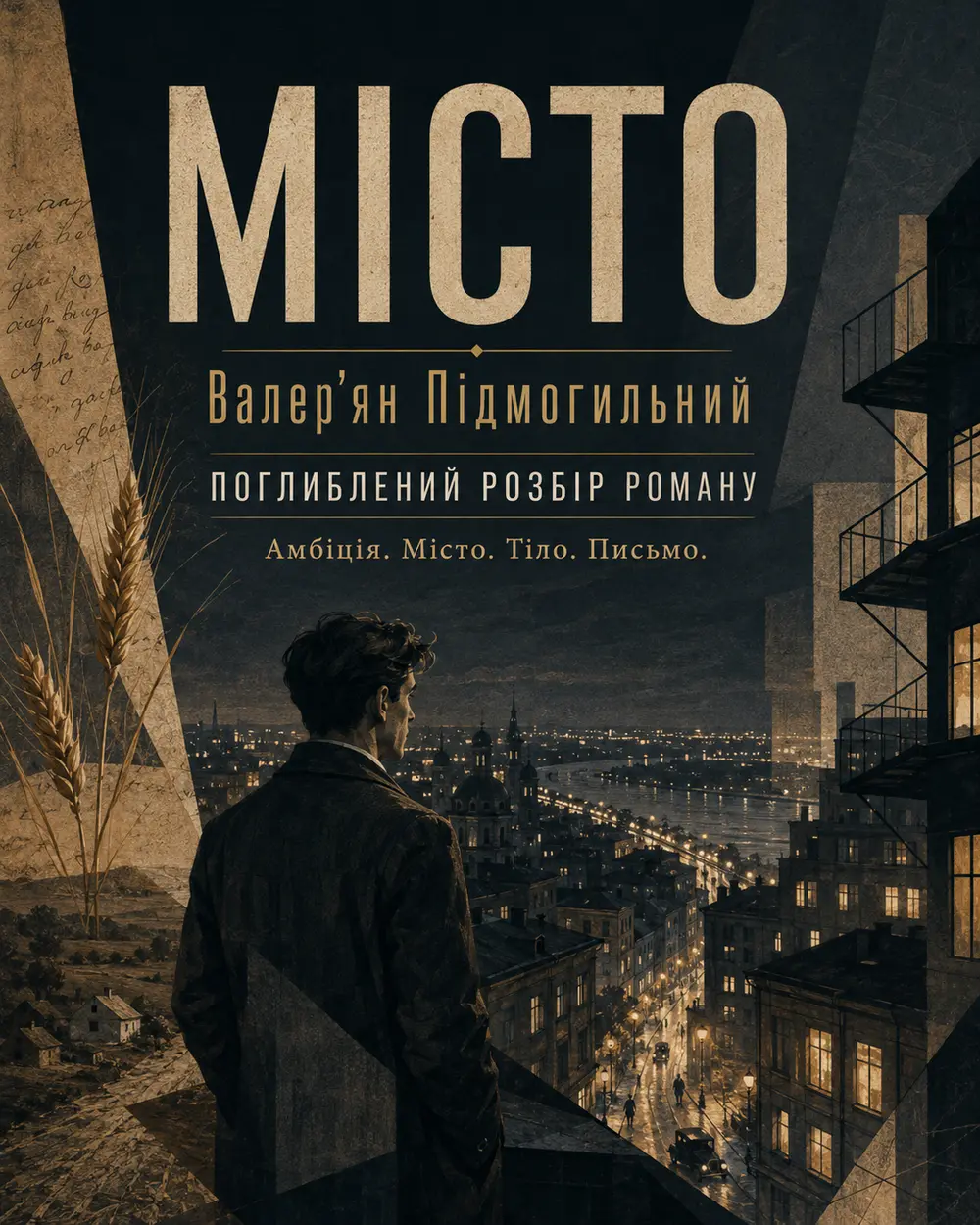
Pidmohylny's «The City»: An Anatomy of Ascent
A deep-dive into Valerian Pidmohylny's novel «The City» (1928): the two epigraphs as a body↔spirit frame, the French intertexts of the career novel (Duroy, Rastignac), Tarnawsky's ontological reading, sublimation as engine, the gender trap, a character and symbol map — and the cruelest irony of the author's fate.
On this page
- The Era, the Author, and the Cruelest Irony
- Two Parts, Two Epigraphs, One Unreliable Voice
- The Ukrainian Rastignac: The Career Novel
- The Body, Sublimation, and the Will to Ascend
- The Trap of “Women as Stepping-Stones”
- The Character Map: Mirrors, Stepping-Stones, Limits
- The Layers of Ascent: Space and Symbols
- Honesty and Limits
The standard reading of «The City» — both the school version and the more sophisticated one — reads Stepan Radchenko morally: a functional egoist who climbs over people. That is true. But it is the middle floor. Below it lies the foundation on which Pidmohylny built everything else, and that foundation is not moral — it is ontological.
The novel opens with two epigraphs: the Talmud on man as half-animal, half-angel, and Anatole France’s question, “How can one be free when one has a body?” These are not ornament — they are the thesis. «The City» is not the story of a good or bad young man taking Kyiv. It is the story of an animal that wants to become pure intellect, and cannot. The women, the apartments, the written pages — merely smoke from that burning.
The Era, the Author, and the Cruelest Irony
Valerian Pidmohylny was the most European voice in Ukrainian prose of the 1920s — and not metaphorically. He translated Balzac, Diderot, Maupassant, and six novels by Anatole France; he knew the French novel from the inside, through the translator’s hand, not the reader’s eye. «The City» (DVK, 1928) — one of the first major Ukrainian urban novels — was written at the peak of Ukrainization: a Ukrainian peasant takes Kyiv, a city that until then had been culturally and linguistically alien to him, and takes it not by force but by word, by lecture, by literature.
Here lies the cruelest irony, one absent from every plot summary. The novel about a Ukrainian conquering a city through culture was written a few years before that very culture was exterminated. Pidmohylny was arrested in 1934, sent to Solovki, and shot on 3 November 1937 in the Karelian forest clearing of Sandarmokh — in the same Solovki transport as Mykola Zerov, Mykola Kulish, Les Kurbas, and Pavlo Fylypovych. The executions were timed to the twentieth anniversary of the “October Revolution”: the regime was marking its jubilee by shooting a generation. Rehabilitation came only in 1956 — to a dead man.
Stepan’s triumphant kiss to the city from the window on the last page was written by a man whom the masters of that city would soon erase from it — along with the language for the sake of which Stepan had taken it in the first place. The Executed Renaissance is not the novel’s backdrop; it is its continuation in reality: the book about cultural conquest preceded the cultural genocide.

Two Parts, Two Epigraphs, One Unreliable Voice
Both epigraphs deserve a literal reading, because the whole book is compressed inside them. The Talmud (Tractate Avot): “Man has six attributes: in three he resembles an animal, in three an angel — like an animal he eats and drinks, reproduces and excretes; like an angel he has intellect, walks upright, and speaks the holy tongue.” And Anatole France — not “Anatole France in general” but a specific line from his novel Thaïs: “How can one be free, Eucrites, when one has a body?”
Here is the detail that transforms the epigraph from a quotation into a confession: Pidmohylny himself translated Thaïs into Ukrainian — the year before «The City», in 1927. The question “how can one be free when one has a body?” was not borrowed for elegance; he lived with it at a translator’s desk. The body as the prison of freedom is not a line from an Alexandrian monk in France’s novel — it is Pidmohylny’s own obsessive idea, placed in the epigraph as the tuning fork to which the entire text is calibrated.
Together, the two epigraphs stretch the axis on which all of «The City» rests: animal↔angel, body↔spirit, instinct↔intellect. Man is the only animal that wants to be an angel, and the only one whose body gets in the way. Technically, Pidmohylny sustains the tension through free indirect discourse: we are almost always inside Stepan’s head, hearing his self-justifications in his own intonation — and precisely because of that, we see more than he does. Hence the novel’s two-beat structure: first, the ascent through the body (Nadiyka, Tamara, Zoska), then through the word (recognition, literature, Rita). First the animal takes the city; then the angel lays claim to it.
The Ukrainian Rastignac: The Career Novel
If one looks for what «The City» genuinely resembles, the answer lies not in Ukrainian literature but in French — and this is not a guess but Tarnawsky’s documented “European connection”: that is the very title of the fourth chapter of his monograph — “Misto: The European Connection.” Stepan Radchenko belongs to a family that the French novel of the nineteenth century drew to the last detail: the provincial who takes the capital. Julien Sorel in Stendhal, Eugène de Rastignac in Balzac, Frédéric Moreau in Flaubert — and the closest relative, Georges Duroy from Maupassant’s Bel-Ami.
Tarnawsky, who began with a Harvard dissertation on Pidmohylny and Maupassant, demonstrates a “strong similarity to Bel-Ami in plot, narrative technique, and philosophical subtexts” and calls «The City» a “spiritual cousin” of Bel-Ami. Even the final gesture is inherited: Rastignac’s “À nous deux, Paris!” — a challenge hurled at the city from a height — is precisely that kiss Stepan blows Kyiv from the window.
But «The City» is not a Ukrainian remake of Bel-Ami, and here lies the subtlest point. Maupassant’s Duroy, in Tarnawsky’s reading, is a Schopenhauerian hero: cynical will to life, a moral animal honestly taking what is his. Pidmohylny’s Stepan is a Nietzschean hero: his drama is not “is he good or bad?” but whether the intellect can subjugate instinct at all. Maupassant wrote morality; Pidmohylny rewrote it as ontology.
| Hero | Novel | Capital | Ascends through | Philosophical frame | Ending |
|---|---|---|---|---|---|
| Georges Duroy | Bel-Ami (Maupassant, 1885) | Paris | women → the press | Schopenhauerian morality | cynical triumph |
| Eugène de Rastignac | Père Goriot (Balzac, 1835) | Paris | salons, patronesses | social ambition | challenge to the city: “À nous deux!” |
| Julien Sorel | The Red and the Black (Stendhal, 1830) | province → Paris | women, a mask | Bonapartist pride | the scaffold |
| Stepan Radchenko | The City (Pidmohylny, 1928) | Kyiv | women → text | Nietzschean ontology | a kiss to the city — and emptiness |
The Body, Sublimation, and the Will to Ascend
The engine of the novel is rightly identified as sublimation — but the mechanism deserves closer attention, because two thinkers are at work simultaneously in the text, and Tarnawsky names both. Freud supplies the mechanics: suppressed libido and undischarged guilt do not disappear; they are redirected — “a characteristically Freudian compensation.” Each woman, having served her stage, becomes not a memory but material; the tension that cannot be discharged in intimacy is discharged into text.
But Freud explains how, not why. The why is Nietzsche. Over the Freudian apparatus of drives, Pidmohylny places a Nietzschean frame: the will to power, self-overcoming, the body as something the spirit must subordinate. Sublimation here is not neurosis but a weapon of the will — the means by which the angel tries to reprocess the animal. That is why Stepan’s coldness is not a character flaw but the price of the operation: to ascend, he repeatedly amputates whatever pulls him down — and each amputation has a name.
Tarnawsky gives this a precise label — futile servitude. Its components: the instincts (above all, sexuality); the drive to complete something — “stone walls with metal roofs, or knowledge and beauty”; and a merciless fate, the meaninglessness of individual existence. And “the city,” he writes, “is the most successful symbol and metaphor of such existence.” That is why Kyiv here is not backdrop: it is that same duality, rendered in stone and storeys. To ascend through the city is to flee the body upward and, at every landing, discover that what awaits above is not freedom but the next floor.
The Trap of “Women as Stepping-Stones”
The most popular reading of «The City» is “every woman is a stepping-stone for Stepan.” It is true in precisely the measure that it is dangerous. The trap is this: “women as stepping-stones” is not the novel’s thesis — it is Stepan’s optic, which the novel hands us so that we fall for it. To read the women as inventory for a man’s career is to repeat Stepan’s crime as readers.
The mechanism of exposure is the final Nadiyka. In Stepan’s mind she was supposed to remain a broken victim waiting for his repentance; instead she is married, pregnant, settled — with a story of her own. For the narcissist this is almost an affront: how dare a person from my novel live outside of me? This is precisely where “woman as stepping-stone” collapses: the stepping-stone was a person all along — Stepan simply looked past her, and we looked past her with him.
Reviewing Tarnawsky, George (Yuri) Luckyj notes that Pidmohylny’s “view of women and sexuality” is “a genuine innovation in Ukrainian literature”: the frank corporeality that scandalized the proletarian criticism of the 1920s is simultaneously the lever that makes instrumentalization visible. The feminist school of later Ukrainian literary scholarship — Solomiya Pavlychko’s discourse of modernism, Vira Ageyeva’s gender studies — reads «The City» in precisely this way: as a male narrative that not only uses women but exposes that use.
The Character Map: Mirrors, Stepping-Stones, Limits
No character in «The City» is independent — each exists as a function in the system of Radchenko’s growth. The women form a vertical ladder of stages of maturation and power; the men are horizontal mirrors, models of fates that Stepan either adopts or rejects.

| Woman | Stepan’s stage | What she provides | How it ends |
|---|---|---|---|
| Nadiyka | peasant past | innocence, continuity with the village | quietly released, outgrown |
| Tamara (Musinka) | bodily initiation | first adult experience, the lesson of tenderness | revulsion, guilt, flight |
| Zoska | conquest of the city | ease, urban rootedness | suicide — his moral nadir |
| Rita | an equal at his level | partnership without dependency | open ending, cold equilibrium |
| Man | What he embodies | His role for Stepan |
|---|---|---|
| Levko | the pragmatic peasant-specialist | the rejected fate of usefulness: the village without flight |
| Vyhorsky | the disillusioned solitary artist | the fate he fears: talent burned down to skepticism |
| Borys | normalcy and domestic life | gives Nadiyka what Stepan could not |
| Maksym | youth, apprenticeship | a living reproach and a damaged double |
| Svitozarov | critic, gatekeeper | the institutional condescension of the city; the slap that ignites ambition |
The Layers of Ascent: Space and Symbols
Stepan’s social rise is literally written into Kyiv’s geography: every step upward means a change of lodging. A barn beside the cows → a kitchen → a room → a private apartment → a high floor. Space functions as a career CRM: change your status, change your address. And the novel’s symbols are that same body↔spirit duality rendered in objects.

| Symbol | Its meaning in the novel |
|---|---|
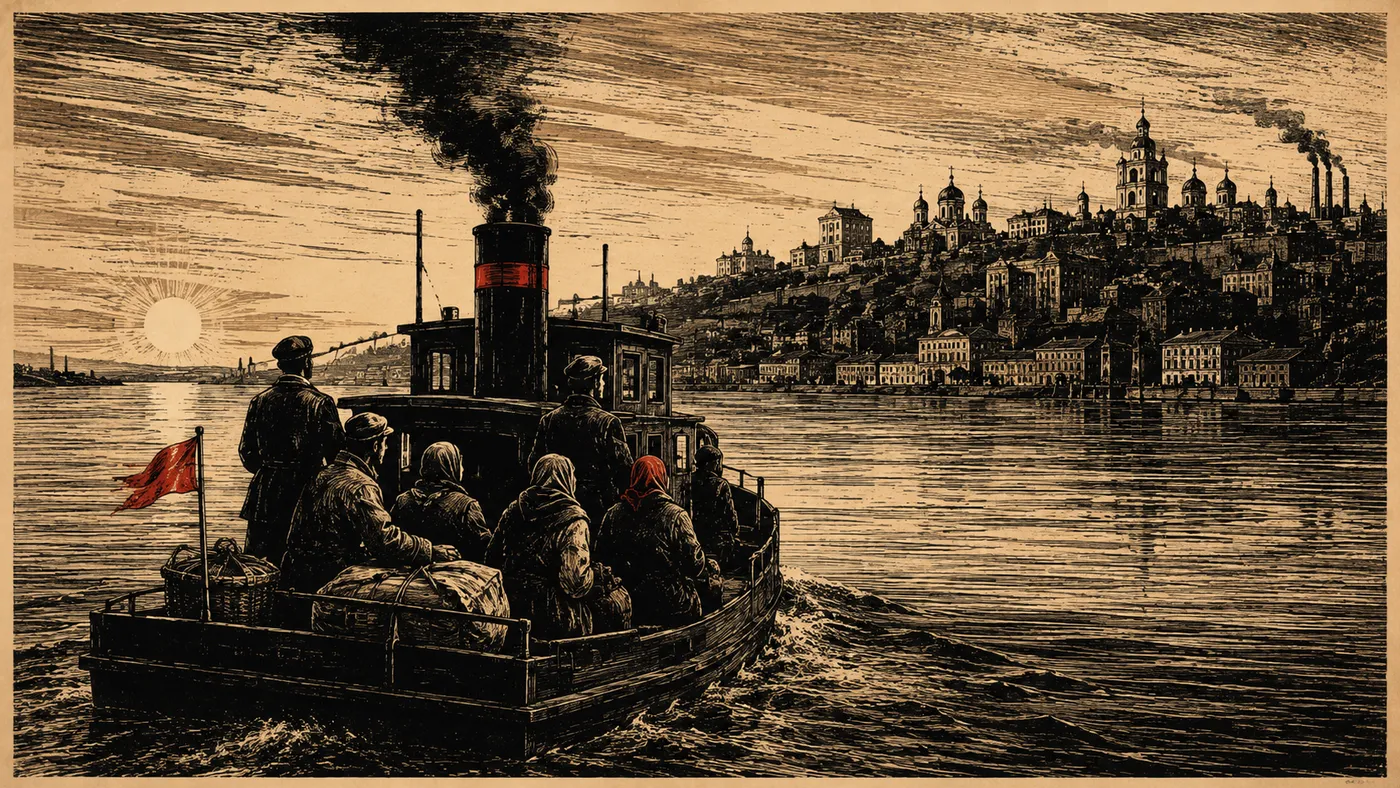
| The Dnipro | the threshold between village and city; not a baptism but an entry into the machine |
| The apartments | the clearest map of social ascent; height equals mastery |
| Clothing | the second skin of identity; burning the old garments = a ritual death of the previous self |
| Name: Stepan → Stefan | a rebranding of the soul; self-branding long before marketing consultants |
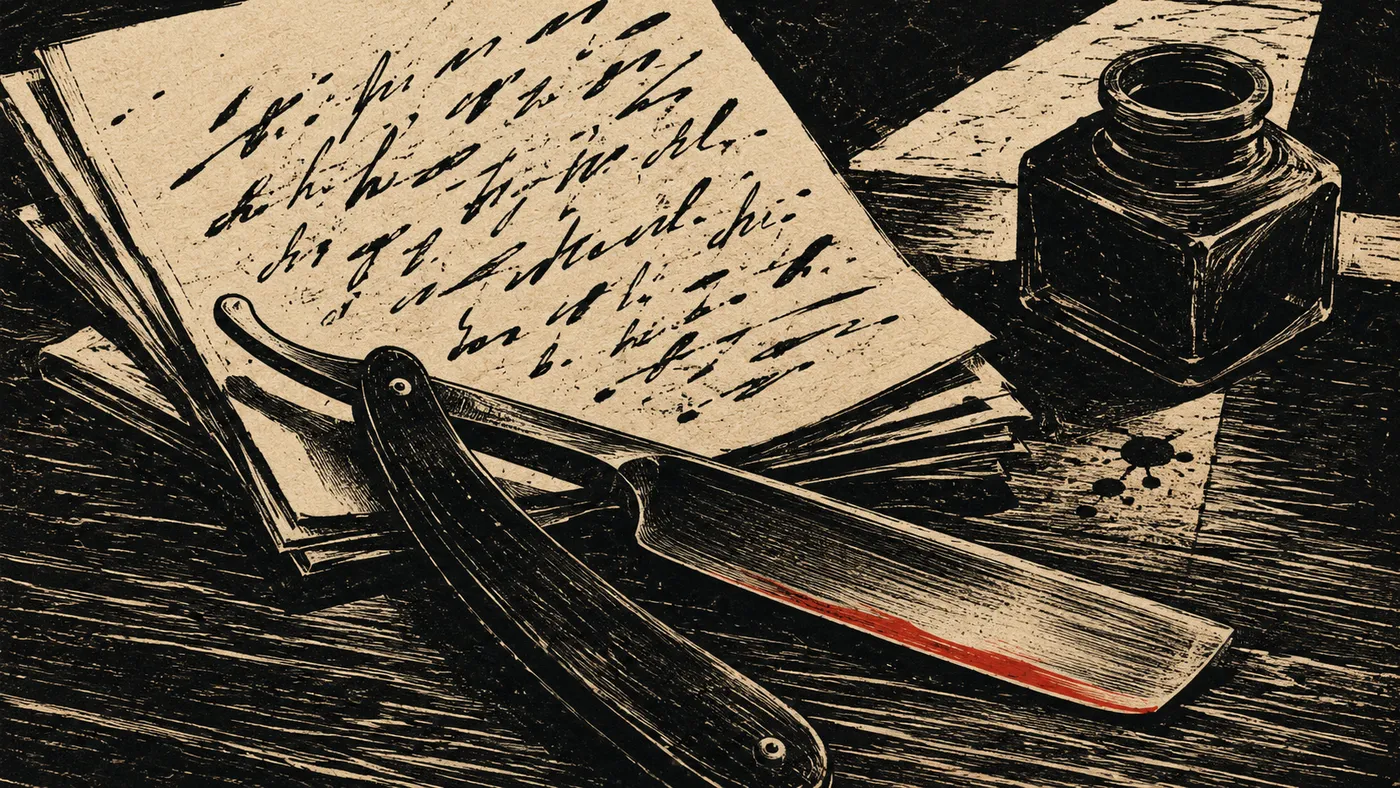
| The razor | violence transformed into text; Stepan himself: cuts, survives, gleams |
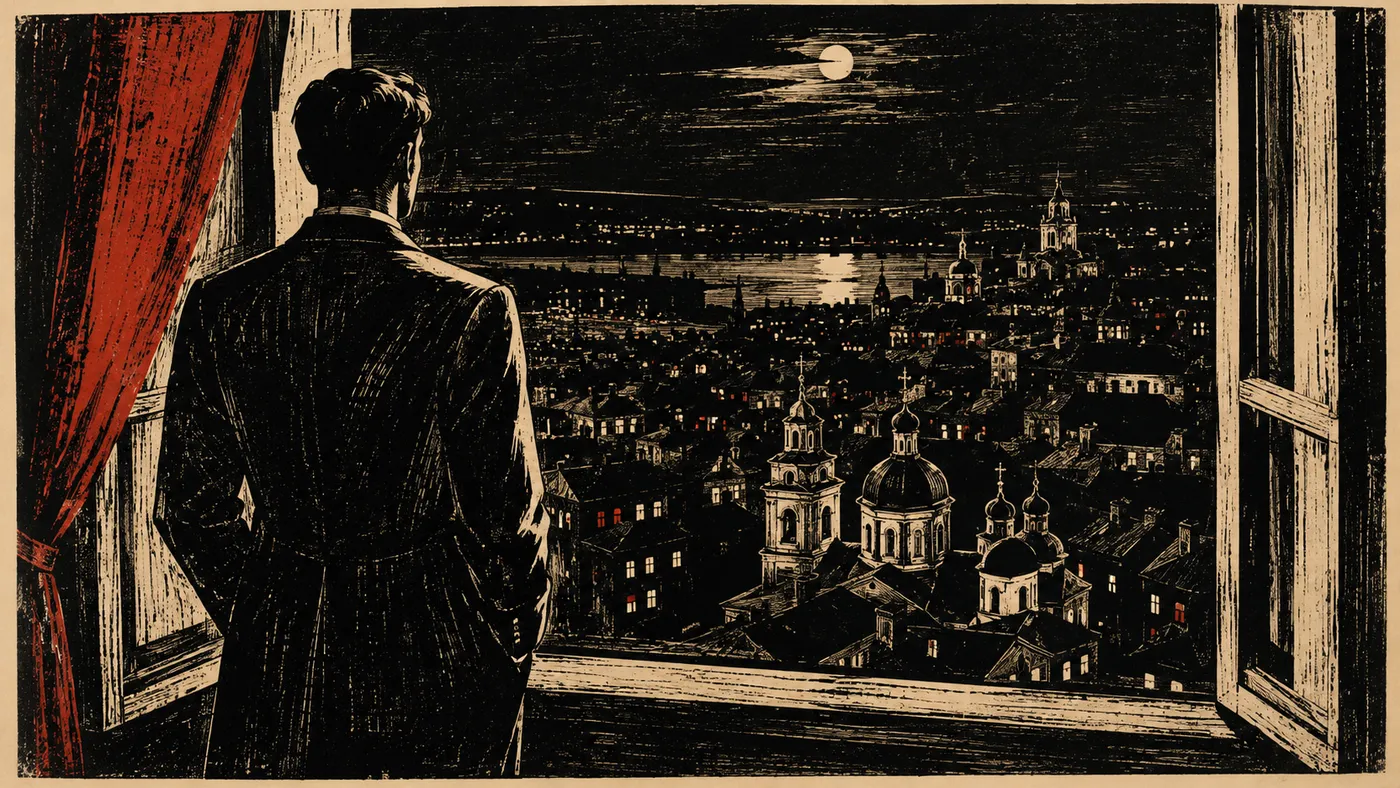
| The window | the boundary between self and city; from a height it is easy to confuse scale with greatness |
Honesty and Limits
What I “know” here (verified, with sources): the verbatim text of both epigraphs and the fact that the France epigraph is from the novel Thaïs in Pidmohylny’s own translation of 1927; Tarnawsky’s thesis that the conflict is ontological rather than moral; the “European connection” and Bel-Ami as the primary channel; the formula futile servitude; the author’s fate down to the date.
What I “think” here (interpretation built on top of fact): the two-beat structure “body → word” is a structural reading of the novel’s movement, not the author’s own label for the parts; the attribution of Pavlychko and Ageyeva is carried at the level of the school’s position rather than direct quotation.
A steelman against my own thesis. One could object that the ontological frame does not cancel the moral one — it merely underlies it: Zoska is still dead, and no philosophy of body and spirit settles that account. That is fair. The ontological reading explains the engine — it does not erase the ledger. The most accurate approach, then, is to hold both layers simultaneously, as the novel itself does — refusing to be convenient for anyone: not the proletarian critic, not the moralist, not the aesthete.
The full immersive version of this analysis — with diagrams, interactive elements, and all the visuals — lives as a standalone special project: neurodrift.org/misto.
Frequently asked
What is Pidmohylny's «The City» really about?
On its surface — a peasant, Stepan Radchenko, who comes to Kyiv and becomes a writer. At a deeper level — about how ambition digests a person: the hero doesn't so much conquer the city as become its product — sharper and stronger, but colder, capable of turning people into raw material for his own growth. The load-bearing conflict is not moral but ontological: body against spirit, instinct against intellect.
What do the two epigraphs of «The City» mean?
The first is from the Talmud (Tractate Avot): man has six attributes — in three he resembles an animal, in three an angel. The second is a line from Anatole France's novel «Thaïs»: "How can one be free, Eucrites, when one has a body?" Together they set the axis of the entire book — body↔spirit. A detail that turns the epigraph into a confession: Pidmohylny himself translated «Thaïs» into Ukrainian the year before «The City», in 1927.
Which European novel does «The City» most resemble?
The closest parallel is Maupassant's «Bel-Ami»: Stepan Radchenko ~ Georges Duroy, both ascending the capital through women. Scholar Maxim Tarnawsky calls «The City» a "spiritual cousin" of «Bel-Ami» and traces the broader French tradition of the career novel — Balzac's Rastignac, Stendhal's Julien Sorel. The key difference: Maupassant writes morality; Pidmohylny rewrites it as ontology.
What became of Pidmohylny and the novel itself?
Valerian Pidmohylny (1901–1937) — the most European voice in Ukrainian prose of the 1920s, translator of Balzac, Maupassant, and France — was arrested in 1934, sent to the Solovki camps, and shot on 3 November 1937 in the Karelian forest clearing of Sandarmokh, alongside Zerov, Kulish, and Kurbas. He was rehabilitated in 1956. The novel about the cultural conquest of a city preceded the cultural genocide of its author.
Why is the "women as stepping-stones" reading dangerous?
Because "women as Stepan's stepping-stones" is not the novel's thesis — it is Stepan's own optic, which the text hands us so that we fall for it. To read the women as inventory for a man's career is to repeat Stepan's crime as readers. The final Nadiyka — married, settled, with her own story — collapses the model: the "stepping-stone" was a person all along.
Comments
Signed-in readers only — to keep it human, not a bot swamp.