Jevons Paradox for AI: Why Cheaper Generation Increases Consumption and Raises the Price of Attention
Efficiency never reduces consumption — it multiplies it. When anything can be generated, the scarce resource is no longer text but judgment: where to look.

On this page
- The mechanism: why efficiency is an accelerator, not a brake
- One staircase of evidence: where scarcity moved
- The cognitive lens: your brain is the bottleneck, and it doesn’t update
- Counter-pressure: won’t the machine simply eat judgment too?
- The market lens: what actually gets invoiced now
- What remains when everything can be generated
In 1865, a twenty-nine-year-old lecturer at Owens College in Manchester is sitting over tables, calculating what nobody asked him to calculate. His name is William Stanley Jevons. On the desk — coal extraction tables. On the wall — soot from the lamp. In his head — a thought that will ruin the mood of the entire Victorian optimism. Engineers have just learned to burn coal three times more efficiently than in Newcomen’s day. Watt’s steam engine does the same work on less fuel. The logic of the era says: wonderful, now coal will last a long time, we’ll save it.
Jevons writes a sentence that will be quoted for a hundred and fifty years: economical use of fuel is by no means the same as decreased consumption. Quite the contrary (Wikipedia, The Coal Question, 1865). And he adds a cold observation: since Watt made the steam engine more efficient, coal consumption in England didn’t fall — it soared (Wikipedia, Jevons paradox). Because when a unit of work becomes cheaper, people start ordering it everywhere — in factories, trains, steamships, in thousands of applications that didn’t exist before because they were unprofitable.
A hundred and sixty years later, Microsoft CEO Satya Nadella opens the X app and writes in the same genre of cold observation: “Jevons Paradox strikes again. As AI becomes more efficient and accessible, we’ll see its use skyrocket, turning it into a commodity we can never get enough of” (Satya Nadella, X, 27.01.2025). The occasion — the Chinese model DeepSeek, whose flagship version V3 was trained, according to its developers, for approximately $5.5 million against the estimated $100-plus million that went into GPT-4 (Fortune, 27.01.2025). The market panicked: if AI gets this cheap, who profits? Nadella essentially answered with the coal clerk: nobody saves. Everyone consumes more.
This scene is not about coal and not about Nvidia’s share price. It is about the mechanism we habitually call progress, though a more precise name is scarcity shift. I will call it the Jevons Paradox of Attention: when the cost of producing something falls to zero, value shifts to the adjacent resource that cannot scale. In the coal century, the cost of work fell — and ecology and coal itself became scarce. In our decade, the cost of generating text, code, and images falls — and what becomes scarce is something that cannot be generated: judgment. The capacity to look at a thousand equally plausible outputs and say which one is worth attention. I’ll examine this through three lenses — economic (why efficiency always multiplies rather than reduces), cognitive (why your brain can’t keep pace with the machine’s throughput), and market (what actually commands an hourly rate now). The thesis-as-blade: the cheaper generation becomes, the more expensive your capacity to decide what to look at — because that is the one thing the machine cannot yet scale.
The mechanism: why efficiency is an accelerator, not a brake
Everyone’s intuition says: if we’ve learned to make something twice as cheap, we’ll spend half as much of it. Jevons showed why this intuition reliably fails. A falling unit price makes profitable the applications that were previously out of reach. Cheaper coal is not “the same coal for less money” — it’s new railways, new factories, new cities that simply wouldn’t exist without cheap coal. Total demand grows faster than unit consumption falls. Economists call this the rebound effect, but Jevons named it more precisely: confusion of ideas (Wikipedia, Jevons paradox).
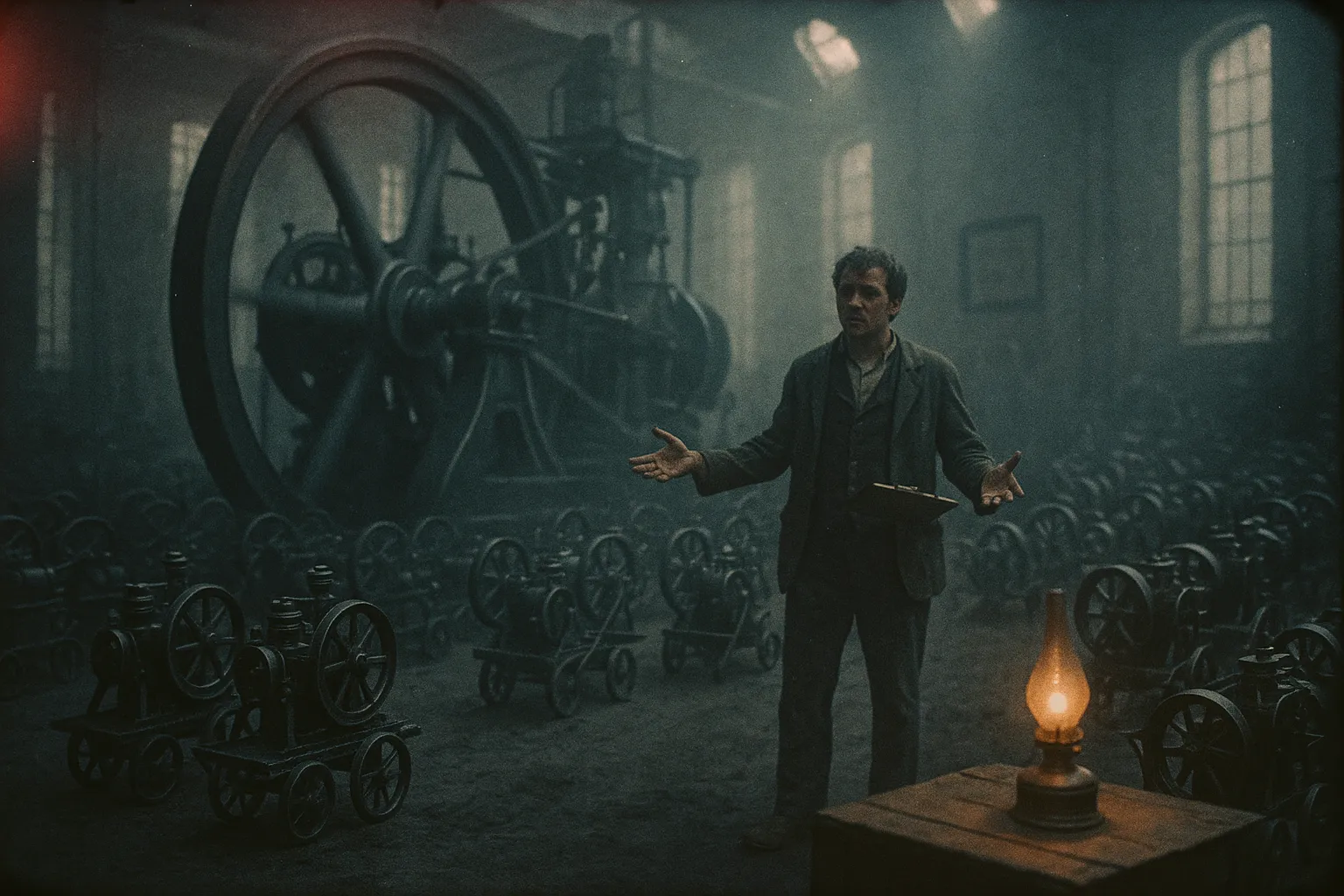
It’s worth pausing on the mechanism itself, because that’s where the whole trick lies. Jevons distinguished two things everyone conflates: specific consumption and total consumption. Watt reduced the specific — how much coal is needed to perform one unit of work. But the price of work — not coal — fell as a result, and when something becomes cheaper, people want more of it in more places. A steam engine that previously only paid off at the wealthiest mines suddenly paid off in a textile factory, then on a railway, then on a steamship. Each new application is a new column in the demand table that simply didn’t exist before the price fell. The sum of these columns grew faster than specific consumption fell. Hence the paradox: the more efficient machine burned more coal than the wasteful one.
Now substitute tokens for tons. In March 2023, a million input tokens for GPT-4 cost $30 (TokenCost, AI Price Index). By early 2025, the cheapest model with comparable baseline capability — Gemini 2.0 Flash — cost $0.10 for the same million, roughly 300 times less than GPT-4’s starting price (TokenCost). By the logic of savings, we should be spending 300 times less on AI. Exactly as the Victorians, by their logic, should have been burning less coal.
We spend more. ChatGPT had 500 million weekly active users at the end of March 2025, 700 million in August, 800 million in early October of the same year (TechCrunch, 06.10.2025). At that point over 4 million developers were building on OpenAI, and its API was processing more than 6 billion tokens per minute (TechCrunch). The coal clerk looks at these numbers and is surprised by none of them. He saw this coming. Cheaper unit — greater total appetite. Always.
And here is the first uncomfortable detail the industry loves to hide behind the word “productivity.” If generation fell 300-fold in price while consumption rose by orders of magnitude, then the physical stream of outputs that someone has to read, verify, reject, or approve grew even faster. The machine learned to produce faster. The bottleneck moved further down the conveyor — to where you sit.

One staircase of evidence: where scarcity moved
Look at the text layer of the internet. By mid-2025, AI-generated articles accounted for approximately 52% of all new written content on the web — machine text had, for the first time by volume, surpassed human text. This figure comes from an analysis by SEO firm Graphite: 65,000 English-language articles from Common Crawl published between January 2020 and May 2025, classified by the Surfer detector (Graphite, More Articles Are Now Created by AI Than Humans). One might conclude that human text has been displaced. But a separate study by the same firm shows a second, opposite number. When Graphite examined what actually ranks at the top of Google — the first two pages of results across 31,000 queries — it found that 86% of articles there are written by humans, and only 14% by machines (Graphite, AI Content In Search & LLMs). In ChatGPT and Perplexity answers, the split runs the same direction: 82% of cited sources are human-authored.
The gap between these numbers — 52% by volume versus 14% by value — is the portrait of the new scarcity. Producing has become infinitely cheap. Producing something worth spending someone else’s attention on has not gotten cheap at all. It has become more expensive, because now it must be done in the middle of an information flood where your signal drowns in 52% noise. The algorithm, in effect, performs the first filtering on the reader’s behalf — and performs it against machine text: among the very top positions, only 7% are held by AI (Graphite, AI Content In Search & LLMs). The cheapness of production doesn’t break through this filter. It only makes the filter more valuable.
Here it’s worth stopping and saying honestly: correlation is not causation. The fact that token prices fell simultaneously with rising consumption does not by itself prove that one caused the other; many things rose and fell in parallel during the AI boom. But Jevons’s logic is not a statistical correlation between two time series — it’s a mechanism of price elasticity of demand, tested on coal, steel, electricity, and computing. Get cheaper — scale into new niches. This is not a trend that will pass when the AI fashion fades. It’s an economic law, like the law of demand. Trends end. Laws don’t.
The cognitive lens: your brain is the bottleneck, and it doesn’t update
Let’s bring this from macroeconomics down into one specific head. Imagine you’re a marketer who at nine in the morning asks AI for “twenty headline variations.” Ten seconds — twenty variations. Previously you’d have spent an hour writing them and had five. A pure gain, it seems.
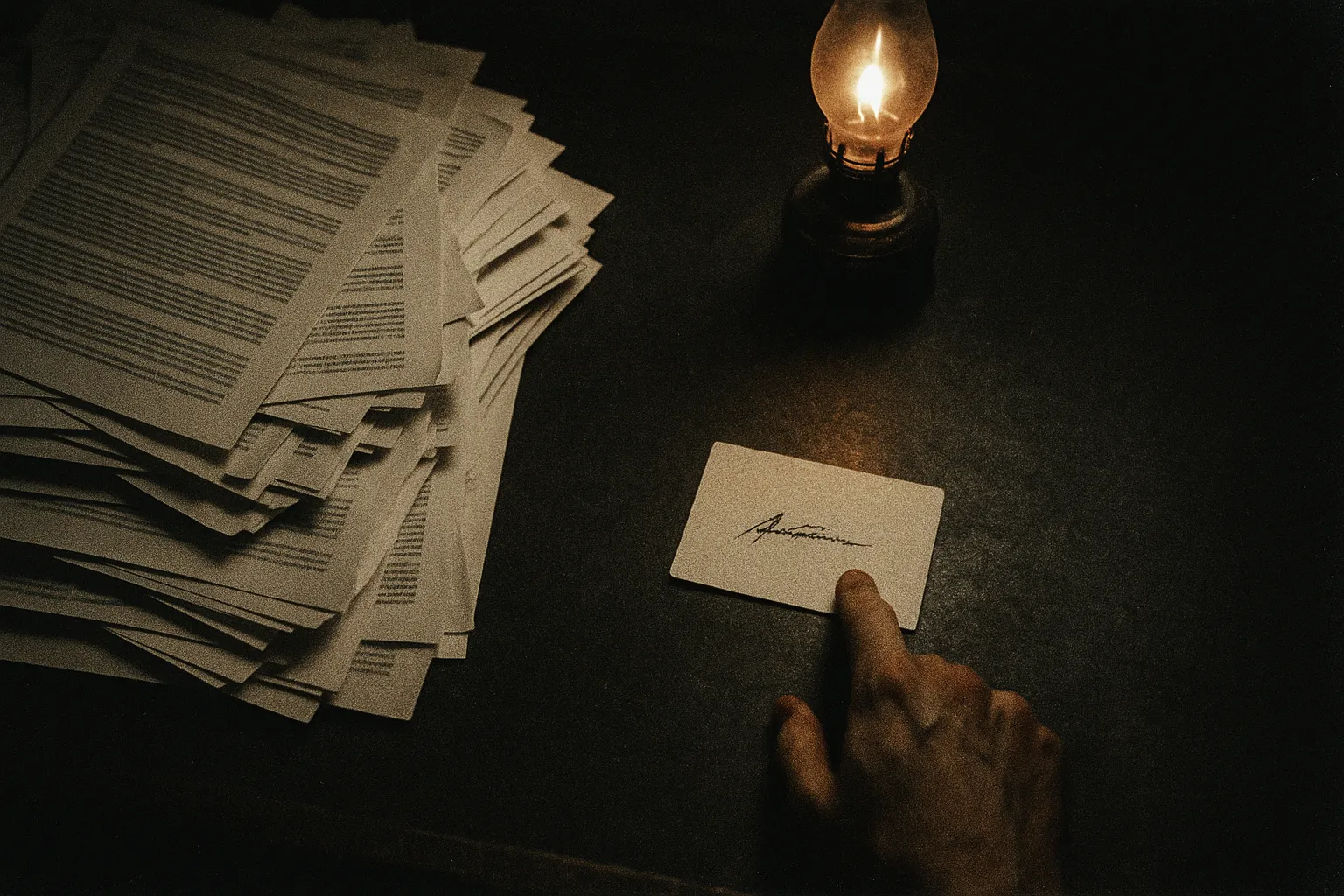
Let’s give him a name so we don’t hide behind abstraction. Andriy, thirty-four, manages content at a mid-sized company. Before 2023 his day looked like this: ten headlines in the morning, lunch, two texts in the afternoon — and the feeling of something accomplished. Now his morning looks different: he prompts the model, gets twenty headlines in ten seconds, and then — spends three hours sitting in front of them. Not writing. Choosing. He leaves at seven in the evening more exhausted than before, even though he “didn’t do anything” — in the old sense of “doing.” Andriy doesn’t understand why fatigue increased when the work disappeared. Jevons would explain it to him in a minute.
Now you’re sitting in Andriy’s seat in front of twenty headlines. All grammatically flawless. All plausible. None obviously bad — because the machine was trained not to produce the obviously bad. And here’s the trap: the cost of generating a variant has fallen to zero, but the cost of evaluating a variant has not. Reading it, feeling it, weighing it against the audience, discarding nineteen and taking responsibility for one — this is work your brain performs at exactly the same speed as your great-grandfather’s over twenty handwritten ones. The machine solved a problem that barely existed (write the variants) and multiplied the problem that was always the real one (choose the right one).
This is scarcity shift at the scale of one person. Previously your value as a professional was partly hidden in the ability to produce — to write, draw, code. The machine has devalued that. What it hasn’t devalued is now exposed: taste, context, accountability for the decision “this one, not that one.” Economists would call this complementarity — when one resource becomes cheaper, the value of the resource complementary to it rises. Cheap nails increase the value of the carpenter who knows where to drive them. Cheap tokens increase the value of the person who knows which of the outputs is worth looking at.
Notice the insidious mathematics of this shift. When AI gives you five variants, you still have time to weigh each carefully. When twenty — you already read diagonally. When two hundred (and the price of generation doesn’t forbid this — it’s zero) — you don’t evaluate, you surrender: you take the first acceptable one, because fully evaluating two hundred is physically impossible. The paradox closes in a mean knot: the tool that promised to expand your choice actually narrows your capacity to choose — because it generates more variants than human attention can weigh. The cheapness of production does not liberate judgment. It floods it.
| Era | What fell to ~zero cost | Where scarcity moved | What commands an hourly rate |
|---|---|---|---|
| Steam (1860s) | Mechanical work (coal + Watt) | Coal itself, air, extraction time | The engineer who knows where to site the factory |
| Print/web (2000s) | Text distribution (publishing ≈ free) | Reader attention, trust | The editor who decides what’s worth the front page |
| AI-generative (2023→) | Production of text/code/images | Judgment: where to look, what to approve | The person who takes responsibility for choosing among a thousand outputs |
One table, one pattern, three centuries. Production gets cheaper — the direction of gaze gets more expensive.
Counter-pressure: won’t the machine simply eat judgment too?
Here an honest opponent strikes the argument’s weakest point. Fine, he says, today a human evaluates outputs. But isn’t evaluation itself a task AI is learning to perform? Judge-models already exist that rank other models’ responses. There are reward models, RLHF, automated evals. If generation was automated, why not automate selection? Then my entire argument about “scarcity of judgment” is just the next niche the machine will fill, and Jevons has nothing to do with it.
The objection is strong, and it would be dishonest to wave it away. Yes, some part of evaluation is already automated — and this only accelerates the stream. But notice the recursion it drives: the judge-model itself produces outputs (evaluations) that someone now has to evaluate — because why do we trust this particular judge? The scarcity doesn’t disappear; it moves up a floor. Now what’s needed is judgment about whom to delegate judgment to. The coal rebound worked the same way — each automation of one link made the next link the bottleneck, and ultimately hit a physical limit (coal is finite) and a human one (someone had to decide why all these factories). A machine optimizes superbly within a given goal. Who sets the goal and takes responsibility when it turns out to be wrong — that has not yet been delegated, and seems unlikely to be without ceasing to be a human decision.
What would prove me wrong? A very specific thing: if a system appeared to which the market massively and voluntarily delegates irreversible decisions with accountability — a signature on a contract, a diagnosis, a dismissal, a publication under your name — without a human in the loop, not because it’s cheaper but because it is trusted. So far, the opposite is happening: the more machine text surrounds us, the more carefully people search for someone to personally trust. 86% of top Google results are still human for exactly this reason.
Why did this sharpen precisely now, in the 2023–2026 window? Because before 2022, generation was still expensive: it was itself the bottleneck, and judgment was hidden inside the act of production — whoever wrote, decided. GPT-4 in 2023 ($30/1M tokens) started the shift, DeepSeek at the end of 2024 collapsed the entry threshold ($5.5M to train a flagship), and the nearly 300-fold price drop over three years completed the phase transition (TokenCost; Fortune). Production and judgment became decoupled. For the first time, it became possible to produce without deciding anything. And only then did it become visible that the decision — is a separate, infinitely scarce commodity.
The market lens: what actually gets invoiced now
Let’s come down from theory to the level of the invoice. Back in 2021, a copywriter sold hours spent writing. Today, writing text costs about as much as the electricity for the tokens — practically nothing. What, then, goes into the hourly rate that people still pay, and pay increasingly?
They pay precisely for the reverse side of the flood. For the person who looks at twenty generated variants and bears reputational accountability for having chosen this one. For the editor who guarantees that amid 52% machine noise your brand ends up in the 14% that ranks. For the analyst who, from ten equally smooth machine reports, spots the one where the model quietly invented a number. The hourly rate increasingly stops paying for production and increasingly pays for quality of gaze direction. The capacity to look where it matters, amid an infinity of places one could look.
This rewrites the very unit of measuring labor. Once a professional was assessed in units of output: how many pages, how many lines of code, how many layouts per day. That metric just lost 99% of its value, like coal per unit of work. The new unit is the number of correct irreversible decisions a person is willing to sign their name to. You can’t mill this by volume, because each such decision consumes exactly as much attention as it consumed for a great-grandfather — the machine hasn’t accelerated this part by a single iota. And that is precisely why it remains scarce while everything around it gets cheaper. The market already feels this, even if it can’t yet name it: it has stopped paying for tonnage and started paying for direction.
The dark joke of the era goes like this: AI promised to free us from routine work, but mostly freed us from the part of work that gave the feeling of having done something. It left us with the most exhausting part — continuously deciding and being accountable, with no break to “just work with your hands.” The machine took the craft and left the verdict. And the bill for this is not issued by the machine — it is paid by you, with your attention, every minute, while 6 billion tokens per minute pour into the world (TechCrunch).
A practical conclusion without pathos. If you’re building a career or a product in 2026, stop competing in what has fallen to zero in price — in the speed and volume of production. A free model will outrun you there. Invest in what Jevons would call the complementary scarcity: taste, context, reputation, the right of signature. That is the resource whose price rises precisely as fast as the price of generation falls.
What remains when everything can be generated
Back to the Manchester study. Jevons sits over extraction tables, the lamp smokes, and he already knows what the era doesn’t want to know: the more efficient machine won’t save coal — it will burn it faster, by making it desirable where it wasn’t burned before. He isn’t counting fuel reserves. He’s counting how fast the boundary of scarcity will shift — and where to.
We sit over our own tables: nearly 300 times cheaper in three years, 800 million users a week, 6 billion tokens a minute, 52% of new text no longer human. And the same cold arithmetic the clerk derived from columns of coal figures works without a single edit. A cheaper unit doesn’t save the resource — it moves the scarcity to the adjacent cell.
Coal ran out not when it became expensive to extract. It ran out as an advantage when everyone started burning it. The same thing is happening right now with generation. And the lamp on the desk is the same one Jevons had: just enough light for one pair of eyes to decide which of the thousand equally bright pages is worth looking at at all.
Sources: Wikipedia — Jevons paradox; Wikipedia — The Coal Question (1865); Yale Energy History — W. Stanley Jevons, “The Coal Question,” 1865; Satya Nadella, X, 27.01.2025; Fortune — Nadella, DeepSeek, Jevons paradox, 27.01.2025; TokenCost — AI Price Index (≈300x drop, GPT-4 $30/1M → Gemini 2.0 Flash $0.10/1M); TechCrunch — ChatGPT 800M WAU, 6B tokens/min, 06.10.2025; Graphite — More Articles Are Now Created by AI Than Humans (52%); Graphite — AI Content In Search & LLMs (86% / 14% Google, 7% top, 82% LLM-citations).
Frequently asked
What is the 'Jevons Paradox of Attention' — and how does it differ from the original?
The original Jevons (1865): a more fuel-efficient steam engine didn't save coal — it burned more, because cheaper work made it desirable everywhere. The authorial extrapolation: when the cost of producing something falls to zero, value shifts to the adjacent resource that cannot scale. In the coal century, the cost of work fell and coal itself became scarce; in our decade, the cost of generating text and code falls, and what becomes scarce is judgment — the capacity to decide what to look at.
Why did a nearly 300-fold drop in generation costs not reduce AI spending but increase it?
Because a falling unit price makes profitable the applications that didn't exist before — this is the rebound effect Jevons called 'confusion of ideas.' A million GPT-4 tokens cost $30 in 2023, while Gemini 2.0 Flash cost $0.10 in early 2025, yet consumption didn't fall: ChatGPT reached 800 million weekly users and over 6 billion tokens per minute. Cheaper unit — greater total appetite. Always.
If 52% of new text is already machine-generated, why has judgment suddenly become more expensive rather than cheaper?
Because the gap between volume and value is the portrait of the new scarcity: 52% of new text is machine-generated, yet 86% of top-ranked Google articles are written by humans, and among the very top positions AI holds only 7%. Producing has become infinitely cheap; producing something worth spending someone else's attention on has not gotten cheaper — it has gotten more expensive, because now your signal drowns in noise. The cheapness of production does not break through the filter — it only makes the filter more valuable.
But won't the machine consume judgment itself — after all, judge-models and automated evals already exist?
This is the strongest objection, and it would be dishonest to wave it away. But the judge-model itself produces outputs (evaluations) that someone now has to evaluate — why do we trust this particular judge? The scarcity doesn't disappear; it moves up a floor: now you need judgment about whom to delegate judgment to. Irreversible decisions with accountability — a signature, a diagnosis, a publication under your name — the market does not yet delegate without a human in the loop.
What is the practical takeaway for someone building a career or product in 2026?
Stop competing in what has fallen to zero in price — in the speed and volume of production: a free model will outrun you there. Invest in the complementary scarcity — taste, context, reputation, the right of signature. The new unit of labor is not tonnage of output but the number of correct irreversible decisions a person is willing to sign their name to. The market has stopped paying for volume and started paying for the direction of gaze.
Comments
Signed-in readers only — to keep it human, not a bot swamp.