The Form Drifts. The Core Doesn't.
I took four of my own texts spanning eighteen years and laid them side by side. A stranger would swear four different authors wrote them: a six-thousand-word academic article, a surrealist manifesto at five a.m., a lecture outline, and three lines of code. Yet the core of all four is one sentence, carried over almost verbatim. On the vessel, the compression curve, the end-of-history illusion — and why form has a shelf life while an idea doesn't.
On this page
- I. Four authors, one archive
- II. What a vessel is
- III. Four vessels of one idea
- IV. The compression curve
- V. The mistake that gets people stuck
- VI. Why you can’t see it from the inside
- VII. They’ve long known this — they just called it otherwise
- VIII. The 2026 vessel: why AI
- IX. The working formula: which vessel is yours now
- X. The core is alive. It needs a carrier, not a funeral
This is a personal text built on my own archive — eighteen years of writing, measured by a machine. Not a theory about creativity, but proof on a single throughline, from which falls out a working formula for anyone who has an idea and doesn’t know what form to keep it in.
I. Four authors, one archive
Lay four of my texts side by side.
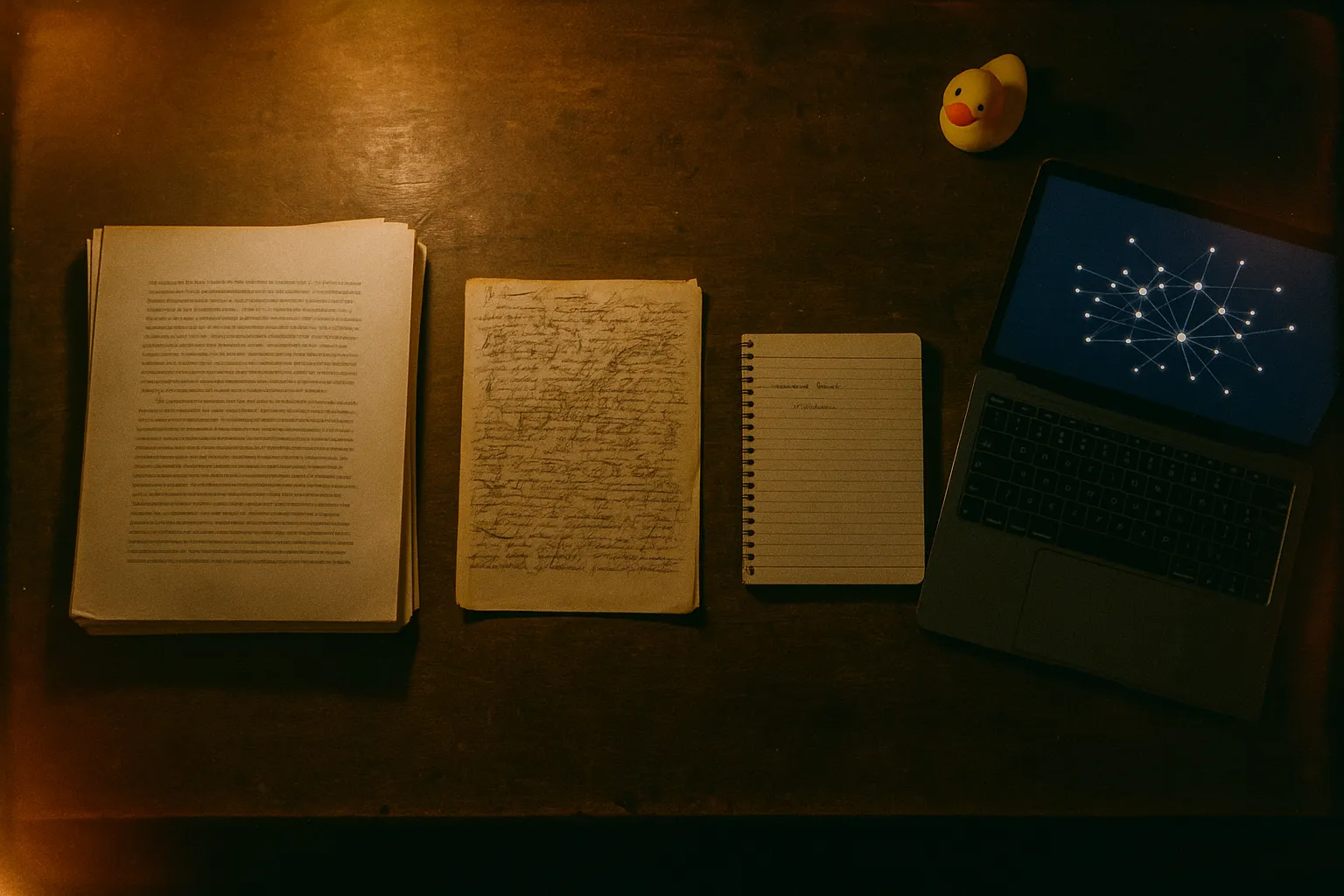
2010: a six-thousand-word academic article on journaling as a method of upbringing. Seven sources, Paulo Freire, two-hundred-word sentences, terminological clusters — “institutionalized reflection,” “hierarchy of values.” 2013: a surrealist manifesto written at five a.m. in exhaustion, lowercase at the start of sentences, “48 Instruments of God” of which one is described, and a self-proclamation as “the father of Ukrainian surrealist futurism.” 2014: a dry lecture outline, twenty paragraphs. 2026: not text at all — a knowledge graph, an agent with memory, and three lines in a YAML file.
A stranger laying these four things side by side would swear they were written by four different people from different eras and temperaments. They would be wrong. It is one person. And, more importantly, it is one idea, carried across all four forms almost verbatim.
This text is about the difference between form and core. About why the form must drift while the idea must not. And about the tool that explains it: the vessel.
II. What a vessel is
Take the simplest definition and don’t complicate it. A vessel is the form your stable core takes in a given phase of life. The core doesn’t change. The vessel changes every time.
My core is one sentence I first groped for as a teenager, without words for it: self-expression under the feat of your own effort gives birth to a sense of meaning; reflection must be taken outside, made shared, and institutionalized. It looks dull. But I tested it across eighteen years and four forms — and it didn’t budge. Only the vessels shifted.
And here begins what most people with a stable idea don’t know — and suffer from for years.
III. Four vessels of one idea
Here are those same four forms, laid into a table. The numbers in the “words per sentence” column aren’t invented for effect: I fed all four texts to a language model and asked it to count. This is my own archive, measured, not drawn.
| Year / age | Vessel | Addressee | Words per sentence | Compression |
|---|---|---|---|---|
| 2010 · 17 | academic armor — 6000-word article, 7 sources | an adult institution I'm not equal to | 50–200+ | maximum |
| 2013 · 20 | anti-form — surrealist chaos at 5 a.m. | no one; a pure gesture for myself | 10–150, no order | collapsed to zero |
| 2014 · 21 | lecture outline — 20 paragraphs | one listener: myself | 30–80 | moderate |
| 2026 · 33 | infrastructure — graph, agent, YAML | a machine indifferent to style | 5–25, fragments | another dimension |
Four radically different forms. One core. Between the densest (the academic capsule) and the most distributed (the infrastructure) lies a chasm through which the texts don’t recognize their own kin.
First — academic armor. At seventeen I wasn’t writing. I was building armor so I’d be taken not for a teenager but for a scholar. Seven sources and two-hundred-word sentences aren’t depth; they’re a suit of mail. Under it I hid one simple idea, because I feared it wouldn’t be accepted naked.
Second — the anti-form. Three years later I dropped the armor entirely. The experiment was merciless: strip away any form and see what remains when there’s no protection. What remained was the core — naked, broken off at the first of forty-eight promised points. The text is unfinished not from laziness. The contract was fulfilled: I’d confirmed the core stands on its own, without armor — and lost interest in finishing the rest.
Third — the lecture outline. Between the second form and the third — a year on foreign construction sites abroad, where no one writes academic articles or manifestos. They write instructions and lists: form dictated by function, not by the author’s ambition. I came back unable to do either the old armor (I’d seen how two-hundred-word sentences irritate living people) or the old chaos (I’d seen how it conveys nothing). Then the third form appeared: the key sentence preserved verbatim from 2010, and around it a compressed, direct register of a lecture for one listener — for myself, who needed to re-argue why to continue.
Fourth — infrastructure. For twelve years I didn’t write an “essay about the method” at all. Instead of text — a knowledge graph, an agent with memory, code that runs itself. What in 2010 took six thousand words and seven sources, in 2026 takes three lines of YAML and a few links. The core is no longer in a separate artifact — it’s sewn into the operation itself, into how I and the machine interact.
IV. The compression curve
If you put the four vessels on a single time axis, a shape appears that’s invisible from any one point. I call it the compression curve — how tightly the core is packed into the form. Not a straight line of growth, but a zigzag: up (maximum armor), sharply down (chaos), moderately up (lecture) — and out into another dimension (infrastructure).
And now the most interesting thing the machine gave me, not I. Sentence length falls almost monotonically over the years: fifty → chaos → thirty-eighty → five-twenty-five. It would seem the author simply learns to write shorter with age, like everyone. But I asked it to measure something else — the semantic distance between the core sentences of each form. It’s near zero. The 2010 sentence about “a researcher of one’s own psyche” and the 2026 operational formulation say the same thing with a precision chance can’t explain.
The zigzag is the norm, not a pathology. A person who fears the drift of form looks at their own life and sees inconsistency: “first I wrote academically, then some nonsense, then quit altogether.” The curve says the opposite — it’s one core trying different densities in different phases. And the direction of compression changes its very nature over time: first you just turn the density dial (more armor / less armor), then the core leaves text behind entirely and becomes infrastructure. Maturity looks not like ideal density, but like the core stepping outside form altogether.
V. The mistake that gets people stuck
Most people with a stable idea look for its ideal form. One. The right one. The one in which the idea will finally ring true. It’s a dead end, and I spent years in it.
At seventeen I was sure the ideal form was the academic article. At twenty — the surrealist manifesto. Each time I thought I’d found the vessel forever, and each time I was wrong — not because the form was bad, but because a form has a shelf life tied to the phase of your life, not to the quality of the form itself. The academic armor was right at seventeen: I needed legitimacy before adults. At twenty-one it became wrong — the addressee changed and the phase changed. I didn’t get smarter. I changed the vessel.
Remember this, because it frees you: you’re not looking for the ideal vessel. You’re looking for the right vessel for your current phase — knowing it will change, and that this is normal. The drift of form isn’t a betrayal of the idea, but a sign the idea is alive and growing with you. The betrayal would be changing the core. Whoever clings to one form their whole life isn’t faithful to the idea — they’re just afraid to test whether the core holds without the familiar armor.
VI. Why you can’t see it from the inside
I lived each vessel as the only possible form of the present moment. The curve is visible only from outside and only when all the points lie side by side. From the inside you have not one line but four separate memories that sincerely seem like four different people.
This isn’t my private blindness — it’s a documented law of the psyche. Psychologists Jordi Quoidbach, Daniel Gilbert, and Timothy Wilson named it in 2013 the “end-of-history illusion” (Science, about 19,000 participants aged 18 to 68). The conclusion: people of any age readily admit how much they changed in the past ten years — and at the same time believe they’ll barely change in the next ten. We feel our present “self” as the final version. We’re always wrong. You don’t see your future vessel precisely because the present form feels like the last one.
Add to this the reminiscence bump — a well-described phenomenon in the psychology of memory, by which the most vivid autobiographical memories cluster in adolescence and early adulthood. That’s where the core is cast, without words. You’re fifteen, you don’t yet have a language for your idea — and it already governs you and will for decades. The narrative-identity researcher Dan McAdams puts it this way: all our life we edit the inner story about ourselves (the vessel) while keeping its protagonist (the core). The edits are radical. The hero is the same.
VII. They’ve long known this — they just called it otherwise
The oldest version of this idea is anthropological. Claude Lévi-Strauss, analyzing the myths of dozens of cultures, showed that beneath radically different plots lies an invariant deep structure. The surface drifts from tribe to tribe; the skeleton is the same. This is literally “core vs vessel,” only on the scale of civilizations. And Arnold van Gennep, and after him Victor Turner, described life as a series of rites of passage with liminal thresholds between phases. My year on foreign construction sites was such a threshold: I entered it with one vessel and came out unable to carry it. The threshold didn’t change the core. It changed the form in which the core could now speak.
Art knew it even better. Fernando Pessoa wrote under several “heteronyms” — invented authors with their own biographies and incompatible styles; a stranger would swear they were different poets. One mind, many vessels. Bowie, over ten years, went from Ziggy Stardust to the Thin White Duke and the Berlin silence — the same restless seeker in incompatible shells. Picasso: blue period, rose, cubism — the same eye, forms that don’t recognize one another. And the most precise film version is Linklater’s Boyhood, the same boy filmed twelve years running: a continuity visible only because the camera laid all the phases side by side. Exactly what the machine did with me.
They’re all about one thing: lasting identity isn’t the constancy of form, but the constancy of the core through the change of form. Whoever confuses the two either clings to the old vessel to the last (and petrifies) or changes the core with every new fashion (and dissolves).
VIII. The 2026 vessel: why AI
Why my fourth form became not text but infrastructure with a language model at its center — that’s no accident. All three of my formulations of the core, going back to 2010, describe operations that aren’t performed by one mind: reflection needs another observer, new formulations need dialogue, the study of one’s own psyche needs method and repetition.
A language model as a partner is the first instrument in history that plays all three roles at once: an observer (reads your text and reflects it back), a dialogic interlocutor (writes back), a methodical agent (remembers between sessions, counts, retrieves what’s needed). At seventeen I couldn’t choose this vessel — the instrument didn’t exist. But the formulations I chose back then were preparing for exactly this fit. It’s not a prophecy. It’s a stable core that stays transferable when a new carrier appears.
This is exactly where the personal story becomes shared. What took me eighteen years and an external archive to see my own curve, today anyone can do — because the “external organ of memory” has finally gotten cheap. AI is neither a magic oracle nor a replacement for thinking. It’s a new instrument of thinking: a mirror that doesn’t tire, and a memory that doesn’t reinvent you from scratch each morning.
IX. The working formula: which vessel is yours now
Enough about me. Here’s the tool that works not only on me. Which form is right for you now is determined by three questions, all three of which I learned to read on my own curve.
- Who is the addressee. Whom are you trying to convince with this form? If no one in particular — and you’re still putting on armor — the armor is superfluous. If there’s an institution that will give you a hearing only in a certain register, temporary armor is justified (as it was justified for me at seventeen).
- How much doubt is still in you. Maximum armor is a sign of maximum doubt: you’re not yet sure you’re right, so you hide behind sources and terminology. Are you still proving your thesis — or already living it? The first pulls toward a dense form. The second frees you to the operational.
- What instrument the era gave you. Each form is available only when the world has matured to its carrier. Don’t reproach yourself for a “worse” form in the past — there was none better then. And watch for new carriers: when an instrument appears that can carry your core more densely or further, that’s the signal of a new vessel.
And here’s a four-step test worth doing in writing — on paper, not in your head (the head will deceive):
- Name the current form. Not what you do, but in what carrier it lives: tables? conversations? texts? code? ritual? “Right now it has the form ___.”
- Find the previous form. What was the same thing five-to-ten years ago? Almost always — cruder, wordier, with more self-justification.
- Extract what did NOT change between them. Not the wording — the movement. Compress it to one sentence. If you managed it — you’ve just groped for your own core, without asking anyone.
- Check whether it’s time for a new vessel. Run the current form through the three questions above. If it has begun to press or to nauseate — that’s not a crisis of the idea. It’s the vessel asking to be replaced.
X. The core is alive. It needs a carrier, not a funeral
The main mistake of the method is to go looking for the core forward: in new practices, new books, new methodologies. But it lies behind — in what you did on your own, without permission, before you knew a single word to name it.
And when the old form stops working, the inexperienced reaction is to decide the idea itself is exhausted. Almost always, only the vessel is exhausted.
Don’t look for the ideal form for your idea — it doesn’t exist. Find the next vessel that fits the current phase of your experience, and be ready to change it again. The vessel drifts. The core doesn’t. The zigzag of form isn’t chaos or betrayal. It’s proof that inside there’s something flat as a table, holding through all your transformations. Most people never see that flat line in themselves — because they look from the inside. Now you have something to step outside with and look.
Frequently asked
What's the difference between form and the core of an idea?
The core is one stable sentence-movement you groped for before you had words for it; the form (the vessel) is the shell that core takes in a given phase of life. The core doesn't move for decades, the form must drift — and confusing the two is dangerous.
What is the «vessel» in this text?
A vessel is the form your stable core takes in a specific phase: academic article, manifesto, outline, code. The author carried one idea across four vessels over 18 years almost verbatim — only the shells changed, not the content.
Why shouldn't you search for the ideal form for your idea?
Because there isn't one: a form has a shelf life tied to your phase of life, not to its own quality. Changing the form isn't a betrayal of the idea — it's a sign the idea is alive; the betrayal would be changing the core.
How do you know it's time to change the form?
Run a four-step test in writing: name the current form, find the previous one, extract what didn't change between them (that's the core), and run the current form through three questions — who's the addressee, how much doubt is left in you, what instrument the era gave you. If the form starts to press or nauseate, the vessel is asking to be replaced — it isn't a crisis of the idea.
Comments
Signed-in readers only — to keep it human, not a bot swamp.