The Economics of Attrition: $3,000 Drones vs $2,000,000 Missiles — Wars Are Won by Economic Endurance, Not Single Battles
All nine previous texts were about how the way we fight is changing: drones, surveillance, asymmetry, the algorithm, open source. This one is about the older, duller truth beneath all of it. Big wars are won not by a commander's genius or by better weapons, but by whoever's economy, demographics, and political will hold out longer. War is three clocks: combat losses, economic attrition, and the patience of society. The loser is the one whose clock stops first. The synthesis of the series.
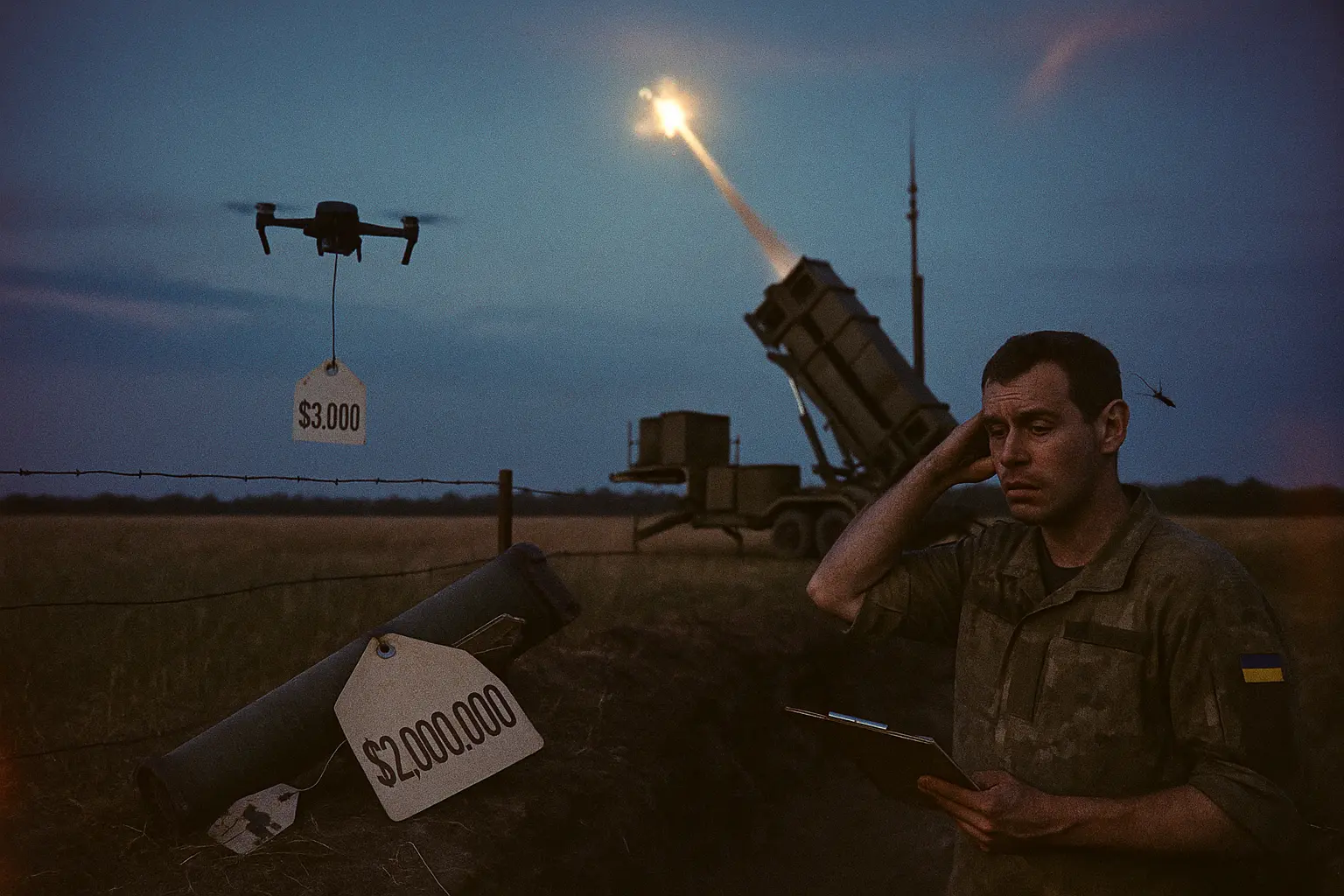
The series “The New Logic of War.” A war is won not by the army but by the endurance of the economy — and by three clocks ticking toward one another.
I. The Dull Truth Beneath All the Glamour
The nine previous texts in the series were about novelty: about drones that upended the economics of war, about surveillance that killed the fog, about the algorithm that picks the target, about open source that turned a weapon into a file. All of that is true and all of it matters. But it would be dishonest to close the series without stating an older and far duller truth, the one all this glamour so often eclipses.
Big wars — not battles, but wars — are almost never won by better weapons or a stroke of genius in maneuver. They are won by endurance: by whoever's economy keeps producing longer, whoever's demographics keep supplying people longer, whoever's financial system holds out longer, whoever's society stays willing to pay longer. All the dazzling tactical revolutions play out against this slow, heavy, almost bookkeeping backdrop. And when the glamour fades, what remains on the table is a question as old as the Peloponnesian War: who endures longer?
This text is the synthesis of the series. About war as a contest of endurances, not of strengths. About three clocks ticking toward one another — combat losses, economic attrition, and political will. And about how all nine technological revolutions we dissected actually serve one ancient end: to rattle one of the enemy's clocks faster than he can rattle yours.
II. Two Ways to Win a War: Annihilation and Attrition
The German historian Hans Delbrück introduced the classic distinction between two strategies. The first is annihilation (Niederwerfung): destroy the enemy's army in a decisive battle, as Napoleon dreamed. Fast, spectacular, final. The second is attrition (Ermattung): don't seek a pitched battle, but wear the adversary down with time, grind away his resources and his will until he breaks on his own.
All the romance of war is about the first method. All the reality of big wars is about the second. Napoleon won battles and lost the war against Russia because he could not exhaust the distance, the winter, and the stubbornness. The First World War turned into four years of mutual attrition, won by whoever ran out of men and bread later. The Cold War dispensed with a pitched battle entirely — it was won by the economic exhaustion of one of the sides.
Modern war, for all its technological glamour, has once again turned out to be a war of attrition. Drones, electronic warfare, surveillance did not lead to swift annihilation — they made the front transparent, saturated, hard to break through (this was the subject of the text on the "empty battlefield"). And when swift annihilation is impossible, what's left is slow attrition — and what comes to the fore is not the army, but what stands behind it.
III. Amateurs Talk Tactics, Professionals Talk Logistics
There's a well-known military saying: amateurs discuss tactics, professionals discuss logistics. Behind it lies a deep truth: the army is the visible tip, and beneath it hides an enormous invisible machine that feeds it, arms it, heals it, and replenishes it. Break the machine, and the finest army falls apart without a single defeat in battle.
That machine is the economy of war. How many shells a day your industry produces. How many people your demographics can supply without collapsing. How much a day of war costs and where that money comes from. Whether you can replace what's lost faster than you lose it. All these dull questions decide the fate of wars more reliably than any maneuver. The army spends — the economy replenishes. The war lasts exactly as long as replenishment keeps pace with expenditure for at least one of the sides.
IV. Three Clocks
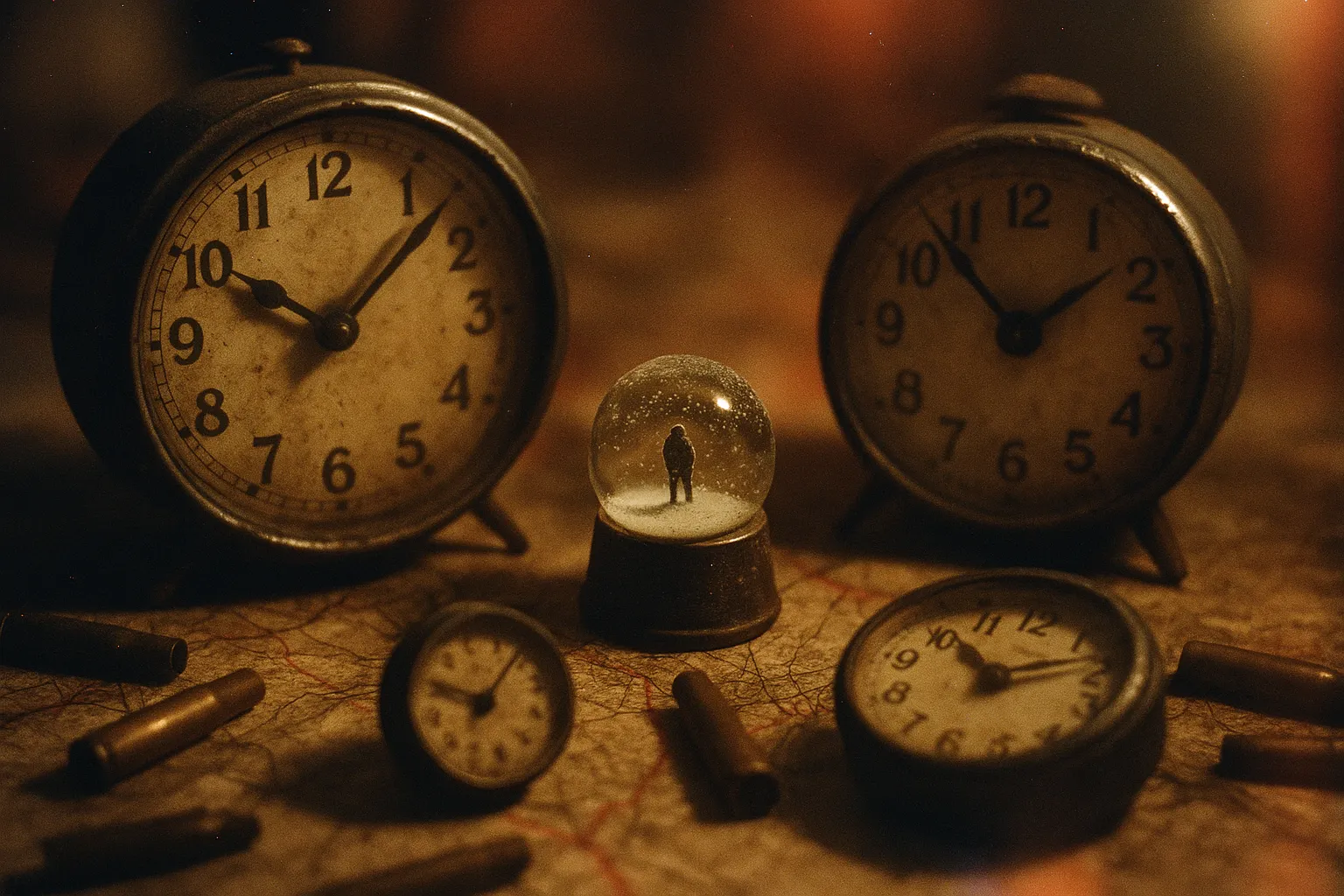
The most precise way to picture a big war is as three clocks ticking at different speeds. The war ends when one of them stops for somebody. And — the key to the synthesis of this series — every technology we dissected is an instrument aimed at one specific clock of the enemy's.
| Clock | What it measures | What attacks it (from this series) | Stops when… |
|---|---|---|---|
| Combat losses | casualties against the ability to replace them | surveillance + a kill chain measured in minutes (#3); the transparent field | there's nothing and no one left to fight with |
| Economy | money burned against the ability to rebuild | the asymmetry of cheapness (#2); strikes on the rear and energy grid (#5); sanctions | there's nothing left to fund the war with |
| Political will | society's patience to pay the price in blood and money | strikes on the rear, fatigue, information pressure | society or the elites break |
The third clock is the most capricious: it can tick faster than the first two (society breaks while it still has both people and money) or slower (a people endures destitution and loss far beyond the bounds of the "rational"). The whole strategy of a big war is an attempt to stop one of the enemy's three clocks before he stops yours.
V. What All Those Drones Are Really For: They Target the Clocks
Let's pull the series together. Every technology we dissected is not an end in itself but an instrument for attacking one of the three clocks. The asymmetry of cheapness (a $500 drone against a tank worth millions) is an attack on the economic clock: forcing the enemy to spend disproportionately more on every exchange. Cheap long-range drones hit the rear, the energy grid, the infrastructure — a blow to the economy and, at the same time, to political will. Constant surveillance and a fast kill chain accelerate the enemy's combat-losses clock. Speed of learning and open source let you sustain your own clocks longer by replacing what's lost more cheaply and faster.
In other words, the whole technological revolution of modern war is not a replacement of the old logic of attrition but its rearming with new instruments. The goal hasn't changed since Delbrück's day: break the enemy's endurance before he breaks yours. Only the levers used to press on the clocks have changed. The drone is not a new goal of war. It's a new screwdriver for an old mechanism.
VI. Why the Economy Matters More Than the Army
The historian Paul Kennedy, in The Rise and Fall of the Great Powers, showed across five centuries a single regularity: military might, over the long run, always follows economic might. States that overstrained themselves on wars beyond their economic capacity declined — even while winning battles. An empire that spends more on its army than its economy can bear wins the war and loses the century. Adam Tooze, in his study of the Nazi war economy, showed it from the other side: the German machine fought from the start against an arithmetic it could not win, and the Blitzkrieg was a bet on swift annihilation precisely because the resources for prolonged attrition did not exist. When the annihilation failed, the clocks did the rest.
The modern economic clock ticks to the same arithmetic — just with new dials. Increasingly, the attempt is to win the war not at the front but on the market: to cut off the revenues the enemy's budget lives on. The figures here are public estimates, which differ, but the order of magnitude is telling:
| Lever on the economic clock | Order of magnitude (per public estimates) |
|---|---|
| Oil price cap (G7+EU, since 2022) | ~$60 per barrel |
| Share of oil and gas in the aggressor's budget revenues | on the order of a third |
| War spending the budget was ramped up to | ~6%+ of GDP (a several-fold rise over peacetime) |
This is the whole point of sanctions, embargoes, and price caps: not to win a battle, but to slow the economic clock so the money for the war runs out before the will does. It works slowly, imperfectly, and with disputed effectiveness — but the logic is the same as Kennedy's: undercut the economy on which the army stands. Because a mediocre army on a solid economy grinds down brilliant adversaries with time, while a brilliant army on a strained economy is merely a defeat deferred.
VII. The Most Capricious Clock — the Will
And yet it would be a mistake to reduce war to economics, because the third clock — political will — is capable of outweighing the first two in both directions. A democracy can have an enormous economy and still pull out of a war because the voters have grown tired of losses in a conflict that does not directly threaten them. A poor country can endure inhuman destitution for years because for it this is a war for existence. Will does not reduce to GDP — it's about meaning: what people are willing to pay for, and for how long. That is precisely why an attack on political will (strikes on the rear, fatigue, information pressure) is often more effective than an attack on the army: breaking resolve is cheaper than breaking the economy.
Classical history made this idea the spine of whole wars. The Roman Fabius Maximus, nicknamed Cunctator — "the Delayer" — deliberately avoided the decisive battle with Hannibal, who won every skirmish: not a brilliant maneuver but distance, time, and attrition slowly ground down an army that had no way to replenish itself far from home. And Thucydides, two and a half millennia earlier, had already described the same mechanism in the Peloponnesian War: decades of mutual wearing-down in which not strength but stamina prevailed, and where "the strong do what they can and the weak suffer what they must" — and suffer, often, longer than the strong think they will.
VIII. The Paradox: Cheap War Lasts Longer
Here the series closes on a troubling conclusion. War's expensiveness once set its own limit: when fighting grew too costly, the sides were forced to negotiate. Attrition arrived sooner precisely because every shot cost a great deal.
The cheap, democratized, open war we have dissected across this whole series breaks that safety catch. When a weapon costs a few hundred dollars, is printed at home, and is developed by a community, the economic clock ticks slower — you can fight longer for less money. That is, the new technologies that make war cheaper for those who wage it cheaply at the same time make it longer. Cheapness does not shorten wars — it extends their capacity to last. And then, more and more often, the decisive factor remains the most human, least technological clock of all — the will. The one who stops is not the one who runs out of drones, but the one who runs out of meaning.
IX. Self-check: Your Three Clocks
The logic of endurance works in any prolonged struggle — a business, a career, a conflict, a project that has dragged on:
- What will really decide your "war" — a spectacular move or the ability to endure longer? And which one are you betting your resources on?
- What are your three clocks — losses, economy, will — and which one will stop first? Do you even know which is the weakest?
- Are you attacking your opponent's "army" (the visible) or his clocks (the economy, the will, the capacity to replenish)?
- Can you replace what's lost faster than you lose it? If not — you are already losing, however many episodes you win.
- Most important of all: do you have a meaning that will outlast the attrition? Because when the resources run out, only the will keeps fighting — or no one does.
X. Who Endures Longer
You can overturn the whole logic of war with new technologies — make weapons cheap, make the field transparent, hand the target to an algorithm, open the blueprints to the world. All of that is real, and all of it changes how people fight. But beneath it remains, unmoved, the old, dull truth — almost insulting in its simplicity — about who wins: whoever's economy, demographics, and will endure longer.
All nine revolutions of this series are merely sharper instruments for the ancient mechanism of attrition. They change the levers, but not the goal: to stop the enemy's clock before he stops yours. And the cruelest irony at the end is this — that cheap, open war, by making fighting more accessible, also made it longer, shifting the resolution onto the one clock that does not depend on technology at all — the human will to endure.
A war is won not by whoever has the better drones, but by whoever's clock stops last. You can win every battle and lose everything — because you ran out of people, money, or meaning first. The whole new logic of war we have dissected across ten texts in a row serves the oldest question, the one that has no technological answer: who endures longer. And most often the answer is given not by the economy and not by the army, but by what cannot be counted — what, exactly, people are willing to die for, and for how long.
Frequently asked
What actually decides a big war?
Not a commander's genius or better weapons, but endurance: whoever's economy keeps producing longer, whoever's demographics keep supplying people longer, whoever's society stays willing to pay longer. Drones decide the battle — the endurance of the economy decides the war.
What are the «three clocks» of war?
Three resources ticking toward one another: combat losses (against the ability to replace them), the economy (money burned against the ability to rebuild), and political will (society's patience to pay). The war ends when one of them stops for somebody.
What are sanctions and oil price caps really for?
Not to win a battle, but to slow the enemy's economic clock — so the money for the war runs out before the will does. By public estimates, oil and gas supply on the order of a third of the aggressor's budget revenues, and the G7+EU price cap since 2022 sits around $60 per barrel.
Why does cheap, open war last longer?
War's expensiveness once set its own limit — when fighting grew too costly, the sides negotiated. But when a weapon costs a few hundred dollars and is printed at home, the economic clock ticks slower, and the decision shifts onto the most human clock — the will: the one who loses isn't the one who runs out of drones, but the one who runs out of meaning.
Comments
Signed-in readers only — to keep it human, not a bot swamp.