Operating Layer: Eight Trends Quietly Rewriting the Rules — and Where They Lead
A week in review without the news noise: AI agents, the deployment gap, a machine-readable world, state capitalism, cascading crises, factory tourism, KPI blindness, and a physical revolt against data centers. One shared shift — from tools to integrated systems — and a detailed forecast of where it's all rolling.

On this page
- The Main Signal: the Era Has Moved to the Operating Layer
- 1. The Agentic Divide: the Split Won’t Be Between “Has AI / No AI”
- 2. The Deployment Gap: Models Aren’t the Bottleneck — Implementation Is
- 3. Reverse UI: the World Becomes Machine-Readable
- 4. State Capitalism: Political Bargaining as a Valuation Factor
- 5. Crisis as a Cascade, Not a Single Villain
- 6. Factory Tourism: China Sells Not Cheapness but Embodied Competence
- 7. The KPI Eats Reality: the Week’s Best Antidote
- 8. AI Isn’t in the Cloud — It’s in Water, Land, and Permits
- Forecast Synthesis: What to Actually Do With This
- Self-Critique, Honest Limits, and a Strong Counter-Thesis
This isn't "follow the news." It's an inventory of a shift that's easy to miss, because it doesn't scream from a headline. Eight different stories — AI, the state, China, crises, ecosystems — and all of them about one thing: the edge has moved from the level of "having a tool" to the level of "owning a system."
The Main Signal: the Era Has Moved to the Operating Layer
Compress a week of analysis into a single thesis and it reads like this: the world is leaving the phase of “grand narratives” and entering the phase of the operating layer. Not “which model is better” — but “whose agent is wired into the workflow.” Not “the state regulates” — but “the state bargains for a stake.” Not “China is the factory” — but “China sells the feeling of speed.” Not “demographics is a personal choice” — but “countries compete for families and care systems.”
The shared mechanism: a system loses or alters its primary function the moment it starts getting optimized for a new center of power. And from this comes the one transferable rule of the week: the edge belongs not to those who have the tools, but to those who have integrated systems. Not AI — but trusted agents. Not the model — but the deployment. Not the KPI — but the ability not to reduce a living system to a single metric. Whoever controls the workflow holds the lever. Whoever has a mere chatbot holds a pretty illusion of productivity.
Below are the eight trends and a forecast of how each plays out in practice. The forecast is deliberately concrete (that’s its only value); where it’s speculation, I say so outright.
1. The Agentic Divide: the Split Won’t Be Between “Has AI / No AI”
The coming inequality isn’t between those who have AI and those who don’t. Everyone will have AI. The divide will be between those who have trusted agents wired into their processes (with data access, permissions, quality control, escalation logic) and those who have a cheap chatbot and a few scripts. “Good enough AI” is a trap: a company thinks it’s “already in AI” because it has ChatGPT, but there’s no real edge, because the agent isn’t integrated into decisions.
Where it leads (2026-2030): a new class of infrastructure appears — the company’s “agentic operating system”: agents for research, sales, QA, follow-up, reporting, monitoring, with a human in the critical loops. The winners aren’t the model owners but the owners of workflow + data + trust. The losers are those who confused having a chat with having a system.

The divide isn’t “has AI / no AI” but tool versus system. The duck sits on the desk where the agent is wired into the workflow, not the one where it lies in a separate tab.
2. The Deployment Gap: Models Aren’t the Bottleneck — Implementation Is
The most lucrative boring truth: the model is no longer the bottleneck. The bottleneck is deployment into a dirty operational reality. Per a widely cited MIT report (2025), roughly 95% of corporate AI pilots deliver no measurable ROI — not because the models are weak, but because of integration, data, permissions, organizational unreadiness. The unexpected winners aren’t the labs but those who can crawl into legacy systems, messy data, and enterprise politics and get it all the way to production (Indian IT as the case study).
Where it leads: value capture shifts from “the magic of AI” to “deploying AI into the dirty reality.” A separate service class grows up — AI implementation: diagnose the bottleneck → workflow mapping → deploy agents into CRM/Gmail/reporting → before-and-after ROI. Selling “we’ll plug in AI” stops working; what sells is “we’ll find the bottleneck and wire in a system.”
3. Reverse UI: the World Becomes Machine-Readable
The strongest philosophical shift: AI stops being “a chat on a screen” and becomes a layer of perception of the world. Before, a human read the machine’s interface (buttons, menus). Now the machine reads the environment: cameras, signage, rooms, products, documents, warehouses, movements, context. This is reverse UI — the interface has turned inside out.
Where it leads: reality is gradually designed for machine reading — from parking lots and warehouses to signage and packaging. “AI visibility” pushes beyond text into physical space: whoever wants to be “read” by the machine designs the environment for it. Capture workflows (glasses, sensors) become a normal work tool, not a gadget.
4. State Capitalism: Political Bargaining as a Valuation Factor
Industrial policy mutates into personalized state capitalism. The state no longer merely grants subsidies or regulates — it can take a stake, veto rights, political control in strategic industries (chips, rare earths, defense, quantum). Support arrives not through a stable policy framework but through a semi-political transaction with the powers that be. A new class of risk is born: equity-for-access and policy capture.
Where it leads: for investing, fundamentals become insufficient. A political-risk layer is added to valuation: is the company in a zone where the state can say “nice business — now we’re in the cap table too.” Almost like VC, only with a flag and a prosecutor’s office. Whoever doesn’t model this underprices the risk in the hottest sectors.
5. Crisis as a Cascade, Not a Single Villain
The most useful macro frame: big crises rarely have a single cause. They emerge when several stress factors synchronize: energy + a monetary mistake + financial fragility + leverage + earnings + liquidity. The primitive fairy tale “2008 happened because of greedy bankers” is worse than wrong: it makes you not smarter but calm in the wrong place.
Where it leads: for an investor this means looking not for “the main trigger” but for the sequencing of stress — the order in which the factors fall onto one another (energy → rates → credit → earnings → liquidity). Risk-cascade models (watching 5-7 macro indicators together, not separately) beat the search for “one signal.”
6. Factory Tourism: China Sells Not Cheapness but Embodied Competence
A very elegant geotech signal: founders and investors pay up to ~$9,000 for tours of the factories of BYD, robotics, robotaxi, and Chinese AI companies. This isn’t tourism — it’s FOMO-driven reconnaissance. The change is that China no longer sells cheap manufacturing but a feeling of speed, scale, vertical integration, and embodied competence.
Where it leads: “economic pilgrimage” becomes its own genre — founders travel not to conferences but to factories, ports, data centers, robotaxi hubs. China exposure stops being assessed solely through macro fear and regulatory noise — people start looking at production density: factory floor, supply chain, manufacturing tempo. The broader lesson: sometimes “going to see the system” has a higher ROI than twenty reports.
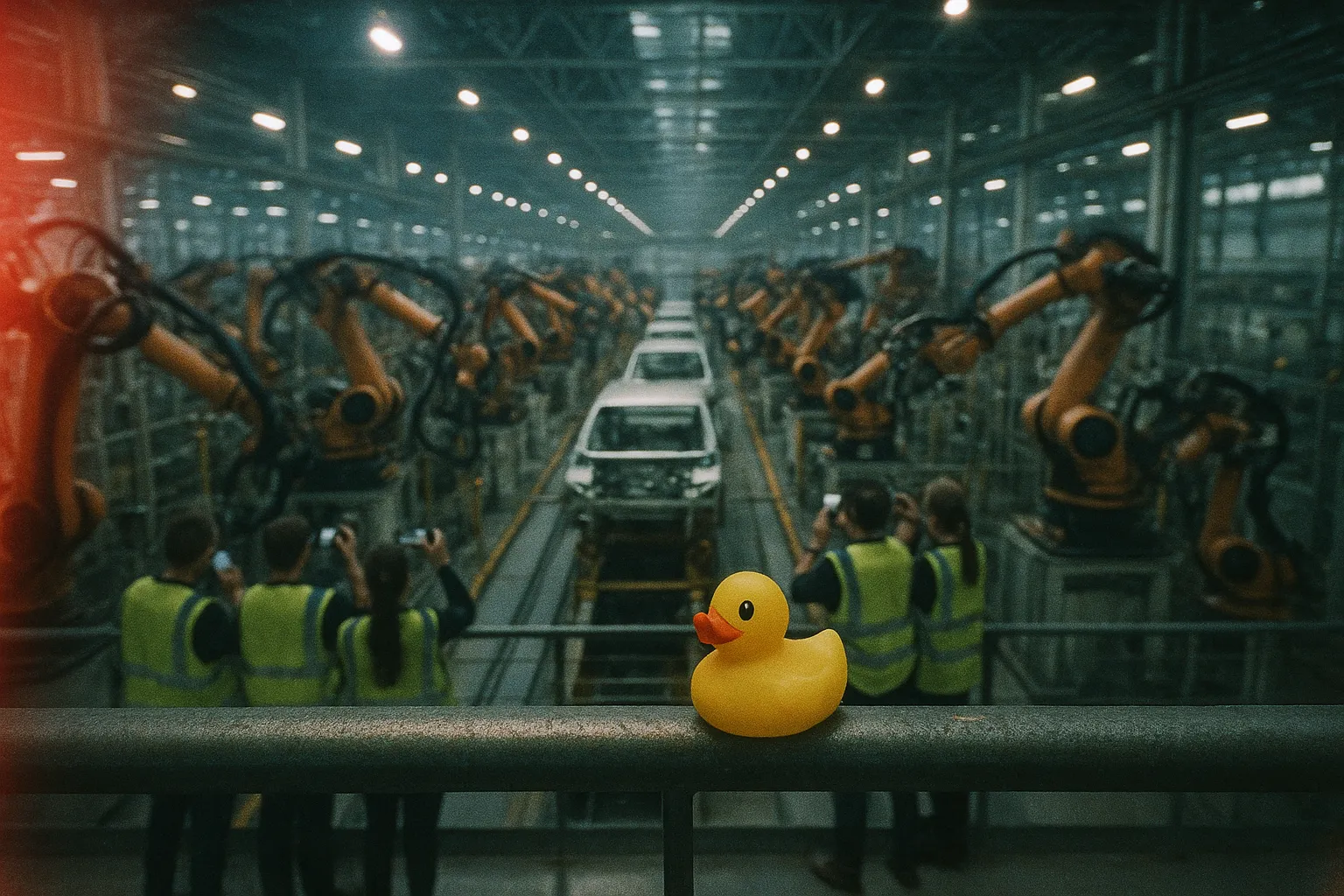
China no longer sells cheapness but embodied competence — speed, scale, vertical integration. Founders pay to see it; the duck on the railing watches for free.
7. The KPI Eats Reality: the Week’s Best Antidote
The subtlest systems-thinking signal: when we say a system “works” or “breaks,” we often substitute a human function for a more complex reality. The Amazon doesn’t “exist to absorb carbon.” A bee doesn’t “exist for pollination.” These are functions important to us, but they don’t exhaust the value of the living. The moment one metric becomes “reality,” it begins to destroy the more complex value.
Where it leads: this is the meta-risk of the entire AI-automation era. Sales revenue can destroy delivery quality. Speed can destroy judgment. AI automation can destroy trust. Traffic can destroy style. Forecast: the winners aren’t those who best optimize one metric, but those who notice in time that the metric has started eating the very thing it existed for. (This, by the way, is the same trap as in the previous seven trends: optimizing for a new center of power kills the primary function.)
8. AI Isn’t in the Cloud — It’s in Water, Land, and Permits
A bonus, but the signal is strong: the backlash against AI stops being an abstract “the models will take our jobs” and becomes very bodily — noise, water, electricity, real estate, distrust of Big Tech. Data centers look like pure growth infrastructure, but in fact they carry political permitting risk: local communities become a veto layer.
Where it leads: investments in AI infra get repriced through physics and politics, not just demand for compute. AI seems like a cloud — but in fact it’s cables, land, water, transformers, permits, and neighbors. Whoever builds a data center now negotiates not only with the market but with the village next door. (And the village, as we saw in a separate longread on the great emptying, is emptying out right now — and that, too, is part of the equation.)

AI seems like a cloud — yet it lives in water, land, transformers, and permits. The data center now negotiates not only with the market but with the village next door. The duck on the fence is on the village’s side.
Forecast Synthesis: What to Actually Do With This
If you boil the eight down to action: build not a set of features but an operating system. For a business (WikiBusiness / Dnister type) this means — not “add AI features” but build out an integrated layer: CRM, research, sales, QA, client updates, monitoring, follow-up, escalation. For an investor — add two new layers to the fundamentals: political risk (who can walk into the cap table) and physical/permitting risk (water, land, permits). For an operator — ask not “which tool is cool” but “where’s my bottleneck and what system do I wire in there.”
Whoever controls the integration holds the lever. Whoever has only a tool holds a dashboard that glows nicely while someone nearby quietly owns the system.
The 2026 edge isn’t in having a tool — it’s in owning an integrated system. The rest is a pretty illusion of productivity with a nice UI.
Self-Critique, Honest Limits, and a Strong Counter-Thesis
A trend review is a genre that’s easiest to turn into pattern-matching theater. So, honestly.
Self-critique. “Eight different trends — and all of them point to one thing (systems > tools)” is a suspiciously tidy narrative. Reality is rarely that neat; part of this unity I laid on from above, because it makes the text more readable. I chose the sharpest formulations (“war for bodies,” “the state in the cap table”) because they catch — at the cost of nuance.
Limits. (1) This is a review + forecast, not research: everything after “where it leads” is speculation, and five-to-seven-year forecasts systematically miss. (2) The numbers (~95% of pilots with no ROI; ~$9,000 per tour) are as reported in 2025-2026 sources, not verified by me against the primary sources line by line; take them with caution. (3) This is not investment advice — it’s a thinking frame. (4) I haven’t accounted for trend breaks (a regulatory shock, a technological leap, a recession that sweeps away half these storylines).
Strong counter-thesis (steelman). Maybe “operating layer” is a consultant’s reframe that conveniently sells implementation services (and that’s exactly what the business of this review’s author lives on — so beware motivated reasoning). “Systems > tools” is a thesis so general it’s almost always true and therefore almost useless: the same held in the era of ERP, and CRM, and the cloud. Most “trends of the week” will fizzle, mutate, or turn out false within a year — so the only honest value of such a review isn’t in prediction, but in provoking one concrete decision (wire in one agent, add one risk layer), not a feeling that you “understand the future.” If you’ve read to the end and won’t do anything concrete — that was a well-made but useless scroll.
Frequently asked
What is a trusted agent and how does it differ from a regular chatbot?
A trusted agent is an AI component wired into a specific workflow: it has access to company data, permissions to act, escalation logic to a human, and quality control. A chatbot answers queries; a trusted agent autonomously executes workflow steps and is accountable for outcomes. The difference is between a tool and a component of an operating system.
If the winners are those who own the system, not the tool — what exactly should be built right now?
Not adding AI features one at a time, but building one end-to-end automated chain: for example, research to CRM entry to follow-up to reporting. One embedded agent with real data access and escalation logic delivers more than ten separate chat windows. The starting point is to identify a specific bottleneck in your operations and wire a system into that exact spot.
Systems versus tools was also the pitch for ERP, then CRM, then the cloud. Why is this time different?
The author acknowledges this himself as the strongest counter-thesis: the claim is so general that it is almost always true, and therefore almost useless. The 2026 distinction is the speed at which agents can integrate into arbitrary workflows without heavy customization; whether this is a structural shift or another hype cycle will only become clear in three to five years.
If 95% of corporate AI pilots deliver no measurable ROI, does that not simply mean AI does not work in business?
It means implementation fails when it ignores dirty operational reality: legacy data, permissions, and organizational resistance. The models themselves are not the cause of failure; failure happens at the deployment layer. Companies that have solved the integration problem gain an edge precisely because most competitors are still stuck at the pilot stage.
What is one concrete action to take after reading this, so it does not remain a well-made but useless scroll?
Pick one repeating process in your business where a person executes mechanical steps, and set a deadline to wire in an agent with real data access by end of month. Not plan an AI strategy, not buy subscriptions: embed one system in one place and measure the before-and-after result.
Comments
Signed-in readers only — to keep it human, not a bot swamp.