How Ukraine Accidentally Became NATO's R&D Lab While NATO Was Still Writing Tenders
Operation Spiderweb wrote off a third of Russia's strategic air fleet with $2,000 drones, while the F-35 at $2 trillion waits five more years for an upgrade. This isn't a story about weapons — it's a story about two speeds of thought. A breakdown through cost-exchange, Boyd's OODA loop, 'Pentagon Wars,' and the honest nuance that the lab runs in both directions. With a decision-loop audit tool for your own cycle.
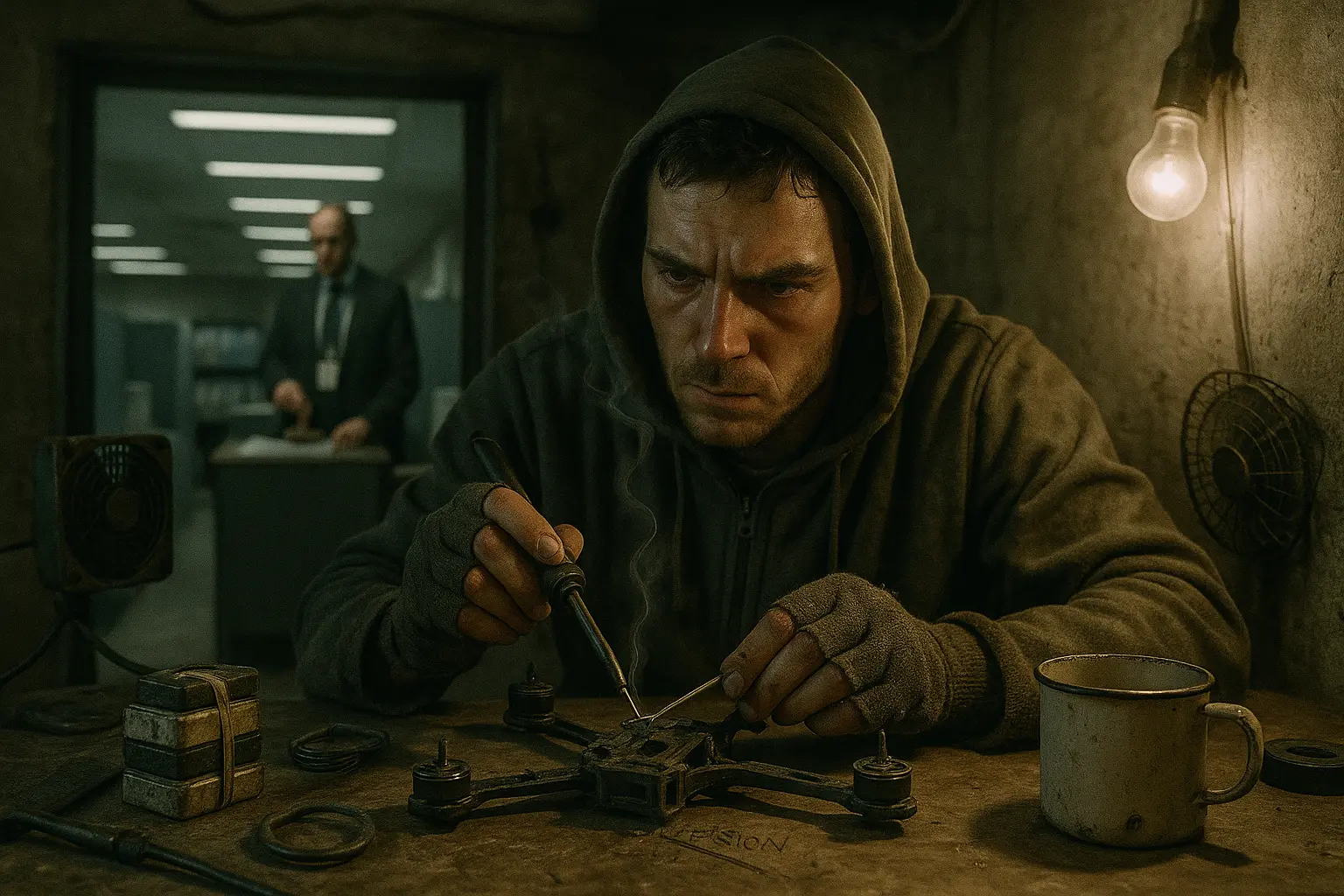
On June 1, 2025, ordinary trucks rolled down Russian roads past gas stations and checkpoints. Inside each — a wooden crate; inside the crate — an FPV drone worth two thousand dollars, assembled by hands that learned to solder the year before. The roofs opened remotely, hundreds of kilometers from the front line, and within minutes Ukraine had written off roughly a third of Russia's strategic bomber fleet — hardware the USSR and Russia had been building for decades. The score, as Kyiv estimated it: $2,000 against $7,000,000,000.
Now hold that number next to another one. The F-35, the most expensive weapon in Pentagon history, will cost over $2 trillion across its full lifecycle. Its Block 4 upgrade was just pushed back another five years, running $6 billion over budget. While one civilization spends five years rewriting the tender for an aircraft upgrade, another rewrites the aircraft itself in a week.
That is the story. Not "brave Ukrainians against evil Russians" — you've seen that series already. The story is thinner and more uncomfortable: battlefield iteration versus specs-cycle. The battlefield counts faster than the committee. And the worst part — the committee knows this, but is structurally incapable of doing anything about it. Because the safest career move inside a large system is not to make mistakes, and the only way not to make mistakes is to release nothing until everything is described. The perfect specification is ready precisely when there is nothing left to specify.
A personal stake, so you don't think I'm observing from above. I build businesses and systems. And I recognize this disease not in the Pentagon — I recognize it in myself. I have my own internal committee that has spent years "finishing the perfect version" of a product while the market's front line has long been demanding a working prototype. This text is about drones exactly as much as it is about how many self-improvement tenders you've written instead of a single field test.
The antagonist has a face, and that face is the process
Let's name the enemy. It is not a stupid official — a stupid official would be merciful, because you can fire him. The enemy is the general-developer of the Bradley Fighting Vehicle. Not fictional: in the film "Pentagon Wars" (HBO, 1998), the general was played by Kelsey Grammer, and the real chronology described by Colonel James Burton in his investigative book (which, it should be noted, some military historians consider biased in Burton's own favor — though this doesn't make the machine any less unfit for purpose) served as the basis for the plot.
The scene. Late 1970s, a proving ground. A colonel looks at a design that was supposed to be a light armored personnel carrier — essentially an armored taxi to get infantry from point A to point B alive. The task is as simple as a nail. Then the process starts. "Higher-ups" add a requirement: let it carry more soldiers. Then: let it have a turret. Then: let it have a cannon, so it's not just carrying but also shooting. Then — anti-tank missiles. Then armor for the new cannon. Seventeen years. $14 billion. The output — an ungainly machine fit neither for carrying infantry nor for tank combat, but vulnerable enough that in the film's climax Burton demands an honest live-fire test with real ammunition inside, and the general fights it with everything he has. Because the test will show what everyone already knows, and knowing it officially is grounds for dismissal.
The genius of this story isn't that anyone was an idiot. Every individual change was rational. "Makes sense it should carry more." "Makes sense it should be able to shoot back." Every signature in the chain protected someone's small local interest — and the sum of all rational signatures produced a monster. This is a tender where the winner is already sitting on the committee. This is a system where no one is at fault, and the result is catastrophe.
Contemporary incarnations of the same antagonist have simply changed in scale. Replicator: in August 2023 US Deputy Secretary of Defense Kathleen Hicks promised to field "thousands" of autonomous systems in 18–24 months, to counter China's mass. By the deadline (August 2025) there were "hundreds," not thousands — the exact number is classified, but even the Congressional Research Service documents the scale of the failure. The program had to be handed to a new structure to drag it to the critical 2027 deadline. Which means the tender for mass scale was itself unable to scale. The bureaucracy meant to chase the swarm lapped itself on the turn and ran into its own tail.
And the F-35 is a Bradley that survived and grew up. From concept to combat readiness — over 20 years. Block 4 was promised by 2026, then pushed to 2029, and now the GAO says: even a reduced set of upgrades won't be ready before 2031, with some functions not arriving until the mid-2030s. A system designed for twenty years and upgraded over decades risks becoming obsolete before it's even commissioned. This isn't an aircraft. It's a monument to process — the world's most expensive way to be late.
Monday, Friday, Monday
Now the other speed. Remember this rhythm — it will repeat.
A Ukrainian operator invents a technique on Monday: a new flight profile, a new frequency, a new terminal-approach maneuver. The technique works. By Friday Russian electronic warfare has jammed it — the other side doesn't sleep either. Over the weekend the operator talks directly to the engineer who built that drone and makes the diagnosis: here's where they're crushing us, here's how we're going down. By the following Monday the engineer has rewritten the firmware, and the drone returns to combat as a different machine. The cycle begins again.
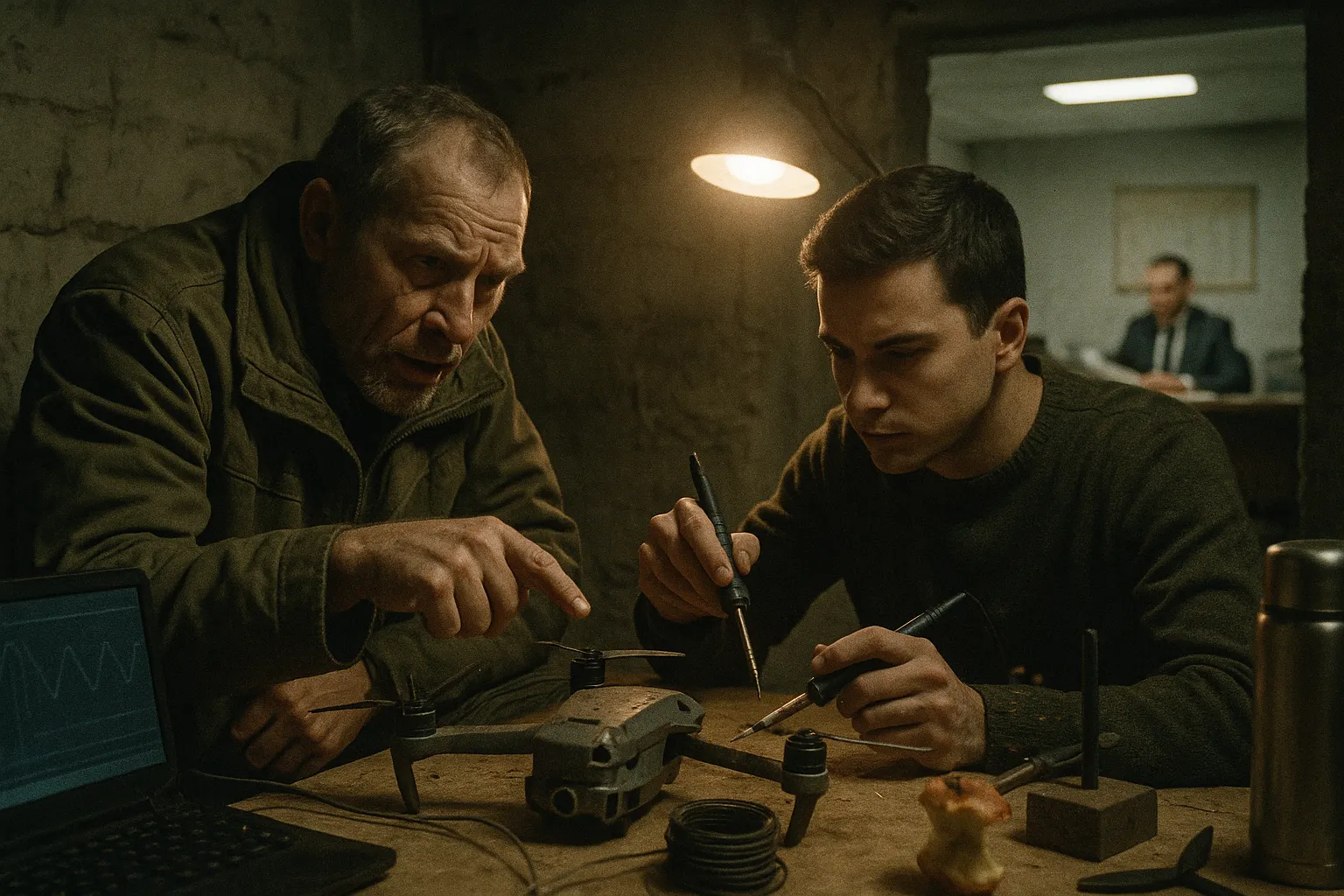
The entire loop — two people over one table and zero levels of approval between the error and the correction. Behind the wall, the same tender is moving into a new folder. And the fruit flies aren’t alone — the colony has run several generations in the time it takes to patch firmware.
This isn't a metaphor. It's the documented rhythm of the war. Exponential View analysts described it this way: a device is designed, deployed to the front, the enemy jams it, the operator in conversation with the engineer makes a diagnosis, it is redesigned and returned to combat — in roughly seven days. Full cycle from idea to combat hardware — one week. Not a tender for a week, not a meeting about a week, not a roadmap of a week. The entire cycle — in one week.
One manufacturer, Vyriy Drone (founder Oleksiy Babenko), raised strike accuracy from roughly 10% to 70–80% in a single upgrade cycle — simply because the engineer heard the operator directly, without fifteen approval levels between them. Imagine: seven out of ten hits instead of one. Not new technology, not a materials-science miracle — just a short feedback loop. The winner isn't the one with the better weapon but the one with the shorter distance between error and correction.
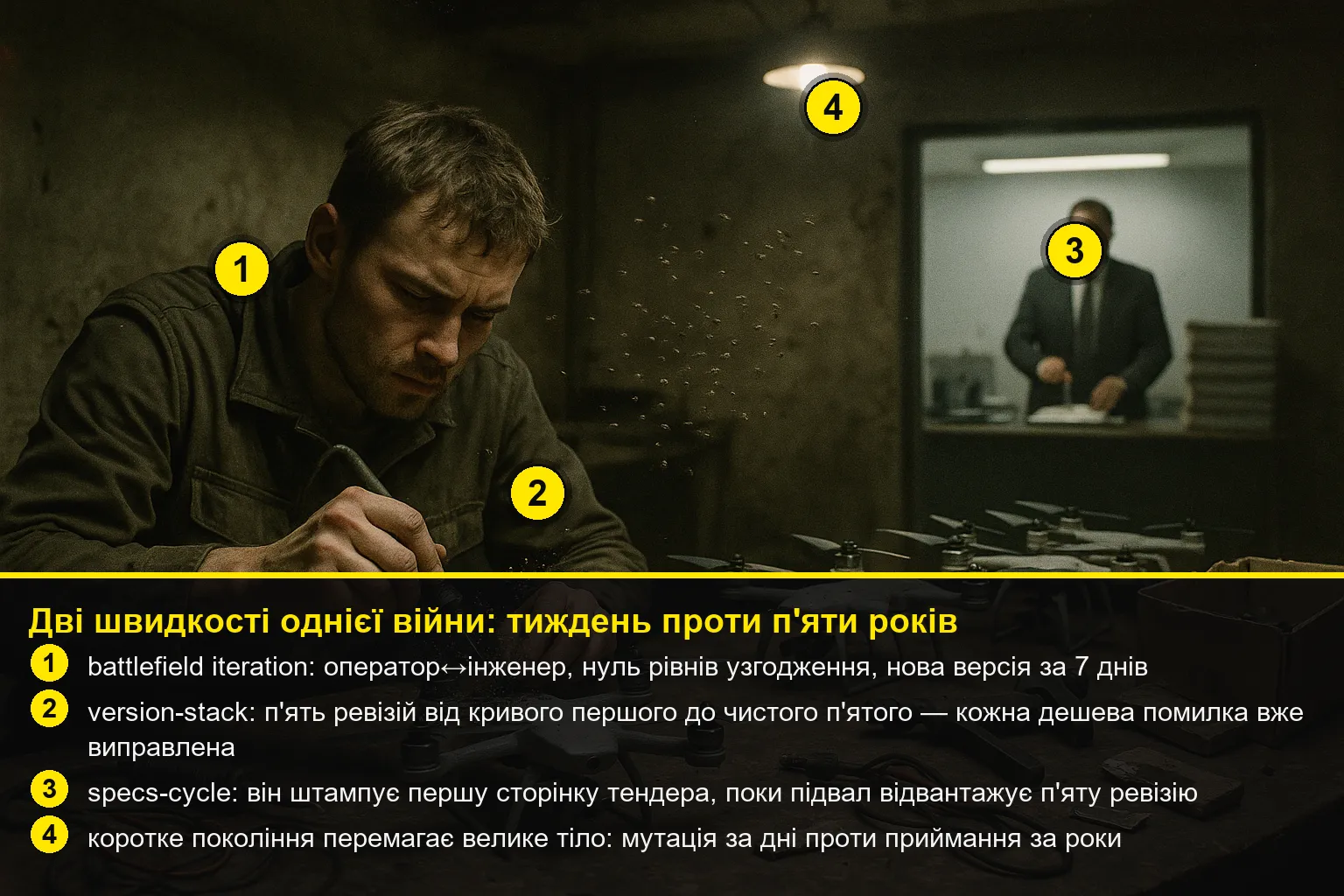
Left — the seven-day loop: five revisions lined up from crooked first to clean fifth. Right — the five-year loop: an official stamps the first page of a tender while the basement ships its fifth. Above the table — a full swarm of fruit flies: a short generation always rewrites itself faster than a large body can commission it.
This is John Boyd's OODA loop — fighter pilot, who in Korea noticed something strange: the American F-86 was outmatched by the MiG-15 in thrust and acceleration, but won the fights. Boyd formalized why: "Observe, Orient, Decide, Act." The winner isn't the stronger but the one whose loop is shorter; the one who completes a full cycle while the opponent is still orienting. Ukraine compressed the loop to seven days — operator to engineer, no intermediaries. NATO has a loop measured in years — tender, specification, contract, acceptance, repeat tender for corrections. Boyd would call this not a loop but a noose the system is tightening around its own neck.
And here, the first mirror for you — not at the end, but now. Is your personal decision loop closer to seven days or twenty years? When did you last release something — not "finish it up a bit," not "polish it just a little more before showing anyone," but release it raw and watch it fall? Or is your internal Block 4 also pushed to 2031 "due to risks"?
The economics broke before the weapons did
Now the numbers that give headaches to people who spent decades optimizing "cost per platform."
An FPV drone costs roughly $300–500 in off-the-shelf components. It destroys a tank worth millions: an American M1 Abrams — $8–10 million, a Russian T-90M — around $4.5 million. Even if it takes ten drones per tank, that's $10,000 — and the ratio still stands at roughly 1:1000. RUSI estimates Ukraine spent around $1–2 billion on drone programs in the first 2.5 years of the full-scale war, while OSINT has documented over 3,000 Russian tanks destroyed or damaged. Tens of billions of burned steel against a couple of billion in plastic and microchips.
| Logic | The West optimizes for | Ukraine optimizes for |
|---|---|---|
| Unit of account | cost per platform | cost per target killed |
| Cost benchmark | F-35 ≈ $2T / lifecycle | FPV ≈ $300–500 / unit |
| Upgrade cycle | Block 4: +5 years, +$6B | firmware: ~7 days |
| Volume | Replicator: "thousands" → "hundreds" | 20,000 → 200,000 FPV/month in one year |
| Who manufactures | government contract, a few giants | garages, volunteers, ~500 producers |
| Objective function | don't err in the specification | err cheaply and correct fast |
This is precisely Clayton Christensen's theory of disruptive innovation, only with blood. Christensen showed how a cheap, "good enough" solution eats the premium product from below: first the market leaders laugh at it, then it matures and takes everything. Here "from below" is not a marketing metaphor — it's literally zero altitude above the trench. A $500 drone isn't trying to be better than the F-35. It isn't even playing the same game. It simply makes the F-35 economically pointless — just as a digital camera didn't beat Kodak on film quality but made the question of film irrelevant. The worst way to lose is not to lose the fight but to discover you've spent decades winning the wrong game.
The scale of the mutation: FPV production in Ukraine grew from roughly 20,000 per month at the start of 2024 to around 200,000 per month by year's end. Ten-fold growth in twelve months. In 2024 — roughly 2.2 million UAVs of all types, over 1.5 million of them combat FPVs. For 2025 a capacity of up to 4 million drones per year has been announced. This isn't a factory on a government contract. These are people who a year ago didn't know which end of a soldering iron to pick up, now holding a pace no defense giant with quarterly reporting could dream of — because quarterly reporting is that pace, and faster than it the giant physically cannot go.
And the state here behaves atypically. Brave1 — the government defense-tech cluster — had issued over 500 grants totaling around $57 million by April 2025, with 1,500 companies and 3,500+ projects in the system; a new round launched in 2025. Over 50 Ukrainian defense-tech startups raised $105+ million in venture capital in a year. The state here is not the tender-writing client who spends ten years drafting requirements. The state here is a fast router for money to the front. The difference between an operator who connects a call in a second and a registry office that logs an incoming letter for three weeks, then loses it in the outbox.
The honest nuance: the lab runs in both directions
Now the part where I ruin the heroic movie for you. Because without it, this text would be just as dishonest as the 2023 Replicator program presentation, where "thousands" of drones existed only in slide form.
The myth "Ukraine is always first" is a dangerous drug. Fiber-optic drones — those that trail a physical cable and are therefore in principle immune to electronic warfare, because there's no signal to jam when it travels through wire — were first deployed at mass scale in combat by Russia. The Knyaz Vandal Novgorodsky model, Kursk region, approximately August 2024, with a spool of around 10 km. Ukraine responded quickly with its own version, but it responded second. Spools have since grown to 5–20 km, with prototypes reaching 50.
And here it is again, that same rhythm — only now not in our favor. The Russians deployed fiber optics on Monday. By Friday Ukrainian logistics routes near the border started burning, because EW is powerless against a cable — jamming a wire is as futile as yelling at a telephone cord. By the following Monday Ukrainian engineers were frantically searching for countermeasures. The loop of "new capability — countermeasure — counter-countermeasure," which once took years, now plays out in weeks — in both directions. This is predator-prey co-evolution, not one-sided advantage. Like antibiotics: you invent a drug, the bacterium invents resistance in a few generations, you invent the next one — and so on without a final whistle. A short loop is not your pet. It's a law of the environment, and it feeds whoever is across from you equally.
Which brings us back to biology, because it's more honest here than geopolitics. Short generation beats large body. A bacterium mutates in hours and routes around a drug that an elephant would need millions of years of evolution to develop. Ukraine is the fast mutation. A large regular army is the elephant: powerful, armored, with generational memory and a complete inability to change within a single combat season. But elephant versus bacterium is not a David-and-Goliath story with a guaranteed happy ending. It's simply a reminder that in evolution the winner isn't the biggest or the smartest, but the one who rewrites itself fastest for the environment. And the environment right now is rewriting everyone — regardless of whose side you're rooting for.
The raw material of distillation is people
There's one more piece of evidence that the battlefield test is merciless, and it hits people I actually root for. Anduril — a startup valued at roughly $31 billion, Silicon Valley's darling, the icon of "new defense." In 2022 it supplied Ukraine with a batch of Altius loitering munitions. Ukrainian forces rejected them by 2024 — reportedly after repeated failures under Russian electronic warfare: the company underestimated how high-power jamming severs the comms link, without which a smart machine becomes a blind lump of metal. Anduril and Palantir update software every 3–4 weeks — fast by Valley standards. Turned out: not fast enough by front-line standards, where the cycle is a week. Meanwhile Palantir Gotham, according to CEO Alex Karp, is responsible for "most of the targeting in Ukraine." The Valley didn't come to teach Ukraine. The Valley came to learn — and found out that its three-year cycles are considered slow, and its $31 billion icon gets rejected by a sergeant with one combat season's experience.
And here's the philosophy, without which all the fascination would be vulgar. McLuhan said: we shape our tools and thereafter our tools shape us. When war becomes an R&D laboratory, the human operator imperceptibly transforms into a sensor in the feedback loop for the machine — a data source generating the signal "here's where they're jamming us," which the engineer converts into the next firmware version.
"Distillation of experience" sounds like progress — until you remember what the raw material of that distillation is. In the primary source, the diagnosis is made by "an operator who lost his drone, in conversation with the engineer who built it." "Lost the drone" — a nice engineering euphemism. Sometimes it means exactly what it says: the device crashed. And sometimes behind that phrase is a person who won't be telling anyone anything anymore, and whose final flight became a row in a dataset. The seven-day loop runs on more than plastic. This is the real price of speed, which no cost-exchange table will ever calculate — because the "cost" column always shows the price of the steel, never the price of the one who carried it.
The tool: audit your own loop
You can't change geopolitics. You can change your loop. So here is a scalpel for cutting yourself, not the news.
Answer five questions honestly. Not "how it should be" — how it is.
| Question | You are the "Committee" (specs-cycle) | You are the "Front" (battlefield iteration) |
|---|---|---|
| How long from idea to when an outsider sees it? | months; "not ready to show yet" | days; I show it raw |
| Who gives you the failure signal? | no one / yourself / an imaginary critic | a real user, directly, with no buffer |
| How many levels between the error and the person who fixes it? | many: approvals, permissions, "let's discuss this" | zero: the one who sees it is the one who fixes it |
| What do you do with failure? | hide it, agonize, postpone the launch | treat it as data, rewrite, return to action |
| How many parallel attempts are running at once? | one "perfect" one — still in development | many cheap ones; need to find the live one |
If your column is mostly the left one — you have a Bradley general living inside you. He's not malicious. He sincerely wants the result to be perfect, so he adds one more requirement, then another, then another — seventeen years, $14 billion, an armored taxi that doesn't drive. The cure isn't to become reckless. The cure is a single move: shorten the distance between your error and your correction to one week. Release something on Monday. Let it fall by Friday. Fix it by the following Monday. Then do it again — because one cycle isn't enough, and that's the whole point.
Finale on the blade's edge
Back to the trucks on Russian roads. The most terrifying thing about Operation Spiderweb isn't the audacity, and isn't the $7 billion in burned bombers against $2,000 per drone. The most terrifying thing is that it worked on the first try, without a proving-ground rehearsal, without a twenty-year acceptance cycle, without any committee that had signed off "approved." While some were writing requirements for a future advantage, others already had the advantage and used it.
The first long-term legal framework for EU defense industry — EDIP — was adopted by the EU Council on December 8, 2025. Almost four years into the full-scale war. €1.5 billion in grants for 2025–2027, of which €300 million goes to Ukraine, now officially written into the scheme as a participant in "joint procurement logic." Translation: the lab was sewn into a tender that is only now coming into force. The test subject was invited to co-author the methodology — three and a half years after it ran all the key experiments with its own blood.
Ukraine became NATO's R&D lab not because anyone planned it. But because it didn't have the luxury of slowness — that same luxury that wealthy systems mistake for maturity. That's what's haunting: the advantage is born not from wisdom but from the absence of a backup option. The elephant can afford not to mutate. The bacterium cannot — so it mutates. And the next time you feel like "finishing the perfect version" of something — a product, a career, yourself — remember the general in the film who spent seventeen years perfecting a machine into complete uselessness, while someone in a garage assembled in a week something that simply flies.
The question isn't whose weapon costs more. The question is whose loop is shorter. And that question you cannot delegate to anyone — committees don't answer it. They discuss it. For years.
Frequently asked
What is Boyd's OODA loop and why does it explain the advantage of Ukrainian drones over the F-35?
OODA is the cycle 'Observe, Orient, Decide, Act,' formulated by pilot John Boyd: the winner isn't the stronger — it's the one whose loop is shorter. Ukrainian operators close this cycle in 7 days — from a drone failing in the field to a rewritten firmware. NATO closes the same cycle in years: tender, specification, contract, acceptance, new tender to fix what broke. The F-35 Block 4 upgrade is a concrete example: pushed to 2031, with some functions remaining until the mid-2030s.
What is cost-exchange and what is the score in Operation Spiderweb?
Cost-exchange is the logic where what matters is not the price of your weapon but the price of your weapon relative to what it destroys. In Operation Spiderweb (June 1, 2025), Ukraine disabled roughly a third of Russia's strategic bomber fleet with $2,000 drones — against a fleet Russia built over decades estimated at $7 billion. An FPV drone at $300-500 destroys a tank worth $4.5-10 million; even at ten drones per target, the ratio stays 1:1000 in the drones' favor.
Why did Vyriy Drone raise accuracy from 10% to 70-80% without any new technology?
Vyriy Drone founder Oleksiy Babenko cut the number of levels between the operator who 'lost' a drone in combat and the engineer who built it to zero. The engineer hears the operator directly, with no approvals, and rewrites the firmware in a week. That direct feedback loop — not new materials or algorithms — lifted the hit rate from one in ten to seven in ten, which is the clearest illustration of the thesis: the winner isn't the one with better weapons but the one with a shorter distance between error and correction.
Why are fiber-optic drones evidence against the 'Ukraine is always first' thesis?
Fiber-optic drones — which trail a physical cable and are therefore in principle immune to electronic warfare, because there is no signal to jam when it travels through wire — were first deployed at scale in combat by Russia. The Knyaz Vandal Novgorodsky model on the Kursk front, approximately August 2024, with a spool of around 10 km. Ukraine responded quickly with its own, but it responded second. This proves that a short OODA loop is not any one side's monopoly: it is a law of the environment, and it feeds whoever is across from you equally, turning the conflict into a predator-prey co-evolution rather than a one-sided technological advantage.
How do Anduril and Replicator illustrate the limits of even 'fast' defense tech?
Anduril — a startup valued at roughly $31 billion — supplied Ukraine with Altius loitering munitions in 2022, but Ukrainian forces rejected them in 2024 following repeated failures under powerful Russian electronic warfare: the company updates software every 3-4 weeks, which is fast by Silicon Valley standards but slow by front-line standards with a seven-day cycle. The Replicator program, where the Pentagon in 2023 promised 'thousands' of autonomous systems in 18-24 months, had delivered 'hundreds' by the deadline (August 2025) and had to be restructured — the bureaucracy meant to chase the swarm ran into its own tail.
Comments
Signed-in readers only — to keep it human, not a bot swamp.