Poland — Europe's Most Toxic Friend
A scalpel dissection of the Polish-Ukrainian alliance 2022–2026: real aid and real pain, the historical account from both sides, the monument war, street-level temperature, the sociology of fatigue — and Russia as editor, not author. Not brotherhood. Strategic necessity with an exposed nerve.
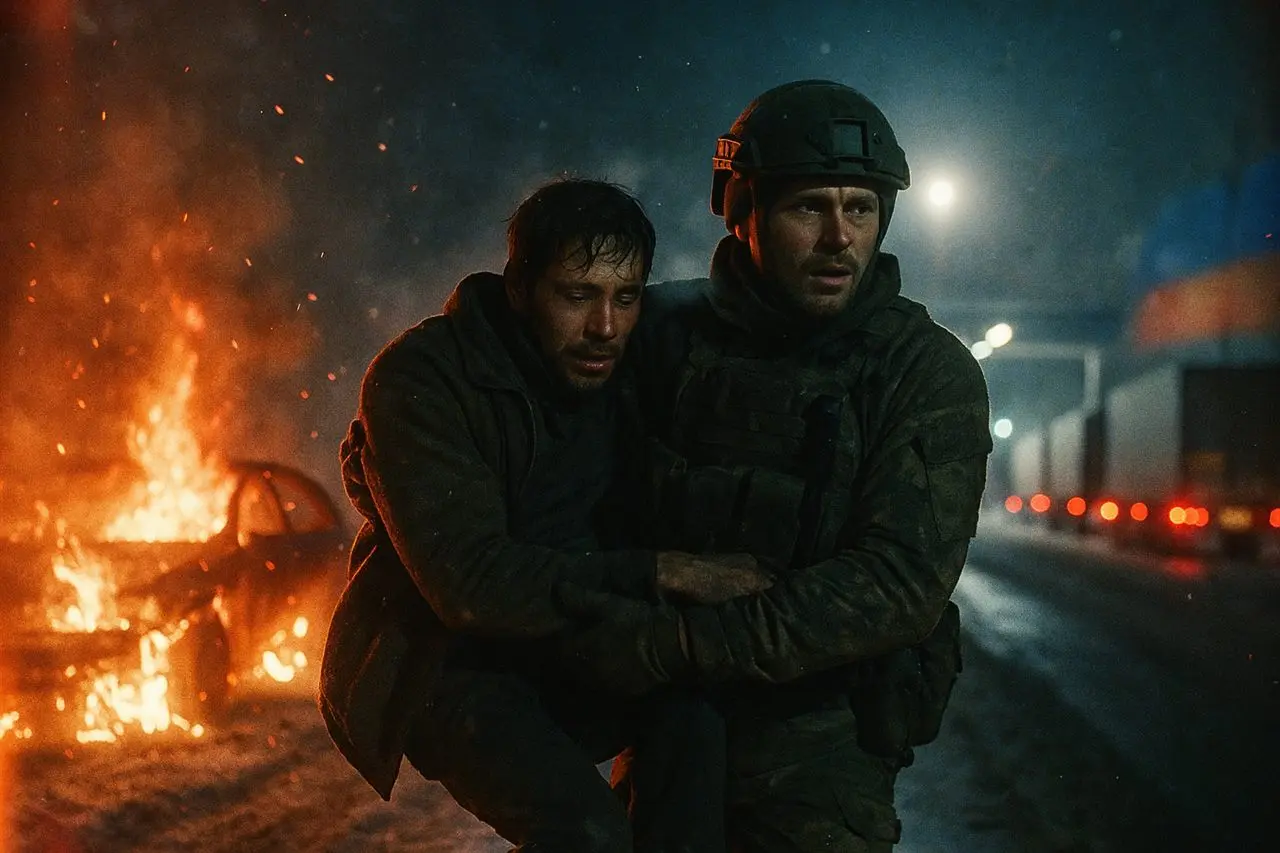
Imagine a friend who pulled you from a burning car. Didn't stand aside, didn't film it on his phone — crawled into the fire, yanked you out, drove you to hospital, paid for the operation, housed your family, gave you his bulletproof vest. And the next morning laid photographs of his own unburied dead on the table and said: "Before we talk about the future, let's talk about what yours did to mine in 1943."
Both scenes are real. Both are about the same country. And that is the whole story.
Poland for Ukraine since February 2022 is not a "complicated partner in the diplomatic theatre." It is the rear through which the blood of the Ukrainian war flows: weapons, refugees, logistics, the first tanks, the first aircraft. And that same Poland is a state with an unhealed historical wound, electoral fatigue, farmers' fear, and a political machine that knows how to monetise grievance precisely when Moscow most wants to hear the scream.
And yes — the headline says "most toxic friend." But the key word there is not "toxic," it is friend. "Toxic pariah" is a lazy frame that turns Poland into a caricature and the Ukrainian into a hysteric. The most toxic friend is not a pariah, not an enemy, not a fairy-tale brother. He is precisely a friend: the one who pulls you from the fire and then puts a bill on the table. Poland is a bulletproof vest with a grater on the inside: it really stops the bullet and really grinds skin to blood. Let's examine both sides of the iron — with a cold knife.
01 · The Poland That Saved
Let's start with what earns the moral right to criticise. Because without this section, every paragraph that follows is spitting in the hand that fed you.
The numbers leave no room for coquetry. 80–90% of all Western military aid to Ukraine passed through Poland; the tiny airport of Rzeszów-Jasionka became the most important logistics hub in Europe. Poland was the first NATO member to give Ukraine tanks, the first to give MiG-29 fighters. Over two million Ukrainians crossed the border in the first weeks — and they were received not so much by ministries as by ordinary families: around 70% of Polish households helped in some way. And when you add it all up — direct aid plus the cost of hosting refugees — you get 4.91% of GDP, the largest in the world in percentage terms.1
And one more figure that Poland's public psyche somehow dislikes: according to a UNHCR and Deloitte study, Ukrainian refugees generated 2.7% of Poland's GDP in 2024, and employment among working-age Ukrainians reached 69% — only slightly below the ~75% rate among Poles themselves.1 The politics screams "burden." The macroeconomics quietly counts "asset."
Remember this section. Everything that follows is said not instead of it, but alongside it. The bulletproof vest is real. Now — the grater.
02 · The Poland That Wounds
The freshest wound is symbolic, and it collapsed literally these past few days. Its roots lie in Volhynia (we will get there honestly), and the trigger was a decree: on 26 May 2026, Zelensky awarded an SSO unit the honorary name "Heroes of the UPA."3 What followed was an escalation straight from a textbook on how not to do things.
On 19 June 2026, Polish President Karol Nawrocki revoked from Zelensky the Order of the White Eagle — the highest award Poland itself had given him in 2023. Nawrocki's formula: "We cannot betray the sacrifice of our ancestors with silence. There are graves that cannot be forgotten."3 And on 20 June, Zelensky responded with a gesture that made the surrealism of this story official: he sent the order back to Warsaw via Nova Poshta, posting a photo of the shipping label. And at that point a linear diplomatic incident turned into a chain reaction. All living former presidents who held the Order of the White Eagle then demonstratively renounced it — Kuchma (who had held the award since 1997), Yushchenko, Poroshenko. After the presidents came the officials: Foreign Minister Andrii Sybiha, GUR chief Kyrylo Budanov, Ambassador to Poland Vasyl Bodnar; former Prime Minister Volodymyr Groysman also returned his Polish award.3
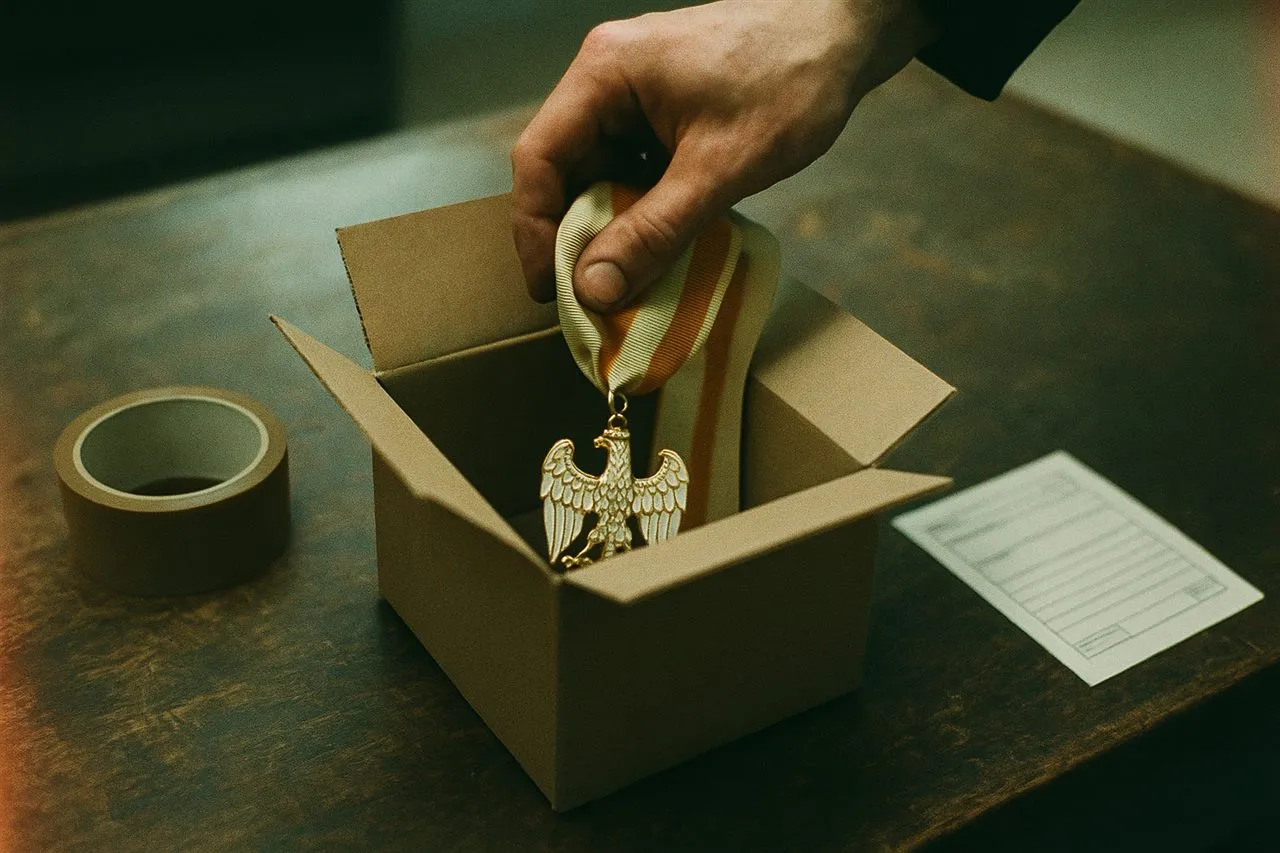
The highest award of a neighbouring state was returned by parcel. Ceremony and logistics met in the same cardboard box.
Tusk tried to douse it with one sentence: "This pleases Putin and shocks our allies."3 Budanov called the decision "a gift to the Moscow aggressor." And both are right — which is what makes the whole scene unbearable.
And on 21 June the story took a turn that fits no diplomatic protocol. Polish former Sejm deputy Piotr Fogiel returned his own Polish state award — the Gold Cross of Merit — in protest against his own president's decision. "I symbolically return my award to this president in protest against the senseless decision to strip the President of Ukraine of his order," he wrote, addressing the demarche to "the current resident of the Belvedere."3 Here is where the real story hides. A Pole returned a Polish award to a Polish president — for the sake of a Ukrainian. The fault line ran not between Warsaw and Kyiv. It ran through Poland itself.
Alongside the symbolic pain — material pain. Grain. In 2022 the EU zeroed tariffs on Ukrainian exports; due to infrastructure bottlenecks, of 4.5 million tonnes of grain in Poland some ~3.4 million stayed, crashing prices for Polish farmers.2 The pain was real — which is precisely why the reaction became so revealing. A unilateral embargo against Brussels. Blockades with over 22,000 trucks on the Ukrainian side. 160 tonnes of corn tipped from wagons — corn that was in transit to Germany and physically could not reach the Polish market.2 And the finale — grain autophagy: by banning Ukrainian rapeseed, Poland left its own oil-processing plants without raw material, and those plants then begged the government to let the rapeseed back in.
03 · Ukraine's Bill Against Poland
And now — the part without which this text would be a Polish indictment against Ukraine. Because the Polish-Ukrainian trauma did not begin with Volhynia. And a Ukrainian is not obliged to stand silently in the dock of a Polish historical court.
1918–1919. The Polish-Ukrainian war for Eastern Galicia. Two national projects on the same land: the Ukrainian village was predominantly Ukrainian, Lwów and the cities were Polish. The WUPR was proclaimed on 19 October 1918, fighting ran from 1 November; Poland won by July 1919, and the Council of Ambassadors ratified Galicia's transfer to Poland in 1923.4 This is not "someone was right and someone wrong." It is a classic conflict between two infant states over the body of dead empires.
1930. The "Pacification" of Eastern Galicia: from September to November, Polish cavalry and police swept through ~450 villages — searches, beatings, destruction of property as collective punishment of the Ukrainian minority.4 And here is an honest nuance that many swallow whole: the OUN itself provoked a wave of sabotage to draw out repression and radicalise the moderates. The pacification did exactly that. This is not "Poles oppressed, Ukrainians responded." It is a radicalisation engine in which both sides were turning the pedals.
1943–1945. Volhynia. Maximum care is needed here, because this is precisely the node where it is easiest to slide into politics. The Volhynia tragedy was real and bloody: the Ukrainian-Polish confrontation on shared land took civilian lives on both sides. But the specific casualty figures — and the very classification of events — remain bitterly contested depending on who is counting and why, which is why we deliberately do not present them as "fact": this field has long been turned into a weapon of memory politics. One thing is clear: this is not symmetry of crimes — and no reconciled accounting exists that could be cited without quotation marks.
1947. Operation Vistula. The Polish communist authorities, with Soviet consent, forcibly resettled 140,662 Ukrainians, Boykos, and Lemkos from the south-east to the "recovered territories" — scattering them so that communities could not reconstitute themselves. The official pretext was fighting the UPA; the real aim was assimilation, since the deportation zone covered areas where the UPA did not operate.4 The Polish Senate condemned the operation after 1989.
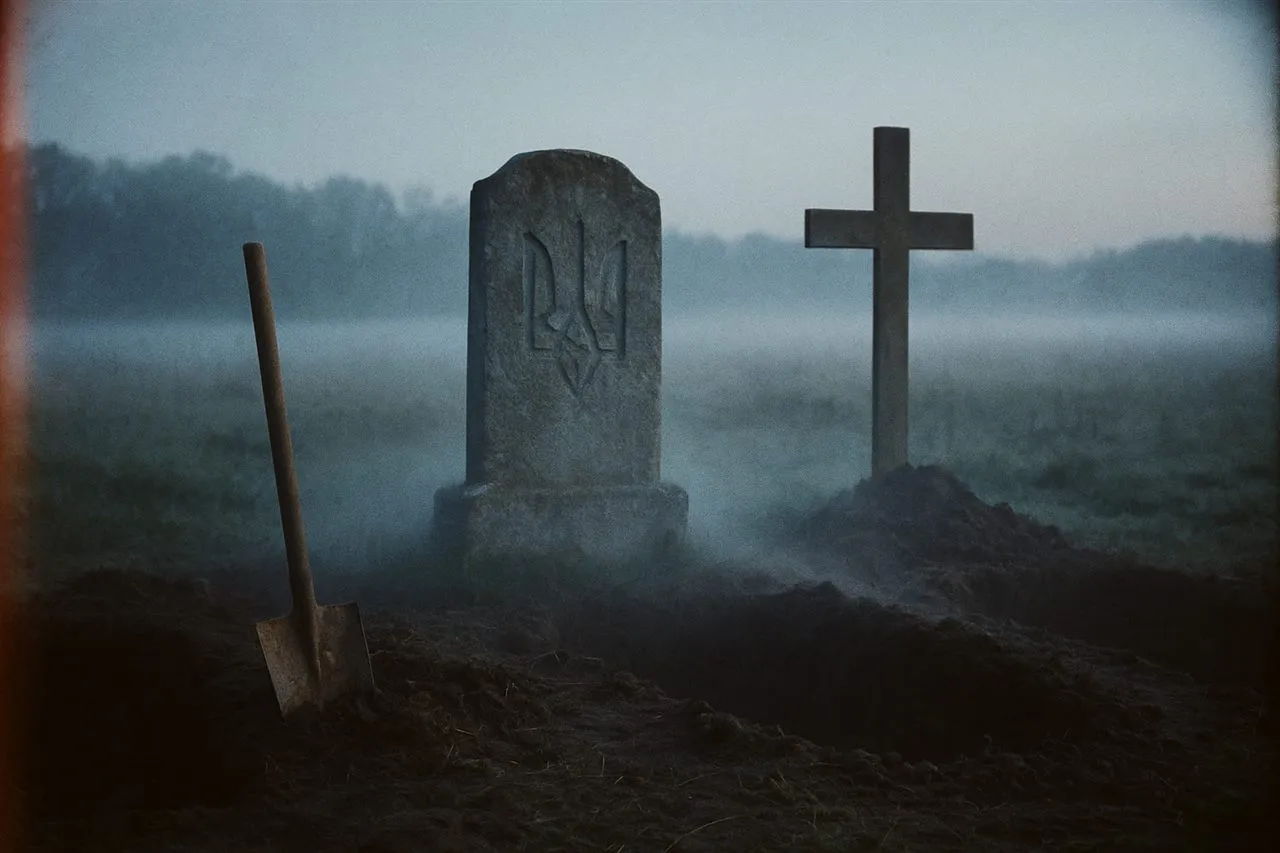
Not symmetry of crimes, but a mutuality of unburied memory — over what has not yet been mourned.
This is not symmetry of crimes — the scales are incomparable. It is a mutuality of unburied memory: both peoples carry wounds that have never been named, and over which they still argue instead of mourning.
04 · The Monument War
In this region the dead do not simply lie in the ground. They perform diplomatic work. They are exhumed, relocated, covered with plaques, dismantled, restored, and vandalised again — and every time a third party is standing nearby with a camera. Four recent cases, each about something different.
The monastery (April 2025). At a grave of UPA fighters, unknown individuals removed the slab and replaced it with a Polish-language one bearing a text about "terror and genocide," covering the trident with a cross. The Ministries of Culture of Poland and Ukraine in a joint statement called it "a deliberate provocation serving Russia's interests." The perpetrators were not found.5
Hruszowice (2017). Polish authorities demolished a UPA monument, citing the illegality of the structure (erected 1994). The Polish IPN conducted research and stated: there are no UPA fighter remains at the site. The Ukrainian side read it as an assault on memory — but "provocation" here was the position of the aggrieved party, not an established fact.5
And now two cases worth placing side by side — because together they are the main thesis of this section.
Legnica (September 2025). A cross was sawn from the dome of a Ukrainian Greek Catholic church. Ukraine's ambassador spoke of "anti-Ukrainian tendencies," Poland's Foreign Ministry "did not rule out a provocation." Then police detained a 29-year-old local who confessed: he had acted alone, for financial motives — he thought the cross was silver.5
Domaslav (August 2025). A monument to Volhynia victims (a child impaled on a trident) was daubed with UPA symbols and Cyrillic inscriptions with spelling errors. A 17-year-old Ukrainian recruited by Russia was detained; Tusk said directly — the aim was to inflame Polish-Ukrainian hostility.5
05 · Street-Level Temperature
An alliance between states can be solid at the level of headquarters and weapons depots — and break at the level of a tram. Because geopolitics lives in communiqués, and xenophobia lives in the courtyard, the car park, the school corridor.
Szczecin, August 2024: a 42-year-old man heard Ukrainian, said "teach your child to speak Polish" — and punched the father in the face twice. The court gave him one year and two months. The victim, who had lived in Poland for over ten years, now asks her daughter to never speak Ukrainian in public.6 Le Monde in September 2025 noted: at the "Ukrainian House" in Warsaw "not a day passes" without such stories, and some Ukrainians had started avoiding their native language in public spaces. A man on public transport to a Kyiv journalist: "In Poland they speak Polish."6
A car with Ukrainian plates has also stopped being merely transport. In Wrocław, Ukrainian plates were removed from a white Ford Focus and the inscription "NA FRONT" left — prosecutors opened a case. In Gdynia, a 42-year-old Pole was detained for a series of arson attacks on cars with Ukrainian plates: caught with canisters, found at home with chemicals for an incendiary mixture.6
06 · The Sociology of Fatigue
Polish fatigue with Ukraine is no longer "grumbling in the comments." It is statistics, and they are harsh.
07 · A State with Several Operating Systems
The laziest explanation is "Tusk vs. Nawrocki." It is true, but shallow. Cohabitation did not create the cracks — it merely gave them institutional form. In reality at least four incompatible operating systems are running inside Poland, and each sincerely considers itself the only Poland.
Hence the "split signal": pro-European Prime Minister Tusk and nationalist President Nawrocki physically cannot speak with one voice. Berlin, Kyiv, and Brussels keep asking the same question: "Which Poland is on the line right now?" And historical grievance is the most convenient fuel — because it is cheap, renewable, and mobilises the rural, older, eastern electorate ahead of the 2027 elections.
08 · Deportations and the Edge of the Law
Legal precision is needed here, because exaggerations are what gets a text caught fastest. So, exactly.
In 2025, Poland forcibly expelled slightly more than 2,100 foreigners — twice as many as in 2024. The largest group was Ukrainians, ~1,150. But this is not evidence of ethnic hunting: Ukrainians are the largest migrant community in Poland (~1.55 million), and these were people who had violated Polish law.8 Separately — the broader figure of ~9,300 who left under removal orders (including voluntary departures). Mixing these numbers is the classic overclaim.
The sharper story is different. In May 2026, Amnesty International and Human Rights First called on Poland to stop facilitating transit operations by US ICE that were returning Ukrainians to a country at war (flights via Rzeszów: November 2025, March and April 2026). The argument — risk of violating the non-refoulement principle. Poland responded through Interior Ministry spokeswoman Galewska: "Poland has no agreement with the US regarding deportations. This is a bilateral matter between Ukraine and the US"; Poland was "merely a transit point."8
09 · Russia as Catalyst, Not Author
And most importantly: do not reduce everything to "Russia drove the brothers apart." That is infantile. Russia did not invent Volhynia. Did not invent "Vistula." Did not invent the grain conflict and housing prices in Wrocław. The wound is real and its own. But Russia professionally turns every crack into a dynamite seam.
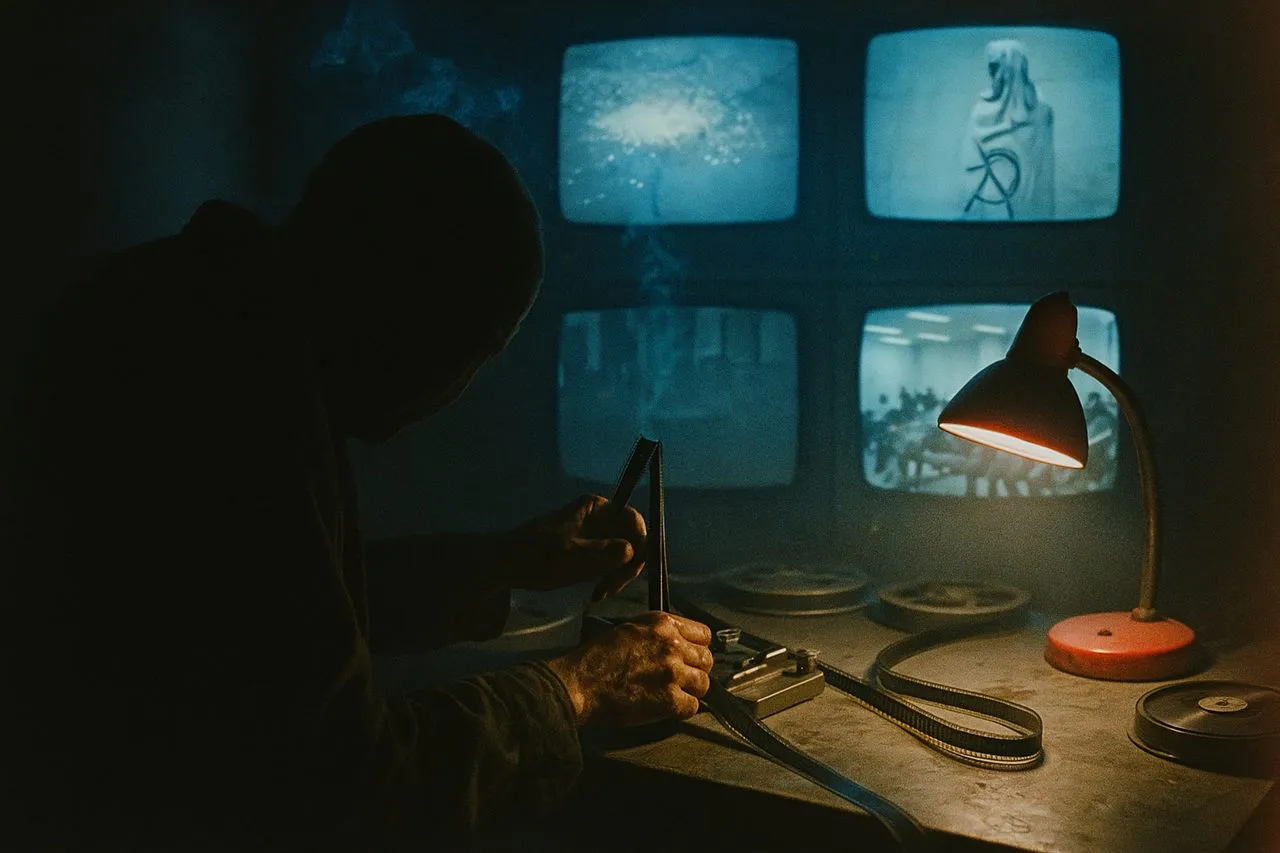
Moscow is not the author of the wound — it is the editor: takes real footage, cuts the context, adds a close-up of blood.
On 16 November 2025, a C-4 charge detonated on a Polish railway line carrying aid to Ukraine. Tusk called it "an unprecedented act of sabotage" and told parliament: the trail leads to two Ukrainians working for the FSB who fled to Belarus.9 Then the blame-shifting machine switches on. Res Futura analysis: 42% of comments in the Polish online space blamed Ukrainians — and only 24% Russia. The Polish Ministry of Digital Affairs warned of disinformation "redirecting responsibility for the sabotage to the Ukrainian side." And Tusk said it plainly: "stoking anti-Ukrainian sentiment is becoming increasingly easy," because it has "dual value for Russian intelligence services."9
Scale of the background: a joint study by Poland's Demagog and the Institute for Media Monitoring recorded nearly 186,000 anti-Ukrainian statements in Polish social media from August to November 2025, over 92% on X. clarification This is a Polish civil-society figure, not "Ukrainian CPD data" as it is sometimes called — which is precisely why it is hard to dismiss.9
| Temptation (overclaim) | What we write instead |
|---|---|
| "Poland deports Ukrainians indiscriminately" | sharp rise in expulsions disproportionately affecting Ukrainians by numbers, applied to lawbreakers |
| "Volhynia — exact casualty figure, full stop" | casualty figures are politically charged and irreconcilably contested — we do not cement any as final; we address the asymmetry of scale qualitatively, without a number |
| "Symmetry of crimes" | mutuality of unburied memory; the scales are incomparable |
| "The cross in Legnica was cut down by nationalists" | a thief was arrested who thought the cross was silver — the provocation framing was not confirmed |
| "185k — Ukrainian CPD data" | data from Polish Demagog/IMM; CPD separately counted AI-generated videos on TikTok |
| "Poland deported Ukrainians to the US" | Poland provided transit; the decision is between the US and Ukraine (non-refoulement remains an open question) |
This table is not an apology. It is the sharpening of the knife. A text that cuts its own side too cuts deeper.
10 · Verdict: Alliance Without Anaesthesia
So — not a "toxic friend" and not a "traitor." And not "eternal brotherhood" either — it is time to bury that mythology alongside the unburied bones. Poland and Ukraine are two patients from different empires whom history pushed into becoming strategic allies faster than their memory could digest the twentieth century. They are fighting on crutches in the corridor of the ICU while Moscow walks along the wall switching off the lights.
Ukraine does not need the mythology of brotherhood with Poland. Poland does not need the role of Ukraine's historical prosecutor. Both need an adult architecture of alliance: weapons without humiliation, memory without blackmail, a border without hysteria, truth without Russian editing.
Poland is not Ukraine's enemy. But not a fairy-tale brother either. It is a strategic ally with an open historical wound, internal political schizophrenia across four operating systems, real aid, real fatigue — and a real capacity to strike the Ukrainian nerve precisely when Moscow most wants to hear the scream.
This is not beautiful. This is not convenient for grand speeches. But it is adult, painful, and complicated — which is normal for a region where even monuments behave like uncleared ordnance, and the highest orders travel between capitals by Nova Poshta.
Frequently asked
"Poland — Ukraine's toxic enemy?"
No. The key word in the headline is 'friend.' Poland gave 4.91% of GDP, funnelled through 80–90% of all weapons, and took in 2M+ refugees. The toxicity is not betrayal — it is friction that remains even in a genuine ally.
"Why did Poland block Ukrainian grain if it was helping with weapons?"
Inside Poland at least four operating systems run in parallel: frontier, memory, farmers' fear, and resentment. Grain is farmers' Poland; weapons are frontier Poland. They don't contradict each other — they simply don't consult each other.
"Is there symmetry between Volhynia and Operation Vistula?"
No — and equating them is incorrect. This is not symmetry of crimes but a mutuality of unburied memory: both nations carry wounds that have never been named. The specific casualty figures are politically charged and irreconcilably contested depending on who is counting — which is why we deliberately do not present them as 'fact.'
"Is Russia the main cause of Polish-Ukrainian conflicts?"
No. Russia did not invent Volhynia, 'Vistula,' the grain conflict, or housing prices in Wrocław. The wound is real and its own. But Russia is the editor: it takes real footage, cuts the context, and pours it into the Polish-Ukrainian TikTok of trauma. 42% of comments on the 2025 railway sabotage blamed Ukrainians, not Russia.
"What does the return of the Order of the White Eagle via Nova Poshta mean?"
On 26.05.2026 Zelensky signed a decree on 'Heroes of the UPA.' On 19.06.2026 Nawrocki revoked the order. On 20.06.2026 Zelensky sent it back to Warsaw by parcel with a tracking number; former presidents and officials then returned their own Orders of the White Eagle, and on 21.06 a Polish ex-MP returned his own award in protest against Nawrocki. 37 months from 'for friendship and solidarity' to a shipping label — and the one who won at every point on that line is not marked on it.
Comments
Signed-in readers only — to keep it human, not a bot swamp.