The World Is Being Rewritten for Machines to Read. And You're Part of the Text
In Bengaluru, a person is paid $230 a month to fold towels with a camera on their forehead — training the robot that will replace them. AI is leaving the screen and turning reality into data: where this leads.
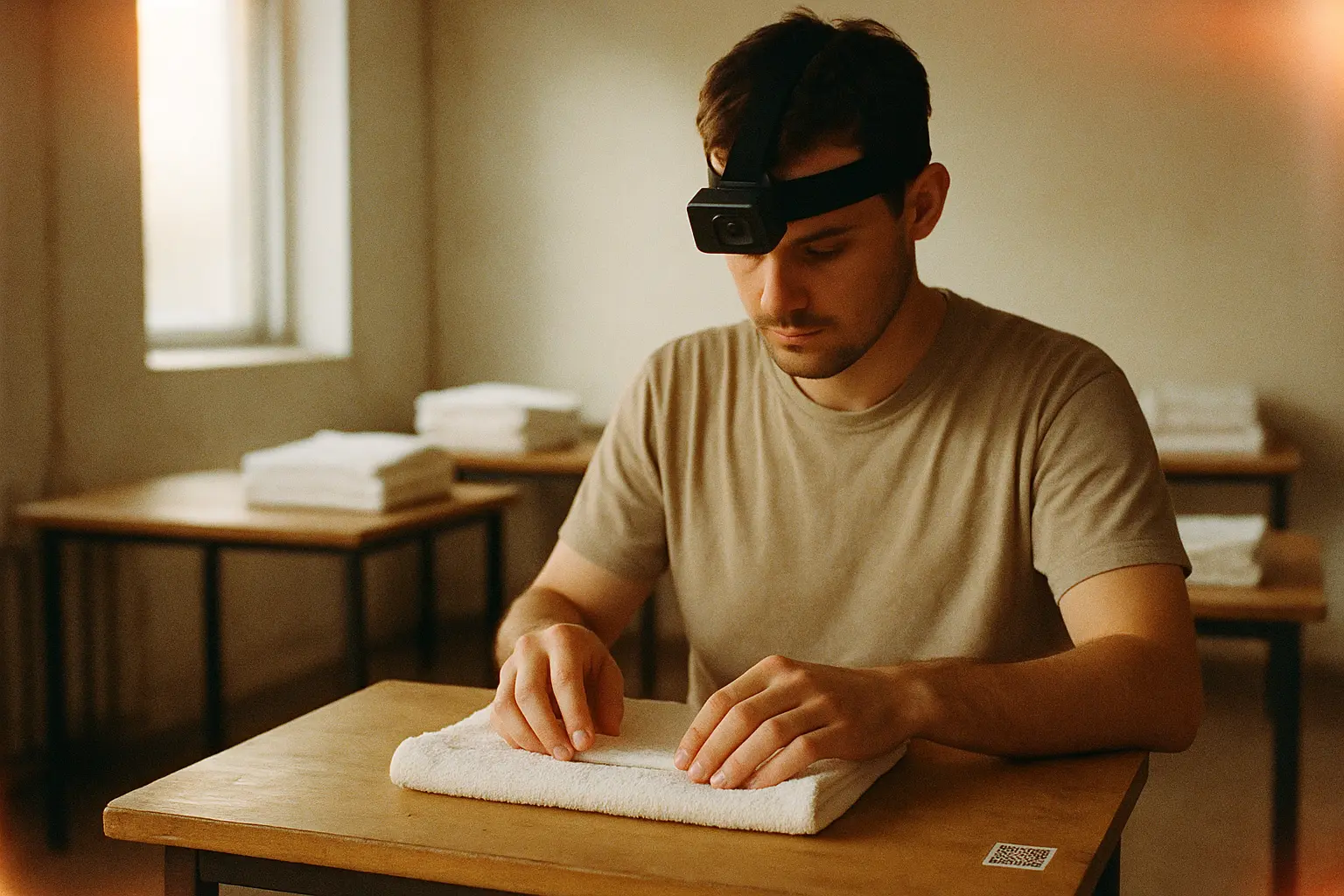
For ten years AI was sold to us as a "smart app": a little window you type into, and it answers. A convenient lie. Because the real thing happening runs the opposite direction — and it's bigger than any chatbot. People used to read the machine. Now the machine reads the world. And the world is being rewritten for that gaze.
I. The scene: $230 to train your own replacement
In Bengaluru there’s a person paid $230 a month to fold towels. Not in a hotel — in a room with dozens of others like them, each with a camera on their forehead. They fold a towel; the camera watches. They stack a box; the camera watches. The company calls it gently: a “movement farm.” The footage flies off to a lab in California, where a neural network breaks down every flick of the fingers — so that one day it can fold that towel without them.
So they’re paid $230 a month to personally teach the thing that will replace them. This isn’t dystopia from a book. It’s a job opening — with a shift schedule, a lunch break, and a camera issued along with the uniform.
And it’s the most honest picture of what’s happening to the world right now. People used to read the machine. Buttons, menus, screens, the floppy-disk icon nobody under 30 has seen alive — all an interface designed so you understand the machine. Now the machine reads the world. Cameras, microphones, sensors, glasses, dashcams — an interface designed so the machine understands you. The arrow flipped. Let’s name it honestly: a reverse UI.
II. Why now
Because they ate the internet. Large language models burned through nearly all the usable text on the planet in a few years — books, forums, code, tweets, vacuum-cleaner manuals. Text ran out. And for a robot, unlike a chatbot, the internet is useless to read: it doesn’t contain how a hand grips a cup, how a loader bends, how a courier wrestles a stubborn lobby door. That data simply didn’t exist — because nobody recorded it. Until someone arrived to whom it’s worth more than oil: a machine learning to move.
Hence the cameras on heads. If the world isn’t recorded, the world must be recorded. Not pretty drone shots, but the dull, specific, first-person reality: exactly how a human hand folds, packs, cuts, carries. Boring? To you. To a neural network it’s the Louvre.
III. How it works (no jargon)
A robot can’t read rules. But it can imitate. Show it a thousand times how a person puts an apple in a bag, and it catches the pattern: which angle, how much force, so as not to crush it. Specialists call it “imitation learning,” but it’s as simple as a child: watch and repeat. Only a child watches its mother, and a robot watches thousands of hours of strangers’ lives, filmed off their foreheads for $230 a month.
So the main currency of this wave isn’t the model or the chip. It’s hours. Hours of recorded, labelled, first-person reality. Whoever has more hours of other people’s movements trains the better robot. And the great hunt for those hours is already on — most people just don’t notice it, because it’s dressed as a courier.
| Who's recording | Who / what they film | What for |
|---|---|---|
| Objectways (Bengaluru) | workers with forehead cameras: folding towels, stacking boxes | "movement farms" for humanoid robots; ~$230–250/mo, data → Scale AI |
| DoorDash (Tasks app, Mar 2026) | couriers filming household chores: washing dishes, folding laundry, making a bed | training data for humanoid robots |
| Meta (Ego4D / Aria) | hundreds of volunteers in 9 countries wearing camera glasses | 3,670 hours of first-person life — so machines learn to see like people |
| Amazon + Covariant | their own fleet of sorting robots in warehouses | over 1M robots; a model learning to grasp anything — from lipstick to a mower part |
IV. This isn’t about robots. It’s about you
It seems to be somewhere out there — Bengaluru, an Amazon warehouse, a lab. No. Look in your own pocket. Your phone has already aimed its camera at a price tag, translated a menu in Paris, recognized a dog, scanned your face to unlock. Your car, if it’s newer than five years, watches the road with more eyes than you. Every time you point a camera at the world and it understands what’s there — that’s not magic. It’s a world already partly rewritten into a machine-readable format. It’s just that as long as it’s convenient for you, you don’t call it surveillance. You call it “a cool feature.”
V. We’ve filmed this twice before
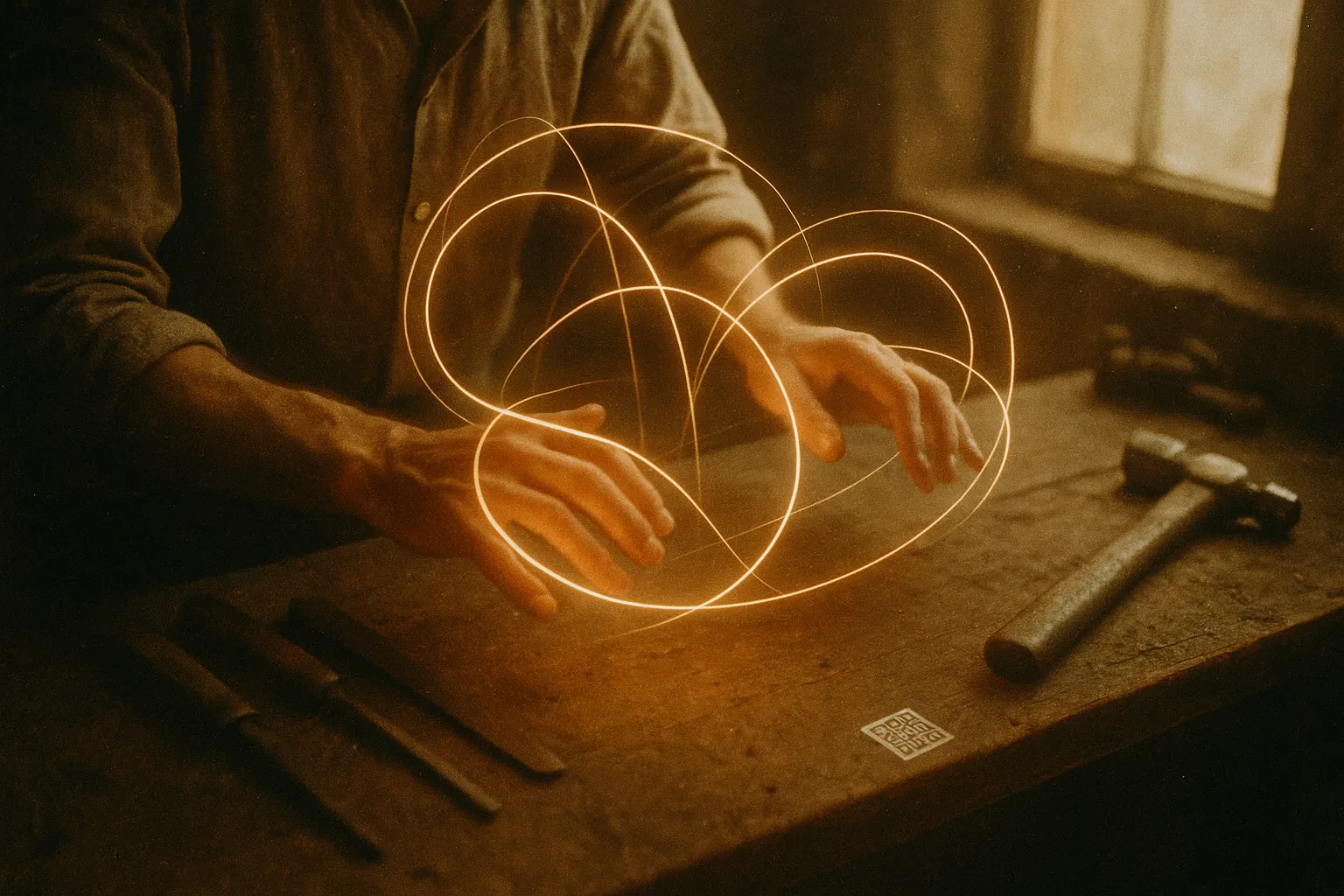
A hundred years ago an engineer named Gilbreth put little lights on workers’ hands and filmed them — breaking bricklaying into “elementary motions” to strip out waste and make the human faster. They called it scientific management. Back then the camera served to optimize the worker. Today the same camera on the same forehead serves to copy the worker. The difference is one verb — and it’s a very expensive verb.
And earlier still there was Borges, with his parable of an empire that made a map at full scale — so exact it covered the whole territory. In Borges the map eventually rotted. With us it’s the reverse: the territory is slowly becoming the map. Shelves, warehouses, streets, doorways, faces — all neatly translated into a layer of data convenient to read not for a human, but for a machine. The world doesn’t vanish. It just gets a second, parallel text — and that text isn’t written for us.
VI. Wait — isn’t this overblown?
Honestly: maybe. Robots are still dim. A nice video of “hands folding a towel” doesn’t mean a humanoid will fold your laundry tomorrow — between “filmed” and “can do” lies a chasm full of broken cups. Data ≠ capability. Most of these “movement farms” are a blind bet for now: nobody knows exactly how many hours it takes to make a robot useful, or whether it ever will. Add privacy revolts, regulators, unions, and plain economics: a human at $230 a month is still cheaper and more reliable than a robot at $200k. Maybe the “hunt for hours” fizzles out — the way the hype around self-driving cars, forever “a year away,” has fizzled for a decade running.
But even if the pace slows, the direction won’t change. Because the problem has been named out loud, and a named problem stops being tolerated. And that’s where it gets interesting: who pays for all this.
VII. Who wins, who pays
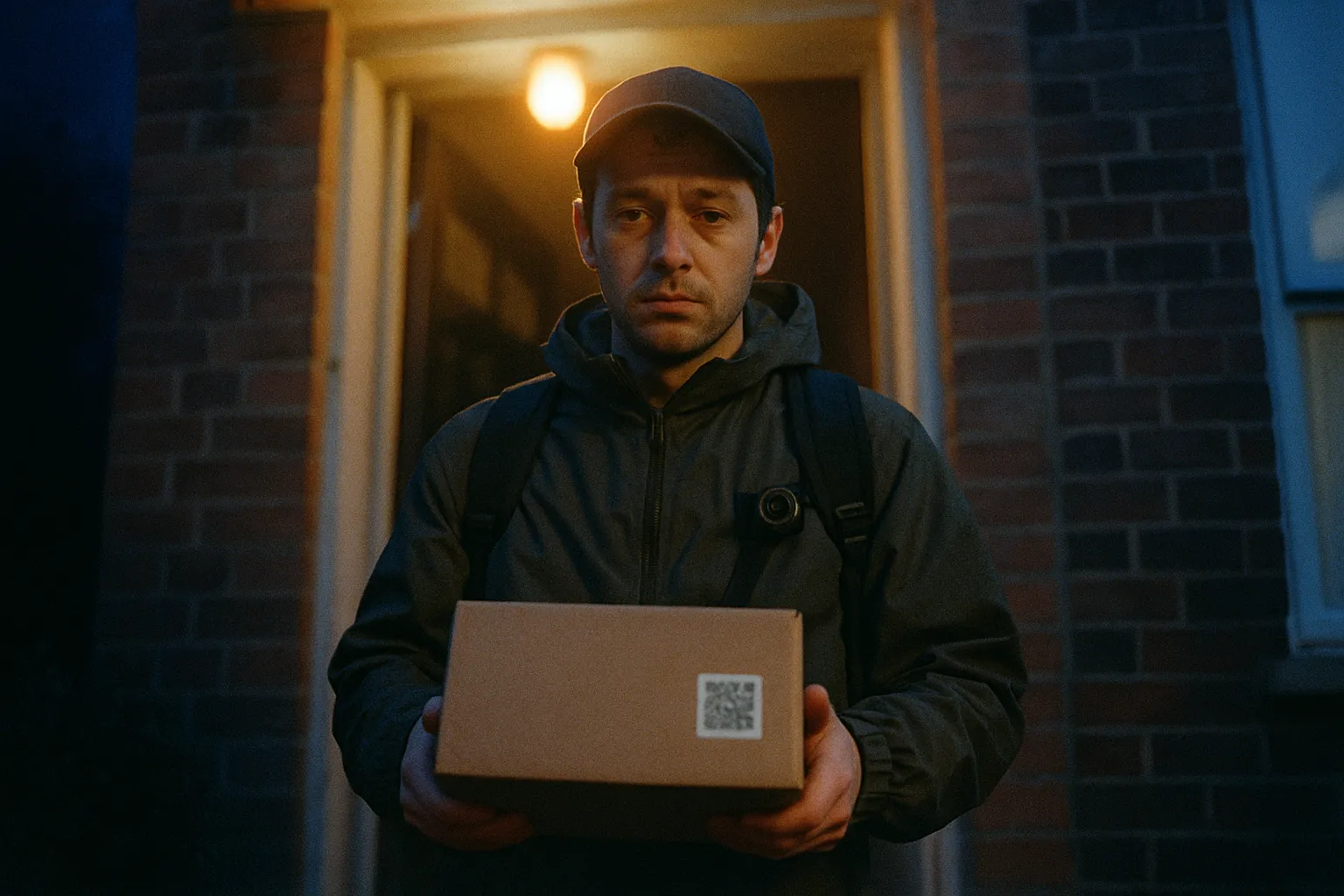
Value flows up — to whoever owns the model, the platform, the warehouse. The bill is sent down. The courier, the “movement-farm” worker, the passerby in a dashcam frame — they hand over the most valuable new resource (a recording of their own reality) almost for free, often without the right to refuse: the camera came with the shift. It’s a classic story, only this time the raw material isn’t coal or your likes — it’s your body in motion. And, as always, whoever stands closest to the raw material earns the least.
VIII. So what now
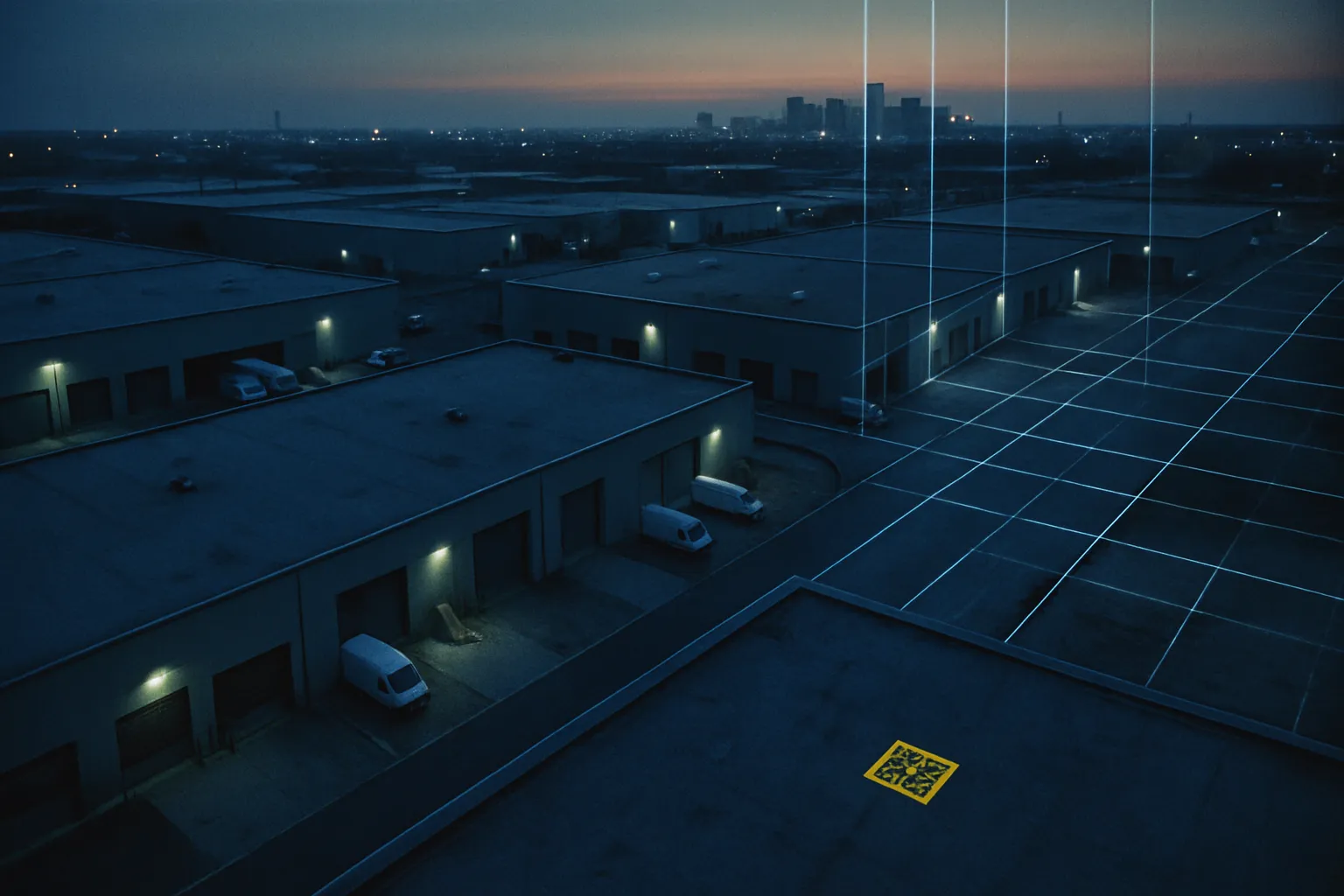
First — stop thinking of AI as an app you “plug into.” It’s already a perception infrastructure, and it will arrive wherever there’s a camera, a sensor, and a dull repetitive process — that is, almost everywhere. Then, the practical, almost mundane part: the world will start being designed for the machine reader. It already is. Coded price tags, warehouses laid out for a robot’s eye, offices where the camera knows who sits where. The design of environments is quietly changing its client: for a long time we shaped space so a human would understand it; now, more and more, so a machine will. The question isn’t “will your business be machine-readable.” The question is who does it for you, and on whose terms.
The first truly mass interface humanity ever built for machines isn’t a screen or a keyboard. It’s us, filmed first-person, at $230 a month.
Frequently asked
What is imitation learning and why does it now determine the pace of physical robotics development?
Imitation learning is a method where a robot receives no explicit rules but instead observes thousands of human movement repetitions and extracts patterns on its own. It is the only realistic way to train a robot for unpredictable physical environments, because rules do not scale: a hand placing an apple does it slightly differently every time. This is why recorded human movement has become scarcer than text and more valuable than oil.
If the physical world is being rewritten into machine-readable format, what does that mean for the design of the spaces we live in?
The client for design is quietly shifting: spaces are increasingly designed not for human perception but for machine readability. Warehouses marked for robot vision, offices with presence-recognition systems, price tags with codes instead of text -- this is not the future, it is current design logic. The question is not whether your space will become machine-readable, but who will decide on what terms and with what visibility for the people inside.
But robots still break cups -- is this wave not overblown, like self-driving cars once were?
The comparison is fair: a vast gap separates data from actual capability, and most current motion farms are blind bets. But self-driving cars did not disappear -- they became quiet infrastructure (Tesla FSD, Waymo) rather than loud hype. The same scenario is realistic here: the pace may slow, but the direction will not change, because the problem has already been named out loud, and named problems stop being tolerated.
Meta collected 3,670 hours of first-person video from real people in nine countries -- who actually paid for that data?
The participants paid: with their time, their privacy, and their first-person reality. Monetary compensation was either symbolic or absent -- this was a voluntary academic program. The value those data will deliver to future models is disproportionately larger: 3,670 hours of this kind of footage cannot be purchased on any open market. This is the classic asymmetry between those closest to the raw material and those who control the processing.
What should a business or individual actually do now that machines are beginning to read the physical world?
For businesses: audit repetitive physical processes -- not to automate them tomorrow, but to understand where you are vulnerable and where a new standard will emerge. For individuals: distinguish when a convenient phone or car feature is collecting data about your movements, and consciously choose the terms rather than defaulting to acceptance. The core practical rule: whoever controls the recording controls the training, and whoever controls the training controls the next generation of machines.
Comments
Signed-in readers only — to keep it human, not a bot swamp.