Between 35 and 40 it isn't life that breaks — it's the currency: 310 artists, Whitehall, and your inner accountant
Thirty-five is sold as the summit. In fact it's a quiet repricing: everything you earned by proof stops buying peace, and you have to learn a new currency or carry the obsolete one around. A dissection: what actually changes in the body and in the sense of time, why the inner prover is no longer fed by a paycheck, what Watanabe in Kurosawa's Ikiru actually did, and why in Ukraine in 2026 this bill has a denominator no one before us had.
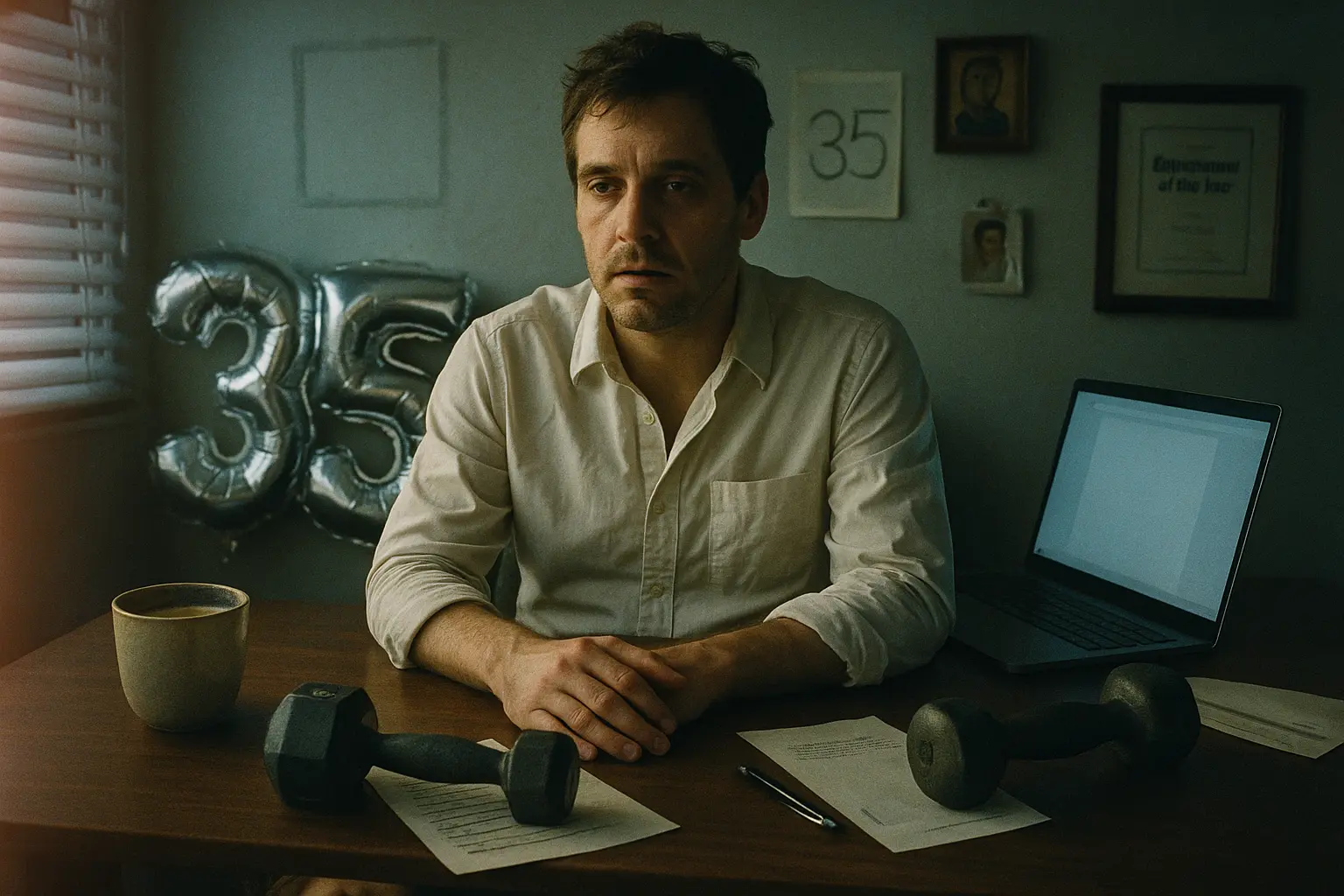
I. Not a summit, a repricing
Thirty-five looks like the moment to congratulate yourself on the climb. By the calendar – the peak. By career – supposedly the midpoint. And even biology seems to play along: the prefrontal cortex, the one in charge of long-range plans, inhibition, and not-shouting-at-your-son, finishes myelinating somewhere between thirty and forty, and some of its regions keep maturing into the fifties. So the instrument for hard, long work is only now reaching its working edge.
But the real news isn't power. The brain wasn't "finished assembling" – it doesn't get completed on some date; that's a pretty lie. What changes is quieter: the horizon. The psychologist Laura Carstensen showed a simple thing – the moment a person stops feeling their time is infinite, they unconsciously rewrite their goals. From "learn more, cover more" to "invest in what actually matters." And this depends not on the number in your passport but on the felt sense of how much is left ahead: young people whose horizon was experimentally shortened began behaving like the old. Thirty-five is most often the first year the horizon contracts on its own, with no experiment.
It was first named back in 1965. The psychoanalyst Elliott Jaques read the biographies of three hundred and ten artists – Dante, Gauguin, Mozart – and noticed that somewhere between thirty-five and forty, what broke for many of them wasn't their fate but the very form in which they'd built themselves: some fell silent, some reinvented their language, some died. He called it the crisis of mid-life, meaning not a motorcycle and a younger secretary but a quiet revaluation of values, triggered by the sudden discovery that life is not infinite. Advertising later stole the word. In the original there wasn't a single coupé.
I'm not saying this as an observer. I'm one of the people for whom that mismatch has already started splitting the suit at the seams. I built through proof: the record, the turnover, the visibility, "one more project before the quarter closes." It worked – empires are built on this. Incidentally, so is the market for burnout pills. These last few years I've watched closely as the very engine that built me starts processing me into fuel.
II. The prover: your cheapest employee
Inside most men who've "wrested" something out of life there lives a quiet character. Let's call him the inner prover. Not the Ego, not the Super-Ego, not "mama's boy." A little accountant in a cheap suit sits at the back of the skull and opens the ledger every morning: what will you prove today. To whom – he doesn't ask. What for – he doesn't ask. He has two buttons: "not enough" and "more." A third, "enough," he doesn't have, because otherwise he'd have been fired on day one.
Until thirty the prover feeds you: gets you up at night, chases deadlines, turns anxiety into results. A useful guy while you're building. The trouble arrives quietly. What used to give you peace – recognition, the number, one more win – gives ever less of it. Psychologists call this hedonic adaptation: any achievement pulls you back to the same baseline, like a treadmill. The loop "got recognition → got peace" first held for hours, then minutes, now – only until you close the tab.
And the engine doesn't switch off. It starts idling and gnawing at everything around it, like those programs from the nineties you launched, forgot, and which quietly eat the RAM. You want to just sit with your kid in the evening – the prover whispers from behind: "What about a post?" You want a vacation – "and what if someone overtakes you?" In clinical form this state has a name and a date: on 28 May 2019 the WHO entered burnout into the international classification – not as a disease but as an "occupational phenomenon," in three parts: exhaustion, cynicism toward your own work, and the feeling that you've gotten worse at it. The prover can drive you to all three and call it ambition.
What rank does to the body is seen best in baboons. Robert Sapolsky spent thirty years measuring cortisol in a wild troop and noticed a paradox: the most anxiety isn't in the one at the bottom but in the dominant whose place has started to wobble. While the top is stable, the alpha's stress hormone is low; the moment the hierarchy begins to move, it shoots up to the level of the weakest. At thirty-five you're most often not "the newcomer at the bottom." You're that same dominant under whom something has started to shift. And the cortisol knows it first. As an analogy, not a verdict: we aren't baboons, but we share the mechanics of status anxiety with them honestly.
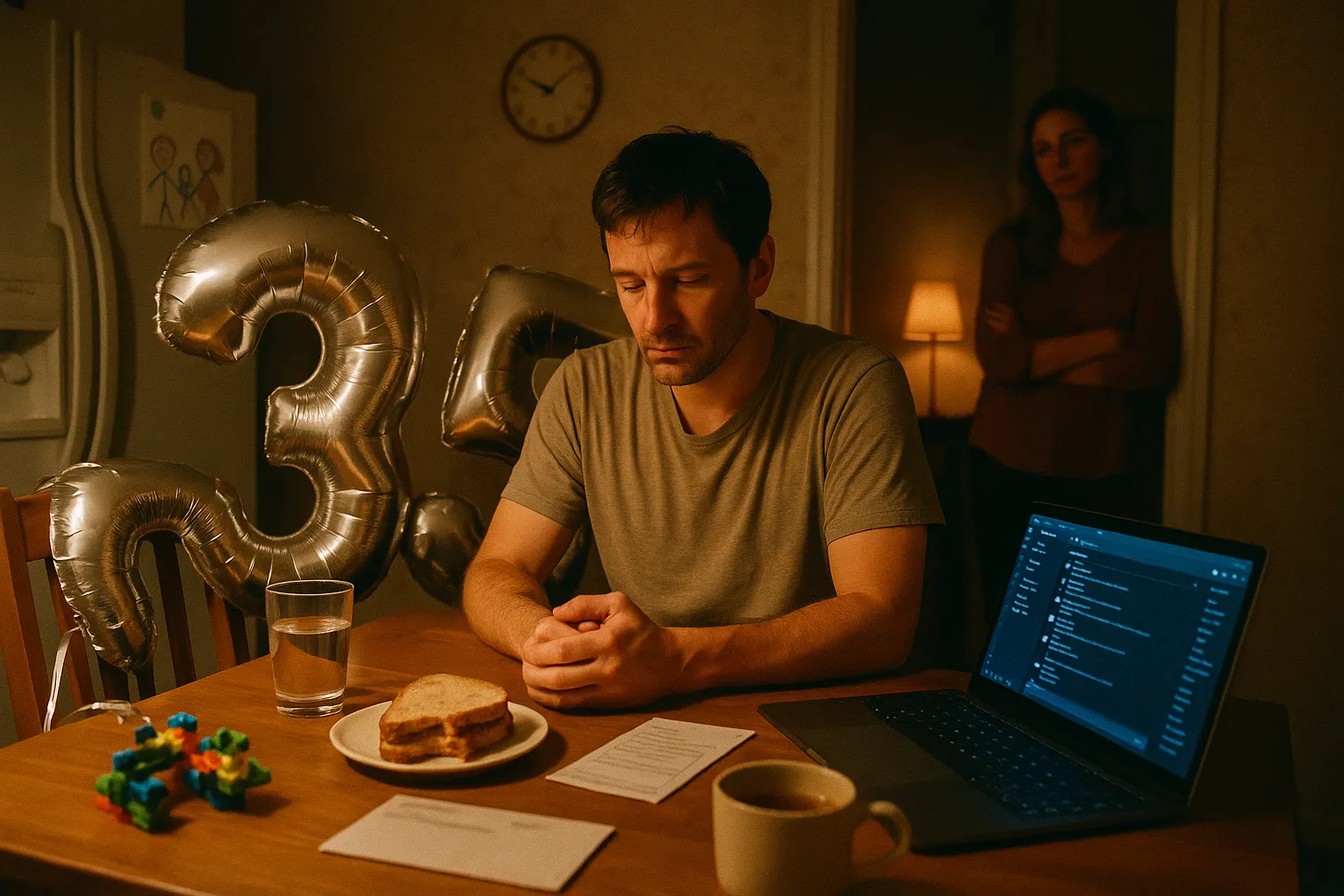
Almost eighty years ago Arthur Miller gave this character a face. Old Willy Loman in Death of a Salesman repeats to his sons like a commandment: the main thing is to be liked, and then you'll never want for anything. He dies not of poverty. He dies because the prover in his head never once sent the signal "stop." The same mechanics today, only instead of a case of samples – Slack open at two in the morning.
III. The denominator you can't factor out
Here I have to say the thing without which this whole dissection would be a hermetic exercise for people with laptops. I'm writing this from Ukraine in 2026. And the very fact that I get to ask "what currency do I pay in at thirty-five" is a privilege someone is paying for on my behalf right now.
Because while I recalculate my exchange rate, men exactly my age – with that same prefrontal cortex just reaching its working edge – are holding the line. Their "mid-life crisis" fits into three minutes over a treeline. They don't have five calm years ahead to "learn a new currency." They have this month.
So the denominator is simple and unpleasant: a second half of life isn't biology and isn't "the prefrontal window." It's the consequence of someone standing between you and the thing that shrinks other people's horizons to three minutes. For anyone who's understood that, the currency rewrites itself differently. The most valuable thing a civilian in the rear can do with his new currency – repeatability, quiet daily work, institutionality – is convert a slice of it into leverage for those for whom it buys nothing right now. On my desk, beside the lab results, lies a transfer document to a fund that equips the people holding that denominator. This isn't "instead of a birthday present." It's the one ledger where the rate doesn't fall.
IV. Watanabe: thirty years he didn't recognize
The most precise frame about the middle of life wasn't even shot about thirty-five. It's 1952, Japan, Akira Kurosawa's film Ikiru – "To Live." The first shot is a chest X-ray of the bureaucrat Kanji Watanabe, with a voice-over: he has stomach cancer, but he doesn't know it yet. Watanabe worked thirty years in Tokyo city hall as a section chief. He stamped seals, passed other people's applications around in circles, never missed a day. And never lived one.
When the diagnosis is confirmed – about six months left – Watanabe sits down at night in a bar beside a stranger and quietly repeats the line the whole film hangs on: I don't know what I've been doing all these thirty years. Not "I achieved nothing" – he achieved a post, stability, the respect of subordinates. But precisely: I don't know what it was. The difference between those two sentences is the entire subject of this text.
Then he does one single real thing. He forces through his own bureaucracy the building of a small children's park in a neglected district – the thing he'd shelved for years. He dies on a swing in that park, snow falling, quietly singing "Gondola no Uta" – an old 1915 song about life being short, so fall in love before the bloom fades from your lips. The camera doesn't weep with him or cue the strings. It just lets an old man finish his song. Not "found his balance." Not "recharged." Not "finally happy." He simply did, for the first time in thirty years, the thing that would outlive him – and knew it, swinging.
A chance, not a guarantee. And most will miss it, because the prover will scream that the park is a "non-core asset."
V. Smaller mirrors: Buchanan and Draper
The same disease has its Western mirrors too – smaller than Watanabe, but recognizable.

The first is Tom Buchanan from Fitzgerald's The Great Gatsby, 1925. A former college football star, a champion, looked upon like a god. Fitzgerald writes about such men plainly: they reach an acute, limited excellence so early that everything afterward savors of anti-climax. So at thirty Tom already drifts through life "seeking, a little wistfully, for the dramatic turbulence of some irrecoverable football game." Money, a wife, a house – and emptiness where the stadium used to be. This isn't about the biology of a thirty-year-old: life expectancy then was around fifty-seven, and Fitzgerald's "thirty" is a cultural verdict, not a medical one. But the mirror is exact: the brighter the prover worked your early sprint, the bigger the bill he brings once the stadium is behind you.
The second mirror is Don Draper, the season-one finale of Mad Men. The adman shows the Kodak clients a slide projector and drops a line that's been quoted on lecture circuits ever since: nostalgia in Greek means "the pain from an old wound." Worth pausing here, because it's beautiful and wrong. The Greek word is built from nostos, the return home, and algos, pain: literally, the pain of being unable to return. And that's the whole scene. What Draper is showing on the slides is the family he no longer lives with. He sells Kodak the most precise marketing truth of the century by displaying photographs of a home he doesn't have. "The pain of being unable to return" is exactly the operating state of a thirty-five-year-old holding the record currency: you have the slides, you have the room, you don't have what's on the slides. And today that Kodak Carousel is switched on by everyone who posts achievements into the feed. The audience in the room weeps. The prover weeps. The algorithm places its bets. There's no one home.
VI. False exits
When the bill arrives, the prover doesn't surrender. He offers exits. All of them are him, in disguise.
The classic – a motorcycle and a younger woman. It isn't even a metaphor; it's literally what advertising turned Jaques's diagnosis into. Buy the thing that roars and the person who looks up at you the way the stadium once did. Works exactly as long as the roar is new.
Subtler – "I'll sell everything and go surf." Downshifting as one more record, except now you're competing over who quit most radically. The prover loves this one: you can make a post about it too.
Fashionable – biohacking. Ice baths, forty-page blood panels, a ring on your finger counting your sleep the way you once counted turnover. The same chase after a number, only the number got moved from the bank to the body. A new table appeared where you can be at the top, and the prover is thrilled.
The most honest-looking – "one more round, one more company." It feels like ambition, not flight. In fact it's the flight that disguises itself as work the longest: you're just adding more treadmill so you don't have to hear the silence. Investors will even pay extra for your inability to stop.
The well-bred one – "reinvent yourself." A new niche every six months, a new rebrand, a new manifesto. Sounds like growth. It's actually the same prover in a fresh suit: he's realized you can shoot stories about "maturity" too.
And the most refined exit – this very text. To write an essay about how you've outgrown the chase for recognition, and then quietly count how many likes it gets. The prover can sell even his own surrender as one more win. If you've caught yourself thinking "that sounds good" – say hello, he's here.
VII. The currency exchange
Subtract all the false exits and a boring truth remains: the market simply changed the price list. Not ceremonially, with no announcement. You notice that the familiar card suddenly won't go through, and you have to lay down something else, something you've never carried.
| The currency you paid with at 22–30 | The currency life accepts after 35 |
|---|---|
| Records (turnover, number of projects, medals) | Repeatability (the same quality in year three without breaking yourself) |
| Visibility ("people know about me") | Anonymous result (the work is known even if you're not cited) |
| Intensity ("I'm on fire") | Pull in one direction without overheating (ten years on one point) |
| Self-presentation ("I'm like no one else") | Institutionality ("the system runs even if I'm gone for three weeks") |
| Speed ("made it before 30") | The composition of decisions ("what of this survived to 50") |
| Anxiety as fuel | Silence as a tool (lift something heavy without outside adrenaline) |
| Proof of your own significance | A readiness to be necessary to another, not "significant before others" |
Honestly list what you're currently trying to settle your account with life with, and lay it against this table – it'll be unpleasant. Most thirty-five-year-olds who consider themselves successful are standing in the new zone with pockets full of the old currency, trying to buy love, peace, time with their kids, the team's attention, with 2019 turnover. Not accepted. Not because you didn't try. Just – wrong rate.
And the rate changed not because the world got harsher. It changed because what you're now short of changed. At twenty-five the scarcity was money, status, and proof – and that's what got traded. At thirty-five, when the horizon contracted, the scarcity became time and the few people who'll stay. And you can't buy them with applause. That's what a repricing is: not new rules of the game, but a new scarcity.
VIII. The counterargument I can't easily parry
Here an honest reader has the right to put the knife to me too. Because all of this sounds suspiciously convenient coming from someone who's already "wrested" himself a second half of life.
Here's the objection I won't wave away. What if this is just a tired engine rationalizing its own drop in output? The prover built everything good in your life – not the child, but the house she sleeps in. "Necessity matters more than significance" – isn't that exactly what's said by the man who's no longer capable of being significant and is ashamed to admit it? Maybe "maturity" is a nice word for "I'm tired of winning." Maybe you didn't outgrow the chase; you lost it and are now rewriting the protocol. And the worst part – you can't verify this from the inside: the prover and the sage use the same mouth.
I have nothing to close this elegantly. I have one correction, and it isn't mine – it's from the psychologist Erik Erikson. He described this exact age as a fork between what he called generativity and stagnation. Generativity isn't "work less." It's switching the same engine from "prove myself" to "make the thing that outlives me": raise, build, hand on. Watanabe's park is pure generativity: he proved nothing to anyone, he just left a swing for someone to swing on after him. Stagnation is when the engine stays idling and spins around itself.
So the answer to the prover isn't to fire him. He's load-bearing; the floor rests on him. The answer is to hand him a different ledger. Not "what did I prove today," but "what of what I'm doing will still stand when I'm not in the room." That isn't a lower standard. It's the same hunger, aimed at a target the register won't accept, because only people do.
IX. In place of a finish
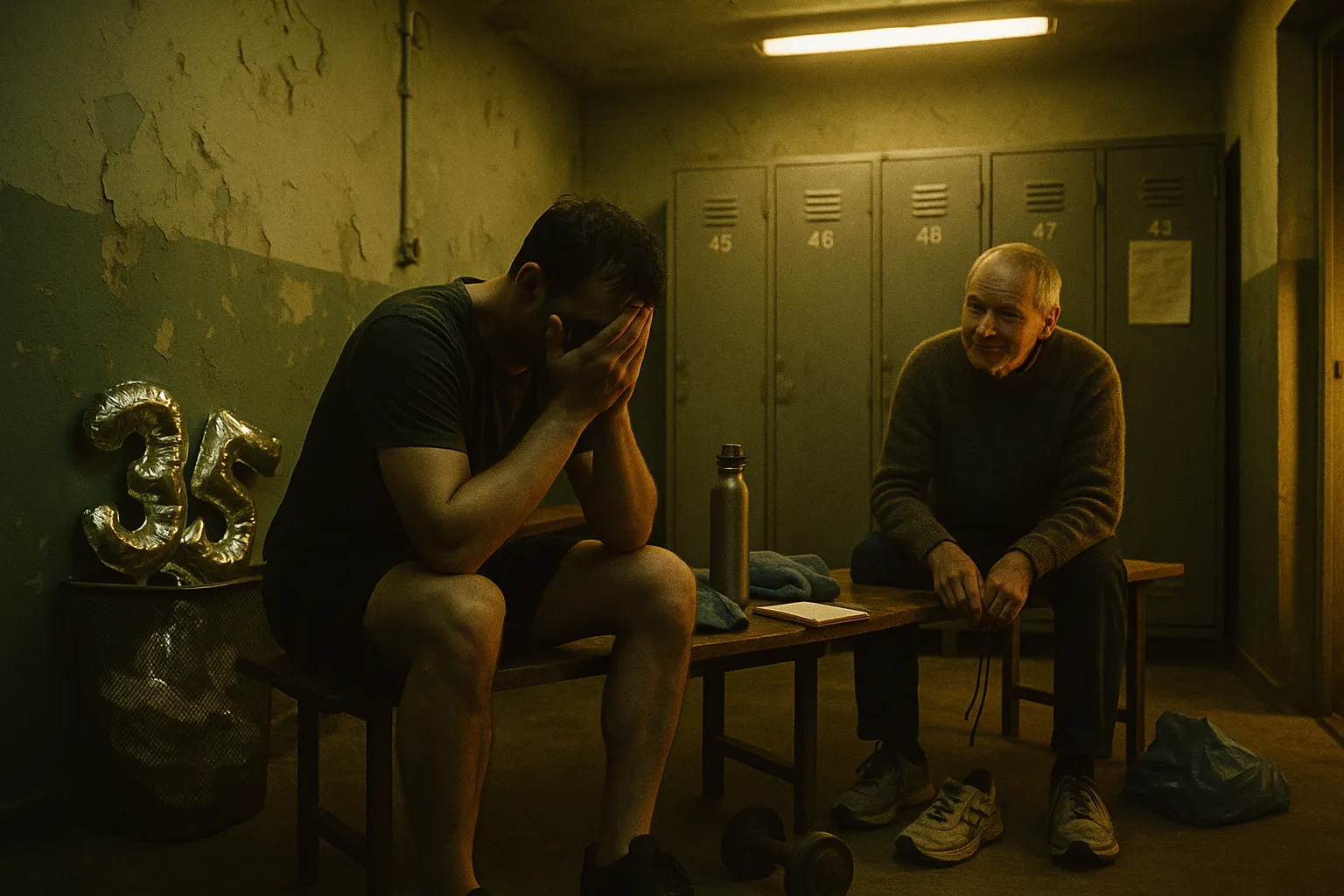
A mature thirty-five doesn't look like one more record post. It looks boring: five-to-seven repeated disciplines you've allowed to give you nothing for two years except the fact that you didn't break. Quiet daily ownership of the process instead of a sprint. Two or three people who've seen you weak and whose numbers in your phone are older than five years – everything else is networking. The right not to prove yourself in a room that hasn't given you anything yet. One reader you work for even when they're not in the room: for Watanabe it was the children of the slums, for Draper the family in the slides, for you – yours. None of this gets you a pretty birthday photo. That's exactly why the market accepts it.
And the blackest part isn't that the currency went obsolete. The blackest is that the prover doesn't die when you outgrow his logic. He just changes clothes. At thirty-five he calls himself "maturity." At forty – "delegation." At fifty – "legacy." The same accountant, the same ledger, the same motif of "not enough." Maturity isn't driving him out; it's recognizing him every morning at six and not handing him the car keys.
Biology gave you the instrument, culture gave you the bill, war gave you the denominator. And in the middle of it all sits a little accountant in a cheap suit whispering "not enough." Now, for the first time, you have something to answer him with.
At thirty-five you don't reach the finish. You find out there was no finish – only the price of the membership, and you'll be paying in a different currency. Preferably the one accepted not by the register, but by the people in your home and the people in your treeline. The balloon with your age slowly sinks to the floor. It's no reason to be sad. It's a reason to finally look at what you can still afford once it's fully deflated.
Frequently asked
What is socioemotional selectivity theory and why does it activate around age 35?
Psychologist Laura Carstensen showed that once people perceive their time horizon as limited, they unconsciously shift goals from learning and expanding toward investing in what genuinely matters. Age 35 is typically the first year this shift happens without any external trigger — not wisdom, but a recalibration of the brain under a compressed horizon.
If the old currency stops working, what exactly should be bought with the new one?
The new currency is repeatability without burnout, nameless results, institutional durability, and being necessary to specific people rather than significant before an audience. Concretely: a system that runs without you for three weeks, and two or three people whose numbers have been in your phone for over five years.
Could this entire essay about maturity just be a rationalization for a tired engine slowing down?
The author raises this objection himself and does not dismiss it cleanly — from the inside you cannot tell the difference, because the prover and the wise man use the same mouth. The only distinction Erikson offers: it is not about the engine level but about what it is pointed at — proving yourself, or building something that outlasts you.
Sapolsky's baboons: does the highest stress at 35 hit those who succeeded, not those who failed?
Exactly — a dominant whose position has become unstable carries higher cortisol than a subordinate with a stable rank. A successful 35-year-old founder is not the newcomer at the bottom; he is the alpha under whom something has shifted. Status anxiety peaks not at the bottom of a hierarchy but at the top the moment the top becomes uncertain.
What can I actually do with this tomorrow morning?
Make two lists: what you are currently trying to pay life with, and what you are doing that will still stand when you leave the room. The gap between those lists shows where the internal prover is spending your budget instead of you. Then pick one repeatable discipline and allow it two years to give nothing back except the fact that you did not break.
Comments
Signed-in readers only — to keep it human, not a bot swamp.