The Strategic Pause in Negotiations: MIT Data on Silences of 3+ Seconds — Who Gains From It and When It Becomes a Wound
A pause of three seconds or more is where negotiation value gets born (MIT, 2022). And at 11:10pm you're burning your whole magazine on a shadow in the bushes, again. Fire discipline for conflict: for whom silence is a weapon, for whom it's a wound — and three kill-criteria to run before you type into the chat.
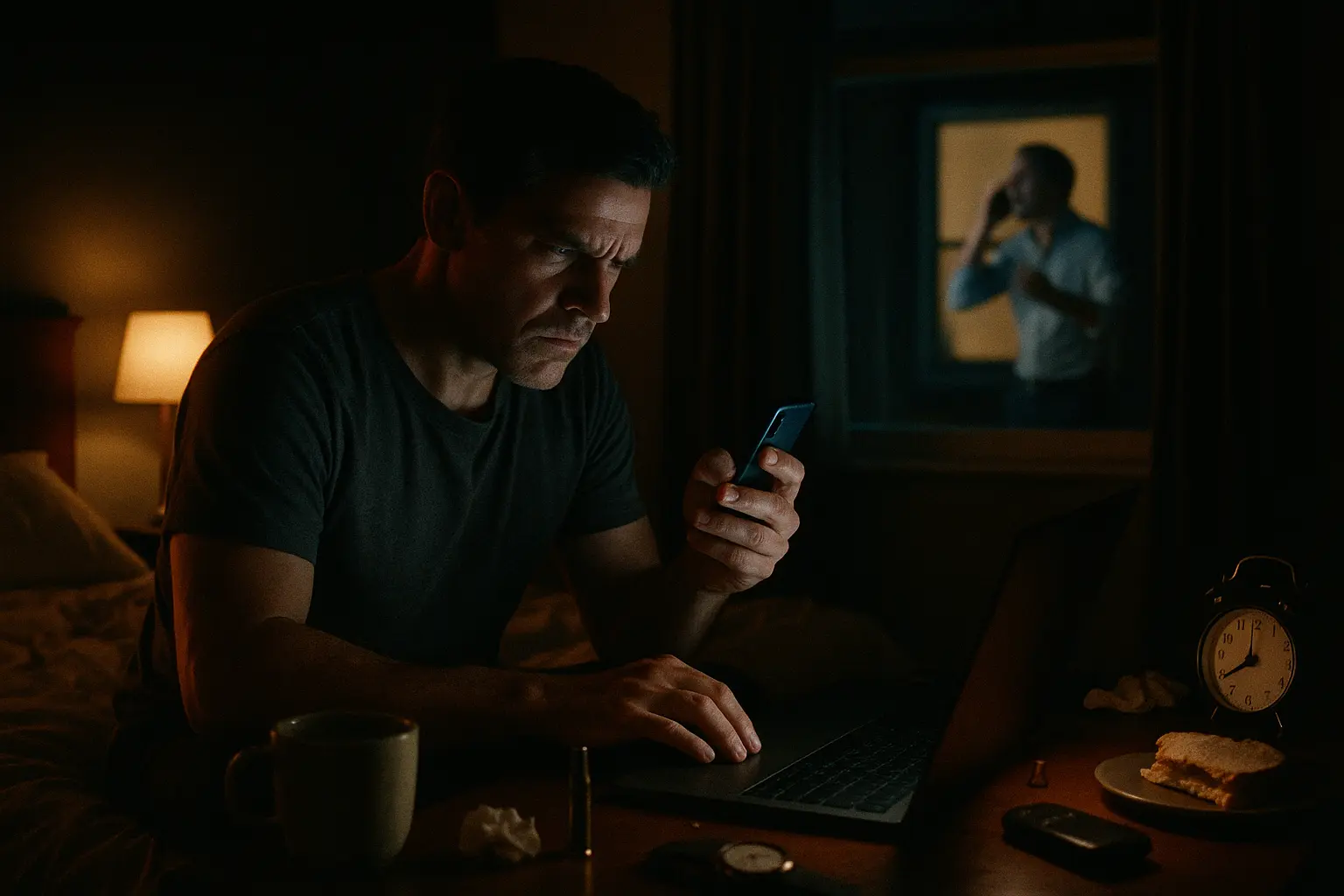
11:10pm. A message is glowing on the screen — a provocation, precision-calculated to get a rise out of you. You're already typing a reply, fingers fast, heat inside, a crushing line already loaded in your head. The three dots on your side pulse in the dark. And then — you stop. You look at this paragraph of fury. Delete it letter by letter. The screen goes dark. Silence. On the other side, "typing… typing…" — and then it goes dark too. Whoever's nerve broke first just lost, and it wasn't you.
That's fire discipline.
The number first, because without it the rest is just mood. In 2022, Jared Curhan of MIT ran recordings of lab negotiations through an algorithm and found the exact point where breakthrough deals are born — the ones where both sides walk away richer. It isn't the smartest line. It's the moment right after a pause of three seconds or more. Then the team turned the screws: some participants were told to "solve the problem together," others simply to "stay quiet before responding." Silence won. Three seconds of discomfort turned out to be a cheaper, sharper tool than all the rhetoric combined — because the pause switches the head from the reflex of "return the serve" to the question "what's actually happening here."
Economists know this mechanic as costly signaling: anyone can make the cheap claim "I'm calm," so it's worth nothing; but genuinely not answering a blow is expensive — and that's exactly why it reads as real. Armies know it under another name: fire discipline — don't shoot at every rustle, because the muzzle flash gives away your position before the bullet even reaches its target. An online fight is the same positional problem, except instead of a flashlight in the dark, you have a line of text. Whoever answers every jab lights up. Whoever holds fire stays in the dark — where you can see everything, and nobody can see you.
The Sergeant Who Orders "Fire!" at Every Rustle
At midnight, inside your head, there's a commander sitting on a folding chair. He doesn't sleep. He never sleeps. Every time someone leaves a message unanswered, drops a barb in the chat, or looks straight through you in a meeting — the sergeant stands up, racks the bolt, and orders: "Fire!" The shell casing clinks against the floor of your skull. He's satisfied. He never asks who you just hit.
The sergeant confuses silence with surrender, a pause with defeat, a non-answer with a confession of guilt. He's certain: if you don't return fire immediately, the audience will chalk it up as a loss, and your opponent will smell weakness and push one step further. The logic is flawless — in a world where everyone is watching your messages at half past eleven at night and keeping score. That world doesn't exist. The one spectator who's genuinely awake and keeping score is him.
What the sergeant never counts: every reply you fire back at a provocation isn't a shot at the enemy — it's a service manual for you, hand-delivered to your opponent by courier. "Press here and he'll jump. Bring up this and he won't sleep." You're not holding a position. You're handing out the manual they'll use to switch you on and off, like a coffee machine.
The sergeant burns the entire magazine on a shadow in the bushes. And when someone's finally, actually in the bushes — he hears a dry click.
Why a Shot Gives You Away: The Mechanics of Information Combat
5:40am, a command tent, a kerosene lamp. A young officer jabs at the map: the target's in position, why the order not to fire? The senior officer doesn't look up: because the moment you fire, the muzzle flash gives away your exact point, your sector, and how many barrels you've got. Before the shot, you were everywhere and nowhere. After it, you're a coordinate. Uncertainty was your armor, and you just took it off for one loud bang.
Aviation wrote this rule in blood. On September 11, 1974, Eastern Air Lines Flight 212, a DC-9, was coming in to land at Charlotte through fog; the cockpit voice recorder captured what the crew was occupied with until the final two and a half minutes — a lively conversation about Watergate and used cars. 72 of 82 people died. After the investigation, the "sterile cockpit" rule appeared, and it still stands: below 10,000 feet, not one word off-task. Not because chatting is a sin. Because at low altitude, every spare word eats attention you can never get back. A conflict thread is always a flight below 10,000 feet. And you're still down there discussing Watergate.
In a chat, the muzzle flash looks different, but the physics is identical. Every reply narrows the fog around you: it reveals exactly what gets under your skin, what you feel compelled to refute, where your nerve runs, and how many hours of your life you're willing to pour into this exchange. Your opponent isn't reading your arguments. He's reading a thermal scope: where you're hot.
Why Now: Silence Got a Timestamp
A hundred years ago, this essay wouldn't exist, because the problem wouldn't exist. A letter took a week — the pause wasn't a signal, it was postal physics. A stamp cost money, paper took effort, and every "didn't answer right away" had a hundred innocent explanations. The messenger app made words free — WhatsApp alone pushes through roughly 150 billion messages a day — and free things, as they will, leaked out of every crack. In a dataset of 3.4 million real messages that researchers analyzed, about 70% of WhatsApp replies land within five minutes. Five minutes is the new unit of breathing. Anything longer now reads as a statement.
And then silence got a timestamp. "Read at 2:32pm" — and silence, which for centuries had been fog, became a document: he saw it and didn't answer. In a Copenhagen study of read receipts, 35% of participants admitted to feeling ignored when the checkmarks turned blue with no reply — and 82% did the opposite: they didn't open the message at all, just to avoid starting the waiting clock. Sit with that posture for a second: a person carrying an unread text in their pocket like a grenade with the pin pulled, because they know that the moment they look, a timer starts that both sides can see. In a more recent sample of almost three thousand WhatsApp users, a third had simply turned off read receipts. That's the first move of digital fire discipline, and it's sitting right there in settings: take your own thermal scope off the battlefield.
The three pulsing dots are a character in their own right in this play. The "contact is typing" indicator was invented in 1997 by IBM engineers, and the patent states its purpose plainly: to relieve the anxiety of waiting — so a person would at least know a reply was on its way. Thirty years later, those three dots have become a genre of anxiety all by themselves: they appear, pulse, vanish — and you sit there staring at the empty space where someone's reply was just born and died. A tool built against uncertainty became its chief supplier. That's the whole of digital comfort in a nutshell: it doesn't remove the waiting — it makes the waiting visible, and bills it by the hour.
And the last number, the most important one for this piece: in that same dataset of message threads, people mirror each other's response tempo almost one to one — a statistical slope of 0.79. Answer instantly, and you train people to expect instantly. Hold for an hour, and within a month your hour becomes the norm, and nobody writes "why are you going quiet on me?" Your tempo isn't a habit. It's a curriculum you teach every one of your contacts, every single day — and you forgot to put yourself on the roster of students.
Whoever Has to Answer Everything Doesn't Own the Conversation
Whoever has to answer everything doesn't own the conversation — the conversation owns him, and every opponent now knows exactly one button to push to send him in circles.
Let's name the lever: Silence as a Weapon. Not passivity, not a sign of weakness, not a psychological shield — a deliberate, precise act, the same fire discipline, just carried over to the negotiating table and into the chat window. Whoever has mastered it isn't merely holding back. He's setting the tempo — and whoever sets the tempo of replies conducts the entire exchange.
Chris Voss, the FBI's former lead hostage negotiator, built half his method on exactly this. His rule reads like an armorer's manual: drop a marker line — "it sounds like this feels unfair to you" — then silence, a minimum of four seconds, no matter what. Voss calls it dynamic silence, and he forbids himself from filling the pause: fill it, and you're firing into your own ambush. In 1993 in Brooklyn, when two robbers holed up in a Chase Manhattan Bank with hostages, this exact mechanic — the low, slow voice of a late-night radio host, mirroring the last words said, long pauses on the line — pulled people out alive, step by step. No raid. The loudest victory of that negotiation was made mostly of silence.
Tim Cook does the same thing without a phone line. People who've sat with him in meetings in Cupertino describe one recurring ritual: he asks a question — and goes silent. For a long time. The only sound in the silence is him unwrapping another energy bar. Someone can't stand it and starts talking — usually saying more than they meant to. Cook himself explained his stone-faced listening plainly: "If I gave any kind of reaction, people would often tell me what they think I want to hear." Notice this: this isn't silence-as-pressure anymore. This is silence-as-filter. Any reaction from you contaminates the input — the other person instantly recalibrates their next sentence to match your face. Silence is the only way to hear what someone actually thinks, instead of what they think about your eyebrows.
10:50pm, a hallway after a meeting, it smells like cold vending-machine coffee. Someone throws a line at your back — barbed, calculated, a touch louder than it needs to be. Waiting for you to turn around. You look at him for exactly one second. Nod. Keep walking. He's left standing there holding his provocation like a boomerang that decided not to come back. This isn't politeness, and it isn't nobility. It's total control over what just happened — and it's printed right there on his face.
The Counterfeit Weapon: When You're Not Holding Fire, You're Hiding
A weapon turns dangerous the moment you mistake where it's pointed. Silence out of fear looks, from the outside, exactly like silence born of strength — lips shut, no reply. But they're different organs. Fear-silence boils on the inside: you draft a line, delete it, rewrite it, rehearse the other person's reactions, sleep in fragments, and at 3am reopen the argument in your head where you've already won every round. A weapon stays quiet and sleeps. A wound stays quiet and swells.
There's one touch-test: what does this silence cost you? If staying quiet is cheaper than answering, you're holding a weapon. If staying quiet costs you more than answering, and you keep quiet anyway because "it's the right thing to do" — you're not holding a weapon, you're holding your own severed artery, and calling the bleeding self-control.
There's a nuance the motivational retellings of this topic leave out: silence carries a class passport. In those same Curhan experiments, the benefit of pauses consistently went to whoever held higher status at the table; for the person lower down, the exact same pause brought no value. Life knows this without a lab: a senior who answers once a day is "someone deep in the work"; a junior on probation with the same tempo is "not really pulling his weight." Researchers of digital pauses add a pinch of salt: the more is expected of a person, the more harshly their delay gets punished. Silence is a weapon issued along with your rank, and taking it without a permit is like a junior parking in the CEO's spot: same space, very different consequences. This doesn't mean "you're not allowed." It means: first calculate how much of your silence the market is actually willing to tolerate, and take a pause sized to your own status, not someone else's.
There's another kind of counterfeit, the mirror image. There are rooms where silence is a betrayal of your position, and, wouldn't you know it, the sergeant is nowhere to be found. A public accusation in front of a strange audience: your silence gets logged in the record as "admitted." A working group about to adopt the wrong course: your pause is your signature on a decision you actually oppose. Here, not firing isn't even cowardice — it's worse. It's letting someone else's mistake set in concrete, with your silent consent poured in as the binder.
A surgeon and a coward both refuse to cut right now. The first, because it isn't time yet. The second, because he's afraid of blood. From the outside, the stillness looks identical. The difference only shows once the patient on the table starts bleeding out: one of them picks up the scalpel; the other keeps watching, calculating which option is cheaper.
Two Speeds of the Weapon: Messaging and Live Speech
Asynchronous combat — chat, comments, correspondence — hands you a luxury almost nobody uses on purpose: time. Most people answer not on the rhythm of strategy but on the rhythm of their own anxiety. A message arrives — anxiety spikes — you answer — anxiety drops. That's not communication. That's a person popping a pill, having mistaken the chat window for the medicine cabinet.
Fire discipline here is mechanically simple and physically hard: wedge a pause between "read" and "replied," even an artificial one. Not "three days" out of principle and not "within a minute" out of reflex, but one cold question: does this reply give the other side information — or does it just discharge me? Modern messengers, by the way, already have a whole grammar of non-combat moves built in that almost nobody uses deliberately: an emoji reaction to a message says "I saw it, this conversation is closed" without a single quotable word; turning off read receipts removes your thermal scope; "I'll get back to you tomorrow" is a legal pause that can't be read as fleeing. The arsenal is already sitting there in settings. What's usually missing isn't the tools — it's the decision to use them.
One separate note, on a phenomenon that's easy to confuse with our topic. Vanishing forever without a word — ghosting — isn't a strategic pause; it's leaving the game without posting the final score. Per Pew, 42% of 18-29-year-olds have been through it; in samples of dating-app users, the figures run to 85% "I've been ghosted" and 63% "I've ghosted someone." Silence as a weapon operates inside a relationship that's still ongoing — it holds a pause without burning the bridge. A ghost doesn't hold fire. A ghost deserts the field and leaves the other person to clean up the crater.
| Situation | What answering shows | What silence shows | Decision |
|---|---|---|---|
| Emotional provocation, face to face | Button found, escalation begins | Imperviousness, indifference | Hold fire |
| Public accusation, there's an audience | You have a position, you're defending it | Reads as an admission | Answer briefly |
| Meeting, someone proposes the wrong course | There's an objection, there's an argument | You let the wrong course set | Answer |
| Argument loop, both sides going in circles | You're in the loop too | An exit without capitulation | Hold fire |
| Negotiation, silence after an offer | Need, discomfort, haste | Strength, absence of pressure | Hold fire |
| A fight with someone close, at home | Escalation at an elevated pulse | No explanation = punishment by silence | Name the pause and the return time |
| A question you don't know the answer to | Unpreparedness on display | The same thing, wearing a mask | "I'll get back to you" — also silence |
Live speech runs at a different speed and a higher stake: there's no time to think it over, but there's a body, a gaze, air. Here fire discipline means the pause after the other person's line, held to the end, not to the first pang of discomfort. Three seconds of silence is uncomfortable for both of you, but differently: you know the pause is deliberate; he doesn't. For him, it's a pit he urgently needs to throw something into. For you, it's a position from which you watch him throw his own words down there instead.
Psychotherapists are the one profession where silence is taught for money, on a schedule. A meta-analysis of thirty-three studies of therapy sessions counted seven distinct types of silence and sorted them into productive and obstructive: a productive pause is when the therapist stays quiet, and the client, inside that silence, arrives on their own at the sentence they'd been circling for months. Notice who's paying here: the client hands over money for an hour, a significant chunk of which is silence — and it's the most effective chunk. The same pump of silence that, in an interrogation, extracts an unnecessary confession extracts, in a therapist's office, the truth a person had been hiding from themselves. Same tool. The difference is where it's pointed.
And there's a technique rarely called a weapon, because it's too quiet for that: repeat the other person's last line back, in a flat voice, with no judgment. "You said the contract isn't worth these terms." Full stop. Silence. This isn't agreement or disagreement — it's a mirror held up to his face. A person who hears their own words played back with no reaction instinctively starts explaining them, softening them, or disowning them — and you haven't done a thing except hold up the glass.
The Checklist Before You Shoot: Three Questions and One Extra
Before you write into a conflict — three questions. No firm "yes" on any of them, and you don't shoot.
1. Does this add information — or does it just discharge me?
If the honest answer is "I need to vent," that's a painkiller, not a strategy. Take the painkiller somewhere else: in your notes, out loud alone in a room, in conversation with someone who isn't involved. Abraham Lincoln did this systematically: he'd write a furious, devastating letter to whoever had angered him — and file it in a drawer. After Gettysburg, he wrote to General Meade that by letting Lee's army escape, Meade "could have ended the war" — the sheet turned up in the president's papers, marked in his own hand: "never sent, or signed." The charge went off. The shot didn't. Meade never found out he'd been executed in a drawer.
2. Am I answering the opponent — or the audience?
No audience — then you're just feeding his anxiety and yours, in a loop. There's an audience — then the line may not be for him at all, but for them, and that's an entirely different sentence, written by a different hand.
3. In 48 hours, will I be proud of this paragraph?
A filter against urgency. Text that feels devastating at half past midnight almost always turns out pathetic by 9am. Midnight's most devastating lines usually end up devastating whoever wrote them — just on a delayed fuse.
And a fourth, outside the formula but the main one: after how many rounds does this exchange turn to dust anyway? Most duels that feel decisive at 11:10pm are minor noise at the bottom of the chat by 9am. The sergeant will never tell you this — he only lives in today, in this very second, shell casing between his teeth. You also live in tomorrow. That's your entire advantage.
Where the Weapon Becomes Torture
Here's the trap, and it needs naming before you fall into it with your head held high. Silence as a weapon is easy to twist into a fresh manipulation: not answering in order to punish; holding a pause so the other person suffers; staying quiet to display dominance. That's no longer fire discipline. That's gaslighting wearing strategy like someone else's uniform, off someone else's shoulders.
The science here is uncomfortably specific. In Kipling Williams's classic "Cyberball" experiment, a person plays a virtual ball-toss game with two other players — and at some point, the other two simply stop throwing to them. That's it. Nothing else happens. That's enough to tank someone's mood and their sense of self-worth — the effect has been replicated in over a hundred studies on thousands of people, and it holds even when participants are told outright that the "other players" are bots. Brain imaging showed why it hurts so much: social exclusion lights up the anterior cingulate cortex — a region also involved in processing physical pain. The brain sounds the alarm using the same bells. How literally "the same" — neuroscience is still arguing about that — but one control fact remains a black diamond: three weeks of ordinary acetaminophen measurably reduced the daily pain of social slights. Silence-pain is physical enough that a headache pill takes the edge off it. The problem is, conflict usually outlasts the packaging.
Now, home. John Gottman's lab spent decades filming marital arguments with sensors wired to people's bodies, and isolated four patterns that predict divorce; stonewalling — the flat, silent shutdown — is the most treacherous of the four, and per the lab's own data, about 85% of stonewallers are men. The mechanics are physical: during a fight, heart rate climbs past a hundred, the body enters "flooding" mode — and the person isn't holding fire, they're drowning silently, stone-faced, with adrenaline roaring underneath. It looks like composure. The heart monitor says otherwise. (An honest footnote to the iconic number: "Gottman predicts divorce with 94% accuracy" is folklore; when his formulas were run on an independent sample, accuracy slid down toward a coin flip. But the underlying link — "demand-withdraw pattern predicts an unhappy couple" — held up in a meta-analysis of 74 studies. The pattern is real. The magic percentage isn't.)
Gottman's fix is insultingly simple, and it's also the exact line between weapon and torture: a break of at least twenty minutes, so the body can physically exit combat mode, at most a full day — and always with an announced return. "I need to stop. I'll come back to this conversation at nine." It's the same silence — but with a timer and an address. Torture begins where the timer gets removed: silence with no deadline, held until the other person capitulates, apologizes for something they didn't do, or starts doubting their own memory. A therapist stays silent so you can tell yourself the truth. A tormentor stays silent so you invent your own verdict. It's the same pump — the only question is what it's draining out of you.
The tell is as simple as a rifle sight. If your silence is aimed at the conflict, it's a weapon. If it's aimed at the person, meant to make them suffer or doubt their own reality, it's no longer fire on a position — it's fire on a living thing. The difference between weapon and torture isn't in the tool. It's the same scalpel. The difference is whether you're cutting out a tumor or cutting into a person — and both hands hold it exactly as steady.
Whoever genuinely masters this weapon doesn't turn cold. He turns precise. He answers less often — but every word carries more weight, because the people around him have already learned: he doesn't do cheap lines, so if he's spoken up, it's for real. Jeff Bezos took this economy down to a single symbol: he'd forward a customer complaint to managers with nothing added but a question mark. One character — and it would set off a scramble on the other end that a three-page memo couldn't have triggered. Scarcity drove up the exchange rate: the fewer words a person spends, the more expensive each one trades for. It's ordinary market mechanics — it's just that the currency here is your attention, and the exchange is someone else's mind.
And the last asymmetry, the one that closes the circle. People who answer everything are the cheapest commodity on this exchange: you can start them up with one word at the right moment and get exactly the reaction you ordered. People who go silent selectively are unreadable. You don't know what will set them off. You don't even know if they've been hit. Cinema closed this argument with a single shot half a century ago: at the end of "The Godfather," Kay asks Michael a direct question, he lies with one word — and then silence does the talking: the caporegimes file in to kiss the new don's hand, and the office door closes on her without a single line. The final word of the strongest scene in the film is its absence.
11:10pm. A message is glowing on the screen. You already know what you're going to do. Fingers — off the keyboard. Screen — face down. The sergeant in your head is screaming "Fire!" You don't shoot — and for the first time all evening, you hear how small he actually is.
Whoever breaks the silence first has lost the negotiation with their own fear. The conflict itself is a separate matter, and it will keep until morning, when you're no longer aiming with a shaking hand. Tonight's bill is closed out with three seconds of silence. This evening has never cost less.
Frequently asked
What is 'Silence as a Weapon' and how is it different from ordinary conflict avoidance?
Silence as a weapon is a deliberate, calm act: you don't answer because it serves you, and you're in control of the state. Avoidance is when you go silent out of fear or anxiety and lie awake at 3am replaying the text you never sent. The tell is simple: if the silence costs you more than a reply would, it's a wound, not a weapon.
Where does the term 'fire discipline' come from in the context of negotiation and messaging?
From field manuals: the military trains soldiers not to shoot at every rustle, because a muzzle flash gives away your position. Aviation has a sister rule — the 'sterile cockpit': after a 1974 crash where the crew chatted about Watergate and used cars until the final minutes, the FAA banned all non-essential conversation below 10,000 feet. In conflict, every reply to a provocation is a muzzle flash: it shows exactly which button works on you, and where your threshold sits.
Why can not-answering be a 'dominant strategy' — is that backed by anything besides life experience?
Yes. In 2022, a team led by Jared Curhan at MIT showed across a series of experiments that pauses of three seconds or longer systematically precede breakthrough deals in negotiation, and a direct instruction to 'stay quiet' produced more joint value than an instruction to 'solve the problem.' The mechanism: a pause switches the brain from reflex to deliberation. Add the classic signaling logic on top — a costly signal (restraint) carries more information than a cheap claim like 'I'm calm.'
When does silence become a mistake, or even a form of violence — and how is a strategic pause different from stonewalling?
It's a mistake when there's an audience (silence reads as an admission) or when it lets a bad decision harden inside a system. It becomes violence when the silence is aimed at the person, not the conflict: relationship researchers document stonewalling as one of the most toxic patterns in a couple. The working line: a strategic pause has a named duration and an announced return ('I'll pick this back up at 9pm'); torture is silence with no timer, held until the other side capitulates.
What three kill-criteria help decide whether to answer or hold your fire?
First: does this add information, or does it just discharge me? Second: am I answering the opponent, or the audience? Third: in 48 hours, will I be proud of this paragraph? No 'yes' on any of them — don't shoot. Even one confident 'yes' — answer briefly, and only on the point where the 'yes' applies.
Comments
Signed-in readers only — to keep it human, not a bot swamp.