NEURODRIFT War

War

Analysis of the future of war from the country already fighting it: drones, electronic warfare, the kill chain, the economics of strikes, and how technology rewrites combat faster than the field manuals. No propaganda — just the mechanics.

13 publications

11 min

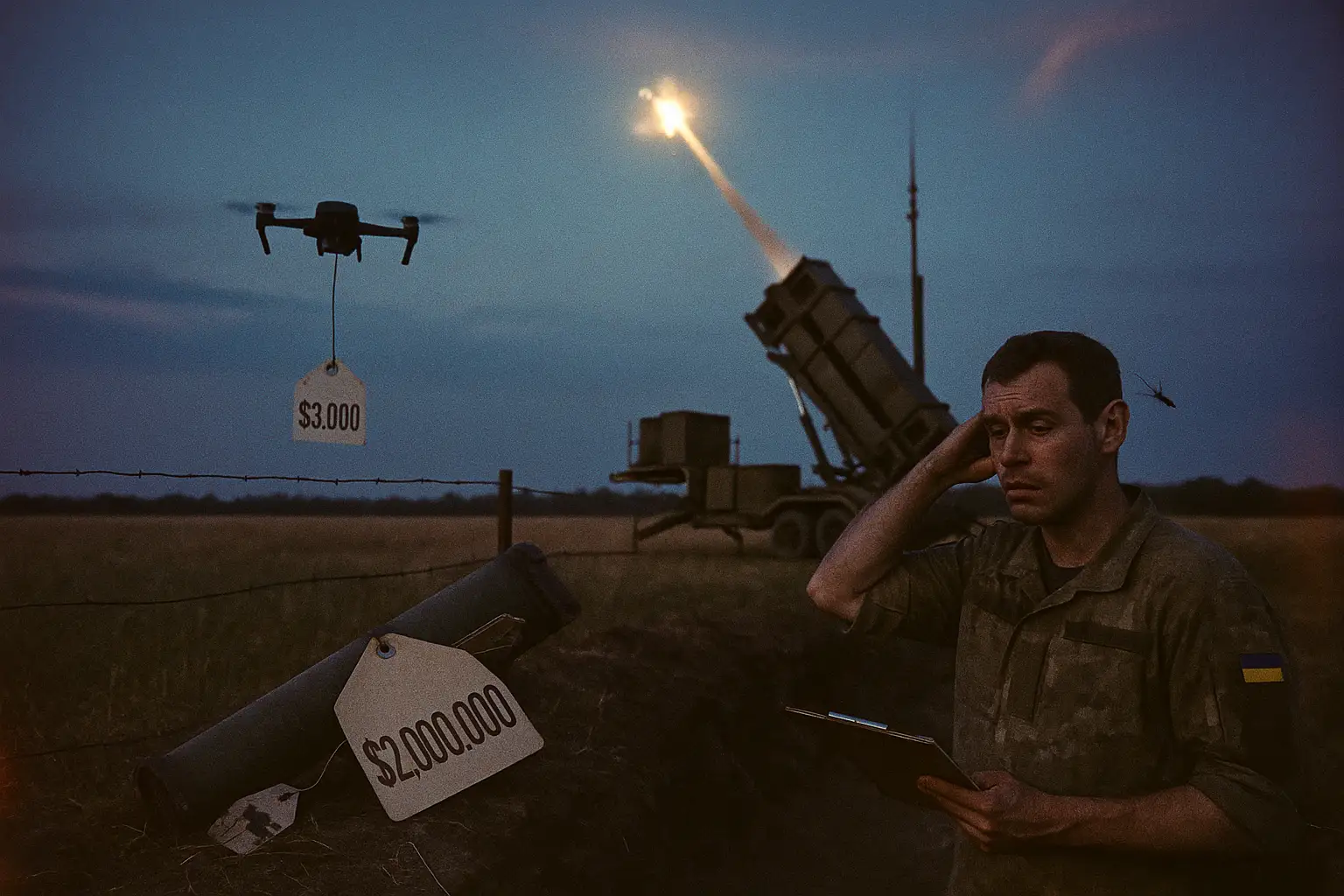
A mortgage to swat a mosquito: the math in which the rich just lose more slowly

All nine previous texts were about how the way we fight is changing: drones, surveillance, asymmetry, the algorithm, open source. This one is about the older, duller truth beneath all of it. Big wars are won not by a commander's genius or by better weapons, but by whoever's economy, demographics, and political will hold out longer. War is three clocks: combat losses, economic attrition, and the patience of society. The loser is the one whose clock stops first. The synthesis of the series.

  • war
  • economics
  • attrition

10 min

War Went Open-Source

Weapons are no longer built solely by closed corporations from secret blueprints. They are now developed like open code: drawings are posted online, enthusiasts print them on 3D printers, the community forks and improves them, shares them in chats. The hobby of makers and RC modellers has become a military supply base. War has migrated from the closed defence industry's 'cathedral' to the 'bazaar' of distributed development — in Eric Raymond's terms. And the bazaar's chief rule is merciless: a published file can never be recalled.

  • war
  • technology
  • open-source

10 min

A Million Drones — a Test of the State's Ability to Learn

When a state announces 'we'll build a million drones,' everyone hears a production figure. In truth it's a stress test: are the institutions able to learn, coordinate, scale, and absorb what they've made. The factory is the easy part. The hard part is training operators, delivering, writing it into doctrine, closing the feedback loop — and not turning the number into theatre. On the state as a system that learns, on the learning rate — and on Goodhart's law, which turns the goal into a performance.

  • war
  • technology
  • state

13 min

The Algorithm as Officer

In 1983 a Soviet officer, Stanislav Petrov, saw 'missiles incoming' on his screen — and refused to believe the machine. He may have saved the world. Today the machine does not warn; it proposes targets: it ranks, recommends, compiles lists. The human stays in the loop — but increasingly only as a signature beneath the algorithm's decision. On the delegation of killing, automation bias, the accountability gap, and the defining question of the era: is anyone left who can still say 'no'?

  • war
  • technology
  • artificial-intelligence

12 min

Electronic Warfare as the New Artillery

Stalin called artillery the god of war. In the 21st century a new god has appeared — an invisible one. Electronic warfare doesn't destroy the drone; it severs its nervous system: it jams the control channel, spoofs the navigation, makes the machine blind in a second. The drone falls without a scratch. This is the war for the electromagnetic spectrum — invisible terrain fought over as fiercely as heights once were. And, as in *Dune*, it brings back to the field the oldest solution of all — the wire.

  • war
  • technology
  • electronic-warfare

12 min

The Shahed Is the Kalashnikov of the 21st Century

The most successful product of the 20th century was neither the car nor the phone, but the Kalashnikov rifle: over a hundred million units, cheap, indestructible, indifferent to ideology. It democratized the firepower of infantry. The cheap kamikaze drone does the same thing — but raises the democratization one floor higher: from the tactical shot to strategic range, the last monopoly of great powers. On the weapon that redistributes power downward — with figures and tables.

  • war
  • technology
  • drones

12 min

Ukraine as NATO's R&D Lab

Western weapons are born on a ten-to-twenty-year cycle: requirement, tender, prototype, trials, production run. Ukrainian drones reflash their firmware overnight and ship to the front by morning. This is a collision of two development models — the slow procurement 'waterfall' and continuous combat integration. And the most uncomfortable question: what kind of lab is it where the test subjects die and the reports are read by someone else?

  • war
  • technology
  • defense-industry

13 min

Kill Chain in Minutes

For two hundred years we were promised that technology would dissolve the fog of war. We compressed the sensor-to-shot chain from days to minutes and made the earth transparent. And then it turned out: the fog didn't vanish. It simply relocated — from the sensor into the head of whoever has to decide. On the kill chain in numbers, the general drowning in data, a map the size of an empire — and why clarity became a new form of blindness.

  • war
  • technology
  • surveillance

20 min

Palantir as the Eye of Sauron

In Tolkien, the palantír is a stone that shows any point in the world in real time. Tolkien made it not a weapon of victory but a trap: the stone never lies — and that is precisely why it drives men mad. The company named after that artifact has become the nervous system of modern wars — and reproduces exactly the same trap. On Gotham, AIP, Maven, the Karp doctrine, the oracle at Delphi, the Ring of Gyges, and the question software does not solve: who holds the other stone.

  • war
  • technology
  • surveillance