$500 vs $5 Million
A $500 drone burns a $5-million tank. A $3-million interceptor shoots down a $20,000 drone. This is not an accident or a temporary anomaly — it is the new arithmetic of war, where the winner is the one who forces the enemy to pay more for every exchange. On the cost-exchange ratio, the math of attrition, the innovator's dilemma — and why the richest army in the world learned to go bankrupt without losing a single battle.
On this page
- I. A division problem
- II. The cost-exchange ratio: the fraction that flipped
- III. The numbers that make your stomach turn
- IV. The Red Sea: a clean laboratory of the fraction
- V. The arithmetic of attrition: how to win everything and lose
- VI. Three curves of cheapening that met at one point
- VII. The innovator’s dilemma: armies repeat the fate of corporations
- VIII. “Good enough” — the scariest phrase in war economics
- IX. This is not new — only the scale is
- X. Why the strong can’t just “go cheap too”
- XI. The limits of cheapness: where the fraction stops saving you
- XII. Self-check: do you think in the old currency
- XIII. War as the accounting we were ashamed to name out loud
The second essay in the series “The New Logic of War” — on how technology rewrites the very grammar of war. Today: the economics of asymmetry, in which cheapness began to beat resources.
I. A division problem
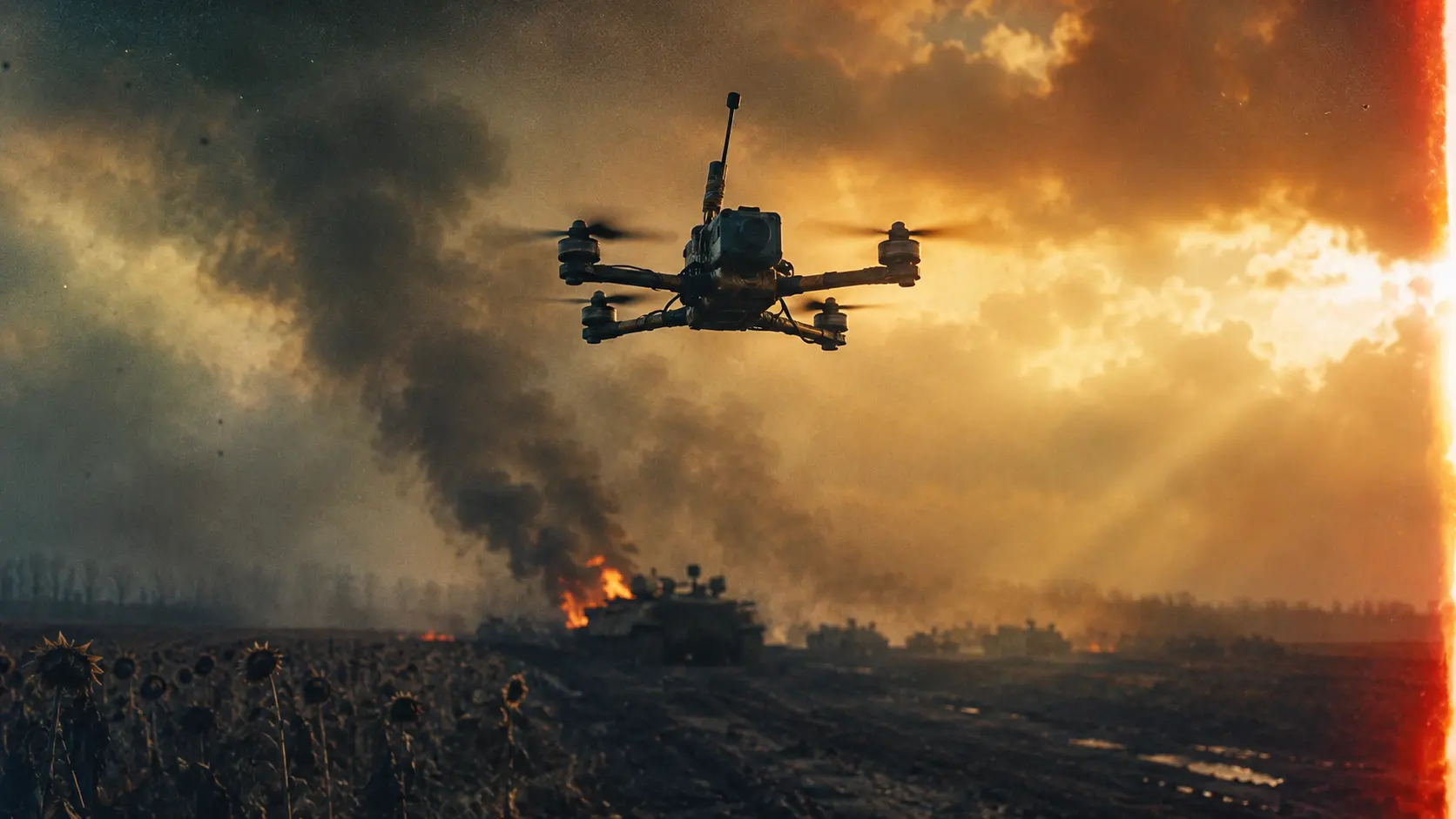
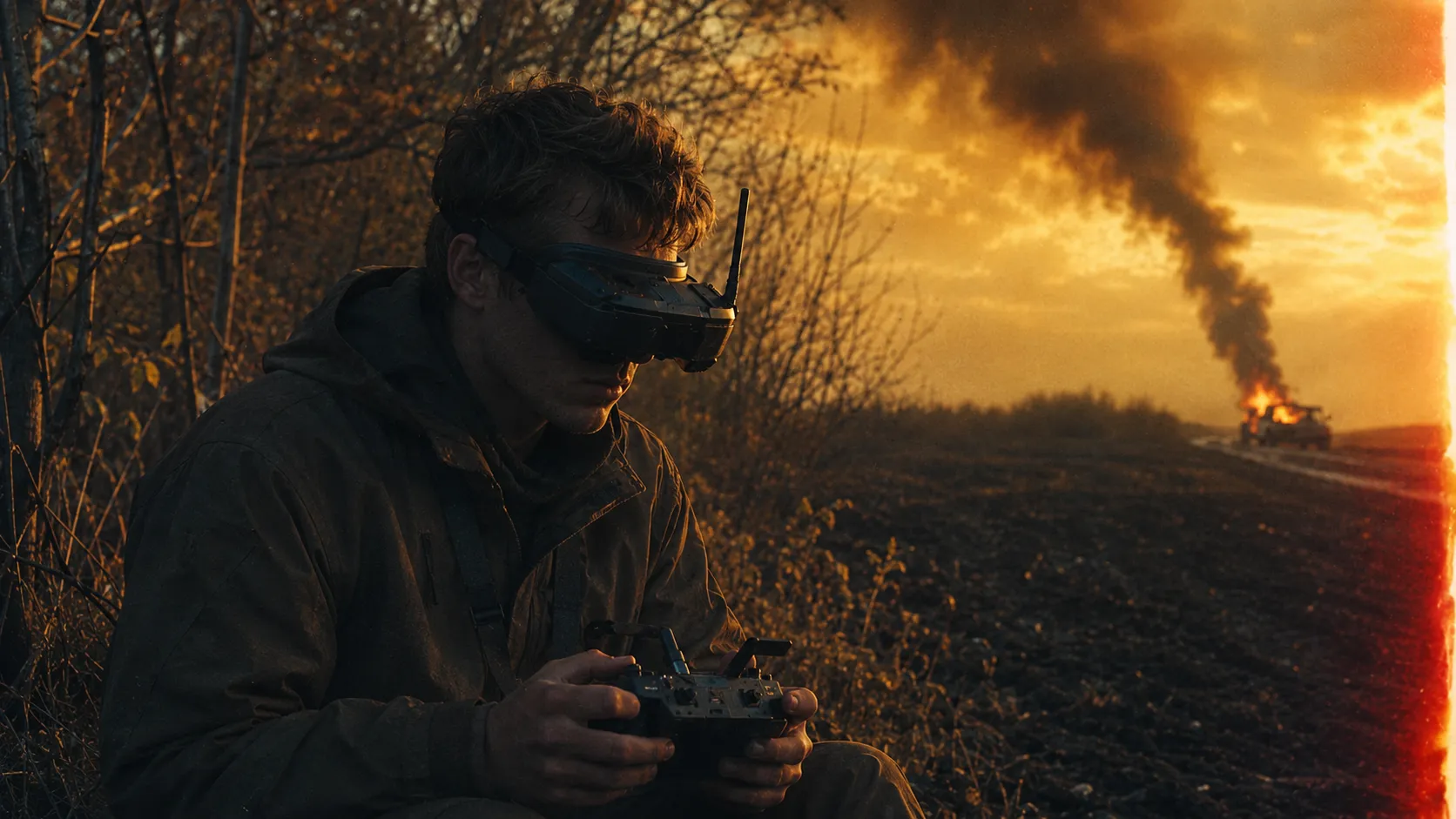
Hold one frame in your head. A tank: a multi-ton machine, years of engineering, alloyed armor, a thermal sight, a crew of three trained people. Price tag — several million dollars. Toward it flies a piece of foam and electronics whose most expensive part is a camera and a battery. Price tag — a few hundred dollars. A second later the tank is gone, and the drone operator reaches for the next airframe.
An engineer looks at this frame and sees neither heroism nor tragedy. He sees a fraction. In the numerator — what you lost. In the denominator — what the enemy spent. And when the fraction reads “millions divided by hundreds,” what you hold is not a failed episode but a hole in the very model of power.
Because war, once you strip the poetry of valor off it, is a division problem. It’s just that for centuries the denominator was classified, and now it’s posted on social media with a music track over it.
This essay is about the arithmetic that quietly rewrote the logic of power: the cost-exchange ratio. This metric used to be known only to staff economists. Now everyone scrolling a feed sees it — they just rarely say out loud that they’re looking at accounting.
II. The cost-exchange ratio: the fraction that flipped
The idea is indecently simple. Every action in war has a price. Firing a shell, launching a plane, intercepting a missile — all of it is money, and it can be counted. The cost-exchange ratio is the ratio of what it costs you to remove a threat to what it cost the enemy to create it.
For centuries this fraction worked for the strong. A great power could afford more expensive weapons — more precise, longer-range — and each of its shots hit more effectively than a poor opponent’s. Wealth converted into advantage almost linearly: whoever spent more, dictated.
Now look at what happened. Against a drone costing from a few thousand to a few tens of thousands of dollars, developed armies raise means costing millions. An air-defense missile shoots down a target cheaper than itself by tens, sometimes hundreds, of times. The fraction flipped. Now it’s the rich who pay disproportionately more for every episode — and for the first time in history, being rich at war means going bankrupt faster.
This does not mean the missile is “bad”: it is brilliantly engineered. The problem is not quality — the problem is the math of series. If the enemy produces threats faster and cheaper than you produce the means to destroy them, then even a hundred-percent-effective defense leads to defeat. You win every battle and lose the war — by the accounting.
III. The numbers that make your stomach turn
So as not to leave this at the level of feelings, let’s put the ratios in a table. The numbers are orders of magnitude, not contract precision: real prices depend on model, batch, supplier, and are always disputed. But even rough orders tell the whole story.
| Cheap means of attack | Order of price | What it hits / what's raised against it | Price of target / response | Fraction |
|---|---|---|---|---|
| FPV drone | ~$500 | tank, IFV, howitzer | $1–5M | 1 : 1000+ |
| Shahed-type kamikaze drone | ~$20–50k | air-defense interceptor missile | $1–4M | 1 : 30–100 |
| Naval drone-boat (fire ship) | ~$200k | combat / landing ship | $300M – $1B | 1 : 1000+ |
| Houthi improvised missile/drone | ~$2–20k | naval air-defense missile | ~$2M per launch | 1 : 100–1000 |
| Improvised explosive (IED, past era) | ~$30 | armored MRAP | ~$500k | 1 : 16000 |
Cost-exchange ratio: a cheap attacker against an expensive target or expensive defense. Numbers are orders of magnitude to illustrate the principle, not exact contract prices.
And to feel not the fraction but the chasm, here are those same prices on one scale. Note: the scale is logarithmic — each step to the right means not “a bit more” but “ten times more.” Otherwise the cheap means would be a thin line you couldn’t see.
Look at the bottom row of the table. The improvised explosive from Iraq and Afghanistan is the forgotten ancestor of today’s asymmetry. Explosives with a homemade detonator for tens of dollars knocked out a machine worth hundreds of thousands and killed trained soldiers. The richest army in the world answered with tens of billions on mine-resistant vehicles. The drone simply lifted this same logic into the air — and added precision.
IV. The Red Sea: a clean laboratory of the fraction
If anyone needs a lab-clean illustration, it was provided not by Ukraine but by the Red Sea. Through 2024, the Houthis of Yemen — a movement hard to call an industrial state — hurled cheap drones and missiles of Iranian lineage, costing from a few thousand to a few tens of thousands of dollars each, at merchant ships and warships.
What was the most expensive fleet in human history supposed to do? Shoot them down. And the only reliable means in those conditions were naval air-defense missiles at millions of dollars per launch. A situation arose that frankly rattled the Pentagon: a superpower burning a $2-million missile so a $20,000 drone wouldn’t scratch the paint on a destroyer. By reported accounts, the munitions bill in this campaign ran to hundreds of millions of dollars in mere months.
Here hides the devil of asymmetry. The attacker doesn’t need to win in the classical sense. He only needs to impose on you an exchange in which you go bankrupt faster than he does. This is a strategy not of destruction but of attrition through price — cost imposition. You can have better ships, better people, a better doctrine — and still end up as a casino that pays out more than it takes in. And here the casino’s owner is you.
V. The arithmetic of attrition: how to win everything and lose
The nastiest thing about this fraction is that it doesn’t forgive even a perfect defense. Let’s show it on a simple calculation (numbers are notional, for the mechanics, not a battlefield report).
Suppose the enemy launches 100 “Shaheds” a month, at ~$40k each. His monthly bill — about $4M. You are the model defender: you shoot down all hundred with expensive missiles at ~$2M. Your monthly bill — about $200M.
| Side | Action per month | Result on the field | Bill |
|---|---|---|---|
| Attacker | 100 "Shaheds" × ~$40k | all shot down — "lost" | ~$4M |
| Defender | 100 intercepts × ~$2M | 100% interception — "won" | ~$200M |
| Bottom line | — | fraction 1 : 50 | multiply by 12 months |
You just won every battle with a hundred-percent result — and lost with a score of 1 : 50. Multiply by a year. Multiply by the fact that his marginal cost of producing the next hundred is near zero, and yours is not. This is cost imposition in its pure form: the enemy converts your victory on the field into your defeat in the budget.
“So shoot it down with something cheaper,” says logic. Correct, and that’s what they do: guns, cheaper interceptors, electronic warfare. But the moment you cheapen the response, the enemy simply increases the salvo — because adding another hundred plywood machines costs him pennies compared to what it costs you to expand the defense. The cheap side always moves last. That is its advantage.
VI. Three curves of cheapening that met at one point
The asymmetry of cheapness is not a whim of the moment. It was made possible by three technological curves that crept down in price for decades and suddenly met.
Computation. What once required a military supercomputer now fits in a chip for a few dollars. Flight, stabilization, navigation, recognition became a cheap mass commodity — a byproduct of the smartphone industry.
Sensors and optics. A camera with a clear real-time picture costs pennies, because they’re made by the billions for those same phones. A thermal imager that twenty years ago was export-controlled technology is ordered online today.
Batteries. The lithium-battery revolution was paid for by the EV and gadget market — and gave cheap dense energy, without which no commercial drone would fly.
None of the three curves was paid for by the military. They were paid for by billions of people who wanted better phones, longer charges, and EVs. Armies simply harvested someone else’s field. The defense giants invested for decades in expensive exclusive technologies — and the competitor armed himself on their own civilian infrastructure, at retail prices. In essence, it’s a dividend of Moore’s law made out to someone else’s name: the cheaper and more powerful the chip for a game in your pocket becomes, the cheaper and smarter the chip that aims a charge at armor.
VII. The innovator’s dilemma: armies repeat the fate of corporations
The most precise description of what is happening was given not by a general but by an economist. Clayton Christensen described the mechanism that kills mighty corporations — disruption from below. A giant owns the market with an expensive, complex, perfect product. From below appears a cheap, simple, “not good enough” alternative. The giant looks down on it: it’s a toy, our client won’t buy that. And he’s right — right up until the cheap alternative, standing on a mass consumer base, rapidly improves and crosses the “good enough” threshold. Then the giant can’t keep up: he has a different cost structure, different cycles, different pride.
Replace “corporation” with “army,” “expensive product” with “manned aircraft or tank,” “cheap alternative” with “drone,” and you get a precise description of the fronts from Donbas to the Red Sea. It is not tactics that gets disrupted. It is the very business model of power — the way a state turns money into the ability to kill and not die.
VIII. “Good enough” — the scariest phrase in war economics
Defense culture prayed to perfection for decades. Each next system had to see farther, hit more precisely, work more reliably. Thus was born the philosophy of exquisite weapons: few units, each brilliant, each incredibly expensive, each irreplaceable. And it was irreplaceability that became the trap. We built weapons so perfect we’re afraid to risk them. Congratulations: that’s called a museum exhibit on combat duty.
The cheap logic plays the opposite game. It doesn’t need perfection — it needs quantity and acceptable quality. Three out of ten drones get through, and all ten cost as much as one “exquisite” missile? Three hits are enough, seven losses are negligible. You don’t mourn the burned aircraft, because it was expendable from birth. It was born to burn.
Hence the painful psychological break of rich armies. They’re used to saving every platform: a loss is months of production and millions from the budget. An enemy who thinks in swarms saves nothing. When a culture of preservation collides with a culture of expenditure, the culture of preservation shackles itself: its most expensive assets become too valuable to risk — and therefore half useless.
IX. This is not new — only the scale is
Asymmetry was not born with the drone. The cheap player always won by refusing to play by the expensive one’s rules. Malcolm Gladwell reminded us of the obvious about David and Goliath: David was not weaker — he was different. Goliath prepared for close combat; David came with a ranged weapon and killed him before he could use his strength. The drone is a sling printed in a million copies.
The cleanest historical precedent of cost imposition is the Hejaz Railway in the First World War. Instead of storming Turkish garrisons head-on, raiding groups cheaply and regularly tore up the track — the empire’s most expensive and most vulnerable asset, its logistical artery. The Turks had to keep thousands of soldiers guarding rails that a handful of men on camels blew up again and again. That’s the same fraction a hundred years before the Shahed: make the enemy spend divisions defending what a dozen riders can break.
And then — IEDs in Iraq and Afghanistan: explosives for tens of dollars against armor for hundreds of thousands, and tens of billions in response. Every time the same math, just with new iron. The drone didn’t invent asymmetry. It cheapened it, scaled it, and gave it eyes.
X. Why the strong can’t just “go cheap too”
The logical objection: if cheap wins, let the rich make cheap too. What’s the problem? The problem is that the cost structure isn’t a choice for today — it’s the inheritance of decades.
The big defense industry is built around expensive contracts, long certification cycles, a zero-risk culture, and a political economy where every program is jobs in the right districts. Such a machine physically cannot make things cheap and fast. When it tries to make a “cheap drone,” what comes out is a drone ten times more expensive than the Chinese analog — because it passes through the same bureaucracy as a fighter jet.
This is the innovator’s dilemma in its pure form. The giant understands everything, sees the threat, even has the resources — and still can’t turn around, because its strength is sewn into the old model. The cheap competitor is not more brilliant. He simply doesn’t carry the burden of greatness.
XI. The limits of cheapness: where the fraction stops saving you
It would be dishonest to sell asymmetry as a universal key. It has limits — let’s name them soberly.
Cheap is easy to jam. The simpler the drone, the more vulnerable it is to electronic warfare. The war of cheapness instantly spawned the war for the spectrum — and that’s a separate essay in this series. Every asymmetry calls forth a counter-asymmetry.
Scale costs too. One drone is cheap. A million drones is already industry, logistics, trained operators, supply chains, and dependence on someone else’s factories. The cheapness of the unit doesn’t equal the cheapness of the system.
Cheap doesn’t hold territory. A drone will destroy a tank, but it won’t enter a city, hold a line, or govern a population. It shifts the balance in fires, not abolishes infantry, rear, and politics. War, as before, is won by people on the ground — it’s just that now a cheap all-seeing eye hangs over them.
So the precise formulation is this: cheapness did not replace resources — it changed the exchange rate between money and power. And whoever still measures might in the old currency of expensive platforms systematically overpays for every operation, even when he wins.
XII. Self-check: do you think in the old currency
This optic reaches far beyond war — it’s about any competition where the big meets the cheap and fast. A few questions to check which side of the fraction your intuition is on:
- When you see a cheap “not serious” competitor — do you laugh, or do you count his cost curve?
- How much does it cost you to remove one threat — and how much did it cost the enemy to create it? Do you count that fraction at all?
- Which of your assets have become too expensive to risk — and therefore half useless?
- Is your advantage sewn into a structure that can’t be quickly rebuilt? Then it’s not an advantage but an inheritance — and it ages.
- Do you preserve or expend? And do you realize that a culture of preservation loses to a culture of expenditure the moment the material gets cheap?
Whoever honestly answered “I laugh at the cheap and preserve the expensive” is already standing in Goliath’s boots. Good armor. Bad fraction.
XIII. War as the accounting we were ashamed to name out loud
In the end, the asymmetry of cheapness is not about drones. Drones merely made visible what was always true but hid behind the poetry of valor: war is an exchange that has a price, and the winner is the one who forces the other to pay more for every transaction.
For centuries wealth automatically meant strength, because the expensive was more effective than the cheap. Three curves of cheapening — computation, sensors, energy — broke that link. Now wealth invested in the old expensive model has become not only an advantage but a burden. And the richest armies in the world found themselves in a role only the poor used to know: they count every shot, because each of their shots costs as much as a whole village of someone else’s drones.
Cheapness did not make war more humane or cheaper — it merely flipped the fraction. The winner is not the one with more steel, but the one who turns the other’s greatness into a line of expenses and has the patience to outlast the other’s budget. War was always a division problem. It’s just that now we see the numerator and the denominator live on air.
Frequently asked
What is the cost-exchange ratio?
It's the ratio of what it costs you to remove a threat to what it cost the enemy to create it. For centuries the fraction favored the strong, but drones flipped it: a ~$500 FPV burns a $1–5M tank, and a million-dollar interceptor downs a drone tens of times cheaper than itself. For the first time, being rich at war means going bankrupt faster.
How can you win every battle and still lose the war?
Through the math of attrition. If the enemy launches 100 Shaheds at ~$40k each (a ~$4M bill) and you down all hundred with ~$2M missiles (a ~$200M bill), you score 100% interception — and a 1:50 loss. Multiply by a year: the enemy converts your victory on the field into your defeat in the budget.
Why can't a rich army just «go cheap too»?
Because cost structure isn't a choice for today but the inheritance of decades: expensive contracts, long certification cycles, a zero-risk culture, jobs in the right districts. Such a machine physically can't build cheap and fast — its «cheap drone» comes out ten times pricier because it passes the same bureaucracy as a fighter jet. This is Christensen's innovator's dilemma.
Does this mean cheap drones made armies and infantry obsolete?
No — cheapness has limits. A simple drone is easy to jam with electronic warfare, a million drones is already industry and logistics, and above all: a drone won't enter a city or hold a line. Cheapness didn't replace resources — it changed the exchange rate between money and power; ground is still held by people on the ground.
Comments
Signed-in readers only — to keep it human, not a bot swamp.