A Million Drones — a Test of the State's Ability to Learn
When a state announces 'we'll build a million drones,' everyone hears a production figure. In truth it's a stress test: are the institutions able to learn, coordinate, scale, and absorb what they've made. The factory is the easy part. The hard part is training operators, delivering, writing it into doctrine, closing the feedback loop — and not turning the number into theatre. On the state as a system that learns, on the learning rate — and on Goodhart's law, which turns the goal into a performance.
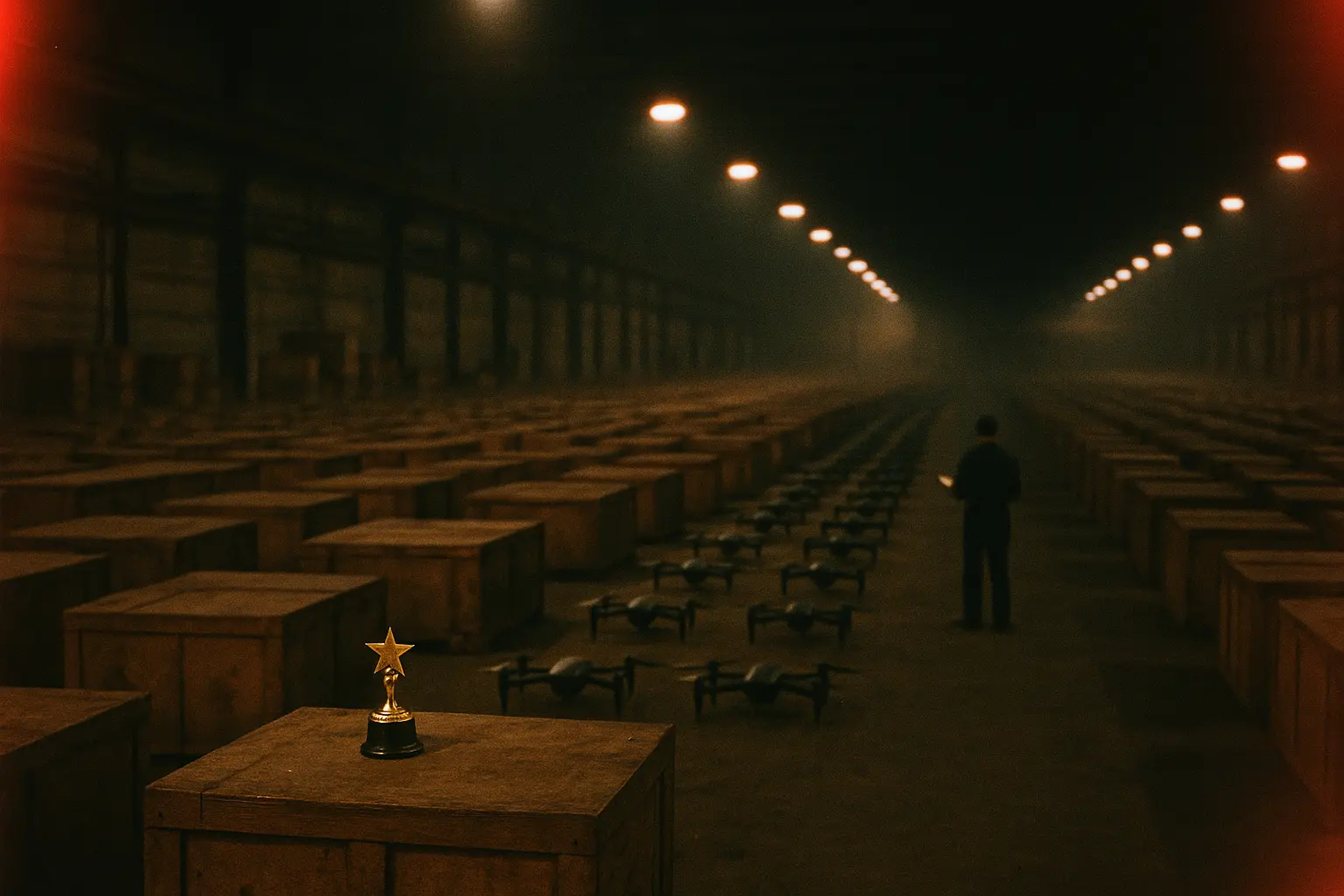
From the “New Logic of War” series. Why the war’s headline number measures not factories but the institutions’ ability to learn.
I. The Number Everyone Heard Wrong
When a state announces an ambition like "this year we'll build a million drones," the public hears a production plan: this many factories, this many units on the conveyor belt. The figure sounds like a promise of volume. And right there lies the central misunderstanding.
Because a million drones is not about factories. Building a million simple machines is technically the easiest part of the task. The real question behind the number is a different one: is the state, as a system, capable of learning to do this — to coordinate, allocate, train people, and absorb the result — faster than the war itself changes? A million drones is not a production goal. It is a stress test of institutional metabolism. An MRI of a state under load.
This text is about the state as a system that learns (or fails to). About why the bottleneck is almost never the factory. About Goodhart's law, which turns any loud target into a performance. And about how the chief military advantage of the 21st century has become not firepower but the speed of institutional learning — a rare quality, and one nearly impossible to fake.
II. What the "Million" Actually Tests
Let's break the figure down into what stands behind it. For a million drones to become force rather than a press release, the state has to pull off a dozen processes at once — and not one of them is "manufacturing."
| What must be pulled off | Why it's not "buy a factory" | The scarcest thing |
|---|---|---|
| Component supply chains | most critical parts are imported → this is geopolitics | access to someone else's factories |
| Funding hundreds of teams | fast, without years-long tenders | speed of decisions |
| Training operators | you can't print a human overnight | trained people |
| Logistics to the front | deliver as a complete kit, without losing parts | working delivery |
| Integration into tactics | otherwise thousands of machines sit idle | doctrine of use |
| Feedback and rework | the enemy adapts every week | cycle speed |
None of these processes is solved instantly with money. It isn't "buy a factory," it's "teach the organism to do what it couldn't do before." And this is exactly where states reveal their true nature — whether they are capable of learning or only of imitation.
III. The State as a System That Learns
Organizational theory has a concept that maps neatly onto war: the learning organization. Peter Senge described why some structures improve continuously while others repeat the same mistakes for years, despite every resource. The difference isn't money and isn't size — it's the learning rate: how quickly a system converts experience into changed behaviour.
Machine learning has a direct analogue — the learning rate: how strongly a system corrects itself after each mistake. Too small, and it crawls toward the right answer for years. Too large, and it jerks around and never converges. A state at war is also a system with a certain learning rate, and war measures it mercilessly: whoever turns failure into a fix in weeks beats whoever digests the same lesson over months through commissions and reports.
IV. Why the Factory Is the Easy Part
Intuition says the bottleneck is in production: too few factories, too few hands. Almost always it isn't. The bottleneck is in the ability to absorb what's been produced. Economists call this absorptive capacity.
Imagine you were gifted a million drones tomorrow. Who is going to fly them? Training an operator who won't crash the machine on its first flight takes weeks; training a pilot for complex missions takes months — the trained human is scarcer than the machine. Who will devise the tactics of mass deployment? How will you get them through broken logistics to the right place on the right day? How will you repair them? What will you do when, in two weeks, the enemy learns to jam them and half become junk? It turns out that having a million machines and being able to use a million machines are two entirely different states.
So the real front of the struggle isn't the workshop — it's operator schools, staff procedures, logistics, repair shops, and feedback loops. Hardware is the cheapest and fastest thing to reproduce. The scarcest things are trained people and well-tuned processes. A state that understands this invests in the invisible. A state that doesn't reports on its factories and wonders why the front feels no million.
V. Goodhart's Law: When the Target Kills the Measure
And now for the most insidious trap of loud numbers. The British economist Charles Goodhart formulated a law that sounds like a curse upon bureaucracies: once a measure becomes a target, it ceases to be a good measure. The moment you declare "a million drones" a political goal, the whole system begins to optimize the number itself — not the thing the number was meant to stand for. (James Scott, in Seeing Like a State, showed the same disease on a broader scale: the state sees the world through what it can count, and mutilates the reality that wouldn't fit the table.)
The consequences are predictable. You can rack up a million by counting the cheapest toy machines that don't reach the target. You can post a production figure while half the stock lies in warehouses with no operators. You can report the plan fulfilled while the front feels no gain in force. The number is alive, the victory is not. The goal turns into metric theatre: everyone plays to the indicator, because the indicator is what they're asked about and the real effect is not — because it's harder to measure.
This is not an argument against ambitious goals. It's a warning: a loud number also tests the capacity to resist the temptation to fake it. A mature system measures what matters (it reached and it hit), even when that's harder to count. An immature one measures what's easy and believes its own report. War quickly works out who's who — because the enemy doesn't read your press releases.
VI. The Dependency Trap: Whose Million Is It, Really
There's one more uncomfortable layer. "We're building a million drones" sounds like sovereign power. But if the brains of those drones are imported chips, cameras, controllers, magnets, batteries — then how much of that million is actually yours?
A modern cheap drone rests on the global supply chain of consumer electronics, the lion's share of which is concentrated in a handful of countries (and, for cheap components, mostly in one). "Sovereign production" may in fact be final assembly on someone else's parts. And whoever controls the components controls your tap: choose to, and they shut it off, and the million turns into zero. A genuine test of learning includes this too: is the state learning to localize the critical links, or only to assemble from others' parts while delighting in the final-output figure?
This brings us back to the theme of dependency that runs through the whole series: vision from someone else's satellite, a strike that depends on someone else's chip, communications over someone else's network. The number "a million" is worth nothing if the lever behind it sits in someone else's hands. A learned state measures not only volume but the depth of its own control over what it supposedly produces.
VII. We've Seen This Before: Production Miracles as Learning Miracles
History knows examples of states that, under the pressure of war, demonstrated an incredible learning rate — and it was precisely that, not resources in themselves, that decided the outcome. In the Second World War the United States converted civilian industry to wartime production with stunning speed — building ships and aircraft at rates that had seemed like fantasy before the war; the "arsenal of democracy" was a miracle not of the number of factories but of mastering a method — the standardization and assembly-line throughput of yesterday's civilian workers. The Soviet evacuation of hundreds of factories deep into the country — dismantle, transport, reassemble, and restart within months — was the same learning under existential pressure. What all the examples share: the deciding factor was not the availability of resources (others had them too) but the speed with which the institution learned to turn them into results.
VIII. Two Ways to Fail the Test
States fail this exam in two opposite ways — and both are instructive.
| Mode of failure | Symptom | Whose disease |
|---|---|---|
| Sclerosis | resources exist, pace doesn't; by the time it's approved, the war has changed three times | rich, comfortable, long-peaceful structures (the Western "waterfall") |
| Theatre | pretty numbers, victorious reports, optimizing the indicator instead of reality | systems where lying in a report is punished less than honest failure |
| The narrow path | learning the real thing fast, slipping into neither sclerosis nor theatre | almost no one walks it perfectly |
The real advantage is the narrow path between two abysses. War is, in essence, a comparison of who fails more slowly and more honestly than the adversary. The winner is not the one who learned perfectly, but the one whose learning rate is higher than the enemy's by even a little, for even a little longer.
IX. Self-check: Your System's Learning Rate
This works in any organization — a company, a team, a state. Questions that expose the real learning rate:
- How much time passes between "we understood the mistake" and "we changed our behaviour"? And does the lesson get lost on the way up and back down?
- What are your loud target-numbers — and are you already optimizing the indicator itself instead of the thing it was meant to stand for?
- Is your bottleneck really in "production" — or in the ability to absorb, train people, deliver, deploy?
- What do you actually control in what you "produce," and what are you assembling from others' components that can be cut off?
- What gets punished harder in your system — honest failure or a pretty fake report? The answer determines whether sclerosis or theatre will kill you.
X. The Number That Shows a State's Soul
"A million drones" is not a production goal, even though it sounds like one. It's an X-ray that sees a state straight through: can it learn, coordinate, scale, and absorb — faster than the war rewrites the rules. The factory is the easiest thing. The hardest are trained people, well-tuned processes, honest measurement, and independence from someone else's components.
And the deepest conclusion of the series repeats here, in a new dimension: what decides is not the resource and not the weapon but the learning rate — the institutional metabolism, the capacity of the state-organism to change itself under pressure. This quality cannot be bought and cannot be faked for long: the enemy doesn't read reports, he reads reality. When a politician names a big number, you should hear behind it not a promise of volume but the question for which the number is merely a pretext: is this state's ability to learn still alive.
A million drones won't win the war. The war is won by the state capable of learning to build a million, deliver a million, deploy a million, and rework it when the enemy adapts — and to do all that faster than the adversary. The number doesn't measure factories. It measures whether the state retains the ability to learn — the rarest and least imitated weapon of the age. The rest is theatre against a backdrop of warehouses.
Frequently asked
What does «we'll build a million drones» actually mean?
It isn't a production plan but a stress test of the state's institutional metabolism: whether it can learn to build, coordinate, train operators, deliver and absorb — faster than the war changes. The factory itself is the technically easiest part of the task.
Why isn't drone production the real bottleneck?
The bottleneck is almost never the factory but absorptive capacity — the ability to make use of what's built: a trained human is scarcer than the hardware (an operator takes weeks, a pilot for complex missions months), plus logistics, doctrine and repair. Having a million drones and being able to employ a million are two entirely different states.
How does Goodhart's law ruin headline target numbers?
Once a metric becomes a target, it stops being a good metric: the system starts optimizing the number itself rather than what it was meant to capture. You can count a million of the cheapest drones that never reach the target, report the plan as met — and the front feels no added strength; the goal turns into metric theatre.
Does «a million drones» make a state truly sovereign?
Not necessarily: if the brains of those drones are imported chips, cameras and batteries, then «sovereign production» may be mere final assembly on someone else's parts — and whoever controls the components controls your tap. A state that has learned measures not just volume but the depth of its own control over what it supposedly produces.
Comments
Signed-in readers only — to keep it human, not a bot swamp.