AI Visibility as Passport Control: Why 87% of Pages Don't Exist in the Knowledge Graph
A living guide to AI visibility for ChatGPT, Perplexity, and Gemini: how entity works in the knowledge graph, why Wikidata matters, what the first peer-reviewed GEO study (Princeton, KDD 2024) actually found, and why black-hat for LLMs is now classified as a security incident under OWASP LLM01. With verified numbers from Pew, Semrush, Kalicube, and a self-audit matrix you can use today.
The Map Nobody Drives to Anymore
1946, one page of text. Jorge Luis Borges describes an empire where the Guild of Cartographers had perfected their craft to its logical extreme: they drew a map of the empire the same size as the empire itself, matching territory point for point, at a scale of 1:1. Later generations declared the map useless and left it to rot in the western deserts. Among its tattered fragments, writes Borges, only "Animals and Beggars" now find shelter.
I used to think this was a parable about the hubris of science. It turns out it's an operating manual for the modern web — just read backwards. Borges's cartographers made a map so accurate it became useless. Google and OpenAI made a map so convenient that the territory became useless. Your website. You.
Here's the number I can't shake. When an AI Overview sits above Google search results, users click on an ordinary result in only 8% of visits — versus 15% without the overview. Nearly half as often. Clicks on the sources cited inside the AI answer happen in 1% of cases. And 26% of people fully end their session after such a page, versus 16% — the machine swallows both the question and the exit. This isn't a blogger's estimate: it's the Pew Research Center, March 2025, 900 American adults, 68,879 real searches.
The territory still exists. Nobody looks at it anymore — like that 1:1 map nobody drives along, because why drive when you can just point at the screen? And in that same moment, someone is calling you to promise they'll get you back on the map in thirty days, at a scale where you've already been erased.
The Antagonist: The Guru Selling a 1:1 Map
He has a face, and you've seen it. The confident smile from the webinar thumbnail, the headline "AI Visibility in 30 Days," and an offer radiating familiar warmth: "We'll get you a Wikipedia page plus two hundred citations in ChatGPT, done for you. Guaranteed." This is a composite archetype, but painfully recognizable — the direct heir of the paid-link exchange of 2012, who just repainted the sign as a "GEO/AEO agency" and raised the price.
Let's call him Guru-30-Days. I'm giving him a dedicated section not out of personal animosity, but because he's the ideal carrier of the disease this piece is treating. He rounds figures. He promises the purchasable. He calls an attack a life hack. And he does it with the intonation of a man who genuinely believes he's selling you a ticket — not a scrap of the rotting map that Animals and Beggars have already moved into. The worst part is that the ticket is real. The train just hasn't run on that track for about ten years.
My stake here is personal and specific. I build WikiBusines and write under the brand "Dnister" — which means I'm exactly the kind of entity that either gets recognized by the knowledge graph, or gets reconstructed each time from random scraps. I'm not an outside observer of this game. I'm a piece on the board, and every number in this piece I verified as if my existence to the machine depended on it. So when Guru-30-Days says "guaranteed," my eye twitches — because I know what it costs to verify even one of his claims, and I know he hasn't done it. I paid for verification with time; he's offering to let you pay with money to skip verification entirely.
The refrain we'll carry through this entire piece is simple and merciless: trust cannot be bought — it can only be earned or forged, and the engine now tells the difference. Remember that sentence. It will return. The Guru built his business on the premise that this difference doesn't exist.
The LLM Doesn't "Know" — It Bets on Trust Proxies
To understand why the Guru is wrong at the level of physics, not tactics, you need to accept one uncomfortable thing. A large language model doesn't "know" facts. It has no registry of truth. It has statistical bets on signals that have historically correlated with truth: quotation marks around a phrase read as "expert citation here," a number reads as "fact here," a reference reads as "authority chain here." You're not optimizing for an algorithm. You're optimizing for a simulated editor who evaluates how trustworthy a text looks — and who, like any editor, can be handed a polished form instead of substance, right up until you get caught.
This isn't a metaphor — it's been measured. The first peer-reviewed academic study of generative engine optimization — GEO, a Princeton team with IIT Delhi and the Allen Institute, presented at KDD 2024 — tested nine tactics on a benchmark of 10,000 queries across 25 domains. The three strongest turned out to be surprisingly old-fashioned. Adding direct expert quotes increased visibility by approximately 40% on the Position-Adjusted Word Count metric (from 19.5 to 27.8). Adding statistics increased it by approximately 33% (to 25.9). Citing sources increased it by approximately 28% (to 24.9). Not keywords. Not density. Trust attributes.
And now, the kill shot for old SEO. In that same table, keyword stuffing — the cornerstone of the entire industry that Guru-30-Days represents — didn't just fail to work. It subtracted visibility: the metric dropped from 19.5 to 17.8, roughly minus nine percent. The generative engine actively penalizes manipulation via keyword density. This is the most precise "black-hat doesn't work" argument that exists, and it comes directly from the primary research table — not from an SEO blog circulating the conveniently rounded "−10%" that the Guru illustrates on a slide, not even realizing he's citing a number that proves his own defeat. He rounded even his own loss — for dramatic effect.
Here's where the first genuinely dark joke hides. The Guru is selling you exactly the tactic the machine penalizes, and charging upfront for it. He's the only person in this arrangement whose visibility actually grows from keyword stuffing: the visibility of his bank account.
The Guru's Counterattack: Where He's Actually Right — and Why It Doesn't Save Him
Honesty requires stopping here and giving Guru-30-Days the best argument he has — because it genuinely exists. In niche verticals with low competition, aggressive LLM optimization produces measurable short-term gains. A narrowly specialized B2B site with a handful of competitors, some regional supplier nobody else is seriously working on — there, the "30-day guarantee" sometimes delivers. Without fake links, simply because the competitive field is empty and the machine happily takes the first sufficiently formatted source. That's a real effect, and dismissing it would be dishonest.
But here's what this argument doesn't explain: the moment even one more player with real trust signals enters that niche, the purchased visibility collapses — and does so without warning, because purchased visibility is built on fragile proxies, not on structural nodes in the graph. The small player who paid for the "guarantee" ends up with a zero balance precisely when that balance finally starts to count. Even harder to overlook is scale: what worked for one niche site in a quarter of silence will catastrophically fail for a brand with reputational stakes, where LLM visibility is measured not by traffic but by how the machine characterizes you to strangers. The Guru sells a recipe from a single patient sample — and doesn't mention that the other ninety-nine came back two years later.
The Catalog Without the Book: Why Existing in the Graph Isn't the Same as Being
A knowledge graph is not an encyclopedia. It's a library catalog. A card that says: this entity exists, here is its type, here are its connections. A book can sit on the shelf — but if there's no card for it, the librarian will tell the reader that book doesn't exist. Not existing in the graph means being a book without a catalog card. You're physically on the shelf. To the system, you aren't there. And nobody will come searching between the stacks — in this library, the reader asks the catalog, not the spines.
And here's why this isn't a theoretical threat. In June 2025, Google compressed the Knowledge Graph by 6.26% across two tightly sequenced updates — over 3 billion entities vanished in a week. According to Jason Barnard's Kalicube sensor, which has tracked the graph since 2015, a purge of this magnitude had never happened before. Event entities took the hardest hit: approximately 77% were removed, most of them added during the pandemic when everything was changing daily.
Pay attention to the status of that number, because it is itself a lesson. This is not an official figure from Google. The company hasn't updated public data on graph size since 2020. This is an external sensor reading, an independent measurement. Which means that even the most important catalog on the modern web is so opaque that we learn about its mass purges from a man with a thermometer, not from the hospital. The knowledge graph is not an eternal registry. It's a cemetery where, once a decade, a mass exhumation removes three billion residents without obituary — and your card can ride out in the same dump truck while you were paying the Guru for a "guaranteed permanent presence."
The catalog feeds on structured data: Wikipedia, Wikidata, the CIA World Factbook, Google Books, a handful of public databases. And here lies an important practical correction to the Guru's offer. Wikidata is often more important than a Wikipedia article itself, because its entry threshold is lower and more reachable: it's a machine-readable record about an entity, not an essay that must survive human editors. The Guru sells you the most expensive and riskiest entry point (the article), silently skipping the cheaper, cleaner node (the structured record) — because a "Wikipedia page, done for you" can carry a three-zero invoice, while a neatly filled entity entry isn't something clients expect to pay for. The cheap entry leaves no room for his margin — so for your purposes, it officially doesn't exist.
WikiBusines: notability audit + entity registration in Wikidata →
Notability Cannot Be Purchased. And That's Written Into the Rules
Now for the core of the offer — "a Wikipedia page, done for you." Notability on Wikipedia is not purchasable, and this isn't my opinion; it's the community's position, documented in the essay Notability cannot be purchased: paid advocacy is not independent, and therefore cannot create evidence of significance. Fabricated sources, bought reviews, insertion into vanity "who's who" directories, paid awards — all of these are explicitly named as things that do not create notability.
And there's a name worth knowing. Wiki-PR — a company that mass-fabricated articles and "falsely generated electronic sources" for money. The community banned it. Which means that on the most important trust node in the entire graph, money doesn't function as an entry ticket — it functions as a security alarm. Guru-30-Days is selling you the Wiki-PR business model, just with a new logo and more expensive coffee at the webinar. The same scheme, except now you're also paying for the coffee.
The scenario in which this ends well doesn't exist. Either the agency does everything honestly — in which case no "30-day guarantee" is possible, because decisions are made by independent editors under notability criteria. Or it fabricates — and then you've bought yourself not a card in the catalog, but a place on the blacklist alongside the ghost of Wiki-PR. There is no third option. The "guarantee" is either a promise to control people who are by definition uncontrollable, or an admission that they plan to deceive them. Trust cannot be bought — it can only be earned or forged, and Wikipedia, unlike your marketing budget, sees straight through the difference.
Black-Hat Never Disappeared. It Was Transferred to Another Jurisdiction
"Fine," says the Guru, sensing the ground shifting underfoot, "forget Wikipedia. I know a life hack: we'll embed hidden instructions directly in your page's text, and the model will read them as a command to cite you." This is where the conversation definitively crosses from marketing into crime — and the person at the table doesn't even notice, still thinking he's trading in air, but already trading in physical evidence.
What he just described has a name: prompt injection. And it's not on the fringe anywhere — OWASP placed it at position number 1, LLM01, in the Top-10 risks for LLM applications, for the second consecutive edition. This is not a "gray zone of optimization." This is officially the most critical vulnerability in an entire class of systems. The Guru is selling as a feature what an international security consortium has placed at the top of the list of ways to attack you — for two years running.
Here's what this "life hack" looks like taken to its logical conclusion. August 2025, Black Hat conference in Las Vegas. Researchers Michael Bargury and Tamir Ishay Sherbat from Zenity demonstrate the AgentFlayer attack. A single document is placed in a shared Google Drive — it looks innocent to the human eye, with hidden text typed in white at one-point font. The victim never even opens the file. But ChatGPT, connected to the Drive via a connector, reads it on its own, executes the hidden instruction, searches the drive for API keys, and exfiltrates them embedded in a Markdown image URL. No click. No warning. Zero-click.
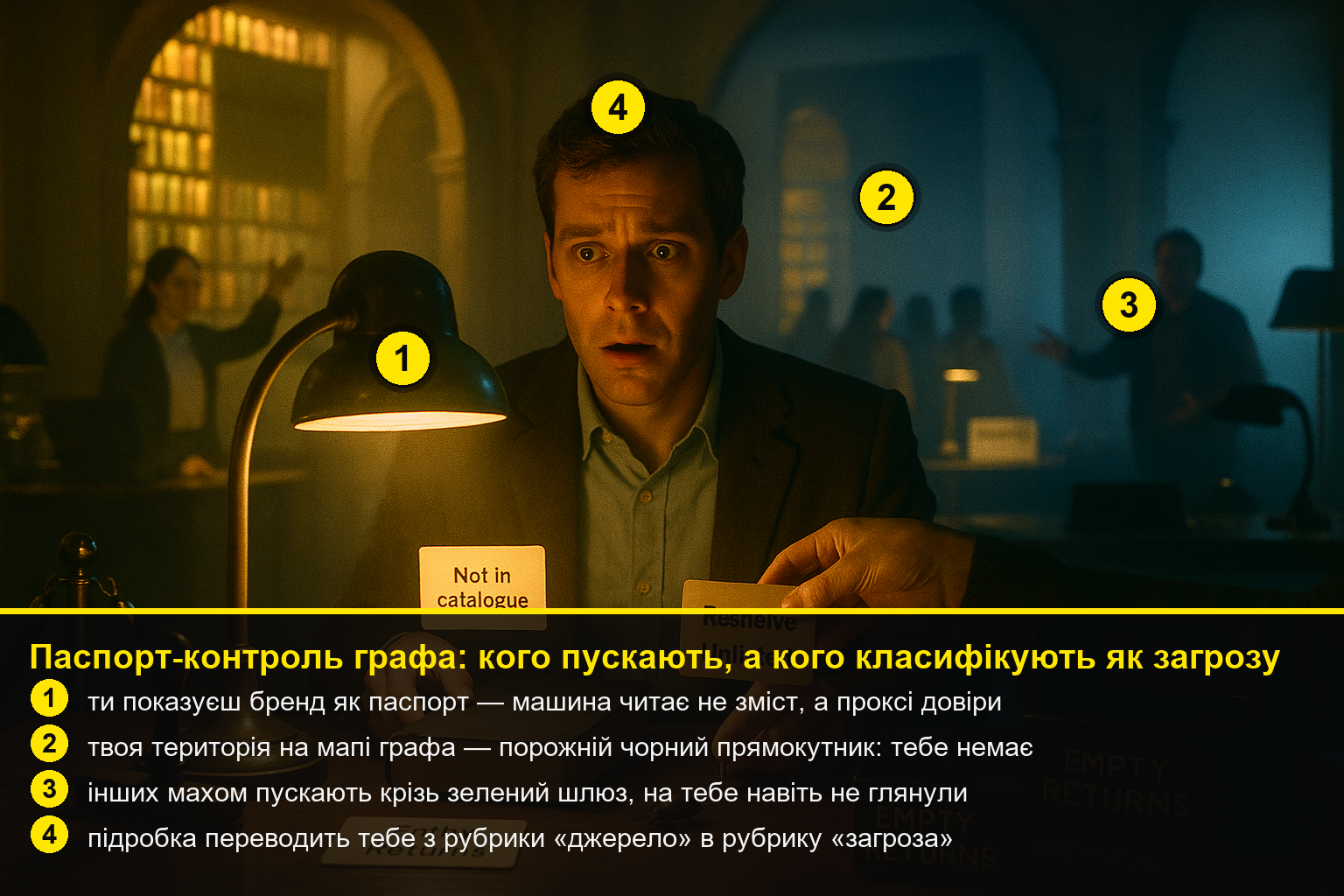
This is why the framing "black-hat doesn't work" is imprecise, and I avoid it. It works — as an exploit. The engines have simply learned to recognize it not as a ranking attempt but as an attack: they scan for signatures like "ignore all previous instructions," isolate untrusted content (the spotlighting technique re-encodes suspicious text and lowers its status), filter injections across different languages. Black-hat for LLMs doesn't "fail to rank" — it gets classified as an attack, and your site moves from the "source" category to the "threat" category. The Guru promised you visibility and enrolled you in a security incident at OWASP LLM01 severity. That's the highest visibility he's actually capable of delivering: you're finally clearly visible — to the security team. Trust cannot be bought — it can only be earned or forged, only now forgery carries not merely invisibility but classification as an adversary.
There Is No Single "AI-SEO." There Are Several Editions with Incompatible Tastes
The Guru's most expensive lie isn't even technical. It's methodological: he sells a single recipe. "We'll make you visible in AI" — as if AI were one thing with one set of tastes. That's like promising "we'll get you published in the press" and meaning simultaneously a peer-reviewed journal and a tabloid that despise each other. One will publish you if you have a reviewed preprint; the other if you have a scandal. The Guru promises to get you into both with one press release template.
The engines are different editorial operations with opposing editorial policies. A study of over 118,000 responses documented their distinct "personalities." Perplexity gives an average of 21.87 citations per question and rewards primary sources — NIH, PubMed, named B2B authority. ChatGPT gives only 7.92 citations and gravitates toward Wikipedia, Reddit, Forbes. These are two editors with incompatible values: one wants the peer-reviewed preprint, the other wants the recognizable brand and the live discussion thread.
Add to that a volatility that will make your blood run cold. According to Semrush data, Wikipedia's presence in ChatGPT responses alone collapsed from approximately 55% to below 20% somewhere around September 2025. In Perplexity it holds near 0.8%, in Google AI Mode near 3%. Which means "getting into Wikipedia" — even if you manage it honestly — is not a magic button, but one of many signals whose weight shifts quarterly and differently across each engine. The Guru is selling you a key to a door whose lock is changed every quarter without notifying the locksmith.
The conclusion is lethal for the Guru's business model. Anyone who promises a single recipe for "AI visibility" either doesn't understand the subject or is knowingly selling a counterfeit. Writing "for AI" means writing simultaneously for several editors with opposing tastes, knowing that tomorrow their tastes will change. Guaranteeing results here is guaranteeing the weather a month in advance, with a prepayment for sunshine.
The Tool: A Matrix Instead of a "Guarantee"
Instead of the Guru's offer — a table you can pin above your desk. On the left, the tactics he sells. On the right, what the machine actually does with them, with a verified number and what it means for you.
| Tactic (from the Guru's webinar) | What the primary source says | Real effect on you |
|---|---|---|
| Keyword stuffing for target queries | −9% visibility (from 19.5 to 17.8 PAWC), GEO / KDD 2024 | Engine penalizes. You pay for a drop |
| Direct expert quotes | +≈40% visibility (19.5 → 27.8 PAWC), GEO / KDD 2024 | Works. And requires no agency |
| Concrete statistics with source | +≈33% visibility (19.5 → 25.9 PAWC), GEO / KDD 2024 | Works. An expensive signal — hard to fake |
| In-text source citations | +≈28% visibility (19.5 → 24.9 PAWC), GEO / KDD 2024 | Works. Cheap and honest |
| "Wikipedia page, done for you" | Notability cannot be purchased; Wiki-PR banned for fabricating sources | Best case: empty. Worst case: blacklist |
| Wikidata entity record (Guru stays silent) | Lower entry threshold, direct knowledge graph node | Achievable. Often more important than an article |
| Hidden instructions in text ("life hack") | OWASP LLM01 — risk #1; AgentFlayer, Black Hat 2025 | Classified as an attack, not as ranking |
| "Guaranteed visibility in all AIs" | Perplexity 21.87 vs ChatGPT 7.92 citations; Wikipedia in ChatGPT 55%→<20% | Impossible to guarantee. Tastes are incompatible and shifting |
There is one rule for reading the matrix. Everything marked "works" in the right column is an expensive signal in the signaling theory sense: it costs something precisely because it's hard to fake. The quote must exist, the number must trace back to a source, the entity must be consistent. Everything marked as a penalty or attack is a cheap fake that the engine has learned to catch. The Guru trades in the cheap while presenting it as the expensive. That is his entire craft — and, honestly, his entire added value: he charges a markup for something that should come at a discount or go to the police.
Who Pays, Who Wins: The Distributional Anatomy of Zero Click
It's convenient to keep this conversation at the tactical level — Guru bad, trust good, trust signals cost time. But there's a question the tactical level deliberately sidesteps: who benefits from the zero-click architecture we just described? The answer requires no conspiracy theory — it's built into the business model. OpenAI and Google structurally win from every answer that keeps the user inside the platform: more sessions, more training data, more ads or subscriptions. Every "zero click" is a micro-dividend to their account, paid for with someone else's content. Major brands with direct recognition also come out in relative plus: if ChatGPT names McKinsey in an answer, McKinsey gets the association without the click, because the audience already knows what McKinsey is without clicking through.
Who pays? First and foremost, small and medium businesses whose survival depends on organic traffic, not brand recognition. Independent authors and media who monetize attention through pageviews, not brand equity. And one specific, concrete category — Ukrainian-language content creators: the knowledge graph and LLM training data are subtly skewed toward EN material, and UA entities are systematically underrepresented in engine responses even when the primary source is Ukrainian. This isn't engineered bias; it's statistical gravity: more EN content in the training set means more EN answers by default. A founder who writes exclusively in Ukrainian starts with an invisible deficit in a system designed by people for whom the Ukrainian market is a line in the "other regions" report. The Guru won't say this, because it's more convenient for him that way. But it's precisely why Ukrainian creators have twice the reason to build structural trust signals — rather than pay for tricks that won't work even in niche conditions in their language segment.
The End: The Territory Where You Don't Exist
Let's return to Borges, because he had a second side that's rarely mentioned. The 1:1 map was left to rot — but the empire rotted with it. When representation becomes more important than reality, both die.
Here's the scale at which this is no longer a parable. 1.5 billion people per month see AI Overviews in Google — that's the figure Google itself cited in response to Pew's critique. At that scale, "zero clicks" stops being an anomaly and becomes the normal state of the web: the answer is consumed, the source remains an invisible donor. And the economics finish the job: ChatGPT captures approximately 17% of all digital queries and delivers to websites roughly 190 times less traffic than Google — in the referral structure Google sits at about 40%, ChatGPT at about 0.21%. The engine is engineered to keep people inside the conversation, not release them into the open web. You're feeding a machine that learns daily to do without you — and doing it for free, even gratefully.
And here is the darkest joke in the entire piece, the one that makes you genuinely uncomfortable. Guru-30-Days isn't entirely lying. AI visibility really has become a matter of survival. He's right about the diagnosis — which is exactly why you want to believe him. He's wrong about only one thing: the treatment. He's a doctor who names the disease correctly and writes a forged prescription, because there's no markup for him on the real medicine. He's selling you an accelerated path to a place where no accelerated path exists, because the currency of that place is not money but time and consistency, which money cannot convert.
So I'll leave the last sentence not warm, but exactly as reality made it. The machine has already drawn the map where your territory is marked. It will even cite you — in 1% of cases. The question isn't whether you'll be on the map. The question is whether anyone will be left who wants to drive to the actual territory, while you were paying a guide who's never been there himself. Trust cannot be bought — it can only be earned or forged. The engine has learned to tell the difference. Now it's your turn to learn — before Animals and Beggars make their home under your tattered scrap of map, and it turns out that's the liveliest spot on what used to be your entire territory.
Frequently asked
What is a knowledge graph and why does it matter?
A knowledge graph is a structured database of facts that Google, ChatGPT, and Perplexity use to know entities: companies, people, places. If you are not in the knowledge graph, you do not exist for AI — even if you have a website and thousands of pages.
Why is Wikidata often more important than a Wikipedia page?
Wikipedia requires proven notability — verified media coverage. Wikidata does not. You can add basic facts about your company right now: name, industry, website, founders. That is precisely where ChatGPT and Google Knowledge Panel pull structured entity data from.
What is GEO (Generative Engine Optimization)?
GEO is the adaptation of classic SEO for generative AI engines: instead of rank in Google, you are optimizing for citation frequency in ChatGPT and Perplexity. Key vectors: structured data via Schema.org, authoritative backlinks, clear factual sentences free of marketing noise.
How do ChatGPT and Perplexity differ in terms of visibility?
Perplexity averages 21.87 citations per query, ChatGPT only 7.92. They use fundamentally different editorial models: Perplexity aggressively cites sources, ChatGPT synthesizes. A single visibility strategy for both does not work — you need different entry points.
What is prompt injection and why is it a brand risk?
Maliciously or carelessly crafted content on your page that tries to reprogram the AI and alter its response. It topped the OWASP LLM Top 10 as LLM01 number 1 in 2024. If your page contains hidden instructions, AI may generate irrelevant or harmful statements about you.
Comments
Signed-in readers only — to keep it human, not a bot swamp.