Why ChatGPT Trusts Wikipedia More Than Your Website
In 2026 Wikipedia supplies 13.15% of all ChatGPT citations — more than OpenAI's own site. In GPT-3's training the model re-read the encyclopedia 3.4 times and the rest of the internet less than once. This isn't about your content quality. It's about whether you're in the registry the machine trusts — and why your flawless About-page matters less to it than one line in Wikidata.
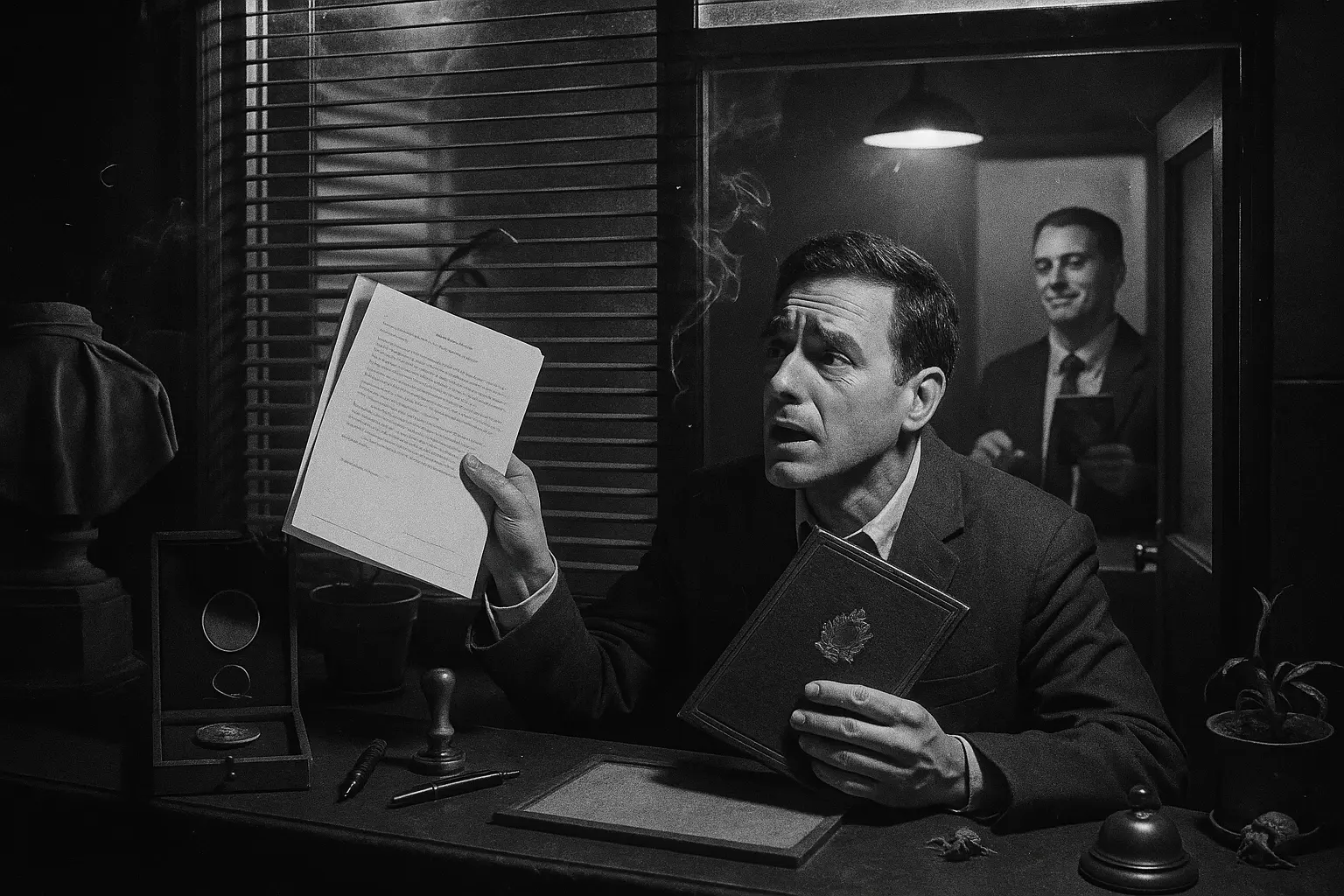

The Catskills, New York, early 1920s. Two men lean over a drafting table at the General Drafting Company. One is the founder, Otto Lindberg. The other, his assistant, Ernest Alpers. They take their initials, shuffle the letters like dominoes, and get a word that exists in no language: Agloe. They place this phantom at the crossing of two dirt roads in the middle of nowhere — where there is really only a pair of ruts in the mud and silence. It's a trap. If a competitor copies their map, he copies the ghost too, and gets caught red-handed.
Years pass. And one day someone looks at the map, sees the name "Agloe," drives there — and opens the "Agloe General Store." A real store, with bricks and a roof. A town that never existed materialized because it landed in a trusted source. Decades later Agloe surfaces on Google Maps — and stays there until a reporter calls Google to ask what that smudge in the woods is. Only then is it erased. The trap-ghost outlived even the firm that birthed it: the map factory is long gone, yet the invented town lasted another half-century — because registries live longer than the people who lie in them.
And now a number to sit down for. In 2026, Wikipedia supplies 13.15% of all ChatGPT citations — source number one. Reddit is second (11.97%). And OpenAI's own site — owned by the very company that built the model — comes third, with a pitiful 6.21%. In training GPT-3, engineers made the model re-read Wikipedia 3.4 times, while the rest of the internet — the giant Common Crawl — it never saw even once in full (0.44 epochs). The company couldn't write its own address into the machine's memory the way it wrote in someone else's encyclopedia.
The machine, like those two cartographers, trusts not the ground underfoot. It trusts the map everyone copies from one another. Your website is territory, real land. Wikipedia is Agloe: what the machine considers real because it stands in the right registry.
Personal stake: I own a flawless About-page
I'll confess up front, or the whole text is hypocrisy. I am that man with the perfect site. For years I polished my About-page as if every comma decided whether the universe would recognize me. I wrote about myself in the third person, like a monument. "Founder, investor, systematizer." It sounds like an inscription on a pedestal, and pedestals, as we know, are raised for those who are already gone.
And then I do what everyone does in 2026: I ask ChatGPT what it knows about me. A pause. The cursor blinks like a cardiograph over a body. And the machine gives me exactly as much as a border officer knows about a person with no documents: almost nothing, or something politely vague, or — worst of all — a confident fabrication. I fed it a thousand words of self-portrait. It read not one. It was checking not against me, the living person on the other side of the screen. It was checking against what is already stitched into its weights. And I'm not stitched in there. I spent years on text the machine classifies roughly as spam from me about me.
This is the refrain I'll repeat until it sinks in: the machine checks not your biography but your passport. And it isn't the machine that issues that passport — and, more painfully, it isn't you.
Epistemology vs ontology, or why a lie with papers beats a truth without them
Here's the uncomfortable part. You think AI is searching for the truth. It isn't. AI never asks "is this true." It asks something else: "is this consistent with what other sources say." That isn't a search for truth — it's a consistency check. The machine checks not your biography but your passport: what matters to it is not correspondence to reality but correspondence to the registry. The gap between those two things is the chasm your business falls into.
And here's the proof that makes your teeth ache. In 2005 the journal Nature ran a blind experiment: it gave experts 42 science articles — half from Wikipedia, half from Britannica, without saying which was which — and asked them to count errors. The result: Wikipedia, 3.9 errors per article; Britannica, 2.9. Wikipedia lost. It has MORE errors. And still the machine loves it more than the old respectable encyclopedia, more than your site, more than anything. The machine doesn't care that a trusted witness gets the testimony a little muddled — what matters is that the witnesses are many and they stand on the list.
Why? Because Wikipedia is structured. Interlinked. It has unique identifiers. It can be cross-checked against ten other sources in a millisecond. Britannica is a closed fortress behind a paywall; your site is a lonely island. And Wikipedia is a public square where all the sources look at one another and nod: yes, yes, this guy exists. The passport of reality checks the format, not the biography. It doesn't care that the passport has a wrong birth date — what matters is that it's in the right registry and issued by the right authority.
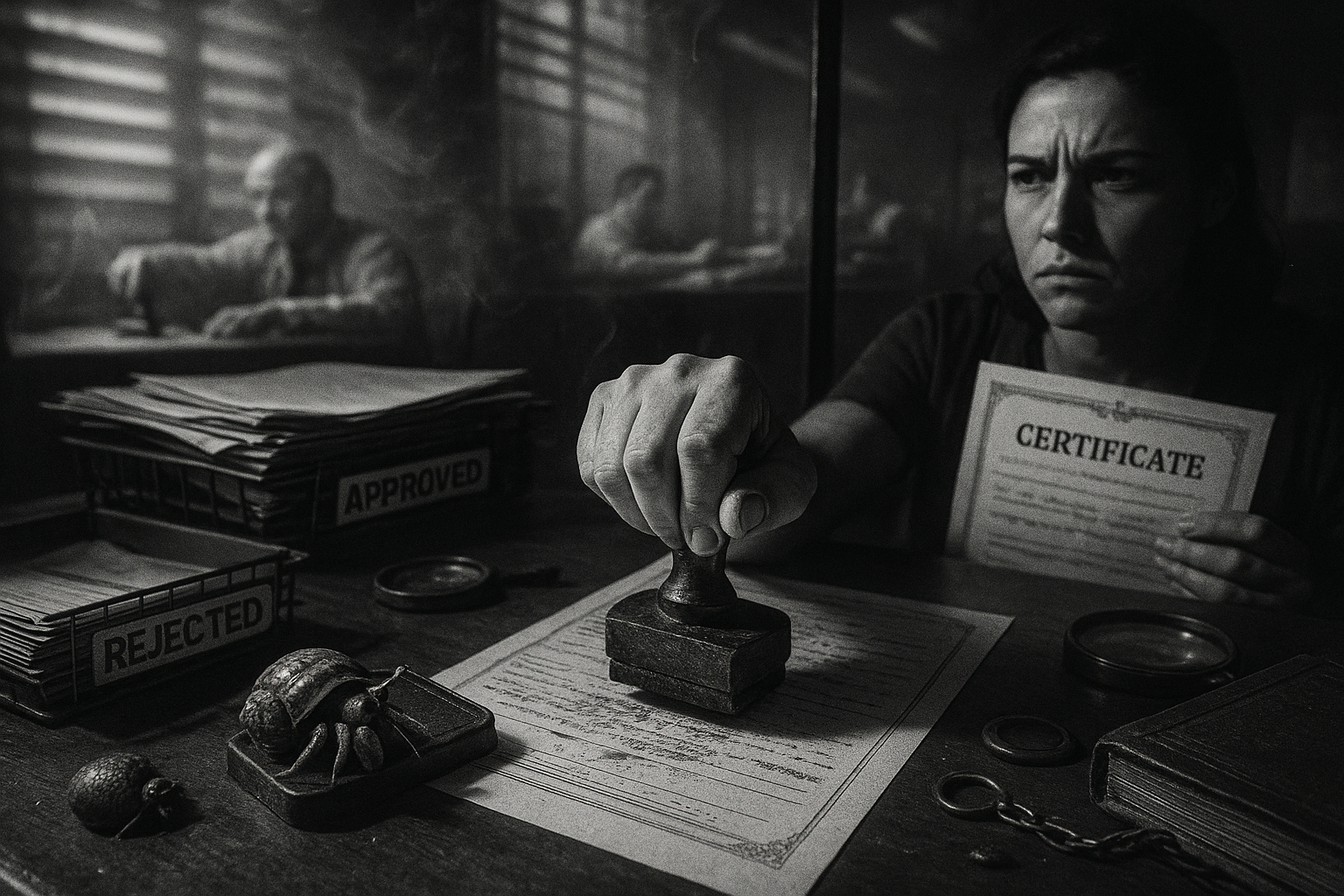
Brutal arithmetic: for the machine, a lie with papers outweighs a truth without them. Your company can be the most honest on the market — if you're not in the registry, you don't exist for the machine. Agloe existed. You didn't.
Kafka in code: the authority you can't reach
Recall the land-surveyor K. from Kafka's The Castle. He comes to the village because the Castle supposedly hired him. He sees the Castle on the hill. He knows it exists. But there's no reaching it: every official refers him to another, every document requires a prior document, and no one — no one — can confirm K. has any right to be there. He spends the whole novel proving the fact of his own existence to an authority that simply doesn't answer.
This is not a century-old parable. It's the technical documentation of your situation in 2026. Because the machine's "Castle" is called Wikidata. A structured, machine-readable database where every entity — person, brand, concept — has a unique persistent identifier, a QID. No QID, no citizenship. The Google Knowledge Graph, which feeds both the knowledge panels and the AI answers, leans precisely on Wikidata. Google's last official figure dates back to 2020: ~5 billion entities and ~500 billion facts. Independent trackers put the graph at ~54 billion entities and over 1.6 trillion facts by 2024 — in four years the gate let through an order of magnitude more. Tens of billions are already inside — and your turn is somewhere back there in the tail, without a ticket.
The bridge between your site and this graph is built by one property — sameAs in JSON-LD markup, pointing from your page to your Wikidata record. It's a notarized line of code that tells the machine: "this text — that's me, and here is my passport in the registry." Without that bridge your site is anonymous text. Surveyor K., shouting "I exist" at closed gates while the clerk behind the door drinks coffee and sees no need to reply.
Self-portrait vs witnesses: why the machine writes off your "about me" as an ad
This is why your flawless About-page is dead weight. The machine reads a self-portrait — text where you write about yourself — and automatically discounts it as what it is: an advertisement. No one has ever written on their own page "we're mediocre and overrated." The machine knows this. It looks not for what you say about yourself. It looks for what third parties say about you — independent, disinterested, scattered sources that happened to coincide on one fact about you.
And here AI simply digitized an old psychological truth we all pretend not to know. Reputation is not what you tell about yourself on a date. Reputation is the intersection of what those who know you independently say about you. You are defined not by a self-portrait but by the number of witnesses whose testimonies agree. The machine counts witnesses. Your site has zero — it testifies only about itself, and that, in any court, is called an "interested party," and such testimony the judge throws out without hearing it.
A bitter detail for everyone who believes "content is king": per Semrush, more than half of ChatGPT queries (about 54%) don't trigger an external search at all. The answer comes straight from the weights in the neural net — where the encyclopedia was already over-weighted at the training stage. So more than half the time the machine doesn't even look at the internet. It checks its memory. And in memory there's Wikipedia, re-read 3.4 times, and there's no you, read zero times. Half the verdicts about you the machine has already passed without even opening the file.
The tool: a passport-control matrix
Enough diagnosis. Here's the scalpel you can cut with. I've laid out the signals the machine actually checks against what we naively think matters. Run your brand down the right column honestly — not how you'd like it, but how it is. This isn't a self-esteem test; it's passport control, and at the border a smile in the form doesn't count.
| Signal | What it is to the machine | Self-portrait or witness? | Your status (honest) |
|---|---|---|---|
| Flawless About-page | An ad. Discounted to near zero | Self-portrait | ☐ have it / gives nothing |
| Wikidata record with a QID | Passport. Citizenship in the graph | Witness (registry) | ☐ has QID / ☐ none |
| Wikipedia article | Visa. Source #1 in the model's weights | Witness | ☐ yes / ☐ no |
| sameAs in JSON-LD site→Wikidata | Notary. Stitches you to the passport | Bridge | ☐ wired / ☐ no |
| Mentions in independent authoritative sources | Witnesses whose testimonies agree | Witness | ☐ many / ☐ few / ☐ none |
| Consistent name/description everywhere | Agreeing testimony = trust | Witness | ☐ uniform / ☐ scattered |
| Presence on Reddit / in communities | Source #2. A living human voice | Witness | ☐ yes / ☐ no |
If you have plenty of checks on the left (self-portrait) and emptiness on the right (witnesses) — congratulations, you're Agloe in reverse: real territory missing from the map. The land is there, the passport isn't. And the machine will say about you exactly what Google said about the nonexistent town: first "don't know," and when pressed — it'll invent and then delete. The only difference between you and the ghost is that the ghost at least had a dot on the map.
The copyright trap as reproach: the machine inherits the lie without checking
Back to the traps, because they're not a curiosity but a diagnosis. The editor of the New Oxford American Dictionary, Christine Lindberg, deliberately entered into the 2001 dictionary a word that doesn't exist: esquivalience, supposedly "the willful avoidance of one's official responsibilities." The trap worked perfectly: within a few years the word surfaced on Dictionary.com — with a straight-faced citation to "Webster's New Millennium Dictionary." Someone copied without checking reality, only the authority of the source. The fabrication got a second home, a registration and the false weight of a solid name — and, like a real impostor, in time began to live its own life: people started using the nonexistent word in earnest.
This is the exact anatomy of an LLM hallucination. The model cites "authority" without checking against the territory. Whoever copies without verifying inherits the lie too — the encyclopedia, the dictionary, and the machine alike. Agloe made it onto Google Maps not because anyone drove there. Esquivalience made it into Dictionary.com not because anyone found the word in living language. Both slipped through because they stood in a trusted registry, and a registry is believed on its word. A lie stamped and sealed travels without a ticket, first class.
And here the dark joke stops being a joke. The same mechanism that stamps a fake town stamps a fake accusation against a living person.
An antagonist with a face: the man the machine slandered because he had no passport
Mark Walters is a radio host in the US. An ordinary man with a microphone. In May 2023 a journalist asked ChatGPT to summarize the contents of a real lawsuit (a gun-rights foundation against the Washington State attorney general). The model, confidently, without a shadow of doubt, wove a new name into the summary and declared: Walters had embezzled funds from a nonprofit foundation. The detail that runs your blood cold: Walters had nothing to do with that case. He wasn't even in the real lawsuit. The machine didn't "get a detail wrong" — it spun out of thin air a consistent-sounding fabrication about a specific living person with a surname, an address and a reputation. It needed a name in the right grammatical case, and it took the first thing lying in memory unprotected.
Why him? Because he didn't have a passport of reality thick enough to override the hallucination. There was no dense, interlinked, independently confirmed record the machine would trip over and say "stop, the facts don't add up." Into the emptiness the machine poured its own invention — exactly as Google poured Agloe into an empty crossroads. The machine doesn't hate you. It simply cannot stand an empty cell and fills it with the first surname to hand, like yours.
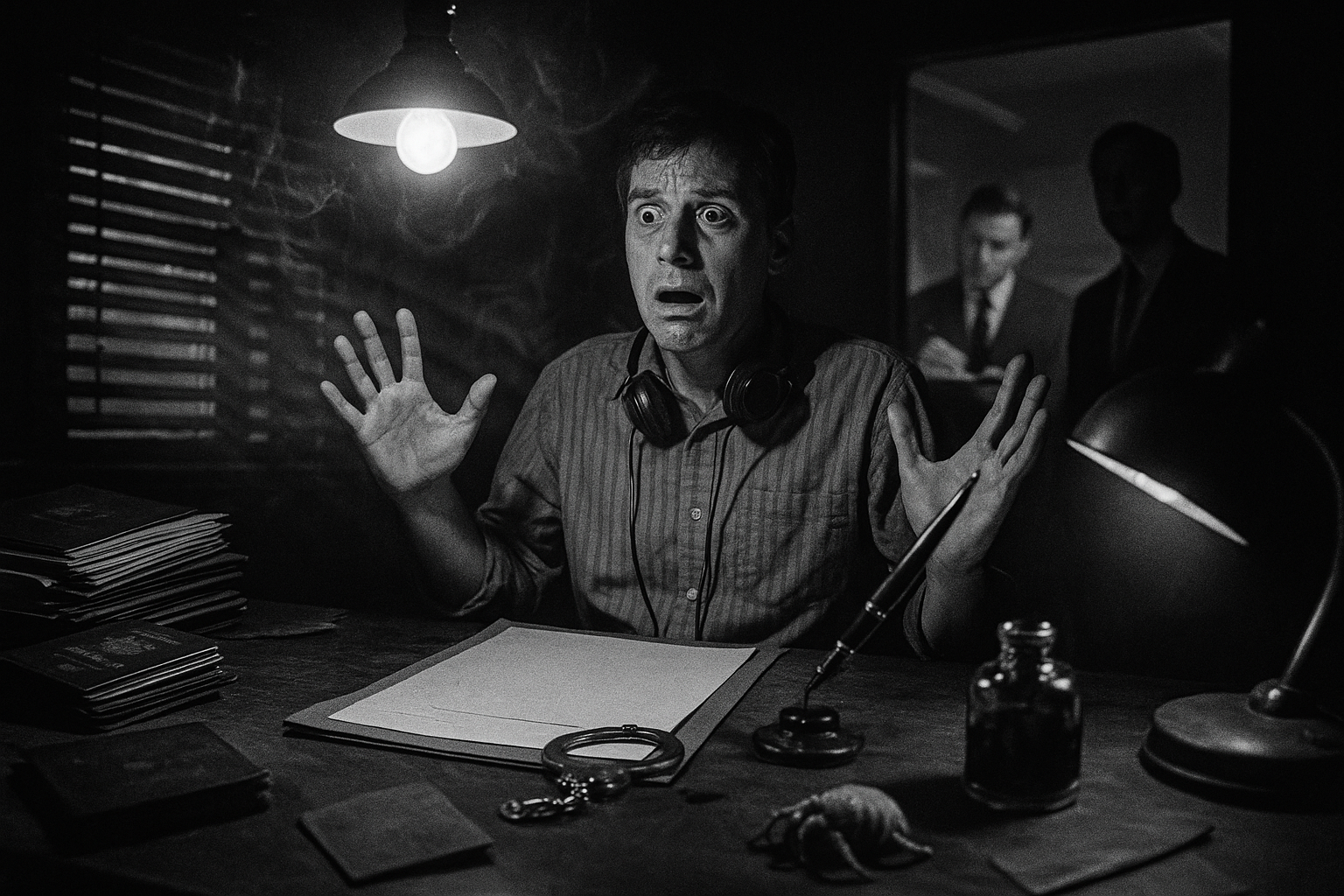
Walters sued OpenAI in June 2023. On 19 May 2025 the Gwinnett County court in Georgia dismissed the case. The defense argument — and here's where you sit down a second time — was that no reasonable reader should have taken the chatbot's words as a statement of real facts. So the system itself officially, through lawyers, in court, declared: I am not a source of truth, don't believe me. And the same system every day gives millions of people answers they take as the final word.
"ChatGPT is not a source of facts," OpenAI says in court, escaping the suit. "Ask ChatGPT," says the same company in the ad, selling the subscription. Both sentences are true at once. And that's the whole horror.
The antagonist's face is not a villain. It's the indifferent machine logic: "I check against my own weights, not against you, a living person." Walters got lucky — he's a radio host, he has a voice, lawyers, the means to sue. Now picture, in his place, your brand with no QID, no witnesses, no passport. The border officer looks through you and says exactly what Google said about the nonexistent town: "you're not in the registry." The only difference is that sometimes he doesn't say "not there" — sometimes he writes into you what you never did. The machine checks not your biography but your passport; and in an empty field it would sooner forge a record than leave the line blank.
Data feudalism: do we want one passport desk for the whole world
And here's where all this is rolling if we don't look. One structure — Wikipedia plus Wikidata — is gradually becoming the single sovereign issuing citizenship of reality for the entire AI world. One registry. One passport desk. One canonical version of who exists and who doesn't. A democracy where all are equal, except one line in the field decides whether you're a person at all.
We've already seen how a monopoly on "the one correct map" ends — and not as metaphor. The Russian state has for decades kept a factory of the official version of reality, where what isn't in the registry is declared nonexistent, and what's written in from above becomes "fact" by force of repetition — to the point of erasing entire countries and peoples from maps and textbooks. This is a cautionary example, not a plan. When truth is decided not by correspondence to the ground but by presence in a single trusted source — you're a step from a world where only the inscribed is real, and only the one holding the pen may inscribe.
But here it's worth stopping and honestly stating what the system's defenders reply — and they're not entirely wrong. Wikipedia-trust isn't just monopolism. It's a certain epistemic hygiene. The alternative — trusting every self-described site equally — is worse. The internet is 80% promotional material, SEO trash and corporate About-pages where everyone is a "market leader" and a "passionate innovator." If the machine learned to trust them on par with an interlinked, edited, publicly verified structure — it would hallucinate ten times more, not less. Wikipedia with its 3.9 errors per article is still more accurate than the average corporate blog with zero errors, because there's nothing there but promises.
But here's what that argument misses: it describes the system as a neutral quality filter — when in fact it's an access filter. The problem isn't that the system demands evidence. The problem is that gathering that evidence is far from possible for everyone — and not through quality, but through privilege. To the one already in the registry the system is genuinely fair. To everyone else it simply doesn't answer.
Who pays for the registry and who lives at others' expense
Because here's how the stakes are really distributed. Large institutions — universities, corporations with PR departments, media holdings — were long ago written into the graph, their QIDs assigned, their Wikipedia articles edited and protected from vandalism. PR agencies specializing in "Wikipedia reputation management" cost from $3,000 a campaign — and their clients are those who already have a reputation budget. English-language players have a structural advantage: Wikipedia EN is the largest version, the most densely interlinked, the best indexed by machines, and it's the one that shaped the weights of GPT-3, GPT-4, Claude. If your business, your name, your organization exist mainly in the Ukrainian, Arabic or Swahili version — you're playing chess on a board where your pieces weigh less by the rules of the game itself, not by your mistake. And now look at who pays: small business with no PR budget, sole proprietors with no media coverage, activists and journalists from countries where authoritative independent outlets are simply fewer by Wikipedia's quantitative criterion — they didn't fall through the net through low quality. They fell through because the net was woven for other sizes of fish. Walters had lawyers. Most people without a passport of reality do not.
A finish on the blade
Those two cartographers in the 1920s weren't interested in truth. They cared whether someone would copy their map. They placed a ghost at a crossroads in the mud — and the ghost outlived the very firm, because it got into registries that copy one another without leaving the office. The machine in 2026 does exactly the same, only with your name, your business, your reputation. It doesn't drive to the crossroads. It looks at the map.
So stop polishing the pedestal. A pedestal is a self-portrait, and the machine writes off self-portraits as ads and reads them zero times. Your task now is not "to be yourself as well as possible." Your task is to get onto the map: a Wikipedia article, a Wikidata record, a sameAs bridge from your site to the registry — exactly the [passport of reality Wikibusines builds on purpose](https://www.wikibusines.net/wikipedia-page-creation), before the machine writes an esquivalience with your surname there instead of you. Because it will. Emptiness it won't tolerate — only the registry.
The machine checks not your biography but your passport. The question is one, and it's not rhetorical: are you Agloe — what is inscribed and therefore real? Or are you that land under the cartographer's feet — real, solid, with a store and a roof — that simply isn't on any map, and that the machine will erase with the first confident sentence, without even driving out to look?
Frequently asked
What is a «passport of reality» and why is the machine blind to me without one?
A «passport of reality» is your entity being listed in a trusted machine-readable registry (Wikidata, Wikipedia) — not the quality of your content. The machine checks not your biography but your passport: whether you exist where it looks. Without that record your flawless site is anonymous text, and you are an empty crossroads, like the non-existent town of Agloe.
Why does AI trust error-prone Wikipedia more than my clean website?
Because AI never asks «is this true» — it asks «is this consistent with other sources». That is a consistency check, not a search for truth. Wikipedia is structured, interlinked, has unique identifiers and can be cross-checked in milliseconds; your site is a lonely island that testifies only about itself. To the machine, a lie with documents beats a truth without them.
What are QID and sameAs — and why do I need them if my site is already perfect?
A QID is a unique persistent identifier for your entity in Wikidata — machine citizenship; no QID, no citizenship. And <code>sameAs</code> in JSON-LD markup is the bridge stitching your page to your registry record: «this text is me, here is my passport». Without that bridge a perfect site stays anonymous text the machine reads zero times.
Why does the machine file my About-page under advertising even when it is all true?
Because it is a self-portrait — text where you write about yourself, and nobody ever wrote «we are mediocre and overrated» on their own page. The machine looks not for what you say about yourself, but for what independent third parties say whose testimonies coincide. It counts witnesses; your site has zero, because it is an «interested party» whose testimony the judge throws out unheard.
Or maybe this Wikipedia-trust is just a smart quality filter, and the system is right?
This is the strongest objection, and it is partly fair: if the machine trusted every self-description on par with verified structure, it would hallucinate ten times more. But the argument describes the system as a quality filter when it is really an access filter. To those already in the registry it is fair; to everyone else — small business without PR, non-English speakers, activists — it simply does not answer, and not through quality but through privilege.
Comments
Signed-in readers only — to keep it human, not a bot swamp.