Knowledge Graph or Death Without a Scandal: How to Vanish from a Market in a Quarter Without Doing Anything Wrong
In one week in June 2025, Google quietly deleted more than 3 billion entities from its Knowledge Graph — no announcement, no email, no warning. Brands in 2026 don't die in a blast; they die in JSON-silence. One morning AI Overviews describes you in someone else's words, ChatGPT says of your founder, 'I don't have reliable information,' and a quarter ago everything was fine. This isn't a post about SEO. It's an audit of whether you exist for the machine.

On this page
- I. Kyiv, 11:40, March 2026 — what JSON-silence looks like
- II. Why now: four events that rewrote the rules in twelve months
- III. What the entity layer is (and why your website is a message in a bottle)
- IV. Axis 1: Presence — there is a Q-ID, or there isn’t
- V. Axis 2: Consistency — do all five mirrors show the same face
- VI. Axis 3: Reconciliation — does the sameAs loop close
- VII. Axis 4: Freshness — how entity drift works
- VIII. Axis 5: Panel-Trigger — the invisible bar you have to clear
- IX. Counter-pressure: “I’ll just buy Wikipedia for $300/month” — and why it backfires
- X. Distribution of risk: who’s most exposed, who’s resilient
- XI. JSON-silence: what death without a scandal looks like
- XII. The 60-minute DIY Entity Survival Index audit
- XIII. The 90-day reconciliation playbook (if ESI-B or below)
- XIV. Hard kicker
"The market will not announce your death. There won't be headlines reading 'X shuts down,' there won't be LinkedIn posts saying 'thank you for the years.' There will be silence — first in AI Overviews, then in your inbound, then in your funnel. By the time it hurts, the graph already has its version of you — optimized for your competitors."
I. Kyiv, 11:40, March 2026 — what JSON-silence looks like
Kyiv, a Wednesday, 11:40 in the morning. A B2B founder running a company of eighty is yelling at his marketing agency over Zoom and screen-sharing as if it were evidence in court. The screen shows Google, querying the category in which his company has been top-of-mind for three years. The AI Overview politely paraphrases his market “according to several sources”; in the citation chiclets, two competitors and an analyst blog he’s never heard of. He switches tabs to ChatGPT and types “who is [his own name].” The model answers honestly: I don’t have reliable information about this person. A quarter ago everything was fine: 14,000 organic visits a month, two inbound deals a week, invoices clearing. No email from Google ever arrived. No alert lit up. One morning he simply realized that in six of his ten most expensive contexts, his company no longer exists — and the night before, it still did.
This isn’t his story alone. In June 2025, according to Search Engine Land’s analysis, Google executed the largest cleanup in the history of its Knowledge Graph: two waves of deindexing — 13 and 20 June — compressed the graph by roughly 6.26%, removing an estimated 3+ billion entities; the “event” category was cut by 76.91%, “thing” by about 15%, with a follow-up on 11 August. The owners of those entities mostly learned about it after the fact — by drops in AI citations, then drops in inbound, then by their CFO asking, “why aren’t we on the shortlist for N?” None of these deletions came with an announcement. It isn’t a sanction. It isn’t a punishment. It’s graph hygiene, and a normal company is a side-effect.
To understand how this became possible in 2026, one unpleasant fact must land: machines no longer read your site as prose. They read your node in the graph. If you aren’t there, or there are three of you, or your node got compressed in the June cleanup — for LLMs you do not exist, even while clients still remember your name. In this piece we map the new visibility layer — the entity layer — and introduce a diagnostic instrument we’ll call the Entity Survival Index (ESI): five axes on which your company either holds in the graph or quietly settles into JSON-silence. This isn’t platform theory. It’s the statement on a second account most founders have never opened, but have been paying into for years.
II. Why now: four events that rewrote the rules in twelve months
Two years ago, if someone told you to think about Wikidata, you got the same look an alchemist gets at a venture-capital dinner. In 2026 the same advice sounds like “you should think about your bookkeeping” — boring, mandatory, predictable. Four events fit between those two states; each was a one-day news cycle on its own, together they reshaped the mechanics of visibility.
First: the graph exploded in size. In May 2024 Google was citing — via Search Engine Land summaries and Wikipedia roll-ups — figures of 1.6+ trillion facts about roughly 54 billion entities in its Knowledge Graph. In 2020 those same numbers were 500 billion facts and 5 billion entities. Eleven-fold growth in four years, including 10+ billion entities added in July 2023 and another 4 billion in a single day in March 2024. This isn’t a fact-base of celebrities anymore. It’s civilization’s address book.
Second: the graph deleted at scale for the first time. After exponential growth came the first reverse motion, and it wasn’t cosmetic. The June 2025 “anti-hoarding cleanup”: -6.26% in a week, 3+ billion entities removed across two waves, no announcement. “Event” -76.91%. “Thing” -15%. Follow-up in August. In parallel, the share of person-entities classed as “unityped” rose from ~70.16% to ~76.78% — Google was actively unifying duplicates into single nodes. The market signal was unambiguous: being in the graph is no longer enough. You have to be in it convincingly.
Third: the demand side changed. AI Overviews, ChatGPT Search, Perplexity, Bing Copilot stopped being toys for tinkerers. Per aggregated industry telemetry for 2025–2026, a significant slice of B2B buyers in tech, SaaS, and professional services now makes first vendor contact in an AI interface rather than in classic Google. The selection mechanics are different in kind, not in degree: classic search shows ten blue links and you can scroll until you find your hero; an AI interface names three vendors — or doesn’t name you. The difference between “third page” and “not in the graph” used to be quantitative. Now it is existential.
Fourth: the defensive layer did not catch up. According to aggregated adoption reports (W3C, amraandelma, WP Newsify, late 2024–2025) of roughly 362.3 million registered domains, only about 12.4% (~45 million) deploy any structured data; meanwhile more than 87% of sites ranking top-3 organic for competitive queries use JSON-LD correctly and consistently. Translation: the winners moved up to body armor while the rest are still in T-shirts. The visibility threshold has risen sharply; most businesses aren’t wearing even the first layer. That’s the window they fall into.
Sum those four moves and you have “why now.” Two years ago you could do SEO the way it was done in 2018 and harvest “normal” results. Now the baseline of market visibility has shifted onto a different plane — the entity layer — and most businesses discover this only when AI Overviews start summarizing their own category without them.
III. What the entity layer is (and why your website is a message in a bottle)
Let’s enter the basics cleanly, because some terms get confused. Website: HTML pages about you, readable by eyes. Profile: your representative record on someone else’s platform (LinkedIn, Crunchbase, X). Entity: not text, not a profile. A record in a machine registry of entities with a stable unique identifier, a set of Subject–Predicate–Object claims, and a network of links to other entities in the same registry.
The scalpel-analogy we’ll return to throughout. Your website is a message in a bottle you tossed into the ocean, hoping someone will find it. The graph is an address book that either has your address or does not. If it doesn’t, the bottle only reaches someone who already recognizes your handwriting. Your brand page can be brilliant; if the address book has no entry that says “AcmeCo → this bottle → these three facts about it → these are its mirrors on LinkedIn, Wikipedia, Crunchbase,” the machine walks past. In 2016 that was inconvenient. In 2026 it’s a slow-motion death sentence.
Wikidata deserves a separate spotlight here. It is a public, free, machine-readable database of entities, community-curated; as of 2025 it holds more than 120.9 million Q-items (unique entities), 1.65 billion statements (claims about those entities), and 13,515 P-properties (types of relations between entities), atop a cumulative history of 2.476 billion edits and around 41,987 active editors — per Wikidata’s own Statistics page. Each Q-item is not a “profile” and not a “page.” It’s a primary key: a stable unique identifier for an entity in machines’ global address book. Google’s Knowledge Graph, Bing’s Satori, OpenAI training corpora, Perplexity’s index, corporate LLM systems — all of them, directly or indirectly, reconcile against this multiplication table. Without a Q-ID, your press mentions have nothing to attach to: for the machine they’re text fragments mentioning a name that might be about you, might be about someone else, might be about nobody real.
And here we introduce the instrument this post was written for.
The Entity Survival Index (ESI) — a diagnostic instrument that scores your brand’s odds of surviving the next machine cleanup. Five axes, each its own way of getting killed independently:
- Presence — do you have a Wikidata Q-ID? Does the global address book see you as a distinct entity at all?
- Consistency — do five or more independent authoritative sources agree on the same name / founder / category / foundingDate? Or do you look like three different companies casting one shadow?
- Reconciliation — do the
sameAslinks between Wikidata ↔ Wikipedia ↔ LinkedIn ↔ Crunchbase ↔ official site close into a clean circle? Does the machine see one you, or two? - Freshness — has your node had a meaningful edit in the last 12 months? Is anyone — even algorithmically — caretaking it?
- Panel-Trigger — have you crossed the empirical threshold of signals (Wikipedia entry + Wikidata Q-item + flawless schema.org markup + roughly 7+ articles on high-authority domains + aligned social profiles) that practitioners (Kalicube, instantpress.co, theStacc) describe as the necessary condition for a Knowledge Panel to appear in SERPs?
The rest of the piece is one axis per chapter. Each is a diagnosis, the specifics of how it breaks, and where it breaks most often. None of the five fixes the others. Any one of them, failed, drops you into the risk window for the next cleanup.

A toe-tag on a server rack — no name, just a QR code where the name should be. Because in the morgue of the graph too, you are identified not by your surname but by your Q-ID. The duck with the stethoscope is the last caretaker who didn’t sign out.
IV. Axis 1: Presence — there is a Q-ID, or there isn’t
February 2026, a budget-prep meeting at a midmarket SaaS of 120 people. The CMO opens a report whose new column is the share of leads from AI channels. The number is uncomfortable: 38% of demo requests last quarter came from people who, before filling out the form, had a ChatGPT or Perplexity conversation that started with “what are the leading tools for X.” For the competitor sitting across the table, the column reads 41%. For her own company, 4%. The CMO doesn’t understand why. The competitor isn’t larger. Not younger. Not louder in PR. The CMO opens Wikidata and searches for her own company. Nothing. She searches the competitor — a tidy Q-item, 23 statements, nine external identifiers, three edits in the last six months. That is, materially, the chasm at axis 1.
Without a Q-ID, you exist for humans. You do not exist for the machine. More precisely: you exist as scattered text mentions the machine cannot reconcile into one entity, because there is no primary key. Imagine bookkeeping in which every transaction is described in prose, with no account code. The information is there; it cannot be summed. A Wikidata Q-ID is your account code as an entity in the graph of civilization.
The black humor here is harsh: it’s like entering a market without a tax ID. Formally you exist, clients shout at you, you pay salaries, you have a stamp. But the state cannot bill you, your contracts cannot be validated, your company cannot be verified against any registry. Only here, the state is not the IRS — it’s Google. And instead of a fine it administers a subtler punishment: it simply doesn’t cite you when it should.
Technically a Q-item is a compact structure. A unique identifier of the form Q123456789. A label (primary name) in one or many languages. A description (one sentence distinguishing this entity from homonyms). Aliases (other names you go by). Statements in property-value format, each ideally referenced to a source: instance of → company, country → Ukraine, inception → 2019, founded by → [Q-ID of a specific person], official website → https://…, industry → [Q-ID of a specific sector], Crunchbase company ID → …, LinkedIn company ID → …, legal form → [Q-ID of a specific corporate form]. A healthy mid-sized company-entity typically carries 15 to 40 statements with references; that lattice of claims is what makes you, for the machine, “a recognizable face” rather than “a mention hard to disambiguate.”
Most often the Q-ID is missing not because someone maliciously erased it. It simply wasn’t created. Wikidata’s community generally auto-creates entities for which Wikipedia articles exist, and otherwise handles them by hand on demand. If your company has no Wikipedia article (and most 20-to-500-person companies don’t), the Q-item likely never appears on its own — and the absence reinforces itself: machine doesn’t cite you → fewer source mentions → fewer chances anyone creates the item → fewer citations. A textbook negative-feedback loop in which passivity is fatal.
Breaking that loop is exactly what this piece’s research partner, Wikibusines, does: creating and maintaining a Wikidata Q-item with a source under every statement and a closed sameAs loop, so the graph sees you as one recognizable entity rather than a scatter of mentions with no primary key.
V. Axis 2: Consistency — do all five mirrors show the same face
Barcelona, August 2025, a conference room at a digital agency. On the whiteboard are three rows about one client-company, sourced from three different places.
| Field | Official site | Crunchbase | |
|---|---|---|---|
| Name | AcmeCo Inc. | Acme Co. | Acme.co |
| Founded | 2019 | 2020 | 2018 |
| Category | Sales intelligence | B2B SaaS | Marketing analytics |
| Founders | Two named co-founders | One named | Three named |
For a human, this is obviously one company whose marketing got sloppy about consistency. For a machine, it’s three different candidates for one mention. When an LLM encounters “Acme has raised $4M” in a TechCrunch story, the model doesn’t pick the most plausible version — it triggers anti-hallucination logic: conflicting semantic triples about what should be one referent send a high-uncertainty signal, and the model chooses not to cite, or to cite with a hedge, or to substitute a neighboring brand whose triples line up. This isn’t a marketing filter. It’s basic post-RLHF behaviour, built in to keep models from emitting “1.3 billion pandemic deaths” out of conflicting sources.
The mechanic, plainly: the more sources you have, the worse if those sources don’t agree. Ten consistent articles about you lift citation probability multiplicatively; ten inconsistent articles about you zero it out more reliably than zero articles, because now the model has an active “this is confused — stay silent” signal. It’s a paradox that sinks many ad-hoc PR strategies: 30 placements a year, 17 of them under slightly different spellings of the name, with different founding dates, different category tags — and then surprise that the AI Overview seats the competitor with three tidy placements whose semantic stacks all align.
Quantifying it through what’s observable in case analyses (semai.ai, Discovered Labs, aruntastic): entities with strong circular sameAs links across Wikidata ↔ Wikipedia ↔ LinkedIn ↔ Crunchbase ↔ official site receive AI citation weight roughly 2–3× higher than entities without such links. That’s an order, not a precision number, but the pattern is stable: what the machine can stitch into a single node, it trusts; what comes apart in confusion, it routes around. Counter-pressure for this axis: “maybe the fix is just getting journalists to write you correctly?” Partly, yes — but the source of truth is your primary source, your official site with flawless Organization markup. If you have foundingDate 2019-04-12 there and “Founded 2020” on LinkedIn, it isn’t TechCrunch’s fault — it’s yours, because you didn’t close the loop.
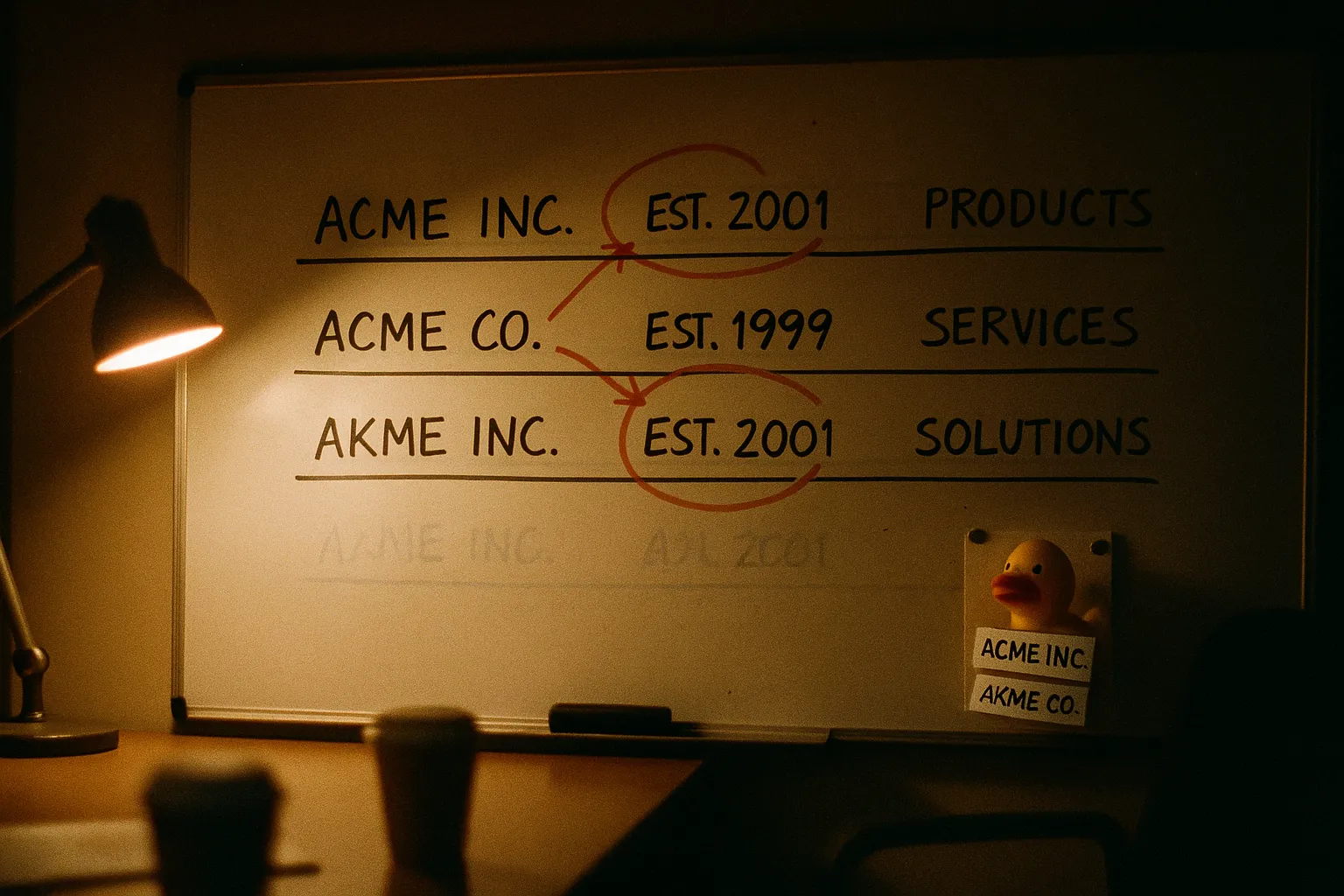
The machine doesn’t “pick the right version.” When triples conflict, it falls silent — anti-hallucination, not malice. The duck with three name badges knows what that’s like: when you’re recognized by photo but no one can confidently introduce you.
VI. Axis 3: Reconciliation — does the sameAs loop close
The single best public case showing this axis in motion is Kelly Sheppard’s (founder of The Structured Data Company), which she documented herself on structureddata.co.uk in “How I Lost My Knowledge Panel.” Short version: Sheppard, whose verified claimed Knowledge Panel had existed for years, left her prior role (Sleeping Giant Media), launched a new company, updated her affiliation everywhere — and the panel vanished overnight, replaced by a placeholder she described as a “fishing monster” (Google pulled in some random homonymous subject with weaker data who happened not to be suffering from “context rupture”). The real cause: for Google she briefly looked like two different people — the old affiliation still anchored the old node, the new affiliation was spawning a new one, and sameAs reconciliation hadn’t closed in time. Recovery took months — through explicit kgmid hints in structured data, circular sameAs links Wikipedia ↔ Wikidata ↔ LinkedIn ↔ personal site, and patient work on unlinked mentions in independent sources.
This is a case from the pro tier — a person who literally built a business teaching others not to lose such panels. Her own panel was down for months. The question: what’s the probability that a normal 80-person company, with no dedicated entity-marshal, going through a rebrand / M&A / change of founder credits, suffers the same? The answer that’s awkward to say out loud: very high. Most M&A communications work between 2023 and 2025 had no checklist item that read “update the acquirer’s and target’s Wikidata Q-items, set replaced by / replaces properties, confirm new sameAs in both directions.” Which means every other merger gives birth to “two of you” in the graph — and then one of them quietly dies, taking half your AI-share along.
Reconciliation isn’t a one-off action. It’s an architectural habit, equivalent to running regular backups. When any of the top-10 attributes changes (name, legal form, founder, CEO, headquarters, primary category, product focus, key identifiers on Crunchbase / LinkedIn / GitHub-org / Twitter), you’re obligated to walk the loop and make sure sameAs runs both ways and statements don’t contradict. Otherwise, after some time, the machine decides for you — and you won’t like its decision.
VII. Axis 4: Freshness — how entity drift works
Third month of silence. The company’s Twitter/X account last posted in March 2024; the LinkedIn company page has the same headline since 2022; the Wikidata Q-item, if one exists, hasn’t been edited in 23 months; the Wikipedia article (if any) reads with the paragraphs that were there at creation. Everything functions — customers arrive, the product ships, hires come in. Inside the company, life is busy. In the graph, the entity drifts.
This is entity drift: the gap between an entity’s real state and how machine systems “see” it, accumulating silently with no alert. The June 2025 cleanup vividly demonstrated what happens in the worst case. One of the most aggressive cuts was on “event”: -76.91%. These were mostly pandemic artifacts (online conferences from 2020–2021, cancelled events, transient initiatives) that formally existed in the graph but hadn’t been edited or received fresh signals in years. The machine said: this is either no longer relevant or wasn’t real → remove. The same logic hit thing entities (-15.27%): the general bucket for everything Google couldn’t classify more precisely. The signal is unambiguous: stale = candidate for cleanup.
Now port that to a company. If you launched a brand in 2019, got early press mentions, then grew, changed your CEO, added three products, entered a new market — but your Wikidata Q-item still has the three statements from 2019, no new CEO applied, no new products added, no edits in 18 months — for the machine your node looks not like “an active company” but “a company that existed in 2019 and may have died.” At the next cleanup, if aggressive duplicate-merging and weak-signal pruning continue, your node may land in the candidate list for “merge under more active competitor” or simply “remove as low-confidence entity.” You won’t be warned.
Freshness isn’t “post to Wikidata every month.” It’s a discipline of synchronization: when an attribute changes in the real world (CEO, HQ, product line, key partnership, funding round) it gets mirrored into the graph within a reasonable window (a week to a month). Not for aesthetics. To make the machine see the node as operational, not archival.
VIII. Axis 5: Panel-Trigger — the invisible bar you have to clear
Here we enter the most contested territory. Google has officially never published the threshold for a Knowledge Panel’s appearance. Black box. But practitioners who’ve worked in entity-SEO for years (Jason Barnard / Kalicube, instantpress.co, theStacc) have empirically derived a recipe that recurs across thousands of cases:
| Signal | Empirical minimum |
|---|---|
| Wikipedia entry | Desirable, not strictly required; sharply increases odds |
| Wikidata Q-item with 15+ sourced statements | Practically mandatory |
Schema.org Organization markup with sameAs array | Mandatory on official site |
| Independent articles on high-authority domains (DA 80+) | ~7+ for a stable threshold |
| Cross-platform social profiles with consistent facts | LinkedIn, Crunchbase, X, GitHub-org at minimum |
| Time from first mention to panel appearance | Typical window 6–12 months |
This is an emergent threshold, derived by practitioners from thousands of cases — not a published Google standard. A small local business with three mentions almost never gets a panel (even with clean schema). A mid-size company with 30+ independent mentions + Wikipedia + clean markup usually does — in the 6–12-month window after the last of the required signals lands. Sometimes 4 months, sometimes 14, but the pattern holds.
A panel isn’t a badge in search. It’s a certificate that the machine is confident in you above an F1-score threshold. Without a panel, AI has a neutral-legal right to skip you because it can’t prove with sufficient confidence that you are you. With one, the machine carries official acknowledgement from the largest graph on the planet that your entity is recognized, unique, and verified. This is not SEO cosmetics. It’s a structural prerequisite for participating in the 2026 market.
Counter-pressure on this axis — and the biggest temptation that triggers half the catastrophes in this field: “what if I just pay someone to make me a Wikipedia article in a week and a Q-item in two, and clear the threshold that way?” That isn’t a plan. It’s a landmine. Why is in the next section.
IX. Counter-pressure: “I’ll just buy Wikipedia for $300/month” — and why it backfires
This is the hardest counter-argument to face honestly. If all we need is Wikipedia + Wikidata + 7 articles on DA-80+ domains, the market is full of agencies that promise exactly that for one retainer. On Fiverr and Upwork the “Wikipedia article creation” category lists thousands of offers for $200–$2,000. Mass press releases through wire services — another thousand a month. Assemble JSON-LD from a template — an hour of work. Why wouldn’t this work?
Because Wikidata and Wikipedia are not corporate listing services. They are volunteer-editor communities with conservative rules on notability, neutrality (NPOV), conflict of interest and paid editing. Wikipedia in particular has waged an explicit, codified war against paid editing since 2014: the WP:COI policy requires mandatory public disclosure of any paid editing, and Wikimedia’s Terms of Use separately clarify that undisclosed paid contributions violate ToU. Wikipedia:Notability (organizations and companies) sets a fairly high bar: “significant coverage in multiple independent reliable secondary sources,” explicitly excluding ads, press releases, and sponsored content as acceptable sources. Workarounds get tracked — and not just at the page level. Wikipedia introduced a dedicated speedy-deletion criterion, G11 (unambiguous advertising), letting admins remove articles with no discussion if they read as promotional; CSD G11 applies thousands of times a month.
What happens to a company that enters the game via the cheapest door:
-
Path 1: paid editor without disclosure. The article is created, holds for a week or two, lands on a patroller’s radar, gets tagged as COI / paid editing / advertising, is deleted; the contracted editor’s account is banned. Often with a parallel investigation into whether this is part of a sockpuppet network (whose detection is its own discipline). In severe cases, the company lands on an explicit blacklist through WP:COIN (Conflict of interest noticeboard), meaning any future attempt to create a page will be rejected with a reference to the prior violations. That’s a reputational mark permanently on the platform that is the root source for every downstream graph.
-
Path 2: inflated “mentions” on shadow media. A PR agency places 30 “articles” across a network of sites that accept anything that comes with payment. Google sees this instantly — classifiers for low-quality / press-release-mill / link-farm domains have existed for years, systematically downweighting or excluding domains from ranking signals. Worse, one of the stated focuses of the June 2025 cleanup was “anti-hoarding” — removing entities with weak or suspicious signals. So inflation doesn’t merely fail to deliver a panel; it actively raises your risk of being swept up in the next deletion wave.
-
Path 3: NPOV violation from line one. Article created with phrases like “AcmeCo is a leading provider of innovative solutions” — misses notability bar at first read. Tagged for deletion, AfD vote, removal. Often together with the Wikidata Q-item, which auto-closes as “article about non-notable entity.”
What actually works — and it’s boring: start with a clean primary source. Your official site with flawless schema.org Organization markup (including sameAs array, founder, foundingDate, legalName, numberOfEmployees, address, contactPoint, identifiers in Crunchbase / LinkedIn / X / GitHub). Then earned media that is actually earned: genuinely interesting stories that make journalists’ lives easier rather than harder. Then time: 6 to 18 months in which independent Wikipedia / Wikidata editors can pick up the entity based on third-party sources. Then light guidance via Talk pages with full disclosure, if you spot factual errors in an existing article. This isn’t fast. It isn’t agency-shaped. It isn’t $300/month. It’s a long road that doesn’t scale across people, because it demands a real brand generating real mentions.
And before you even enter this game, the honest move is to start with a cold answer to “do I clear the notability bar at all?” That’s a separate Wikipedia notability audit, which this piece’s partner, Wikibusines, runs before you burn a quarter and a budget on a page an admin will delete under G11 — and which tells you whether your case passes at all, or whether you first need to build the sources.
In 2026, your visibility in a market is no longer your website or your SEO. It is a machine-readable node in the graph. Everything else is a message in a bottle you tossed into the ocean, hoping someone finds it.
X. Distribution of risk: who’s most exposed, who’s resilient
Risk isn’t evenly distributed — and that’s the most operationally important part of this text for anyone reading. Some categories of companies and people sit in the graph almost unkillable. Others are bare.
Most exposed (entity-fragile):
- D2C brands with generic names. A company called “Coastal,” “Bloom,” “Forge,” “Reform,” “Method” is doomed to homonym collision. Wikidata already has dozens of Q-items with such labels. Add an indistinct description and at the first reconciliation attempt the machine either merges you with someone else or leaves you outside the lattice entirely. Launching a D2C brand with a generic name in 2026 is operational malpractice: your marketing dollars will hit an entity ceiling.
- Single-founder consultants and agencies-of-one. When you and your company are one entity with a fuzzy boundary (personal brand + LLC + project site), the machine encounters a classic “people vs. organization” confusion. One of the most expensive mistakes is using the same name for person and company without an explicit
sameAs / founder ofloop, leaving Google to decide which one is canonical — and it usually doesn’t decide in your favor. - Startups that renamed after a round. Classic pattern: raised on one name, rebranded at Series A. If
replaces / replaced byproperties aren’t set in Wikidata, the next cleanup often keeps the “previous” entity as the active one (it has more mentions) and the new one as low-confidence. Especially painful in YC cohorts where rebrands are common. - B2B verticals without their own Wikipedia coverage. If your niche has no enthusiast journalist who writes about it in Wikipedia regularly (in narrow B2B, as a rule, none does), even a perfect campaign won’t get organic entity pickup. You have to build it manually, through primary source plus clean PR.
Most resilient (entity-resilient):
- Named individuals with academic citations. If you’re a person with an ORCID, a Google Scholar profile with a handful of citations, an h-index of even 5, authorship in peer-reviewed journals — your person-entity in the graph is almost unkillable. Academic databases (Crossref, OpenAlex, Semantic Scholar) provide structured machine-readable signals Google swallows and ties to your Q-item automatically. It’s the cheapest “entity hedge” in existence — and tens of thousands of academics have created it for themselves without thinking about it.
- Brands with pre-2020 PR history. If your company appeared in TechCrunch in 2014, Forbes in 2016, Bloomberg in 2018, you have dozens of “old” high-quality mentions the machine reads as baseline trust. Not a panacea — you have to maintain it — but the starting position is structurally higher.
- Public companies with an exchange ticker. Structured financial identifiers (CIK, ISIN, ticker, EDGAR filings) are the strongest entity anchor money can buy. The machine never wonders whether Apple Inc. is Apple Inc., because the SEC explicitly bound the entity to unique codes.
- Brands with geographic or numeric disambiguation. “Bloom of Brooklyn,” “Forge Industries Cleveland,” “Method 47” — even when the generic component is muddy, a disambiguating token (city, number, vertical) sharply lowers homonym risk.
The chapter resolves simply: take the list above and honestly see which column you’re in. If column one, your ESI is likely failing on 2–3 axes simultaneously, and your 90-day playbook starts with reconciliation, not content. If column two, your job is not “starting from zero” but defending an existing capital from accidental rebrands and entropy.
XI. JSON-silence: what death without a scandal looks like
June 2025. 3+ billion entities deindexed in a week. Among them, companies that had broken nothing. Google’s internal metrics had simply stopped being confident they were distinct real entities. What did the founder of one such company see?
First, an anomalous drop in AI-share. Where previously 12 of every 100 category-level queries had AI Overview mentioning the brand, starting in the third week of June the number fell to 4. Tools like Profound, Otterly, and Goodie make this visible in near real time — but only if you had them connected; most didn’t.
Then, a month of quiet, because most inbound channels are inertial: remarketing, direct visits from old articles, newsletters. Then a slow slide: cold-leads thin out, CTR on branded queries falls 8–14%, the “where did you hear about us?” share of demo requests shifts from “ChatGPT / Perplexity” to “friend recommended.” A key B2B deal falls through because the procurement team did a vendor-check in ChatGPT, got “no reliable information,” and chose a more transparently-described competitor.
Three months later, the CFO arrives at the quarterly review with a chart: pipeline -19% YoY, inbound -27%, cost-per-acquired-lead +34%. Marketing looks for the cause in SEO; SEO is fine. In content; content is fine. In performance; performance is stable. Nobody looks at the entity layer because there’s no dashboard for it. Six months in, a “death certificate” gets written: this company is no longer a node in the graph but a footnote in articles that mention it in a competitor’s shadow — the competitor that has now occupied its SERP.
| Brand X (death certificate) | Value |
|---|---|
| Status | Deindexed from KG (June 2025, wave 2) |
| Cause | Insufficient cross-source confidence |
| Notice given | 0 |
| Detected | +12 weeks (via AI citation drop) |
| Symptoms prior | Inbound -27%, lost 2 procurement deals, CPL +34% |
| Recovery window | 6–14 months (rebuild from scratch) |
| Avoidable | Yes, with a quarterly ESI audit |
This isn’t a horror story. It’s a financial report with a terminal diagnosis that was missed in time.
XII. The 60-minute DIY Entity Survival Index audit
No agencies. No $5K retainers. No “first we need a month of strategic discovery.” Seven steps, one 60-minute timer, an honest score. This isn’t a full audit — it’s a liveness test every founder or CMO should run once a quarter. Like taking a pulse: too simple to skip, too important to do once a year.
| # | Step | How to check | Time | Pass/Fail |
|---|---|---|---|---|
| 1 | Presence: Q-ID exists? | wikidata.org → search → your company → is there a Q123…? | 5 min | ___ |
| 2 | Consistency: name / founder / foundingDate / category identical across 5 sources? | Cross-check official site / LinkedIn / Crunchbase / Wikipedia / Wikidata | 15 min | ___ |
| 3 | Reconciliation: Organization JSON-LD with sameAs array valid? | search.google.com/test/rich-results → your URL → check schema + sameAs | 10 min | ___ |
| 4 | Panel: branded query returns a Knowledge Panel? | google.com → your exact name → is there a panel on the right? | 2 min | ___ |
| 5 | AI citation: ChatGPT answers specifically or hedges? | chat.openai.com → “who is [your company]” and “who is [founder name]“ | 5 min | ___ |
| 6 | AI citation #2: Perplexity cites your domain? | perplexity.ai → query in your category → is your domain in citations? | 5 min | ___ |
| 7 | Freshness: last edit on Wikipedia / Wikidata / LinkedIn < 12 months? | History tab on each | 8 min | ___ |
Score: 7/7 — ESI-A (“The graph likes you — maintain freshness, don’t break things”). 4–6/7 — ESI-B (“Quarter-to-fix: reconciliation and one or two strong fresh mentions resolve it”). 2–3/7 — ESI-C (“Not bankrupt, but close; the 90-day playbook is required”). 0–1/7 — ESI-D (“Entity bankruptcy de facto: you exist for clients, you don’t exist for the machine”).
This isn’t certification. It’s quick self-examination, after which you either exhale and go back to work, or it becomes clear that one of next quarter’s priorities is an entity audit with a specific owner.

The form the bank won’t send: seven checkboxes against your entity in the graph. The yellow duck on the stethoscope — the same caretaker who stayed after every agency clocked out.
XIII. The 90-day reconciliation playbook (if ESI-B or below)
No agencies. No retainer. One owner inside the team (head of marketing / head of growth / head of brand), 4–6 hours a week, plus willingness to coordinate with legal on public changes. Broken into four-week sprints.
Week 1: Audit and baseline the starting position. Walk through the 7-step self-audit, capture screenshots of every failure: an AI Overview without your brand, a ChatGPT answer with “no reliable info,” empty space where a Knowledge Panel should be. This is the baseline for measurement at day 90.
Week 2: Primary source cleanup. Verify the schema.org Organization markup on the official site. It must include: name, legalName, url, logo, description, foundingDate, founder (as sub-objects), address, contactPoint, numberOfEmployees, industry, and — critically — a sameAs array pointing at the LinkedIn company page, Crunchbase, X account, GitHub-org, Facebook page, Wikipedia (if one exists), Wikidata Q-item (if one exists). This is the most important single unit of work in the whole playbook: your primary source has to be the source of truth from which everything else reconciles.
Weeks 3–4: Mirror sync. Walk every mirror: LinkedIn (Founded, Industry, Specialties, Founder credits, About blurb), Crunchbase (Founded Date, Founders, Categories, Headquarters), GitHub-org (about block, links, founder accounts), X bio. Align the foundingDate (with month and day, if known), the name (with the full legal suffix or without — pick one and hold it), the category (a single consistent primary tag), founder credits (a complete founder list in consistent order), the official headquarters. Every change references the same source-of-truth site.
Weeks 5–8: Wikidata Q-item. If the Q-item doesn’t exist, create it (via wikidata.org → new item, with appropriate statements and obligatory source references under each claim). If it exists, fill it out: instance of (company / startup / corporation), inception (with source), founder (with a Q-ID for each), industry (with Q-ID), country, headquarters location, official website, all relevant external IDs (Crunchbase ID, LinkedIn ID, GitHub-org ID, X ID), social media followers (where relevant). Everything strictly NPOV: no marketing phrasing, no superlatives, no promotion. If you are an employee of the company, you must declare Conflict of Interest on your user page. Without disclosure, this is the road to a ban.
Weeks 9–12: Earned-media loop. Launch a content pattern that naturally generates three to five high-quality mentions: contributions to industry reports (Gartner / Forrester / IDC quotes), data stories with your own original analysis, notable product launches with a PR playbook, expert bylines in tier-1 outlets of your niche. Each such mention is fuel for reconciliation: when a journalist writes “AcmeCo, founded in 2019 by two founders X and Y,” that semantic triple aligns with your Q-item and primary source, and the model registers another confirming signal.
Day 90: Re-audit. The same 7-step self-audit. Expected metric: ESI rises by ≥2 grades (C to A, or D to B). The Knowledge Panel is in the 6–12-month emergence window — so it may not yet have appeared by day 90, but every precondition is met. The AI-citation rate begins rising from month two and is noticeable by month three.
This playbook isn’t magic. It’s discipline that costs one owner four hours a week over a quarter — and resolves a problem that otherwise costs you market share two years later.
XIV. Hard kicker
The market will not announce your death. There will be no “X shuts down” headlines, no LinkedIn posts saying “thank you for the years,” no press release of bankruptcy. There will be silence — first in AI Overviews, then in inbound, then in the funnel, then in revenue. By the time it hurts on the P&L, the graph already has its version of you, optimized for the competitors who started thinking about the entity layer two quarters earlier.
The question worth letting hang. In the next Knowledge Graph cleanup — and there will be one, because AI Mode and Gemini’s corporate workloads need a still cleaner base — will your company remain an entity with five consistent mirrors, or as a third candidate entity Google couldn’t confidently disambiguate? In 2026, existing in a market means caretaking your node in the graph as deliberately as cash in the bank, contracts in legal’s folder, and code in the repository. The graph is not loyal, not malicious, not biased; it is cold. It needs a consistent signal. If you don’t provide one, it picks someone who does — without regret, without an alert, without an emailed invoice. One morning you simply realize you’re no longer cited. A quarter ago everything was fine.
The graph is not loyal, not malicious, not biased. It is cold. It needs a consistent signal. If you don't have one — it picks someone who does. Without regret. Without an alert. Without an emailed invoice.
Frequently asked
What is a Q-ID and why does its absence mean a company does not exist for machines?
A Q-ID is a unique identifier for an entity in Wikidata, the global machine-readable database with 120 million records. Without a Q-ID, press mentions and LinkedIn entries are just unanchored text strings for LLMs — they cannot be resolved to a single entity, trusted, or cited. It is the equivalent of operating a business without a tax registration number: you exist for people, but the system has no entry for you.
If a brand has a low Entity Survival Index, what happens to inbound revenue and how fast?
First, AI citation share drops quietly (from 12 to 4 per 100 queries), then inbound leads decline over one to two months, cost-per-lead rises, and procurement teams pick the competitor ChatGPT can describe with confidence. The typical gap between a Knowledge Graph deletion and visible P&L pain is three to six months; recovery from entity bankruptcy takes six to fourteen months.
Is a strong website and active LinkedIn page not enough — why does a brand also need Wikidata and a Knowledge Graph node?
A website and LinkedIn are letters in a bottle for humans to find. The Knowledge Graph is the address book machines read. AI Overviews, ChatGPT Search, and Perplexity do not crawl your site at query time: they look up your node in the graph. If the node is absent or contradictory, no amount of content quality rescues you — the model skips you and names the competitor whose node is clean.
Google deleted over 3 billion entities in one week in June 2025 with zero notice — is that a one-time event or the new normal?
It is the new normal. Google called it an anti-hoarding cleanup, and a follow-up wave hit in August 2025. As AI Mode and Gemini require an ever-cleaner knowledge base, structured cleanup cycles will recur, and companies without a consistent entity signal will be candidates for removal in every subsequent wave.
What can a founder or CMO do in the next 60 minutes to assess actual risk?
Run the seven-step ESI self-audit: check for a Q-ID on wikidata.org, compare name, founding date, and category across five sources, validate Organization JSON-LD via Google Rich Results Test, check for a Knowledge Panel in branded search, query ChatGPT and Perplexity about the company and founder, and review the last edit date on Wikipedia and Wikidata. Score of 7/7 means you are safe; 0-1/7 means entity bankruptcy is already in effect.
Comments
Signed-in readers only — to keep it human, not a bot swamp.