Self-Awareness in Numbers: 95% Are Sure They Know Themselves, 10–15% Actually Do — Eight Levels of the Skill (Eurich's Data)
A child passes the mirror test at 18 months. The harder one it still fails: 95% of adults are sure they know themselves; about 10–15% actually do. Between those two numbers isn't a question of 'enough or not' but a staircase of eight floors, each governed by one law: the moment you climb, you see there are more floors than you thought. Call it the Mirror-Recession Rule. And while you spend eighty years studying your own face, the mirror has quietly moved into someone else's server, learned you better than your spouse in 300 likes, and turned the lens on you.
On this page
- I. The test you passed at six months (and are still proud of)
- II. Let’s name it: the Mirror-Recession Rule
- III. The first three floors: how a tenant moves into an empty room
- IV. The third floor: where the inner courtroom is born (and no one calls a recess)
- V. The fifth floor: you drew the frame yourself (and polished it for twenty years)
- VI. The strongest objection: higher is not always better
- VII. Why now: the mirror left your control
- VIII. Who benefits from the floor you’re stuck on
- IX. A tool: which floor is this specific behavior on
- X. Instead of a conclusion: who holds the mirror
The eye sees everything except itself. The mirror supposedly fixes this — and immediately hands you a worse problem: now you see not yourself but your reflection. And for the next eighty years you confuse the two, entirely free of charge and with no pangs of conscience whatsoever.
I. The test you passed at six months (and are still proud of)
The scene from which any “I” begins is staged in the bathroom. A mother quietly dabs a spot of rouge on her child’s nose and sits them in front of the mirror — supposedly just to amuse, but in fact running one of the most fundamental experiments in the history of consciousness without bothering to take off her dressing gown. Until about eighteen months, the child reaches toward the mirror — toward the spot on the glass, toward the cute stranger on the other side. After eighteen months the hand suddenly goes to its own nose. In that second, into a room that was empty until now, someone finally moves in: “this reflection is me.”
The same test was run in 1970 by Gordon Gallup on chimpanzees marked with red above the brow. An animal that has never seen a mirror first gives the glass its full repertoire: threat, courtship, an attempt to befriend the impertinent stranger. And then, seeing itself a second time, it touches its own forehead. Most species on the planet flunk the exam and go on politely greeting the idiot in the mirror for the rest of their lives.
The number first, because without it the rest is just a mood. You passed the mirror test at about six months. Now the harder one: by the estimates of researcher Tasha Eurich, about 95% of people are convinced they know themselves — and only 10–15% actually do. Between those two numbers — between eighteen months and eighty years — sits this entire text. Because self-awareness doesn’t toggle to “on.” It has floors. And most of life a person spends on the floor where they’ve learned to recognize their own face but have never once climbed to where you can see that they drew the frame themselves.
II. Let’s name it: the Mirror-Recession Rule
Picture not one mirror, but a mirror that, with every floor you scramble up to, steps back exactly one pace — and shows more. On the first it shows a stranger’s face. On the second, yours. On the higher ones, no longer the face but what paints it: the patterns, the frame, the very hand holding the brush. And on the last floor the mirror suddenly peels off the wall, moves into your phone, and calmly begins to look at you.
Let’s name the mechanism, because the nameless isn’t remembered: the Mirror-Recession Rule. The wording is simple and faintly mocking: the moment you climb one floor higher and decide you finally see yourself, that floor reveals there are more floors than you thought, and the mirror has receded another flight. Self-awareness works like that dream where you run down a corridor toward a door while the corridor lengthens in sync with you. The more honestly you look, the more it opens up of what you haven’t yet seen. This isn’t a flaw in the staircase. It is the staircase.
It sounds like a metaphor for a mood. In fact it’s a map, and one drawn long ago. Psychology, neuroscience, and developmental theory have named these floors one by one — only nobody bothered to set them in a single flight and walk it top to bottom. Let’s walk it.
| Floor | "I can now see…" | Backed by | Number / marker |
|---|---|---|---|
| 1 | …that another has a mind of their own, which can be wrong | Theory of mind (Sally–Anne test) | ~4 yrs; 0% → 57% at 4–6 |
| 2 | …that this reflection is me | Mirror test (Gallup) / "core self" (Damasio) | ~18 months |
| 3 | …that I am continuity in time, with a past and a tomorrow | "Autobiographical self" (Damasio) | where self-gnawing is also born |
| 4 | …the patterns I repeat for years | Internal / external self-awareness (Eurich) | only 10–15% see them |
| 5 | …that I drew the frame I live in myself | Double loop (Argyris) / "self-authorship" (Kegan) | ~⅓ of adults get there |
| 6 | …awareness itself — a thought about thought | Metacognition (Flavell) / higher-order (Rosenthal) | here the hall of mirrors begins |
| 7 | …that I am not my thoughts; I can step back from the mirror | Decentering / quiet DMN (Brewer) | less narrative, not more |
| 8 | …that the mirror is no longer in my hands | Algorithmic model of personality | machine > spouse by ~300 likes |
III. The first three floors: how a tenant moves into an empty room
From below the staircase grows fast and almost automatically — the body builds itself, without your consent and without a receipt. Damasio split it into three nested selves: the proto-self — a neural map of the body where no one is home yet, just the lights on and the fridge running; the core self — an actor aware of this scene, here and now; the autobiographical self — an actor who remembers every previous performance, keeps the reviews, and is already nervous about the next premiere. Each floor stands on the one below: no body, no “now”; no “now,” no story.
And here’s the first uncomfortable detail, the one that breaks your intuition over its knee. You’d think: first you know yourself, then others. In fact it’s wired the other way. A child recognizes its own face at 18 months, but learning to model that someone else’s head can hold a false belief takes until about four years. The classic scene: Sally hides a marble in a basket and leaves the room; while she’s gone, mischievous Anne moves the marble into a box. You ask a three-year-old where Sally will look, and they point confidently at the box, because they know where the marble is, and other heads haven’t been invented for them yet. A four-year-old says “in the basket” for the first time — because they can now hold someone else’s wrong picture of the world, separate from their own.
A child learns to catch where YOU are wrong years before it learns to see the program running inside itself. Write it down, because it’s a sentence for life: we’re born brilliant prosecutors of other people’s blind spots and hopeless auditors of our own. Everyone has seen it at a family dinner — the uncle who diagnoses a neighbor’s neurosis from half a second of intonation, while writing off his own third heart attack as “bad coffee.”
IV. The third floor: where the inner courtroom is born (and no one calls a recess)
The autobiographical self is a great achievement and at the same time the costliest trap on the staircase, one with a paid subscription to suffering built in. The instant an “I-in-time” appears, so does a voice that endlessly retells the story: what they thought of me, how I looked from outside, who I should already be at my age. The narrator is useful right up until it turns into a round-the-clock inner tribunal where you are simultaneously the defendant, the prosecutor, and the sole juror who reliably votes against himself — while the judge has been on sick leave for about ten years.
So climbing to the fourth floor — seeing not a single act but the pattern of your acts over years — is managed by a minority. In a multi-year program (a review of roughly a thousand studies) Eurich found two entirely different things under one worn-out word: internal self-awareness (I know my values and feelings) and external (I know how others see me) — and they barely correlate. You can be a genius of self-excavation and have not the faintest idea how you sound in a meeting when you think you’re “just bringing clarity.” And sharpest of all: those who dug into themselves most turned out not to be the most self-aware. The question “why am I like this?” the brain serves instantly — with a smooth, convincing, almost always invented story. The working question is “what is happening right now?”, not “why.”
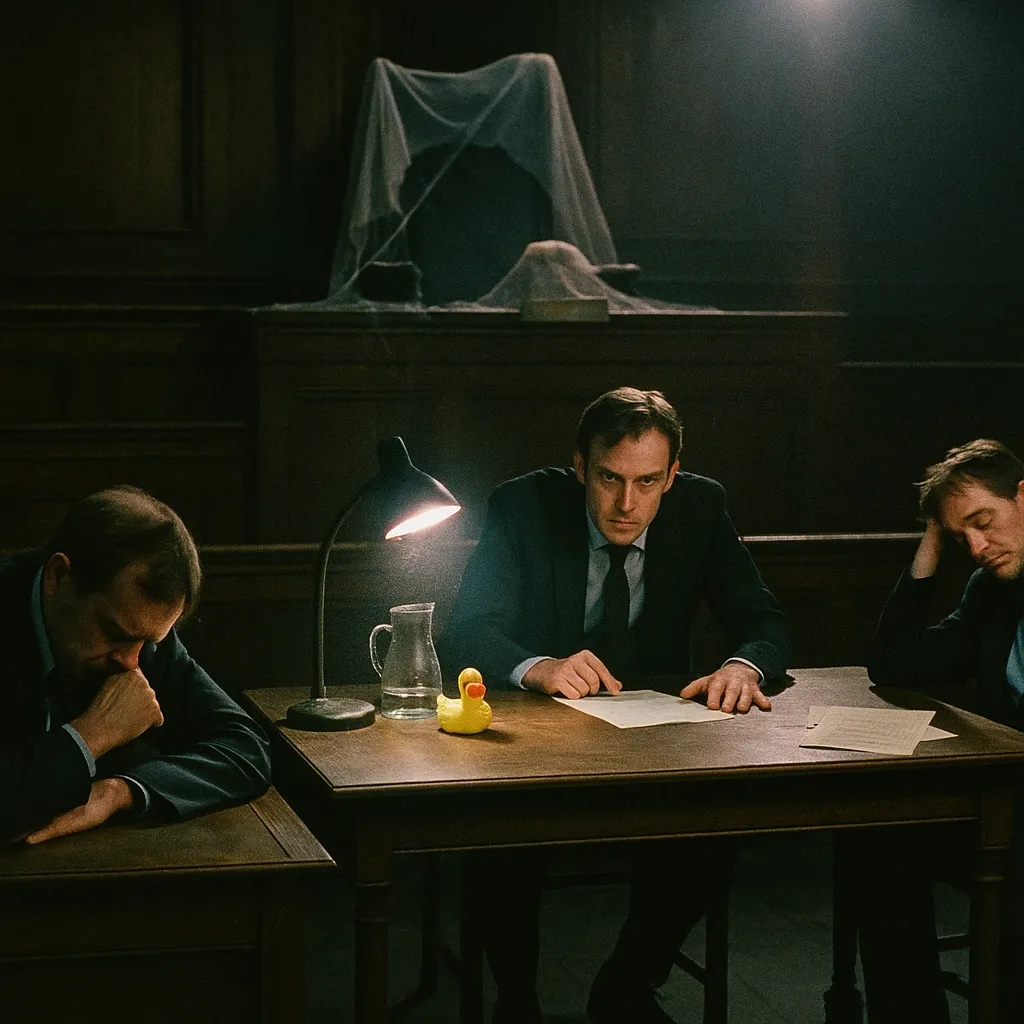
The third floor: the autobiographical self opens a round-the-clock inner tribunal where you are at once defendant, prosecutor, and juror. The judge — the one who would call a recess — has long been on sick leave.
V. The fifth floor: you drew the frame yourself (and polished it for twenty years)
Here the staircase turns steep, the handrails end, and most stop for a smoke break — permanently. The fifth floor is when you see not just the pattern but the rules that generate the pattern. Argyris called it the double loop. A thermostat holding the room at 20° works in a single loop: spot a deviation, adjust, good boy. A thermostat that suddenly asks “and why 20 at all, and who the hell set that?” works in a double one. Most people — especially the smart and successful — are brilliant thermostats of their own lives and utterly hopeless engineers of their own setpoints. They spend years flawlessly optimizing the answer to a question they never once dared to reread, because to reread it is to admit they spent twenty years heating the wrong room.
Kegan calls the same floor “self-authorship”: the moment you stop being your beliefs and start owning them — holding the frame in your hands rather than looking through it as through the only possible glasses, in which, it turns out, you’d been asleep. By estimates from his data (a paraphrase, not a census), about a third of adults reach it, and the next floor — a handful, and rarely before midlife, when half the rooms have already been heated for nothing. This isn’t an IQ verdict. It’s simply a rare and unpleasant operation: to diagnose your own diagnosing. A surgeon operating on himself, without anesthetic, with a little mirror.
VI. The strongest objection: higher is not always better
Here the text must strike itself before you do. Because everything above reads like a cheerful “climb higher and win a prize.” Not true. The staircase is not monotonically good, and here’s the proof from research, not from an inspired mood.
The psychologists Trapnell and Campbell (1999) described the self-absorption paradox: the same attention turned inward correlates equally with more self-knowledge and with more suffering — because two opposite animals hide under one word. Rumination — the neurotic loop of “why does this always happen to me,” tied to depression and anxiety. Reflection — curious self-inquiry, tied to openness and well-being. From outside the motion is identical: a person sits and looks inward. The result is opposite, like two passengers in the same elevator, one going up and one only thinking he is, while the cable has snapped. Looking inward is not a virtue by default; what makes it poison or medicine is how exactly you look.
And then the sixth floor — a thought about thought, a mirror facing a mirror — turns into a trap: a corridor of endless reflections where it’s wonderfully cozy to spend an entire life, mistaking inaction for depth. The smartest way not to live is to analyze yourself endlessly and exquisitely; the headstone will read “he almost understood himself.” And the way out of the corridor, confirmed by neuroscience, is not one more flight up. It’s the seventh floor: decentering. Under the scanner the brains of experienced meditators show not more self-narrative but less — a quieted “default mode” network, the very radio station that, around the clock and even in sleep, retells you to yourself. The top of the staircase looks and sounds quieter than its noisy middle. Which, by the way, quietly kills an entire industry of “dig into yourself deeper, another forty sessions.”
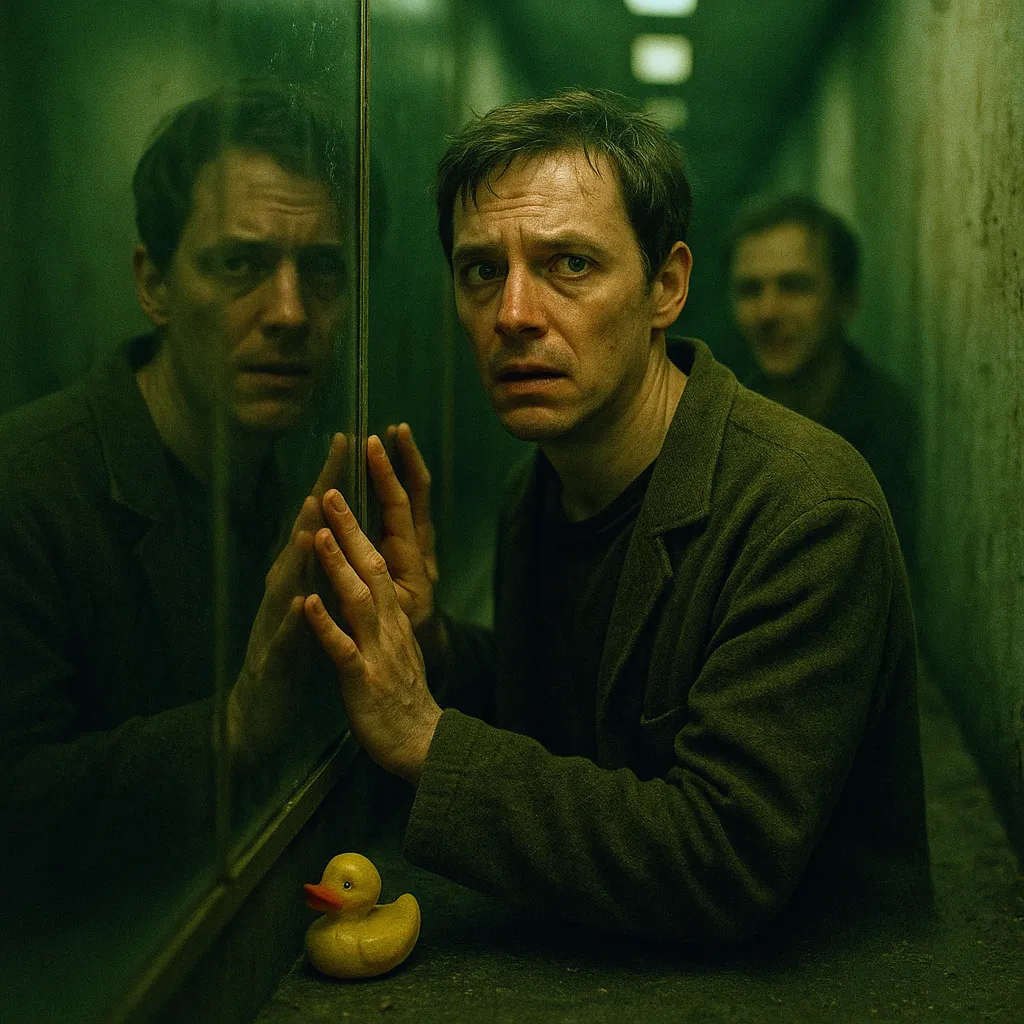
The sixth floor — a thought about thought — easily becomes a hall of mirrors, where analyzing the self elegantly substitutes for living it. The way out is not up but sideways: step back from the mirror, don’t breed reflections.
VII. Why now: the mirror left your control
This flight of stairs always existed — sages, confessionals, the analysts’ couches, kitchens at night. But between 2018 and 2026 a lift was added to it that didn’t exist before. And it goes the wrong way.
First, therapeutic language went mass-market — and immediately cheapened. “Boundaries,” “trigger,” “trauma,” “toxic,” “self-awareness” moved out of the therapist’s office and into reel captions and comment-section fights. Self-monitoring became a consumer identity rather than a clinical act: “I’m working on myself” now means you bought a journaling app and dutifully logged your mood for three weeks without changing a single behavior. The terms spread like water across a floor, and now they’re slapped onto anything you can’t be bothered to name more plainly.
And the main thing — the most accurate mirror moved into someone else’s hands. A friend forgets you and interrupts with their own problems; a therapist sees you 50 minutes a week and also wants to go home; but a model remembers everything you ever wrote, connects patterns you don’t see yourself, does it round the clock, untiringly, and with no reproach. In 2015 a study in PNAS showed something that recommender systems operationalize daily ever since: a computer needs 10 of your likes to describe your personality more accurately than a colleague, 70 — more accurately than a friend, 150 — more accurately than family, 300 — more accurately than a husband or wife. The slogan “the algorithm knows you better than you do” stopped being a slogan and became a measured fact with a confidence interval. And unlike a spouse, the algorithm never brings it up at dinner. It just silently builds the conclusion into the next recommendation — and you, unsuspecting, agree with the diagnosis by clicking “buy.”
VIII. Who benefits from the floor you’re stuck on
Self-awareness is not a neutral virtue hanging in the air. On every floor stands someone quite specific to whom it is materially profitable that you stay right here and don’t make a fuss.
From below you’re held by the attention economy. A person on the third floor — a narrator hungry for approval and steered by social proof — is the ideal customer for advertising, outrage, and belonging-marketing. The self-authoring user (floor 5) is a terrible customer: he noticed his pattern “I buy to mute something,” named it out loud, and unsubscribed. So the feed is engineered so that you spend your whole life looking into a mirror at the level of “how do I look in this” — and never into a mirror at the level of “who drew the frame in which ‘in this’ even seems to matter.”
From above you’re gently milked by the self-awareness industry. Coaching, assessments, boundless “inner work,” journaling apps and tender AI companions sell you a mirror — and a hammer to go with it, included, at a discount on the annual plan. Their interest is that you circle the line rather than cross it: because endless reflection retains a payer more reliably than a clean exit, which zeroes out the LTV. The cleverest part is that both camps are one trick from two sides. One keeps you below the line so you stay steerable; the other makes you circle it so you stay billable. A genuinely self-authoring person is a bad customer for both — which is exactly why no one advertises to them.
IX. A tool: which floor is this specific behavior on
The point isn’t to “live on the eighth floor” — no one moves in there, there’s nowhere to put the kettle. The point is to ask, for each of your reactions: which floor am I looking from right now? Because you’re not on one floor — you jump between them dozens of times a day, sometimes between two adjacent sentences.
| Floor | Question to yourself | Marker that you're stuck here |
|---|---|---|
| 3 — narrator | What am I feeling right now? | Third hour replaying how you looked; checking if it got liked |
| 4 — pattern | Have I done this before? How many times? | "Same thing again" — but with no name for the pattern, so you'll step in it again |
| 5 — frame | Whose rule is this and who set it? | Optimizing the answer to a question you haven't reread in twenty years |
| 6 — corridor | Am I analyzing — or avoiding action under cover of thought? | Third week "figuring yourself out," done nothing |
| 7 — step-back | Is this me — or a thought passing through? | Forgot there's any gap at all between you and the thought |
The rule is one and blunt: if “why am I like this” spins longer than “what to do now,” you’re not at altitude, you’re in the hall of mirrors, and you’re paying rent. Go down to the floor where there’s action, because there at least the furniture moves.
X. Instead of a conclusion: who holds the mirror
The Greek Narcissus died not of vanity, as he’s been slandered, but of a banal level-error. The youth bent to a forest pool to drink, saw in the water a face of unheard-of beauty, fell in love — and never grasped that he was looking at himself. He reached out, and the face dissolved into rings; the water stilled, and it returned. He could neither embrace it nor tear himself away, because the surface seemed enough, and he died over his own reflection, mistaking a mirror for another person. The whole staircase is about not repeating his gesture: not confusing the face in the mirror with the one who looks, the surface with the depth, the narrator with the author.
But in 2026 the question has shifted, and this is the most important thing in the whole text. Once the entire mirror was in your hands — imperfect, forgetful, biased, cracked and smeared, but yours. Now the most accurate mirror stands in someone else’s hands, holds your whole chronicle at once, never looks away, and earns precisely from your looking into it. And then the highest floor of self-awareness is no longer “how much do I see myself.” It’s about something else, sharper:
You passed the mirror test at six months and still quietly take pride in it. The hard one you fail daily. And while you spend eighty years trying to make out your own face, the mirror slipped out of your hands, moved into someone else's server, and turned the lens on you. So the final question of self-awareness is no longer "how well do I see myself," but "who holds the mirror — and to whom is it profitable how it shows you." Because whoever owns the reflection sooner or later starts quietly editing the original — while you go on thinking it was you who shifted your shoulders.
Frequently asked
What is the «Mirror-Recession Rule»?
It's the mechanism the text names: the moment you climb one floor higher in self-knowledge and decide you finally see yourself, that floor reveals there are more floors than you thought, and the mirror has receded another flight. The more honestly you look, the more it opens up of what you haven't yet seen. This isn't a flaw in the staircase — it is the staircase.
If I passed the mirror test at six months, what is the «harder» test I still fail?
The mirror test (recognizing your own face in the glass) is passed at about 18 months. The harder one is actually knowing yourself, not just your reflection. By researcher Tasha Eurich's estimates, about 95% of people are convinced they know themselves, while only 10–15% actually do. The whole eight-floor staircase sits between those two numbers.
Why is introspection not the same as self-awareness?
Because the brain serves the question «why am I like this?» instantly — with a smooth, convincing, almost always invented story, as if you'd hired your own press secretary. Eurich found that those who dug into themselves most turned out NOT to be the most self-aware. The working question isn't «why» but «what is happening right now?».
Isn't climbing higher up the staircase always better?
No, and the text strikes itself with this objection. The same inward attention correlates equally with more self-knowledge and with more suffering (Trapnell and Campbell's self-absorption paradox): rumination leads to depression, reflection to well-being, while from outside the motion is identical. The sixth floor — a thought about thought — easily becomes a hall of mirrors where analyzing the self elegantly substitutes for living. The way out is not up but sideways: step back from the mirror.
What does «who holds the mirror» mean in 2026?
Once the entire mirror was in your hands — imperfect, but yours. Now the most accurate one is held by the algorithm: a PNAS study (2015) showed a model needs 300 of your likes to describe you more accurately than your spouse (150 — better than family, 70 — better than a friend, 10 — better than a colleague). So the final question is no longer «how well do I see myself» but «who owns the reflection — because whoever does sooner or later starts quietly editing the original».
Comments
Signed-in readers only — to keep it human, not a bot swamp.