Intimacy as an Attention Delivery System: Responding to Small Bids Predicts Marriage Stability — 86% vs 33%
Intimacy is not an emotion that happens by accident. It's an infrastructure of proof that another person exists in your head even when they're not in the room. Spontaneity has poor uptime: if love runs on mood alone, it crashes in the first week of work, kids, fatigue, and a phone in hand. Cached presence, bent coins of the 14th century, Gottman, and the 48.8% of care that nobody noticed.
On this page
- This isn’t cuteness. It’s cached presence
- Why the bouquet is weaker in this exact mechanism
- Three operations of the hidden note
- Seven centuries of tradecraft
- The science of small signs
- Why the phone loses to the pocket
- Cinema: love delivered by other hands
- Impulse versus protocol
- A catalog: low-cost, high-specificity
- The fine line: attention, not control
- Instead of a conclusion
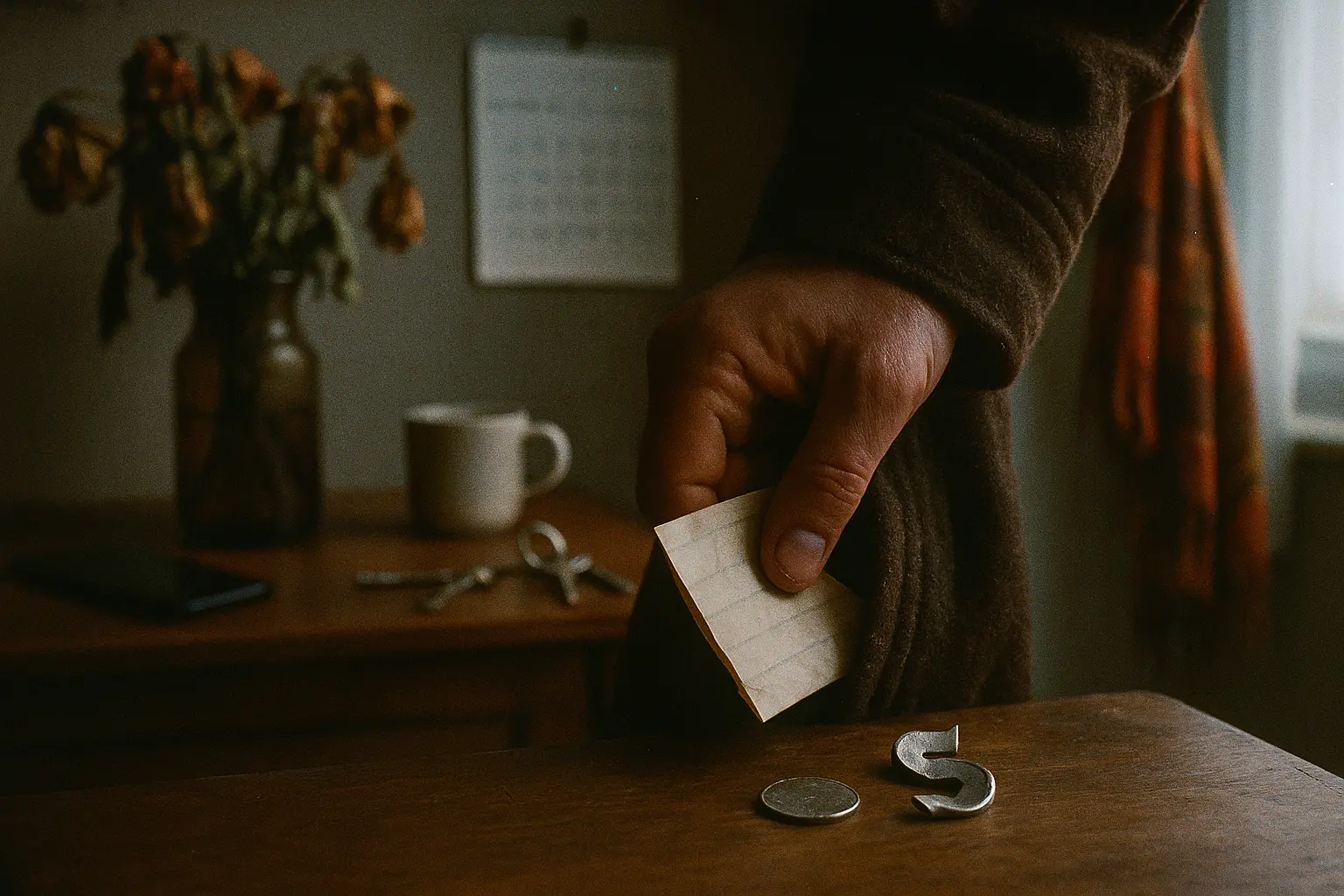
Someone puts on a coat in autumn they haven’t worn since spring, slips a hand into the pocket — and finds a note folded in four. A foreign hand, familiar. “If you’re reading this, then it’s gotten cold, and I’m thinking about you again.” The note was placed six months ago. Whoever wrote it forgot long ago. But it fired at exactly the right moment — with zero effort in that moment.
The hand was looking for keys and found proof that its owner had once been anticipated. This isn’t a notification. It’s an encounter.
This isn’t cuteness. It’s cached presence
Ordinary intimacy is synchronous: I’m here, I speak, I touch, I give. A note is asynchronous. It works like an email from a past version of you — not in your inbox, but in a coat pocket. An emotional dead drop: a cache of tenderness only the one who knows the spot will retrieve.
Intimacy is not an emotion that happens by accident. It’s an infrastructure of proof that another person exists in your head even when they’re not in the room.
And here’s why this is engineering, not a sentimental tip. Spontaneity has poor uptime. If love runs on mood alone, it crashes in the very first week of work, kids, deadlines, fatigue, and a phone in hand. In the first months love works like fireworks. In a long couple it has to work like the power grid: not always visible, but stable. Mature intimacy builds backup power.
Why the bouquet is weaker in this exact mechanism
“Better than a bouquet” is unfair to the bouquet: it can be beautiful, bodily, publicly visible. The point isn’t that the bouquet is bad. The point is that it plays in a different coordinate system — expected, ritual, synchronous. It dies in the vase by Thursday, having hit its quarterly romance KPI.
| Gesture | Weakness | Strength |
|---|---|---|
| Bouquet | expected, ritual, often generic | beautiful, bodily, visible to others |
| Note | almost no market value | personal, unexpected, works without the author |
| Playlist | can be banal | encodes shared memory |
| "Open when…" letter | needs effort in advance | works in the moment of weakness |
| Private meme | opaque to outsiders | creates the couple's micro-sovereignty |
Hence the sharpest thesis of the section: the bouquet says “I remember the date.” The note says “I remember you beyond the date.” A ritual has a date. Proof has latency.
Three operations of the hidden note
- Collapsing absence into presence. A bouquet works while you hand it over. A note works when you’re not in the room, the city, the time zone. It proves: I thought about you even when you couldn’t see or control me.
- Surprise as amplifier. Dopamine fires not on reward, but on unexpected reward — the same circuit that keeps people at slot machines. A note on a random Tuesday gives a disproportionate spike precisely because it wasn’t expected.
- Proof of continuous attention. The other is present in your head as a background process — one you can’t kill even when you want to. The note makes that background process visible.
Seven centuries of tradecraft
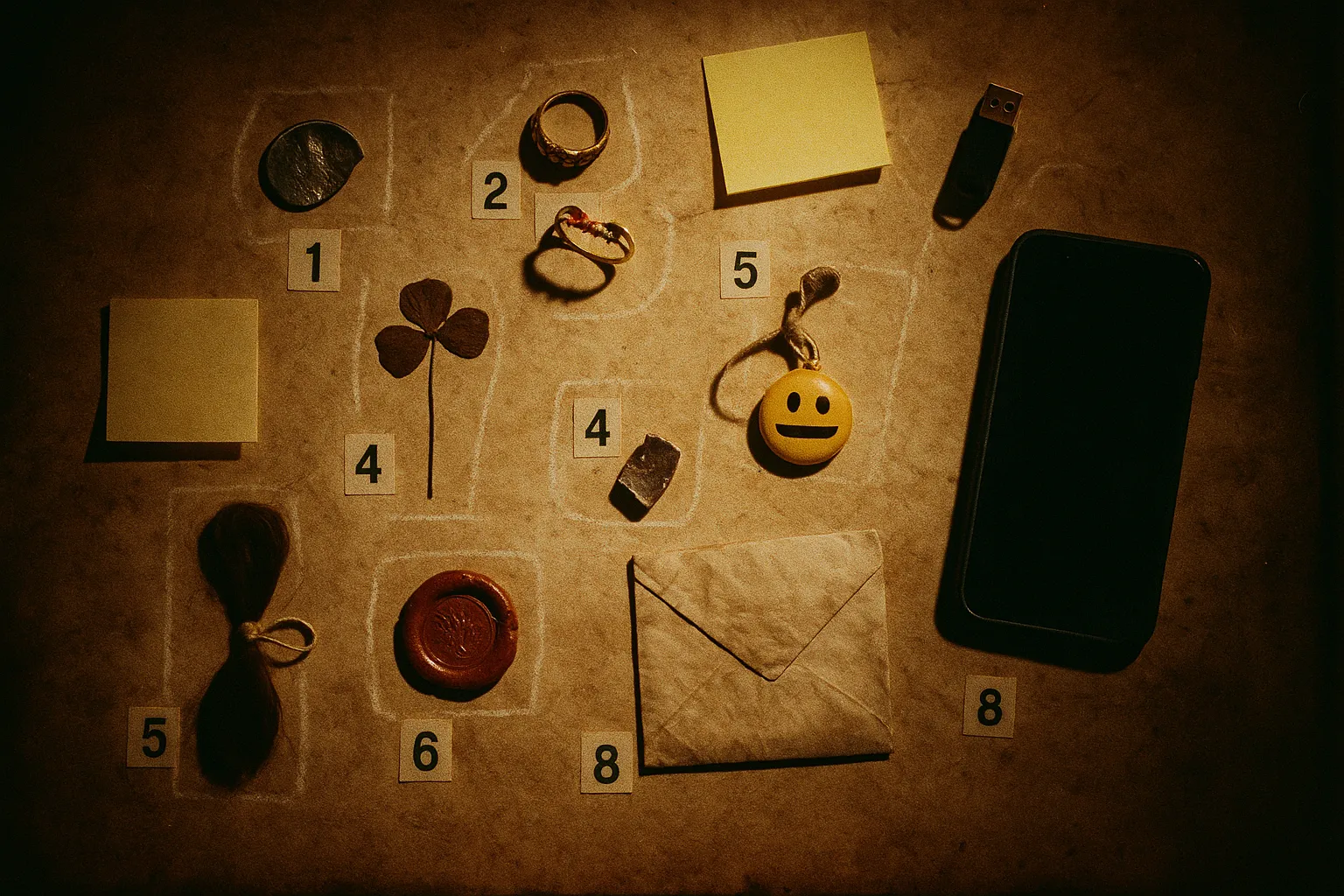
Seven centuries of caches of tenderness: a coin, a ring, a cipher in stone. Among the artifacts — an incongruous modern sticky note. Same genre.
Hiding tenderness in an object is an old technology, suspiciously like a spy’s dead drop:
- Bent coins (England, from the 14th c.). A coin was bent, taking it out of circulation: it stopped being money and became a token of memory. The first way in history to make money finally mean love — ruin it enough that it can’t be spent.
- Posy rings. Rings with a short love inscription — often inside the band, where it touched the skin and stayed invisible to others. The same note in the pocket, only the pocket is a finger.
- Acrostic ring. The first letters of the gems spelled a word: DEAREST — Diamond, Emerald, Amethyst, Ruby, Emerald, Sapphire, Topaz.
For seven centuries people bent coins, hid inscriptions inside rings, ciphered love into stone — anything but say it out loud. The engineering of intimacy has always also been a technology of cowardice.
The science of small signs
Count your bids today: how many times did your partner toss out a “look at this” and you answered into your phone? John Gottman coined bids for connection. His data is harsh: “master” couples turn toward bids 86% of the time, “disasters” 33%. Over dinner, masters make up to 100 bids in 10 minutes; those heading for divorce, about 65. Happy couples don’t have one big moment — they have a higher density of small ones.
His “magic ratio” is roughly 5 positive interactions to 1 negative during conflict. This isn’t “say nice things,” it’s a safety margin: a couple survives not by never fighting, but by banking enough small proofs of “I see you” between fights. And the “six-second kiss” — long enough for the body to register contact; two a day is under 90 seconds a week. Not all intimacy needs an hour. Often it needs the right protocol.
And the harshest number is from the diaries. Algoe, Gable & Maisel (“It’s the little things”) collected 14 nights of reports from 67 couples: 1,768 daily entries. Partners noticed the other’s thoughtful act on about 39.5% of days. But here’s the blow: nearly 48.8% of the thoughtful acts one partner reported, the other simply didn’t notice.
And this isn’t “cuteness”: articulated attention has a measurable effect. Slatcher & Pennebaker had one partner in 86 couples write for three days about their deepest feelings on the relationship; three months later those couples were significantly more likely to still be together than a control group. And the best gift, per consumer researchers, isn’t an object but a change in inner state: experiential gifts strengthen the bond more than expensive things. A €0 note beats a costly object if it hits the person more precisely.
Why the phone loses to the pocket
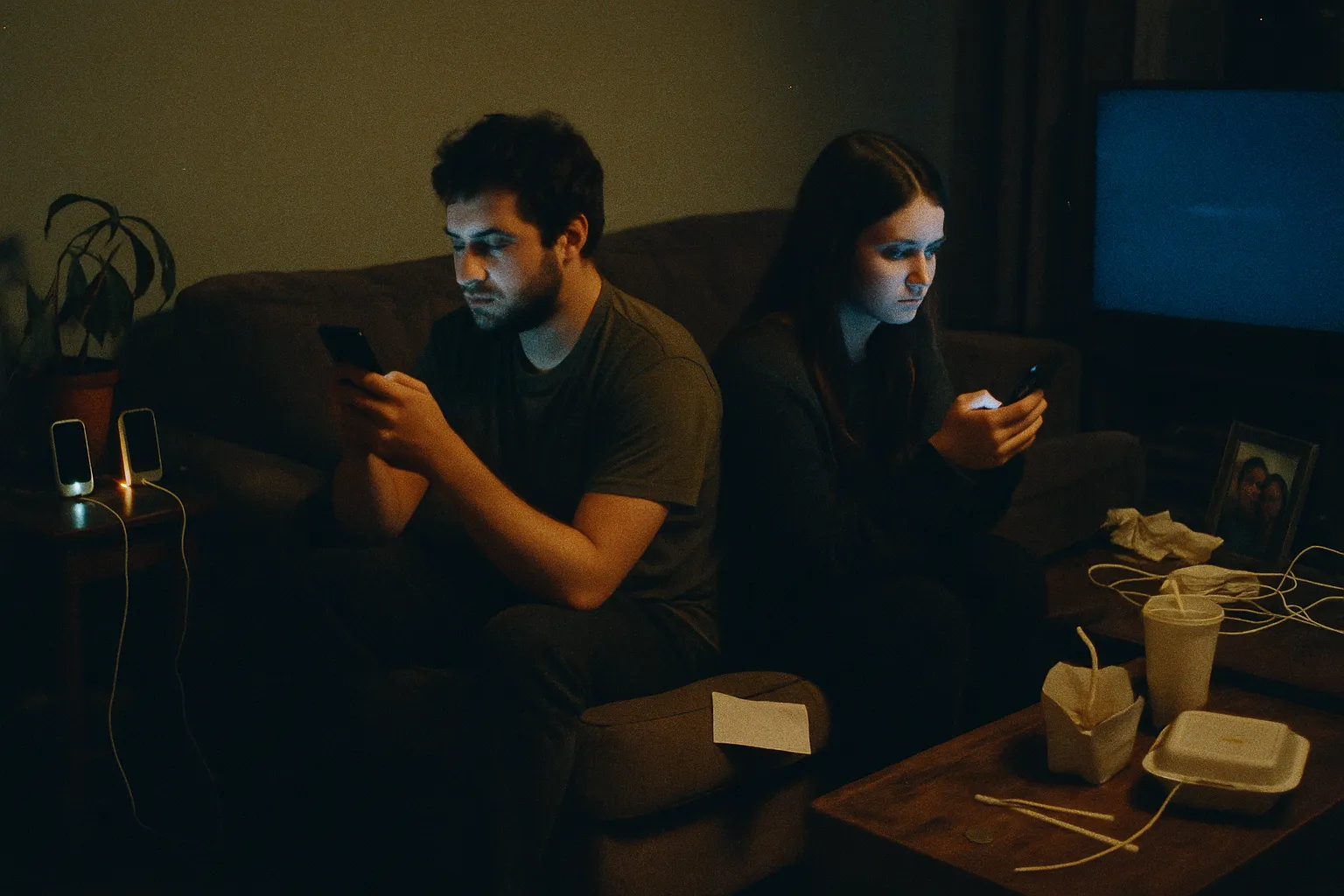
Two on one sofa, back to back, each glowing into their own screen. On the nightstand — two phones charging like two life-support machines: sustaining a life that’s no longer in the room.
We live in an age where you can type “love you ❤️” in 0.7 seconds — and that’s exactly why the signal cheapens. It arrives in the same channel as the internet bill, a friend’s meme, the work chat, and the latest end-of-the-world headline. A read receipt is the evening’s coldest epitaph: “read 14:32,” and nothing more. And he sends her a voice note from the next room, because getting up and saying it out loud is already too synchronous.
This isn’t an invented dystopia. Pew (2020): 51% of partnered people say the other is often or sometimes distracted by their phone when they try to talk; 40% are bothered by how much time their partner spends on the phone. A person can be physically present — and absent in attention. That’s why a note in the pocket is strong not because paper is magic, but because it’s a trace of attention with no competition from the screen. It doesn’t arrive in the feed. In a messenger, love arrives as one more bubble. In a coat pocket — as an event.
Cinema: love delivered by other hands
“Amélie” (2001) isn’t a film about a quirky girl. She finds a child’s box of treasures, anonymously returns it to its owner, watches him break down at the encounter with his past — and then starts quietly “nudging” other people’s lives with small interventions. The strongest feeling can be delivered not by words but by a properly arranged discovery.
“P.S. I Love You” isn’t a melodrama about letters after death. It’s the most radical form of asynchronous love: the hero engineers letters that will reach his wife after presence is no longer possible. “Lost in Translation” — the final whisper the viewer never hears: the most intimate thing doesn’t belong to the audience; it’s a private channel. And “In the Mood for Love” proves the opposite of grand gestures: corridors, stairs, near-touches, repetition — ritual becomes more erotic than event.
Impulse versus protocol
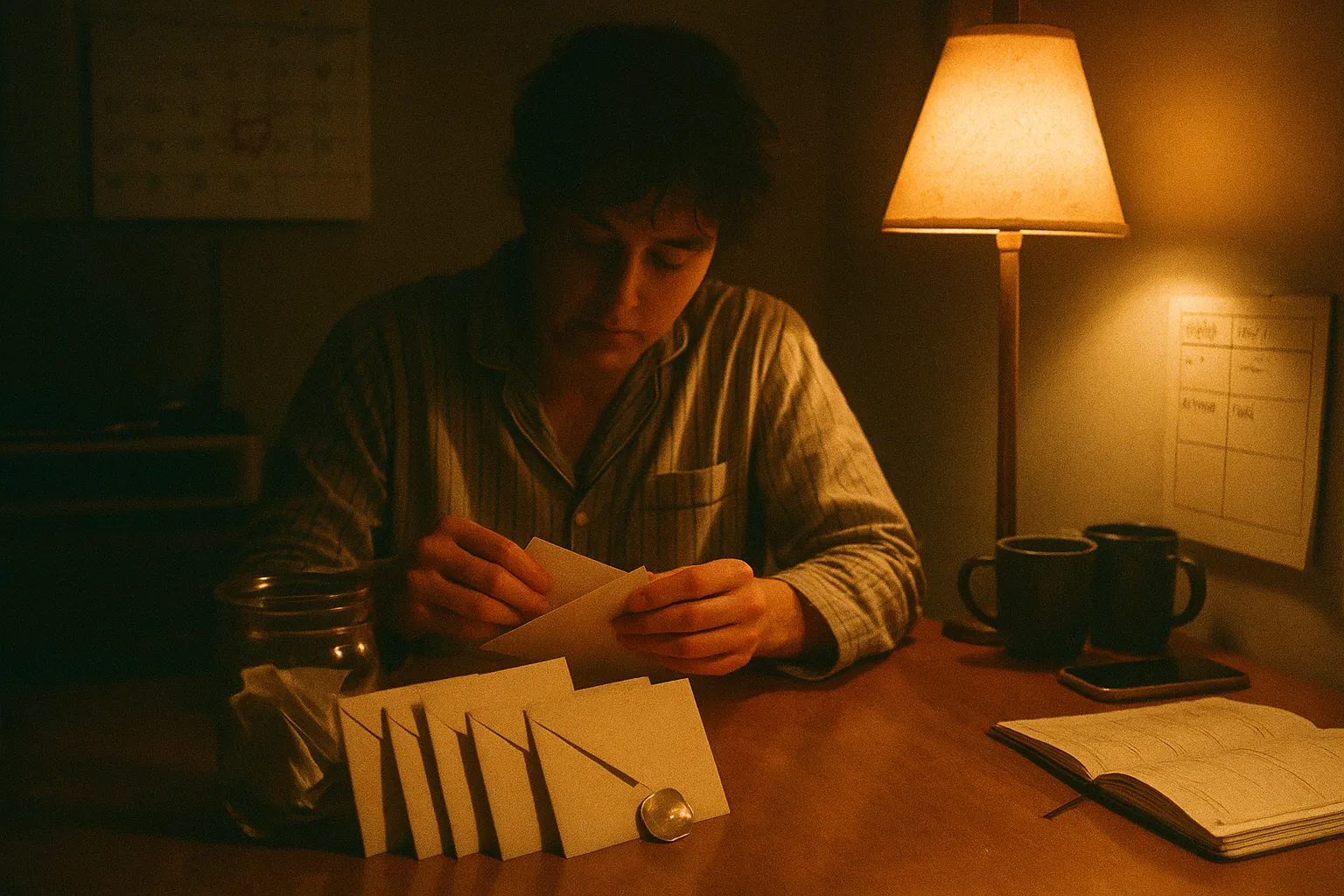
“Open when…” is when the strong version of you writes an instruction for the weak version of you both. A pre-commitment of love, assembled on a good day.
There are couples where the note lands in the pocket on a whim. And there are those who systematize intimacy: a shared calendar, a weekly date, the “infrastructure” of an evening — light, playlist, coffee. The culture’s first reaction is suspicion: if it’s planned, is it even real? Imagine the partner who finds the surprise-spreadsheet and feels cheated.
But the research says the opposite. Spontaneity doesn’t scale: it’s the privilege of the first months, like a twenty-year-old’s metabolism. Over years, it isn’t impulse that holds, but backup power. The planned is sometimes more real than the spontaneous, because it doesn’t outsource another person’s happiness to the randomness of your mood. The most mature couples lay protocol as the floor — a guaranteed minimum of small signs — and leave impulse as the ceiling. Structure doesn’t kill spontaneity; it saves you from the fear that without it everything falls apart.
A catalog: low-cost, high-specificity
A gesture’s power grows not from price but from precision. An expensive gift says “I spent a resource.” A precise gesture says “I tell you apart from everyone else.” A working set:
- Notes in unexpected places: in the cereal box; in a laptop file the partner opens during a meeting; in a suitcase packed for a trip.
- “Open when…” letters — “when we’ve fought,” “when I’m far away,” “when it feels like I don’t see you,” “when we’ve gotten too grown-up and boring.” A chatbot of your own voice for when you don’t pick up the phone yourself.
- Playlist / mixtape — the acrostic ring of the 20th century: instead of stones, songs; instead of DEAREST, the track order (“High Fidelity” made it an art).
- A jar of reasons. Slips of “why I love you,” one a day. Most jars die at note #11 in February.
- A private code. A phrase, a meme, an odd word. Intimacy begins where a third person stops understanding what’s going on. A private joke is more intimate than a compliment: a compliment is legible to everyone, a code only to two.
The fine line: attention, not control
Let’s name the risk honestly: the engineering of intimacy can sound like manipulation. The difference is simple. Engineering attention creates a space where the other feels seen. Engineering control tries to elicit the desired reaction. A note is strong not because it “programs” an emotion, but because it leaves freedom: you can find it, smile, cry, put it back, not reply. It doesn’t demand. It testifies.
Instead of a conclusion
A bouquet often says: I remember that today I’m supposed to be romantic. A note says something else: I remembered you when nothing demanded remembering. That’s the difference between a ritual and proof. Proof comes not when it’s expected, but when a person is just looking for keys, cold, running late, thinking about work — and suddenly finds in the fabric of a coat a small shard of someone else’s attention.
This isn't "cuteness." It's a technology of asynchronous presence — love that knows how to work offline. The most honest definition of love at a distance: not a feeling that washes over you, but a network of small artifacts, rituals, and private codes through which a person finds, again and again, proof in the world that they are remembered here. You don't fall in love once. You deploy an infrastructure and fight for uptime every day.
Frequently asked
What is "cached presence" and how is it different from ordinary attention to a partner?
Cached presence is an asynchronous proof that you were thinking of someone when they were not watching and not asking for anything. Ordinary attention is synchronous: you are there, you speak, you react. Cached presence is laid in advance and fires without you, like a letter from a past version of yourself, except delivered not to an inbox but to the pocket of an autumn coat.
If intimacy is infrastructure, what exactly needs to be built in a long relationship?
Density of small signals, not frequency of grand gestures. Gottman showed that lasting couples survive not because they avoid conflict but because between conflicts they accumulate enough small proofs of recognition. Practically: respond to bids for connection, maintain the 5:1 ratio, and occasionally leave traces of attention that will be found without you.
If intimacy has to be planned, is it not already simulation rather than genuine love?
No. Planned care is often more genuine than spontaneous care, because it stops putting another person's happiness at the mercy of your mood. Spontaneity is a privilege of the first months, like a fast metabolism at twenty: it does not scale across years, children, and deadlines. Protocol is the floor, the guaranteed minimum; spontaneous moments remain the ceiling.
Nearly half of caring acts go unnoticed anyway, so what difference does it make what you actually do?
The difference is form, not intention. The Algoe, Gable, and Maisel study (67 couples, 1768 diary reports) found that 48.8% of caring acts the reporting partner described were simply not noticed by the other. A note works precisely because it makes invisible attention physically visible: it is found, held, read twice. Attention without form often does not arrive; attention with form arrives even offline.
What is one concrete thing to do today to invest more attention in a relationship when there is almost no time?
Pick one of three: (1) write a note and hide it somewhere unexpected - a coat pocket, a suitcase, a laptop folder; (2) write a single envelope labeled with a specific situation it should be opened for; (3) start turning toward your partner instead of your phone when they make a bid for connection. Gottman showed that this one habit separates lasting couples from those heading for divorce. Under 90 seconds a day is enough if the protocol is right.
Comments
Signed-in readers only — to keep it human, not a bot swamp.