A Penny Against a Million: The Anatomy of Asymmetric Exposure
Why in the 21st century it's not the weaker side that loses — it's whoever pays more to respond. The cheap signal doesn't strike directly — it hijacks someone else's expensive response system: bureaucracy, lawyers, clients, cashflow, the nervous system. The kill chain of asymmetric exposure — from fake review to behavioral sterilization — and the architecture of defense.

In the 21st century, power often doesn't look like force. It looks like a button.
You don't need an army, lawyers, infrastructure, or capital. You just need to find the spot where your cheap signal launches someone else's expensive procedure. One fake review — and the business owner is proving they didn't poison anyone with coffee. One DMCA — and the creator is proving their right to their own video. One report — and the seller is proving to the platform they're not a fraudster. One lawsuit — and the journalist is counting not truth but legal budget.
This isn't just "new internet risks." It's a new economy of power. And it's clearest up close.
Picture a small coffee shop on the corner. Not a "third wave coffee experience" — a normal human place where the barista still remembers who takes their flat white without sugar. The owner opened after two years of saving, damp walls, contractors with a philosophy of "we'll do it tomorrow," and a bank that looked at him like he was asking for the keys to a nuclear plant. One morning he wakes up and sees ten new one-star reviews. "Food poisoning," "unsanitary conditions." Two photos are from a different establishment entirely. One review is clearly generated: "The atmosphere lacked customer-centric emotional intelligence." Within the hour, a message arrives: "$60 and the reviews stop."
The owner did nothing wrong. But he's already paying — in time spent on appeals, money spent on a lawyer, sagging conversion, sleeplessness. And that's why this scene isn't a minor grievance — it's a weapon. Harvard Business School research: a one-star increase on Yelp raises an independent restaurant's revenue by 5–9%.2 Flip the equation — and one fake star becomes a calibrated financial grenade. The attacker risks a penny. The defender risks their cash flow.
That is asymmetric exposure.
01 · A Penny Buys Access to Someone Else's Emergency System
Here's where the main optical illusion hides. We think of an attack as a blow — someone strong hitting someone weaker. But the real power of an attacker in the 21st century is almost never direct. They don't have your money, your team, your audience, your infrastructure. They can't reach you themselves.
Their power lies elsewhere: they can press a lever that forces your system, your platform, your lawyers, your clients, and your nervous system to work against you. This isn't a punch. It's an attack through someone else's emergency protocol. The penny doesn't strike the million directly — it presses a button after which the million must justify itself.
So asymmetric exposure is most precisely defined as: a situation where one side has a cheap, often anonymous, and nearly consequence-free action that creates an expensive, prolonged, and often irreversible risk for the other side. In digital civilization, the new form of power isn't owning someone else's assets — it's having a cheap way to trigger someone else's expensive review process. You can't shut down a restaurant physically — but you can launch a review incident. Can't take down a channel — but you can file a DMCA. Can't break a company — but you can hit its compliance nerve. Power without accountability: a small finger on someone else's emergency button.
02 · Don't Measure Strength — Measure the Cost of Response
The classic thinking error: we measure strength. "The company is big — it'll hold." "The creator has an audience — they'll sort it out." But what we need to measure is the cost structure: who pays for the mistake, who proves their case, who waits, who carries the irreversible tail.
Don't look at the size of the players. Look at whose workday turns into hell after the click.
03 · Skin in the Game: When the Skinless Presses Someone Else's Skin
Nassim Taleb and Constantinos Sandis put the principle simply: if a person can harm others, they should be at least somewhat exposed to the consequences of their own actions. Otherwise moral hazard emerges — one side takes the upside and offloads the downside onto others.8 In plain language:
If you can set fire to someone else's barn without risking so much as an eyebrow, sooner or later someone will make a business model out of it.
Modern platforms are often built in precisely the opposite way. They minimize friction for the complainant — because they want to respond quickly to abuse, avoid legal liability, scale moderation, and have a simple button instead of a live judge. This is understandable: the world is full of fraudsters, pirated content, harassment, and digital mold. Without complaints, platforms would drown.
But a complaint is a dual-use technology. Like a drone: it can deliver medicine to a village, or fly into a tank hatch. The same button saves an employee from a toxic boss — or becomes a cheap weapon for a wounded psychopath with Wi-Fi. And if the button launches someone else's expensive process with no real penalty for lying, the system becomes a casino for minor villains. They flip one coin. Didn't work — no loss. Worked — someone else's month of life becomes a call center with the devil.
04 · Cheap Lie, Expensive Truth
The math of an attack is simple: expected value = probability of success × gain − cost of attempt − probability of punishment × cost of punishment. When the cost of an attempt approaches zero, the chance of punishment is low, and the platform reacts automatically — an attack has positive EV even for an idiot. And idiots are a grossly underestimated market participant: we imagine the attacker as a genius in a hoodie over a terminal, when in reality it's more often a person with a wounded ego, three fake accounts, and so much free time that economics is embarrassed to stand next to them.
Because the economics of a lie are excellent. It's short, cheap, emotional, and carries no obligation to bring its own archive. Truth is a chubby animal: it arrives with dates, screenshots, invoices, context, a chain of events, and a request to "please review once more." The lie throws a stone. Truth spends three weeks proving the window existed.
Hence the hardest part. Innocence has terrible UX. It demands documents, screenshots, dates, context, a tone free of hysteria, legal precision, and a morally clean voice. A lie needs one sentence. And the very act of explaining already looks like smoke: "if he's explaining so much, maybe there's something there?" Systems have excellent UX for filing a complaint and terrible UX for innocence: the button marked "ruin someone's day" is easy to find, while the button marked "I'm not the camel, here are 14 pieces of evidence" is buried in the basement under "Contact us."
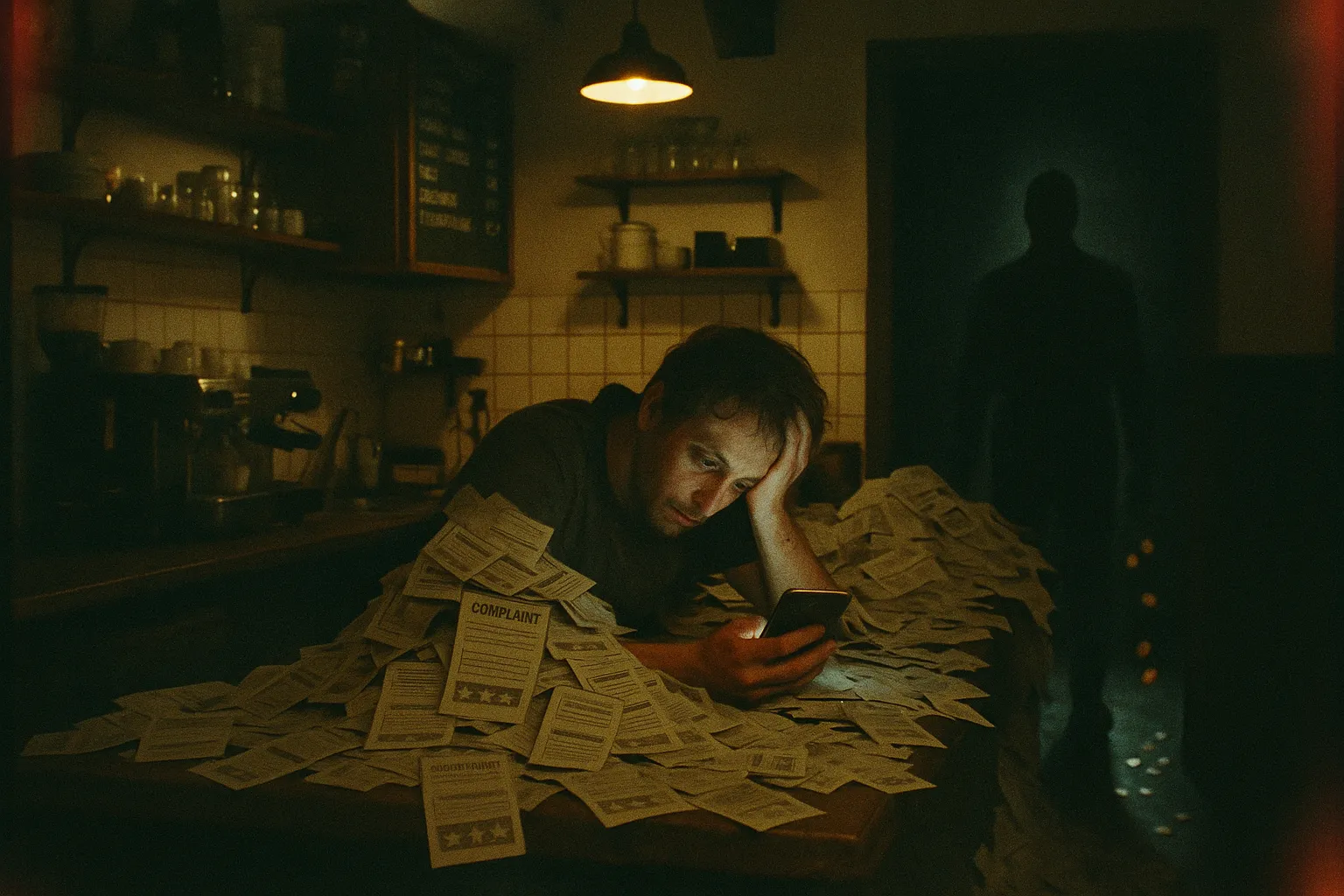
A small grievance got a factory: the cheap signal scales, the expensive response doesn’t.
05 · Kill Chain: How a Penny Goes Nuclear
A cheap signal detonates disproportionately not by accident, but through a chain. This isn't a list of misfortunes — it's a sequence where each link passes the damage to the next. The same kill chain operates in a fake review, a DMCA strike, and a marketplace ban.
06 · The Battlefield: The Same Chain in Different Interfaces
Copyright as a cardboard sledgehammer. DMCA takedowns were created against piracy, and piracy is real. But a mechanism that pulls content before review is a perfect surface for abuse. Google's own Transparency Report reads like a museum of ingenuity: a studio asked to remove its own movie page on IMDb with the official trailer; a British driving school demanded a competitor's site be taken down for "copying" an alphabetical list of cities; a woman wanted court references removed because her name was supposedly "an object of copyright."1 None of the requests were granted — but filing them cost zero. In 2022, Bungie sued a fraudster who impersonated the company and filed 96 fraudulent DMCAs against other people's videos; in 2024, that became a $8.1M judgment.1 A rare outcome where the penny finally got a bill — usually the complainant vanishes into the fog while the channel creator sits up at night with two strikes, afraid of the third.
Reviews as the market's public toilet. Harvard research (Luca and Zervas): approximately 16% of Yelp restaurant reviews are filtered by the algorithm as suspicious proxy metric, not a proven fake verdict, and these reviews tend to be more extreme — clustered around businesses with weak ratings in fierce competition.2 In 2025–2026, a wave of extortion hit small businesses worldwide: dozens of fake 1-stars, then a message — "$100 to remove the review" or "£100 and I'll stop."2 Pay up and you've marked yourself as a target.
DDoS: $10 against your infrastructure. Almost cartoonishly clean asymmetry: the attacker rents noise, and you have to buy infrastructural maturity. At the low end of the booter market, an attack costs from ~$10/month — not a guaranteed hammer against anyone, but the symbolic price is striking.3 In 2025, Cloudflare repelled 47.1 million DDoS attacks; the record peak — 31.4 Tbps, lasting all of ~35 seconds.3 Thirty-five seconds at the right moment of a launch — and while the founder is digging through logs, the attacker is eating chips.
AI-slop: semantic DDoS. AI added a new form — cheap production of plausible garbage, where "almost normal" is the most dangerous kind because it requires human review. Stack Overflow banned generative AI answers as early as 2022; research showed 52% of ChatGPT answers to SO questions contained errors, and users failed to spot the misinformation 39% of the time — because it sounded convincing.4 A Medium analysis estimated over 47% of posts there are likely AI-generated estimate; detectors are imperfect.4
Lawfare: when the process is the punishment. When participation in a case is itself the punishment, law becomes a premium subscription for silencing critics. SLAPP — a lawsuit not to win but to exhaust the critic through costs. Patent trolls are a related genre: according to Bessen and Meurer's estimates, direct costs from disputes with non-practicing entities reached ~$29B in 2011, with most defendants being small companies estimate is contested.5 The troll's logic is naked:
I don't need to be right. I need to be cheaper than your defense.
SLAPP doesn't work through a verdict. It works through an internal editor with cold hands: the journalist didn't lose the lawsuit — they just received a letter from a law firm, and the piece that yesterday was an investigation today became mortgage risk, a spouse's nerves, and the thought "maybe I should cut that paragraph?"
Platforms as feudal gates. For many businesses, an account isn't a channel — it's oxygen. Amazon reports blocking over 275 million suspicious fake reviews in 2024; and the DOJ case revealed the flip side — $100K in bribes to Amazon employees helped fraudsters earn over $100M by reinstating banned accounts and torpedoing competitors.6 A small seller wakes up — listing suspended. Not the whole business, "just the listing." But that listing fed the team. First appeal — a template. Second — a different template with a different temperature of indifference. Somewhere in the system, there may have been real abuse. Or maybe a competitor. Or maybe an automation script. For the seller, the difference is zero: the oxygen got cut off.
Finance: cousin, not twin. caveat The asymmetry here isn't clean, because a short seller also risks capital — this isn't "a penny against a million." But the scale of the tail is striking: after the Hindenburg report in January 2023, the Adani Group lost over $118B in market value in ten days.7 In June 2026, a Grizzly Research report dropped French company 2CRSi's shares by ~43% (over €400M), trading was halted, the company denies everything and calls it an activist-short strategy.7 Whether it's honest or manipulation is contested; the principle only illustrates that an information signal at the right point can move a massive tail. On the public market, reputation isn't "what people think of you." It's your discount rate.
07 · The Platform Is Not a Judge — It's a Liability Animal
The laziest explanation is "moderators are dumb." Too shallow. The platform is not a judge of truth at all — it's an animal that sniffs liability. Its brain doesn't ask "who's right?" It asks: "what's cheaper — temporarily banning an innocent person or letting a dangerous one through?" In that arithmetic, the person with a real business often loses to a throwaway account: the throwaway account has no SLA, no payroll, no public reputation. It's not a platform customer. It's noise. But noise that triggers a procedure.
And this isn't theory about "soulless corporations" — it's industrial scale. In the EU under the Digital Services Act, users appealed over 165 million moderation decisions by major platforms — and nearly 30% of those were overturned as erroneous.9 False positives aren't exotic — they're a conveyor belt. For the platform, that's a statistic. For a small business — a barista's wages, rent, night-time tachycardia, and a conversation with a spouse about why "I'll work just a little more."
This is how appeal debt is born — debt created not by your mistake but by someone else's cheap signal. You suddenly owe the platform an explanation, your clients peace of mind, your team their salary, yourself a night without checking email. Debt without a contract. It was simply billed to you in the interface.
08 · The Button-Person and Behavioral Sterilization
Not every attack is cold calculation. Often it's psychology. Resentment: "I can't rise — but I can make sure you crawl too." Deindividuation: for some people, someone else's business is a health bar in a game, not a human being; conscience works poorly when the victim has been reduced to a username. And the most dangerous — moral licensing: when revenge puts on a "Trust & Safety" vest and starts speaking in the language of principles. Sometimes "I'm protecting people from scams" means exactly that. And sometimes it means "I was wronged, so now I'm a little prosecutor with a Telegram channel."
And on the receiving end, the attack doesn't hit the money — it hits identity and reprograms behavior. Here's the real victory condition: not the attack that knocked you down, but the attack after which you started walking lower on your own. Not writing sharply. Not launching the controversial thing. Not hiring. Not touching that topic. You weren't broken — you were formatted to the expectations of a future complaint. That is behavioral sterilization in "reputation management" packaging: looks like wisdom from the outside, is actually a narrowing of amplitude.
09 · When Asymmetry Is a Good Thing (and Why You Can't Just Remove It)
Before talking about defense, an honest admission is needed — otherwise this whole piece sounds like "make it impossible to complain about a business." Sometimes asymmetric exposure is a good thing, and a large one. The weaker side often needs exactly these cheap mechanisms against the stronger one: an employee against a toxic boss, a customer against a scam company, a journalist against a corporation, a whistleblower against systemic wrongdoing. If every complaint required a $10,000 deposit, the powerful would simply buy silence.
So the goal isn't to eliminate asymmetry — it's to tell its two breeds apart.
Elinor Ostrom, Nobel laureate, showed that common resources are well governed through clear boundaries, monitoring, graduated sanctions, and dispute resolution mechanisms.8 Translation to digital platforms: the greater the potential harm from a complaint, the higher the evidence threshold; high-impact actions need fast appeals; serial liars should lose trust, and fraudulent complaints should carry a cost. A complaint should be easy for the good-faith person and more expensive for the serial manipulator.
10 · The Regulatory Countermove: Skin in the Game Returns to the Button
Good news: civilization is already hearing the floor crack. The FTC in the US adopted a rule banning the buying and selling of fake reviews — including AI-generated ones — suppression of reviews through threats, and manipulation of social signals, with civil penalties up to $51,744 per violation.9 The EU through the Digital Services Act forced platforms to open appeals and out-of-court mechanisms. And the EU Anti-SLAPP Directive (in force since May 2024) gives courts the power to dismiss clearly baseless lawsuits early and to shift costs onto whoever filed the lawsuit as a gag.9 This is precisely an attempt to put skin in the game back where it was missing: into the button, the complaint, and the lawsuit.
Bad news: regulation always arrives at the apartment after the neighbors have already knocked the door off its hinges and left a note saying "we're very much in favor of order." The law is a first-aid kit on the wall. By the time it reaches you, you'll need to save yourself first.
11 · Not a Fortress — a Proportion
Defense isn't becoming a fortress. A fortress is also a form of defeat, just with thick walls, and it often smells of fear. What works isn't a heroic counterstrike — it's architecture: making it so one cheap signal can't buy itself your entire week.
Reduce blast radius. A channel can go down — the business shouldn't go down with it. One payment processor, one platform account, one founder as the sole appeal/PR/legal brain — these are single points of failure. Not spreading across 47 platforms like soup on a wall, but having critical redundancies. Pre-cheapen your own verification: on the day of an attack, your memory will resemble a wet paper napkin archive — so contracts, invoices, logs, and confirmations get gathered before, not during the fire. Reputation buffer: if you have 4 reviews, one fake hits like a hammer; if you have 400 — it's no longer a single source of truth. Proportional response: the attack wants to pull you into a disproportionate reaction — spend $5,000 on a lawyer over a fake review, and the attacker got exactly what they wanted. Respond not with ego, but with ratio.
| Level | Situation | Response |
|---|---|---|
| 1 | isolated noise | document + monitor |
| 2 | recurring pattern | platform complaint + evidence package |
| 3 | hit to conversion/revenue | public explanation + escalation |
| 4 | extortion / identity theft | lawyer + platform + police |
| 5 | systematic attack | incident team, PR, lawyers, technical defense |
- Evidence folder: contracts, invoices, client confirmations, photos, access records, timestamps.
- Platform map: who owns which access, which emails, where's 2FA, who files the appeal and who's the backup.
- Review buffer: collect real reviews consistently — not when things are already burning.
- Crisis template: a short public response without hysteria, drafted in advance.
- Escalation contacts: lawyer, platform, hosting provider, payment processor.
- Backup cashflow: alternative processor / invoice route.
- Monitoring: alerts for brand mentions, Google Business, social media.
- Response ladder + postmortem: don't fire a cannon at a mosquito — and don't pet the scorpion.
And the fragility diagnosis can be reduced to a single product. Don't defend everything equally — that's the road to a paranoid circus where every Slack message gets a threat model.
cheap attack × high dependence on a single point × slow recovery = existential fragility. Close the gaps where the product is high: build redundancy and evidence before the fire. The rest is monitoring and a clear head.
Because paranoia is also defeat. Paranoia is when the attacker no longer needs to attack — you're running their night shift yourself. If you spend all day looking for enemies, you'll find them even in the coffee machine.
12 · Verdict: Don't Remove the Button — Return the Skin
The internet democratized voice — and that's beautiful. But along with the voice, it handed everyone a small court, a small police department, a small informant, and a small guillotine. Now society resembles an office where everyone has an emergency button, but half of them press it when they didn't like the tone of an email. We don't live in the information age — we live in the age of operational noise with legal consequences.

Everyone got an emergency button. The civilizational question isn’t removing the buttons — it’s whose hands they belong to.
The penny presses. The million justifies itself. And until we put skin in the game back into buttons, complaints, lawsuits, ban hammers, DMCAs, and reviews — we'll live in a civilization where every aggrieved minor deity can rent someone else's bureaucracy for an hour.
This doesn't mean "take the voice away from the weak." On the contrary. It means telling the whistleblower from the vindictive pest with a three-day account. Telling the fire alarm from the kid setting the trash can on fire. Telling protection from parasitism. Because civilization isn't a place without emergency buttons. It's a place where pressing a button has memory, cost, and accountability.
Don't build a glass cathedral on someone else's emergency button. Don't run your business on a single platform. Don't confuse honesty with protection. And don't surrender your nervous system to every penny that learned how to press Submit.
| Temptation (overclaim) | What we actually write |
|---|---|
| "All negative reviews and complaints are fake/attacks" | many complaints are legitimate; sometimes you're not being attacked — you're being described accurately. The problem is in the failure to distinguish, not in the existence of complaints |
| "16% of Yelp reviews are proven fakes" | 16% is the share filtered by the algorithm as suspicious (a proxy metric), not a judicial verdict on forgery |
| "Short seller = attacker with a penny" | no: a short seller also risks capital. This is the cousin pattern (tail scale), not "a penny against a million." 2CRSi is a contested case, not a proven manipulation |
| "47% of Medium posts are definitely AI" | detector estimate (likely AI-generated); detectors produce false positives — hence "likely" |
| "Patent trolls cost $29B — fact" | Bessen-Meurer estimate for 2011; other estimates are lower |
| "Platforms are just evil / they don't care" | they optimize for their own risk, scale, and liability — not your justice. Make friction too high and the weak won't be able to report real abuse |
This table isn't an apology. It's a sharpening of the knife. A text that cuts its own side too cuts deeper.
Frequently asked
What is asymmetric exposure?
A situation where one side has a cheap, often anonymous, and nearly consequence-free action that creates an expensive, prolonged, and often irreversible risk for the other side. The point isn't direct damage — the attacker usually can't reach you themselves. Their power is pressing a button after which YOUR system (the platform, lawyers, clients, bank, nervous system) starts working against you. It's an attack through someone else's emergency protocol.
Isn't this just whining — aren't complaints and reviews necessary?
Yes, and that's the key honesty of this piece. Cheap mechanisms are vital for the weaker side: an employee against a toxic boss, a customer against a scam, a whistleblower against systemic wrongdoing. That's protection asymmetry — a good thing. A complaint is a dual-use weapon: the same mechanism saves the weak or becomes a cheap brass knuckle for a wounded ego. The goal isn't to remove the button, but to put skin in the game back into it: who presses it, what they prove, what they lose if they lie.
What is appeal debt?
Debt created not by your mistake but by someone else's cheap signal. After a fake signal, you suddenly owe the platform an explanation, your clients peace of mind, your team their salary, yourself a night without checking email. Debt without a contract, billed to you in the interface. The most expensive part of the attack isn't what the attacker did — it's what you're now forced to do next.
What does a cheap attack actually cost?
A fake 1-star review — $0 to the attacker, but minus 5–9% revenue for an independent restaurant per rating star (Luca, Harvard). DDoS — from ~$10/month at the bottom of the booter market (no guaranteed attack against anyone). 96 fraudulent DMCAs cost the channel creator months, and the fraudster — a $8.1M judgment (Bungie) — but that's a rare outcome. Usually the attacker pays nothing.
How do you defend without sliding into paranoia?
Not a fortress — an architecture: reduce blast radius (don't run your business on one platform), pre-cheapen your own verification (evidence folder, logs, contracts), build a reputation buffer, prepare an appeal playbook, use a proportional response ladder, add monitoring. Close the gaps only where cheap attack × dependency on a single point × slow recovery all intersect. Paranoia is also a loss: that's when the attacker no longer needs to attack — because you're running their night shift yourself.
Comments
Signed-in readers only — to keep it human, not a bot swamp.