Founders pay $9,000 to tour a BYD factory — and it's not tourism, it's reconnaissance
Investors and founders pay up to $9,000 for 3–5-day tours of BYD's plants, Unitree's robot factories and China's robotaxis. It's not tourism — it's FOMO-driven reconnaissance. Why 'go and see the system' became a tradable edge no report can give you, and why the West still flies to conferences while the signal sits in a factory with the lights off.
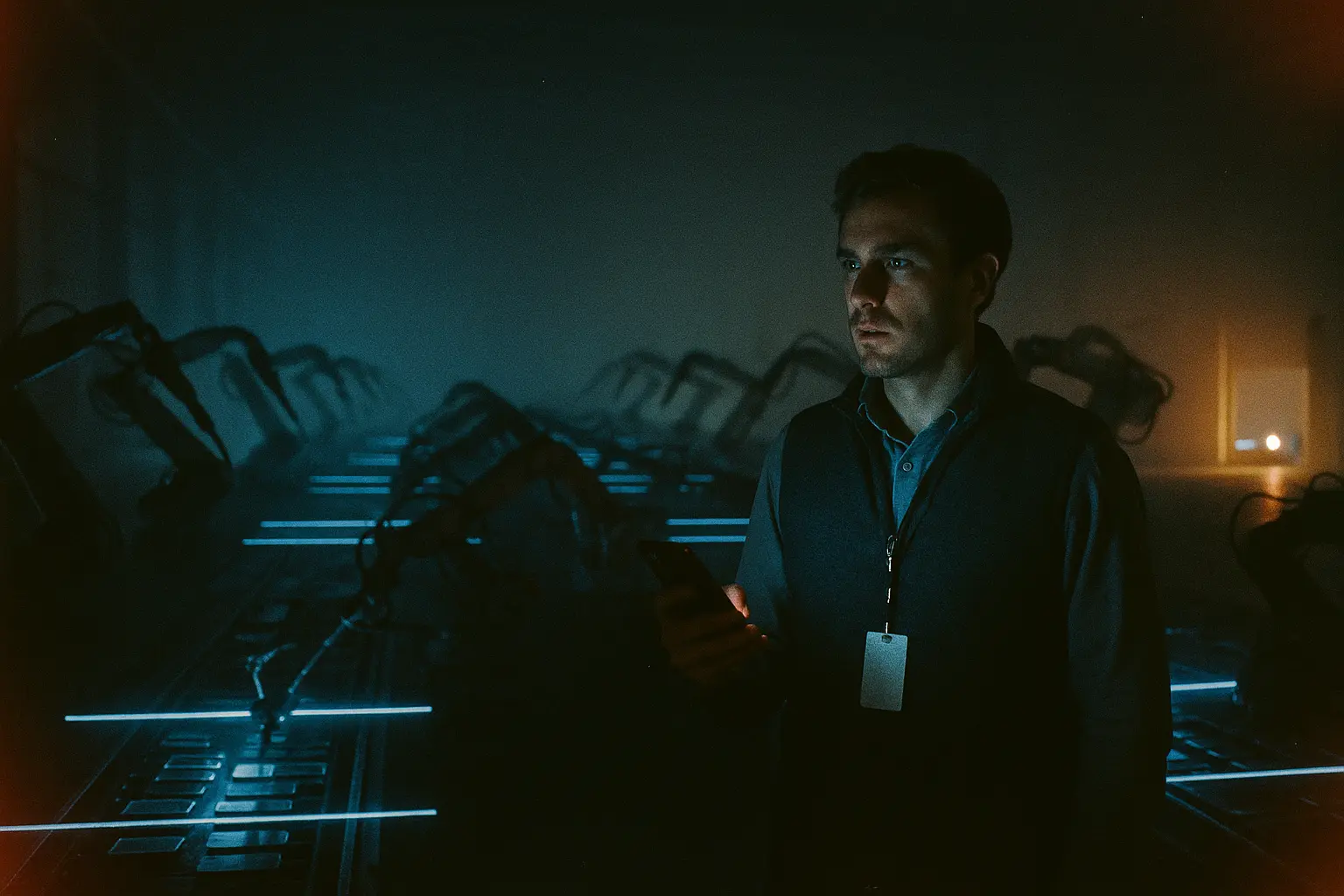
For $9,000 they’re not selling you the Great Wall. They’re selling you a workshop where a smartphone rolls off the line every second — and the lights are off, because robots don’t need eyes.
On 27 January 2025, Nvidia lost $589 billion in market capitalisation in a single trading day — the largest one-day wipeout in the history of the US stock market. The cause was not a bank, not sanctions, not a war, but a Chinese AI model, DeepSeek, which its makers claimed to have trained for under $6 million in roughly two months. The figure is disputed. The market’s reaction wasn’t: half a trillion dollars evaporated because the consensus suddenly realised it had been pricing China off an old map.
And here’s the interesting part. The people who had already walked a factory floor in Shenzhen weren’t surprised by that day. They had seen the density with their own eyes. For exactly that difference — between what a report says and what a workshop shows — investors now pay nine thousand dollars a ticket.
Act I. Economic pilgrimage
A new class of travel has appeared. Not a beach, not a museum, not a conference. Founders, investors and engineers fly to Shanghai, Hangzhou and Shenzhen to spend three to five days inside factories, incubators and research centres — with private Q&A sessions with executives. The tours carry telling names: “Shanghai AI and Robotics Innovation Tour”, “EV and Battery Deep Dive”. The price ranges from ~$1,000 for a basic format to $9,000 for a premium one (flights excluded). The Shanghai operator GloPen, run by entrepreneur Boyang Shen, hosted over a thousand visitors in eighteen months; Tech Buzz China, run by Rui Ma, brings cohorts of about thirty. At the other end is the sightseeing “Shenzhen Tech Tour: Explore the Future” for $92, which topped the ranking of 104 city activities.
Why do they go? The investor Chetan Shah, from Mumbai, put it best:
Shah is no romantic. This is a man who, by his own account, exited several investments that subsequently dropped 40–50%. His verdict after the trip reads like a sentence on an entire investor class: “The cost at which China can manufacture is something India can never compete with.” Not “cheaper”. Not “more efficient”. Never. You don’t write that in a report — you bring it back from a workshop.
Rui Ma frames the motive even more broadly: she wants “parents to have the most up-to-date knowledge, to update their priors about what their kids could or should be studying.” People don’t go for a deal. They go to rewrite their own assumptions about where the future is now actually being built.
Act II. Why now
Every trend has a birthday, and this one has two — both in 2025.
The first is the DeepSeek day itself. Before it, the thesis “China only copies cheaply” was intellectually comfortable and cost Western portfolios nothing. After it, the same thesis started costing half a trillion a session. DeepSeek wasn’t an event in AI — it was an alarm clock: maybe you’re valuing the wrong country by the wrong metrics.
The second date is February 2025, when Xi Jinping convened a symbolic summit with tech founders: Jack Ma, the heads of Huawei, BYD, DeepSeek, Unitree, Xiaomi at one table. After years of regulatory crackdown, the read was unambiguous — the state had re-blessed its tech champions and put them on display. And a showcase someone has just switched on from above is very convenient to show visitors.
Add the cultural layer — a video of streamer iShowSpeed riding a flying car-drone pulled over 600,000 views; Unitree robots dance in prime time on the New Year broadcast — and you get a shift that’s easy to miss behind the macro digests.
Soft power here works not through cinema and not through diplomacy, but through the factory floor. This is factory-floor soft power: persuasion that comes not from growth slides but from the physical sense that things are made here faster than you can read about them.
Act III. Epistemic arbitrage
Let’s name the mechanism driving these nine thousand dollars. It is epistemic arbitrage.
Arbitrage is when you profit on the difference between two prices of one asset. Epistemic arbitrage is when you profit on the difference between two valuations of one reality. The consensus prices China through macro fear, regulatory noise and headlines about provincial debt. A person who has walked the floor prices it through observed production density. The difference between those two valuations is the tradable edge. A $9,000 ticket literally buys you a reduction of that gap.
NYU professor Shaoyu Yuan says it most precisely: “If you’re building a startup or making investment decisions — reading about BYD’s vertical integration is one thing. Walking through the factory floor is another.”
Let’s unpack what exactly is visible on the floor that a report doesn’t convey.
BYD’s vertical integration. On paper it’s a dull phrase. On the floor it’s a line that makes almost everything itself: BYD produces roughly 75% of a car’s components internally — batteries, electric motors, power electronics and even its own chips (notably IGBT transistors, via the BYD Semiconductor division). The result is a cost advantage that Switzerland’s UBS estimates at about 25% over legacy carmakers. It isn’t magic — it’s structure: when R&D, engineering and manufacturing sit in one company, the feedback loop is shorter than any rival’s. During the global chip shortage of 2021–2022, BYD kept building cars while Ford and GM idled lines. In seven years the company grew from 500,000 to over 4 million cars a year — a 700% increase.
“Dark factories” (黑灯工厂). This is what’s worth flying for. A fully automated workshop that runs 24/7 with the lights off — because light is for eyes, and there are no humans on the line. Xiaomi’s plant in Changping makes one smartphone per second: 81,000 square metres, ~$330M invested, 10 million units a year of capacity, zero workers on a shift. Foxconn, reportedly, has rolled out lights-out lines at several sites, replacing over 60,000 workers at its Kunshan plant alone.
Robotisation density. Per the IFR (World Robotics 2025), China’s operational stock of industrial robots passed 2 million in 2024 for the first time — roughly four and a half times Japan in second place. In 2024 alone the country installed 295,000 new ones — 54% of all global installations, more than the rest of the planet combined. That’s not a chart in a report. It’s a hum you feel in your body when you step into the workshop.
Robotaxis. In November 2025, Baidu reported that Apollo Go runs 250,000 rides a week — the same as Waymo. Except in China you get into one of these cars for a dollar and ride, while the West is still arguing whether it’s safe.
| What’s visible on the floor | The number | What a report doesn’t convey |
|---|---|---|
| Robots in China’s factories (2024) | stock >2M (≈4.5× Japan); 295k new = 54% of world | a report gives the number — the floor gives the tempo |
| Xiaomi’s “dark factory” (Changping) | 1 phone/sec, 24/7 lights-out, ~$330M | ”automation” on paper ≠ a workshop with no people |
| BYD’s vertical integration | ~75% of components in-house, ~25% cost edge (UBS) | a report says “cheaper” — the floor shows why |
| BYD’s scale | 500K → 4M cars in 7 years (+700%) | a growth curve ≠ the feeling of the line |
| Apollo Go robotaxi | 250K rides/week ≈ Waymo | ”it exists in China” ≠ you got in and rode for $1 |
This is why “go and see the system” sometimes has a higher ROI than reading twenty reports. A report is reality compressed into text; half the signal is lost in compression. The floor hands you the uncompressed version: the speed, the density, the silence of an automated line. And the uncompressed signal is exactly what people pay for.
Act IV. Why the West still flies to conferences
Now the uncomfortable question. If the signal sits in a workshop with the lights off, why hasn’t the old model — the Western establishment, investment committees, European policymakers — shifted that way? Why do they keep flying to conferences, forums and panels instead of real excursions to those same dark factories?
Because a conference is a comfortable genre, and a workshop is not.
At a conference they show you a map. In a workshop you stand on the territory. The map is more pleasant to discuss: it’s clean, air-conditioned, comes with coffee and networking, and it never contradicts your previous slides too rudely. Davos manufactures a consensus about China; Changping manufactures a smartphone per second. The first reassures you, the second frightens you. Human nature and career incentives push toward the reassuring.
There’s a deeper, structural reason too. A Western investment committee rewards the ability to speak confidently about risk, not to physically verify it. “Regulatory risk”, “geopolitical noise”, “governance concerns” — this is a lexicon that lets you not go. It turns ignorance into caution, and caution into virtue. And as long as that lexicon costs zero, it won’t change: why fly to Shenzhen if your cautious scepticism already pays your salary?
DeepSeek was the first time that scepticism sent an invoice — $589 billion in a day. But one invoice doesn’t change a habit. Institutions are inertia machines; they’ll move from conferences to excursions not when it becomes smart, but when not going becomes more expensive than going. The individual founder, for $9,000, has already made the switch. A committee of twenty will make it in about five years — when there’s nothing left to reprice.
This is the classic trap of incumbents: they optimise the defence of a prior thesis rather than the speed of updating their assumptions. Whoever flies to the floor first is arbitraging. Whoever steps off the conference stage last is paying for someone else’s arbitrage.
Act V. Honesty and limits: where pilgrimage lies
Now let’s switch off the enthusiasm and turn the scalpel on our own thesis. Because a curated tour has a built-in lie, and not seeing it means buying the ticket like a mark.
The curator shows you the best plant, not the average one. You’re taken to Xiaomi in Changping, not to the thousand second-tier suppliers where it’s still dirty, manual and robot-free. A tour is, by definition, direction. You see the top of the distribution and extrapolate it to the whole. This is the Potemkin risk: a showcase of speed assembled specifically for your eyes and your FOMO.
What you see is a signal, not due diligence. The feeling of “they’ll crush us” is a bad basis for capital allocation, as bad as its opposite, “they fake everything”. Density on a line tells you nothing about margins, debt, demographics, or whether a company survives the deflationary price war China’s carmakers are waging against each other. Changping is impressive. But “impressive” is an emotion, not a model.
FOMO buys at the peak. The irony in Chetan Shah’s story is that his best move was the opposite of the crowd — he exited assets that later fell. A tour sells the reverse impulse: everyone’s excited, so you should get in. The worst time to buy a narrative is when it already costs $9,000 and people are filming reels about it. The first go for the signal. The last go for someone else’s stories.
And yet — the steelman the other way. Even with all those caveats, seeing the system beats not seeing it. A Potemkin workshop still physically exists; it wasn’t painted, it was built. A curator can hide the average but can’t fake the fact that a smartphone really does come off the line every second. A report is curated too — just by someone else, thousands of kilometres away. The question isn’t “go or trust the report”, but “which of the two directed signals is closer to reality”. A workshop, even a staged one, loses to reality by less than a macro overview compressed into a paragraph.
| Who wins | Who loses | |
|---|---|---|
| Epistemic arbitrage | whoever flies first and updates assumptions | whoever reads the report with a quarters-long lag |
| Factory-floor soft power | China: rewrites its own brand for the price of a ticket | the Western “they only copy” narrative |
| ”Dark factories” | capital, owners, the consumer of cheap goods | ~30M manufacturing jobs (estimated, 2013→2025) |
The last row is the most important and the darkest. The speed visitors admire has a price, and it isn’t they who pay it. By industry-review estimates, China’s manufacturing employment fell from ~115M (2013) to under 85M — a loss of about 30 million jobs — even as exports hit records. The tour shows you a workshop with no people as a triumph. It is one — an engineering triumph. But the emptiness on the floor was once someone’s shift. Who pays for the feeling of speed is a question not on the $9,000 itinerary.
Bottom line
The China tech tour isn’t about China. It’s about how we price reality from a distance — and how expensive it is to be wrong. For thirty years Western capital priced China by narrative: first “the world’s cheap factory”, then “a bubble about to burst”, then “a copier without innovation”. Each narrative was comfortable and cheap at the moment of writing — and expensive at the moment of verification.
DeepSeek showed the cost of verification: half a trillion in a day. Xiaomi’s plant showed that the argument is already over — one smartphone per second doesn’t debate. And a $9,000 ticket is the cheapest insurance against the most expensive mistake: pricing a system by the report while your competitor prices it by the floor.
China no longer sells cheap manufacturing — it sells speed. And speed doesn’t transmit through a report: you have to see it with your own eyes, which is exactly why it costs $9,000 a ticket.
You can, of course, choose not to go. You can keep reading overviews, nodding at regulatory risk, and pricing the world’s second economy by the headlines. It’s even safe — right up until one Monday at half past four in the afternoon, when someone’s portfolio sheds $589 billion because someone in a workshop with the lights off did the thing that wasn’t in the report.
Pilgrims don’t travel to pray. They travel to see what the god has already managed to build while the sceptics were writing memos about him.
Frequently asked
How much does a China tech tour cost and what's included?
Curated tours run 3–5 days and cost from ~$1,000 for a basic format to ~$9,000 for a premium one (flights excluded, but hotels, food and transfers included). The programme covers factories, incubators, industry conferences and private Q&A sessions with executives. The cheapest 'entry' is a ~$92 sightseeing Shenzhen Tech Tour with a drone-courier demo and a robotaxi ride.
Which companies do these tours show?
The backbone is China's tech-rise symbols: BYD (EVs and vertical integration), Unitree (humanoid robots gone viral), DeepSeek (the AI model compared to ChatGPT), plus Alibaba, Tencent, XPeng, Baidu, CATL, DJI and Apollo Go robotaxis. Operators like GloPen or Tech Buzz China arrange access in advance.
Why physically go if reports and analysis exist?
Because a report conveys a number, while a factory floor conveys tempo. As NYU professor Shaoyu Yuan puts it: 'Reading about BYD's vertical integration is one thing. Walking through the factory floor is another.' A physical visit closes the gap between the consensus valuation (via macro fear and regulatory noise) and the real production density. That gap — epistemic arbitrage — is the tradable edge.
What are 'dark factories' (黑灯工厂)?
Fully automated plants that run 24/7 without lighting, because there are no humans on the line — light is needed only by robots' machine-vision cameras, not by human eyes. Example: Xiaomi's plant in Changping — one smartphone per second, ~$330M invested, 10 million units a year of capacity, zero workers on shift.
What's the risk with these tours — isn't it propaganda?
The risk is real: the curator shows you the best plant, not the average one, so a tour easily becomes a Potemkin showcase of speed. Density you see is a signal, not due diligence. A smart visitor distinguishes 'I was shown the best' from 'this works everywhere' — and remembers that FOMO pushes you to buy the narrative at the peak.
Comments
Signed-in readers only — to keep it human, not a bot swamp.