Marathon and Ultramarathon Without Illusions, Romance, or Vanilla
Not how to run 42.195, but why. Roughly half of all finishers cross the line with elevated troponin — the same blood test that diagnoses a heart attack in the ER. The fittest hearts carry the most coronary plaque. The average person's first marathon comes at around 38, not 18. A dissection of the physiology without anesthesia, of proving yourself through the body, and of a $5.2-billion suffering industry — plus the honest line past which running adds years to your life instead of trading them away.
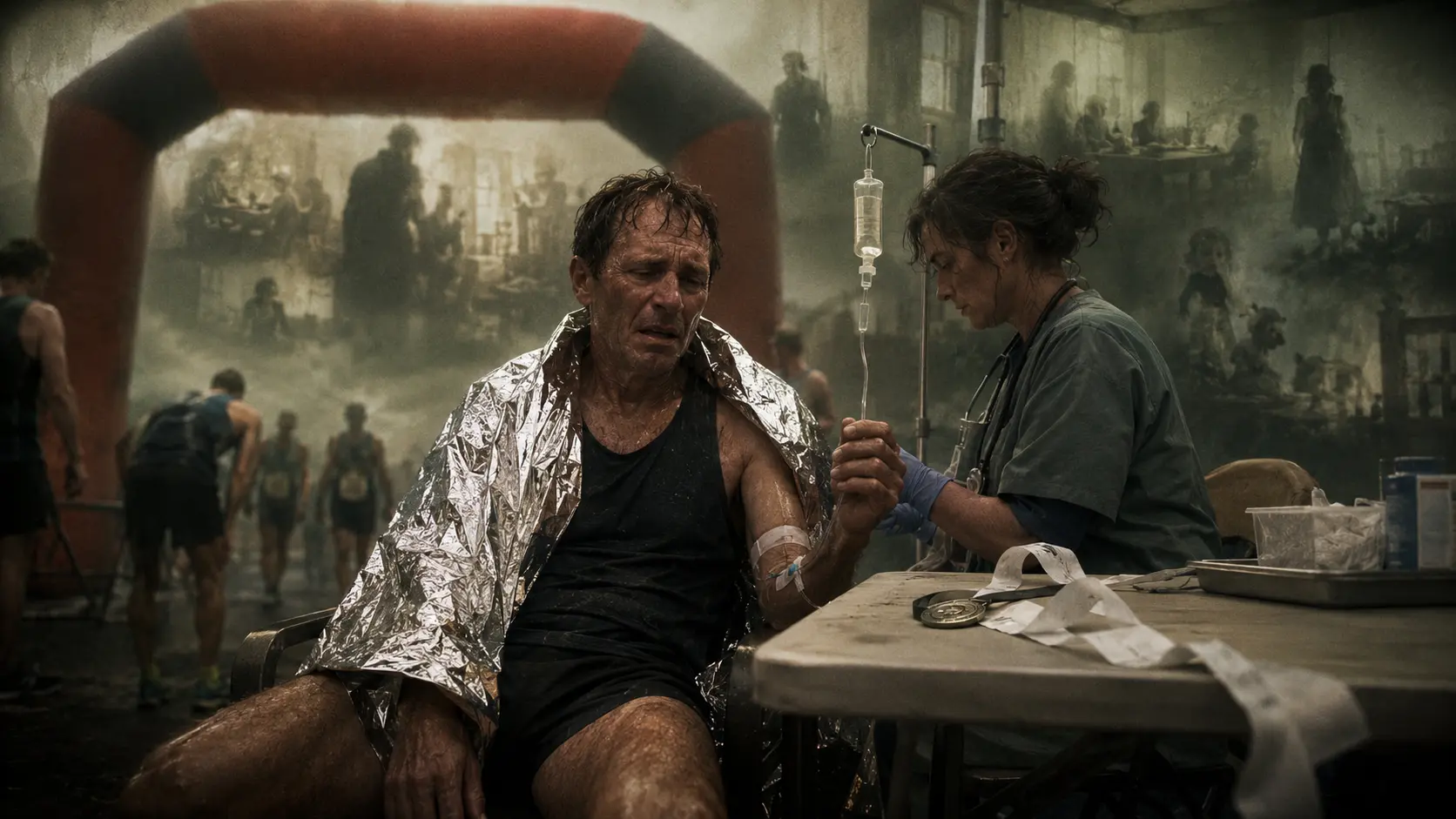
Kilometer 35. The exact spot where the romance promised you a meeting with your true self. Your legs stopped obeying not because you're weak in spirit, but because your muscles and liver hold around 2,000–2,500 kcal of glycogen — and that's roughly 32 kilometers, not 42. You run the last ten on an empty tank, and your brain, which feeds on glucose alone, starts economizing on everything, optimism included.
"The wall" is not a test of character. It's an accounting balance that didn't come out in your favor. And here's the ugliest part: you didn't build that wall at kilometer 35. You built it at kilometer 5 — when the adrenaline and the crowd let you go out 10% faster than you should have, and you gladly agreed, because that is exactly what courage looks like inside your head.
And now a number that makes the romance quietly leave the room. Cross a marathon finish line and in roughly half of all runners the blood will spike cardiac troponin. That's the same marker the ER uses to diagnose a myocardial infarction. A meta-analysis of 16 studies on 939 finishers averaged 51%, and on high-sensitivity assays the signal shows up in nearly everyone. We call it "benign," because runners mostly don't drop dead. Mostly.
This is not an essay about how to beat the wall — for that we have a preparation guide and a timeline of the race itself, both honest and useful. This is a dissection of a different question: what you're actually buying along with your race bib. Because the marathon long ago stopped being a sport about speed. In the 2020s it became a product — and what it sells you isn't health, it's a verdict. A verdict on whether you're enough. The body is the only ledger in which the question "am I enough" can be forged so convincingly that it looks like a number. And the price of that forgery is a separate line item, one they never show you on the finish-line banner.
I. The pitch that's easy to believe
Let's be honest about the seduction: the story of the marathon as transformation is appealing, and partly true. "Running changed my life," "I overcame myself," "I never thought I could." Sixteen weeks of discipline. Early mornings. Community. The feeling that in a world where almost nothing depends on you, there are exactly 42.195 kilometers that do. That part is real. Hold it in mind — we'll come back and give it its due, honestly and with numbers.
The canonical scripture of this religion is Christopher McDougall's Born to Run: a book about how the human being was made to run easily, barefoot, without pain or injury, if only we return to natural movement. Millions bought that promise along with their "minimalist" shoes. Remember that promise of effortless, painless running. We'll meet its protagonist later — under circumstances the book would rather not have printed.
The pitch always sounds like a sword: you take on the challenge, you overcome, you become. In reality it's a crutch that learned to look like a sword. Because beneath the pretty story about conquering yourself runs a far colder mechanism — and it's not about you alone, but about a whole class of people who found a socially sanctioned way to diagnose themselves and foot the bill personally.
II. Physiology: the accounting you can't romanticize
Let's start with the body, because the body doesn't know how to lie beautifully. It keeps a double-entry ledger, and every "heroic" line has a matching one — in the debit column.
First, the great inversion about water. For thirty years the finish-line gospel went: "drink before you feel thirsty, don't let yourself get dehydrated." The world's hyponatremia experts now say it flat out: that advice is a recipe for killing a healthy runner. In the Boston Marathon study (NEJM, 2005), 13% of finishers crossed the line hyponatremic — with dangerously diluted blood; in 0.6% the sodium level was critical. And the leading risk factor turned out to be not dehydration but the opposite — gaining weight during the race (odds ratio 4.2). Meaning the ones who "dutifully drank at every station" and came in heavier than they started — those are the ones whose brains were swelling.
It's easy not to believe until the story has a face. Cynthia Lucero, 28, Boston 2002, her second marathon. Running for charity, drinking at every aid station, looking strong at mile 20. Just before mile 22 she said her legs felt "rubbery," and she collapsed. Sodium level: 113, against a normal floor of 135. Cerebral edema. Within days, brain death — the second fatality in the race's history at that point. And then a detail that runs cold: her first aid was ordinary saline — a fluid that, in that state, is ineffective and can worsen the swelling. She did not dehydrate to death. She drowned her own brain from the inside, sipping water carefully, exactly as she'd been told. The 2015 consensus conference put the conclusion without anesthesia: drink to thirst, and only thirst; hyponatremia is "entirely preventable." The danger was never the lack of water. The danger was the slogan that told you to drink more.
The painkiller that breaks your kidneys. Runners eat ibuprofen like candy to mute the pain of the distance. In the one randomized trial that ever tested it (an ultramarathon, 2017), the pill that quiets your legs quietly doubled the odds your kidneys would start to fail: acute kidney injury in 52% of those who took ibuprofen versus 34% on placebo — one extra casualty for every five-to-six people who reached for the bottle. (Honest caveat: the difference was clinically striking, but on 89 participants it fell short of statistical significance. Still, a number-needed-to-harm of 5.5 rarely sounds reassuring.) The drug works on pain. It also works on the organ that filters your blood while you grind out 50 miles in the desert.
And the most beautiful inversion of all — the heart. Here the romance told its prettiest fairy tale: the "athlete's heart," large, slow, efficient. Look at the data that dims the tale. Longitudinal studies in men with the lowest cardiovascular risk and the best VO₂max show: the most highly trained carry the most coronary plaque. In the Master@Heart study (European Heart Journal, 2023; 558 men), lifelong athletes had at least one plaque in 63.4% versus 50% in a healthy control group (odds ratio 1.86). In Aengevaeren's work (Circulation, 2017), the most active third had triple the odds of carrying plaque. The artery doesn't thank you for the training — it scars under it.
An honest nuance, because without it this would be cheap horror: these two studies argue over the consolation prize. One says the plaque is mostly "stable, calcified" — the body, as it were, armor-plating its own pipes. The other disputes it: lifelong athletes carry more "soft," rupture-prone plaque in the proximal segments. But that same study adds something unexpected: truly vulnerable plaques were rarer in the athletes (0.5% versus 3.4%). All of these studies are observational, in men only, and none has yet proven these athletes have more heart attacks. That has to be said out loud, once. Just keep the image: an athlete's heart is not a healthier heart. It's a differently rebuilt heart, and part of the rebuild is masonry you can no longer chip back out.
Add to that two deferred currencies in which the "athlete's heart" is paid for. Atrial fibrillation — those same stretched chambers that let you pump blood like a piston start, over the years, to lose the rhythm: risk 2–5 times higher, concentrated precisely in lean, fit, middle-aged men we never file under "at risk." And fibrosis: in one in five lifelong endurance athletes, MRI finds a scar in the heart muscle (21% versus 3% in the untrained) — and we still don't fully know what that scar will do at 70.
And now — where the heart stops. The registry of cardiac arrests at American races (RACER-2, JAMA, 2025) logged 176 arrests across 29.3 million finishers — rare, yes. But two details cut. First: most arrests happen in the last quarter of the distance — at exactly the moment a runner decides to "empty the tank" and kick at the finish for a personal record. Second: the leading cause is no longer the congenital defect of the young, but ischemic disease — the older drop from arteries they earned. Survival doubled over 13 years — but not because the hearts got safer. Because the defibrillators started reaching them faster. The course learned to resuscitate, not to prevent.
The section's summary is simple and unromantic: the medal is handed to a body in a state of mild multi-organ failure. The body keeps accounting you can't romanticize.

III. Psychology: why a person voluntarily buys their own suffering
If the body pays, then who places the order? Here the usual answer is: "for health." Look at what runners themselves show when you ask them anonymously, with a validated marathoner-motivation scale (MOMS). In a study of 493 participants, "health orientation" genuinely comes first. But right behind personal goal, in third place, sits self-esteem — above belonging, life meaning, and overcoming. And down at the bottom of the table, in last place — "recognition" and "competition." Nobody admits they run for applause or to beat you. Everyone runs to earn the right to respect themselves. "Health" is the alibi the body files with the registry. Self-esteem is the transaction itself.
Psychology gave this a precise name back in 2004. Crocker and Park described "contingent self-worth": when your value is staked on a specific domain, that domain becomes both a source of motivation and the place where you can be destroyed. Stake your worth on the body — and every DNF, every slower split, every injury stops being merely a bad day. They become evidence against your right to exist. This is not a metaphor from a seminar. It's a documented architectural vulnerability: the domain that gives you self-respect is exactly the domain that can demolish you.
Here the marathon clicks into a mechanism we already dissected in the essay on Evidentiary Existence — a mode in which existence is treated as a hypothesis requiring daily confirmation. Bodily records stood there as proof-channel number one: speed, endurance, form as an argument in the case of "do I have a right to be here." The marathon is that channel, packaged into a medal, an entry fee, and a finish-line photo. Maximally legible test: passed / failed, accurate to the second, public, repeatable.
And when something can be repeated, dependence appears. Among ultrarunners, the share in the danger zone for exercise addiction reaches 20%; in one study of 507 ultra-athletes, only a fifth were free of any addiction symptom — the "healthy hobby" turned out to be the minority's condition. The diagnostic sign isn't in the mileage. It's in the withdrawal — in how foul you feel when you miss a session. You don't train. You dose.
Where do these people come from? Not from teenage sport. The average person's first marathon comes at around 38, not 18. The distance appears exactly when the career plateaus, the body begins its slow betrayal, and the question "is this it?" gets loud. 42.195 kilometers is a quantitative answer to a non-quantitative dread. You can't measure whether your life has meaning, so you measure something else and call it by the same word. This isn't sport. It's a midlife audit with a race bib on your chest.
And here's the proof that the answer never arrives. A qualitative 2024 study of endurance athletes found a distinct theme that participants described themselves: "emptiness," "mild depressive symptoms" in the week after the finish. Quantitative work going back to 1991, on 106 runners, showed the same and added a hard irony: the faster finishers slumped harder in mood. And the medicine they reach for? A participant's quote: "I start planning the next race, almost to climb out of the slump." That's not recovery. That's a maintenance dose of an addiction. The emptiness isn't marathon-shaped — which is why the marathon doesn't fill it. And it becomes a subscription.
Remember Forrest Gump, running across America for three years. A crowd gathers behind him, projecting meaning onto him: "he's doing it for something big." He stops in the middle of the road and says: "I'm pretty tired. I think I'll go home now." The whole country was searching his run for a verdict. There was no verdict in the run. There was a run.
Let's name the buyer. It's the verdict-seller — a voice (half industry, half your own head) that promises 42.195 kilometers will hand down a ruling in the case of "am I enough." He's honest, friendly, and not the least bit malicious. He just deals in a forged verdict. The medal is a receipt. The debt is denominated in a currency the kilometers don't print.

IV. Economics: a $5.2-billion suffering industry
Now about who issues the bill. The largest study of running results in history (over 107 million finishes) showed a thing the industry would rather not say out loud: the average marathon time got worse — from 3:52:35 in 1986 to 4:32:49 in 2018. Forty minutes slower across three decades. Not because people degenerated. Because the word "finisher" stopped meaning "runner." The slowdown isn't a side effect. It's the product. The industry lowered the bar and sold the medal to everyone who stepped over it. The 4:32 audience is the market.
The engine of that market isn't running — it's scarcity. The 2025 London Marathon drew 840,318 applications for roughly 17,000 ballot places — a chance of about 1.3%, worse than getting into the Ivy League. The "free" public ballot exists precisely to generate a rejection that will then sell you a charity place for £2,000–3,000. One critic called it "brilliant social engineering that turns despair into philanthropy." And the math checks out: the world's 50 marathons generate an economic impact of $5.2 billion; London alone raised £87.5 million for charity on a record day, and over £1.3 billion across its history — the Guinness record for the largest single-day fundraiser on the planet.
Three things are true at once, and this has to be said honestly: the cause genuinely gets the money, the runner genuinely suffers, and the race genuinely sells the scarcity that makes both possible. You're shown only one of the three.
The ultramarathon is a separate plotline in the same play. It grew 1,676% over two decades precisely as an escape from the medal-and-merch conveyor belt, as a place for purists. Then IRONMAN bought the shop: in 2021 UTMB struck a partnership, and the trail community started talking about "Starbuckization" — the fear that every trail becomes the same trail, that local races get bulldozed, that the entry fee climbs until a corporate logo shows up on the finish arch in the wild forest. In parallel, Hyrox — fitness suffering on a schedule — pulled $140 million in revenue in 2025, grew 1,000% in five years, and projects 650,000 participants for 2026. Voluntary suffering became the currency of status.
Why status? Because suffering can't be delegated. In a world where almost everything can be bought ready-made, self-inflicted, documented agony is the last thing that certifies: you're still alive and still capable of effort. The medal on the wall is the only scar you can show off over dinner.
And here's the distributive truth the romance carefully sidesteps. "Anyone can" breaks against the budget. A 16-week cycle runs $1,500–5,000+ on shoes, a watch, a coach, gels, and a flight, plus the main thing: 100–160 hours of unpaid training labor that's "free" only for those who own their own weekends. The data doesn't argue: surveys consistently show that around 73% of runners earn above $75,000, and peer-reviewed work confirms it — socioeconomic status correlates directly with endurance-sport participation. The marathon didn't democratize suffering. It gave the professional class a socially sanctioned way to buy it.
Look at who stands on the other side of every line in this bill:
| Who | What they get | What they pay with |
|---|---|---|
| Organizer / WMM | $5.2B impact; scarcity as the demand engine | Nothing — the risk sits on the participant's body |
| Shoe / nutrition brands | $300 per pair of shoes, $150–300 in gels per cycle | Nothing |
| Charity | £2,000–3,000 from everyone who lost the ballot | Reputational risk of "social engineering" |
| Runner with capital and free time | Medal, status, a legible verdict on the self | $1,500–5,000 + 100–160 hours + organ wear |
| The one with no weekends | Nothing — they're not on the start line | Exclusion, disguised as "just get started" |
V. The scene the myth would rather not print
Back to the promise of effortless, painless running. Born to Run made a hero of Micah True — a loner nicknamed Caballo Blanco, the embodiment of natural, endless, injury-free running. In 2012 he went out for an ordinary twelve-mile jog in New Mexico's Gila wilderness and didn't come back. His body was found four days later. Autopsy: cardiomyopathy — an enlarged heart with a thickened left ventricle that can produce a fatal arrhythmia under load. The protagonist of the book about pain-free running died alone on a trail at 58, with a heart that had quietly outgrown itself.
And now a different image, from the pre-digital era. Alan Sillitoe, The Loneliness of the Long-Distance Runner: a teenager from a borstal, a natural talent, whom the governor enters into a race in order to bask in his victory. In the final meters, with a huge lead, the boy stops — and lets himself be overtaken, looking the governor in the eye. Running here was an act of class defiance: the one thing they couldn't take from him was the right to lose on his own terms. Sixty years later that same running is sold as middle-class wellness and "find yourself." The darkness stitched into this sport was carefully scraped off — because it converts poorly into a sponsorship contract.
And a final image about survivorship bias. The Barkley — an ultra that, in almost forty years, exactly twenty people have fully finished. The first woman, Jasmin Paris, finished in 2024 with 22 seconds to spare, having coughed up her lungs on the final climb. The finish photo with the medal is survivorship bias with a buckle on the belt. On an ordinary hundred-miler, one in three or four doesn't make it; on courses like UTMB, around 38% drop out. You're shown the twenty. You're not shown the fifteen hundred who went into the forest and never came out to the camera.
VI. Counter-pressure: where the romance is actually right
Now the most important part — the place where honesty earns its keep. Because if we stopped at the previous sections, we'd land on a lie in reverse: "running will kill you, stay home." That's false, and the data here is merciless toward the skeptic himself.
Running in moderate doses is one of the best things a person can do for longevity. In a prospective study of 55,137 adults, runners had 30% lower all-cause and 45% lower cardiovascular mortality and gained around three years of life. And the dose that buys it is almost insultingly small: 5–10 minutes a day, slower than you'd think, twice a week. The marathon does not appear in that prescription. Running in recreational doses protects the joints: a meta-analysis of 114,000 people found 3.5% hip/knee arthritis in recreational runners versus 10.2% in the sedentary. Sitting on the couch is worse for your knees than running. Older runners in a 21-year study had 39% lower mortality, and disability set in roughly 16 years later.
So where's the trap? In the dose. The benefit curve doesn't climb forever — it bends and, it seems, turns back. A Copenhagen study hinted that in "strenuous" runners mortality approached the sedentary, while in light runners it was the lowest (relative risk 0.22). Here I'm obliged to caveat honestly, because otherwise the attentive reader has every right to tear me apart: the "strenuous" group was tiny (about 36 people, two deaths), the confidence interval was enormous, and this result was heavily criticized. It's a signal, not a verdict. But it fits the rest of the picture: everything that protects in recreational running (3.5% arthritis, +3 years) inverts when you climb to elite-ultra volumes (13.3% arthritis in competitive runners, acute kidney injury on the course, atrial fibrillation, hallucinations in multi-day races where nearly one in five sees something that isn't there).
So the blade isn't pointed at running. Running isn't the villain. The villain is the dose, and the romance that sells the dose as transcendence. What would falsify this thesis? If the emptiness after the finish didn't return, if finishers didn't sign up for the next start, if the medal actually closed the question. It doesn't close it. They register again. That is the proof the debt is unpaid.
VII. The instrument: the same event without vanilla
Not in order to "process" it. In order to see the shape of what you were sold — alongside what's actually happening.
| What you were sold | What's actually happening | What to check in yourself |
|---|---|---|
| "The wall is a test of character" | Glycogen runs out at ~32 km; the wall was laid at km 5 by too fast a start | Do I start by feel — or by adrenaline and the crowd? |
| "Drink more so you don't dehydrate" | Overdrinking kills more often than dehydration; the guide is thirst, not a schedule | Do I come in heavier or lighter than I started? |
| "The athlete's heart is a healthier heart" | The most trained carry more plaque; differently rebuilt, not safer | Am I running for my heart — or for the number on my watch? |
| "I'm doing this for my health" | Self-esteem is the third motive; "health" is the alibi for the registry | What do I feel when I skip a session — calm or guilt? |
| "The finish will change me" | Emptiness within a week; the faster slump harder; the cure is the next start | Have I ever had a bodily experience I showed no one? |
| "Anyone can" | $1,500–5,000 + 100–160 hours; 73% of runners earn >$75k | Whose privilege is this really — and who isn't on the start line? |
VIII. Re-plating: suffering under your command, not for sale
The conclusion isn't "don't run." The conclusion is run, but know what you're buying. The difference between the adult and the sold runner isn't the distance. It's who holds the pen that signs the decision to suffer.
Camus asked us to imagine Sisyphus happy — a man condemned to roll a stone forever that rolls back down every time. The point isn't that the stone will finally stay at the top. The point is that Sisyphus knows the stone will roll back, and rolls it anyway — consciously, not because someone sold him the stone as the path to the summit. The adult marathoner is a Sisyphus who stripped the promise of a verdict off the race. He runs even, fuels on plan, starts restrained — not to prove, but because he chose.
And the most radical act in this sport isn't the ultra. It's the unregistered run. The same practice as the 24-hour pause from the essay on Evidentiary Existence: do something with your body that doesn't need to be converted into proof. Run a distance you'll never post. No watch, no Strava, no medal, no witnesses. If, afterward, the experience still wants to be told — tell it. If it vanished — it was yours anyway. Not an argument in a case. Just something that happened to you while you were alive.

Kilometer 35. The medal up ahead weighs about 200 grams. The question you came to answer weighs more — and the finish line never intended to close it, because the debt was never denominated in kilometers.
The body keeps accounting you can't romanticize. The medal is a receipt. And the receipt for "am I enough" is one you write to yourself — and you're also the only one who can stop writing it.
Run. Just know what you're buying. And at least once, run in a way that leaves no receipt.
Frequently asked
Is running a marathon bad for your heart?
Roughly half of all finishers cross the line with elevated cardiac troponin — the same marker the ER uses to diagnose a heart attack — and the fittest lifelong athletes carry the most coronary plaque. It isn't a verdict, but the «athlete's heart» is not a healthier heart; it's a differently rebuilt one, with deferred costs like atrial fibrillation and myocardial fibrosis.
How much running is actually good for you — and where does the harm begin?
Moderate running adds about three years of life and cuts mortality by 30%, and the dose that buys it is almost insultingly small: 5–10 minutes a day, twice or three times a week. The villain isn't running but the dose — the benefit inverts once you climb to marathon-and-ultra volumes.
Why is drinking too much water during a marathon dangerous?
For thirty years the advice was «drink before you feel thirsty» — and that's a way to kill a healthy runner: in Boston 13% of finishers crossed the line hyponatremic, and the leading risk factor wasn't dehydration but weight gain during the race. Drink to thirst, not to a schedule.
Why do people really run marathons, if not for health?
On a validated motivation scale, «self-esteem» ranks third while «health» is the alibi the body files with the bureaucracy. The marathon is the maximally legible test of «am I enough», and the average first marathon happens around age 38 — exactly when a career plateaus and the question «is this all?» gets loud.
Comments
Signed-in readers only — to keep it human, not a bot swamp.