How to Travel as a Family, Not a Tourist
A practical field manual for family travel across Europe and the Balkans with a wife, a nanny and a 2-year-old: how to pick bases, dodge tourist traps, build a daily rhythm and engineer memory instead of a checklist.
There are two ways to ruin a trip. The first is dragging the family through five cities in seven days, collecting attractions like stamps: a tired child, parking stress, restaurants with laminated menus, hundreds of photos and zero memories. The second, quieter one is settling into a hotel room and running the same beach loop until comfort curdles into numbness. Neither is travel. This article is about a third gear: dense slow travel, where a place becomes lived experience rather than consumed content.
It is written for a specific setup — an operator father, a wife, a nanny and a two-year-old daughter, a car, Europe and the Balkans — but the logic scales. No «just be present», no list of 50 «hidden gems» (publishing a hidden gem is precisely the mechanism that kills it next). Instead: detectors, rhythms and regional anchors. The full interactive version — with a base-score calculator, a trap filter and decision trees — lives as a separate tool (link at the end).
Three speeds: not fast food, not pensioner
Think of a gearbox. The common mistake is getting stuck in one gear: either permanently in first (fast-food tourism — five cities in seven days, flat memory), or in neutral (pensioner mode — the same deck chair, zero novelty, days blurring into one). Mastery is the third gear: dense slowness. You move little but live a lot — the same bakery three mornings running, plus exactly one new thing each day.
| Mode | Pace | Memory | Child stress | Risk |
|---|---|---|---|---|
| Fast food | 5 cities / 7 days | Flat, blurs | High | Burnout, no memories |
| Living base | 3–5 nights / base | Dense, durable | Low | Needs disciplined choice |
| Pensioner | 1 spot, no trips | Erased by routine | Low | Numbness, «wasted it» |
The route shape — a star, not a loop
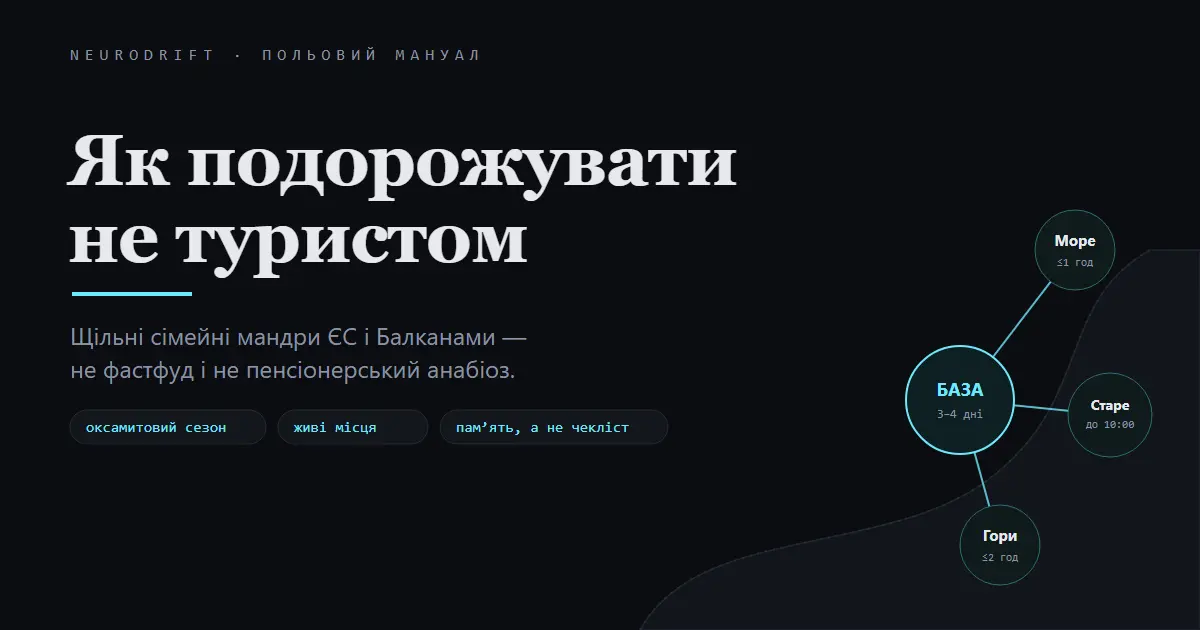
The right shape for a family with a toddler is not a loop (a new bed every night) but a star: settle on a base for 3–5 nights and radiate to points around it. Stability substitutes for the child's home routine and saves you hours of packing. The star rules: ≤3 hours of driving per day (ideally ≤2), stops every 1.5–3 hours timed to meals, arrival before dusk, transfer day ≠ sightseeing day, every 3rd–4th day a rest day. Scenic switchbacks (Lovćen, Vršič) are a dose-day of their own, not transit — Kotor's cable car takes 11 minutes instead of 25 hairpins with no guardrails.
Velvet season: when to go
One rule across all of southern Europe: June and September beat July–August. Peak is a double penalty — the worst crowds plus heat that already shuts sites at midday (2024 was Greece's longest recorded heatwave, 16 days; 2025 brought 46°+ records to Spain and Portugal). The velvet months keep the sea swimmable (~22–24°) at a quarter of the crowds and 25–35% cheaper.
| Region | Sweet spot | Avoid |
|---|---|---|
| Croatia (Dalmatia) | First half of September (sea ~23°) | July–August |
| Montenegro (Kotor) | Early June / mid-September | Peak + switchbacks |
| Slovenia (lakes) | June, September | Lakeshore crowds at peak |
| Albania (Riviera) | June, September | July «fiendishly hot»; late Oct everything shut |
| Greece (Peloponnese) | June, September | Peak + meltemi for ferries |
Living vs polished
Every famous country has a structural «second layer» — a living place instead of a hollowed-out one. The test is always the same: do residents actually live, shop and work here? Living bases matter more than perfect infrastructure.
| Instead of | Take | Why |
|---|---|---|
| Hvar Town | Jelsa / Vrboska | Where the islanders themselves holiday |
| Bled | Bohinj | Quieter, less commercial — sleep here, dose Bled |
| Ksamil (Albania) | Himarë | Half-built hotels vs real Riviera texture |
| Sunny Beach (BG) | Sozopol / Nessebar | Walkable, no concrete towers |
| Tuscany | Le Marche | The «un-Tuscany»: top healthcare, 15–25% cheaper |
| Costa del Sol | Green Spain | Cool Atlantic, a pace that suits kids |
The tourist-trap filter
Traps are field-detectable by concrete signals. A laminated photo menu in seven languages + a greeter + a spot adjoining the monument = a footfall conveyor. Walk 2–5 blocks off — quality is sorted spatially, not absent (Split, Prague, Venice). Don't boycott famous places bluntly either: the question is not «is it famous» but in what dose, from what angle, at what hour. Dubrovnik at 7–9am and after 5pm — versus Dubrovnik at 1pm — are two different cities. The single highest-ROI tactic in the whole research: stay overnight instead of day-tripping — day visitors vanish after 6pm and the town is finally yours.
Daily rhythm, the nanny and memory
A day with a two-year-old holds together on the 1-2-1 formula: one main anchor (before 10am, before heat and crowds) → two local rituals (food off the landmark + a playground) → one protected recovery block. Plus a designed evening — because memory weights the peak and the ending disproportionately (peak-end rule).
The nanny here is not luggage but leverage: while she is with the child at the base, the couple takes an excursion to a point an hour away (walls, a wine village, a canyon — where the toddler would be bored or overheated). The conditions: a private room for the nanny, explicit on/off blocks, and a childcare backstop so she gets breaks too. And memory is engineered on purpose: one novelty per day stretches retrospective time (the Holiday Paradox), one repeated ritual lowers anxiety, and a one-line «story of the day» micro-journal fixes the memory better than 200 photos.
The full interactive manual — separately
🧭 This is the condensed version. The full field manual — 17 layers with interactive tools: a Family Travel Base Score calculator (16 factors + vetoes), a tourist-trap filter, a switcher across 6 day archetypes, «go or skip» and «pick a restaurant» decision trees, a velvet-season heatmap across 13 regions, playbooks for 9 countries and printable checklists:
👉 Open the interactive manual (in Ukrainian).
The final doctrine
If you forget everything, keep this: choose better bases, not more stops. Protect rhythm — it matters more than the itinerary. Sleep where others merely day-trip. June and September beat July–August. Sleep 10–25 minutes from the core. One anchor per day, the rest is pauses. Authenticity comes from repetition, not from a sign. Design the peak and the ending. Sleep, food and peace first — then the view. The child is not an obstacle but a better design; the nanny is leverage, not a life raft.
Frequently asked
What does travelling «not as a tourist» actually mean?
Not collecting places like stamps, but living fewer of them deeper: settle on a base for 4–7 nights, enter ordinary local life (the bakery, the market, the playground) and engineer one memorable scene per day. Not fast-food tourism, not slow-motion pensioner mode, but a third gear — dense slowness.
When should you visit the Balkans and the Adriatic with a child?
June and September — the velvet season: warm sea, a quarter of the crowds, prices 25–35% lower. July and August are a double penalty: peak crowds plus heat above 40° that now closes sites at midday. The first half of September on the Croatian coast is the warmest sweet spot.
How much driving per day with a two-year-old?
The comfort ceiling is 4.5–5 hours, but the real killer is not one long day — it is several long days in a row. Keep it under 3 hours a day, time stops every 1.5–3 hours to meals, and lock arrival to daylight.
How do you spot a tourist-trap restaurant in seconds?
A laminated photo menu in seven languages, a greeter waving you in, a spot right next to the monument, pre-made desserts on display, the word «authentic» on the sign. Walk 2–5 blocks off the landmark — quality is sorted spatially, not absent.
Comments
Signed-in readers only — to keep it human, not a bot swamp.