Locus of Control and the Level Below: What Separates People Who Write Their Own Rules from Executors of Someone Else's
Freely choosing from a ready-made menu is not yet authorship — not until you ask who compiled the menu. True authorship begins not with a better choice, but with looking at the frame itself, the one inside which you are choosing.
On this page
- Locus of control: the first, seductive, and insufficient answer
- What Rotter missed and Bandura almost said
- The staircase of proof: three floors of a single illusion
- What if all of this is intellectual self-flattery?
- Why now
- Markers of transition: a table you can live with
- The second person in the room
- A small but obligatory brutality
- What to do with this (and what I am not promising)
In 2003, two researchers took a map of Europe and coloured it in two shades. Not by language, not by religion, not by GDP — by a single line in a form that citizens sign when they get their driving licence. In some countries it read: “tick the box if you want to become an organ donor.” In others: “tick the box if you do NOT want to.”
One line. The same Europe, the same people, the same death that sooner or later turns someone into a potential donor. And here is the result of their experiment: where people had to tick “yes” themselves, 42% consented to organ donation. Where the tick was already there and you had to remove it to opt out, the figure was 82% (Johnson & Goldstein, 2003, Science; figures from an online experiment with 161 participants, Welsh Government review, 2019).
A doubling. Not from advertising, not from preaching, not from a shift in values. From which side the default tick happened to sit. And the most telling detail — a third group, given no default tick at all and forced to choose from a blank slate: 79% of them said yes, almost as many as the pre-ticked group. Meaning the moment you strip away the default and leave someone alone with themselves, they lean toward yes. But the “no” default drives that down to 42%. The invisible frame does not merely influence the choice. It chooses for the person — even against their own inclination.
Now the most uncomfortable part. Every one of those 42% and every one of those 82% walked out of the booth with the absolute conviction that they had decided. That they had weighed things, thought about their family, about their own body, about death — and reached their own conclusion. Not one of them said to themselves: “actually, the designer of a government form just decided for me.” Because that is not how it feels. From the inside, a decision-by-default is indistinguishable from a decision-of-one’s-own.
This scene is not about organ donation, and not even about behavioural economics — the donor form here is simply the cleanest laboratory model of what is actually happening to every “adult, considered, personal” decision we make. It is about a mechanism I will call the modality of existence — the difference between someone who writes the rules of the game and someone who plays brilliantly by someone else’s rules. The alibi of this mechanism is called “freedom of choice”: we believe that since we freely choose among options, we are the authors of our lives. And I will clarify straight away, so as not to make a cheap nihilistic gesture: I am not saying that all choice is illusion and free will a myth. I am saying something narrower and more uncomfortable — that choice inside a frame you never questioned gives you the full feeling of authorship without giving you authorship itself. I will unpack this through two lenses — the psychology of control (who we believe governs outcomes) and the theory of authorship (who actually drew the frame inside which we so proudly choose). The razor-thesis: most people confuse freedom of movement inside a cage with the freedom to build the cage — and that is precisely why they live someone else’s plot with complete confidence that they are writing their own.
Locus of control: the first, seductive, and insufficient answer
Psychology gave an answer to this question sixty years ago, and that answer is so elegant it has been used to mask the real problem ever since.
In 1966, Julian Rotter published a monograph summarising a decade of research and introduced the concept of locus of control (Rotter, 1966, Psychological Monographs, 80, 1–28). The idea is beautiful in its simplicity. People differ in where they locate the source of events in their lives. “Internals” believe that outcomes depend on their own behaviour, effort, and decisions. “Externals” believe everything is decided by chance, fate, luck, or “powerful others.”
And from there — mountains of data saying: being internal pays off. The largest meta-analysis on the topic records a notable association between external locus of control and both depression and anxiety — a correlation of roughly r ≈ .30 for each (Cheng et al., 2013, Psychological Bulletin), and broader reviews add: internal locus goes hand in hand with better mental health and higher self-control (review in PMC, 2023). It sounds like a ready-made prescription: want to be an author — move your locus inward. Take responsibility. Stop blaming circumstances. Become someone who believes everything is in their hands.
This is precisely where the trap is hidden — the trap over which half of all self-help books helplessly spin their wheels.
Correlation is not causation, and that is not a minor caveat — it is the heart of the matter. The fact that internal people feel better does not mean the prescription “just believe you control your life” works. Because internal locus comes in two diametrically different varieties. There is the person who actually rewrote the conditions — changed careers, left a toxic relationship, moved to another country — and therefore believes they control their life. And there is the person who changed nothing but trained themselves to feel in control. The second type is our donor from the 42% or the 82%. They are also “internal.” They are also certain they decided for themselves. And that certainty is not evidence of authorship — it is its finest counterfeit.
Locus of control measures where you feel the source of events to be. It does not measure where it actually is. And those two things diverge precisely where things get interesting.
What Rotter missed and Bandura almost said
A student does not always build on what a teacher left unfinished — but sometimes they do. Albert Bandura, who spent several decades developing the psychology of agency, broke down human agency in a late paper into four properties: intentionality, forethought, self-regulation, and self-reflection (Bandura, 2006, Perspectives on Psychological Science). He called the last one the most distinctly human — the capacity to reflect on one’s own thoughts and actions and make corrections.
Almost. Because even here, reflection operates inside a given field. I can reflect indefinitely on whether to tick “yes” or “no” on the donor form. I can weigh it, hesitate, mature in my decision. But I do not reflect on the fact that the form itself is structured around a default tick, that someone decided which side to put it on, that there are countries where the question is posed the other way around. My reflection works brilliantly on the variable and is blind to the frame.
And now I am ready to name my frame directly. Let us call it the modality of existence — from the grammatical category of modality, which distinguishes “I do,” “I must,” “I can,” “I want.” The question of modality is not what you do, but in which case you are present in your own life. A character lives in the active voice only grammatically: “I choose,” “I decide,” “I want.” But look closely at where those options came from and it turns out they are in the passive — choosing from a menu they did not compile.
Authorship is not freedom of choice within the frame. Authorship is authorship of the frame itself.
Everything else — even the sharpest, most painful, most responsible decision — may turn out to be simply a well-played role.
It is worth pausing a moment on the mechanics, because they are subtler than “we are being deceived.” Nobody is deceiving anybody. A lie is when you are told an untruth; here you are simply told nothing about the main thing. The donor form did not write “we decided for you” — it simply did not mention that the side of the tick was also someone’s decision. Its power lies precisely in that silence: what is presented as a choice is loud and visible, while what was done before you is not presented at all. When a government offers you a “yes” or “no” tick, it loudly and honestly hands the choice to you — and that very loud gesture with the choice masks the quiet one, made before you, about which side the default tick would occupy. The visible choice works like a conjurer waving the right hand while the left does the work. The more attention you give to your decision — weighing it, agonising over it, maturing inside it — the deeper it pulls you into the frame, because all that inner work happens inside it and only confirms its reality. A character who plays their role conscientiously and honestly is more convinced of their own authorship than one who plays carelessly. Conscientiousness is not an exit from the frame. It is often the firmest nail by which you pin yourself to it.
The staircase of proof: three floors of a single illusion
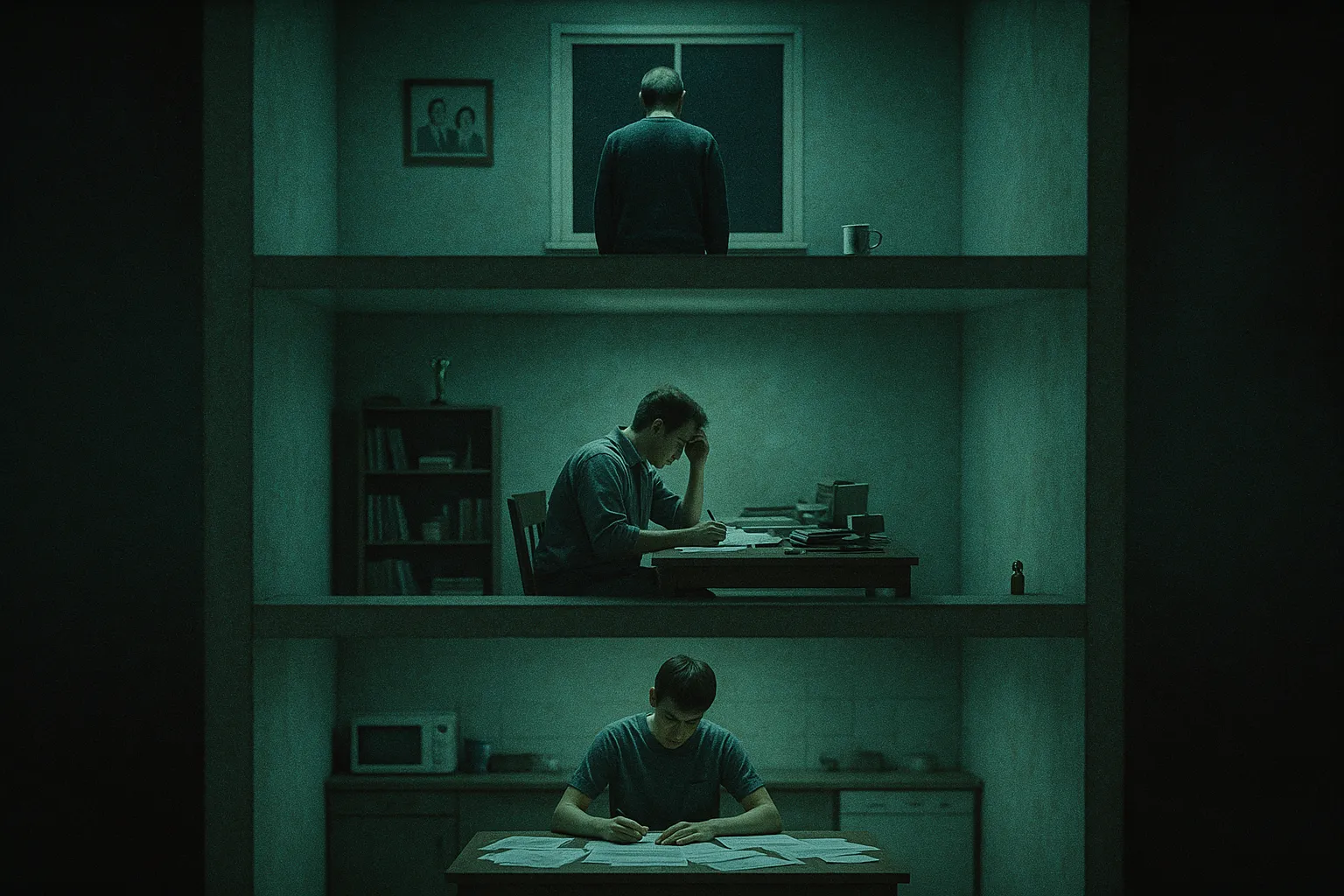
To avoid leaving the thesis floating in mid-air, let me descend the staircase of proof — from the distant to the personal.
First floor, digital. Back to the tick. The doubling of consent (42% → 82%) from a simple change of default is not some exotic quirk of organ donation. It is a universal mechanism: the overwhelming majority of people leave in place whatever stands as the default and rationalise it as their own choice. Pension contributions, privacy settings, pricing plans, even how many episodes we watch in a row (autoplay is a “yes” tick placed for us) — all of these are frames inside which we “freely choose” what has already been chosen for us.
Second floor, structural. Move up a level and you see that ticks are placed not only by form designers. They are placed by family, school, class, language, state, and era. The same donor tick scales to the size of a country: Germany runs on opt-in, with roughly 12% of its population on the donor register; neighbouring Austria runs on opt-out — and nearly 99% of its population counts as potential donors (Stanford SPARQ; expert opinion review, PMC, 2019). Two peoples sharing a border, almost sharing a language, the same medicine and culture — and opposite answers to a question of life and death. Not because the Austrian is kinder than the German. Because the frame for each of them has already been silently placed on the opposite side, and each of them sincerely considers that frame the “normal attitude toward death.”
The same applies to quieter ticks. A child does not choose whether to value education — they are born into a family where the tick is already set one way or the other. A teenager does not choose whether it is normal to take out a loan for a wedding — they inherit a frame in which that is either obvious or unthinkable. The largest meta-analysis on this subject to date — 152 samples, over 33,000 adults from 18 cultural regions — showed something more: the very association between external locus of control and anxiety is noticeably weaker in collectivist cultures than in individualist ones, and the level of individualism accounts for roughly 20% of that difference (Cheng, Cheung, Chio & Chan, 2013, Psychological Bulletin, 139, 152–188). Meaning even how harmful it is “not to feel in control” is set by the cultural frame into which no one chose to be born. The advice “move your locus inward” is itself someone’s default tick, placed by the individualist West.
Third floor, the reader’s — a tool. And now the most important part: how do you tell which floor you personally live on, right now? I will give a diagnostic table below. But first — one honest warning, because without it the table will become just another default tick.
What if all of this is intellectual self-flattery?
Here, in the middle of the text, I must stop and shoot myself in the foot — because otherwise this is a sermon, not an argument.
The strongest objection to the entire construction sounds like this: it is impossible to rewrite the frame, and all this talk of “authorship of the frame” is an elitist fantasy for people who already have resources. A single mother working two jobs does not “choose her frame.” A refugee does not “rewrite their modality of existence.” The very idea that you can step out of someone else’s plot is available only to those who already have enough money, time, and safety to experiment on themselves. Everyone else is left playing a character — and it is a good thing the character at least moved their locus of control inward, because that at least protects them from depression.
This objection is strong and I will not knock it down with a cheap trick. Part of the truth here is ironclad: frames are rewritten unevenly, and the starting frame is a birth lottery in which none of us drew our own ticket.
But I will tell you where it breaks down. It confuses the scale of the frame with the fact of authorship. A refugee cannot rewrite geopolitics — true. But within their own corridor of possibility they are, at every moment, either accepting someone else’s story about themselves (“I am a victim, being carried along”) or writing their own (“I am the one who will get my children through this”). The frame does not have to be global to be yours. And here is the test that would prove me wrong: if the transition from character to author depended in no way on the individual, but only on resources, we would never encounter authors among the most deprived and characters among the most privileged. Yet we encounter both, constantly. The freest person in the room is not always the wealthiest. Sometimes it is precisely the one who has passed through a frame that the wealthy person never escaped — because the frame was too comfortable to leave.
So: resources widen the corridor. But authorship is not the width of the corridor. It is the question of whether you know you are walking a corridor, or whether you think it is the entire world.
Why now
This question did not become acute by accident, nor has it always been this sharp.
From roughly 2018–2019, recommendation feeds widely switched to reinforcement learning, where the system optimises not your click today but your long-term engagement — how often you come back over months (Zou et al., “Reinforcement Learning to Optimize Long-term User Engagement,” ACM SIGKDD 2019). Previously the default tick was placed by a form designer — one tick for everyone. Now it is placed by a system learning from you — unique for each person, rewritten every second in response to your reactions. And in the broader engineering literature on RL recommenders, a recognised side effect has emerged: when engagement is the reward signal, feedback loops naturally surface sensational or emotionally provocative content that undermines the user’s long-term wellbeing. The feed you scroll is not a menu from which you choose. It is a menu that chooses you, and rebuilds itself to keep you inside rather than to serve your benefit.
The character has always lived inside someone else’s plot. The novelty of 2018–2026 is that the plot is now written in real time, adaptively, for each person individually — and the sense of authorship does not weaken as a result, it intensifies, because the frame is tailored specifically to you and therefore feels more your own than ever. Never before has someone else’s cage looked so much like a house you built yourself.
Markers of transition: a table you can live with
The transition from character to author has markers — ones you can recognise in yourself without waiting for a revelation. Here is one table (and exactly one) worth reading slowly, holding it up against a specific decision you made last week.
| Dimension | Character (lives inside someone else’s frame) | Author (writes the frame) |
|---|---|---|
| The question they ask | ”Which option should I choose?" | "Who compiled this menu and why exactly these options?” |
| Relationship to the default | Accepts and rationalises it as their own choice | Notices the default as a separate decision made by someone else |
| Source of the rules | Invisible, perceived as “that’s just how the world works” | Visible, localised: “here is who set this and when” |
| Response to discomfort | Looks for a better move inside the game | Asks whether it is worth playing this game at all |
| Locus of control | Internal at the level of feeling | Internal at the level of actual changes to the frame |
| What they change under pressure | Tactics, behaviour, effort | Conditions, context, the very framing of the question |
| Most dangerous illusion | ”I am free because I am choosing” | (Aware that part of the frame remains invisible regardless) |
Note the lower right corner. The author is not someone who has shed all frames — that is impossible; we are always inside some frame. The author is someone who knows a frame exists, can see its edges, and periodically checks who drew them. The character sincerely believes there is no edge — that this is simply the horizon.
The second person in the room
Now picture a specific person. Not an abstraction — someone specific.
Forty-two years old. A good position he chose himself — he changed jobs twice, each time deliberately, analysing offers, tallying compensation, consulting his wife. He chose his car himself. He chose the school for his children himself. His holiday itinerary, his investment portfolio, even his therapist — all himself, all thought through, all with the feeling of adult responsibility. Give him Rotter’s test and he comes out deeply internal. He will tell you, looking you straight in the eye: “I build my own life.”
And not once in twenty years did he ask who compiled the menu. Why a “good position” is necessarily a corporation rather than a business of his own. Why “providing for the children” means specifically a private school, rather than, say, a different city or a different way of organising life. Why success is measured by the same yardstick as his colleagues use. He made brilliant choices among options for twenty years — and never once drew his own frame. He is the author of every move and the character of the entire game.
You may have recognised him. Or perhaps — and this is the most uncomfortable part of this paragraph — you recognised yourself, but immediately thought: “well, in my case it’s different.” That is exactly what a frame feels like from the inside. It always seems to be about other people.
I recognised myself, so I write this from no superior vantage point. For years I made decisions I considered my own that were someone else’s: I built businesses because “that’s what serious people do,” checked email at seven in the morning because “discipline,” and was extraordinarily effective throughout — such a model character that you could safely hold me up as an example. The worst part is that this state does not hurt. Depression hurts, crisis hurts, but life inside someone else’s frame is a steady, barely audible hum of a functioning part that gets paid extra for functioning. A part that is paid for being a part will never free itself — it is not stupid.
Now place a second figure beside the first — for contrast, because without it the first becomes a caricature of a “zombie office worker,” which would be a fraud. Imagine a woman with half the resources of our forty-two-year-old. Less money, fewer qualifications, a worse starting corridor. But at some point she did something he never did once: she asked who compiled the menu. Not “which job to take,” but “why must my life be measured by work at all.” Not “how to raise children better according to the rules,” but “whose rules are these and are they mine.” She did not shed all frames — nobody manages that. But she saw the edges of at least one and rewrote its terms, even in a narrow corridor, even at the cost of comfort. On Rotter’s test they may both come out equally “internal.” By the modality of existence they are on different floors: he is a masterly character with rich props; she is less wealthy, but an author. And if the thought that a poorer, less educated person might turn out to be more the author of their own life than a successful senior executive makes you slightly uncomfortable — hold onto that feeling. It is the place where your own frame just showed its edges.
A small but obligatory brutality
I will be direct, because without this the text becomes therapeutic reassurance: the overwhelming majority of the self-help genre is an instruction for becoming a better character, sold as an instruction for becoming an author. “Take responsibility,” “change your mindset,” “move your locus inward” — all advice on how to sit more comfortably in the chair, packaged as advice on how to leave the room. This is not a conspiracy; it is simple incentive economics: the business model of a course, an app, or a coach depends on you coming back for the next dose of motivation. To advise you to question the very frame in which that product is the obvious choice would be to advise you to leave — and nobody builds a subscription on that. It would be a “no” tick in its own donor form, and nobody is in any hurry to place it.
What to do with this (and what I am not promising)
I am not promising that after this text you will leave the room. Most likely you will not. Frames hold precisely because they are invisible, and one article does not restore sight for long.
But I will leave you with one marker — the cheapest and the most honest. The next time you catch yourself thinking proudly “I decided that myself,” add one question: and who compiled the options I was choosing from? Not to paralyse yourself — you will still have to choose. But at least to see the edge of the frame once. Because the difference between a character and an author does not begin with the author making better choices. It begins with the author knowing: there was a tick here, and someone placed it before them.
And where you have seen the tick, you are already halfway to picking up the pen.
Viktor Frankl, who passed through a concentration camp — a place built specifically to have every possible tick pre-filled on your behalf in the most final way imaginable — formulated the limit so precisely that there is nowhere to run after him: “Everything can be taken from a man but one thing: the last of the human freedoms — to choose one’s attitude in any given set of circumstances” (Frankl, Man’s Search for Meaning, 1946). Sit with the brutality of that sentence. If the space in which you can at least rewrite the frame of your own attitude remains even where everything else has been taken away, then its absence in your warm, well-lit life is not a frame placed by someone else. It is a tick you quietly, habitually, place yourself every day. And the most inconvenient part is that the alibi has expired: Frankl took your last excuse from you there, where he should have lost it himself.
Two researchers coloured a map of Europe in two shades, over one line in a form. Most people on that map lived out their lives and died never knowing that their most personal decision — whether or not to give their own body after death — had in fact been made for them by someone designing a document. They were certain they had chosen for themselves. In a certain sense they had: they chose the tick brilliantly. They just did not place it.
Frequently asked
What is 'modality of existence' and how does it differ from locus of control?
Modality of existence is the grammatical case in which you are present in your own life: are you writing the rules of the game, or brilliantly playing by someone else's? Locus of control (Rotter's term, 1966) only measures where you FEEL the source of events to be — not where it actually is. So a person can have an 'internal' locus and a full sense of authorship without having changed a single condition. That is the best counterfeit of authorship, not the thing itself.
What does the thesis 'authorship is authorship of the frame itself' mean, as opposed to freedom of choice?
Choice inside a frame you never questioned gives you the full feeling of authorship without giving you authorship itself. A donor who ticks 'yes' or 'no' freely chooses the variable — but who placed the default tick, on which side, and why, was decided before them. The author is not the one who chooses better; it is the one who asks who compiled the menu.
Why is the default tick so powerful if nobody is actually being deceived?
Because this is not a lie — it is a silence: the visible choice is presented loudly, while the decision made before you is presented not at all. Switching the side of the default doubled consent to organ donation — from 42% to 82% (Johnson & Goldstein, 2003). The visible choice works like a conjurer: it waves the right hand while the left does the work, and the more conscientiously you weigh the decision, the more firmly you nail yourself to the frame.
But what if 'rewriting the frame' is an elitist fantasy for people who already have the resources?
This is the strongest objection, and part of it is ironclad: the starting frame is a birth lottery, and frames are rewritten unevenly. But the objection confuses the scale of the frame with the fact of authorship. A refugee cannot rewrite geopolitics, yet within their corridor they choose at every moment between accepting someone else's story about themselves and writing their own. The test: if the transition depended solely on resources, we would never encounter authors among the most deprived, and characters among the most privileged — yet we encounter both, constantly.
What changed after 2018 that has made this question so acute right now?
Recommendation feeds switched to reinforcement learning optimising not your click today but your long-term engagement (Zou et al., SIGKDD 2019). Previously the default tick was placed by a form designer — one tick for everyone; now it is placed by a system learning from you, unique for each person, rewritten every second in response to your reactions. The sense of authorship does not weaken as a result — it intensifies. The frame is tailored to you and therefore feels more like your own than ever before.
Comments
Signed-in readers only — to keep it human, not a bot swamp.