Raising a Child for an Unknown Job Market: the '65% New Professions' Myth, a 2.5-Year Skill Half-Life — What to Pass On Instead of Forecasts
Parenthood at the intersection of war and AI — not an essay but an attempt not to hand the child over to experts, algorithms, and one's own fear. Why '65% of jobs don't exist yet' is fiction, what the MIT preprint says about cognitive debt, and how to pass on the 'right column' — skills with a half-life measured in decades. With data from WEF, OECD, UNICEF, Pew, RAND 2026.
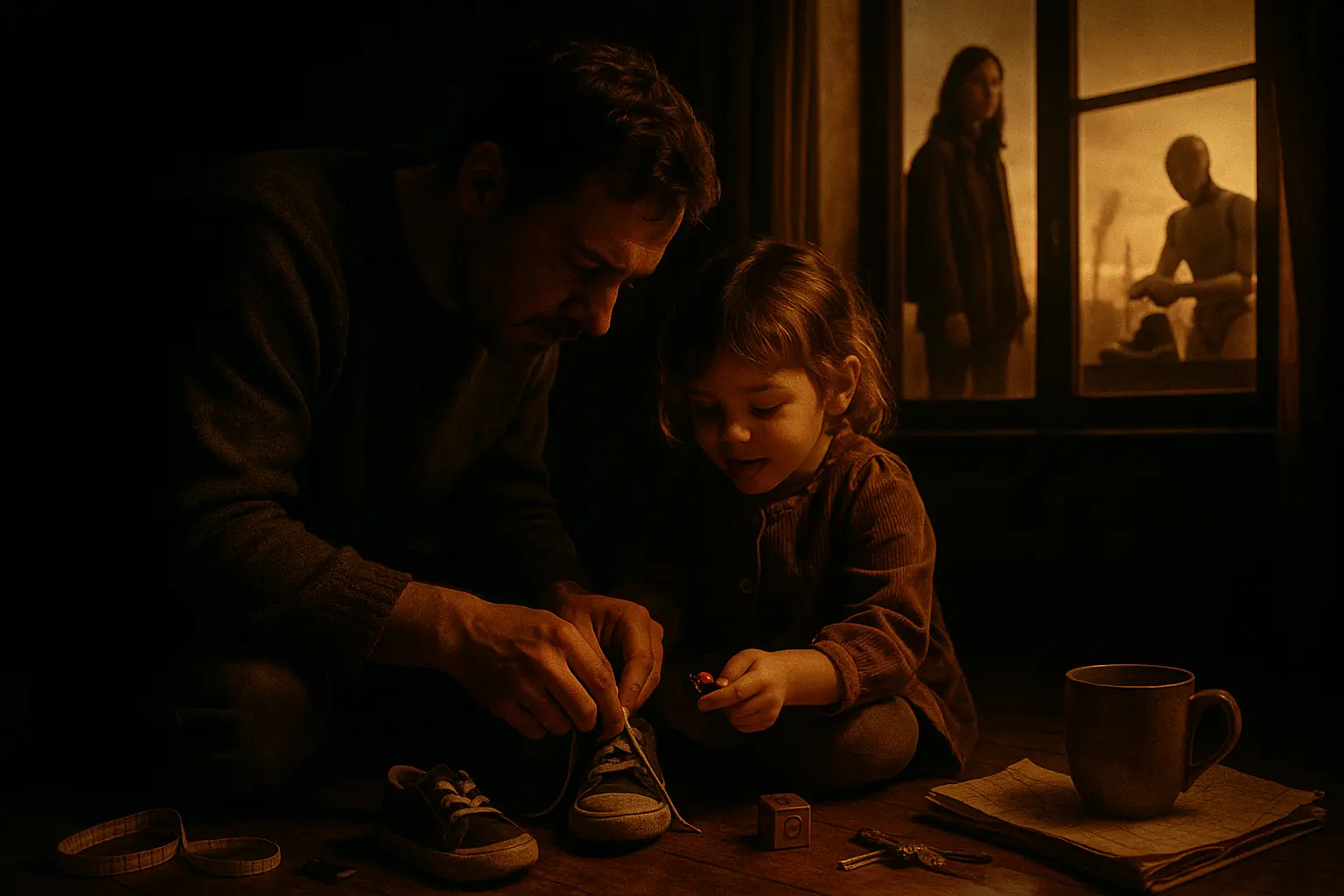
07:18. The floor is cold. On the table — an unfinished banana, a spoon in dried-up porridge, and a small sock that for no discernible reason is sitting in the bowl, as if it is part of the educational curriculum.
My child sits across from me and hates shoelaces. Not abstractly — concretely, loudly, wetly hates this small knot that won't obey her fingers. I show her again: loop, wrap around, pull through. She tugs, the knot falls apart. Eyes fill with tears. Mine fill with coffee that hasn't been made yet.
The phone is right there. It already has the answer to everything: how to teach a child to tie shoelaces, how to prepare her for AI, how not to break her psyche, how to be a good parent in 12 steps, 4 modules, and $19 a month. And in that moment I catch the most shameful thought of the morning: maybe someone else already knows what world to prepare her for? Maybe I can just hand this decision over to the system — a course, a specialist, an app, an expert in a tie who will say "don't worry, we'll build her future"?
And then the child tugs the lace again, it falls apart again, and the future for a moment becomes very small: two loops, one knot, and an adult who has no right to escape into analytics while his child is learning not to give up.
Half-life: why almost everything I'm teaching is radioactive slag
There is a concept I borrowed from radiophysicists and have never been able to escape: half-life. A radioactive isotope loses half its mass in a fixed amount of time — the clock inside the nucleus ticks in utter indifference to your plans and prayers. Human skills behave the same way. According to IBM estimates, a typical professional skill has a half-life of around five years, a narrow technical one two and a half; for "perishable" digital skills the window is even shorter, under two. Half of what you know turns to slag while you blink.
And now the contrast that holds the whole piece together. My grandfather from Lviv passed on to me not a single skill that survived a decade: his trade is obsolete, his technology is museum-grade. But he passed on a ritual. A Galician does not drink coffee — he holds a small council with the cup: spoon, pause, glance out the window, an unhurried phrase. This ritual has no half-life, because it is not information. You cannot Google it, delegate it, or update it to version 2.0 — you can only live it alongside someone and absorb it. And so I sit with my own child and understand for the first time: the only thing I can pass on to her with a decade's guarantee — is not a fact, not a stack, not a "skill of the future." But a way of being at the table when the table gets rearranged twenty-two times.
And I am doing this in a country where last year 168,778 children were born — against 485,296 deaths. Almost three times more deaths than births. Having a child in Ukraine in 2025 became a statistically rare act. Here I lower my voice, because this is not a hook — it is a wall.
And here I am, a nominally grown adult, catching myself doing what all frightened parents do: searching for a number. A figure to grab on to, like a handrail in a braking tram. And it appears instantly. It was already waiting for me — with a polished handrail and a warm smile.
The antagonist in a tie: the number they frighten us with was itself never born
"65% of children starting school today will work in professions that don't yet exist." You have heard this. I have heard this. The line is delivered from TED stages, printed on covers of courses, deployed to open parent-teacher evenings. It lands like a revelation and hits like a sucker punch: everything you teach your child is already obsolete, you have already lost, buy our coding course for four-year-olds.
This number does not exist. It is fiction — an orphan adopted by an entire industry, because its biological parents refused it. Professor Cathy Davidson first read the figure in a futurist's book in 2007; that book cited some Australian government website. Davidson inserted the number into her own 2011 book — and when she went to verify the source, the site was dead, and the Innovation Council it supposedly referenced, according to a BBC investigation, had never existed at all. Davidson herself honestly admitted she stopped repeating the number around 2012. The author withdrew her own child — and it had already grown an army of adoptive parents: US Education Secretary Betsy DeVos was waving it in 2017, propping education policy for a superpower on a figure whose only primary source was a website that never was.
The most successful education statistic of the 21st century turned out to be an orphan with a forged birth certificate. Its authors disowned it, its primary source was never found — yet it keeps attending conferences in a suit, as if it holds a degree.
That is my antagonist. Not the number itself — but the person who trades in it. The expert in a tie who takes your parental fear, converts it into a number without a source, and converts the number into courses, reforms, and a thin, sticky guilt that you are not preparing your child enough for the Future-with-a-capital-F. You are not being consulted. You are being milked — gently, so you keep coming back. "AI literacy for toddlers" sounds like a joke, until you see the landing page with three pricing tiers where the most expensive one is called Genius and includes a certificate the child cannot yet read.
The honest numbers are less dramatic. That's why nobody sells them
The problem is not that the future of work is harmless. The problem is that the real data is not as dramatic as the fiction — and therefore sells less well to a frightened parent. Real numbers are worrying, but not apocalyptic. And precisely because of that they are useful: you can work with them. Fake 65% paralyzes. Real 22% churn forces you to build a system.
The WEF's 2025 report projects that by 2030, technology, demographics, and the green transition will create 170 million new jobs and destroy 92 million. Net gain — only 78 million. But inside that tranquil "plus seven percent" roils a 22% churn — every fifth job either emerges from nothing or disappears. This is not the end of work. It is a total replacement of tables in the hall while the orchestra keeps playing, and the only one who doesn't notice his table has been carried out is the one sitting at it. The OECD adds sobriety: roughly 27% of jobs in developed countries are already at high risk of automation — every fourth seat is perched on a trapdoor; the door just hasn't opened yet.
And here is the comfort the anxiety industry will never show you: "skills instability" is actually falling. WEF calculates that 39% of existing skill sets will transform or become obsolete by 2030 — but at the pandemic peak in 2020 it was 57%, in 2023 it was 44%, now 39%. The storm is easing. It's just that the trailers still running show the 2020 cut, where the wave is higher and the frightened parent clicks "buy" more often.
| Number | What it actually means | Source | Status |
|---|---|---|---|
| 65% of jobs don't exist yet | Nothing. The trail leads to a website that never existed; the author withdrew it | 2011 book → ∅ | Fiction |
| 170 / 92 / 78 million | Created / destroyed / net by 2030. A table swap, not the end of work | WEF 2025 | Verified |
| 22% churn | Every 5th job will be born or die by 2030 | WEF 2025 | Verified |
| 27% at risk | Already at high automation risk right now (OECD countries) | OECD 2023 | Verified |
| 39% of skill sets | Will transform or become obsolete by 2030. Trend declining: 57%→44%→39% | WEF 2025 | Verified |
| half-life ~2.5 yrs | A narrow technical skill loses half its value (general skills ~5 yrs) | IBM 2021 | Approximate |
Notice the structure? The only number that frightens you into paralysis — "65%" — is the only fabricated one. The rest is worrying but manageable. That is the business model of the anxiety industry: sell you the scariest figure that would not survive peer review, and quietly suppress the declining trend of the real ones.
Two columns I now live by
Enough diagnosis — a parent needs not a verdict but a screwdriver, and needs it early. The logic is simple and merciless: stop teaching a child skills with a short half-life and invest in those that almost never decay. Not "what to know" — but "who to be," because being does not become obsolete the way knowing does.
| Half-life ~2 years (the machine will do it better) | Half-life 30+ years (remains human) |
|---|---|
| Memorize specific facts and dates | Endure boredom without reaching for a screen |
| Know the "correct" answer in advance | Survive uncertainty without fleeing into a cage |
| Quickly Google a ready answer | Tell truth from generated-sounding plausibility |
| Generate text | Bear responsibility for what was said |
| Execute fast from a template | See your own crooked attempt through to the end with your own fingers |
| Pass a standard exam | Calm yourself down without chemicals or likes |
| Translate a text | Make a friend and hold that friendship for years |
A school that still prepares children for a 1950s exam supplies the child exclusively with the left column — precisely what a machine already does cheaper and without ever tiring. The right column cannot be tested on any standardized exam, cannot be Googled or delegated — and it is exactly this column that has a half-life of decades. Harari frames this as the core competence of the century: emotional resilience and the ability to relearn again and again, because there will be no stable professional identity anymore. The school of 1950 set the task. AI of 2026 has done it. The child of 2036 will arrive on the job market with a degree, excellent formatting, and the internal musculature of wet pasta.
But here — where I am almost certain about my rightness — it is worth saying something uncomfortable. Access to the "right column" is also a privilege. Developing resilience and critical thinking requires a stable environment, parental attention, relative safety. But a displaced child is not learning "adaptability" — she is carrying it in a bag with her documents: fourth apartment in two years, different hallway, different tap water, different "where is your home?" A working-class family in a liberated city is not buying critical-thinking courses for $19 a month — they are wondering whether there will be water in the taps. My two-column frame is honest. But it is written from the position of a father who has a floor to tie shoelaces on and time to think about it. For half of Ukraine's children, that floor is still moving.
The tool designed "to help" switches the light off in the head
Fine, I tell myself. The future of work is more manageable than they're scaring you into believing. So I'll give my child the most powerful tool of the era — AI — and let her sail. What could go wrong? (This, by the way, is the favorite last line of every person who later gets a monument.)
And here I must be careful, because the topic tempts one to overclaim. Picture a room: 54 adults (not children) in electrode caps writing essays. One group — just their own brain; the second — with Google; the third — with ChatGPT. The "brain only" group shows the densest neural connectivity network; the ChatGPT group — the palest; and when the tool was taken away, the brain did not return to full capacity immediately. The researchers called this cognitive debt — like technical debt: you borrow speed today on credit, and pay the interest as atrophy tomorrow. Honest caveats: this is an MIT Media Lab preprint (Kosmyna et al., 2025), not peer-reviewed, the sample is tiny (n=54), the subjects are adults who already knew how to think before the button existed. This is not a verdict on a child's brain. It is a warning drawn from an adult self — and it cannot be stretched to mean "AI makes children dumber."
Alongside it — Gerlich (2025): on a sample of 666 people, found a correlation (not causation) between intensive AI "cognitive offloading" and lower critical-thinking scores; the strongest association was in the youngest participants. (Honestly: the paper had a published correction — a duplicated table; the conclusions held.) And Anthropic, having analyzed roughly one million student conversations (574,740 after filtering for academic relevance), showed that university students most often ask Claude not about routine but about the summit: by Bloom's taxonomy 39.8% is "creating," 30.2% is "analyzing," and only 1.8% is "remembering" — this describes what Claude did in the conversation. An inverted pyramid balancing on its tip.
None of these three proves that AI damages a child's brain. Together they give something else: a reason for caution. AI does not steal thinking by force — it offers a discount on effort. A child doesn't need to be "future-proof" — she needs to be "self-proof": given a way to remain herself when the future once again pretends to be a system update and asks the person to reboot. I thought I was giving my child a prosthetic — an amplifier for the mind. I risk handing a crutch to a healthy leg: a crutch does not heal a healthy leg — it teaches it not to walk. And the cruelest joke is that the failure is invisible: the essays are excellent, the report card shines, the parents are proud — it's just that inside the light has dimmed, and the bill arrives fifteen years later, when it becomes necessary to think about something that exists in no model, and it turns out there is nothing left to think with.
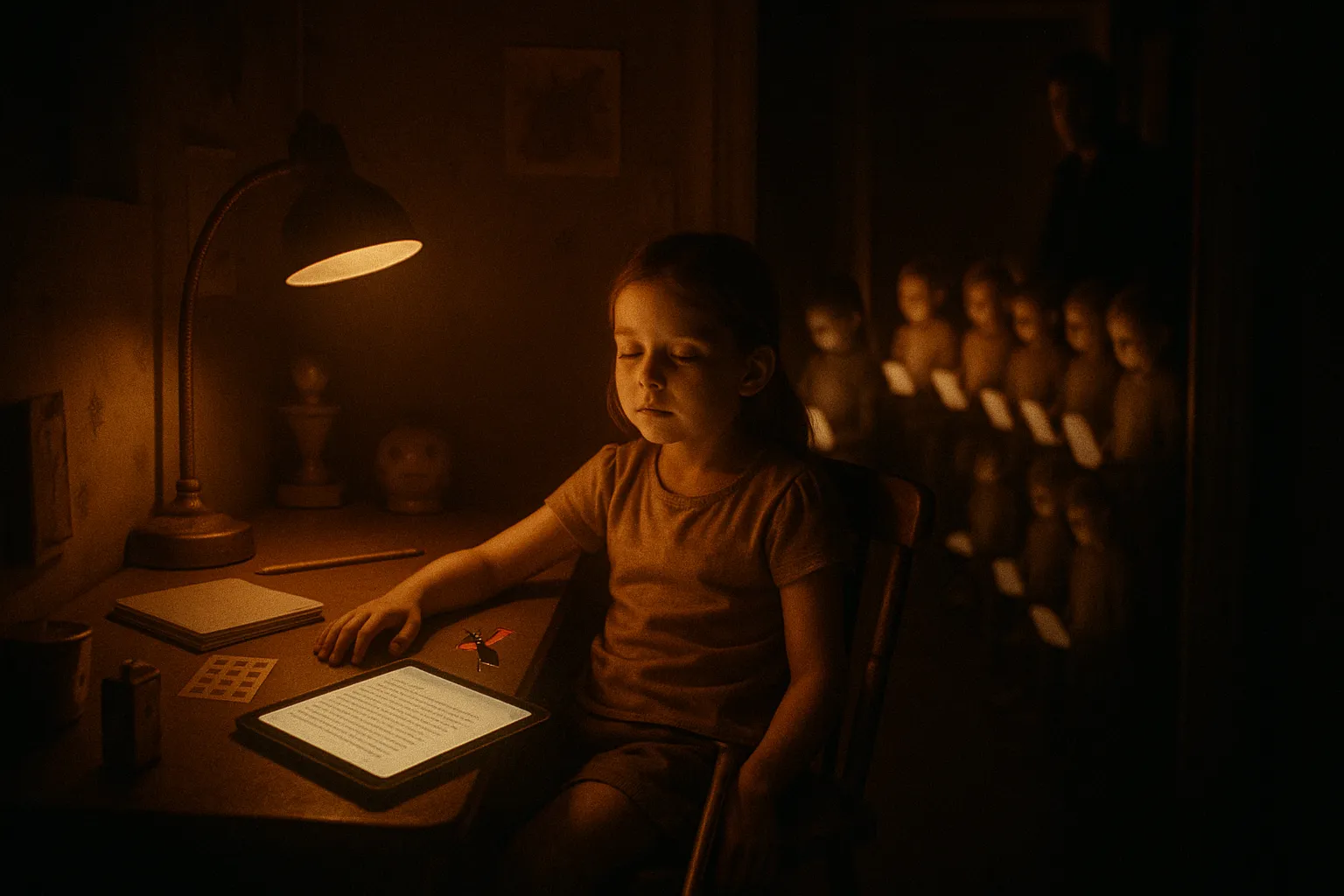
I thought I was giving the child a prosthetic for the mind. I risk handing a crutch to a healthy leg: the report card shines, the essay is flawless, and the light in the head quietly goes out — bulb by bulb down the corridor.
AI is already in the children's room — this is not a future problem
And here the numbers stop being theory. But let me be upfront: the data below is American — a benchmark, not a cross-section of Ukrainian children. The order of magnitude, however, is visible. Common Sense Media in 2026 surveyed 1,204 children aged 9–17: 86% already use or interact with AI, almost a quarter daily, and more than 4 in 10 say no adult has ever spoken to them about AI safety. "Someday I'll need to explain AI to my child" is already a late phrase: the child may have talked to AI before you ever sat down with her to talk about AI.
Pew (February 2026) shows that for American teenagers 13–17, AI is no longer just a "homework helper": 57% have searched for information via chatbot, 54% for help with schoolwork, 47% purely for entertainment, 12% for emotional support or advice. It is becoming librarian, tutor, toy, adviser, and a small nightly confessor in their pocket. And RAND (2026) found a strange honesty in students themselves: AI use for homework among school and older students rose from 48% (May 2025) to 62% (December), and yet 67% of those same students agreed that using AI for homework harms critical thinking. They already smell the smoke. The fire-safety instructions just haven't arrived yet.
A child used to have two voices in her head: the parent's and her own. Then school, friends, and YouTube were added. Now there is another — bodiless, patient, always available, never tired. It does not shout, does not forget, does not say "I'm busy," does not smell of sweat after work. And this is precisely why it is dangerous: a child may decide that love, too, should respond instantly, correctly, and without irritation.
Parent OS: protocol instead of panic
The most honest admission is this: I am not afraid that my child will use AI. I am afraid that I myself will be the first to teach her to use it wrong. Because at 21:43 after work, bills, a siren, a child's meltdown over "the wrong cup," and my own brain resembling a chewed-up supermarket receipt, I do not want to cultivate critical thinking. I want to type into ChatGPT: "explain this to the child instead of me." That is where the real risk lies — not in the machine seducing the child, but in an exhausted adult, out of love and exhaustion, handing her the crutch themselves.
So I now have a house rule, uncomfortable precisely because it is simple: AI does not get to be the first attempt. The first draft is human. The first mistake is human. The first "I don't know" is human. Then you can call in the machine — but as a trainer, not an oracle.
| Situation | Not allowed (crutch) | Allowed (dumbbell) |
|---|---|---|
| Homework | "Write the answer" | "Ask me 3 questions so I can figure it out myself" |
| Essay | "Make the text" | "Critique my draft" |
| Math | "Solve it" | "Explain where I went wrong" |
| History | "Give me the ready report" | "Compare 2 versions, show the weak spots" |
| Emotional problem | "Tell me what to do" | "Help me put into words what I'm feeling, so I can talk to an adult" |
Three forbidden buttons as simple family policy: AI does not make the first version; AI does not replace a difficult conversation with a person; AI does not have the final word on questions of truth, morality, or self-worth. And an age ladder — not a dogma but a framework:
| Age | Focus | AI mode |
|---|---|---|
| 0–6 | body, language, play, attachment | no direct access; AI for parents only |
| 7–10 | first attempt, patience, hands-on work | AI shown by adult together with child, not child alone |
| 11–14 | source verification, "AI can lie" | AI as a question trainer, not answer provider |
| 15–18 | projects, portfolio, ethics | AI as co-pilot with a log: what I did, what the machine did |
| 18+ | professional fluency | AI as leverage, but with accountability for output |
And here is a parental scorecard, so "raise a person" stops being a slogan and becomes daily mechanics:
| Ritual | What it looks like at home | What it kills | What it trains |
|---|---|---|---|
| Boredom | 20 min without a screen, without "entertain me" | instant video | self-regulation |
| First attempt | "try yourself first, then I'll help" | AI-answer first | frustration tolerance |
| Thinking aloud | adult shows a dead end and works through it | ready answer | metacognition |
| Truth | "how do we know this?" | plausible generation | source-checking |
| Body | shoelaces, scissors, sport, cooking | screen skills only | agency |
| Friendship | regular live contact | AI companion as substitute | attachment |
War targets exactly the column AI cannot replace
Notice one thing. Almost everything in the right column is what war destroys. AI devalues the left column. War burns out the right.
Here I lower my voice again, because this is not a rhetorical battering ram. According to UNICEF data (as of the fourth year of war, February 2026, only UN-verified cases — real numbers are higher), since February 24, 2022, more than 3,200 children have been killed or wounded in Ukraine. Every third Ukrainian child — 2,589,900 — is displaced: more than 791,000 inside the country and almost 1,799,000 abroad. More than 1,700 schools and educational facilities have been damaged or destroyed; one in three children cannot fully attend in-person education. PTSD, anxiety, depression — UNICEF warns that around 1.5 million Ukrainian children are at risk of mental health disorders.
War targets exactly the organ that does not become obsolete — the psyche. It is trying to destroy the right column faster than AI devalues the left. My child is being shelled from two directions at once: what should become her capital on the 2040 labor market, a neighboring state is trying to burn right now, in advance, while it is still only taking root. In Cuarón's film ("Children of Men," 2027), childlessness was magic, a curse from nowhere. For us it has a return address — with missiles included and a return address on the casing. The artist had to invent a mystical cause, because without a cause it is not frightening. Ours was helpfully provided from outside.
Escape from freedom: why this is not a new problem
And here the most repugnant thing happens to me. I feel the temptation to give in. Not surrender the child — worse: surrender the decision about her. Erich Fromm in "Escape from Freedom" (1941) described the mechanism: when a person is given freedom, they discover it is unbearable — because it is solitude and responsibility with no guarantees — and flee into voluntary submission, into authority, into any system that promises to lift the burden of choice. A parent facing their child's uncertain future is the ideal candidate: I want someone in a tie to tell me exactly what world to prepare my child for, and I will sign anything with relief. The expert in a tie always says "the future is uncertain" in a tone that suggests he personally had the future by the throat, but it broke free.
And beside me stands Camus, laughing quietly. Because my entire panic — "I don't know what world to prepare her for" — is not a bug of the age of war and AI. It is parenthood itself. No parent in history has ever known what world they were preparing their child for. A 14th-century peasant laced his son's boots not knowing the plague was coming from beyond the horizon. A mother in 1910 was proud her son was born in the most peaceful century in history — and was preparing him for the trenches at the Somme that nobody had yet heard of. War and AI did not create uncertainty — they stripped the makeup off it. The only honest answer from Camus: keep tying the shoelaces, knowing you don't know — and surrender that freedom to nobody in a tie, however convincing their graph looks.
Ritual instead of instructions: how an analog father passes on what cannot be taught
Here yawns a gap that every text about "teach your child critical thinking" carefully steps around. Suppose I agreed: invest in the right column. But how? I am an analog father, I remember a world without a smartphone; my child will not remember a world without a machine that thinks on demand. The right column is not transmitted as information. It is not transmitted through teaching at all. I cannot teach her to endure boredom by lecturing on the benefits of boredom — that is like teaching swimming by PowerPoint.
And here the Galician grandfather is more practical than any "educational app for $19." He did not teach me the coffee ritual — he drank it nearby, and I absorbed it. Not "content," but presence; not a lesson, but a ceremony repeated a thousand times until it became part of how I stand in the world. Habitus is not taught — it is absorbed through the body in shared time. From this follows an uncomfortably concrete tool:
- Ritual instead of instructions. Boredom is not explained — it is experienced together: a family dinner without screens, a Sunday walk along the same route, reading aloud. Repetition writes a way of being into the body.
- Thinking aloud. A child who has never seen an adult get stuck on a problem and work through it alone will believe being stuck is a defect, not a norm. "I don't know — let's check" is a vaccine against the crutch.
- AI as interlocutor, not oracle. Always ask a second question after the first answer: not "give me the finished thing" but "argue with me."
- Protected zones without the machine. The Galician coffee ceremony worked because work was not carried in there. A child needs her own small council — a time and place where the screen does not enter.
This is not a guarantee. The ritual is slow, tedious, does not scale, and gives no progress dashboard the anxious parent so desperately wants to watch. But it is the only technology known to humanity for passing on a way of being instead of a set of facts. A ritual is a slow firmware update for the body. You cannot download it — but you can absorb it.
Finale on the edge
She finally pulls the knot tight. Crooked, over-tightened, one end longer, the other sticking up like a flag of a small victory over motor skills. No robot would tie it that way. A robot would do it beautifully, symmetrically, instantly — without tears, snot, or my numb knee. But that is precisely why this is her knot.
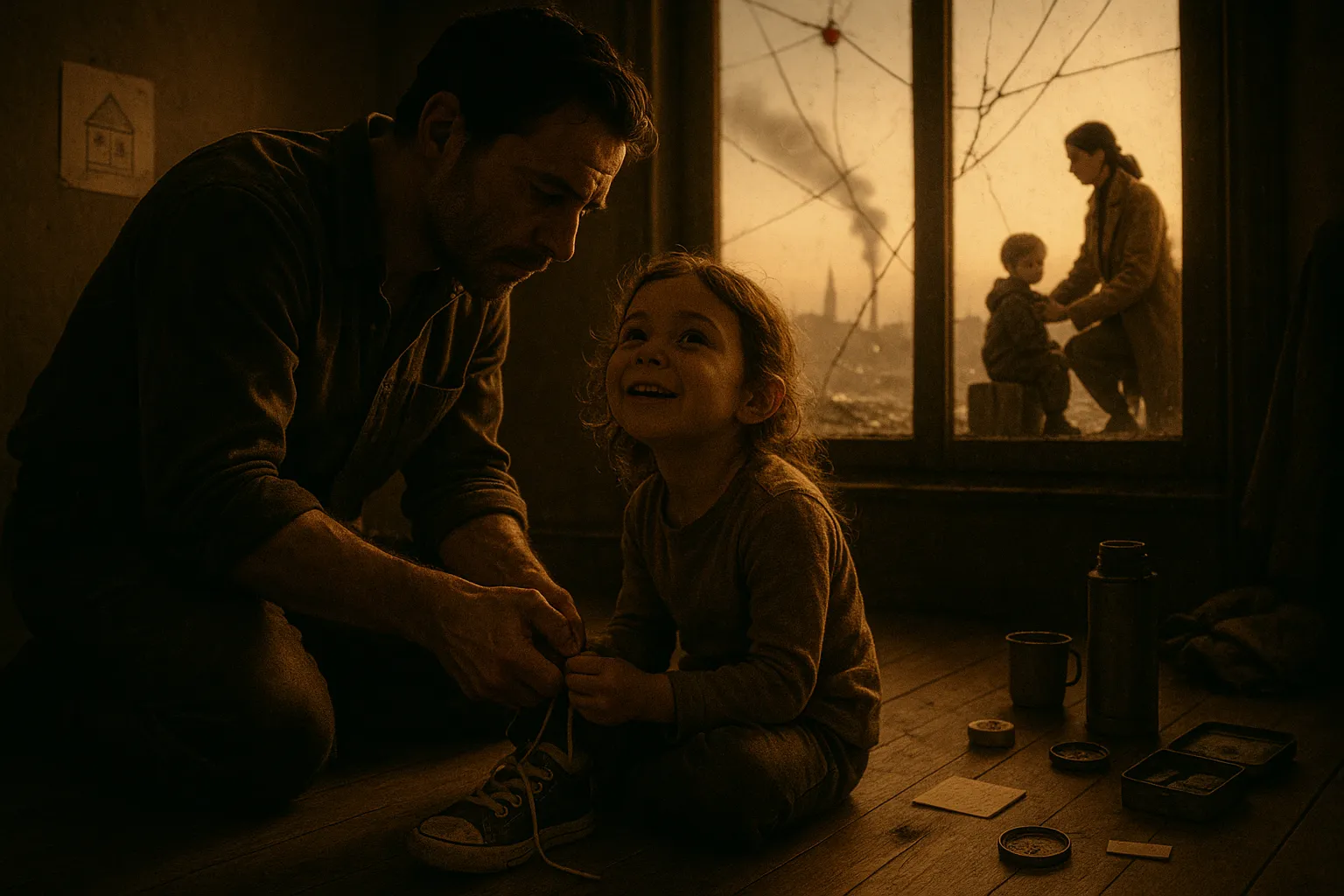
Crooked, over-tightened, one end longer — and that is exactly why it is hers. No robot would tie it that way, because a robot would do it beautifully. The glass is already cracked — but the ladybird walks calmly along the crack, as if a broken world were just another path.
I look at it and understand: perhaps everything I can pass on to a child in the age of war and AI is not the right skill set. But the experience that something difficult can be brought to the end with one's own fingers. That not everything has to be instant. That not every answer has to come from a screen. That an adult does not always know, but can remain nearby.
The number they frighten me with — was never born. The real children of my country — rare enough to ache. Between those two facts I make my bet: not on a world I do not know, but on a person I do. Because if I surrender her freedom to someone in a tie in exchange for a stranger's promise of certainty — then even if I predict the future world perfectly, I will not be sending a child into it. I will be sending a crutch that once knew how to walk, with a glittering report card in hand and the light gone out inside.
The future does not exist yet. But this knot already does. And as long as it holds, I will not give her first attempt to anyone — not the expert in a tie, not the school with the dead textbook, not the machine that answers faster than the child has time to think. The shoelaces, in the end, are not about shoelaces. They are the first small proof that her hands still belong to her. While you were reading this sentence, somewhere nearby your child is waiting for you to sit down on the floor.
Frequently asked
Where did the '65% of jobs don't exist yet' figure come from, and should it be trusted?
No — it's phantom statistics with no primary source. The trail leads from Cathy Davidson's 2011 book to a citation of an Australian government website that never existed; Davidson herself publicly disowned the number as early as 2012. Yet the figure keeps circulating — US Education Secretary Betsy DeVos waved it around in 2017. Practical takeaway: any 'scary number' without a verified primary source is an anxiety-sales instrument, not analysis.
What is 'cognitive debt' and does science prove that AI damages a child's brain?
No, it does not prove this — and it is important to say so honestly. 'Cognitive debt' is a term from an MIT Media Lab preprint (Kosmyna et al., 2025) in which n=54 ADULTS wrote essays: the ChatGPT group showed lower neural connectivity on EEG and weaker recall of their own text within the experiment. This is a signal-hypothesis on adults, not a verdict on children's brains, and it is not peer-reviewed. Gerlich's study (2025) showed a correlation (not causation) between intensive AI 'cognitive offloading' and lower critical-thinking scores. Honest framing: a reason for caution in parenting, not proof of harm to children.
What do the real WEF and OECD numbers actually say about the labor market up to 2030?
WEF (2025) projects 170 million new jobs created and 92 million destroyed — a net gain of only 78 million, but with 22% churn inside: every fifth job either emerges or disappears. OECD (2023) records that already ~27% of jobs in developed countries are at high risk of automation. Meanwhile, 'skills instability' is actually falling: 57% (2020) → 44% (2023) → 39% of existing skill sets will transform or become obsolete by 2030 — a declining trend the anxiety industry suppresses, because a falling wave sells less well.
What is the 'AI-second' rule and why does a child need it?
The rule is simple: the first attempt is human. The child tries on their own first, then asks a person, and only then AI — and even then not 'do it for me' but 'ask me questions / show me the weak spot.' The difference between a crutch and a dumbbell: a crutch removes the load, a dumbbell creates it. If after AI the child found it easier but did not get stronger — that is a loan against their future brain. AI should not be the first adult a child turns to when things are hard, boring, or frightening.
How does an analog father pass on the 'right column' to a child who grew up inside the machine?
Not through teaching, but through ritual. Emotional resilience, the ability to endure uncertainty, the skill of telling truth from plausible — these are not information; they cannot be delivered by lecture; they are absorbed through the body in shared time. A family dinner without screens, reading aloud, thinking out loud in front of the child (with dead ends and corrections), protected zones where no machine enters. You are not passing on knowledge (it will be obsolete in two years) but a way of being (it will hold for a lifetime).
Comments
Signed-in readers only — to keep it human, not a bot swamp.