Self-Measurement That Backfires: Rewards Reduce Intrinsic Motivation (d≈−0.34), Orthosomnia Ruins Sleep — the Limits of Tracking
Rewards erode intrinsic motivation by d≈−0.34 (a meta-analysis of 128 studies): pay yourself for what you loved, and it becomes a job. Orthosomnia (3–14%) is when you chase the 'perfect' sleep score until you sleep worse. The market for gadgets that measure you is $84–93bn. This text is about the over-engineered self vs. the unmeasured: the science, an honest counter-argument (where measurement saves lives), and a detailed 'measure → learn → switch off' stack. Because the most expensive device measures not your body but your anxiety — and sells you the cure for an anxiety it manufactures.
On this page
- I. The man who turned “not dying” into a full-time job
- II. The number first: pay yourself for love, and it becomes a job
- III. Goodhart, aimed inward
- IV. When the cure becomes the disease
- V. The strongest objection: the unmeasured is often romanticized laziness
- VI. The practical stack: measure → learn → switch off
- VII. Why now
- VIII. Who profits — and who pays
- IX. Instead of a conclusion
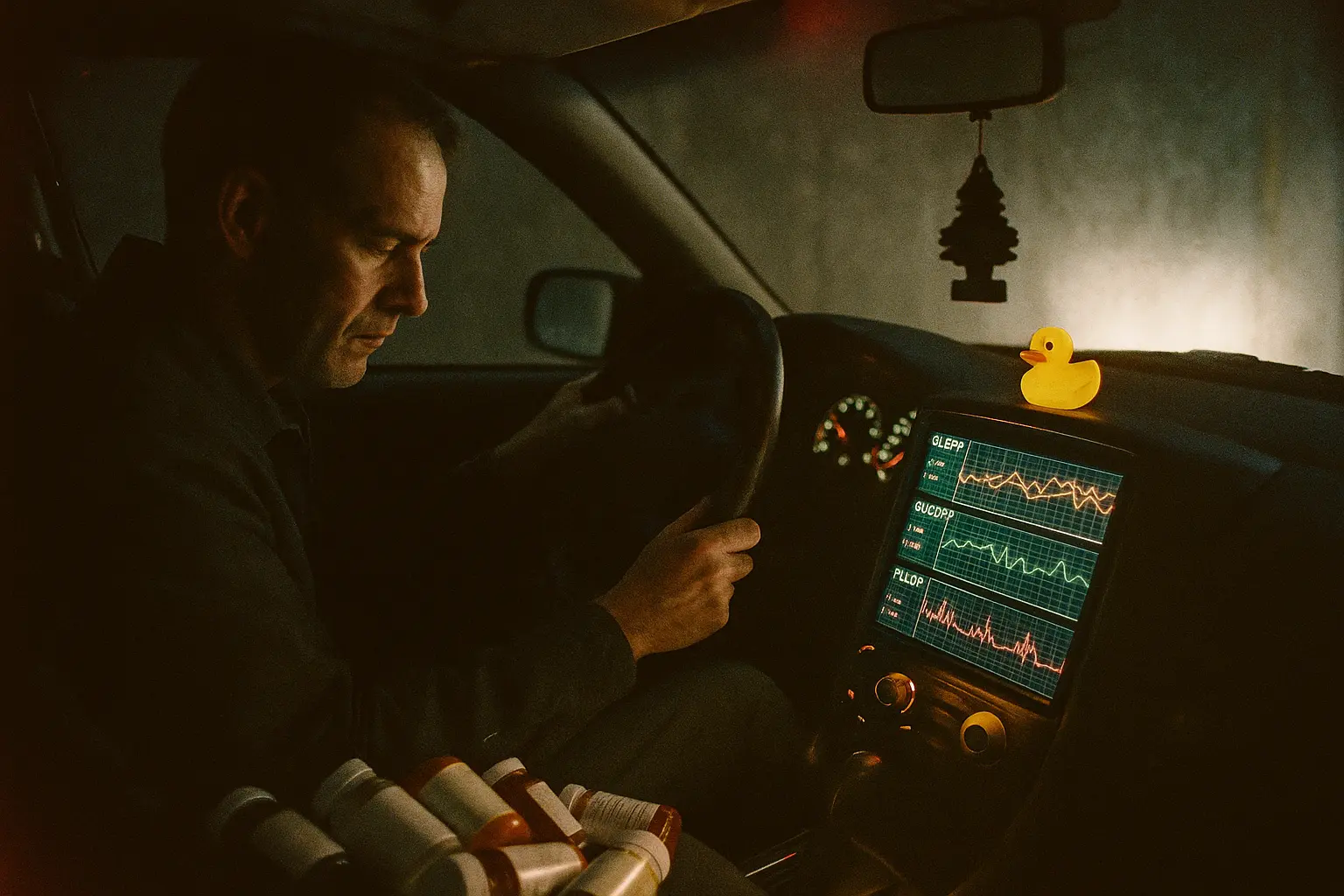
You can drive a car watching the instruments, or watching the road. The over-optimizer tunes the dashboard so diligently that he drives into the wall the windshield would have shown him.
I. The man who turned “not dying” into a full-time job
There’s a person who turned the refusal to die into a full-time job. Bed at 8:30 p.m. Last meal of the day around 11:30 a.m. Sleeps alone. No spontaneous trips, no small talk. Over forty supplements and compounds a day, a full stack of more than a hundred items, including prescription and experimental ones. It runs to roughly two million dollars a year. The only “clinical trial” of this protocol had one subject — himself. He even drew up a public list of “ten reasons women will hate me.”
And then — the plot twist the whole text ought to start from. In 2025–26 this same high priest of optimization dropped part of the protocol: cut rapamycin (“the benefit doesn’t justify the side effects” — skin infections, lipids, pulse), trimmed other doses. Even the man who optimized himself to the edge began to de-optimize. That’s the most honest frame for this conversation: the question isn’t “to measure or not,” but where the line runs past which you’re no longer the device’s owner but its servant.
II. The number first: pay yourself for love, and it becomes a job
The most important science here is old and dully well-proven. In 1973, children who already adored drawing were given a reward for it — and they drew less. They called it the overjustification effect: a meta-analysis of 128 studies gave an effect of d ≈ −0.34 — tangible expected rewards reliably undermine intrinsic motivation. The brain rewrites “I do this because it’s mine” into “I do this for the number.”
Now apply it to yourself, without anesthesia. When you hang a metric on something you loved — on sleep, on food, on running, on a journal kept for the “streak” — you do exactly what ruined drawing for the children. The most expensive device measures not your body but your anxiety — and sells you the cure for an anxiety it manufactures itself. Measure to learn — and have the discipline to switch off when the sensor has stopped teaching and started taxing.
III. Goodhart, aimed inward
The Quantified Self movement was born in 2007 from a fine slogan — “self-knowledge through numbers.” At the very first gathering, as movement legend has it, the first speaker stood beside a handsome three-year graph of his sleep and work — and couldn’t say what exactly he had learned. The whole critique was already sitting in the scene of its birth.
Because the Campbell–Goodhart law applies here, aimed inward: once a measure becomes a target, it stops being a good measure. The runner racking up steps for the counter. The person who eats “to macros” rather than to hunger. The journaler optimizing a streak of entries rather than a thought. The thermometer was a tool — and we started feeding the thermometer. Add to this self-objectification (Fredrickson and Roberts): when you look at yourself through the eyes of an outside observer-evaluator, you get not control but anxiety, shame, and — worst of all — a dulled sense of your own body from within. The dashboard quietly outsources the very intuition you bought it for.
IV. When the cure becomes the disease
Medicine already has names for crossing the line. Orthorexia (term coined in 1997) is when concern for “correct” food becomes a pathology: all of life’s value is transferred onto the act of eating. Orthosomnia (2017) is when the chase for a “perfect” sleep score makes you sleep worse: people who slept beautifully began lying in bed longer to pad the number, trusted the gadget on their wrist more than their own body, and got irritated by any night under the “perfect” eight hours. The first population estimate gave 3% to 14% depending on the threshold. A healthy person watches a banana “spike” their glucose to 140 and rebuilds breakfast around a number their pancreas handled perfectly well anyway. The device manufactures the very anxiety it promises to remove.
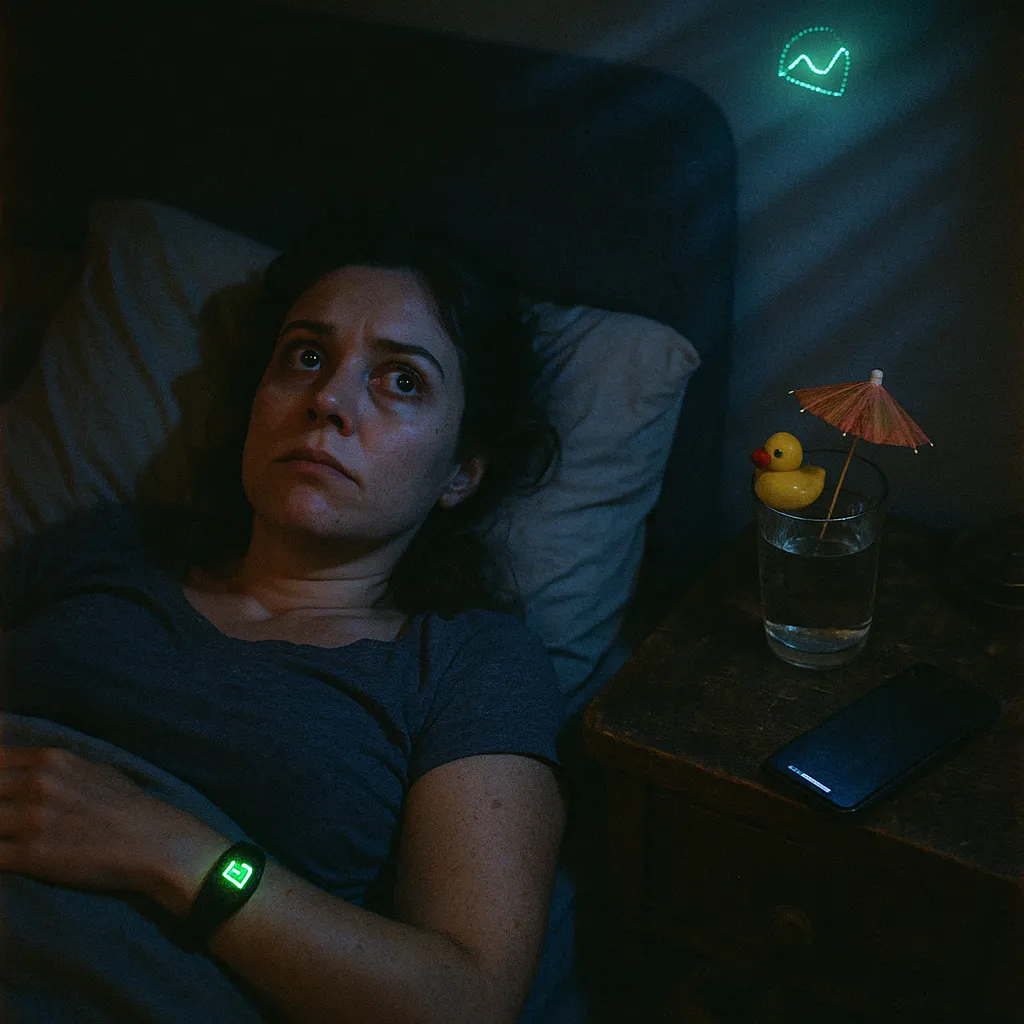
Orthosomnia in a single frame: the tracker shows “perfect sleep” while its owner manufactures, with her own hands, the sleepless night it warned her about. The cure became the disease — and it glows in the dark to make sure you don’t fall asleep.
V. The strongest objection: the unmeasured is often romanticized laziness
Here the text must honestly take the opponent’s side, or else it’s a Luddite pamphlet. The strongest objection is twofold.
First: measurement genuinely works where the question is real. Continuous glucose monitoring saves a diabetic; a sleep tracker catches undiagnosed apnea; lab tests catch a disease creeping up. Jerry Muller, the author of The Tyranny of Metrics, is not against measuring; he’s against fixation on the metric that replaces judgment. Second: the “unmeasured life” easily becomes a self-congratulatory excuse — “bed rotting” as “therapeutic laziness,” a phone-free flight as virtue, can just be ordinary avoidance in the costume of wisdom. And some people genuinely need structure: with ADHD, depression, in recovery, or when your own bodily sense lies, an external metric is a prosthesis for a broken compass. Telling such a person to “just listen to your body” is advising someone whose compass spins to navigate blind.
What the objection doesn’t account for: the overjustification effect (−0.34 isn’t zero; to measure love is to risk killing it); the ortho-tail (3–14% of the anxious-perfectionist group); and the cost of a finite life spent on self-maintenance (the same bargain: is it worth winning the game of “not dying” if you never live inside it?). The strongest evidence for tracking is clinical and limited; the cultural practice is endless staring at a lag metric. So the synthesis isn’t “track or not,” but — measure to learn, and have the discipline to stop.
VI. The practical stack: measure → learn → switch off
This is the heart of the text, because without it it’s just one more essay that complains beautifully. The core of the cycle: track to answer a question, not to live inside the dashboard. The moment a metric stops teaching, it starts taxing.
- Name the question before you buy the sensor. “Does late coffee break my sleep?” — not “let me measure everything.”
- Set a timer — 2–4 weeks, not forever. A diagnostic sprint, not a way of life.
- Extract the lesson → translate it into a rule that works without the device (“no coffee after 2 p.m.”).
- Take the sensor off. The win is in the absorbed habit; the gadget was scaffolding.
- Measure again only on a real signal (a new symptom, a big change), not on calendar reflex.
| Track (high signal, limited) | How long | Never / protected virgin zone |
|---|---|---|
| Glucose — if diabetes/prediabetes (real clinic) | As prescribed by a doctor | Hunger, satiety, taste, pleasure in food |
| Sleep — in acute deprivation / suspected apnea | Diagnostic window, then stop | Whether a night "counts as good" — ask the body, not the ring |
| Weight/labs — when a doctor flagged a marker | Until it's corrected | Self-esteem, mood, "whether you earned rest" |
| One habit you're actively changing (steps for a month) | The change window | Sex, play, conversation, creative flow, grief |
| A symptom diary for the undiagnosed | Until there's an answer | Spontaneity, boredom, daydreaming, doing nothing |
Three rules that hold it all together:
- Minimum effective dose: the fewest metrics that answer the question. One question — one sensor — one window.
- Lead vs. lag: track leading indicators you control (bedtime, steps), not lagging ones you can only stare at (sleep score, weight, “biological age”). Lag numbers breed anxiety; lead numbers breed action.
- Protected virgin zone: declare whole domains permanently off-limits to digitization — food, intimacy, rest, awe. The sense of the body from within survives only where it’s left room to speak.
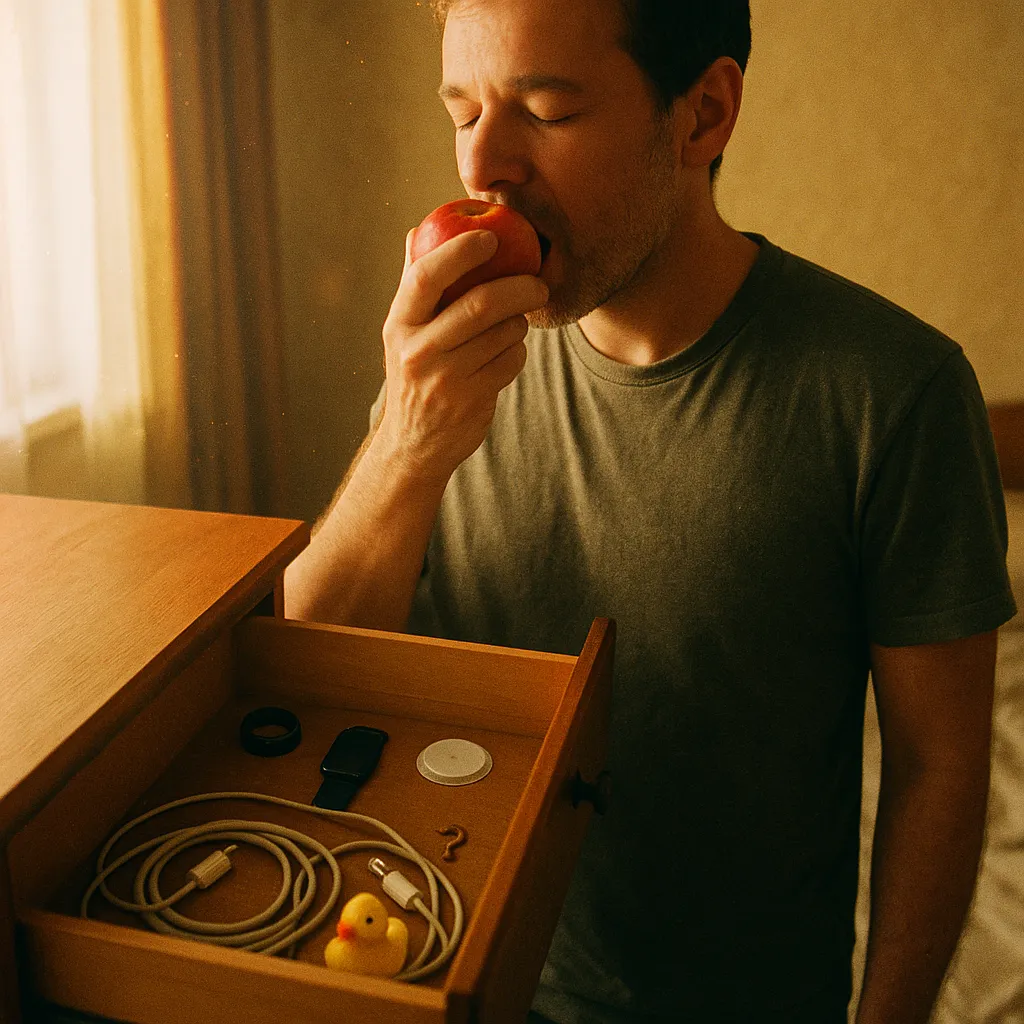
Measure → learn → switch off: the gadget was scaffolding, the win is the absorbed habit. The “machine of self-knowledge” most often ends up where old chargers lie — next to a forgotten rubber duck.
VII. Why now
The pendulum is right now at the middle of its swing — which is exactly why it’s timely.
- 2018: The Tyranny of Metrics comes out as institutions drown in dashboards.
- 2020–2023: gadgets go mass-market (hundreds of millions of smartwatch users; Oura sold its 5.5-millionth ring, Whoop valued at around $10bn), and the pandemic turns everyone into a home bio-monitor.
- 2022–2026: the $2-million-protocol story becomes the cultural reductio of optimization; “bed rotting” appears as the first counter-trend; “raw-dogging” a flight with no screen becomes a viral feat of endurance (a culture so over-stimulated that doing nothing became an achievement). In 2024, over-the-counter glucose monitors land on healthy arms (the “wellness” buyer market is around $154m, with no proof of benefit for the healthy). And then even the high priest de-optimizes.
VIII. Who profits — and who pays
The incentives here are crystal clear. Who profits: gadget makers (a $84–93bn market), the supplement industry (sells the stack), glucose-monitor makers opening up the healthy market with no proof of benefit, and subscription apps that render your body into a feed every month. Who pays: the anxious optimizer — in money, attention, sleep (orthosomnia), food (orthorexia), inner joy (overjustification), and a sense of the body outsourced to the wrist.
The formula is merciless: the industry sells the cure for an anxiety it manufactures itself. Goodhart’s law is profitable — for everyone except the one being measured. And ⅓ of people, by the way, eventually toss the tracker into a drawer — the “machine of self-knowledge” most often ends up where the old chargers lie.
IX. Instead of a conclusion
The unmeasured self isn’t laziness or Luddism. It’s an engine that simply runs: a little under-tuned, alive, unsupervised. The over-engineered self is an engine tuned to the point where it can no longer idle: a person optimized into an expensive eating disorder, as one critic aptly put it.
So literacy here isn’t “track more” or “throw it all out.” It’s a single move: measure to learn — and find the courage to switch off when the sensor has stopped teaching. Because the goal was never a perfect score. The goal is the life that score was supposed to serve, not replace.
The cheapest way to ruin anything is to hang a number on something you already loved. The most expensive dashboard in the world is a windshield painted over with figures: you see every graph of your body and not the road it's driving down. Take the ring off for one night. If without it you don't know whether you slept well — the problem isn't your sleep. The problem is that for a few years now you've been asking about yourself everyone but yourself.
Frequently asked
What is «Goodhart-on-yourself», and why does it ruin exactly what you loved?
It's the Campbell–Goodhart law aimed inward: the moment a measure becomes a target, it stops being a good measure. Hang a number on sleep, running, or a journal — and you optimize not sleep but the sleep score; not a thought but a streak of entries. The metric that was supposed to teach you quietly becomes the thing you live for — and stops being a metric.
What is orthosomnia — and how is it different from ordinary insomnia?
Orthosomnia (coined in 2017) is when chasing a «perfect» sleep score makes you sleep worse: people who slept beautifully began lying in bed longer to pad the number, trusting the ring on the wrist more than their own body. The first population estimate gave 3–14% depending on the threshold. The blunt difference: insomnia happens to you, orthosomnia you manufacture with your own hands — on a subscription.
If measurement genuinely saves a diabetic and catches apnea, isn't the «unmeasured life» just romanticized laziness?
The strongest objection, and partly right: measurement works where the question is real, while «bed rotting» as «therapeutic laziness» can be ordinary avoidance in the costume of wisdom. But the evidence for tracking is clinical and limited; the cultural practice is endless staring at a lag metric. So the synthesis isn't «track or not», but — measure to learn, and have the discipline to stop.
What is the overjustification effect, and why is −0.34 not a trifle?
It's when an external reward erodes intrinsic motivation: in 1973 children were paid for the drawing they already loved — and they drew less. A meta-analysis of 128 studies gave an effect of d ≈ −0.34: tangible expected rewards reliably kill «I do this because it's mine». −0.34 isn't zero, so to measure love is to risk killing it; the quantified self pays for self-knowledge with the joy of the process itself.
Okay, I'm convinced. What concretely do I do tomorrow to check whether I own the device or serve it?
The cycle «measure → learn → switch off»: name the question before you buy the sensor; set a 2–4 week timer; extract the lesson into a rule that works without the device («no coffee after 2 p.m.»); take the sensor off. Hold two tests — track lead indicators you control (bedtime), not lag ones you can only stare at (sleep score); and declare food, intimacy, rest off-limits to digitization. If without the ring you don't know whether you slept well — the problem isn't your sleep, it's that for years you've been asking about yourself everyone but yourself.
Comments
Signed-in readers only — to keep it human, not a bot swamp.