The Nehaj Protocol: Pirates Raised by a Border, and a State That Said 'Not Us'
The strongest wind ever recorded in Croatia hit 248 km/h. A few thousand refugees on bare rock turned it into a business partner and held Venice, the Habsburgs, and the Ottomans by the throat for four centuries. This is the story of the Uskoks of Senj — pirates raised by a border and unpaid wages. And about the Nehaj Protocol: four moves by which any empire creates an uncontrollable force of its own, then pretends it isn't hers.
On this page
- The word that means escape
- A port with no hinterland, and a fortress built from churches
- When the wages don’t arrive, the raid becomes the wage
- The bora as a business partner
- Three empires and one gray zone
- A head on the dinner table
- And what if Venice was right?
- How to switch off a system
- Four truths at once
- The long memory of a word
The strongest wind officially recorded in Croatia blew at 248 kilometers per hour — December 1998, the Maslenica Bridge. Unofficially, nearby instruments caught gusts past three hundred — but those readings were already off the calibration scale, so the record stayed unrecognized. That's meteorology, not history.
But one small military nest on the Adriatic turned that wind into a business partner. A few thousand people, a few dozen rowing boats — and four centuries ago they held three empires by the throat at once. They were called the Uskoks. The word means "those who leapt across": across the border, away from the Turks, into someone else's service. Not a people. Not a gang.
The Uskoks are the frontier's operating system. The empires assembled it themselves, out of refugees and unpaid wages. Then they were surprised it ran without a remote control.
The border made soldiers out of peasants. Scarcity made raiders out of soldiers. The sea made pirates out of raiders. And the state pretended it wasn't hers.
The word that means escape
First came the destroyed homes. Ottoman pressure in the sixteenth century pushed people out of the Balkans northward and westward, into a narrow strip between the sea and the mountains. The Habsburgs caught these fugitives in a net historians call the Military Frontier: a buffer zone where a refugee was given land, a weapon, and one task — keep the Turks from going further. A peasant fleeing war was issued war as his new address.
This war had its own genre — Kleinkrieg, "the little war": not pitched battles, but an endless raid back and forth across the line. Croatian historian Sanja Lazanin describes the border not as a line on a map, but as a migration machine that ground people up without pause.
The emblem of the age is Klis, the eagle's-nest fortress above Split. On 12 March 1537, captain Petar Kružić led his men out to break the Ottoman siege — and was trapped outside the walls. His head was cut off; Murat-beg Tardić mounted it on a spear and raised it under the walls. The defenders looked at their commander's head — and surrendered the fortress that same day for the right to walk away alive. The psychological weapon outran the siege.
The survivors moved north, to a port whose name would become a curse across half the Adriatic. Senj.
A port with no hinterland, and a fortress built from churches
Senj is a port with no rear. Behind it rise the Velebit mountains, bare rock where nothing worth eating grows. The surrounding land is unfit for farming. So the town had to feed itself from the sea — and not with fish.
In 1553, Uskok captain Ivan Lenković began building the Nehaj fortress above the town. Emperor Ferdinand I paid for it; the stone came from churches and monasteries dismantled outside the town walls. The logic was pure bookkeeping: the Turks would burn those churches anyway, so let the holy stone serve as a bastion while it still could. During the 1965 restoration, the remains of an eleventh-century church were found beneath the fortress, along with a Glagolitic slab roughly nine hundred years old — God was, quite literally, laid into the foundation of the defense.
The fortress's name is still translated different ways: "never mind," "don't worry about it," or, plainly, "who cares." You could not invent a more fitting psychological protocol for an entire way of life. This is not architecture built to be admired. It's a diary entry: one more day, still not dead.
When the wages don’t arrive, the raid becomes the wage
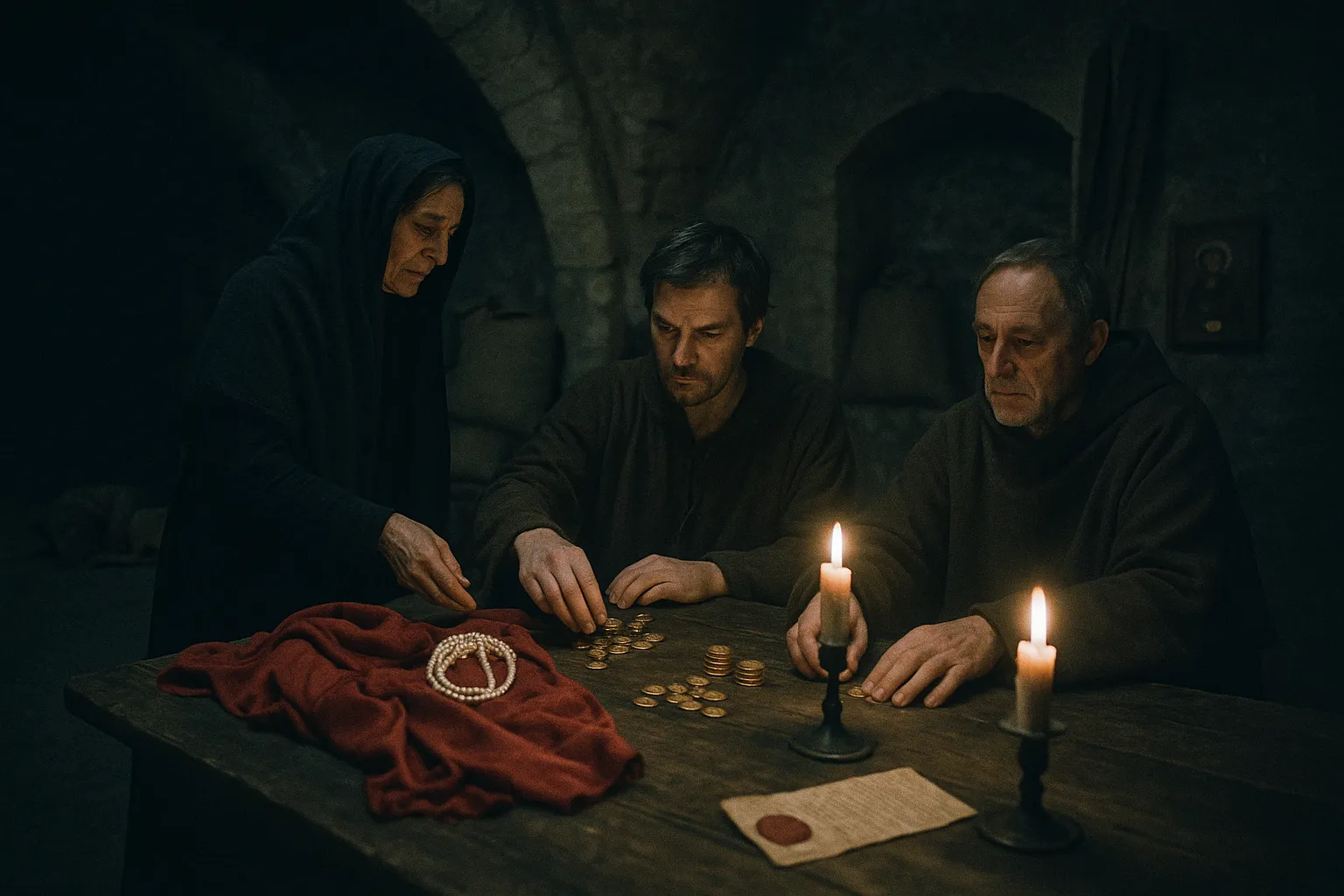
The Habsburgs promised the Uskoks pay. It came from the "levies of the Estates of Inner Austria," routed through several chancelleries, and arrived rarely — sometimes not at all, for years. Historian Alexander Koller describes the logic this way: when wages fall years behind, the raid becomes the wage. Plunder here isn't a crime against the system; it is the system, billing itself.
The bill was split by price list. In 1558, a quarter of any plunder worth more than 15 ducats went up the chain — to the border officials and the captain of Senj. Later the captain was left a tenth, plus the right to take an "especially fine" item for himself as a gift. The Uskoks themselves grumbled that they put their heads in the bag while the best of the loot went to the bosses anyway — and in the same breath admitted that this was, in fact, insurance. A Venetian observer noted that with this cut the Uskoks "built themselves their own Monte Albano" — in other words, bought protection from above.
The church took its tenth too. Senj's priests, and the bishop himself, received a tenth of the plunder in cash. The 1551 garrison payroll lists the name of Bishop Frane Živković — as an honorary soldier. In 1566, near Omiš, a priest was caught raiding personally alongside the Uskoks. A Venetian critic summed it up: the clergy didn't merely approve of the plundering, they "fully justified it on religious grounds, so that no evil was left without the clothing of virtue." Plunder with a theological aftertaste — and a receipt for the parish.
The very top brass wasn't shy either. The Venetians retold an endless tale about a pearl necklace: the Uskoks rob a Jewish merchant. Some time later, that same necklace is "coincidentally" spotted around the neck of the archduke's wife in Graz. A tall tale — but a persistent one, because everyone knew how the till worked. When Dubrovnik, in 1596, wanted the captain of Senj to finally execute the raider Maslarda, it instructed its agent to "spend as little money as possible" — up to five hundred thalers in bribes. Maslarda went on raiding calmly for another five years. Those five hundred thalers turned out to be Dubrovnik's best investment of the decade: five years of someone else's impunity, bought wholesale.
The bora as a business partner
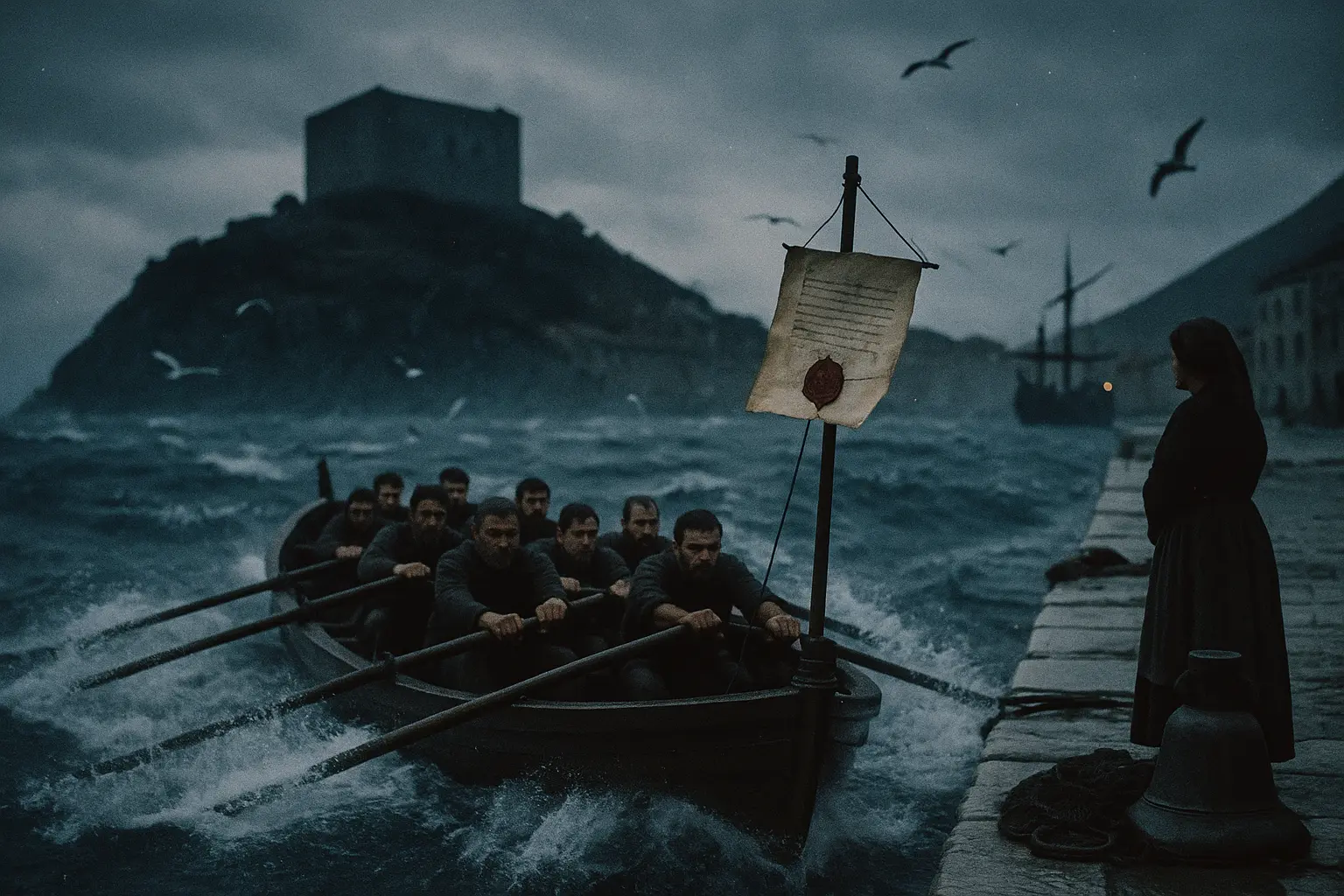
Now, about the wind. The bora is a cold northeasterly squall that drops off the slopes of the Velebit straight onto the water. Near Senj it regularly reaches 220 kilometers per hour. For a heavy Venetian galley, that's a death sentence — in such weather it hides in the coves or settles on the bay floor. For an Uskok boat, it's a work schedule.
The boats were built exactly for this. The small rowing barge — ten meters long, gunwale barely waist-high, six pairs of oars, up to fifteen men. So low that it was nearly invisible on the horizon until it was right on top of you. Lighter than a galley, faster, with a shallower draft — where the galley ran aground, the boat passed through. And what wouldn't pass by water, they carried overland.
| Parameter | Uskok rowing barge | Venetian galley |
|---|---|---|
| Draft | shallow, 0.3–0.4 m | deep |
| Bora during an attack | a helpful partner | a mortal threat |
| Overland portage | yes, carried by hand | impossible |
| Visibility on the horizon | near zero | visible from afar |
| Working window | night, winter, storm | clear day, calm sea |
That's the whole point — not courage, but environmental arbitrage. The Uskoks didn't beat the galley in a fair fight. They rewrote physics in their own favor: they went out at night, in winter, in storms — deliberately in the worst possible weather for their pursuer.
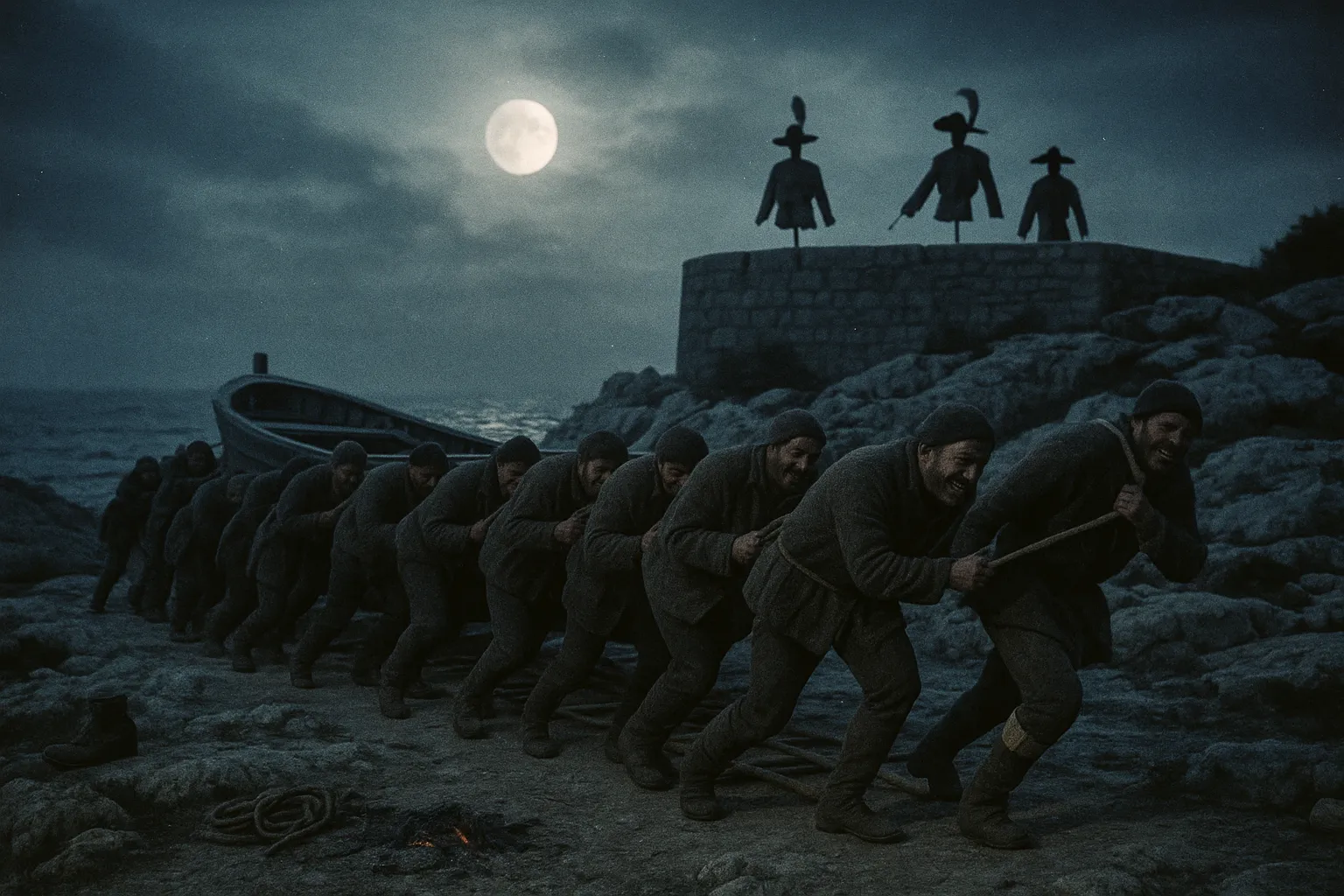
Christmas 1604, the island of Iž. The leader Jure Vranjanin, with eight boats, swept up around fifteen thousand head of livestock from the Ottoman shore — so much that his own vessels weren't enough, and he had to grab another dozen that weren't his. The Venetians sealed him inside the strait. So the Uskoks hauled seven boats onto land and dragged them across the entire island. Under the hulls they laid oars, cut olive branches, and freshly taken meat — in place of grease. And to keep the fort's garrison from interfering, they mounted heron-feather hats and sticks in place of muskets along the walls — and while the scarecrows "stood guard," they vanished into the sea. A few days later, for good measure, they seized a Venetian frigate carrying forty thousand ducats.
Against this, Venice fielded a "captain against the Uskoks" — for the entire upper Adriatic, two light galleys and three small fustas. Chasing a boat that hides in a creek or crosses an island on foot with that force is roughly like hunting mosquitoes with a boat hook.
Three empires and one gray zone
The interests of three empires converged over this nest — and none of them could either claim the Uskoks or get rid of them.
Venice considered the Adriatic her own bathtub. She called it custodia maris — "guardianship of the sea," the right to police the gulf and collect toll on it. The trouble was that after the 1540 peace with the Ottomans, Venice, "mistress of the seas," took on escorting Turkish merchant vessels as well. So a Christian republic was escorting Muslim cargo — and every time, Senj came flying out of the bora and wrecked this delicate business. You press "I own the sea," and out from under the Velebit comes a boat and takes the goods.
The Habsburgs kept the Uskoks — and at the same time disowned them. The formula sounds familiar: "we don't control them." This is a very early version of what's called today plausible deniability. The archduke in Graz accepted silk and jewels from Uskok plunder for his court ladies — and with the same mouth condemned the piracy of his own subjects.
The Ottomans applied pressure — but not on the Uskoks, on Venice: rein in your Christians, because this is your sea and your responsibility. It made a perfect triangle, where everyone had someone to blame except themselves.
| Empire | What it wanted | What it did | What it pretended |
|---|---|---|---|
| Venice | a monopoly on the Adriatic (custodia maris) | escorted even Turkish vessels | that she was the sea's "guardian," not its toll collector |
| Habsburgs | a cheap buffer against the Ottomans | kept and fed the Uskoks | that "we don't control them" |
| Ottomans | calm at sea and profit from trade | pressured Venice, not Senj | that it was someone else's, Venice's, problem |
And the market for stolen goods ran independently of diplomacy. Historian Fernand Braudel showed that the fencing of Uskok plunder rested on Trieste — a flea-market town where Turkish slaves for Tuscan galleys were sold next to stolen Venetian gold embroidery. The pirate robbed, the diplomat fumed, the merchant bought. Three floors of one building.
A head on the dinner table
When negotiations went nowhere, the empires sent in a cleaner. In 1601, imperial commissioner Count Josef Rabatta arrived in Senj with orders to "finally liquidate" the Uskoks. On 2 February he executed the leading captains, headed by Prince Martin Posedarski, hanged many more, and sent the rest off to die on the Turkish front. It looked as though the system had finally defeated itself.
That same winter, the system answered back. The Uskoks, led by Ivo Senjanin, who had escaped the February massacre, stormed the fortress, cut off Rabatta's head, and displayed it in the window — like a headline. As the story goes, the body was hung in the church, and the women of Senj licked the blood from his wounds with their tongues, to prove they were no gentler than the men. Worth pausing here: this detail comes from later romantic prose; there's no primary source for it. But it's telling — even the most bloodcurdling tall tales about the Uskoks came easily, because the reputation already justified everything.
The Uskoks already had a protocol — Rabatta's head in the fortress window proved that. Twelve years later they would repeat the exact same gesture: only this time the head would be Venetian, and the window would become a dinner table. The most famous scene: 12 May 1613. The Uskoks captured the galley of Venetian captain Cristoforo Venier off the island of Pag. In Senj they brought him ashore, cut off his head with an axe, stripped the body and threw it into the sea. And they set the head on the dinner table — and dined beside it through the whole meal. This is not legend: the scene stands in the Historia degli Uscochi, written by the Venetian Paolo Sarpi. The worst table manners on the Adriatic turned out to be the most exact: they seated the enemy in the place of honor.
And then propaganda begins — and it, too, is a source. Sarpi himself never settled on one version. Some testimonies said Venier's heart was eaten; others, that bread was merely dipped in his blood, on the belief that tasting an enemy's blood binds you to something. The Venetian chronicler publishes both versions and leaves the reader to pick the more terrifying one. When the author himself doesn't know whether it was the heart or the bread, he's no longer testifying — he's advertising horror. Venetian sources demonize, Austrian sources heroize, papal sources cautiously play diplomat; but even the lies record what people feared, and what they were selling.
The chain of escalation is simple. In the spring of 1613 the Venetians intercepted an Uskok fleet, beheaded sixty men, and displayed the heads on the Piazza San Marco, like goods on a counter. The Uskoks, so the story goes, answered with a recipe of their own: they seized a galley and kneaded bread with the crew's blood. Venier was only the loudest dish on that menu. The Venetian saying "God save you from the hands of the Senj men" held on so long that, two hundred fifty years later, it gave its name to a Croatian bestseller. Terror turned out to be a durable brand.
And what if Venice was right?
The temptation is to root for the Uskoks. Romantic songs, refugees, the wind, boats against an empire. So let's take an honest step to the other side.
Imagine yourself a Venetian merchant. You're no oppressor — you've put everything into one hold of silk and you're sailing to feed your family. A boat comes flying out from under the Velebit, and at best you lose your cargo, and at worst you lose your head, and your head ends up on someone's table. The Uskoks' victims weren't only "enemies": they cut down Christian and Jewish merchants alike, held them for ransom, sold people into slavery. A Morlach, a burned village, a child priced at eighty ducats — that too is the Uskok economy, just on the other side of the price list.
Venice wasn't innocent — she policed the sea for toll and monopoly. But her demand sounds reasonable: a state that keeps armed men on its payroll is responsible for what they do. "We don't control them" isn't an excuse, it's a diagnosis. And this is where the Uskok romance cracks: one man's frontier freedom is someone else's plundered hold and someone else's son on the slave market.
Both sides were right exactly as much as it suited them. On the frontier, morality stretches exactly to the size of the current need for plunder — and not an inch further.
How to switch off a system
Venier's killing became the pretext for war. In 1615–1617, the Habsburgs and Venice locked horns in what became known as the Uskok War — over Gradisca, in Friuli and Istria. Venice assembled a fleet of eighty-six galleys and smaller craft, and hired English and Dutch pirates against the Croatian ones — to defeat banditry, she bought banditry.
Here the young Albrecht von Wallenstein enters the stage — the same man who would go on to become commander-in-chief of the entire imperial army of the Thirty Years' War. For now he had simply grown rich off the inheritance of his wife, who died in 1614. At his own expense he equipped and personally led two hundred horsemen to the archduke — and with them broke the Venetian siege of Gradisca. The great career of one of the century's most fearsome figures began with a man buying his way into grand politics with two hundred horses.
The Treaty of Madrid was signed on 26 September 1617 — thousands of kilometers from Senj, by diplomats who had never once seen that sea. The terms were surgical. The Uskok boats: burned publicly. The companies: cut down to a thousand men. The Uskoks themselves: resettled inland, by some accounts some forty miles from the sea, into the area around Karlovac. A permanent Habsburg garrison was installed in Senj.
Sixteen years earlier, Rabatta had tried the sword — and his own head ended up in the window of the fortress he was supposed to clear out. Madrid tried the pen — and won where the sword had lost.
Think through the mechanics of it. The Uskoks weren't beaten in battle. They weren't exterminated. They were administratively switched off: their boats burned, cut off from the water, resettled on land where the frontier operating system simply doesn't boot. A fisherman without a sea is called a peasant. What was killed wasn't the people — it was the system.
Let's name it plainly. The Uskoks lived through the entire Nehaj Protocol — four moves any state makes with a frontier force of its own making. Create: settle refugees on the border and hand them weapons. Underpay: promise wages and withhold them for years. Exploit: quietly treat your capital to someone else's plunder. Disown: when the bill reaches the diplomats, say "never mind, not us." The same word — nehaj, "never mind" — that named the fortress eventually became the name for the way an empire rids itself of what it raised.
The Uskoks are not a gang and not a people. They are what grows when an empire creates a force on its own border, feeds it scarcity, and lives off its violence — then, at the moment of reckoning, says: never mind, not us.
The border made them soldiers. Scarcity, raiders. The sea, pirates. And Madrid pretended it was just burning boats.
Four truths at once
You can't look at the Uskoks through a single lens, because each one shows something true. Through the first, they're refugees driven out by war. Through the second, pirates who cut down merchants. Through the third, a proxy force, a cheap tool of someone else's politics. Through the fourth, a frontier caste with its own code, godparenthood, and blood-brotherhood. They even bonded in blood with their Turkish enemy, and then, under ransom agreements, lay down to sleep in the same bed with him. All four truths hold at once: victims, perpetrators, useful, uncontrollable.
Modern military analysts read this history as an instruction manual. In 2025, the Irregular Warfare Initiative published a piece by Robert Redding with a telling title — "Pirates or Proxies?" The logic is eternal: a patron buys cheap pain for the enemy and plausible deniability, then pays for it in the proxy's autonomy, escalation, and unmanageability. The Uskoks are piracy as a line item in the defense budget, with all its hidden interest.
Let's keep the analogy on a short leash. It's tempting to draw a straight line from the boats of Senj to the Balkan wars of the 1990s — the same rock, the same wind, the same songs. But a long fuse isn't a single cause. A border shapes people over centuries; blaming modern violence on some medieval gene just repeats the exact same convenient lie that Venice once used to demonize and Vienna once used to heroize. History here is a mirror, not a verdict on blood.
The border, scarcity, the sea, the state — and at every step, someone pocketed somebody else's plunder.
The long memory of a word
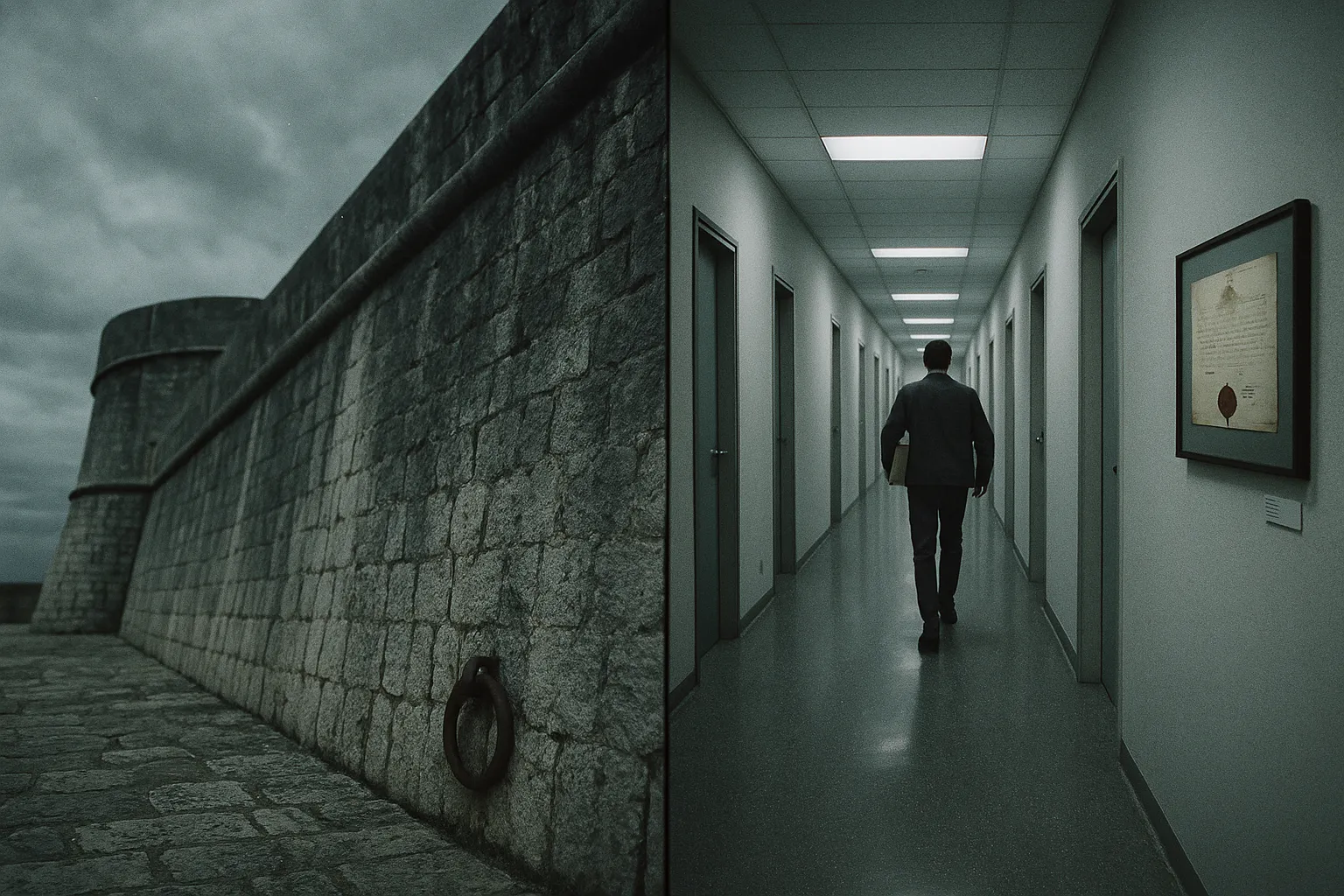
The word "Uskok" outlived the Uskoks themselves — and takes its revenge on them with irony.
Take their greatest hero. In song, Ivo Senjanin cuts down fifty thousand Turks with eight hundred sabers. In real life, Ivan Vlatković fought at Lepanto and at Klis — and in 1611 was arrested for stealing garrison grain. In 1612 his own side executed him in Karlovac. A pardon came later — posthumous, which is to say, for no one. The Adriatic's folk hero ended up a petty thief, executed by his own side over a sack of grain.
And now the best punchline that history itself wrote. In 2001, Croatia created an anti-corruption bureau and named it USKOK — deliberately, in honor of the very smugglers who didn't pay their taxes and robbed merchants. Journalists dubbed it "Croatia's Untouchables." The smugglers' descendants now catch corrupt officials in the smugglers' name. And since 2009 there's also a police unit with an almost identical name — so the pun could work two shifts.
The memory of the place is no less strange. In 1940, a German communist fleeing the Nazis arrived in Senj, met local homeless orphans nicknamed "Uskoks" — and wrote a cult novel about them, Die rote Zora (Red Zora). Its action unfolds by the Nehaj fortress. In Senj itself, the novel wasn't published in Croatian until 2017 — seventy-six years later. Meanwhile, every summer the town "returns to the sixteenth century": reenactors stage sea battles in the harbor. And meanwhile the USKOK prosecutor's bureau, named in their honor, handles entirely different cases, hundreds of kilometers from that harbor. In the end, the Uskoks won the only way left open to an ownerless force — they became a brand.
Let's tally up who got what.
| Player | What they got | What it cost, and who paid |
|---|---|---|
| Habsburgs | a buffer against the Ottomans for a century | in Uskok blood and a wrecked relationship with Venice |
| Venice | eventually "cleaned up" the sea | up to 360,000 thalers a year, and a reputation as a toll collector |
| The captain of Senj and the church | a tenth of every raid | nothing — paid by those who "put their heads in the bag" |
| The Uskoks | songs, a name, an anti-corruption bureau 400 years later | with the sea and the boats; Ivo Senjanin with his head, over a sack of grain |
| Merchants and captives | nothing | with holds, ransoms, and lives — for everyone |
No tribunal tried the Uskoks, and no fleet crushed them. They were simply pushed back from the water and penciled into the column marked "resolved." The border made soldiers out of peasants, scarcity made raiders out of soldiers, the sea made pirates out of raiders. And the state pretended it wasn't hers — and signed its name a thousand kilometers from the first blood spilled.
The word that once meant a leap across a border now sits printed on a prosecutor's letterhead. The empire that pretended not to see the Uskoks has long since been buried. The office named in their honor still works today — nine to five, with no wind anywhere on its list of excuses.
Comments
Signed-in readers only — to keep it human, not a bot swamp.