The Cost of Interruption: Up to 40% of Productivity Lost to Context Switching and ~23 Minutes to Re-Enter a Task
Why a 'quick reply' isn't a two-minute favour — it's a hidden tax on the nervous system. The economics of context switching: switch cost up to 40%, attention residue, ~23 minutes to recover, attention span collapsing from 2.5 minutes to 47 seconds over 20 years. Surgery built a sterile field with a silence protocol; the office is still an operating room with the doors wide open, where everyone walks in 'just for a sec' without covering their shoes.
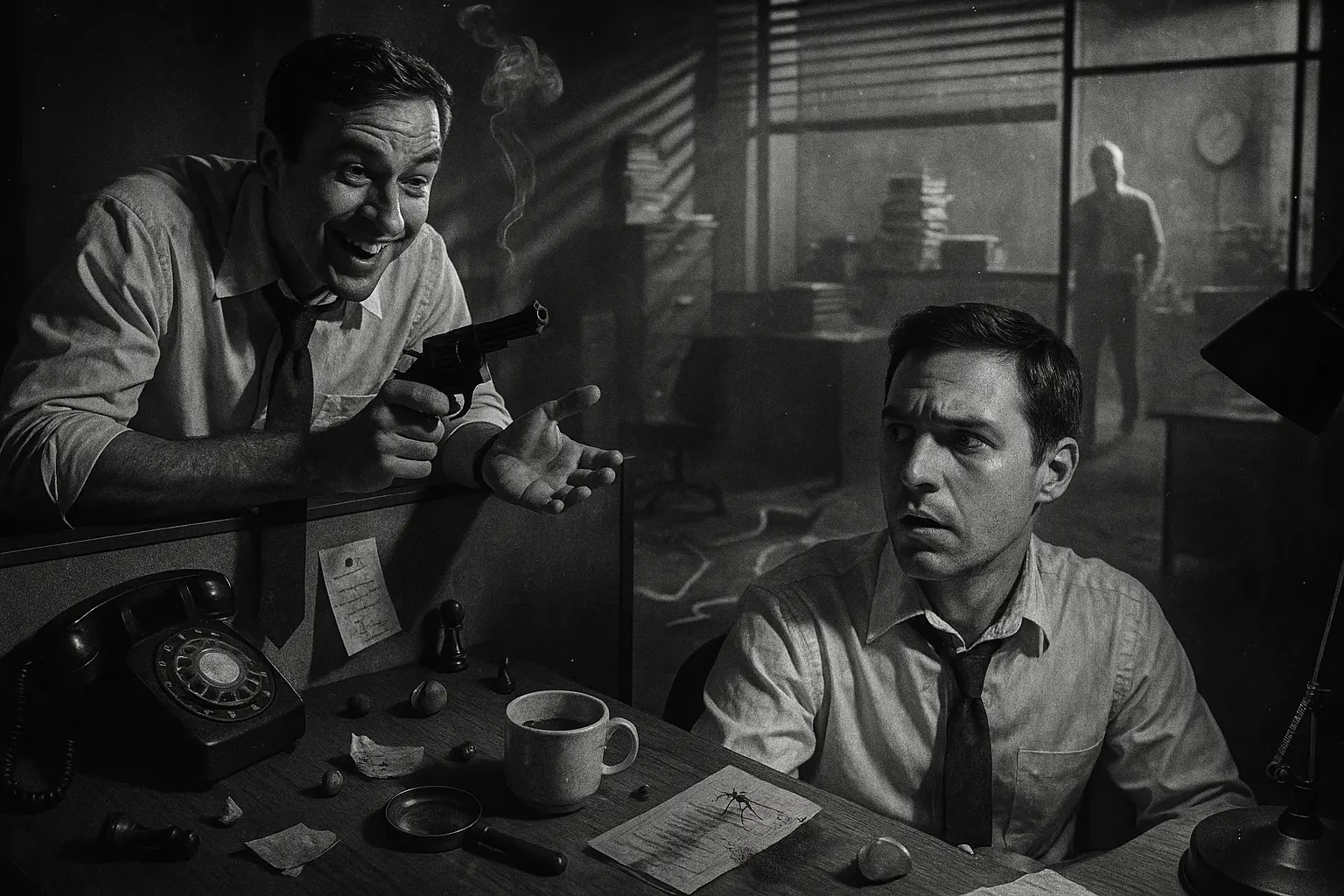
The cockpit where two men talked about used cars
11 September 1974. A McDonnell Douglas DC-9 approaches Charlotte on final approach. In the cockpit, two experienced pilots. They are not watching the altimeter. They are cheerfully chatting — about Watergate and Nixon's resignation exactly thirty-three days prior, about the used-car market, about some mutual acquaintance. A warm, pleasant, very human conversation between two professionals who work well together. Meanwhile the plane is descending lower than they think. Seconds later, Eastern Air Lines Flight 212 slams into a field five kilometres short of the runway. Seventy-two of the eighty-two people on board are killed.
The NTSB report phrases the cause with cold, almost clerical revulsion: impertinent conversation. Not engine failure. Not fog. Not metal fatigue. Conversation. Two competent people said a few words to each other at the wrong moment — words that had nothing to do with flying — and that was enough. Ninety seconds of attention bled out into nothing, along with seventy-two lives. The cheapest small talk in aviation history: entry price, a few remarks about the price of a used car; the bill, seventy-two bodies.
The industry needed six years to draw the lesson. In 1981, the FAA created the sterile cockpit rule: below three thousand feet — complete silence. Nothing that isn't about the flight. Not "please, if convenient," but law. Because it turned out that conversation at the wrong moment isn't politeness. It's a risk measured in bodies.
Now let's move to the place where the same discipline was rewritten in blood — not by pilots but by surgeons, and the surgeon will guide us through the rest of this piece. In modern operating rooms, 22% of operative time leaks to distractions, interruptions, and disruptions. Every fifth minute. A meta-analysis published in 2021 in the Int. J. for Quality in Health Care (27 studies): point estimate 22.0%, 95% confidence interval 15.7%–29.9%. The surgeon counts instruments, a nurse gets asked a question, the count is thrown off, it starts again. The scalpel that couldn't be accounted for sometimes stays inside the patient — to await its own report on a different table.
An honest note right now, because without it the number lies: those 22% are about operating rooms, not your open-plan office. To apply the price tag from under a scalpel to your Slack one-for-one would be the same contextual fraud this article is dissecting. I take from surgery not a number but a lens. The surgeon is the one person on earth who has already proven that interruption discipline can be made into a protocol — because the price of failure lies open on the table under the lamp. What the office calls "good manners" the operating room would call a sterility breach — and it is tried in court.
Because surgery did what the office hasn't even grown into yet: it sterilized attention itself. The sterile field is not only about microbes. It's a zone into which nothing unaccounted can enter — not an unwashed hand, not a spare word, not a "just a quick question." Break the field — you don't apologize, you go scrub your hands from scratch, full cycle. The surgeon doesn't believe in multitasking for the same reason they don't lick the scalpel: one unconsidered penetration costs not time, but a body. The knowledge worker's office, meanwhile, is still an operating room with the doors thrown wide open, where everyone walks in "for a second" without taking off their street shoes — and takes offence when asked to wait. The only difference: your shattered 90-minute block doesn't land in an NTSB report. It just vanishes. And you sign off the day as "productive" and go home as if you'd saved someone.
I wrote this piece in four sittings. Not because the material ran dry — there was more than enough. But because I kept getting interrupted. And the most humiliating part is that I organised half the interruptions myself: check a notification, "quickly reply" to one person, "just a second" in another chat. I — the person writing an essay about the cost of interruptions — couldn't hold my own attention longer than one paragraph. So let's start with an honest admission: I am not the doctor over this disease. I am the patient who has studied their own case history well enough to recognise the symptoms out loud — which is precisely why I spot the Colleague-with-a-second immediately: most often they are staring back at me from a mirror.
The antagonist named "just a sec"
This story has a specific villain, and the villain has a face. Not the abstract "distraction" of corporate well-being presentations. It's the colleague who inserts themselves into your space at the exact moment you've finally caught a thought by the tail. Or the team lead who at 16:47 on Friday types the word "urgent" followed by three dots. Let's call them the Colleague-with-a-second. Their calling card: "Got a minute?"
The genius of this phrase is its accounting lie. It poses as a modest request for two minutes — hardly anything, won't burden you. In reality it tables a bill for twenty-five minutes and a degraded following hour. And the most refined part: the Colleague-with-a-second's weapon isn't brazenness — it's your own politeness. Refusing "just a second" means looking rude, arrogant, "not a team player." So you yourself, voluntarily, sign your own sentence — and still thank the executioner for not making you wait long.
This is why the scheme is so durable. The cost of the interruption is always paid by the receiver — never the sender. For the person who interrupts, your attention is free: they spend one second of their own and buy twenty-five of yours. The best exchange rate in nature, and Slack and email are designed to make this robbery feel like normal communication. Notifications are on by default. And the green online dot is essentially a sign that reads "open — come in — wipe your feet on me" that you hang on your own forehead every morning and call it availability.
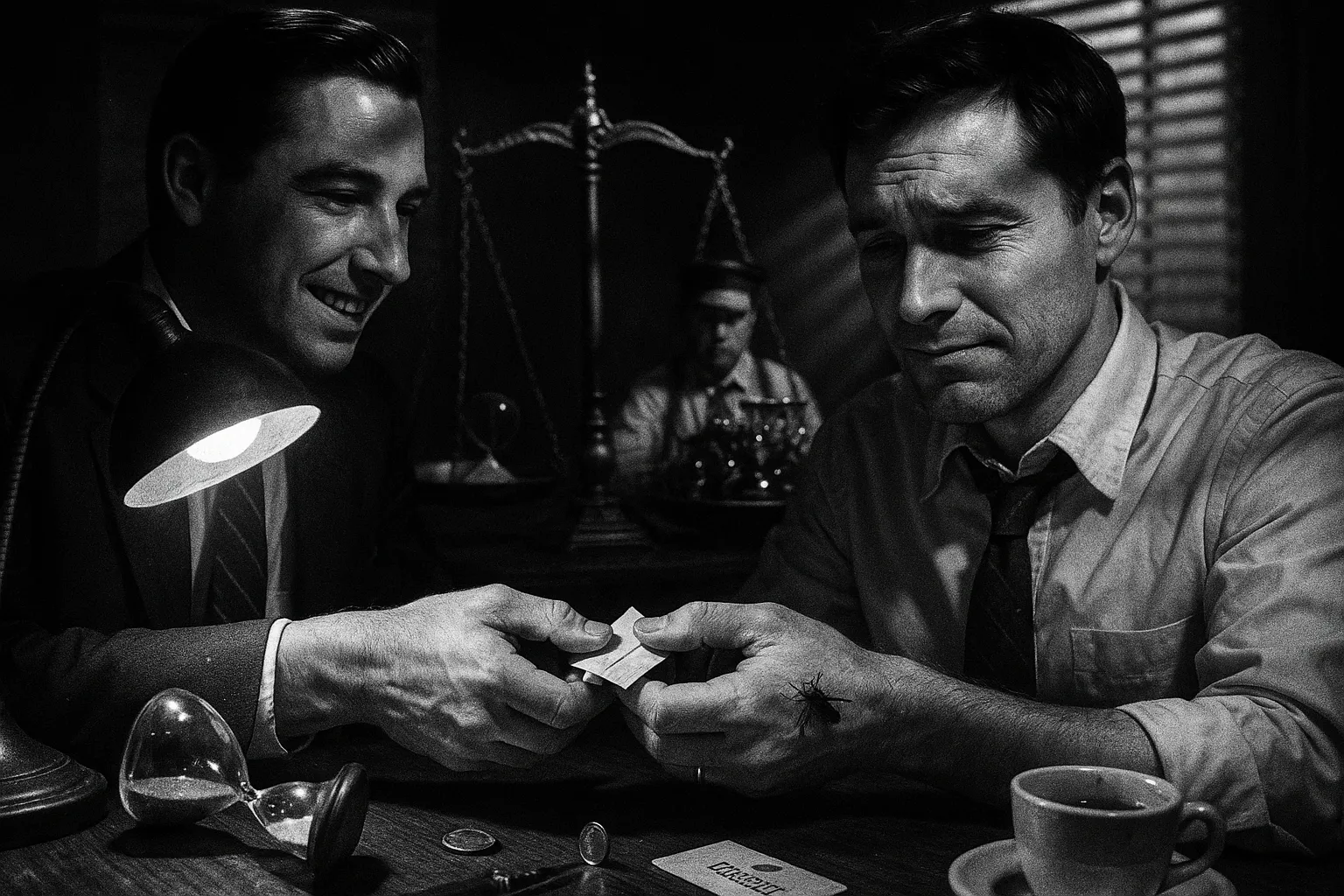
The Colleague-with-a-second’s weapon is not nerve — it’s your own politeness: you sign the contract yourself and then say thank you. On their scales, one feather of “one second” against two dozen of your hours. The mosquito has already bitten and is filling itself — feeding right in the middle of the transaction.
So what does one "second" actually cost? The most cited figure here — 23 minutes and 15 seconds to return to the original task, attributed to Gloria Mark, the researcher who has spent twenty years measuring attention in real offices. And this is precisely the number that should be laid on the table first — you take a history from primary sources, not hearsay, or else you're treating the wrong disease. Because here's the autopsy of that figure: it appears in none of Mark's peer-reviewed papers, and not even in her 2023 book "Attention Span" (which says ~25 minutes). The trail leads to a 2006 verbal Gallup interview where Mark mentioned it aloud — and since then the internet has copied it as scripture, without once looking at the case file. The symptom is eloquent: a text about the cost of unverified quick replies very nearly operates on an unverified figure.
And here is what Mark actually measured and published — and it's no less frightening. In the 2005 field study (CHI, "No Task Left Behind?") people worked on a task for an average of only about 10.5 minutes before being interrupted, and 57% of work "spheres" experienced interruptions. And — the detail every motivational retelling skips — roughly 44% of those interruptions were initiated by the person themselves. Half the incisions are made not by the Colleague-with-a-second but by the surgeon, who mid-suture sets down the instrument and goes to check whether anyone wrote in the chat. The typical task doesn't even reach adulthood: it's killed in childhood, and in every second case by the hand of its own parent.
So let's count together, aloud, the way a surgeon calls out every step to the whole team — so no one can later pretend they didn't see the numbers. 2 minutes for the "favour" itself plus ~23 minutes to return equals 25 minutes. One "I'll be quick" costs approximately twenty-five minutes of your life. Now multiply: five of those a day — and five is laughably few, that's just before lunch — and you've had over two hours of clean time written off. Not counting the immeasurable loss of depth. This isn't saving time. It's a loan at a thousand percent: you pay one minute and owe an hour — and the interest compounds silently, because the lender smiles politely and says "thanks, you really helped."
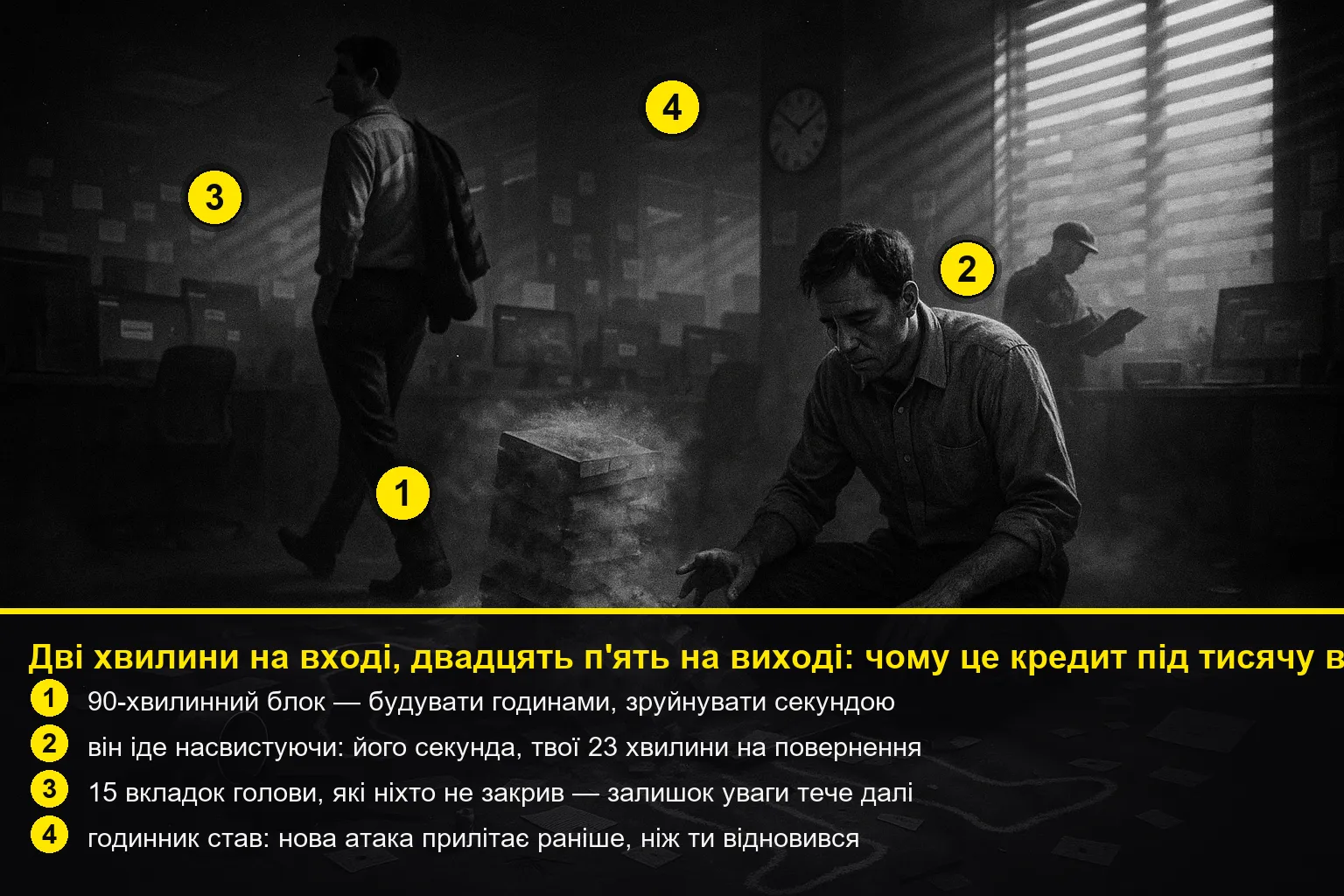
Build for hours, demolish in a second: that’s the entire arithmetic of “I’ll be quick.” They walk off whistling, because they don’t pay the bill — you do: 23 minutes to recover and a poisoned next hour. The mosquito is no longer landing — it’s already bloated with blood, heavy and sated, beside the body it drained.
The accountant who only counts visible line items
Picture an accountant who books only expenses that appear on receipts. Rent — there's a receipt, logged. Payroll — there's a ledger, logged. But the warehouse quietly burning, the wiring shorting, half the stock expiring on the shelves — none of that is on a receipt, so formally it doesn't exist. On paper, the company is profitable right up until the day it's bankrupt. This accountant isn't lying in the books — they simply don't look where it hurts, and call that optimism.
That's exactly how we calculate the cost of a "quick reply." The visible line item is two minutes of typing. Easy to see, so we see only that. The hidden ledger — where the money is actually bleeding — stays off the books.
The first hidden line is switch cost, the tax on switching itself. Psychologist David Meyer and colleagues Rubinstein and Evans showed in 2001 experiments that switching between tasks can consume up to 40% of a person's productive time. Not a folk-stat from a motivation seminar — this is the Journal of Experimental Psychology. The mechanism is almost mechanical: every switch has two stages — first a "goal shift" (deciding that you're now doing something else), then "rule activation" (turning off the rules of the old task in your head, turning on the rules of the new one). Each individual switch costs only a fraction of a second. But they don't disappear — they accumulate, like pennies in the lender's ledger, into those same 40%. Your brain pays a border tax between tasks all day and genuinely wonders where its attention salary went.
The second hidden line is attention residue, and it's the most insidious of all. Sophie Leroy in her 2009 experimental paper (the one that won the Best Paper Award) demonstrated something chilling: when you switch from task A to task B, part of your attention physically remains on A. You're already answering the Colleague-with-a-second, and a piece of your brain is still finishing the thought you hadn't completed. And the "denser" that residue, the worse your performance on the new task. In the sterile language of surgery this has a precise name: field contamination. A surgeon who touched something non-sterile and returned to the incision didn't "get slightly distracted" — they introduced an infection not visible today, one whose fever will spike tomorrow. So the quick reply doesn't just steal minutes now — it sows the residue of the previous task into the next hour, and that hour rots from the inside. You're physically present everywhere and mentally nowhere — the ideal operator for an era that confuses being busy with working, and a sweaty forehead with clean hands.
The third line has already been measured in minutes. The Qatalog report in partnership with Cornell's Ellis Idea Lab (survey of 1,000 respondents, 2021): after switching to another app, it takes a person an average of 9.5 minutes to return to a productive flow. The honest patient note here: this is self-report, not objective measurement of cognitive recovery — people rate themselves on when they feel "back in the flow." But even discounting for self-report optimism, the picture doesn't soften: not "click — and I'm working" but ten minutes of warm-up every time. Now the scale Harvard Business Review captured — not via survey, but telemetry: 137 users across three Fortune 500 companies, 3,200 days of logs. The average worker switches between apps and tabs nearly 1,200 times a day and burns "just under four hours" a week just on reorientation after switches — roughly 9% of annual working time. That's nearly five full work weeks a year spent asking yourself "what was I doing?" — a complete annual vacation you're taking not at the beach but in a browser tab.
| Line item | What the Colleague-with-a-second sees | What actually gets charged to you | Source of mechanism |
|---|---|---|---|
| The "favour" itself | ~2 min of conversation | ~2 min | visible line item |
| Return to task | 0 (you're "already free") | ~23 min (verbal, Gallup interview 2006); what was measured: ~10.5 min to interruption | Mark, interview 2006 / CHI 2005 |
| Ramp back to flow | 0 | ~9.5 min (self-report, survey) | Qatalog / Cornell 2021 |
| Attention residue | invisible | degraded quality for the next hour | Leroy, 2009 |
| Cumulative switching tax | 0 | up to 40% of productive time | Meyer et al., 2001 |
| Total for one episode | "just two minutes" | ~25 min + a poisoned hour | — |
The accountant who counts only the first row of that table is not an optimist. They are a bankrupt who hasn't yet noticed the warehouse is on fire. And the worst part: that accountant is you — the one who at six in the evening genuinely wonders why you "seemed to work all day" and got nothing done. The books balanced perfectly. There's just no company left.
The trap that rewards you for losing
Here's where the scheme becomes truly diabolical. Logic suggests: if interruption is harmful, the interrupted worker should perform more slowly. But the experiment by Gloria Mark, Daniela Gudith, and Ulrich Klocke (CHI 2008) showed the opposite — and that is precisely why the trap is perfect. The best trap isn't one that hurts at the gate. It's one that hands you a sweet at the gate.
The setup was simple: a simulated office, participants composing and answering emails, periodically interrupted by a "manager" with questions. The result: interrupted people completed the task not slower — but faster. Yes, faster. But they paid for that speed with higher stress, greater frustration, more effort, and a sharper sense of time scarcity. (The specific "7% faster" figure circulates in secondary retellings, so I give you the direction, not the exact number: faster — but more expensive for the nervous system.)
Let's unpack the mechanics of the betrayal. A brain that's been interrupted clenches and works more frantically to "catch up." You get a dopamine hit of "I managed it, I held my ground, I closed it!" — immediate, sweet, palpable reward. And the bill — stress, exhaustion, the feeling that the day ate you alive — arrives separately. Deferred. Anonymously. Without the sender's signature. This is the classic structure of all the worst addictions and all the worst loans: the reward is immediate and addressed to you; the price is spread out and nobody's. The casino also lets you win the first bet — just enough to keep you at the table until morning.
That's why "quickly replying" feels so good. You are literally rewarding yourself for losing depth. Every derailed task gives you a small firework of "I'm efficient," and you don't notice that the firework is burning your own wood. By the end of the day the wood is gone, the firework has died out, and the building you were going to construct is still a foundation. But how many times it flared up — and how tired you went home, as if you'd actually been building something.
The shore that sinks a millimetre at a time
One could console oneself that this is temporary, that we're just an overloaded era that will somehow level out. We won't. Because the most frightening thing here isn't a catastrophe with a date — it's a drift without any date. A catastrophe at least can be mourned; drift you can't even find time to notice — that would require holding your focus longer than forty-seven seconds.
Gloria Mark spent twenty years tracking how long a person holds attention on a single screen before switching. 2004 — an average of about 2.5 minutes. 2012 — 75 seconds. Recent years — 47 seconds. Independent replications gave 50 seconds and 44 seconds, meaning the number is stable — this isn't one lab's error. Over twenty years, the average screen-attention span fell from two and a half minutes to forty-seven seconds — and nobody decided one day to become like this.
Why now — in 2025–2026 — is this curve accelerating rather than flattening? Interruptions have always existed: the phone on the desk, the colleague in the open-plan office. But before, there was friction between them and the brain — you had to pick up the receiver, stand up, turn around. Today the interruption system has become part of an infrastructure nobody chose but everyone inherited. Copilot in VS Code suggests while you're thinking; Slack AI generates summaries of missed conversations and decides on its own what's "urgent"; after the pandemic, hybrid work destroyed async norms — there's always someone online in the Zoom room, and silence reads as indifference. On top of that, the business model of every app depends on open-counts: notifications are on by default not because it's more convenient for you — but because the company's DAU metric grows with every reflexive click of yours. The drift of attention is not a personal weakness of a manager or developer. It's a product someone intentionally designed.
This is the drift. Erosion, not explosion. The shore sinks a millimetre a year — imperceptibly, without calculation, no alarm raised — until one morning the house slides into the sea and everyone is surprised by how suddenly. The antagonist didn't break down the door with a battering ram. They seeped under the threshold, drop by drop, each one called "just a second." No battering ram needed when the victim leaves the door ajar every day "just in case something urgent comes up."
And let's add one more layer of reality on top of this drift — the one RescueTime captured across more than 50,000 users, measuring not self-reports (where everyone lies about being focused) but actual screen time. The average knowledge worker checks email or a messenger every six minutes. Six. The maximum of sustained focus a median human maintains — about forty minutes. And then the statistic that makes you want to close the laptop in a safe: 40% of workers never get even 30 minutes of unbroken focus in an entire working day. 17% never manage even 15 consecutive minutes. Only 30% get even one full hour of unbroken attention in a day.
Re-read those three numbers slowly — if you aren't interrupted mid-sentence. Most people who call themselves knowledge workers physically never enter the state in which knowledge work is even possible. It's like a surgeon who calls themselves an operator but is never allowed to finish washing their hands: just as the fifteenth second of scrubbing ends, a head pokes through the door with a question, and they go back to the sink. Developers feel this most sharply: Chris Parnin analysed 10,000 programming sessions by 86 programmers and found that after an interruption a person needs 10–15 minutes just to START editing code again, and when interrupted mid-method edit, only 10% return to work in under a minute. A typical developer gets barely one unbroken two-hour session per day. One. DeMarco and Lister in "Peopleware" arrived at the same figure from the other direction: roughly fifteen minutes to re-enter flow. The result: an operating room where the surgeon is sent to rewash their hands every six minutes, and then everyone is surprised the sutures are crooked and it's already getting dark.
The surgeon who steps away from the table themselves
Here the text must cut its own comfortable assumption — because until now it has been holding it the way a surgeon holds someone else's fault. Everything so far has painted the enemy as external: the Colleague-with-a-second, the team lead with three dots, the green online dot. A convenient diagnosis — blame "them." But remember the Gloria Mark figure that every motivational retelling quietly skips? Roughly 44% of interruptions are self-initiated. Almost half the incisions are made not by an assistant with a question but by the surgeon themselves, who mid-suture sets down the instrument and walks over to check whether anyone has written in the chat. The sterile field is most often broken not by the person who entered the operating room but by the person performing the operation.
And this isn't a minor difference in phrasing — it's the difference between two distinct floors of the disease, which are treated with different instruments. There is the systemic level: Slack defaults, the visibility culture, the DAU metric, the operating room with the open door. And there is the personal level: your own hand reaching for the phone the instant a thought becomes difficult. Confusing the two is a clinical error in both directions. Blame everything on the system — and you strip out the half you personally control; you start waiting for the manager to rewrite the defaults while never removing your own hand from the wound. Blame everything on yourself — and you take personal responsibility for infrastructure designed by corporations to make you break; that's self-flagellation dressed up as discipline.
Why do we do those 44% ourselves? Because deep work is painful. A difficult thought presses, uncertainty itches, and the brain does what every animal with an open wound does: looks for something to distract itself from the pain. Notifications are the painkiller that's always in your pocket. Self-interruption isn't laziness or weak character; it's anaesthesia from the discomfort of thinking that Slack pre-placed under your tongue and made appear free. The most honest and most uncomfortable operation in this piece is this one: to realise that in half of cases, the Colleague-with-a-second is looking back at you from the same mirror in which, every morning, you hang the green dot on your own forehead.
The strongest argument in defence — and why it doesn't hold
Not every "just a sec" is an act of robbery. There's an honest version of the always-on culture's defence, and it deserves an honest answer — otherwise this would be a prosecutor who bribed the judge before the session began. Start with the strongest case: the surgeon themselves — our running lens — will be the first to confirm that some signals don't wait. Arterial bleeding on the table doesn't defer until 17:00 — "code blue" cuts through any silence protocol, and rightly so. A manager who wants the team available often has the same logic: a live signal about a blocker won't wait; the serendipitous corridor conversation produces a decision no Notion document ever would; the isolated "deep work" silo sometimes means a developer spent three days amputating a healthy leg because they didn't ask a question in time. Team coherence lives on micro-signals, not only on syncs. This isn't management paranoia — it's a real coordination need, and it will be the last thing to disappear.
But here is where the defence falls apart on the table. The sterile field also has an exception for "code blue" — and that's precisely why it works: because the exception is defined, rare, and recognisable to everyone. The office's problem isn't that it lets a haemorrhage through to surgery. The problem is that it has declared every touch a haemorrhage — and now the surgeon stops the incision identically for an arterial bleed and for the question "where's the stapler?" Genuinely urgent blockers are rare; real serendipity requires a psychological resource unavailable to someone who's switched contexts 1,200 times before lunch; and "the manager needs a live signal" mostly translates as "the manager needs the feeling of holding the scalpel" — which is not coordination, it's anxiety with a leadership badge. A system where availability became the default does not reward coordination — it rewards visibility. The most available on Slack and the most productive are rarely the same person; an organisation that hasn't drawn a line between them is operating blind and writing off the difference from someone else's nervous system, with no line in the budget.
How to build yourself a sterile cockpit
Remember the finale of Whiplash. Drummer Andrew in a multi-minute solo — the world has disappeared, only hands, cymbals, and a rhythm consuming him entirely remain. That is the ninety-minute block worth living a working day for. And now the key observation that holds all the tragedy: to reach that state, Andrew rehearsed until his hands bled. To destroy it, one tap on the shoulder is enough. The cost of entry and the cost of destruction are absolutely asymmetric — build for hours, break in a second. The "just a sec" parasitises exactly that asymmetry: it builds nothing in a second, but in a second it breaks everything, and that's very nearly the only thing it does efficiently.
Both aviation and surgery answered this asymmetry the same way: not with advice, but with a protocol. "Below 3,000 feet — silence." "Before the incision — surgical time-out: the whole team stops, verifies the patient, the side, the procedure." No one left this to the goodwill and strength of character of a specific pilot or surgeon — because they knew that willpower at 16:47 on a Friday loses to fatigue. Individual discipline is the wrong level of intervention here, just as demanding a surgeon "just not touch the non-sterile" instead of removing the non-sterile from the field is. If Slack notifications are on by default and the culture rewards quick replies, no focus mantra will close this wound. Structural changes at the team and tooling level are required. Here's the protocol — without anaesthesia, but addressed not to your willpower, but to the default settings.
| Situation | Open microphone (as it is) | Sterile cockpit (as it should be) |
|---|---|---|
| Deep work | Slack open, notifications on by default, "in case something urgent comes up" | 90-min block in the team calendar as a meeting; messengers closed — not minimised, closed; default changed by the team, not personal willpower |
| "Got a sec?" | "Sure, of course" (cultural norm; refusing = "not a team player") | "In 40 minutes I'm completely yours — write down what you need, nothing will be lost" (team norm, backed by the manager) |
| Own urge to check | Reflexive click — result of app design, not of the person's character | One "clear communications" window — 12:00 and 17:00 — as a team agreement; microphone off for the rest of the day |
| Signal to the team | Green dot = "stomp through any time" — a default Slack never asked whether you wanted | Status "focus until 14:30," explicit norm: async is the default, sync is the exception, declared by the team |
| Genuinely urgent | Everything is "urgent" because there's no agreed definition of the difference | One separate channel for fires only; everything else by definition can wait 40 minutes — and the team knows it |
The essence of the protocol is brutal in its simplicity: the cost of the interruption should be paid by the person who interrupts. "Got a sec?" — "In forty minutes." Full stop. But that phrase is free to say only in a team that has already agreed that a deep block is a resource, not a display of antisociality. Where that agreement doesn't exist, every defensive "in forty minutes" is won from scratch, with your own reputation, against assumptions baked into Slack before you ever joined the team. If the manager hasn't changed the defaults — the problem isn't personal discipline. The problem is that the operating system is configured against you by default.
The four hundred and fifty billion nobody counted
And finally — the sharpest twist of the knife, aimed not at the Colleague-with-a-second but at the very industry that supposedly cures us.
Productivity blogs by the dozen repeat this figure: context switching costs the US economy $450 billion a year. Attributed variously to Gallup, HBR, Atlassian — it sounds weighty, it's pleasantly citable. There's only one problem: it can't be traced to any primary peer-reviewed source or methodology. It's a round number that acquired authority purely through repetition. Nobody verified it — everyone just forwarded it, because that's faster than thinking.
Do you feel the irony? The figure about the harm of quick replies is itself a quick reply. The critique of context switching is infected with the very virus it describes: give a round number instead of the slow truth, because checking the source is boring, long, and dopamine-free. This is the same genre as a surgeon delivering a lecture on sterility while eating a sandwich over an open wound: teaching hand-washing while dripping crumbs into the field. Even those who sell you "deep focus" hand out folk-stats on the run — a temperance sermon delivered half-drunk.
And here is the mirror I hold first in front of myself, because I have forwarded unverified things with a clean conscience more than once. How many "facts" that you live by and use to make decisions are unverified quick replies you once accepted on faith and forwarded without clicking the source? "Just a sec" creeps not only into your work block. It's already in the way you know things — you accept other people's conclusions with the same haste with which you answer other people's messages. Interrupted attention and interrupted thinking are the same crime; the second one just leaves no blood, which is why you don't even register it. (If you want a number at scale, honestly — take the verified four hours per week from HBR and calculate it yourself, transparently. It takes longer. But it's yours.)
Those two pilots over Charlotte wouldn't have been called negligent by anyone. Experienced, competent, likeable people who were simply talking — warmly, politely, the way we all do, constantly. The NTSB report called it impertinent conversation; in the operating room it would have been called a sterility breach; in your calendar it's called a "productive day." The same violation, three different forms — and blood only on the first one.
Your shattered block won't crash into a field or land on a table under a lamp. It will just quietly disappear — hour by hour, year by year, from 2.5 minutes to 47 seconds — and you won't even issue a death certificate, because there's no body, and so formally no one was cut at all. The surgeon at this table is you. You schedule half the incisions yourself, the field is open by a default you never chose, and someone keeps nudging the scalpel under your elbow with the words "got a sec?" The anaesthetic is in your pocket, the mirror is in front of you. Will you move your hand — or will they interrupt you one more time before you finish reading this sentence?
Frequently asked
Where does the '23 minutes to recover' figure actually come from, and can it be trusted?
This number doesn't appear in any peer-reviewed paper by Gloria Mark — not in her field studies, not in her 2023 book 'Attention Span' (which says about 25 minutes). The trail leads to a verbal Gallup interview from 2006 that the internet has been copying as scripture without ever checking the source. What Mark actually measured and published at CHI 2005: people worked on a task for an average of only ~10.5 minutes before being interrupted — and that's not recovery time, it's time until the next break.
What is attention residue and why is it more dangerous than the interruption itself?
Attention residue is a term coined by Sophie Leroy (Best Paper Award, 2009): when you switch from task A to task B, part of your attention physically stays on A, and the denser that residue, the worse your performance on the new task. In surgery this is called field contamination: a surgeon who touched something non-sterile didn't 'get slightly distracted' — they introduced an infection that won't show up until tomorrow. That's why a quick reply doesn't just steal 25 minutes now — it seeds the next hour with the residue of the previous task, and that hour rots from within.
How does a switch cost of up to 40% square with interrupted people actually working faster?
Switch cost (Meyer, Rubinstein, Evans, 2001, JEP) is the cumulative tax on all switching across a day: up to 40% of productive time goes to 'goal shifting' and 'rule activation' with each switch. Meanwhile Mark, Gudith and Klocke (CHI 2008) showed that interrupted people complete a specific task faster — but pay for that speed with higher stress, greater effort, and a sharper sense of time pressure. Classic trap: the immediate dopamine reward of 'I managed it' masks cumulative burnout and the erosion of deep work.
Why is the drift of attention from 2.5 minutes to 47 seconds a systemic problem, not a personal one?
Gloria Mark tracked the average time a person holds focus on one screen for twenty years: 2004 — ~2.5 min, 2012 — 75 s, recent years — 47 s (replications gave 44 s and 50 s, so the number is stable). The acceleration is explained not by weak character but by infrastructure: the business model of every app depends on open-counts, notifications are on by default deliberately, and the post-pandemic hybrid office destroyed async norms. Nobody decided one day to become like this — it's a product someone intentionally designed.
Why is 'sterile cockpit' a team protocol, not a personal discipline?
Aviation answered the risk of interruptions not with advice but with law: FAA 1981 — below 3,000 feet complete silence, no appeals to goodwill. RescueTime measured across 50,000+ users that 40% of knowledge workers never get even 30 minutes of unbroken focus in an entire working day — because Slack notifications are on by default. Until the manager changed the defaults and the team agreed on async as the norm, no personal focus mantra will close this wound: the right level of intervention is a system setting, not one person's willpower.
Comments
Signed-in readers only — to keep it human, not a bot swamp.