Slot-Machine Mechanics in Work Tools: Variable-Ratio Reinforcement in Slack, Telegram, and Gmail — Analysis and Defense
Work messengers operate on the exact mechanics of a slot machine: Skinner's variable-ratio schedule, anticipatory dopamine, KPI called time on device. Why you can't last 6 minutes without checking your inbox, what a single 'ding' costs in hours of your life — and why the architects of these systems don't let their own children near them.

It's 11:47 in the morning. You're writing a sentence — an important one, the kind that comes once a week — and halfway through it, before the comma, your hand is already moving toward your phone. You didn't decide to move it. The intention arrived half a second after the motion, like a justification catching up to a crime already committed. Your finger knows the way better than you do. And that's the most honest diagnostic of the day: you are not playing the machine — the machine is already playing you, and you're just obligingly providing the finger.
A trader would recognize that gesture with his eyes closed. It's the move of a person hitting F5 on an open position — not because new information came in, but because the body can't bear the uncertainty of an unclosed trade. He calls it checking the quote. You call it seeing if there's anything new in Slack. The mechanics are identical: you're both holding an open position in someone else's volatility and can't look away. The difference is that the trader at least knows the ticker of his asset. You don't. Your asset is called your own attention, it prices every second, and the only one who sees the chart is the one you're bleeding it to.
Let me start with one sentence, because the whole article is folded inside it. In the slot machine industry there is a metric by which Las Vegas engineers judge whether a machine turned out well. It's called time on device. Not the player's winnings. Not their satisfaction. Not "did they go home happy." Just one number: how many minutes a person physically cannot get up from the chair. Anthropologist Natasha Dow Schüll, after fifteen years of field research in Vegas, documented this as the central goal of every design decision about slot machines — maximize the time spent in front of the machine.
Now look at the dashboard of any work messenger. The same metric is there. It's just been recolored and given a name you're not embarrassed to cite at a conference: daily active users, engagement, time in app. The same counter of minutes you couldn't leave. And beside it — numbers that turn cold: the average knowledge worker doesn't last six minutes without checking email or Slack (RescueTime, 50,000+ people), and their attention stays on one screen for around 47 seconds, down from two and a half minutes in 2004 (Gloria Mark, UC Irvine: 47 seconds is the averaged figure from a series of studies conducted 2014–2020 with automated screen-switch logging; the 2.5-minute baseline comes from a 2004 paper when switches were counted manually with a stopwatch). Your desktop has already been optimized for the same single number as the casino machine. You were just issued it under the label of productivity and asked to pay for it with your own salary.
My personal stake here is not theoretical. For years I built systems where "being available" was considered a virtue, and a fast reply was proof you were a serious person. I was proud to respond in four minutes. I didn't understand that I was proud of my time on device — exactly the number a slot machine is designed to maximize, the one that keeps a woman sitting in front of it without getting up to use the bathroom. This article is my own autopsy of the Skinner box I voluntarily inhabited for years, paying the entrance fee in the most expensive currency there is.
But in 2025–2026 the stakes changed. What used to be a personal weakness of particular individuals has become systemic infrastructure. The pandemic and the shift to remote work normalized "always online" as the default mode: the boundary between work time and personal time dissolved, and nobody is in a hurry to restore it. Now AI-generated notifications are layered on top of this — when Copilot in your Outlook or a bot in Slack starts initiating messages on its own, the number of "levers" multiplies without any human involvement. Meanwhile Telegram crossed a billion active users — it's no longer a messenger for tech enthusiasts but an operating system for a billion working relationships. The EU, for its part, is preparing regulation of addictive design patterns in digital products under the Digital Services Act, effectively conceding that personal responsibility isn't enough here. The difference between 2010 and 2026 isn't that people got weaker. The difference is that the operating system underneath this behavior went planetary.
The faceless antagonist: the KPI nobody switched on
Let's name the enemy. It's not a person. The convenient move would be to point a finger at a villain in a black hoodie somewhere in Silicon Valley who sat down in the morning to engineer your addiction. No such person exists. The antagonist of this story is a metric. Engagement. A KPI nobody switched on with malicious intent, which quietly, over a single decade, rewrote the goal of every work tool from "help you finish" to "keep you from leaving."
This faceless enemy does have a human face — just not a villain's. A whistleblower's. Tristan Harris, former design ethicist at Google, explicitly compared the smartphone to a slot machine: picking up your phone is pulling the lever of a one-armed bandit to see what comes up. The "pull to refresh" gesture on your feed or inbox is the same hand movement a player makes over the reels. And here's the detail that makes it genuinely unsettling: Harris acknowledged that for email and notifications these variable rewards emerged largely by accident — nobody deliberately engineered them in. But the industry consciously chose not to remove them. Because they're profitable. The addiction wasn't designed — it was discovered, like a gold vein, and the decision was made not to fill it in.
And here sits the load-bearing irony of the whole structure. The shadow rhyme to Harris is Steve Jobs. In the autumn of 2010, having just released the iPad to the world, he told journalist Nick Bilton that his own children had never used it: "we limit how much technology our kids use at home." Bilton published this conversation in the NYT only in September 2014, in a piece pointedly titled "Steve Jobs Was a Low-Tech Parent"; Adam Alter later moved it into his book "Irresistible." Chris Anderson, former editor of Wired, imposed hard limits on every device in his house — "because we have seen the dangers of technology first-hand" — and banned screens from his children's bedrooms. Translation: the people who build the machine don't let their own children near it. That's an insider arrangement in its purest form: the seller recommends an asset to retail clients while quietly keeping it away from his own family. On a trading desk, a spread like that between what you recommend and what you hold in your own account gets your license pulled. In product design, it gets you a keynote slot at a conference.
Counter-thesis: where constant connection actually works
Not every Slack check is a deposit bleed. There are positions that have to stay open: for a market maker, sitting in the flow of quotes is not pathology — it's the craft. A distributed team spanning six time zones, where asynchronous messaging is the only way not to stop production. A support operator whose entire job is real-time response. A project manager coordinating five contractors — for them the 23-minute cost of an interruption simply doesn't apply, because the interruption is the job. Cal Newport's "deep work" thesis describes the reality of a solo programmer or a writer well. For a middle manager in a distributed team it describes a privilege they simply don't have.
But here's what this correction doesn't explain: why the same mode is imposed uniformly on everyone — regardless of whether constant availability is part of a person's actual role or not. A messenger doesn't distinguish between a support operator and a developer in deep concentration. A notification doesn't ask whether it's timely. The engagement metric doesn't count how many people constant connectivity genuinely helps and how many it destroys the one kind of work they were hired to do. The system is optimized for total time in app — and everyone falls into the same funnel, regardless of role. What's useful for one becomes a norm that costs everyone else dearly.
Why 50% beats 100%: dopamine is the "maybe" molecule
Now for the central misunderstanding the whole trap is built on. You think you're addicted to good news in Slack. You're not. You're addicted to "maybe there's good news in Slack." Those are different substances.
Picture Robert Sapolsky's laboratory. A monkey, a lever, a signal, then food. Logic suggests that dopamine — the "pleasure molecule" — should fire at the moment the monkey gets its reward. Nothing of the sort. Dopamine releases at the moment of the signal — before the lever press, before the food. It's the molecule not of reward but of anticipation. But then comes the detail that explains your phone better than any productivity lecture. When the monkey received food guaranteed, 100% of the time, a certain amount of dopamine was released. When the reward came only half the time — dopamine released at twice the level. The peak is not on certainty. The peak is at maximum uncertainty. At pure "maybe."
Any trader will confirm this with his body, even without knowing the word "dopamine." A closed profitable trade is boring: the position is done, the excitement is over, the chart is no longer interesting. The high lives not in the locked-in profit but in the open position that still might fire. A guaranteed 4% annual deposit doesn't deliver the tremor that a leveraged position on an asset equally likely to double or zero out does. Casinos and exchanges have long been selling not the win but that "might" — the most expensive molecule in economics. Slack just hands it out for free and calls it a workflow.
An empty inbox disappoints not because of missing mail but because the thrill is over: you pulled the lever, the reels stopped, and it turned out there's nothing left to play for. That's why you refresh what you just refreshed. Why you pull down a feed that just showed "all caught up." You're not looking for information — you're feeding a prediction system that doesn't care about the outcome, as long as the waiting continues. Behaviorist B.F. Skinner described this mechanically: the variable-ratio reinforcement schedule — where reward arrives after an unpredictable number of actions — produces the highest response rate and the greatest extinction resistance of all the regimes he tested. That is, the behavior hardest to extinguish, hardest to quit. Skinner himself said he could turn a pigeon into a pathological gambler. Not an eagle, not a dolphin. A pigeon. Think about that next time you pull down your inbox for the fifth time in ten minutes.
A messenger is a Skinner box perfected. The lever is free — pressing it costs nothing. The reward is unpredictable — maybe a client message, maybe an ad, maybe nothing. And the success metric of the box's owner is that same time on device. All three ingredients of a slot machine are present, only instead of coins you feed it your attention.
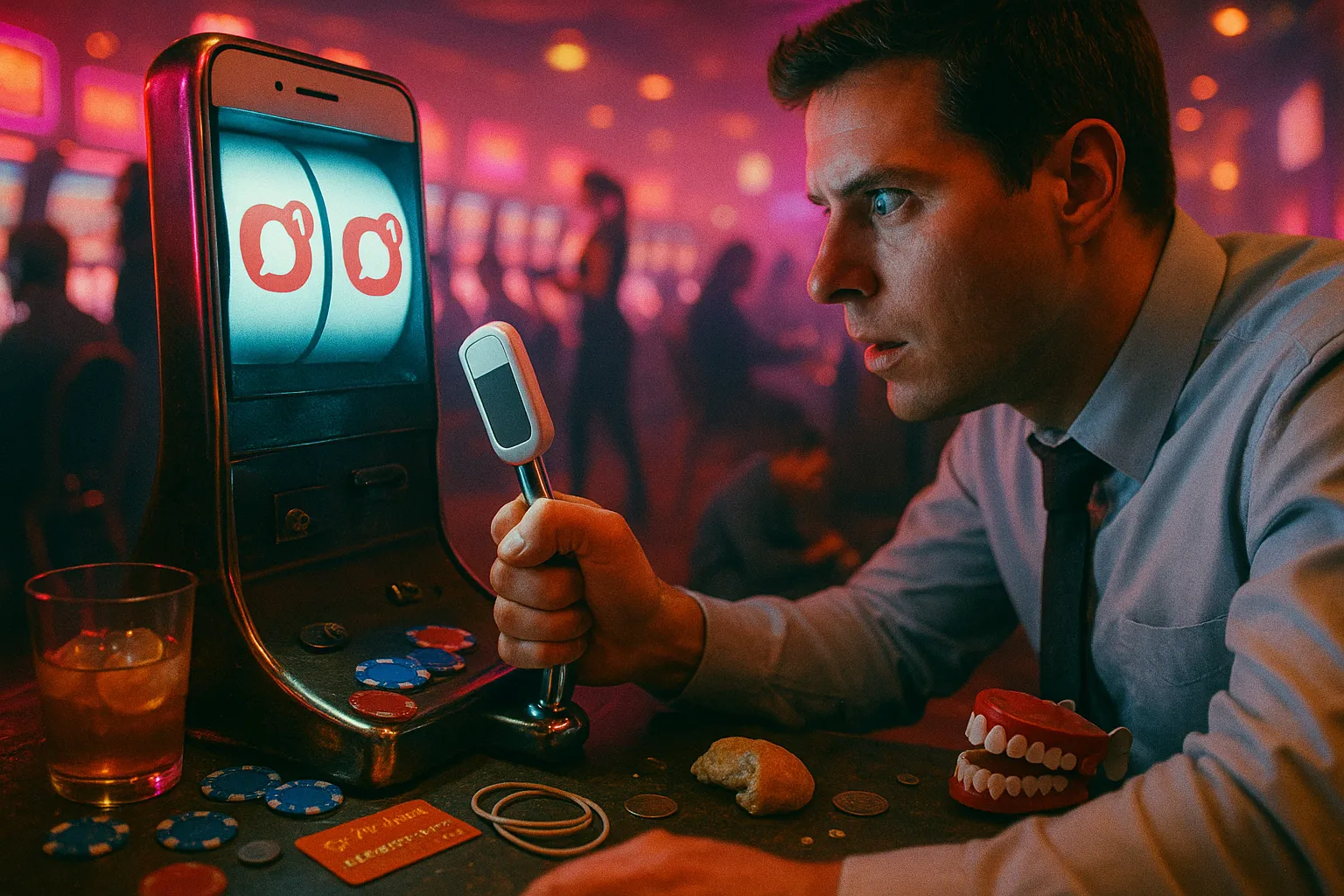
The dopamine peak is not on the win — it’s on the “almost.” The reels froze on two unread badges and a third that slipped past, and you pull the lever again. The technician behind you calmly turns a screwdriver into the payout chart: the addiction wasn’t a malicious plan, it was a setting. The clockwork jaw is already slowing — the spring runs out eventually.
Not all levers are equal: when a bot is sitting behind the reels
Until now we've been talking about "notifications" as if it were a single instrument. It isn't — and a trader spots the difference first, because he has spent his whole life distinguishing real order flow from algorithmic noise designed to bait his reaction. Three distinct types of lever are mixed inside your feed, and they pay out in different dopamine.
First — a message from a real person. A colleague, a client, a friend wrote to you directly. This is the rarest and most valuable signal — a genuine order in the flow, a real trade on the other side. This is what you're actually waiting for.
Second — an automated alert. "Deploy succeeded," "invoice paid," "meeting at 3pm," a bot digest in a channel. No human on the other side at all — it's a machine pulling the lever on your behalf. The dopamine charge is lower because the news is predictable, but the lever is pulled with the same force: you still reach to look.
Third, the new one and the most insidious — an AI-generated prompt. Copilot in your Outlook offering to "summarize the thread," a Slack bot initiating a message, an assistant reminding you about something you didn't ask to be reminded of. This is a lever that pulls itself, with your hands, and presents this as a service. A trader has a precise name for this — wash trading: fictitious transactions that inflate volume to make the market look more alive than it is. Only here, the volume being inflated is your attention, and the commission on each fictitious move is billed to you.
This is the quiet substitution that's invisible from the inside. The casino floor used to run on live players — people writing to each other. Now more and more of the reels are spun by bots: auto-alerts and AI prompts artificially sustain the sense that something is constantly happening in there. The quote feed is already half-synthetic, but the body reacts to it as if it were real — and seats you back at the lever with the same clenched jaw. You pull the lever in honor of a trade nobody placed.
The bill they never hand you: 23 minutes per "ding"
"I'll just take a second." This is the most expensive sentence in modern office life, and it's wrong by two orders of magnitude. Gloria Mark of UC Irvine, in her classic study "The Cost of Interrupted Work" (CHI 2008), measured the actual price: after an interruption a person returns to their original task in an average of 23 minutes and 15 seconds. Not a second. Twenty-three minutes of travel back to the thought a single notification yanked you out of.
Meaning when you tell yourself "a second," you're lying by a factor of 1,395. This isn't carelessness — this is the magnitude of error that normally disqualifies people from holding a driver's license. Now let's add up what those "seconds" become across a day. I built a table, because the casino counts everything too — it just doesn't show the player the running total.
| What you tell yourself | What actually happens | Source |
|---|---|---|
| "I'll just take a second" | 23 min 15 sec to get back to the task | Mark, CHI 2008 |
| "I'm not in Slack all the time" | Check every 6 min; Slack users every 5 | RescueTime, 50,000+ |
| "I'm someone who can focus" | 47 seconds on one screen (vs 2.5 min in 2004) | Mark, UC Irvine |
| "I definitely did some deep work today" | 40% have no 30-min uninterrupted block all day; 17% don't have 15 min | RescueTime |
| "Being available is responsible" | 35.5% check email/messenger every 3 min or more | RescueTime |
Read that last row again. Every three minutes. This isn't a worker who occasionally gets distracted. This is a player who can't take their hand off the lever. Forty percent of people don't get a single half-hour of genuine silence across an entire working day — then wonder why the big and important things never move. They don't move because there's physically no uninterrupted corridor left for them. You're trying to cook soup on a stove someone switches off every five minutes, and you're blaming yourself for the soup being cold.
The body in casino-floor mode: a "high alert" we renamed a virtue
Until now we've been talking about attention. But the body is being taxed too — and that's the bill you feel in the evening, unable to explain the tiredness when you "didn't even do anything hard."
Gloria Mark and colleagues ran a hard experiment (CHI 2012): thirteen office workers had their email simply switched off for five working days while they wore heart-rate monitors on their chests. (The sample was tiny — thirteen people — and the authors say so honestly; keep that number in mind as a limit, not a verdict.) They measured heart rate variability — a physiological marker of stress. Result: without email, people multitasked less, stayed in a single window longer, and were measurably less stressed. Their pulse "breathed" — speeding up, then releasing, the way a healthy person's does. Those who kept email were switching screens twice as often and remained in a constant state of "high alert": a flatter, wary pulse, the pulse of a person bracing for impact at any moment.
This is the physiology of the casino floor — and the same physiology of a trader with an open leveraged position at three in the morning. Look at him: he's not shouting, not pacing, outwardly almost calm. Inside — jaw clenched, shoulders up near his ears, palms damp, breath short and even, heart beating not "thud-pause-thud" but monotonically, like a metronome that forgot about pauses. The player at the slot machine holds their body exactly the same way: a high-alert trance, muscles mobilized to wait for the next "maybe." Always-on email seats you in the same chair. The only difference is the lighting: Vegas has neon, the trader has the blue glow of four monitors, you have the cold rectangle of a phone on your pillow. And here's the supreme irony of the whole story: the casino holds the body in a state of anxiety for revenue, the trader — for a chance at profit, and you do the same to yourself for free, with no position, no potential upside, for an unread badge reading "(2)." You pay the entry fee in your own cortisol and call the ticket professionalism.
Schüll named the trance in which addicted players operate the machine zone: a woman sits in front of the machine for hours without getting up even to use the bathroom, her fingers pressing the button automatically, her gaze glassy. She's not playing to win — she's playing not to stop, because stopping brings back reality. And now the quiet copy of that same scene, only without the neon: an office worker at 11:40 pm scrolling Slack in bed with that same glassy look. Not because they're waiting for an important email at half past eleven at night. But because closing the app means being left alone with silence — and silence has become unbearable, because in it there's no next "maybe."
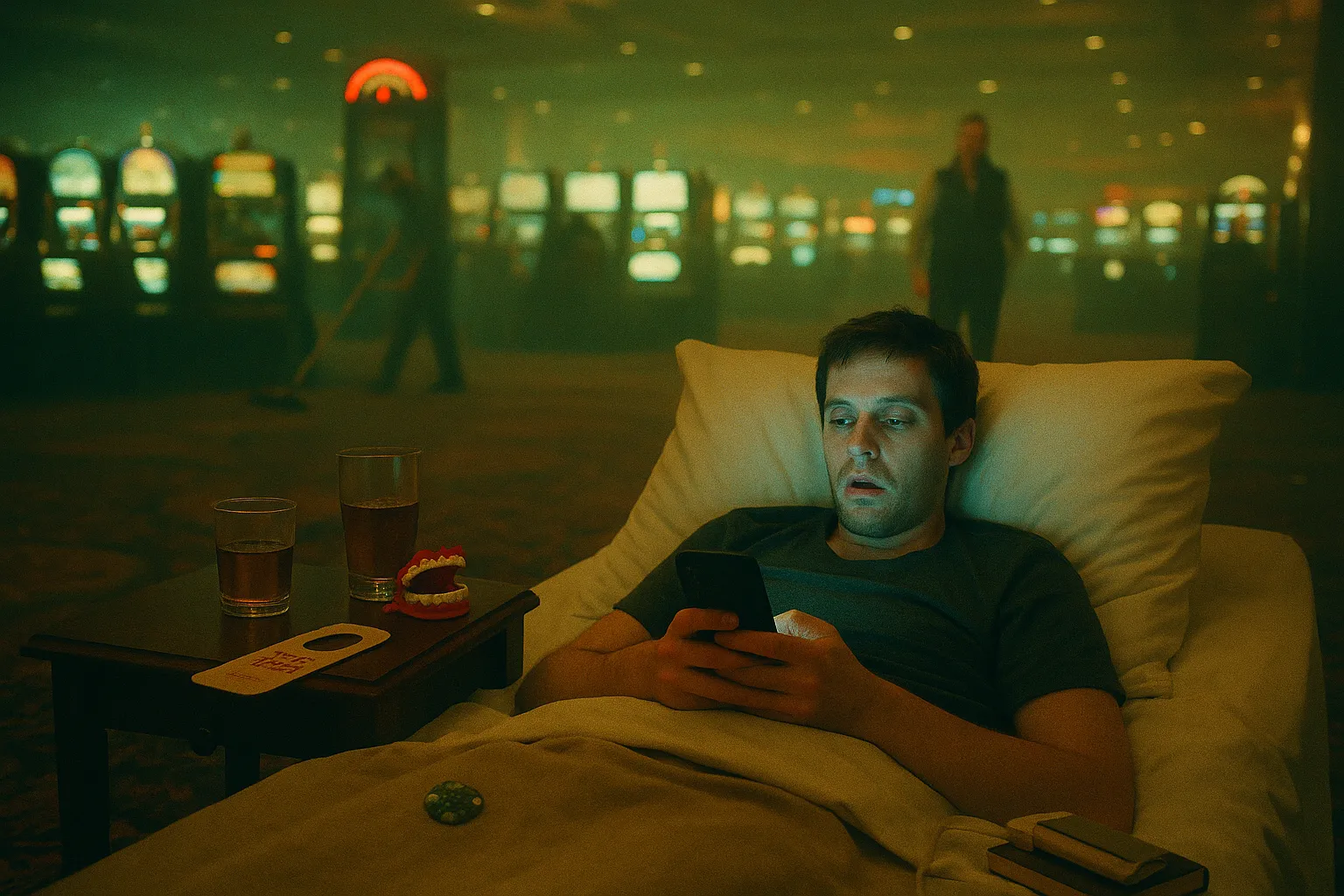
This is the machine zone: the player plays not to win but to not stop — because stopping brings back reality. The bed is already inside the casino, the engagement counter burns even at midnight, and the product-manager pit boss quietly enjoys the screen that never switches off. The clockwork jaw has finally gone silent — because the spring snapped and the mouth got stuck open.
The illusionist's misdirection: how addiction was recolored into a virtue
Every illusionist's core trick is making you look the wrong way. In this story the trick is one: the gambling mechanic was renamed as a productivity virtue, and you applauded your own cage into existence. The casino says "time on device" — and it sounds like what it is: keeping someone on the hook. The office says "engagement" and "responsiveness" — and it sounds like something to aspire to. Different words. The machine underneath is the same.
Here's your tool. Print it or write it down. This is a translation dictionary from casino language to office language — and back again to what's actually happening. Next time you hear the corporate word in the middle column, mentally substitute the right one.
| Casino term | Office term | What's actually happening |
|---|---|---|
| Time on device | Engagement / DAU | How many minutes you couldn't get up and leave |
| Variable reward (lever) | Pull to refresh | The player's gesture: pull and see what comes up |
| House edge | "Always available" | Your time converted into someone else's metric for free |
| Near miss | Unread badge, "(3)" | A signal that "something might be here" that forces a check |
| Machine zone (trance) | "I'm in the zone / in the flow" | Glassy stare, scrolling for the sake of scrolling |
| Comp (free drink) | Free app | The one who pays isn't the one playing — you pay with attention |
And so you don't think this is a metaphor pulled from nowhere, listen to the architects themselves. In the documentary "The Social Dilemma" (Netflix, dir. Jeff Orlowski, premiered September 9, 2020) former senior executives of Google, Facebook, Pinterest, and Twitter sit in studio light and take turns describing their own creation in the same language a neuroscientist would use for a monkey. Positive intermittent reinforcement: the user doesn't know whether a notification will come or whether there'll be anything worth seeing — and this works exactly like slot machines in Vegas. The casino builders testify against the machine they welded together themselves. When the people who built the apparatus refuse to use it and then step in front of a camera to warn you — that's not a paradox. That's a confession on the record.
Who's counting the money on this casino floor
Before moving to the size of the room, it's worth naming who takes the winnings — because in a casino there definitely are winnings, just not yours. Salesforce paid $27.7 billion for Slack (announced December 2020, closed July 2021) — and not for the convenience of messaging. Let's unpack that number the way a trader reads it, not a press release: it's the price placed on the ability to hold your attention, multiplied out across years in advance. An analyst doesn't ask whether you became more productive. He asks how many minutes a day you spend inside, because those minutes are what builds the renewal rate next year, and renewal rate is what builds the company's valuation. Your attention isn't a metaphor for an asset. It's literally a line in the discounted cash flow model: each "ding" you generate is being capitalized somewhere into dollars on someone else's balance sheet. Telegram monetizes Premium and advertising in direct proportion to the time a billion people spend inside. But the cost of all this is distributed extremely unevenly — and here starts the most cynical spread in the entire scheme: an autonomous knowledge worker — a freelancer, a programmer, a writer — can move the phone into the next room and exit the game for at least half a day. An hourly support operator, a cashier, a dispatcher, a junior manager in an open-plan office cannot: real-time response is written into their contract, and "turning off notifications" means getting a written warning. The gains from the engagement economy flow to shareholders and SaaS funding rounds. The bill is paid by those with the least freedom not to pay it.
The scale of the room and the exit nobody will show you
To give you a sense of the room's size: Slack had around 32.2 million daily active users in 2023. Telegram officially crossed one billion monthly active users in March 2025 — announced by Pavel Durov himself. This is not a cozy room with a few machines. This is the largest casino floor in human history — only none of the billion visitors think they're gambling, because the sign above the entrance reads "work." It's not on an island in the desert: it's in your pocket, on your desktop, in the hand that moves before the intention does.
This is the moment when I'd normally deliver a warm list of life hacks: turn off notifications, set "do not disturb," do a digital detox on Sundays. I'm not going to do that — because it's the equivalent of advising a gambler to "play more mindfully." The problem isn't your willpower. The machine is engineered to beat willpower — that's the point; otherwise the industry wouldn't exist. Fighting it with self-control is bringing a knife to a gunfight and feeling proud of the knife.
The only move that works is changing the environment, not yourself. Here it's worth stealing the one honest habit of a trader: he doesn't rely on willpower in the middle of a trade, because he knows nobody has any at that point. He sets the stop-loss in advance — a mechanical rule that will close the position without his participation when his own psychology is already working against him. Remember Mark's experiment: they didn't hand the participants mindfulness training. They simply switched off email — the stop-loss fired for them — and the body returned to baseline on its own within five days. Removing the lever from the room is more effective than training your hand not to reach for it. Close the tab, don't "intend not to open it." Take the phone into another room instead of placing it face-down beside you. And insert your own version here: a channel you can mute; an hour of the day when the app is simply off; a device that simply doesn't have work email on it. This is the difference between leaving the casino and sitting in it with a firm intention not to play.
And finally — without anesthesia. A trader at least sees the liquidation on the chart: the position burned, it's red on the screen, the P&L posts a final number you can't argue with. The woman in Vegas loses her money and that's visible too — the balance drains in front of her eyes. Your machine is designed to be simultaneously more merciful and more brutal: it doesn't take money. It takes hours in which you could have done the one thing you sat down to do — and it prints no summary line, no red on any screen for you to stare at in horror. The liquidation happened, the margin was called, and there's no statement. The counter exists only on his dashboard, in the engagement column. You don't have a counter. That's why you still think you're winning.
While you were finishing this paragraph, your hand checked twice for anything new. You didn't notice — the intention arrived after the motion. That was the answer to the question of who's playing, and who's the machine.
Frequently asked
What is 'time on device' and why did this metric end up inside your work tools?
'Time on device' is a slot-machine metric: how many minutes a person physically cannot get up from their chair. Anthropologist Natasha Dow Schüll documented it as the central design goal of casino engineering. The same counter sits on the Slack and Gmail dashboards under corporate aliases: engagement, daily active users, time in app. The goal is identical — maximize time inside the product, not the quality of your work.
Why does dopamine spike harder at a 50% reward probability than at 100%?
Robert Sapolsky showed that dopamine is a molecule of anticipation, not of pleasure. When a monkey receives food guaranteed every time, a certain amount of dopamine is released; at 50% unpredictability, it releases twice as much. The peak sits at maximum uncertainty — at pure 'maybe.' That's why you refresh a feed you just refreshed: you're not looking for information, you're feeding a prediction system that doesn't care about the outcome, as long as the waiting continues.
What does a single Slack or Gmail 'ding' actually cost in time?
According to Gloria Mark's data (CHI 2008), after an interruption a person returns to their original task in an average of 23 minutes and 15 seconds. When you say 'just a second,' you're off by a factor of 1,395. RescueTime data (50,000+ people) shows the average knowledge worker checks email or Slack every 6 minutes, and 40% have not a single 30-minute block of uninterrupted focus across an entire day.
What is Skinner's variable-ratio reinforcement schedule and how does it explain messenger addiction?
B.F. Skinner established that when a reward arrives after an unpredictable number of actions, it produces the highest response rate and the greatest extinction resistance of any conditioning regime he tested — in other words, the behavior hardest to quit. This is exactly the mode implemented in messengers: the lever is free, the reward (a message, a reaction, a headline) is unpredictable. Fighting it with willpower is bringing a knife to a gunfight; the only move that works is removing the lever from the environment, not training your hand not to reach for it.
How are AI-generated notifications different from ordinary alerts, and why are they more insidious?
An ordinary automated alert — a deploy notification, a meeting reminder — is predictable and carries a lower dopamine charge. An AI-generated prompt — Copilot summarizing a thread you didn't ask it to summarize, a bot initiating a message without your request — is a lever that pulls itself using your hands and presents this as a service. The author compares it to wash trading on an exchange: fictitious transactions that inflate the volume of your attention and extract a commission from you, even when there's no real signal from a real human on the other side.
Comments
Signed-in readers only — to keep it human, not a bot swamp.