A Founder's Open Loops: 15–25 Active Threads on a 4-Slot Working Memory — the Mechanics of Overload and a Closing Protocol
Human working memory holds 4±1 chunks. The average founder runs 15-25 live tracks — a 575% overflow sold to the brain as 'I see lots of opportunities.' Why the most dangerous procrastination looks like useful work, and how a clean no becomes the discipline of scale.
On this page
- I. Scene: one “no” that detonated into twenty-four decisions
- II. The numbers that didn’t fit (and we keep pretending they did)
- III. Named framework: Open-Loop Hoarding (four axes of decay)
- IV. Axis #1: Vivid bias — why one live candidate weighs more than twenty CVs
- V. Axis #2: Cost asymmetry — the visible price of a loop lies by 10×
- VI. Axis #3: Closure cowardice — the brain fears “killing” more than “opening”
- VII. Axis #4: Productive escape — the satisfying prompt always beats the uncomfortable hire
- VIII. Five recognizable types (autopsy, not zoo)
- IX. Full counter-pressure: “what if I just have more bandwidth than average?”
- X. Distributional lens: whom does this break — and who’s structurally immune?
- XI. The Founder WIP Dashboard: make the invisible visible
- XII. The Expansion Gate: ten questions before any “small yes”
- XIII. The Closure OS: an operational protocol, not a motivational poster
- XIV. Two founders, same reality, different OS
- XV. So what about Candidate A? (re-plating)
- XVI. Hard kicker
"I don't procrastinate. I'm always doing something." — a person with seventeen half-alive tracks, none of which has produced a decision in three weeks. Procrastination with a laptop and an oat-milk latte gets renamed "productivity" — only the currency on the receipt is different: not hours, but the capacity to think deeply.
I. Scene: one “no” that detonated into twenty-four decisions
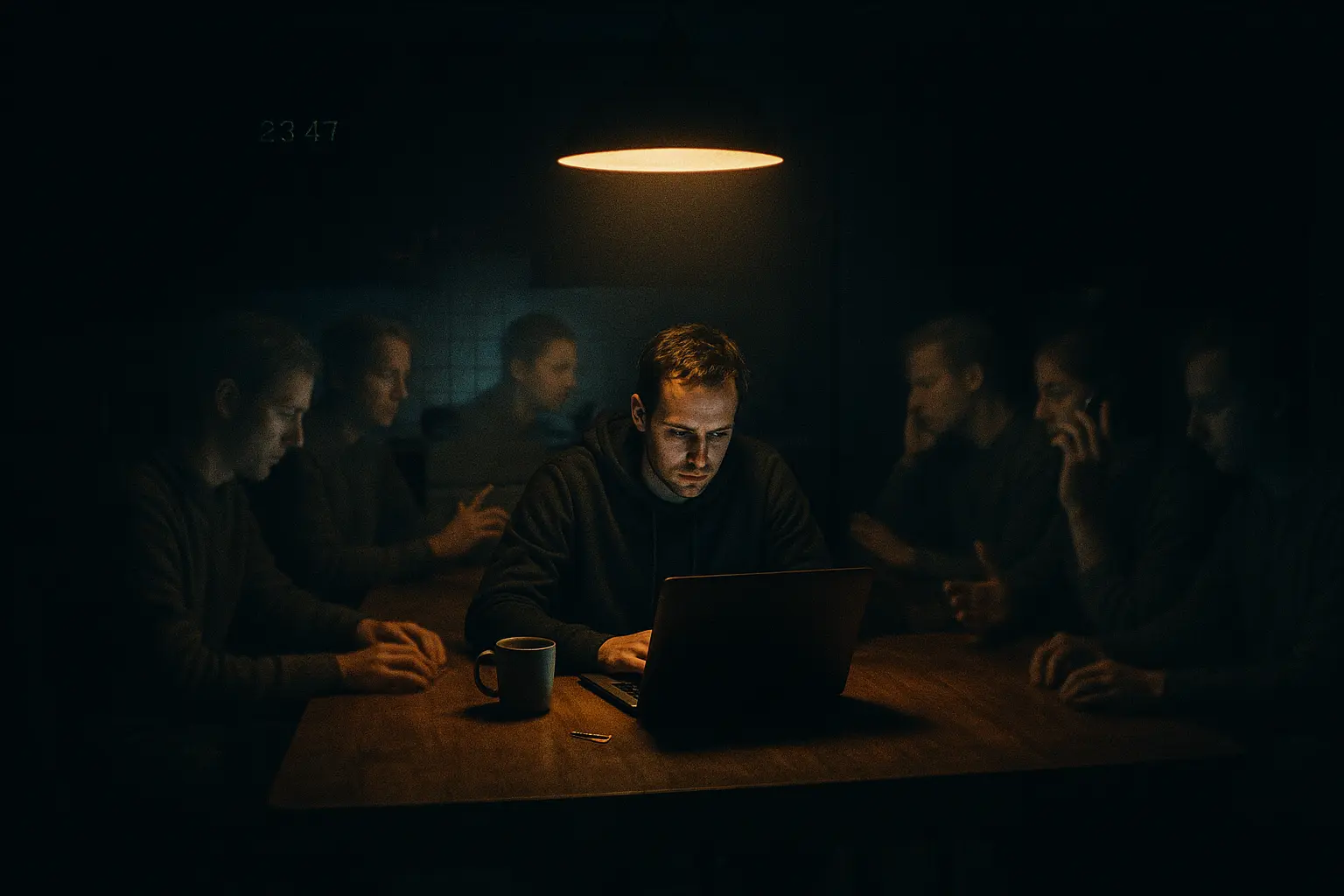
23:47. Kitchen, lamp over the table, monitor humming blue. The founder has just sent a thoughtful, warm rejection to Candidate A — a sharp student who reads books, uses Claude, and quoted someone clever in roughly the right place. Structurally a miss: exams through June, a September relocation still in flux, zero operational experience, a calendar invite sent to the wrong time zone. Decision made, door left open, message dispatched without HR sugar. The mug of tea has gone cold. Done.
At 23:51 a notification pings. “If no one better turns up, I could do a few months unpaid as an internship.” And in that single moment, between “o” and “k,” an event occurs that no time-tracker will ever register: one clean no quietly mutates into twenty-four micro-decisions. Give him a shot? Unpaid? Paid? €100 for a small task? I need that news-aggregation bot anyway. I’d spend four hours building it myself. This way I test the human and close the task at once. Start with a brief? Ask him to write longhand, no AI, to see the thinking? Which payment rail? Call first? A week? Two? And if it’s good — then what? If it’s bad — how not to break him? If it’s mediocre — re-do, or pay and close?
The founder stares at this sudden mushroom in his head, pushes the mug aside, and recognizes the scene. This isn’t a new opportunity. It’s a loop that’s just hatched out of doors that were supposedly closed. One non-hire has spawned twelve micro-projects and twelve future decisions. This isn’t entrepreneurial vision. It’s the scale killer — live, with his own kitchen cast in the lead. And the worst part: on the surface, the scene looks like a virtue. I’m not on the couch. I’m thinking about work. I see the opportunity. Which is exactly why it’s so hard to kill.
II. The numbers that didn’t fit (and we keep pretending they did)
The most painful number in this essay is neither “18.5 million digital nomads” nor “60% kimchi premium” from earlier longreads. It’s four. Not my estimate — Cowan, 2001, Behavioral and Brain Sciences: an adult’s working memory holds 4±1 chunks at once. Not seven (Miller was wrong), not eight, not “well, mine is bigger.” Four. An engineering limit, like 220V in the wall. Pretend it’s 380 and the bulb explodes at exactly the moment you most need its light.
Now the applied arithmetic. A typical small-company founder runs, simultaneously: sales, delivery, hiring, CRM, finance, product, marketing, website, bot, content, legal, investments, health, family, relocations, side project, new vertical, Candidate A with his unpaid-internship offer. Quick audit last week: twenty-three active tracks. Four versus twenty-three isn’t “a little overload.” It’s a 575% overflow rate. If your broker saw that margin on your account, the position would be liquidated automatically, no courtesy call.
But overflow is the gentle part. The harsh part is Sweller (1988, Cognitive Science): cognitive load grows not linearly but roughly as O(n²) — because the brain must hold not just n elements, but the relationships between them. Three tracks = 9 load units. Five = 25. Ten = 100. Fifteen = 225. Twenty-three = 529. Going from five to fifteen isn’t “three times harder.” It’s nine times harder. And the brain doesn’t slow down twice as much — it silently turns off depth-of-processing across the board, without asking. You still think you’re a strategist. You’re a switchboard with a good CV.
“Why now?” — the question The Economist demands in the first third of any serious piece. Here’s the honest answer, now with data. Microsoft’s Work Trend Index 2023 (31,000 workers across 31 markets, Edelman Data x Intelligence, Feb 1 – Mar 14, 2023) named the condition digital debt: the volume of data, email, meetings, and notifications has overrun human processing capacity. The figures are blunt: 64% say they lack the time and energy to do their job; 68% say they lack enough uninterrupted focus time; the average Microsoft 365 user spends 57% of the time communicating and only 43% creating. This isn’t laziness or an individual flaw. It’s the structure of an environment where head capacity stayed at four while the number of contours competing for a slot rose by an order of magnitude.
And that’s before AI. The barrier to launching a sixth track has dropped to thirty minutes: once you had to lease an office; now you click “Create workspace.” Loops breed at Slack-notification speed. AI doesn’t just speed execution — it collapses the cost of generating new options. One sentence → full bot architecture + roadmap + pricing + schema + a hero prompt in forty seconds. For someone with open-loop hoarding, that’s a turbine bolted onto a meat-grinder: option-generation now outruns closure.
III. Named framework: Open-Loop Hoarding (four axes of decay)
Name the diagnosis correctly, because without a name it’s just background noise. Open-Loop Hoarding is the pathological accumulation of open attention contours, each individually reasonable while collectively producing a system in which nothing ever finishes. Not laziness, not a discipline deficit, not “I need to plan better.” It’s an architectural disease of the small organization, in which the owner has become the aggregation point for every decision and still treats this as a competitive advantage.
Four axes along which the disease fractures into recognizable syndromes:
- Vivid-bias axis — vivid weighs more than statistically important. One candidate with a voice and a bookshelf displaces twenty CVs. One Telegram thread with an interesting prospect drowns out three weeks of work on the actual top account.
- Cost-asymmetry axis — the visible price of a loop (€100, two hours, “a small brief”) is almost always an order of magnitude smaller than the real one (drafting the brief + explaining tone + reviewing + not breaking the person + not opening a new format + not returning to it mentally twelve more times).
- Closure-cowardice axis — the brain fears “killing” more than “opening.” “Paused” is an open loop in a sweater. “Let’s revisit in September,” undated, is a trash can no one empties.
- Productive-escape axis — between an uncomfortable hire and a satisfying prompt tweak, the brain picks the prompt. Not because it matters more, but because it’s more controllable. The safest-looking procrastination, because it ships output.
Each axis gets a scene, the research, the mechanism, and an honest counter-pressure. No academic distance — I’m writing this from the same kitchen where, at 23:47, I almost opened twenty-four new decisions.
IV. Axis #1: Vivid bias — why one live candidate weighs more than twenty CVs
Scene. Twenty-three CVs in the pipeline, processed by an assistant, laid out in a grid: experience, location, salary expectation, notes. All dry. All interchangeable. All correct. The founder skims, stars three, closes the tab. A week later: a twenty-minute call with Candidate A. He quotes cognitive psychology (mangling the names), recounts a Python bot he built in school, laughs in the right places, honestly admits to gaps. Twenty minutes — and in the founder’s head, A now occupies more space than the other twenty-three combined.
Textbook vivid bias — described by Tversky & Kahneman in 1973, sharpened in Nisbett & Borgida (1975): a concrete living story by one actor crowds out a statistically stronger baseline. The brain didn’t evolve to compare twenty-three résumés. It evolved to weight a moving silhouette in the grass against twenty rustles. The pipeline is rustle. Candidate A is silhouette. The game is lost before Notion opens.
| What the brain registers as "real" | What's actually the stronger signal | How it warps the decision |
|---|---|---|
| Twenty minutes with Candidate A | 23 CVs with higher average fit-score | A gets 80% of attention; pipeline stalls |
| One loud client messaging at 02:00 | Top-5 quiet accounts who pay and stay | The loud one eats a week; the quiet ones decay |
| An idea Claude generated today | The roadmap written three months ago | Roadmap ages in a drawer; idea steals the sprint |
Counter-pressure: “but a vivid signal is often the real signal — that’s an experienced operator’s intuition.” Fair: sometimes Candidate A really is the unicorn. The problem isn’t that vivid is sometimes right. It’s that the brain accepts it by default, with no explicit weighing. Operator intuition isn’t trusting the vivid; it’s asking whether you’re trusting it because it’s stronger or merely because it’s louder.

One silhouette in the grass the brain recognizes as “real.” Twenty-three CVs it files as “background noise.” Except here, the background noise is the labor market.
V. Axis #2: Cost asymmetry — the visible price of a loop lies by 10×
Scene. The founder messages the candidate: “OK, small paid trial — €100, brief in a couple of days.” Internal monologue: “Four hours of my time on a bot = €400-600 of my hourly. I save €300, test the human, close a task. Win-win.” The arithmetic is bookkeeping. The error: bookkeeping only counts what made it to the receipt.
Let’s break the €100 task down to the bone, because the arithmetic lie lives right here. The real cost of this “small” loop: draft the brief (45 min) + recall references (20) + explain tone and voice (30) + answer clarifying questions (×3 rounds, 20 each) + review the interim output (40) + give feedback that doesn’t crush the person (25) + decide whether to accept the final (60, scattered across the week) + handle payment with KYC (15) + close the comms warmly (20) + emotional residue lingering for 10-14 days. Total: 8-12 hours of pure founder time plus two weeks of ambient mental presence instead of the promised four hours. Estimation error: roughly 3-10×. “€100 is cheaper than my time” isn’t a calculation. It’s the anesthetic the brain injects to license opening the loop.
And note: this loop isn’t opened by laziness — it’s opened by someone with too many options. Paul Graham’s “Maker’s Schedule, Manager’s Schedule” (2009) explains why it’s especially expensive for a founder. A maker works in half-day blocks; less isn’t enough to reach depth. A manager lives in hourly slots. A founder is a cursed hybrid: maker + manager + seller + strategist + therapist-for-the-client + family operator + investor in one head. Every open loop steals not just time but the very ability to enter maker-depth, because it shatters the day into pieces too small to do anything hard in.
This is what Leroy (2009, Organizational Behavior and Human Decision Processes) measured — attention residue. Switch from task A to task B and part of your attention physically stays with A, even if A is finished. Under dense switching, effective bandwidth on the next task drops by 20-40%. Multiply by ten loops a day and you operate on 40% of your brain, wondering why the main task crawls.
Counter-pressure: Taleb argues, correctly, that optimizing for cleanliness is fragility, and optionality — keeping many doors open — is a strategic asset in volatile environments. Let’s engage this honestly, because it’s strong. Yes — for a financial position. An option on a stock sits there for free: carrying cost near zero, upside unbounded. That’s exactly why financial optionality compounds for you. But an option on Candidate A is not free. Every live loop drips attention residue daily. In a founder’s head, the carrying cost of every loop is meaningfully above zero — so what Taleb calls optionality becomes, in the operational context, its opposite: not an expansion of options but fragmentation that compounds against you. Optionality multiplies the space of future decisions at zero present cost; founder-fragmentation multiplies present cost for the illusion of future decisions. Not the same mechanism in different jackets. Antonyms that happen to sound alike.
VI. Axis #3: Closure cowardice — the brain fears “killing” more than “opening”
Open your Notion. Look at “paused,” “backlog,” “later,” “maybe Q3.” Honestly — how many will actually be unfrozen? Fewer than 15%. The rest aren’t on pause. They’re funerals without a death certificate. The body is on the table; the relatives pretend the deceased is on a business trip; someone keeps setting a plate. You sprinkle a little attention onto each “paused” project — then wonder why there isn’t enough for the live ones. A backlog without kill isn’t a list. It’s a graveyard with a search bar.
Why doesn’t the brain just kill the dead? A combination: sunk cost fallacy (Arkes & Blumer, 1985) + identity attachment (this is my idea; killing it kills a sliver of me) + the plain fact that hard decisions feel harder than soft ones (Baumeister 1998’s ego depletion, caveated by Hagger 2016’s failed replication — but the discomfort asymmetry between “leave it” and “kill it” survives even if the construct doesn’t). “Leave it paused” — zero discomfort now, infinite tail later. “Kill it” — a sharp pang now, zero tail. The brain always picks the first, because the brain is short-sighted.
Here’s a knot worth untying, because half the productivity self-help canon was built on it. The Zeigarnik effect is not the thing to fear. A fresh meta-analysis (Ghibellini & Meier, 2025, Humanities and Social Sciences Communications, 12:962) re-examined both classic effects. The verdict is sharp: the memory advantage of unfinished tasks (Zeigarnik proper, 1927) is not a reliable effect — it depended on experimenter authority and context, both rare today, and it nearly vanishes in modern replications. But the Ovsiankina effect — the tendency to RESUME an interrupted task — is the robust, stable finding. So the danger of an open loop isn’t that you “remember it better.” It’s that it tugs you back — “let’s just take one more look” — like a small black hole shaped like “what if.” The unfinished doesn’t lie quietly in the archive. It gravitates.
The good news: this gravity can be switched off — not by completion, but by a plan. Masicampo & Baumeister (2011, Journal of Personality and Social Psychology; PMID 21688924) showed intrusive thoughts about the unfinished are removed by writing a specific plan — when, how, with whom, by what date. But “plan” is the precise word. “NewsHarvest — someday” does NOT close the loop: the brain doesn’t believe “someday,” because there’s no closure condition in it. “NewsHarvest — frozen until July 15, reopen only after the EA hire; if no reopen is scheduled by July 15, delete from roadmap” does. The brain wants not the illusion that it’s done, but a trusted container with a date and a condition. A deadline on the pause, not eternal suspension.
| Bad status | What the brain hears | Good status |
|---|---|---|
| Paused | "Keep it in your head; it resumes" (Ovsiankina) | Frozen until <date>, else delete |
| Later | "Someday, i.e., never" | Active from <date>, owner: <name> |
| Maybe | "Keep running background analysis" | Killed, one-line postmortem |
| Backlog | "A graveyard with a search bar" | Top-5 or killed; nothing between |
VII. Axis #4: Productive escape — the satisfying prompt always beats the uncomfortable hire
The hardest axis to spot, because it disguises itself as work. The founder has a day with three things: (a) write a painful rejection to three second-round candidates, (b) confront an account underpaying for the third month, (c) tweak the prompt for one of the agents. Which gets done? The prompt. Always the prompt. Because the prompt is a clean, controlled, satisfying task with immediate feedback. Candidates will be hurt, the account will argue, but the prompt just runs better or worse — and you get a dopamine hit or a clear next iteration.
Why hiring loses to the bot is best explained by the “ugh field” from the LessWrong community (Roko, 2010). If a task — and hiring is mess, ambiguity, small rejections, someone else’s pain — has been associated with discomfort enough times, the brain propagates the psychological pain back to the first moment you think about it. The flinch happens before you consciously begin to solve it. So you don’t avoid hiring on purpose — you simply drift, unnoticed, into a clean, pleasant task. The candidate-task wasn’t strategy. It was a comfortable exit from the hiring ugh-field. The brain isn’t dumb here — it’s sometimes a con artist: it hands you useful-looking work so you won’t touch the thing that stings.
Newport, in Deep Work (2016), calls this “shallow work disguised as deep” — surface tasks performed with deep-work energy, because the deep tasks frighten. In the typical week of a founder complaining about chaos, 60-70% goes to productive escape, and only 15-25% to work that actually unblocks the company. His later book Slow Productivity (2024) offers the antidote in three phrases: do fewer things, work at a natural pace, obsess over quality. “Slow” here isn’t “lazy.” “Slow” = don’t open more WIP than the system can digest. That’s a WIP limit for knowledge work.
And one more myth to clear — motivation. Huberman (hubermanlab.com) popularized a simple neurobiological point: dopamine drives goal pursuit and effort. The counter-intuitive conclusion for us: the founder’s problem is not a lack of drive. The drive is there — just smeared across twenty-three channels. The best “biohack” here isn’t cold showers or tyrosine. It’s a systemic reduction of cognitive debt: fewer open loops, fewer self-interruptions, more clean closure, sleep without unresolved ghosts. It doesn’t sound sexy — which is exactly why it works.
Counter-pressure: “but technical work matters, and founders should stay hands-on.” Fair, up to a point. The question isn’t “do it or delegate.” It’s: am I doing this because it’s the highest-leverage thing, or because it’s the most pleasant thing in my calendar today? Sam Altman puts it sharpest in his productivity essay (blog.samaltman.com/productivity): it doesn’t matter how fast you move if the direction is worthless; picking the RIGHT thing to work on is the most important and most-ignored element of productivity. Applied to the scene: the question isn’t “is NewsHarvest useful?” (it is). It’s “is NewsHarvest-via-this-candidate the right task NOW?” The answer is no.
Every “no” said in time is not a lost opportunity. It’s the return of control over your own head. Only those who can cleanly close loops have earned the right to open new ones — anything else isn’t strategy, it’s incontinence.

Productive escape: the hand always reaches for the prompt, never the envelope. The prompt will say thank you. The envelope would say the truth. The paperclip in the middle holds what you’ve decided, once again, not to decide.
VIII. Five recognizable types (autopsy, not zoo)
The four axes are mechanics. Here are five real people in whom they settle into stable patterns. I recognize myself in each at different ages. You probably will too.
1. The Curious Magpie. A Notion with 147 ideas. Four executed. The other 143 “might come in handy.” The Magpie doesn’t lack ideas — it lacks scissors. Antidote: a hard cap on the ideas page (say, 20). Every 21st idea evicts the weakest. The deleted are mourned for thirty seconds, then forgotten.
2. The Reluctant Closer. No project is ever killed. Everything is active or paused. Antidote: a three-status reality — Active / Completed / Killed. Paused doesn’t exist. Neither active nor complete = killed, with a one-line postmortem in a someday-maybe file.
3. The Optimistic Time-Traveler. “This’ll take a week.” It takes six. “Eight goals this quarter.” Closes two. Planning fallacy (Kahneman & Tversky, 1979) in pure form. Antidote: multiply every forecast by your own past-estimate track record (usually 2-3×). Not “I’ll be more accurate this time.” You won’t.
4. The Reciprocal Trap. Can’t say no to a likable person — especially one offering a free favor. Candidate A with his internship is canonical. Antidote: separate human warmth from professional decision. “You’re great, I enjoyed this, and I am not opening this format.” Two separate things, both sincere.
5. The Architect’s Distraction. Ten productivity tools, zero productivity gain. Notion → Linear → Obsidian → Logseq → Tana → back to Notion. Each migration eats two weeks because “this time it’ll be perfect.” Antidote: a 30-day consistent-usage rule before any new tool. If the current one isn’t used systematically for a month, the new one isn’t coming.
The field for these five isn’t a private defect but a mass pattern. On r/Entrepreneur there are more threads about “too many ideas” than about idea scarcity; on r/productivity, “closing the loops” tactics rack up thousands of upvotes; on r/ADHD, “100 tabs open” is described not as laziness but as a storage problem — the head as an overflowing buffer. On Hacker News, threads on “context switching costs more than we give it credit for” and side-projects-as-productive-escape draw recognition from hundreds of engineers. Not proof (anecdote ≠ data), but a field signal: people mass-describe overload-by-unfinishedness, not laziness.
IX. Full counter-pressure: “what if I just have more bandwidth than average?”
Time to walk honestly into the strongest objection. Maybe I’m extrapolating my own mediocrity. Watson & Strayer (2010, Psychonomic Bulletin & Review) — the “Supertaskers” paper out of the University of Utah — found roughly 2.5% of people show no measurable decay running two demanding tasks in parallel. So in every hundred founders, two or three really do have architecturally different bandwidth. Maybe you?
Almost certainly not. First, Strayer tested driving + auditory OSPAN — well-defined tasks on the scale of minutes, with immediate feedback. Founder tracks are months of latency, fuzzy goals, delayed signals — a different class of load to which the supertasker effect may not generalize. The replication (Medeiros-Ward et al., 2014) didn’t expand the population. Second, self-rated multitasking ability is negatively correlated with actual ability (Sanbonmatsu et al., 2013, PLOS ONE) — those who think they’re good are usually worse. The inner sense of “I’m coping” is the weakest possible signal.
Third, even if you are a genuine supertasker — you’re also the founder. Every undelegated open loop signals to the team: “this can route around us; the owner decides anyway.” The team learns not to close instead of learning to close. A year later you still have 23 tracks, plus five people waiting on your decision instead of making their own. A supertasker without architecture isn’t scale. It’s a very intelligent bottleneck, ringed by passive executors.
And the harshest: even if you’re a supertasker, your family isn’t. Your head on those 23 tracks means your partner gets half-presence, your kid three-quarter-presence, your mother quarter-presence. Not a metaphor. A concrete attention deficit, draining toward whichever Slack channel pinged loudest most recently. Your spouse doesn’t care that your multitasking score is in the 97th percentile. They care whether you make eye contact when they tell you about their day.
X. Distributional lens: whom does this break — and who’s structurally immune?
Open-loop hoarding doesn’t hit everyone equally. Three structural positions, three views.
Who wins by adopting closure systems. Founders with built-in decision frameworks (Bezos’s Type 1 / Type 2; Jobs’s “focus is about saying no” from WWDC 1997; Buffett’s 25/5). Not smarter — they’ve narrowed the class of decisions deserving deep mode. Type 2 (reversible) — fast, light, delegate. Type 1 (irreversible) — slow, 70% information, deep deliberation. Most founders process both the same way and burn deep mode on “which AI tool for CRM notes.” That’s not strategy. It’s paralytic perfectionism.
Who’s structurally vulnerable. Smart curious magpie types — broad intellectual appetite, high openness, a history of success because they see connections others miss. At 25 it’s a superpower. At 35, leading a 12-person company, it’s the chief internal saboteur. Every interesting idea looks like leverage. Every interesting person looks like a future partner. Every new AI release is another contour it’d be a shame not to open. These people aren’t lazy. They’re afflicted by a strength — seeing opportunity — that has no off-switch at “enough.”
Who’s structurally immune. Operators-deliverers — minds trained to close, not generate. They thrive in low-novelty, high-execution-density environments. Often they don’t become founders; they become COO/Head of Ops at companies where the founder is a magpie. That pair works. A lone magpie without an operator counterpart always arrives at the tyranny of loops — a matter of years, not “whether.”
The systemic diagnosis, without moral verdict: the problem isn’t the person. It’s the architecture of a role in which a curious magpie sits in a seat that demands operator discipline, then tries to solve the mismatch with willpower instead of architecture. Two solutions: either install operator discipline through hard systems (the Closure OS below), or hire the operator beside you and honestly delegate execution mode (often cheaper and more honest). A third — “I’ll fix this with willpower” — doesn’t exist in nature. If the ego-depletion replication crisis taught anything: willpower is intermittent, systems are constant.
XI. The Founder WIP Dashboard: make the invisible visible
Before you treat it, count it. The first Closure-OS exercise is to list every active track in one table with seven fields. Not the pretty strategic directions — the actually active ones: what you think about, whom you owe a reply, what awaits your decision, where you’re the bottleneck. The rule: a track with no owner and no closure condition isn’t a track. It’s a ghost.
| Track | Owner | Strategic link | Next action | Closure condition | Review date | Kill switch |
|---|---|---|---|---|---|---|
| EA hire | me | revenue / health (frees 6h/day) | 2nd round, 5 finalists | offer signed | Fri weekly | no offer by Aug 1 → pause, outsource ops |
| Candidate A (€100 bot) | none | vanity / curiosity | — | none | — | KILL now (ghost: no owner, no closure) |
| NewsHarvest | me | moat (for now) | none active | none | — | frozen to Jul 15, reopen after EA hire |
| Top-5 accounts | me + Dara | revenue (green) | QBR with 3 key | recurring, never closes | Mon weekly | n/a — core |
Look at the “Candidate A” row: no owner, no closure condition, strategic link = vanity. On the dashboard it doesn’t look like an “opportunity.” It looks like a ghost quietly eating 3-4% of attention every night. The dashboard doesn’t motivate. It just makes the invisible debt visible — and once you see it in one column beside “EA hire / revenue / health,” the “kill” decision makes itself.
XII. The Expansion Gate: ten questions before any “small yes”
The dashboard shows what’s already open. The Expansion Gate prevents thoughtless new openings. Not “10 tips” — a gate every temptation must pass before it becomes a track. Before any “small yes,” ten questions:
| # | Question | Red flag |
|---|---|---|
| 1 | Does this open a new loop? | yes — with no other answers |
| 2 | Would I do this if the trigger (person/email/release) hadn't appeared? | no → reverse-causation |
| 3 | Does it reduce the current bottleneck? | no / "indirectly" |
| 4 | Who owns it besides me? | no one |
| 5 | What do I close instead? | "nothing, I'll fit it in" |
| 6 | What's the deadline? | none / "soon" |
| 7 | What's the closure condition? | can't state in one sentence |
| 8 | Is it reversible (Type 2), and closeable in one move now? | no |
| 9 | Is this productive escape from a worse main task? | yes (check the ugh-field) |
| 10 | Am I doing this to avoid the discomfort of a clean no? | yes |
The scoring rule: weak answers on 3-4 questions → no. Not “maybe.” “Maybe” is a vampire decision that drinks 4% of your attention nightly, giving neither blood nor rest. The key question is #2 — the reverse-causation test: if this person didn’t exist, would I go looking today for a junior dev at €100 for this bot? If not — the person created the task, not the strategy. It isn’t a priority. It’s a gravity tax levied by someone else’s orbit.
XIII. The Closure OS: an operational protocol, not a motivational poster
The dashboard counts, the Gate filters. The Closure OS is the daily hygiene that keeps the system clean. Five components, each I use myself, each installable in a week without migrating to new software.
1. Weekly Track Audit. Once a week — a traffic light on every dashboard track. Green (revenue, health, family, strategic moat) — move it. Yellow (interesting, not critical) — max 1-2. Red (vanity, curiosity, emotional residue) — kill / freeze with a date. Hard cap: no more than 5 active at once. If you’re at 5 and something new appears, something old must leave. Don’t add. Replace.
2. Daily Close-Out. End of day. Five minutes. In a journal, not your head. Three questions: (a) What did I close today (decisions, not activity)? (b) What did I open? (c) How many did I expand without the Gate’s permission? Track the closed/opened ratio. Three days in a row of “opened > closed” = the system is rotting. A week = full system failure — stop everything and audit.
3. Plan-as-closure. If a task can’t be finished now, close it with a plan, not a “someday.” Formula: when + how + with whom + closure condition. “I should do X” does NOT close the loop (no condition → Ovsiankina tugs it back). “X — frozen until <date>, reopen after <event>, else delete” does. The brain wants a trusted container, not the illusion of completion.
4. One-touch closure. For small decisions — no “I’ll think about it.” One move: yes / no / delegate / later-with-date / delete. “Later” without a date isn’t later — it’s an open loop in disguise. Touched once, closed once.
5. No test without path-to-hire. No test task, free or €100, without a clear path-to-hire. “Just testing the person” with no active role isn’t delegation and isn’t hiring. It’s a new attention-drain channel with a warm name.
Plus the expansion antivirus — if-then plans (implementation intentions; Gollwitzer & Sheeran, 2006: meta-analysis of 94 studies, 8,000+ people, effect d=0.65 — serious). Pre-written reflexes strip future-you of the ability to re-negotiate an already-made decision:
- IF a candidate fails the hard filters, THEN I invent no alternative format for 30 days.
- IF “maybe a small task” appears, THEN I ask: “is there a path-to-hire or an active owner?”
- IF a task arose because of a specific person, THEN I ask: “would I seek this solution without them?”
- IF a new idea has no owner / deadline / closure condition, THEN it’s backlog or kill — not active.
- IF I say “later,” THEN I attach a date, or it isn’t “later.”
Six or seven tools, ~50 minutes a week. Not expensive. Expensive is 23 tracks in your head, nine-times load, 575% overflow, and no deep sleep. The Closure OS isn’t asceticism. It’s hygiene.
XIV. Two founders, same reality, different OS
Real example from last week. Candidate A. 23:47. The unpaid-internship message.
Founder A — Open-Loop OS. Thinks: “Well, he’s hungry. Maybe a small task for €100. I need the bot anyway.” Drafts the brief two days late (forgot). Gets output a week later (candidate has exams). The bot is mediocre. Can’t decide whether to ask for a rewrite. Pays €100 + €50 “for effort.” Two weeks later the candidate returns: “Another task?” Founder says “sure.” A chain of five follow-up tasks begins, none with an assigned owner. A month on: the bot is half-alive, the assistant isn’t hired, the candidate is “in the orbit,” and Founder A has 26 active loops instead of 23. The candidate pipeline didn’t move all month — no attention left for it. Derek Sivers would say: all these tasks passed the “interesting” filter. None passed “hell yeah for the system.”
Founder B — Closure OS. At 23:48 he replies: “Thanks for the genuine offer. I’m not opening an unpaid-internship format — and a paid trial without a path-to-hire doesn’t make sense for either of us. I’m closing this conversation, because the role decision is made. If you’re job-hunting in September and we have a relevant opening, reach out — I’ll flag our prior contact to HR. Good luck with exams.” Ninety seconds. Loop closed. The candidate isn’t hurt (warm tone, clear reason). A month later: five candidates at the second round, the bot outsourced to an Upwork freelancer (€280, clean, NDA, no residue), the assistant hired from the pipeline. Founder B is sleeping.
The difference isn’t morality, IQ, or discipline. It’s that Founder B has the operational muscle to close a loop in one touch, and Founder A doesn’t. That muscle trains. The Closure OS is the gym. This is Sivers’s filter in its founder version: not “is this interesting to me?” (everything passes), but “hell yeah FOR THE SYSTEM, or no for the system?” The founder doesn’t suffer from a shortage of interesting. He suffers from too many things passing “interesting” and failing “reduces the bottleneck now.”
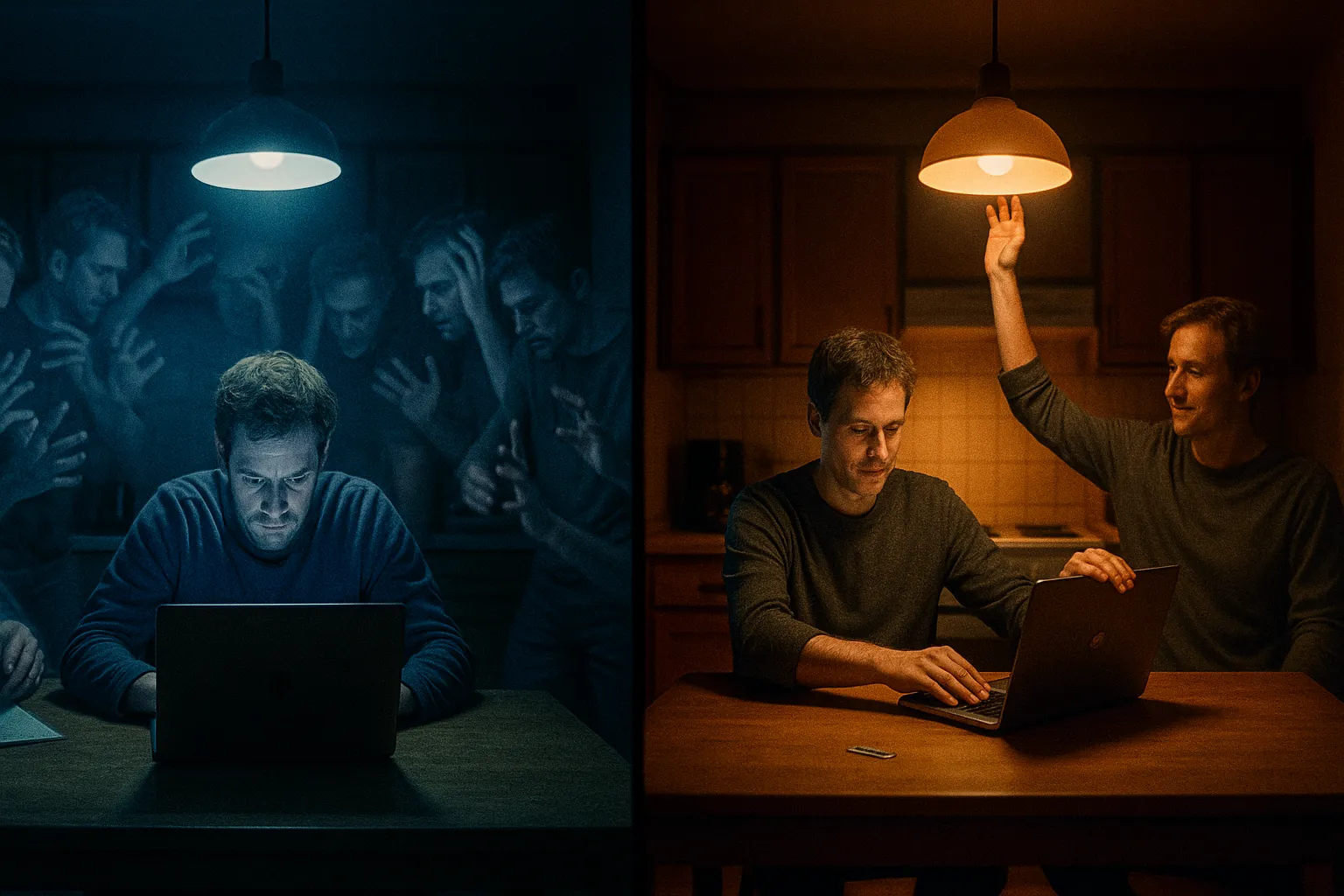
The same reality, two operating systems. Left: incontinence mimicking busyness. Right: hygiene mimicking laziness. The paperclip in the middle holds what one was able to put down and the other is still carrying.
XV. So what about Candidate A? (re-plating)
If you’ve made it this far — go back to the scene in §I. Kitchen. 23:47. Twenty-four decisions instead of one “no.” I was Founder A for about ten years. At 35 I’m methodically training to become Founder B. Not because I’ve gotten smarter — the opposite: the more traps I see, the harder it is not to open another. But because I finally counted the second curve.
The same geometry I described in the previous longread on the geographic-arbitrage tax: two positions running on compound interest in opposite directions. Money compounds up; belonging compounds down. Here it’s a different pair: operational clarity compounds up; the main task compounds down. Every added loop doesn’t “subtract a little attention.” It rewrites the entire priority system so the main task gets a smaller share of an already smaller pie. Not linearly. Cascadingly.
I won’t open the twenty-fourth loop with Candidate A. Not because he’s bad — he’s good. Not because €100 is a lot. Not because I don’t need the bot. But because on the spot where I add one more loop, my daughter gets one less dinner of her father’s presence. That isn’t a metaphor. It’s the banal arithmetic of a finite resource. Every loop opened at the kitchen table at 23:47 is a movie ticket in the attention theatre that someone else doesn’t get to use.
XVI. Hard kicker
The scale killer isn’t a character defect. It’s the structural disease of a small organization in which a curious magpie sits in a role demanding operator discipline and tries to solve the mismatch with willpower instead of architecture. It is treatable. Not by motivation. Not by the next productivity app. Not by “starting Monday.” By a Founder WIP Dashboard, an Expansion Gate, and a Closure OS — and one hard admission: your bandwidth is 4±1, like the rest of the primates, and your only real asset is not the memory of twenty-three opportunities, but the ability to close twenty of them in time — without shame, without residue, without “let’s revisit in September with no date.”
An open loop is attention debt that invoices you in cortisol. Every closed loop returns a patch of mental real estate where something large might grow. Every open one is a room of your apartment where you’ve laid a rug, plugged in a lamp, and will never set foot again — but the rent debits your account for the rest of your life. In the end, the founder wins not because they saw more opportunities. They win because they managed to say “no” to those who hadn’t yet realized this about themselves. Those who learn to close will scale. Those who don’t remain very intelligent bottlenecks, ringed by graveyards of half-finished “almosts.” And the harshest thing about those graveyards: no one writes the cause of death on the headstones. In nine cases out of ten it would read the same: “died of never having been killed in time.”
Frequently asked
What is Open-Loop Hoarding and how is it different from ordinary busyness?
Open-Loop Hoarding is the pathological accumulation of unresolved attention contours, each individually reasonable but collectively producing a system where nothing ever finishes. Unlike ordinary busyness it generates no decisions: the person is always doing something, but not from strategy — from an inability to close what they have already opened.
If the brain is capped at four chunks, what exactly breaks at 23 active tracks?
Cognitive load scales as O(n²): 23 tracks produce 529 load units versus 9 at three tracks. The brain does not slow down proportionally — it quietly turns off depth-of-processing across the board. The founder still believes he is a strategist; in practice he is a switchboard: signals pass through, but none are processed at depth.
The Zeigarnik effect says unfinished tasks are remembered better — so why not keep loops open to avoid forgetting what matters?
A 2025 meta-analysis (Ghibellini & Meier) found the recall advantage for unfinished tasks is not a reliable effect and nearly disappears in modern replications. What is stable is the Ovsiankina effect: the tendency to return to an interrupted task regardless of its actual priority. An open loop does not help you remember what matters; it gravitates and pulls you back at the wrong moment.
If AI has collapsed the cost of generating new options, can a founder now run more parallel tracks without the same cognitive penalty?
The opposite is true. AI lowers the cost of opening a loop but does not change head capacity, which stays at 4±1. The result is that option-generation now outruns closure, accelerating overflow rather than relieving it. Bolting a turbine onto a meat-grinder does not turn the meat-grinder into a strategic instrument.
What do you do with a loop you cannot close now or kill outright — for instance, a project you will revisit after hiring?
Close it with a plan, not a word. The formula: a specific return date, the condition that triggers the return, and an explicit consequence if that condition is not met. Without a date and a closure condition it is not a pause — it is an open loop wearing a pause costume, and Ovsiankina will pull you back to it every night. Masicampo & Baumeister (2011) confirmed that a concrete plan eliminates intrusive thoughts about unfinished goals.
Comments
Signed-in readers only — to keep it human, not a bot swamp.