The VR Headset Market in 2026: Shipments Fell 37% in Two Years, and 70% of the ‘XR Market’ Is Glasses Without a Screen
A factual breakdown of the VR headset market as of November 2026: what analysts count under the word XR, how many headsets are shipped, how much Meta loses in Reality Labs, who buys games, which devices sell and at what price in the US, Europe and Ukraine, why the niche is not becoming mass-market, and three scenarios to 2036. 21 charts, a game payback calculator, an applications map, a navigator by role.

On this page
- 01 · What is counted under the word XR
- 02 · How many headsets are shipped
- 03 · Meta Holds the Market and Pays for It
- 04 · Who Connects Headsets to Steam
- 05 · Games are released, but the money is concentrated in a few
- 06 · 2026 hardware: three classes and two new bets
- 07 · Why the niche is not going mass-market
- 08 · Where VR already pays off
- 09 · Europe and Ukraine
- 10 · Where we came from
- 11 · What next: three scenarios to 2036
- 12 · What this means for you
- Honesty and limitations
- Sources
On 30 Oct 2026 IDC updated its review of the augmented and virtual reality market and forecast average annual shipment growth of 38.4% in 2026–2030 (a basket of AR/VR headsets together with XR glasses, counted from the base of two weak years). A figure like that is easy to read as “the XR market will explode.” The same update has less conspicuous lines: shipments of mixed reality headsets in Q2 2026 fell 22.3% year on year, and of VR devices 37.6%. The growth comes from glasses.
The data show something different from both headlines. About 37% fewer new VR headsets were shipped in 2025 than in 2023, and according to the latest known breakdown (2024), about three quarters of shipments came from a single company, Meta, and that company loses more than $4bn every quarter on its Reality Labs division. At the same time, there is money in the niche: Quest owners have spent over $2bn on games and apps over the whole period (according to Meta’s data of March 2025), more than 300 apps have earned over a million dollars, and in 2026 new approaches to hardware were announced: the Steam Frame from Valve (sold through a queue of invitations) and the lightweight VR Glasses from Meta (on sale in spring 2027).
Quest prices rose in 2026, new devices promise to be lighter, but shipments of VR headsets fell by about 37% over 2024–2025, and the “XR growth” in headlines comes mainly from glasses: by our estimate, the constraint on the niche now is not graphics but the fact that a headset is inconvenient to put on every evening, and big games are hard to pay back on a small active audience.
A review of published data from analysts, manufacturers and platforms as of 2 Nov 2026. Analyst firms count different baskets of devices, so we do not merge their figures into one series. The scenarios to 2036 are a NeuroDrift calculation, not a market forecast. This is not investment advice.
01 · What is counted under the word XR
Under the abbreviation XR, analysts combine very different devices. A VR headset closes off the real surroundings with a stereo image and responds to head and hand movement. A mixed reality (MR) headset shows the room through cameras and adds digital objects on top of it; the Quest 3 and 3S can do both modes. Display glasses create a personal screen or prompts over the real world; they usually do not give full immersion. Audio glasses such as Ray-Ban Meta have no display at all: a camera, a microphone, speakers and a voice assistant.
In IDC’s broad “headsets and glasses” basket for Q2 2026, 70.3% of shipments were display-less audio glasses, 14.3% display glasses and only 15.4% headsets (the rest to 100%). The basket as a whole grew 35.3%. By our calculation from two IDC reports, the headsets in it shrank by about 23%.
IDC’s narrower tracker does not count audio glasses, but the picture is the same there: mixed reality headsets fell over a year from two thirds of shipments to half, while XR display glasses grew 79.8% and almost caught up with them. The tracker itself grew only 5.1%. IDC forecasts that VR as a separate category will disappear. This is our explanation, not IDC’s wording: Quest-type devices can already do both VR and mixed reality, so the VR experience remains, and what changes is the category to which analysts assign the device.
A filter for the news. If a headline promises “explosive XR growth,” check two things: whether display-less glasses are in the sample, and what is being talked about: shipments to stores, sales to people, or active users.
02 · How many headsets are shipped
According to Counterpoint, VR headset shipments fell 12% in 2024 and 28% in 2025. Together that is about −37% from the 2023 level: 100 × 0.88 × 0.72 ≈ 63. Counterpoint itself calls 2024 the third year of decline in a row, so 2025 is the fourth. In Q4 2025 shipments fell 44% year on year, but the base is high here: a year earlier the Quest 3S came out.
In 2026 the decline slowed but did not stop: −17% in Q1 and −18% in Q2, according to Counterpoint. For Q2 Counterpoint names the Meta price increases against the backdrop of more expensive memory as part of the reason (prices rose on 19 April, that is, already after Q1). We did not find Q3 2026 data from any of the four analysts as of 2 Nov 2026; IDC gives only a forecast for that quarter (+1.1% for the whole basket).
This is above all a change in the flow of new devices, although the active installed base according to Omdia also shrank by 8% in 2024. Old headsets keep working, and some purchases merely replace earlier models. Omdia estimated 2024 at 6.9m consumer VR headsets sold (10% fewer than in 2023) and 21.9m in active use. Omdia saw the cause of the decline in the fact that Quest 2 owners (according to Omdia’s estimate, over 20m were sold) are in no hurry to upgrade.
The absolute figure depends on what is counted, and four analyst firms estimated the same year 2024 in a range from −12% to +10%. TrendForce in December 2024 forecast 9.6m shipments of VR and MR together (+8.8%), and IDC for its basket with AR headsets gave +10%. We did not find a primary absolute total of VR/MR shipments for 2025: Counterpoint publishes only percentages, and IDC in December 2025 forecast −42.8% for VR and MR headsets, whereas Counterpoint then measured −28%.
Three terms worth telling apart in any news item about the market:
- Shipments are devices shipped to stores and sales channels. This is what most analysts count.
- Sales to end buyers are the closest thing to “how many people bought.” Almost nobody discloses them publicly.
- Active installed base is devices that are actually in use. For studios this is the most important figure, and we did not find an absolute figure from Meta: at GDC 2026 the company called Quest use in 2025 a record, but gave no number.
03 · Meta Holds the Market and Pays for It
About three quarters of VR headset shipments in 2024 went to Meta: 77% according to Counterpoint, 73% according to TrendForce (VR and MR together, forecast), 74.6% according to IDC (AR/VR together); we did not find a more recent breakdown for headsets alone. According to TrendForce, the second largest is Sony with PS VR2 (9%) and the third is Apple with Vision Pro (5%); at IDC, where the basket includes AR devices, Apple (5.2%) is ahead of Sony (4.3%). The rest (13% at TrendForce, our calculation as the remainder; IDC names ByteDance with 4.1% and XREAL with 3.3% among the others) are smaller manufacturers.
The niche’s dependence on a single company cuts both ways. By our estimate, Meta kept Quest prices lower than most competitors for years and funded games; without this, the market would probably have been smaller. We did not find direct data on subsidies for the devices themselves. But the whole segment feels one company’s decisions on prices and priorities. In April 2026, Meta raised Quest prices, citing more expensive components.
This shows up in the financial reporting. The Reality Labs division, which includes Quest headsets, smart glasses, Horizon and research, received $443m in revenue in Q3 2026 (−6% year on year) and posted a $4.13bn operating loss. For 2025, the loss was $19.2bn on revenue of $2.2bn.
Cumulatively from 2020 to September 2026, that is a $96.4bn loss on $13.1bn in revenue, more than seven dollars of loss for every dollar of sales. In January 2026, Meta cut more than a thousand positions in Reality Labs (about 10%) and closed three in-house VR studios, explaining this as a shift of investment from the metaverse to wearable devices. In its Q3 report, the company writes that it expects the loss to shrink to roughly $15bn in 2027, because investment is being reallocated “primarily to AI.”
The Reality Labs loss is not the same as a loss on VR: it also includes Ray-Ban Meta glasses and long-running interface research. But the scale shows that the headset market in its current form rests on one company’s willingness to pay.
Manufacturers usually do not disclose exact sales by model. Below are the best dated benchmarks.
| Manufacturer · line | Benchmark | Type and what follows from it |
|---|---|---|
| Meta · Quest 2 | more than 20m since the 2020 launch | Omdia estimate (Dec 2024); the largest available benchmark (via a reprint of the release; the Omdia page is unavailable), Meta does not disclose an overall total |
| Meta · all Quest | ≈5.6m in 2024; 1.7m in January–September 2025 (−16%) | IDC estimates as relayed by The Register (5.6m covers Quest and Quest Pro; the source’s wording on the period is ambiguous); there is no separate data for Quest 3 and 3S |
| Sony · PS VR | 5m as of 31 Dec 2019 | Sony estimate; first generation, not PS VR2 |
| Sony · PS VR2 | slightly under 600 thousand in the first six weeks of 2023 | per a Sony statement as relayed by GamesIndustry.biz (sales to buyers); there is no current official total |
| Apple · Vision Pro | ≈390 thousand in 2024, ≈45 thousand in 2025 | IDC estimates as relayed by The Register; Apple does not disclose unit sales |
| Valve · Steam Frame, Samsung · Galaxy XR, PICO, HTC | no comparable public data | first batches and order queues give no basis for estimating volume |
04 · Who Connects Headsets to Steam
The most detailed open cross-section of owners is the monthly Steam Hardware Survey. In October 2026, 1.75% of Steam users connected a VR headset (in September, 1.35%). Among headsets, Quest 3 (27.3%) and Quest 2 (22.2%) lead, followed by Quest 3S and Valve Index. Steam Frame, for which Valve began sending purchase invitations on 18 September, grew in a month from 0.41% to 4.13% of connected VR headsets (the September figure covers only 13 days of invitations being sent).
The survey is voluntary and covers only those who play on a PC: Quest owners who play without a computer and PS VR2 owners on PS5 do not appear in it. So these are not shares of global sales but a portrait of the PC gamer with a headset. But one thing is clearly visible: Quest 2, released in 2020, still accounts for a fifth of connections, which means people upgrade slowly. In the Valve survey snapshots we found for 2018 to 2026, the share of PC gamers with a headset stayed within 0.8–2.3%; we did not find data for 2023–2025, and the source considers the anomalous peaks of 2022 a sampling error.
05 · Games are released, but the money is concentrated in a few
According to SteamDB data, which we could not verify independently (the site is closed to automated reading), 486 games with the VR tag were released on Steam in 2025, roughly nine a week. That is 9.5% fewer than in 2024 and 54.6% fewer than the 2017 peak (1,071). By 29 October 2026, 365 had been released. The tag covers both VR-only games and ordinary games with a VR mode, so it is not a counter of major premieres.
After standalone headsets appeared, part of development moved to the Quest store, but open data does not show the exact share of that shift. The Steam, Quest and PlayStation catalogs cannot simply be added together: one game often ships in three stores.
There is money in content. In March 2025, Meta reported that Quest owners had spent more than $2bn in total on games and apps, and that in 2024 payments grew by roughly 12% and monthly time in VR by 30%. In November 2025, Meta reported that more than 300 apps in its store had earned over $1m, and ten had earned over $50m. Omdia estimated annual spending on VR content across all platforms in 2024 at $904m; for comparison, $37.4bn was spent on console games.
These figures prove that hits are possible, but say nothing about the median studio, its costs or its profit. At GDC in March 2026, Meta clarified: more than 100 apps earned over $1m in 2025 alone, and developer revenue in the Quest store grew “very modestly” compared with 2024.
Meanwhile, studios are closing. In January 2026, Meta shut down its own Twisted Pixel, Sanzaru Games and Armature Studio, and Cloudhead Games (Pistol Whip) laid off about 70% of its staff, citing a lack of funding from platforms. In June, Vertigo Games closed its Amsterdam studio, the makers of Metro Awakening, and in mid-September Polyarc, the developer of the Moss series, announced it was winding down development.
The niche’s best-known commercial hits, the rhythm game Beat Saber ($255m lifetime as of October 2022) and the social game Gorilla Tag (over $100m as of June 2024), sell repeat sessions; we did not find revenue data by genre, including fitness and simulators. A story game is played through once; a workout is returned to every week. Strong story-driven works do come out (Half-Life: Alyx (2020), Metro Awakening (2024), Little Nightmares VR: Altered Echoes (April 2026)), but a few notable premieres a year do not yet amount to a steady flow of big campaigns.

Shipments into sales channels are shrinking, and how many headsets reached buyers is not publicly visible.
06 · 2026 hardware: three classes and two new bets
In 2026, affordable standalone headsets, headsets for consoles and PCs, and expensive spatial computers coexist on the shelf. The price range is tenfold.
| Model · status | Display per eye · refresh rate | Weight on the head | Price US / EU | Main trade-off |
|---|---|---|---|---|
| Meta Quest 3S · on sale | 1832×1920 LCD, Fresnel lenses · up to 120 Hz | 514 g | $349.99 / €359.99 | affordable entry, but a narrower sharp zone |
| Meta Quest 3 · on sale | 2064×2208 LCD, pancake lenses · up to 120 Hz | 515 g | $599.99 / €619.99 | wider sharp zone; PC games by cable or wirelessly |
| Sony PS VR2 · on sale | 2000×2040 OLED · 90/120 Hz | 560 g | $399.99 / €449.99 without console | HDR and eye tracking on PS5; not available via the PC adapter |
| PICO 4 Ultra · Europe and Asia | 2160×2160 LCD (render 1920×1920) · 90 Hz | n/a | €599 at the 2024 launch | not sold in the US; the current 2026 price was not checked |
| Valve Steam Frame · reservation queue | 2160×2160 LCD · 72–144 Hz (144 is an experimental mode) | 440 g | $1,059 / €1,049 for 256 GB | streaming from a PC; standalone, more than 100 verified games |
| HTC VIVE Focus Vision · 2026 sales status not checked | 2448×2448 LCD · 90 Hz | n/a | $999 at the 2024 launch | eye tracking, DisplayPort; business and enthusiasts |
| Samsung Galaxy XR · from 21 Oct 2025 | 3552×3840 micro-OLED · up to 90 Hz | 545 g + 302 g battery | $1,799.99 | Android XR and Gemini; controllers sold separately for $249.99 |
| Apple Vision Pro (M5) · from 22 Oct 2025 | 23m pixels in total, micro-OLED · 90–120 Hz | 750–800 g + 353 g battery | $3,499 | more than 3,000 apps for visionOS; games are not the focus |
| Meta VR Glasses · announced, spring 2027 | 2412×2288 micro-OLED · 120 Hz | ≈100 g + puck | $1,299.99 | 70° field of view vs 110° in Quest 3; puck on a cable |
Specifications are from manufacturers’ documentation; the weight of Quest and PS VR2 is from Road to VR and the Sony store. US prices are before sales tax, EU prices include VAT, as of the date of announcement or last change.
Prices are moving against the usual logic of electronics. Since 19 April 2026, Quest 3S costs $349.99 in the US and Quest 3 costs $599.99, which is $50 and $100 more than before. Meta explained this by saying that “the cost of producing high-performance VR hardware has increased substantially” because of the jump in memory chip prices, which affected almost all consumer electronics.
Meta’s bet is to take the weight off the head. Meta VR Glasses, announced on 23 September 2026, move the battery, compute and storage into a separate puck connected by an optical cable. About 100 g remains on the face, five times less than in Quest 3. The price is $1,299.99, with sales in spring 2027. The trade-off: a horizontal field of view of 70° versus 110° in Quest 3, a separate unit with a battery and compute on an optical cable, and the comfort of the production unit is not yet proven. Meta did not show a new Quest at Connect 2026, and after its Q3 report, as relayed by Road to VR, it said it would release new devices only if there is a significant technological leap.
Valve’s bet is to remove friction from PC games. Steam Frame is designed primarily for wireless streaming from a computer, with the highest detail where the eye is looking. This gaze-based compression saves channel bandwidth (Valve promises, as a rule, more than a tenfold gain in effective bandwidth), but does not by itself reduce the graphics card’s workload. Standalone, the headset runs more than 100 verified compatible games, not the whole Steam library. Since 18 September, Valve has been sending out purchase invitations from the reservation queue, and, according to its own announcement of 9 October, some buyers will receive them only in December or in 2027. On 13 October, Valve discontinued its previous headset, the Index.
Higher resolution does not guarantee a better game: lenses, field of view, weight, tracking, latency and the catalog all matter. But every pixel has to be drawn twice, once for each eye, and on time. At 90 Hz there are 11.1 ms per frame, at 120 Hz 8.3 ms. On a monitor, a brief frame-rate drop is annoying; in a headset, it breaks the sense of presence and can cause nausea.
Standalone play on Quest or PICO does not need a graphics card: the headset itself processes the game. A PC is needed for the PC game catalog and more complex graphics. The minimum for Half-Life: Alyx is a Core i5-7500 or Ryzen 5 1600, 12 GB of RAM, and a GTX 1060 or RX 580 with 6 GB of video memory. For PS VR2 on a PC, Sony recommends an RTX 3060 or RX 6600 XT or better, as well as the adapter, DisplayPort 1.4, USB 3.0 and Bluetooth.
07 · Why the niche is not going mass-market
VR competes for the evening with the sofa, the TV and the phone. Each time, immersion has to outweigh the effort it demands, and the effort has several parts that add up.
Body. Weight on the face, straps, glasses for vision correction, heat, battery charge. Movement in a virtual world that the vestibular system does not feel causes nausea in some people. Sensitivity varies widely, and there is no single “percentage of people who get nauseous.”
Launch. Charge, put on, adjust the fit, pick up the controllers, sometimes clear space in the room. Each step is small, but together they eliminate spontaneous twenty-minute sessions.
People nearby. A headset covers the eyes from the person you are talking to. Video from the headset’s cameras helps you see a child or a keyboard, but a conversation with people in the room is still awkward.
Total cost. Headset, strap, lenses, games, adapters, and for PC games, the PC itself. In 2026 even the cheapest Quest got more expensive.
Platforms. Different stores, chips, controllers and publishing rules. Porting a game to another platform costs studios money, and purchased games do not carry over between platforms.
A reason to come back. A story-driven game is played through and set aside. To keep the headset from ending up on a shelf, you need new releases or an activity people return to every week.
This leads to the main arithmetic for studios. Millions of headsets sold do not equal millions of buyers of a game: some devices sit idle, and some owners buy nothing new. The calculator below models a hypothetical game with a $10m budget and $20 of net revenue per copy.
Calculator: will a VR game pay back
A hypothetical game with a $10M budget earns $20 net per copy. Change the headset base, the active share and the share who buy the game.
Blue bar — the game’s net revenue; orange tick — the $10M budget. Simplified model: one game, no DLC, no marketing or taxes.
With the same base of 20m headsets, raising the share of active users from 30% to 60% doubles revenue without a single new device sold. That is why, in our view, the niche’s biggest lever is lowering the cost of returning to the headset: a comfortable fit, a fast start, a clear library, an activity with repeating value. The hardware problems do not go away, but the return on effort is highest here.
08 · Where VR already pays off
The value of VR is clear where the body is part of the experience or where a mistake in the real world is expensive.
Games. Simulators, rhythm games, fitness, horror and object manipulation have a natural advantage in VR. Tabletop strategy or a text interface gain far less from a headset.
Media. A large virtual screen and spatial video do not require constant work with the hands, but a long film is especially sensitive to weight, fit and battery.
Work and training. Training in safety procedures, complex equipment or conversations pays off through fewer physical mock-ups, trips and risky exercises. In its own 2020 study (training for more than 1,600 new managers on unconscious bias), PwC found that the course was completed four times faster in VR than in a classroom, and three times faster once the time to get familiar with the headset was included. This is the result of a specific course and of the company’s own study design; it should not be extended to education in general.
Medicine. In the US, the RelieVRx program for home therapy of chronic lower back pain is a prescription medical device. Since 1 Apr 2023, a separate Medicare code (E1905) has applied to such devices, but CMS did not require payment for it: coverage is decided case by case for each claim.
Corporate success does not guarantee consumer success. A company uses a headset on a schedule, with configured software and an instructor. At home, a person decides on their own whether the experience is worth the preparation.
Map: where VR already works and where it is still a pilot
Status reflects the strongest evidence we found as of 2 Nov 2026. Filter by maturity and area.
Games, fitness and social worlds
Standalone headsets without a PC; Quest, Steam and PlayStation stores. The best-documented hits are Beat Saber (about $255M lifetime as of Oct 2022) and Gorilla Tag (over $100M as of Jun 2024).
An established but niche format: VR device shipments fell 37.6% in Q2 2026 (IDC); in Germany only 12% of people who have tried VR use a headset weekly (Bitkom, Oct 2026).
Private cinema and a giant virtual screen
Films, sport and spatial video on a virtual screen. Available on every headset, but long sessions are sensitive to weight and battery.
We found no public data on the share of time spent on video; Meta pitches its VR Glasses (announced 23 Sep 2026) precisely at films and live sport.
Corporate training
Safety drills, complex equipment, soft skills. The headset is used on a schedule, with pre-configured software.
Cases from PwC (2020), Ford, Tyson are company and vendor data, not controlled studies; market-size estimates differ 2.5× because definitions differ.
VR museums in small towns
VR KOLO: digital exhibits in headsets for museums without large collections.
5 venues (Chernihiv, Khortytsia, Okhtyrka, Pryluky, Dubno), 120+ exhibits, backed by the Ukrainian Cultural Foundation (Mezha, Oct 2025).
VR for chronic pain (RelieVRx)
A home cognitive behavioural therapy programme in a headset, prescription only.
A Class II medical device; Medicare code E1905 has applied since 1 Apr 2023, but CMS did not mandate payment — coverage is decided claim by claim.
Spatial computers for work
Apple Vision Pro, Samsung Galaxy XR: apps, virtual monitors, video. Games are not the point.
By IDC’s estimate (via The Register) Apple shipped 45k Vision Pro units in 2025 versus 390k in 2024; Apple does not disclose sales.
Military VR trainers
Combat simulations for recruits, weapon and counter-drone trainers in training centres.
Ministry of Defence competition for VR/AR simulators across 16 areas (May 2024); recruits train in headsets (ArmyInform, Dec 2025). The number of trainers is not disclosed.
VR therapy for veterans with PTSD
Headset sessions as part of psychological rehabilitation after combat trauma.
The Borodianka centre is ‘one of the few places in Ukraine’ doing this, at an early stage; up to 10 weekly 50-minute sessions (Kyiv Independent, Oct 2024). We found no measured outcomes.
Sound-orientation trainer
HeisterVR: training to locate gunfire and drones by ear.
A UAH 100k grant; first version in development, no users yet (dev.ua, Dec 2024).
ZU-23 anti-aircraft gun simulator
A VR trainer for the Desna training centre built by Atmaraksi.
Announced 19 Jan 2026, in development; the ‘hundreds of thousands of dollars’ saving is the maker’s own claim (Militarnyi).
Original VR games from a Ukrainian studio
MiroWin (Kyiv) released six VR games, including Boiling Steel, and now makes its own projects for PC, with VR only on commission.
‘Each next VR game earns less than the previous one’ — MiroWin to Mezha, Apr 2024.
09 · Europe and Ukraine
Europe. We did not find public breakdowns of headset shipments by EU country. The only regional cut is IDC for Q2 2026: the whole basket of AR/VR headsets and glasses in Western Europe shrank 25.2% year over year, in the US by 24.1%, while in China it grew 85.8% and worldwide it fell 5.1%. IDC does not split this decline into headsets and glasses, so the figure cannot be carried over to headsets alone.
The best European measurement of the habit is the Bitkom survey in Germany (results published on 21 October 2026, 1,164 people aged 16+, of whom 403 are VR headset users). 35% of Germans have used a VR headset at least once (a year earlier, 28%), but only 12% of them put one on every week. By our rough calculation, that is about 4% of adults. Prices in the EU include VAT, while in the US they exclude sales tax, so they cannot be compared directly: Quest 3S is €359.99, Quest 3 is €619.99, PS VR2 is €449.99, Steam Frame is €1,049 for 256 GB.
Ukraine. Meta Store does not deliver headsets to Ukraine: the list has 24 countries and the US, Poland among them. We did not check whether Ukraine has authorized Quest sellers. Devices are imported and sold by third-party shops. On Hotline on 2 Nov 2026, Quest 3S 128 GB cost from UAH 17,099, Quest 3 512 GB from UAH 27,400, PS VR2 from UAH 19,189 to 25,970. According to an undated post on the Meta forum, the Quest interface has no Ukrainian language; we did not check the current state. We did not find a clear answer on how the warranty works for such devices.
Among the public examples of VR in Ukraine that we found, defense is more visible than games. In May 2024 the Ministry of Defence announced a tender for VR and AR simulators in 16 areas, from small arms and drones to air defense, tactical medicine and cybersecurity. At the end of 2025, recruits at one of the training centers went through their first combat simulation in headsets, and in January 2026 the company Atmaraksi reported that it would build a ZU-23 anti-aircraft gun simulator for the Desna center. How many simulators are operating, and on which headsets, is not disclosed publicly.
In rehabilitation, VR therapy for veterans with PTSD is at an early stage: the center in Borodianka was described in 2024 as one of the few places in Ukraine where it is being developed. The VR KOLO network has opened VR exhibitions in five venues (Chernihiv, Khortytsia, Okhtyrka, Pryluky, Dubno). And the Kyiv studio MiroWin, which has released six VR games, said in a 2024 interview that it had switched to its own PC projects and does VR only on commission: “each new VR game earns less than the previous one”. We did not find data on the size of the Ukrainian VR market, on VR clubs, or on Ministry of Education and Science VR programs; this is a gap in the data, not proof that the phenomenon does not exist.

The most visible public examples of VR in Ukraine are a training center and a rehabilitation room, not a living room.
10 · Where we came from
The history of VR consists of several separate inventions: stereo vision, motion tracking, fast graphics and convenient control. In 1838 Charles Wheatstone showed that two slightly different images create a sense of depth. In 1962 Morton Heilig patented the Sensorama, a stereo cinema with sound, wind, smell and vibration. In 1968 Ivan Sutherland described one of the first headsets in which the image changed as the head turned. Each wave solved only part of the problem.
The modern wave began with the Oculus Kickstarter campaign in 2012 ($2.44m from 9,522 people) and the purchase of Oculus by Facebook for roughly $2bn in 2014. In 2016 the Rift, HTC Vive and PlayStation VR came out, with cables and external sensors. In 2019 the Quest removed the mandatory PC, and Half-Life: Alyx in 2020 set the bar for games. Since then the main changes have been not in the idea but in how much friction remains between a person and immersion.
11 · What next: three scenarios to 2036
Public forecasts contradict one another because they count different devices. IDC’s forecast of +38.4% a year to 2030 refers to a basket in which glasses grow fastest; for mixed-reality headsets alone, IDC expects −27.2% in 2026 and +34.7% a year over 2026–2030 from an already low base (for the whole basket, +78.6% in 2027). Extrapolating either of these rates over ten years has no basis.
So we calculated three conditional trajectories for annual shipments of VR and MR headsets, excluding glasses. The starting point is normalized to 100, because full-year 2026 volume is not yet available. The growth rates are a tool for testing assumptions, not the output of a statistical model; we assign no probabilities to the scenarios.
- Resilient niche (−2% a year, ≈82 in 2036). Improvements are gradual, price and inconvenience remain, and new purchases mostly replace old headsets. Games are made by smaller studios, plus a few big hits subsidized by the platform.
- Base case (+8% a year, ≈216). Lighter systems, more reliable wireless connections, simpler setup; regular use grows at home and in business. More mid-budget games and ports from other platforms.
- Broad market (+18% a year, ≈523). A comfortable long session at an affordable full price, activities with repeatable benefit, wide distribution and a healthy content economy. For this, several constraints would have to disappear at the same time.
The nearest test is 2027: whether buyers will purchase serial-production light systems with an external power source, and whether they will come back to them several months after the launch wave. Varifocal optics could reduce the focusing conflict that tires the eyes, but there is no reliable date for mass adoption. It is entirely possible that light information glasses will spread much more widely than headsets, while gaming VR will have a stable but separate business in simulators, sports, horror games and large spatial adventures. How cheap video generation is changing the wider market for games, film and streaming we examined in the briefing “The screen economy to 2040”, and where big tech companies’ money is flowing is covered in the analysis “Will AI infrastructure pay off”.
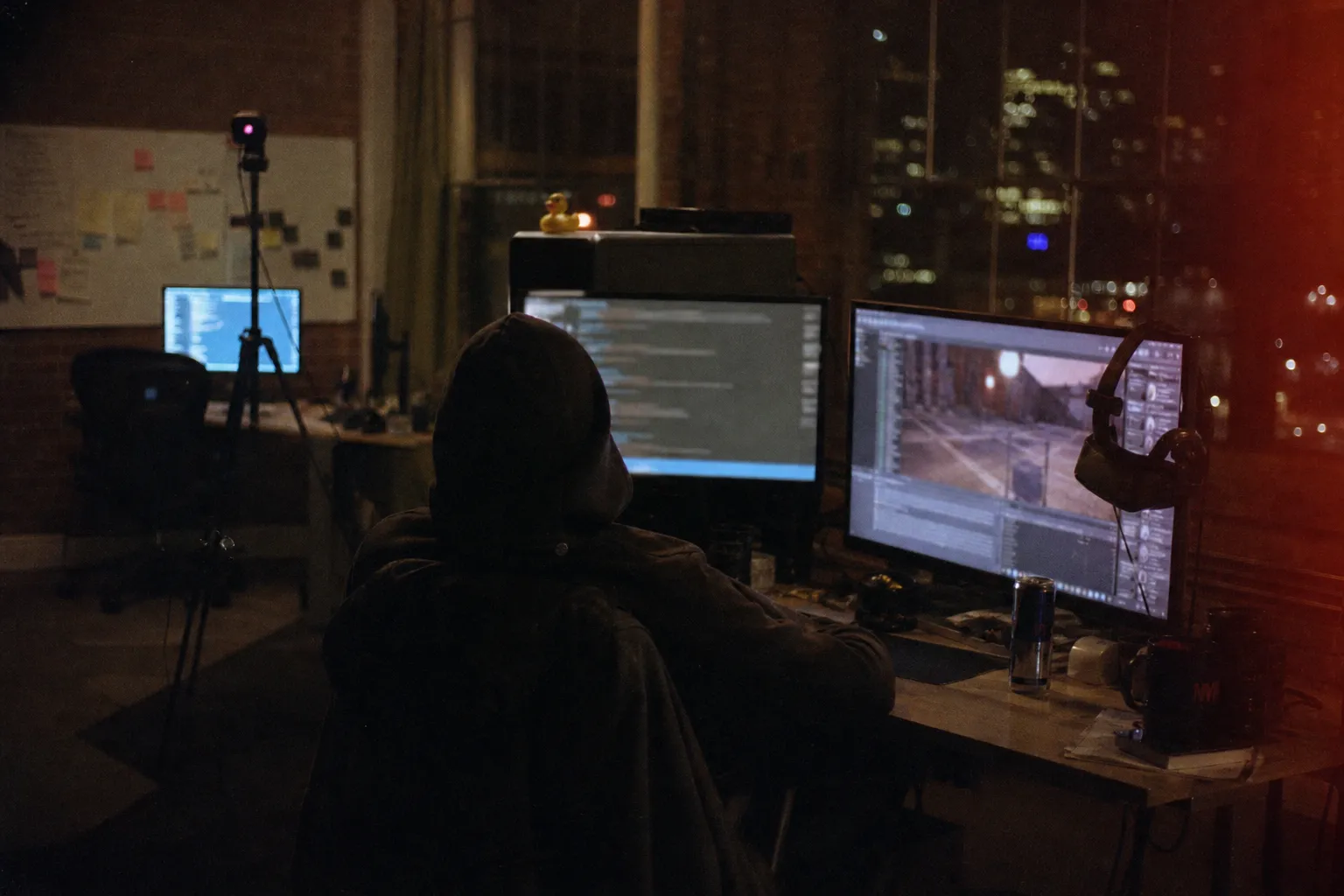
The future of VR is decided not at presentations but in studios that have to recoup their next game.
12 · What this means for you
Four signals that will change the assessment of the niche: public data on active users 3, 6 and 12 months after purchase; the comfort of a long session in a serial-production device, not just the weight of the front unit; studios’ repeat investment after their first game; and separate reporting of headsets, glasses, sales to consumers and active users in analyst reports.
Honesty and limitations
The strongest argument against our thesis. VR is not a dead niche but a solvent one. Quest owners have spent over $2bn on content, the game Gorilla Tag had 3m monthly players and over $100m in revenue as early as 2024, and in Germany the share of people who have tried VR rose from 28% to 35% in a year. Apple, Samsung and Google with Android XR have entered the market, and in the first nine months of 2026 Meta lost 3% less in Reality Labs than a year earlier ($12.8bn versus $13.2bn), although the loss grew in Q2. The fall in shipments is partly explained by the high base of the Quest 3S and by the fact that millions of old headsets are still in use.
The strongest argument for an even worse picture. VR devices fell faster than mixed-reality headsets in Q2 2026 (−37.6% versus −22.3%), the whole basket in Western Europe and the US shrank by a quarter, Meta holds up the market with losses of over $4bn a quarter, and Apple, by IDC’s estimate, shipped only 45 thousand Vision Pro units in 2025. If Meta redirects money from headsets to glasses and AI, there is no second company of that scale to pick up the subsidies.
Limitations of this review. We did not have access to the paid reports of IDC, Counterpoint, Omdia and TrendForce: we used their public press releases, some of them in reprints (Omdia’s pages are not available for automated reading). IDC’s estimates for Meta and Apple are known from The Register’s retelling. We could not open a number of SteamDB releases automatically (Cloudflare) and did not check them against the primary source; like the Steam survey, it describes only the observable PC catalog. European Quest prices are taken from Thurrott, not from Meta’s EU page. Prices in Ukraine are minimum offers on a single date. The scenarios, the causal loop and the calculator are illustrative NeuroDrift calculations and cannot be cited as measured market results. “We did not find” here means exactly that, not “does not exist”.
Sources
- Market size: Counterpoint — VR 2024, Counterpoint — 2025 and Q4, Counterpoint — quarterly shares 2026, IDC — AR/VR Headsets Market Insights, Q2 2026, IDC — smart glasses growth cools to 35%, IDC — 2024, Omdia — reality check for VR, Dec 2024, Omdia — near-eye displays, Jun 2026, Omdia — XR headwear 1H26 (reprint), TrendForce — VR/MR 2024, The Register — IDC estimates for Vision Pro and Quest.
- Meta and Reality Labs: Q3 2026 report, Q2 2026, Q1 2026, full year 2025, full year 2023, full year 2021, 10-K for 2021, CNBC — Reality Labs job cuts, Road to VR — Quest sales and “major breakthroughs”.
- Content and studios: SteamDB — releases tagged VR, Valve — Steam Hardware Survey, vr.org — Steam Frame in the September survey, Road to VR — VR on Steam, 2018, Road to VR — 2019, bit-tech — 2020, UploadVR — 2021, Mixed News — 2022, Meta — GDC 2025, Meta — Unite 2025, Road to VR — GDC 2026, UploadVR — Beat Saber, Road to VR — Gorilla Tag, Mixed News — Ready at Dawn, Game Informer — Meta studios, Road to VR — Cloudhead, Road to VR — nDreams 2025, Road to VR — nDreams 2026, Road to VR — Vertigo, Road to VR — Polyarc, VGC — Firewall Ultra, Half-Life: Alyx, Metro Awakening, Little Nightmares VR: Altered Echoes.
- Devices and prices: Meta — new Quest prices, Meta — device comparison, Meta — VR Glasses, Shacknews — earlier Quest prices, heise — prices in Germany, Valve — Steam Frame, Valve — Steam Frame launch and prices, Valve — reservation queue, Valve — Index discontinued, Sony — new PS VR2 price, Sony — PS VR2 specifications, Sony — PC adapter, Sony — PC requirements, Samsung — Galaxy XR, Apple — Vision Pro with M5, Apple — specifications, PICO — specifications, UploadVR — PICO 4 Ultra in Europe, HTC — VIVE Focus Vision, Road to VR — Focus Vision price, Road to VR — Quest 3 and 3S weight, Meta Display Week 2025 — Quest 3S optics.
- Europe, Ukraine, medicine: Bitkom — VR-Brillen, 21 Oct 2026, Thurrott — Quest prices in the EU, Meta — Quest shipping countries, Hotline — Quest 3S, Hotline — PS VR2, DOU — Ministry of Defence competition, ArmyInform — VR in training, Militarnyi — ZU-23 simulator, dev.ua — HeisterVR, Kyiv Independent — VR therapy for veterans, Mezha — VR KOLO, Mezha — MiroWin interview, DLA Piper — Medicare code E1905, strategy+business — PwC study, Saredakis et al. 2020 — meta-analysis of VR sickness, Sony — PS VR2 FAQ.
- History: Wheatstone, 1838, Sensorama patent, Sutherland, 1968, Nintendo — company history, Oculus Rift on Kickstarter, Facebook acquires Oculus, Google Cardboard, Meta — F8 2019, Quest, Sony — 5m PS VR, HTC — 2019 annual report.
- Source package: the study “How the VR headset market is doing” (data as of 29 Oct 2026, 45 sources), checked and supplemented by NeuroDrift.
Frequently asked
Is the VR market growing or shrinking in 2026?
Headsets are shrinking. According to Counterpoint, VR headset shipments fell 12% in 2024 and 28% in 2025, about 37% in total from the 2023 level; the decline continued in Q1 and Q2 2026 (−17% and −18% year on year). For Q2 2026 IDC records −22.3% for mixed reality headsets and −37.6% for VR devices (over one quarter, year on year; this is not the same as Counterpoint’s −37% over two years). The growth that headlines write about comes from glasses: in IDC’s broad “headsets and glasses” basket, 70.3% of shipments are display-less audio glasses.
How many VR headsets are sold per year?
There is no single agreed figure: analysts count different devices. Omdia estimated 2024 at 6.9m consumer VR headsets sold and 21.9m in active use; TrendForce at the end of 2024 forecast 9.6m shipments of VR and MR together. For 2025 we did not find a primary absolute total, only percentages. The manufacturers themselves usually do not disclose unit sales.
How much does Meta lose on VR?
The Reality Labs division, which includes the Quest headsets, glasses and the metaverse, received $443m in revenue and posted a $4.13bn operating loss in Q3 2026. From 2020 to September 2026 the cumulative operating loss of Reality Labs was $96.4bn against $13.1bn in revenue. For 2026 Meta expects a loss of $18–19bn, and for 2027 about $15bn. This is not only VR: the loss also includes smart glasses and research.
Which VR headset should I buy in 2026?
Without a PC or console, the basic entry is the Quest 3S ($349.99 / €359.99) or the Quest 3 ($599.99 / €619.99). For PS5 owners, the PS VR2 ($399.99 / €449.99 without a console). For owners of a powerful gaming PC, the Steam Frame from Valve ($1,059 / €1,049 for 256 GB), which bets on wireless streaming; it is not yet on open sale: Valve sends purchase invitations from the reservation queue, and some buyers will receive them only in December or in 2027. The main question is not the model but whether you will put the headset on every week. Meta Store does not deliver Quest to Ukraine, headsets are imported by third-party sellers; on Hotline on 2 Nov 2026 the Quest 3S 128 GB was sold from UAH 17,099.
Why did VR never become mass-market?
The barriers are small but numerous: weight and heat on the face, nausea in some people (according to a 2020 meta-analysis (46 experiments, mostly on headsets from before 2020), on average 15.6% of participants dropped out of an experiment because of nausea; the estimate may be inflated because 22 studies did not report dropouts), the ritual before launch, closed eyes for the people nearby, the full cost including a PC, different stores. A small active audience makes big games risky, and without big games the audience grows slowly. In Germany 35% of people aged 16+ have tried VR at least once, but only 12% of them put a headset on weekly.
Comments
Signed-in readers only — to keep it human, not a bot swamp.