GLP-1 vs Willpower: an Injection That Turns Off Food Noise — and a Revision of Self-Control Ethics at $16,000 a Year
For 80 years, Western ethics told fat people to 'get a grip.' In 2024, a once-a-week injection switched off the 'food noise' — and it turned out willpower was never a virtue. It was a tax on people whose biology billed them more. A dissection of the era where self-control is sold in a syringe: Novo Nordisk, worth more than its own country; how every vice eventually gets renamed into a molecule; thinness as a logo of solvency; the vanishing of 'wanting'; and the question of what you'll be moral with once the choice disappears.
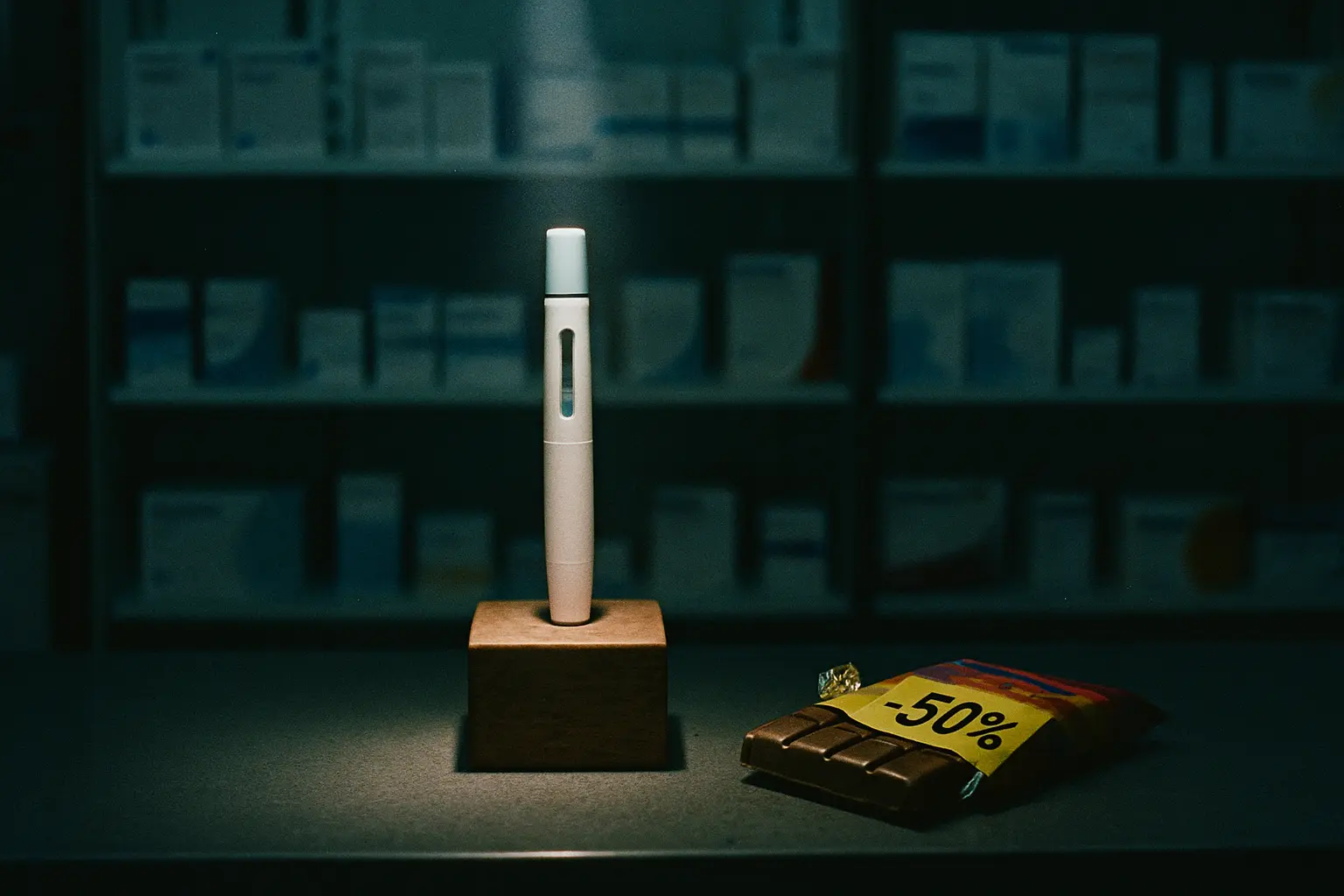
In 2023, the Danish company Novo Nordisk became worth more than the entire economy of Denmark — the country it lives in. One manufacturer cost more than its own state. Its flagship product: the absence of appetite. That is, Europe's most valuable company spent a while making money on people no longer wanting. An economy built on consumption found a way to also charge you for consuming less.
I. A fridge in Silicon Valley
California, 2024. A tech millionaire shows the camera his medicine fridge — a dedicated climate cabinet next to his anti-aging compounds. On the top shelf, a row of automatic injector pens. Semaglutide. He picks one up, unscrews the cap with the air of a man taking communion, and says into the lens: "This isn't for lazy people. It's for people with the discipline to take control."
Freeze the frame. The man just called discipline the act of injecting himself with a compound whose only function is to replace discipline. He's dosing himself with a substance that turns off hunger and calling it willpower. This isn't hypocrisy. It's the chime of an era: the moment the last Western virtue quietly moved out of character and into the pharmacy — without even saying goodbye.
Now step out of the glossy biohacker's frame and into the one nobody films for YouTube. The same drug, the same Thursday, only instead of a climate cabinet — the door of an office toilet, and instead of a millionaire — a middle manager injecting her belly between two calls, holding the pen with the same fingers that, twenty years ago, smoothed the paper in a fax machine that refused to send. No communion. Just one more maintenance procedure on a body that long ago stopped being your ally and became an asset on a balance sheet. Revolutions are always imagined with flags. This one arrived as a woman hiding in a stall so no one in the open-plan office sees her switch off her own appetite before the KPI meeting.
For eighty years we were told that a fat person is a person who failed. Couldn't hold back. Gave in. In 2024 it turned out that "couldn't" is treatable with a once-a-week injection. Which means it was never about "couldn't" at all.
II. What "food noise" is and why you never knew about it
People who start on GLP-1 describe the same effect, almost word for word. Not "I eat less." But: "it went quiet."
It turns out that in some people's heads a radio had been playing the whole time, unnoticed, because it played always. A background stream of thoughts about food: what to eat, when, how much is left in the fridge, that slice of cake at work, whether one more is okay. They named it food noise. For some people, the volume of that radio is a 2 out of 10. For others, a 9. And the entire life of the second group ran under a soundtrack they took to be simply "themselves."
Semaglutide and tirzepatide act on brain receptors tied to the reward system. They don't make food disgusting. They turn off the radio. And when it goes off, a person hears silence for the first time — and realizes that for 30 years they weren't fighting cake. They were fighting a station other people never had to hear. Imagine being scolded your whole life for sleeping badly at a disco — and then someone finally turns off the speakers that had been bolted over your bed, speakers your neighbor never had.
This is why it's not a cosmetic story about weight loss. It's an epistemological bomb. Because if "holding on" is a function of the loudness of a biological signal, and the loudness can be turned down with a syringe, then self-control was never a moral property. It was physiological luck that the lucky rewrote as their own merit. It's as if, for centuries, people with good eyesight had been handed medals for "virtuous acuity" and the nearsighted jailed for "moral blurriness" — and then glasses were invented, and it turned out the whole ethics rested on the shape of a cornea.
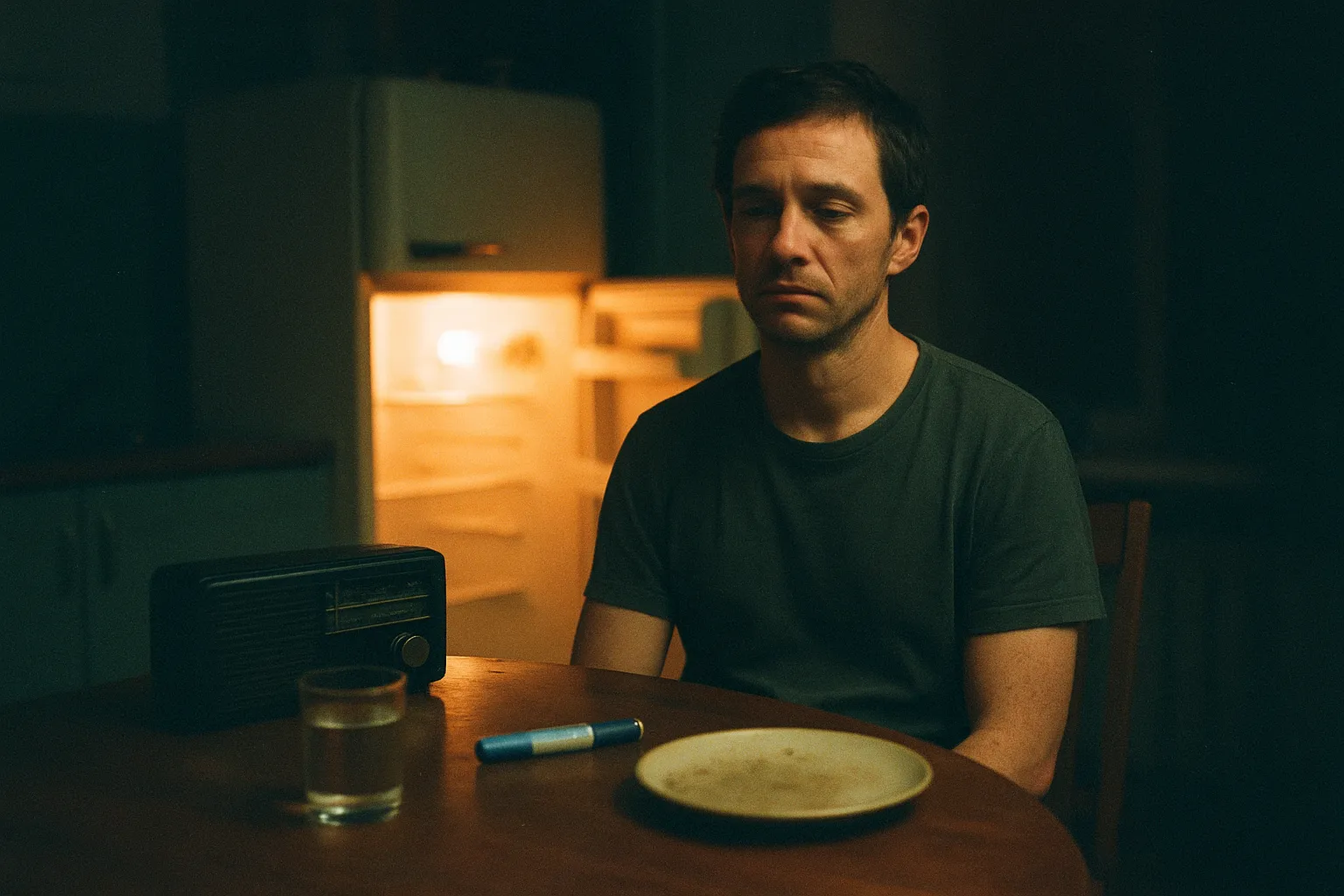
For the first time in 30 years the radio switched off. And in the silence the person heard not freedom but a question: if it was a station, then who was she herself?
III. Why now
All three conditions converged at one point somewhere around 2023–2024.
First: over 50 years the food industry built an environment engineered perfectly to crank that radio to maximum. Ultra-processed food isn't "tasty junk." It's a product fine-tuned by flavor labs as surgically as a TikTok feed is tuned by attention labs. There's even an engineering term — the bliss point: the calibrated combination of sugar, salt, and fat at which the brain stops saying "enough." You were made hungry on purpose, professionally, and for money that was later booked in a quarterly report as growth.
Second: a molecule developed for diabetes was caught on a side effect — it removes appetite. And pharma realized it was holding not a cure for a disease but a cure for the environment that the industry next door had created. Picture a firefighter and an arsonist who work in the same office tower, lunch in the same canteen, and rise on the stock exchange together every year. The arsonist sets the fires, the firefighter puts them out by subscription, and the building is you.
Third: the price turned out to make the market gigantic overnight. And here the arithmetic that chills you kicks in.
IV. A company worth more than a country
| Object | Order of magnitude (2024 peak) |
|---|---|
| Novo Nordisk market cap | ~$570 billion |
| GDP of Denmark (home country) | ~$410 billion |
| Eli Lilly market cap | ~$700–900 billion (touched $1 trillion) |
| Wegovy / Zepbound list price (US) | ~$1,000–1,300 / month → ~$13–16k / year |
| Share of US adults who've tried GLP-1 | ~12% (≈32 million) |
| GLP-1 market forecast by 2030 | $100+ billion / year |
A Danish insulin maker became worth more than the state it sits in. Not more than a rival company — more than a country. And the product that did it isn't a plane, a chip, or oil. The product is silence inside someone else's head. The absence of wanting, packaged in a pen you inject into your belly every Thursday.
This is the final form of 21st-century capitalism: first one industry sells you wanting (the bar, the feed, the dopamine), then the one next door sells you release from that wanting (the injection), and both grow. You pay on the way in and on the way out. You're milked on both sides of the same nerve.
And so it doesn't sound like an abstract conspiracy of men in ties, drop down to the level of a kitchen. Capitalism isn't a villain with a cigar in a leather chair. Capitalism is a woman crying at half past eleven at night while finishing the tenth cheeseburger of the week — one she didn't even want — from a chain whose ad an algorithm pushed to her, an algorithm paid for out of profit that partly sits in a pension fund meant to support her in the old age she may not even reach on this diet — and the only exit the system offers her is to buy, from that same system, an injection to stop wanting the thing that same system did everything to make her want. A closed loop, every revolution of it monetized by someone. And at the center of the loop — not a villain. At the center — a crying human with a napkin.
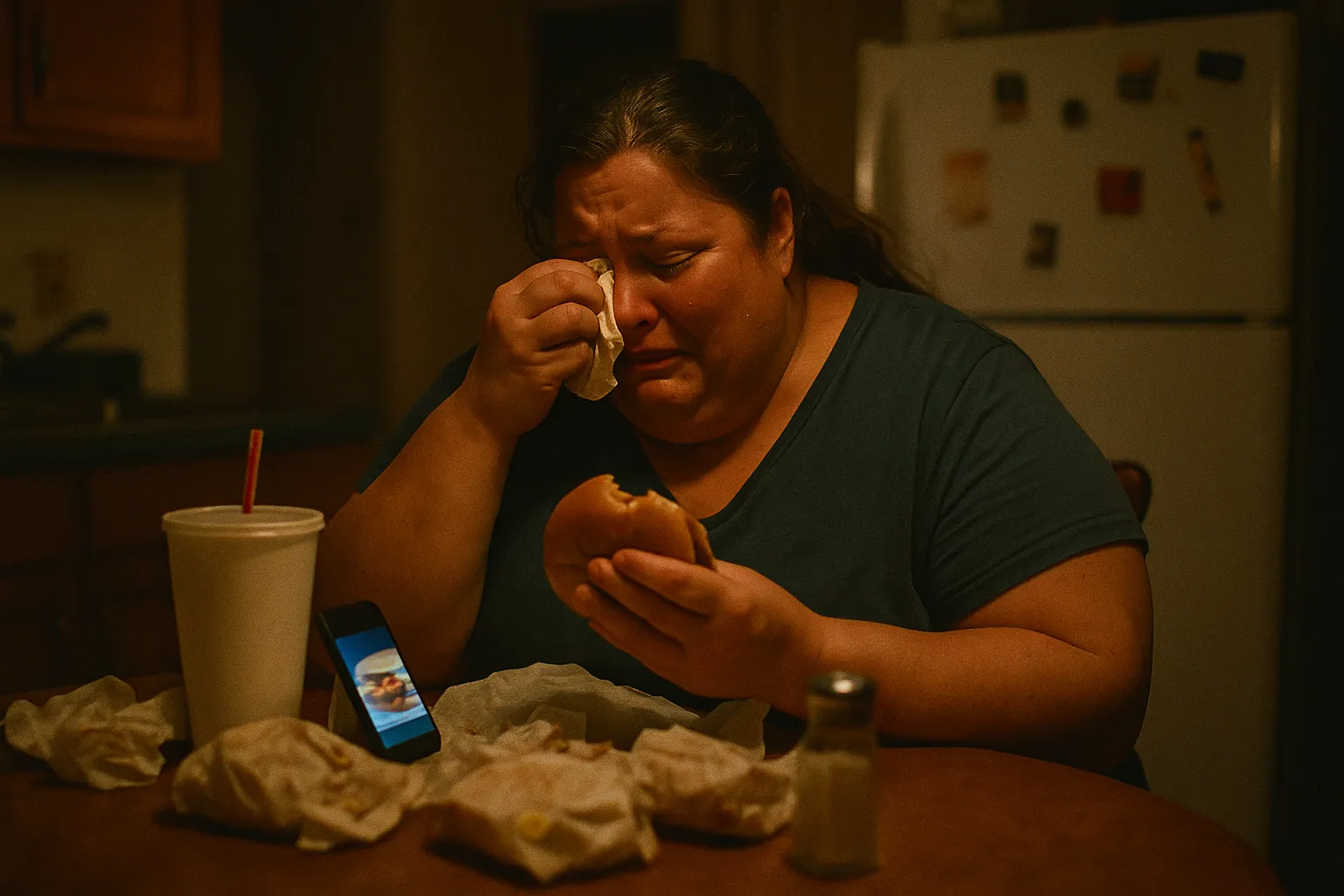
At the center of the loop there’s no villain with a cigar — just a crying human with a napkin. The system that made you hungry and the system that sells you fullness are held by the same shareholders.
V. Case history: every vice eventually gets renamed into a molecule
What's happening to willpower, we've seen before. Several times. The script is so repetitive you could print it as a form and just fill in the name of the next "vice."
Act one is sin. The drunk is a weak, dissolute person who chose the bottle. The melancholic is a lazy coward short on faith and vigor. The child who can't sit still is ill-bred and must be broken by discipline. The fat one is a glutton, one of the seven deadly. Society looks at suffering and sees character.
Act two is diagnosis. Alcoholism becomes a disease of dependence. Melancholy becomes depression with a neurotransmitter basis and a line in the classifier. Restlessness becomes ADHD. And every time, the same public that had just despised "the weak" is outraged: "but that's just an excuse! Coddled! In my day people simply got a grip!" Moralists defend the right to despise with the fury reserved for defending their last possession.
Act three is a molecule with a price tag. SSRIs. Stimulants. And now — GLP-1. What was a sin, then a diagnosis, becomes a market with a starting price. And here's the play's black finale: the instant a vice cheapens into a subscription, the moral outrage evaporates — not because humanity grew kinder, but because you can no longer feel superior for free off the back of it. Contempt for the fat held up exactly as long as it was free. The moment thinness became a purchase rather than a verdict, the contempt lost its only capital — being cost-free.
VI. Counter-pressure: but people got relief
And here we have to stop and not slide into cheap moralizing, because that would betray the facts.
For millions of people this isn't "laziness in a syringe." It's the first moment in their entire life when the radio went quiet. The woman with PCOS, the man with metabolic syndrome, the person whose genes handed them a bill no amount of "get a grip" could ever pay — for them GLP-1 isn't a cheat code. It's glasses. Nobody demands a nearsighted person "focus the lens by willpower." We just hand them a lens. And suddenly it turns out the person was seeing perfectly fine for their eyes — the eyes were just different.
More than that, there are hard medical numbers behind this, not just cosmetics. Large trials have shown these drugs cut not only weight but the risk of heart attacks and strokes in people with obesity and cardiovascular history — by a margin hard to write off as fashion. That is, some of those injecting aren't "buying beach thinness" — they are literally pushing back the date of their own death. And arguing with that from a "well, in my day" stance is arguing with an ECG.
So the scalpel isn't in the patient. The scalpel is in the 80-year-old construct that convinced an entire society that a different volume of biological radio means a different moral worth of a human being. That the thin one earned it and the fat one slacked off. That construct just burst — and the loudest screams come not from the fat but from those it gave a free pass to feel superior.
VII. Who wins when wanting disappears
Any revolution should be read not by its slogans but by its bookkeeping: look at whose pile of money grew after it. The disappearance of appetite reshapes whole industries — and the list of beneficiaries is longer than two pharma companies.
| Player | What they win | The hidden line |
|---|---|---|
| Pharma (Novo, Lilly) | A lifelong subscription instead of a one-off course | Sold not a drug but rent on a body |
| Insurers & employers | Fewer heart attacks, less diabetes, fewer sick days → a cheaper worker | They'll cover the "profitable"; the rest get "try a diet" |
| The aesthetics economy | "Ozempic face" → a market of fillers, lifts, cosmetology | One drug shrinks you, you pay another to fix the consequences |
| Compounding pharmacies & grey market | Shortage and price → a boom in "semaglutide" from sketchy vials | Save on the brand, gamble with your own blood |
| The food industry itself | "GLP-1 friendly" lines: a smaller portion at a higher price | The same industry sells you both the hunger and its taming |
Note the last row — it's the most beautiful in its cynicism. Food giants are already releasing "protein mini-portions for people on GLP-1." That is, an industry that spent decades paying labs so you couldn't stop now sells you — at a higher price per gram — the small portion, because now you can. The snake finished eating its own tail and billed for it, with a surcharge for mindfulness. And the loser in this table, as always, is the one whose row isn't in it: the uninsured person, for whom "just get a grip" remains the only prescribed treatment, because the vial costs as much as their monthly rent.
VIII. Thinness as a logo of solvency
For a hundred years a lean body read as a moral report. A trim silhouette meant: this person can deny themselves, therefore — reliable, disciplined, worthy of promotion. Thinness was a free résumé of character you wore on your body. The thin got hired more readily, because the body "proved" the will.
GLP-1 rewrote that code overnight. Now a lean body means not "I can deny myself" but "I can afford $16k a year so I don't have to." Thinness stopped being a report of virtue and became a logo of solvency — the same as a watch or a car brand, only tattooed into a silhouette. The rich now get a double prize: they lose weight — and they get to look like people who "just take care of themselves," when they merely signed up for a subscription. The former symbol of discipline turned into a symbol of income that does a very good impression of discipline.
And then — a grimace already visible: "Ozempic face." Rapid volume loss leaves the face sunken, aged — and a person who paid to be more attractive pays a cosmetologist again to fix what the first drug did. The beauty of the 21st century is no longer what you have by nature or what you won through labor, but how many interlocking subscriptions you're willing to carry at once to hide that you won none of it. The mirror no longer shows character. It shows your card statement.
IX. The bill they don't show in the ad
Willpower was never a virtue — it was a tax your biology charged you personally, and society filed under "character." GLP-1 abolished the tax for those who can pay $16k a year. Everyone else keeps paying in the currency they were born with.
And under that bill come, in fine print, other lines that aren't on the sunny billboards:
- Muscle. Up to a quarter or two-fifths of the weight lost can be not fat but lean muscle. You shrink — and weaken, unless you simultaneously lift iron and eat the protein you no longer want. The drug switches off the very appetite that should rebuild the body. Picture a renovation where the contractor hauls out not just the rubbish but a load-bearing wall, because "well, the weight went down."
- Anhedonia. The radio that turns off hunger reaches other stations too. Patients report that the pull dropped not just for food — for alcohol, gambling, shopping, scrolling. Sounds like a win. But some add quietly: "it got boring. Nothing pulls anymore." You removed the craving for cake — and dialed down the craving for life along with it. Schopenhauer wrote that life is a pendulum between pain and boredom; he just didn't live to learn the pendulum can be stopped subcutaneously, once a week, with a four-millimeter needle, for the price of a used car a year.
- A subscription, not a course. Stop injecting — the radio returns, the weight returns. This isn't treatment that ends. It's a lifelong membership in your own slimness. Pharma didn't sell a pill. It sold rent on your body — and under the lease you're not the owner, you're the tenant, and the eviction is called "the yo-yo effect."
- Children. A generation is growing up for whom appetite is not fate or struggle but a switch. What happens to a culture where hunger can be turned off with an injection as casually as the sound on a phone? We don't know yet. The lab is running, the subjects are alive, the report comes in 30 years — and the subscription to the conclusion is already prepaid.

The weight dropped, the bill stayed. The scale reads less, the mirror reads emptier, and the subscription debits every month — until you reconsider existing thin.
X. The person who no longer wants anything
For two thousand years philosophers sold the fading of desire as the summit of the spirit. The Buddha called it release from suffering. The Stoics, ataraxia. Ascetics went into the desert to stop wanting, and were canonized for it. The whole lofty tradition agreed: whoever craves less is freer. And now humanity has finally reached that state of enlightenment — en masse, affordably, no desert required.
It looks like this. A forty-seven-year-old administrator sits in the kitchen one evening, the plate half-eaten — because "I don't really want it" — and for the first time in his life he leaves food unfinished not out of willpower but out of its absence. Food doesn't pull. The alcohol in the cupboard doesn't pull. The notification on the phone barely pulls. He has reached the very extinction of desire the saints wrote about — only instead of illumination he feels a flat, grey silence in which it's unclear why to get up tomorrow, beyond the fact that it's customary. Enlightenment arrived by mail, in a thermal pouch with dry ice, and somehow didn't make him happy. Ascetics walked into the desert for this over years. He had it couriered in two days, and didn't even remember to say thank you — because gratitude, too, stopped pulling a little.
Here's the uncomfortable discovery: wanting isn't a bug to be patched. Wanting is the engine. The same "I want" that drives you to the fridge drives you to work, to another person, to tomorrow morning. It's one engine for all of them. And when pharma turns its volume down, it can't selectively mute only the pull toward a cheeseburger — it mutes the pull itself, entirely, like a kill switch, not an equalizer. You asked to turn off one nagging station. They lowered the volume of the whole receiver, along with the station that broadcast why you turned the sound on in the first place.

He reached the enlightenment the saints wrote about: desire went out. Only instead of illumination — a flat grey silence and a fax printing emptiness. The whole engine switched off, not just the one station he asked to mute.
XI. What it does to morality
For two and a half thousand years Western ethics — from the classical virtues through religious restraint to modern behavioral economics — agreed on one thing: self-control makes you a better person. The ability to defer, to abstain, to tell yourself "no" was held to be the spine of character. The Protestant ethic raised it into a cult: restraint, thrift, the refusal of pleasure — not merely useful habits but proof you were among the chosen. A whole capitalism grew out of the idea that whoever can deny themselves deserves more.
Now imagine the spine can be bought. $16k a year — and you're "disciplined." And the question that rises from this is uncomfortable to the point of physical discomfort: if your restraint is a prescription, then where in you does virtue live? Were you moral — or just born with a quiet radio and spent your life mistaking luck for merit? The whole Protestant pyramid of "the more restrained, the more worthy" rested on the assumption that restraint comes from character. It turned out to come from neuroreceptors. And the medal handed out for character was, all along, being handed out for a lucky anatomy.
Capitalism has a habit of turning virtues into products. "Being in shape" once took time and pain — now it's a subscription. "Staying calm" was once a practice — now it's a $70-a-year meditation app. "Having willpower" was once character. GLP-1 is simply the next virtue taken off the shelf of the soul and placed on the shelf of the pharmacy, with a price tag and a discount for those whose insurance covers it. And next in line for packaging stands, it seems, motive itself — desire, attention, the capacity to want. And when that, too, is packaged, the question "what in a person is their own" will stop being philosophical and become a question for the pharmacist.
Sources
- Novo Nordisk market capitalization vs Danish GDP — Bloomberg / Financial Times, 2023.
- Eli Lilly valuation milestones 2024 — company filings, market data.
- KFF Health Tracking Poll, "Use of GLP-1 drugs among US adults," 2024 (~12%).
- Wegovy / Zepbound US list prices — manufacturer pricing pages, 2024.
- "Food noise" phenomenon — patient reports compiled in JAMA / Nature Medicine coverage, 2024.
- "Bliss point" / engineered hyper-palatability — M. Moss, "Salt Sugar Fat" (2013); food-science literature.
- Cardiovascular risk reduction — SELECT trial (semaglutide), NEJM 2023 (~20% MACE reduction in overweight/obese with CVD).
- Lean-mass loss with GLP-1 — published clinical trial body-composition data (STEP / SURMOUNT programs).
- Anhedonia / reduced cross-domain craving — emerging reports, JAMA Psychiatry coverage 2024 (causality not established).
- "Ozempic face" / aesthetic sequelae — dermatology & plastic-surgery commentary, 2024.
- Compounded semaglutide & grey-market risks — FDA warnings, 2024.
- Disease-model history (alcoholism, depression, ADHD) — general medical-sociology background; M. Weber, "The Protestant Ethic and the Spirit of Capitalism" (1905) for the virtue-of-restraint frame.
- Goldman Sachs / Morgan Stanley GLP-1 market projections to 2030.
Frequently asked
What is food noise, and why does it matter for understanding this article?
Food noise is the constant background stream of thoughts about food running in some people's heads: what to eat, when, how much is left. The volume of this signal varies from person to person, roughly 2/10 to 9/10, and those with a loud version spent their lives fighting not a character flaw but a physiological signal that others simply do not have. GLP-1 silences this noise, making clear that willpower never measured character — it measured the volume of a specific neural broadcast.
If willpower is biological luck rather than virtue, what is left as a moral standard for judging people?
That is the central question the article leaves open: if self-restraint is a function of neuroreceptors rather than character, the entire moral architecture built on self-control as proof of worth collapses. The article does not offer a replacement, but makes the task explicit — a new basis for moral evaluation is needed, one that does not rest on physiological fortune.
Millions of people managed without these drugs, so does that not prove willpower is real?
Those who managed typically had a quieter radio from birth and mistook anatomical luck for personal merit. Willpower as effort is real, but it is not equally distributed as a resource: the biological tax varies by individual, not by intention. People with loud food noise spent equal or greater volitional effort just to stay in place, and society ignored this because the visible outcome was different.
Anhedonia from GLP-1 — is this a handful of edge cases or a systemic effect worth taking seriously?
Currently these are documented patient reports without established causality, but the mechanism is plausible: the drug acts on the brain's reward-system receptors, which do not distinguish the pull toward a cheeseburger from the pull toward a project or another person. Pharmacology cannot yet work as an equalizer — it adjusts the master volume, not a single channel. The population-scale effect will become visible over 10 to 20 years of sustained use.
What should someone considering or already using GLP-1 actually do with this information?
Three things the marketing omits. First, start resistance training and adequate protein intake from day one, because up to two-fifths of weight lost can be lean muscle mass. Second, treat this as a permanent subscription, not a course — stop injecting and the weight returns, so the decision is financially and psychologically long-term. Third, monitor whether appetite loss has taken something else with it — motivation, interest, pleasure — because that is not a normal side effect and warrants an explicit conversation with a doctor.
Comments
Signed-in readers only — to keep it human, not a bot swamp.