Deep Focus as the Last Advantage: 78,500 Tech Layoffs in a Quarter — AI Devalued Work That Can Be Done Inattentively
In Q1 2026 the tech industry cut ~78,500 jobs — nearly half blamed on AI. The machine now does everything shallow for half a cent. What's left is exactly the work that demands depth — and that depth has become the last uncommoditized competitive advantage, because it can't be outsourced to a model.
On this page
- I. Scene: the watchmaker who didn’t notice watches got cheap
- II. “Why now?” and the named framework: how depth suddenly became a moat
- III. Axis #1: the shallow — the layer the machine already ate
- IV. Axis #2: depth — what demands forty unbroken minutes of silence
- V. Axis #3: scarcity — why depth appreciates as everyone else unlearns it
- VI. Axis #4: the price premium — the arithmetic of why an hour of depth beats a shallow day
- VII. Five types on the new market (autopsy, not a zoo)
- VIII. Full counter-pressure: “what if depth is romanticism, and the fast-shallow-with-AI actually win?”
- IX. Distributional lens: for whom depth is a moat, and for whom a wall
- X. Reader tool: the Depth Audit — where your hours actually go
- XI. Re-plating: depth not as asceticism but as the one inalienable property
- XII. Hard kicker
"But I work all day." — said by a person who just spent eight hours doing what a model does in eight seconds for half a cent. A shallow day used to be a virtue. Now it's a résumé set in a font no one reads anymore, because the machine reads it for them.
I. Scene: the watchmaker who didn’t notice watches got cheap
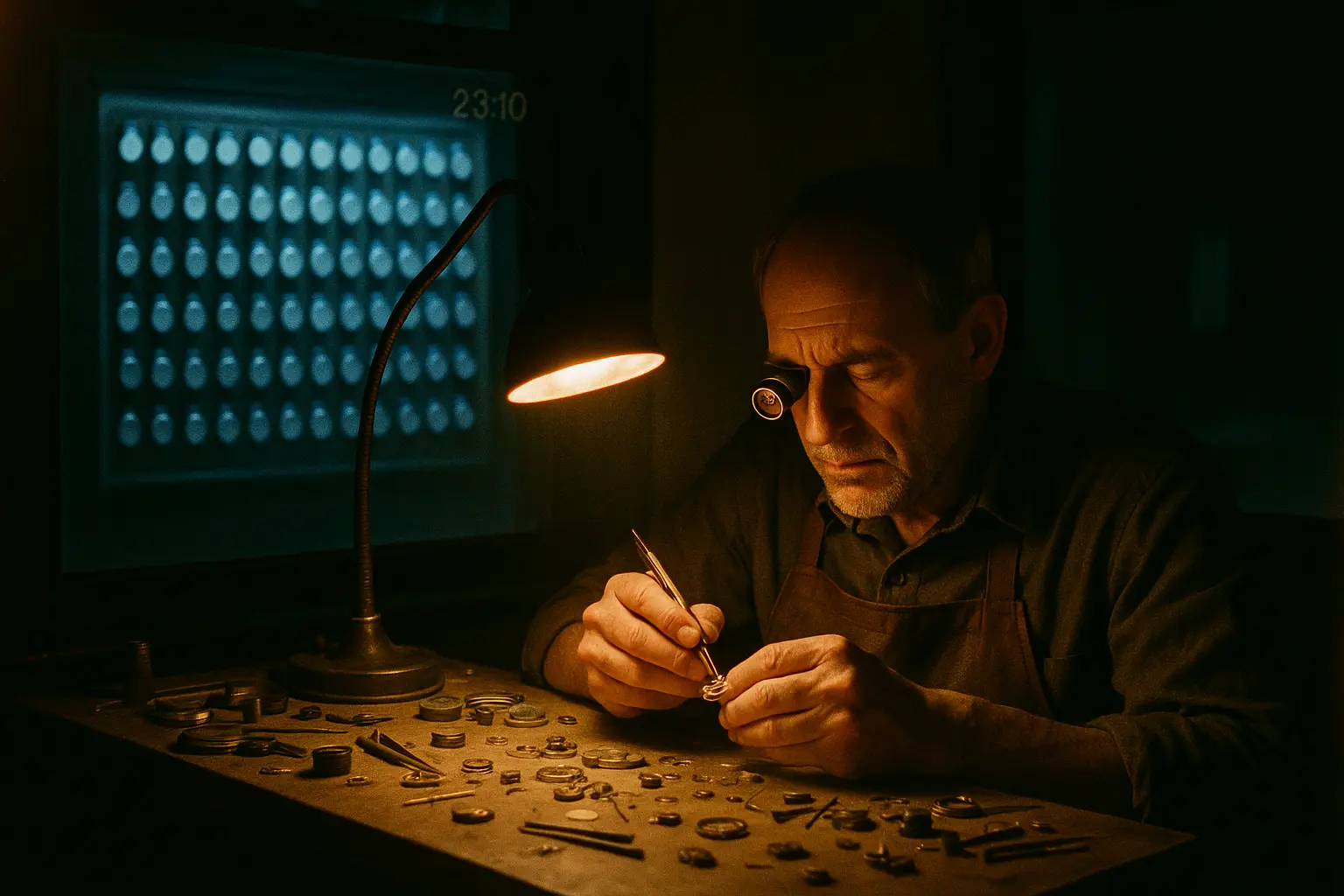
A second-floor workshop, 23:10, a desk lamp bent on its gooseneck at an angle that hasn’t moved in ten years. The master screws a loupe into his eye socket and hovers over a single movement — balance wheel, hairspring, a jewel the size of the comma in this sentence. He needs forty minutes of unbroken silence to seat one part so the watch will run. Across the street, on a shop shelf, three hundred plastic quartz watches tick quietly — each more accurate than his masterpiece, each cheaper than a cup of coffee. He knows this. He screws the loupe in deeper anyway.
Here is the number this whole essay starts from, and it isn’t about watches. In the first quarter of 2026 the tech industry laid off roughly 78,500 people, and by industry trackers’ count nearly 48% of those cuts were attributed to automation and AI (Tom’s Hardware, April 2026). Translate from HR: half of those people were let go because what they did now ticks on the shelf across the street — more accurate, cheaper, no lunch break. Shallow cognitive labor just became a quartz watch. And the master behind the loupe isn’t nostalgia. He’s the only person in frame whose work nobody has yet managed to mark down to half a cent.
The scene looks sentimental — old craftsman, warm light, noble stubbornness. That’s the trap. The master isn’t a romantic. He’s a rational investor who ran a cold calculation: he handed the machine everything that could be done without attention, first, and deliberately kept only the work that needs those forty minutes of silence. He isn’t fighting the quartz. He simply moved to where the quartz can’t reach. And that is why his scene isn’t about the past — it’s about the next five years of anyone who lives by their head.
II. “Why now?” and the named framework: how depth suddenly became a moat
People have always prized mastery. That’s not new. What’s new is that in 2025–2026 the machine, for the first time, began doing the shallow layer of knowledge work cheaply and at scale, leaving the deep layer exposed the way an ebbing tide bares the seabed. The Anthropic Economic Index for March 2026 records it: roughly 49% of occupations now use AI for at least a quarter of their tasks, and Claude itself takes on tasks that average 14.4 years of education versus 13.2 years for the median task in the economy (Anthropic, March 2026). Read that slowly: the machine isn’t taking the dumb work. It’s taking the educated-but-shallow work — the exact layer most white-collar jobs are built on. Shallow stopped being safe precisely because it was skilled, yet not deep.
This isn’t about dystopian robots. It’s about price. When any task that can be done without immersion is done by a machine in seconds for a fraction of a cent, the market does what markets always do with a glut: it drives the price to zero. Economists call it commoditization. NeuroDrift puts it plainer: what everyone can do, and now what the machine can do, no longer feeds you. What’s left is exactly the work that demands depth — full, unbroken, expensive focus that can be neither faked, nor outsourced, nor generated from a prompt.
Name the mechanism, because without a name it’s just anxiety in a news feed. The depth moat — the last uncommoditized competitive advantage of a person who lives by their head. The water around the castle that doesn’t run dry, because it’s fed by the one spring the machine can’t yet counterfeit: the ability to stay inside a single hard problem long enough for the non-trivial to be born. Four axes, along which this moat either holds you or gets waded across:
- The shallow axis (commoditized). Everything that can be done inattentively, in fragments, between notifications. The layer the machine has already eaten. Price heads to zero.
- The depth axis. What requires forty minutes of unbroken silence: a new argument, a hard decision, taste, the synthesis of incompatibles. Here the machine assists but does not replace.
- The scarcity axis. The fewer people capable of immersing, the more each hour is worth. And fewer can — which, paradoxically, is good news for those who still can.
- The price-premium axis. One hour of real depth is worth multiples of a shallow day — and the gap widens at exactly the speed shallow gets cheaper.
I’ll unpack each axis with a scene, a number, and a mechanism. Without academic distance — because I catch myself daily finding the shallow day easier than the hour of depth, and daily have to choose the harder one.
III. Axis #1: the shallow — the layer the machine already ate
Scene. A junior analyst, first year on the job, gets a task: consolidate five regions’ quarterly data into a table, write the cover paragraph, build the slide. Once this was a whole week — and it was on weeks like these that a person learned the craft: erred, asked again, finally understood why column C didn’t reconcile. Now that week is one prompt and four minutes. The analyst looks at the finished slide and feels, for the first time, not relief but a chill: the machine didn’t just do his task. It did his rung.
This is the quiet collapse the robot headlines miss. AI doesn’t kill the job — it kills the path to your first one. Yale researchers find that AI’s job destruction lands first where careers haven’t even started — on entry-level, on the very shallow tasks the craft used to be learned on (Yale Insights, 2026). The share of graduates landing at the Magnificent Seven has more than halved since 2022; Big Tech graduate hiring is down by roughly a quarter, while hiring of people with 2–5 years’ experience rose +27% (SignalFire State of Talent). Translation: the market stopped paying for the ability to do the shallow and started paying for accumulated depth. They took away the ladder, and the balcony is still up there waiting.
| Shallow (price → 0) | Deep (price → premium) | Why the machine takes the first, not the second |
|---|---|---|
| Consolidate data into a table | Understand why the data is lying | First is pattern; second is judgment against context |
| Write "competent" prose | Say what no one has said yet | The machine interpolates the known; depth extrapolates into the unmapped |
| Assemble a best-practices plan | Choose what to refuse | Refusal needs taste and ownership, not the corpus average |
| Prep "from a template" | Hold complexity to a non-trivial decision | Template is surface; decision is immersion |
Counter-pressure mini: “but someone still needs the shallow, and someone still earns on it.” Fair — for now. The transition isn’t instantaneous; market inertia is real. The problem isn’t that shallow vanished today. The problem is that its price now falls at the same speed tokens get cheaper — and tokens, recall, get roughly ten times cheaper a year. Building a career on the shallow in 2026 is like signing a thirty-year mortgage on a house in a town whose factory just started moving out. The house still stands. The price already decided for you.

The machine didn’t do his week of work. It did his rung — and now the stairs to the balcony where depth is paid for are missing their first ten steps. He’ll have to climb the wall.
IV. Axis #2: depth — what demands forty unbroken minutes of silence
Scene. 09:50, a person sits down to a genuinely hard task — the kind that needs five moving parts held in the head at once until they click. At 09:54, Slack. At 09:58, a “quick” question in chat. At 10:03, an email that’s “two minutes, tops.” By lunch the person has been “busy” seven times and immersed zero. By evening they honestly don’t understand why the main task hasn’t moved. It hasn’t moved because depth is not the sum of minutes. It’s continuity, which fragmentation kills not proportionally but at the root.
Here’s the mechanism, rendered as a number. The average office worker switches apps roughly every 40 seconds — about 720 times a workday; getting back into flow after each switch takes on average ~9.5 minutes (Cognitive Economy, 2026). Do the honest arithmetic: if each switch costs nine minutes of recovery, then a person who switches every nine minutes has nothing left for depth. They spend all day revving an engine that stalls right before it catches. In aggregate this fragmentation costs the U.S. economy roughly $450 billion a year — that’s not “people get a little distracted.” That’s a mid-size nation’s half-year budget, burned to ensure no one ever enters flow.
Now the other face of the same coin, because depth is not only about avoiding losses. A decade-long McKinsey study found that executives in a flow state report being roughly five times more productive than in their normal working mode (McKinsey, “Meaning quotient of work”). Fivefold. Meaning one hour of depth is not “a bit better than an hour of fragmentation.” It’s five hours compressed into one, plus the single non-trivial result that the fragmented mode never produces, no matter how many hours you pour in.
Counter-pressure mini: “but AI is itself a tool of depth — it augments me, it doesn’t replace me.” Yes, and that’s the strongest argument against this entire essay, so let’s enter it honestly. Anthropic records that 57% of AI use is augmentation (amplifying the human) and only 43% automation (replacement) (Anthropic Economic Index). The machine does assist more often than it replaces. But here’s what the argument misses: augmentation amplifies only someone who has something to amplify. AI is an amplifier of depth, not a prosthetic for it. Hand a violin to a virtuoso and he plays better. Hand the same violin to someone who can’t hold the bow and you get louder screeching. The one who can immerse becomes fivefold with AI. The one who can’t becomes a faster generator of shallow, whose price already heads to zero. The tool doesn’t level. It widens the scissors.
V. Axis #3: scarcity — why depth appreciates as everyone else unlearns it
Walk in your mind into any open-plan office and count how many people, in the last hour, spent even twenty minutes inside one task with zero switching. Honestly? Almost no one. And here hides the most uncomfortable, most cynical, and simultaneously most optimistic thesis of this whole text: depth appreciates not only because the machine ate the shallow, but because the very capacity to immerse has become rare. Every notification that breaks someone else’s focus quietly raises the market price of yours. Your competitors for a scarce resource walk out of the game themselves — voluntarily, smiling, every time they pick up the phone.
Scarcity is always about two things at once: how many people can do it and how hard it is to learn. Deep focus fails both tests of the mass-produced — which is exactly why it’s an asset. The ability to hold the hard for long doesn’t scale with a single prompt; it can’t be bought by subscription; it isn’t transferred at a one-week onboarding. It has to be grown — over months, against an entire environment engineered to fragment it. What’s hard to acquire and easy to lose, the market prices high. Depth is acquired over years and lost over a quarter of unfocused scrolling. That is the definition of a scarce asset, just without a ticker on an exchange.
Everything that can be done inattentively is now done by the machine — cheaply and at three in the morning. What’s left is exactly one thing that can be neither outsourced nor generated from a prompt: hours of real depth. That is the last moat — and it runs deeper the more people around you unlearn how to enter it.
| Who they are | What the machine does to their work | Where their price moves |
|---|---|---|
| Shallow generalist (fast, "fine") | Does the same in seconds, free | ↓ to zero — competing with a free copy of himself |
| Deep specialist (rare but non-trivial) | Amplifies, doesn't replace: hands him another fivefold | ↑ premium grows with the scarcity |
| One who can immerse + drives the machine | Becomes a lever, not a substitute | ↑↑ the rarest, dearest combination of 2026 |
| One with neither depth nor machine | Squeezed out from both sides at once | ↓↓ the scissors close |
Counter-pressure mini: “sounds like elitism — as if only a chosen few with superhuman focus survive.” Fair: that reading is a risk, and it needs removing outright. Depth is not the innate gift of a handful of the elect. It’s a skill people unlearned to train, because the environment paid for the opposite. The good news is precisely that it’s learnable — and therefore available to anyone willing to pay in the discomfort of silence instead of the dopamine of the feed. The bad news is that the market won’t wait while you get around to it. The moat isn’t elite by birth. It’s elite by effort. And effort, unlike talent, is an honest entry fee.
VI. Axis #4: the price premium — the arithmetic of why an hour of depth beats a shallow day
Now the coldest axis — money. Because as long as this stays a philosophy about focus, the brain nods politely and changes nothing. Convert it to an invoice.
A shallow day is eight hours of fragmented work, each piece of which the machine repeats in seconds for half a cent. Its market price races toward the cost of those same tokens, because the buyer now has an alternative for half a cent. An hour of depth is the single non-trivial argument, decision, or synthesis that isn’t in any model’s training data, because it was just done for the first time. By definition it isn’t commoditized: it can’t be copied from a corpus that doesn’t yet exist. So the market pays for it not “a bit more.” It pays categorically differently — the way an original is paid for against endless copies.
Add up the difference, bone by bone. The shallow day competes with a free machine copy — so its marginal price presses to zero, because why pay a human for what an API outputs. The hour of depth competes only with itself, because there’s no equivalent — so it sets the price itself. Layer on flow’s fivefold multiplier (McKinsey) and net out the $450 billion in annual fragmentation losses (Cognitive Economy), and you get not a metaphor but bookkeeping: one hour of real depth is worth not “eight times an hour of shallow” — it’s worth more than an entire shallow day, because a shallow day now costs exactly what its machine copy costs, which is almost nothing. This isn’t the moral superiority of deep work. It’s the difference between a good that just got a free substitute and a good that has no substitute by definition.
And one more thing, the most unwelcome for our comfort. Depth is expensive not because it’s pleasant. It’s expensive precisely because it’s unpleasant — it demands sitting in the discomfort of not-knowing longer than the body tolerates, against every instinct screaming “check your phone.” If it were easy, everyone would do it, and the premium would vanish. The premium on depth is, in essence, a premium for voluntarily enduring the very thing everyone else flees into the feed. The market doesn’t pay for your intelligence. It pays for your ability not to blink first in a staring contest with a blank page.
VII. Five types on the new market (autopsy, not a zoo)
The four axes are the mechanics. Now five real positions in which those axes settle into a fate. I recognize myself in each at different years; the reader probably will too.
1. The Skilled Shallow. Ten years of doing it “fine and fast” — reports, copy, decks, calls. A master of the average. The trouble: the average is exactly what the machine is trained on, because the average is the corpus average. Woke up in 2026 a competitor to a free API. Antidote: pick one task where you can go deeper than the model, and grow depth there — while they still feed you for speed.
2. The Unfocused Clever. The IQ is there, the immersion isn’t. Forty tabs, zero finished hard tasks. Smart enough to see opportunities, scattered enough to finish none to non-trivial. Antidote: not a new time-management technique but one rule — a single block of depth a day, sacred, until the first switch. Let the rest of the day burn.
3. The Deep Craftsman. Capable of the forty silent minutes, but afraid of the machine as a rival and so ignores it. The mirror error of the Shallow: that one surrendered depth, this one surrenders leverage. Antidote: put the machine on the shallow to free more hours for the one thing only he can do. The violinist who refuses the amplifier loses to the violinist who took it.
4. The Lever (rare). Can immerse and drives the machine. Delegated the shallow first, kept the depth, made AI an amplifier. The dearest combination of 2026 — and the least numerous. Needs no antidote; needs only the discipline not to slide back into the comfort of the shallow, which is always nearer to hand.
5. Squeezed from both sides. Neither depth nor machine. Automation took the shallow; the deep was never grown. The most painful position — and, alas, the most populous at the start of this cycle. An antidote exists, but only one: start growing depth today, with discomfort and no guarantees, because yesterday already got commoditized.
The field for these five isn’t private drama but a mass pattern. On r/cscareerquestions, threads about “the junior market is dead and I didn’t bank the experience in time” gather thousands of comments; r/ExperiencedDevs debate that they now pay for judgment, not for coding speed; Hacker News runs thread after thread about “AI raised the bar — mediocrity no longer sells.” This isn’t proof (anecdote ≠ data), it’s a field signal: people en masse describe the same drop under their feet — and call it by different names.
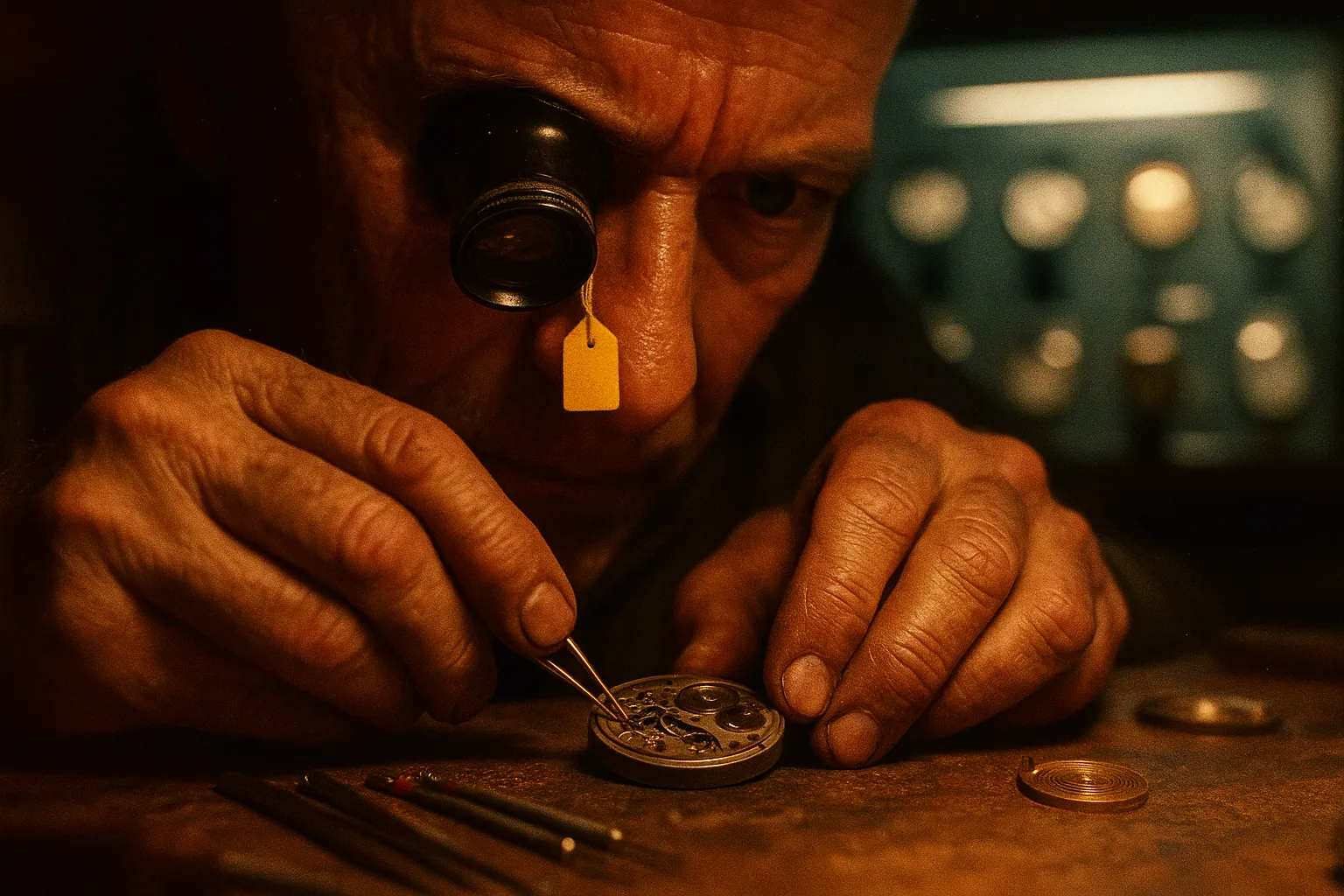
Three hundred watches behind the glass, each more accurate than his masterpiece and cheaper than coffee. He knows it — and screws the loupe in deeper. Not from stubbornness. From calculation: he simply moved to where the quartz can’t reach.
VIII. Full counter-pressure: “what if depth is romanticism, and the fast-shallow-with-AI actually win?”
Time to enter the hardest argument against this entire essay, honestly and without a strawman. Maybe I’m confusing cause with effect. Maybe tomorrow the market will pay precisely whoever pushes shallow through the machine fastest — ten mediocre outputs a day, cheaper and often “good enough,” while depth is costly perfectionism the client won’t pay for. The argument is strong. In a world where 57% of AI use is productivity augmentation (Anthropic), the winner — so the claim goes — is not the deep one but whoever stuffs his day densest with machine-made shallow.
Where this argument has real force: in tasks where “good enough” genuinely is enough. Mass content, routine code, boilerplate reports — there speed beats depth, and it will. But here’s what it can’t explain. First, when everyone pushes shallow through the same machine, shallow devalues for everyone at once — you don’t win a competition where each person holds the same free tool; you simply join everyone in driving the price to zero. The advantage isn’t access to the machine (everyone has it) but what you put on top — and only depth can go on top. Second, “good enough” is a moving bar: when the market is flooded with competent machine-average, the only thing that breaks through is the non-trivial — which is exactly what requires immersion. The more shallow noise, the dearer the signal of depth. The fast shallow-with-AI isn’t the deep one’s competitor. He’s the background against which the deep one finally becomes visible.
“What would prove this wrong?” — an honest falsification condition: if, in two or three years, the market consistently pays a premium for the volume of machine-generated shallow rather than for rare depth, I’m wrong. What to watch in 2026–2027: whether the wage gap widens between “does the non-trivial” and “does a lot fast”; whether the premium keeps shifting from junior speed to senior judgment (so far — yes, +27% for experience versus −25% for graduates). If the vector reverses — the thesis goes under the knife. So far it’s only accelerating.
IX. Distributional lens: for whom depth is a moat, and for whom a wall
The depth moat doesn’t fall on everyone equally. Three structural positions, three different views.
Who wins. Those with depth already banked — seniors, masters, specialists with years of immersion behind them. For them AI is an amplifier: it trims their shallow and frees still more hours for what only they can do. Their price rises, because the experience premium just got scarcer. The market is already voting with its wallet: +27% hiring at 2–5 years’ experience against a collapse for graduates.
Who pays the most. Those at the entry. The young, the graduates, the juniors — those who haven’t had the time to grow depth, because the ladder of shallow tasks they once grew it on, the machine removed first. This is the cruelest injustice of the cycle: depth is acquired through years of shallow work, and it was precisely that shallow work that got automated. The generation that most needs the rungs arrived exactly when the rungs were taken away. They’re told “become deep” — and denied the shallow experience depth grows from.
Who is structurally immune — and why that’s the problem. The owners of the capital and the platforms the machine runs on. They’re indifferent to whether a human or an API produces the shallow — they take a margin on both. Which is exactly why it’s so convenient to frame this as “personal failure”: couldn’t adapt, your own fault. But this is not a character defect of the laid-off. It’s a structural shift in which the value of shallow labor was appropriated by those who own the tool, and the risk offloaded onto those who used to sell that labor. The systemic diagnosis, without moralizing: the problem isn’t that people “were too lazy to go deep.” The problem is that the market spent decades paying for shallow speed, trained whole generations on it — and then, in one turn of the cycle, stopped paying and called it their fault.
X. Reader tool: the Depth Audit — where your hours actually go
Before growing depth, you have to look honestly at how much you already have. Lay out yesterday’s workday hour by hour and mark each on one scale: was it shallow (the machine would do it in seconds) or deep (something non-trivial was born)? Most people see, for the first time in this table, what they felt but wouldn’t admit: deep hours a week amount to one or two; the rest is fragmented noise the brain was selling itself as “busy.”
| Symptom (how it looks) | What's actually happening | Its price in the machine age | What to check tomorrow |
|---|---|---|---|
| "Busy all day, got nothing done" | 0 hours of depth, 7 switches an hour | Spent the whole day competing with a free API | How many blocks >40 min without a switch? |
| "AI did all the work for me" | The machine did your shallow — your rung | You delegated the thing you grew on | What did you put on top of the machine's output? |
| "I'm fast, I do a lot" | A lot of shallow = a lot of zero | Speed is what the machine already won | What of it can't be generated from a prompt? |
| "No time for the deep stuff" | There's time; it's shattered by notifications | $450B/year — and your share of it | One sacred block of depth — yes or no? |
| "Depth isn't for me" | An untrained skill, not "no talent" | Refusing the one asset that appreciates | Did you survive 25 min of silence, no phone? |
The tool isn’t motivational. It’s diagnostic. Its job isn’t to inspire but to show, in a single column, how many hours yesterday you sold at the price of a free copy of yourself. When you see it as a number, the decision to grow depth makes itself — because the alternative just got a price tag, and that tag is zero.
XI. Re-plating: depth not as asceticism but as the one inalienable property
Rise back to altitude. For the whole history of capitalism, a person has sold the market two things: time and skills. The machine has just devalued the first (shallow time) and half the second (shallow skills). What remains is what can be neither alienated nor copied: the capacity to immerse. This isn’t one more skill on a list. It’s the meta-skill, without which all the others become machine-average, and with which all the others become your lever.
And here hides the inversion the whole text was written for. Depth isn’t a sacrifice you make to productivity by giving up the pleasant scroll. Depth is the one property no employer, no algorithm, and no next model release can take from you. The salary gets cut, the role gets automated, the skill gets cheapened. The ability to hold the hard for forty minutes until it clicks — that’s yours, as long as you train it. It’s not a pension fund that can be frozen. It’s the single asset sitting in a vault whose key exists in one copy — and that copy is your ability not to blink first.
The same geometry of two curves as always in these texts, only now the stakes are bared to the bone. The price of the shallow compounds downward — cheaper each year, because the machine is cheaper each year. The price of the deep compounds upward — dearer each year, because rarer each year. These aren’t two parallel lines. They’re scissors, closing exactly on you, and the only question is which side of the blade you’re on when they meet. The side isn’t chosen on the day of the layoff. It’s chosen every morning, in the moment the hand reaches either for the phone or for that one hard task that makes you flinch.

One curve falls as coins, the other rises as a movement. The same hours feed both — and the scissors close exactly on you. The yellow tag on the lower blade is blank: the shallow side simply ran out of price.
XII. Hard kicker
Everything that can be done inattentively is now done by the machine — cheaply, sleeplessly, and without complaint. This is neither catastrophe nor salvation. It’s just the ebb tide that bared the seabed and revealed what was holding the water all along. Depth was holding it. You couldn’t see it while the shallow still cost something; now that the shallow costs zero, it’s the only thing visible — like a rock that was always under the water.
Depth is the last moat, because it’s the one thing that doesn’t scale with a prompt, doesn’t commoditize with a release, and doesn’t outsource to an API. It can’t be bought by subscription. It has to be grown — over months, against an entire environment engineered to fragment it. The market no longer pays for doing a lot of shallow fast: that now costs half a cent to a machine that never asks for lunch. It pays for the one hour in which you did what isn’t yet in any training data, because you did it first.
And the hardest part is the same as the watchmaker behind the loupe at 23:10. The quartz on the shelf across the street is more accurate, cheaper, and there are three hundred of it. The master knows it and screws the loupe in deeper anyway — not because he’s a romantic, but because he’s the only one in frame whose hour hasn’t been marked down to half a cent. Everyone else looks at the shelf of quartz and thinks it’s about watches. It was never about watches. It’s about the fact that the ebb has already begun — and the only question is whether you’re the rock or the foam.
Frequently asked
What is the "Depth Moat" framework and why does the author give it a name?
The Depth Moat is a four-axis framework (commoditized, depth, scarcity, price premium) that maps the one competitive advantage a machine cannot yet replicate: a person's ability to stay inside one hard problem long enough to produce something non-trivial. The author names it because without a name it stays anxiety in a news feed rather than a mechanism you can act on.
If deep work commands a premium, what should someone who has been selling shallow work actually do next?
Pick one area where you can still go deeper than the model, protect a daily block of uninterrupted work on it before the first notification, and delegate the rest of your shallow output to the machine first to free those hours. Depth is not a sum of minutes but their continuity, so the block must be unbroken.
Since AI augments humans in 57% of cases, why wouldn't a fast shallow worker with AI simply outcompete a slow deep specialist?
Augmentation only amplifies what is already there. When everyone pumps shallow work through the same machine, shallow output becomes worthless for everyone simultaneously because access to the tool is equal. What differentiates is what you place on top of the machine output, and that layer can only come from depth. More surface noise makes the signal of depth more valuable, not less.
Yale researchers say AI is killing the on-ramp to careers, so how is a junior supposed to build depth when the entry-level ladder has been removed?
The article calls this the cruelest injustice of the cycle: depth is built through years of shallow work, and shallow work is exactly what was automated first. There is no comfortable answer, only an honest diagnosis: start building depth now, with discomfort and without guarantees, because the market will not wait for a convenient moment.
What is the Depth Audit and how do I run it on myself?
Write out yesterday's working hours and label each one: shallow (a model could do it in seconds) or deep (something non-trivial emerged). The single most diagnostic check for tomorrow is whether you had even one continuous block of more than 40 minutes with zero context switches. Most people find fewer than two deep hours in their entire week.
Comments
Signed-in readers only — to keep it human, not a bot swamp.