The 'Buy the Dip' Reflex: How 12 Years of Zero Rates Conditioned Investors — and Why the Reflex Loses Money After 2022
From 2009 to 2021 every dip was bought back. The Fed held rates near zero, printed money — and the market quietly trained a reflex: see red, buy more, get a seed. It wasn't a strategy. It was Pavlovian conditioning on a variable reinforcement schedule — the most extinction-resistant form of habit science knows. Then 2022 raised rates the fastest since the 1980s, the lab changed the schedule — and the reflex started misfiring. A text about the difference between a reflex and a strategy, about the survivorship bias hiding every dip that never came back, and about the pigeon that pecks faster the longer the seed fails to drop.
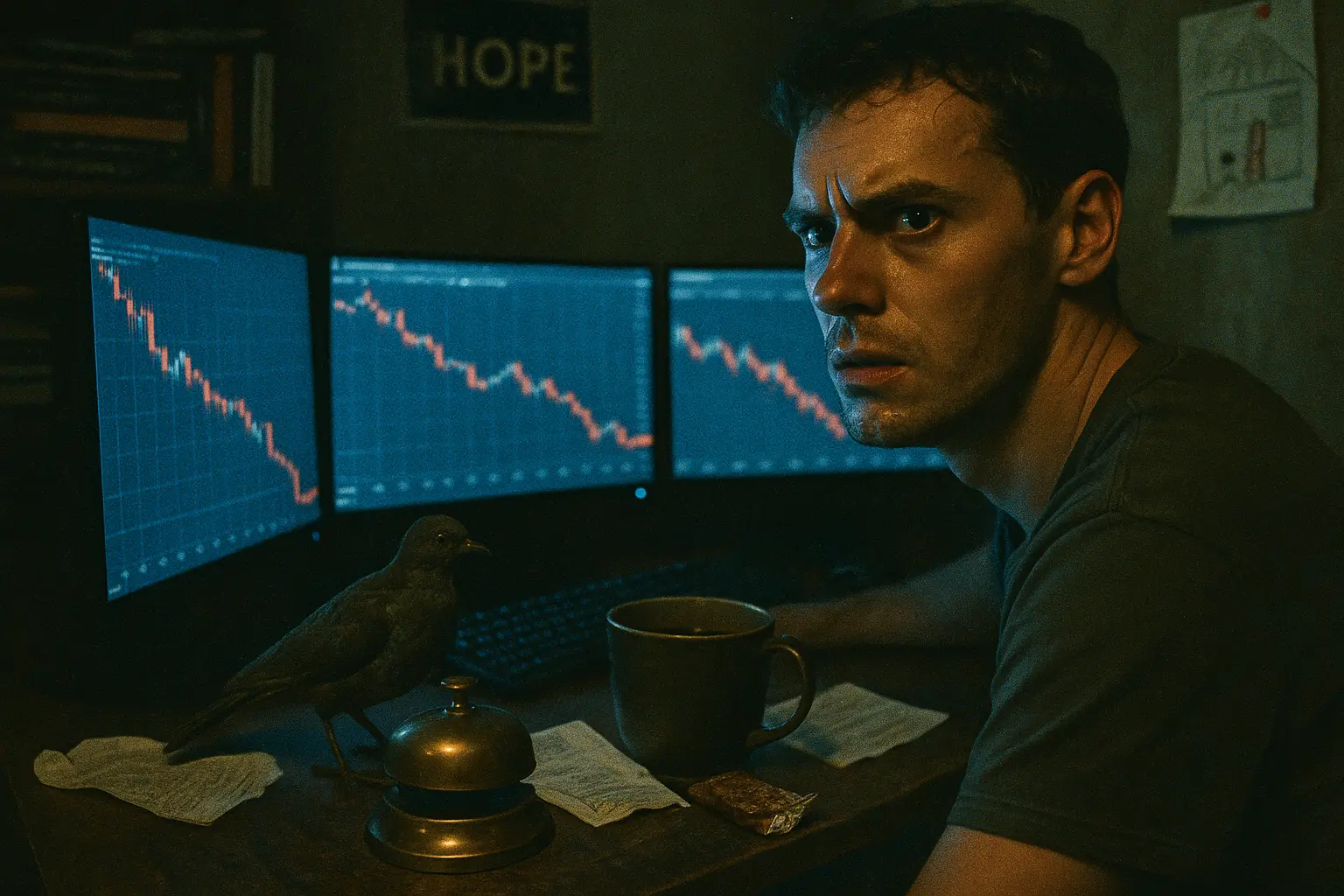
"Buy the f***ing dip." — folk market wisdom of 2009–2021 that a million people mistook for an investment thesis.
I. The pigeon that thought itself a genius
First — the lab. Without it, all this talk of "I cleverly buy the dips" is just the fairy tale of a pigeon that mistook its cage for an MBA. In the 1950s, B. F. Skinner put hungry pigeons in boxes and taught them to peck a lit button. He paid in seed. Then he started playing with the schedule: not for every peck, but for a random number of them — sometimes the fifth, sometimes the twelfth, sometimes the fortieth, in unpredictable order. This regime is called variable-ratio reinforcement, and it produced the most disgusting discovery in all of behavioral science: a pigeon on such a schedule pecks fastest, most devotedly, and gives up the slowest when the seed suddenly stops dropping. This is the exact schedule slot machines, lotteries, and "one more scroll" run on.
Now the harshest number you'll read today, and it's not from the market but from behaviorism. When reinforcement disappears, the animal doesn't stop at once. First comes the extinction burst — a surge of extinction: the pigeon pecks more often and harder than when the seed was still dropping. The organism behaves like a bacterium on the last dose of antibiotic — before death it makes its most aggressive attempt to survive. The pigeon decides it didn't try hard enough. The same narrative the small investor enters his third margin call with: "I just bought too little, now I'll get serious." Hold that picture in your head — it's the portrait of the retail investor who in 2022 averaged down into a falling position the more aggressively the deeper it fell. Pulling the last $300 off his card "for a chance to recover," while his wife slept and thought he was watching Netflix, not preparing the family's next margin call. Peck. Redder. Peck-peck. Redder still. This isn't analysis. It's an extinction burst in a mammal that wears a blazer and calls itself a contrarian.
The contrarian "genius" who bought every dip from 2009 to 2021 and turned out right every time isn't Warren Buffett. He's a lab pigeon that, for ten years straight, got a seed for pecking a red button. He wasn't smart. He just got lucky to be born in the right cage, on the right feeding schedule. And he mistook the cage for his intellect — as everyone does who's been rewarded for the same thing long enough.
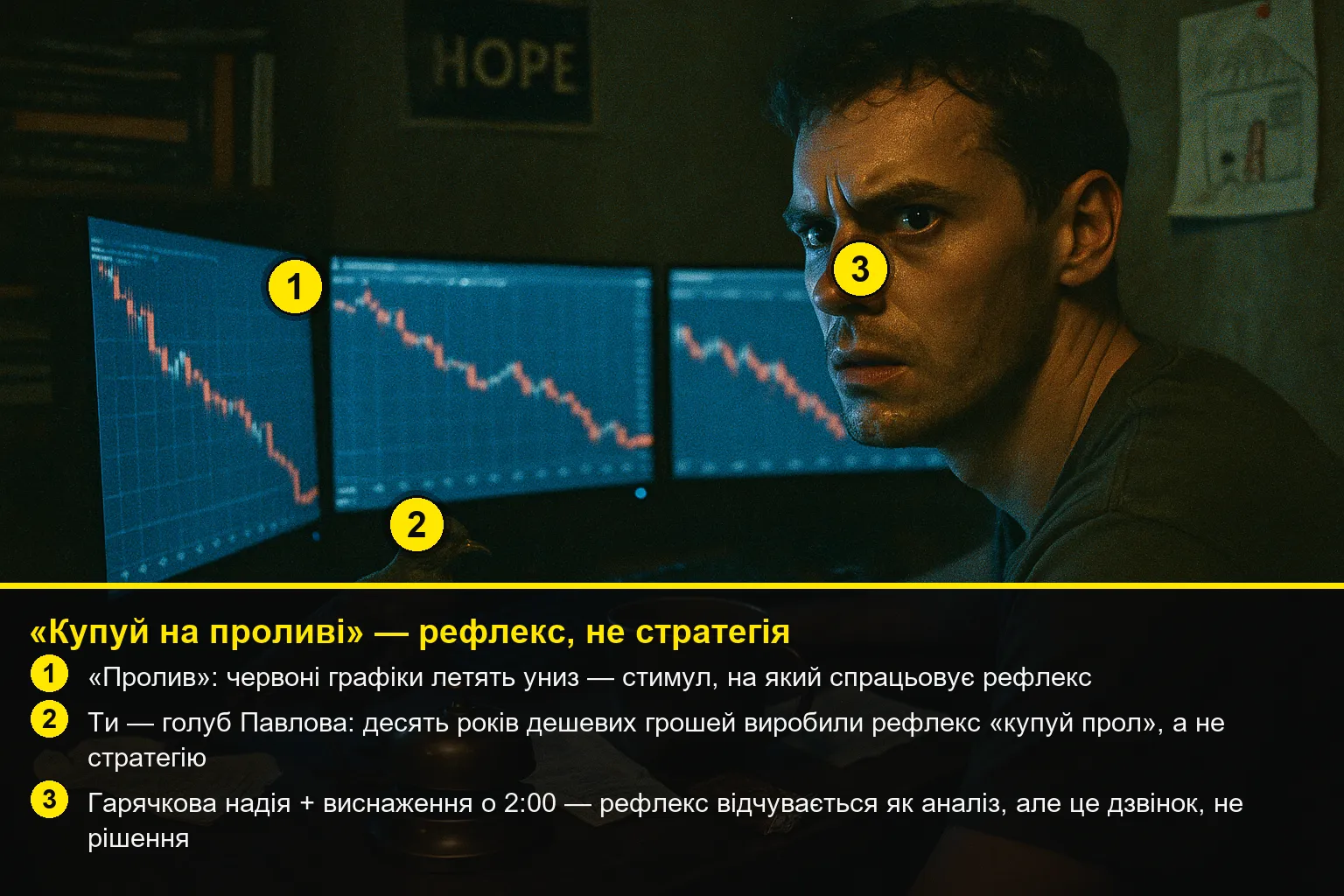
The same frame, broken into the reflex. ① the “dip” — red charts plunging, the stimulus; ② you — Pavlov’s pigeon: ten years of cheap money built the reflex “buy the dip,” not a strategy; ③ feverish hope + exhaustion at 2 a.m. feel like analysis, but it’s a bell, not a decision.
II. Who was the feeder: ZIRP as a seed machine
Let's name the antagonist, because without it the story turns into an abstraction about "crowd psychology." The feeder wasn't the market. The feeder was the Federal Reserve, or more precisely — the regime it held almost continuously from late 2008.
On 16 December 2008, Ben Bernanke for the first time in modern US history dropped the key rate to near zero. It's called ZIRP — zero interest-rate policy. It lasted from late 2008 to late 2015, then, after rising a bit to a modest 2–2.5%, fell to zero again in March 2020 and sat there until March 2022. In parallel, the Fed bought up bonds through "quantitative easing" — QE was the artillery barrage before the assault: while shells of cheap money flew across the whole field, even the crookedest shooter could hardly miss. The S&P 500 performed a trick under this rain that's worth saying out loud: from about 676 points in March 2009, it crawled past 2,000 by 2014.
And somewhere in a residential neighborhood, a person with zero financial education opened a broker app and thought their +30% a year was IQ, not the Fed rate floored to the bottom. These are the same years startups raised rounds on the slide "Uber, but for dogs," and brokers handed every new user a free share — like a candy by the register. Everyone who bought a red candle in those years got a seed. Everyone. It was cheaper for banks to give you a loan than to honestly say you can't count. The market just chose the first option — entertainment is more expensive than education.
That's why the reflex sewed itself so deep. For almost fifteen years — from 2009 to the early 2020s, with one brief scare in spring 2020 that the Fed put out within weeks with new seed — the market never once let the punishment last long enough to extinguish the habit. The generation that opened its first brokerage account between 2009 and 2015 walked the whole path — from first share to its own Telegram channel — in conditions where red always meant "discount," not "warning." They don't believe in BTFD. They feel it, the way a pigeon feels the button — at the level of motor memory, before the cortex even switches on.
The phrase BTFD — "buy the f***ing dip" — appeared exactly then. One of the first online uses is dated to 2011 and directly tied to quantitative easing. By the 2020s it became an r/wallstreetbets meme — language gave the reflex a slogan, and the slogan gave the reflex a sense of its own genius. Very convenient: you just peck, and it sounds like you're the Socrates of discounted cash flows.
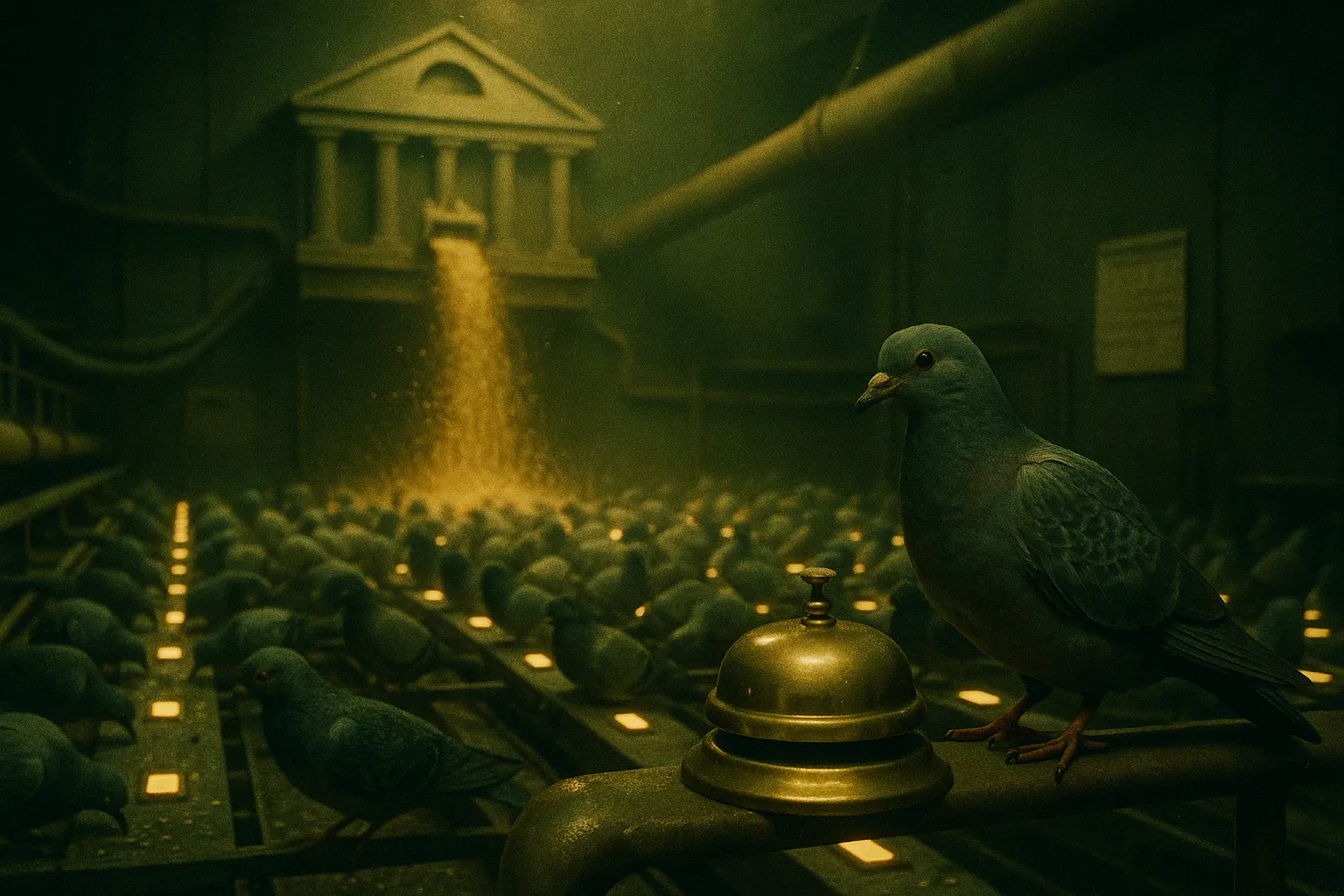
For over a decade the machine poured seed for every peck at the red button. The flock decided it was talent. No one looked at who stood by the dispenser lever — and what was written on his badge.
III. The Pavlovian Dip: I give it a name
Here a name is needed, because without one the phenomenon stays "well, psychology," and psychology is easy to pin on others. I call it the Pavlovian Dip: a conditioned reflex to buy more on a decline, grown by a long reinforcement schedule, which the investor mistakes for a rational strategy — because he too loves to think he has principles, not a conditioned reflex trained by the Fed instead of the belt we're used to.
Over 15 years the reflex managed to grow itself a theology, preachers, and shrines on Reddit — a full-fledged financial cult with no miracle but the zero rate. "Buy the dip" turned into a religion at exactly the moment it stopped being a strategy. Faith always comes where the numbers stop working.
The difference between a reflex and a strategy isn't in the action. The action can be literally the same: the market falls, you buy. The difference is what stands under the action. In a strategy, under "I'm buying" lie three things the reflex doesn't have at all:
- A thesis. Why exactly this asset is worth more than it's priced at today. Not "it fell," but "here are the cash flows / here's why the market is mispricing it." A price drop isn't a thesis. A price drop is the very circumstance to be explained, not the proof.
- Position size. How much I add and what happens if I'm wrong. The reflex has no size — only "a bit more, because the next peck will surely return it."
- A falling-knife scenario. A pre-named condition under which I admit this isn't a dip but a hole, and I exit. The reflex has no such condition in principle — the pigeon has no "give up" button.
The pigeon does exactly one of the three — the action. The thesis it replaces with the feeling "it always worked." Size — with thrill. The exit scenario — with faith that the bottom is already close. This is the Pavlovian Dip: a reflex grown on cheap money that looks like a strategy from the inside, because the lab never shows the cage to the one sitting in it.
IV. The lab changed the schedule
And now the moment the pigeon dies. In March 2022 the Fed began raising rates — and did it sharply: about 5.25 percentage points in under a year and a half, from near zero to 5.25–5.50% — one of the fastest hiking cycles since the 1980s. 2022 simply switched off the anesthesia. The same operation, only now every cut surfaced with pain hidden for years under the morphine of cheap money.
What does that mean for the reflex? The lab didn't tell the pigeon: "attention, from Monday no more seed drops." The lab couldn't care less — it has inflation, not a pedagogical mission. It just stopped pouring. And the pigeon does the only thing it knows: pecks faster. One such pigeon "bought the bottom" of the S&P 500 in January 2022 — the market went 15% lower from that level. Bought again in March — the market kept falling. Again in June — the market down again. Every attempt to "buy the bottom" throughout 2022 ran into a new wave of selling. The bell rang — a red candle, the familiar signal, the hand reaches out. There was no seed. This is the extinction burst, scored on a stock chart.
Like in "The Big Short," where the guys realize the system is already rotting while the crowd still takes mortgages "on a dream." In 2022 you were that crowd, just with a different app on your phone. The most galling part here is the asymmetry of knowledge. The pigeon has no access to the experiment log. It doesn't see the line "reinforcement schedule changed 16.03.2022." It sees only the button and the memory of seed. An investor who for almost fifteen years bought dips and grew rich was, in 2022, doing literally the same thing — and for the first time in his career it cut him. Not because he got smarter or dumber. Because the schedule was changed, and he didn't know it and couldn't from inside the cage. The market is a lab that never posts notices.
It changes the feeding schedule silently and watches who learns to read the regime, and who pecks the old reflex into the new void — and finances the feeding of the few who guessed the new schedule.
V. The graveyard you don't see
And here hides the biggest lie — not even in the reflex itself, but in the data it was grown on. The reflex "every dip gets bought back" is built on a sample from which everyone who died was removed in advance. This is survivorship bias — the error of one who counts only the planes that came back.
The number that should end any conversation about "the market always recovers." J.P. Morgan, in its study "The Agony and the Ecstasy," ran the entire Russell 3000 index since 1980. The result: over a third of all stocks at some point suffered a "catastrophic" fall — minus 70% or more from the peak — and never recovered. Not "dipped in a crisis and bounced." Fell forever. Among tech companies — over half. Most of all stocks over that period lagged the index itself.
Against this backdrop, your investing course from a blogger is a tour of the crematorium where you're shown only the urn room, not the furnace. The pigeon trained in a graveyard with all the headstones removed and decided no one dies here. And these: Enron, Kodak, BlackBerry, Lehman — where are they now? Silent. Peloton, from a peak of about $171 in early 2021 to lows around $3 in 2024 — minus over 95%, and no way back. Zoom, after its pandemic peak, lost about 85% and still hasn't recovered — a wonderful "dip" that turned out to be just a clipped revenue chart.
| Asset | Peak | Bottom after the "dip" | What it really was |
|---|---|---|---|
| Peloton | ≈$171 (early 2021) | ≈$3 (2024); a few dollars in 2026 | Not a dip. A hatch. Minus >95%, no return |
| Carvana | ≈$370 (autumn 2021) | ≈$3.55 (Dec 2022) | Fall ~99% — then a bounce >500% to a new peak. A survivor that feeds the legend |
| ETF XLK (infotech) | peak Jan 2022 | −about 30% by October | Zoom, Roku, Shopify −70–90% and still no return; the sector aggregate hides individual coffins |
| The "average" Russell 3000 stock since 1980 | — | Over a third fell ≥70% forever | The base rate the reflex ignores |
Carvana here is the cruelest exhibit, because it illustrates both traps at once. Whoever "bought the bottom" at $300 in 2021 burned to ash, minus almost 99%. And whoever "bought the bottom" at $3.55 in December 2022 made over 500% and looks like a genius. Two opposite fates, the same action, the same phrase "I'm buying the dip." The difference is the pure coincidence of the entry point, which both participants will retroactively rewrite as "I saw the fundamentals." 90% of "successful buy-the-dip stories" are just survivors speaking into a microphone over a shared mass grave.
And one more graveyard detail usually left unsaid: the retail buyer's liquidity isn't an abstraction. When in 2022 retail investors mass-"bought" falling positions, their buy orders absorbed the sells on the other side of the trade. On that side sat not fellow pigeons, but hedge-fund algorithms that exited rate-sensitive positions back in October 2021, market makers who earn on the spread regardless of direction, and macro funds shorting long-duration Nasdaq because they read the forward rate market. This isn't a conspiracy — it's just the asymmetry of access to information, dressed up as a market mechanism. Retail capital served as the exit for the institutional. Every "smart" peck in 2022 financed someone's dinner — just not its own. This is the real anatomy of what's called a "market correction": not an abstract "market" punishing the overconfident — specific players with an information edge converting your optimism into their liquidity.

Headstones shaped like candles looking down. The crowd takes photos by a few green sprouts and doesn’t turn to the field. The pigeon also looks the wrong way — at the survivors. In the background a conveyor delivers new headstones with meme tickers.
VIa. But Vanguard, though
Here the strongest counterargument appears, and it deserves an honest stage, because without it the whole prior analysis sounds like "don't invest at all" — which is an utterly wrong conclusion. Not every dip-buy is a Pavlovian reflex. There's a regime where buying on a decline really is a disciplined strategy, and it has 30 years of data behind it: regular DCA into a broad index. A person who put a fixed sum into Vanguard S&P 500 or MSCI World every month and bought more during the 2008–2009, 2020, and 2022 crises really did get a systematic edge. Vanguard's own research showed that DCA into a diversified index over any 20-year stretch of the US market gave a positive real return. This isn't a reflex. It's the math of dollar-cost averaging applied to an instrument where survivorship bias is already accounted for inside — the index automatically throws out the dead and keeps the living.
But here's what that doesn't explain: the difference between index DCA and "buy the dip" isn't style, but object and mechanism. DCA into a broad index buys the whole lab at once, including the winner pigeons no one yet knows. "Buy the dip" in a specific stock or sector buys one pigeon and bets that exactly it survives. The index is diversification through ignorance; the reflex is concentration through the illusion of knowledge. That's exactly why Vanguard's statistics say nothing about Peloton, Carvana, or "the next Nvidia" someone "saw at the bottom." Turning "DCA into the S&P 500 works" into "I'll buy every dip in anything" is pulling a rule out of context and applying it where it stops working. The pigeon in Skinner's lab could also point to someone who did get a seed — and would be right. The question isn't whether a seed will drop. The question is how much a bet on the right button costs.
VI. How to tell a peck from a decision
Enough diagnosis — here's a tool, because a text without one would also be a form of pecking: pleasant, rhythmic, and fruitless. Here's a checklist that separates a Pavlovian Dip from a strategic buy on a decline. Run your next "discount" through it before your hand touches the button.
| Question | Pigeon (reflex) | Investor (strategy) |
|---|---|---|
| Why am I buying this exactly? | "It fell" / "it always bounced" | A named value thesis, independent of how far it fell |
| What if I'm wrong? | Didn't think; "it can't fall further" | A pre-defined max loss and position size |
| Under what condition do I admit it's a falling knife? | No such condition | A specific level / fact that refutes the thesis → exit |
| Where did I get this idea? | From a thread / because everyone / because it always was | From my own analysis that survives an argument |
| Does my plan work in a high-rate regime? | "Rates? I thought that's only about mortgages, not my genius" | Yes, because the thesis doesn't rest on cheap money |
| Am I adding calmly or thrill-seeking? | The deeper it falls, the more feverishly I buy | Per plan, regardless of the red-screen emotion |
| Do I account for those that didn't bounce? | I look only at success stories | I hold the base rate in mind — over a third of stocks "down forever" |
A simple pocket rule: if your only reason to buy is that it got cheaper, you're not investing, you're pecking. A price drop by itself carries no information about value. Cheaper isn't "a better deal," it's just cheaper; sometimes because the market finally saw what you didn't. Averaging down with no thesis is like paying off one credit card with another. The papers move, the numbers grow, the debt doesn't disappear.
Contrarianism without a thesis isn't courage. It's gambling in the costume of philosophy, with a diploma from "I feel it" and a certificate from YouTube University — and the only person it impresses is you in the mirror at 2 a.m.
BTFD made no one a genius. It just let the average investor not notice the Fed subsidizing his mistakes with future inflation. The market wasn't rewarding you for intelligence. It just hadn't gotten around to punishing you — because at that moment the printing press was still spinning.
VII. The bell ringing into the void
The worst news at the end isn't about the market. It's about memory. A reflex grown on a variable schedule extinguishes the slowest of all. A pigeon fed for a peck for almost fifteen years won't stop pecking when the seed disappears. It will peck harder — the extinction burst — and finance someone else's dinner for a long time before the body admits the schedule is no longer the same. The Pavlovian Dip is a legacy function in your brain, written in the ZIRP era. A new version of the market shipped, you didn't install the patches, the bugs are paid in cash.
The BTFD generation won't vanish after the first painful year. It will need not one "red" year, but perhaps a whole new five-year plan of higher rates, before even part of these hands resign and stop pressing the button. And then they'll go on a motivational podcast to tell how "the market took it away," not how it pressed the same button ten times, hoping the universe would change the rules specially for it.
And the lab is silent. From time to time it changes the feeding schedule — generous on cheap money, stingy on dear — and watches. The bell now is a YouTube host in a Bitcoin T-shirt saying "this is a generational opportunity." Generational — because the next generation will be working off for a long time what you're now happily scooping up at minus 30%. The bell rings just fine. There's just no one automatically pouring behind it anymore.
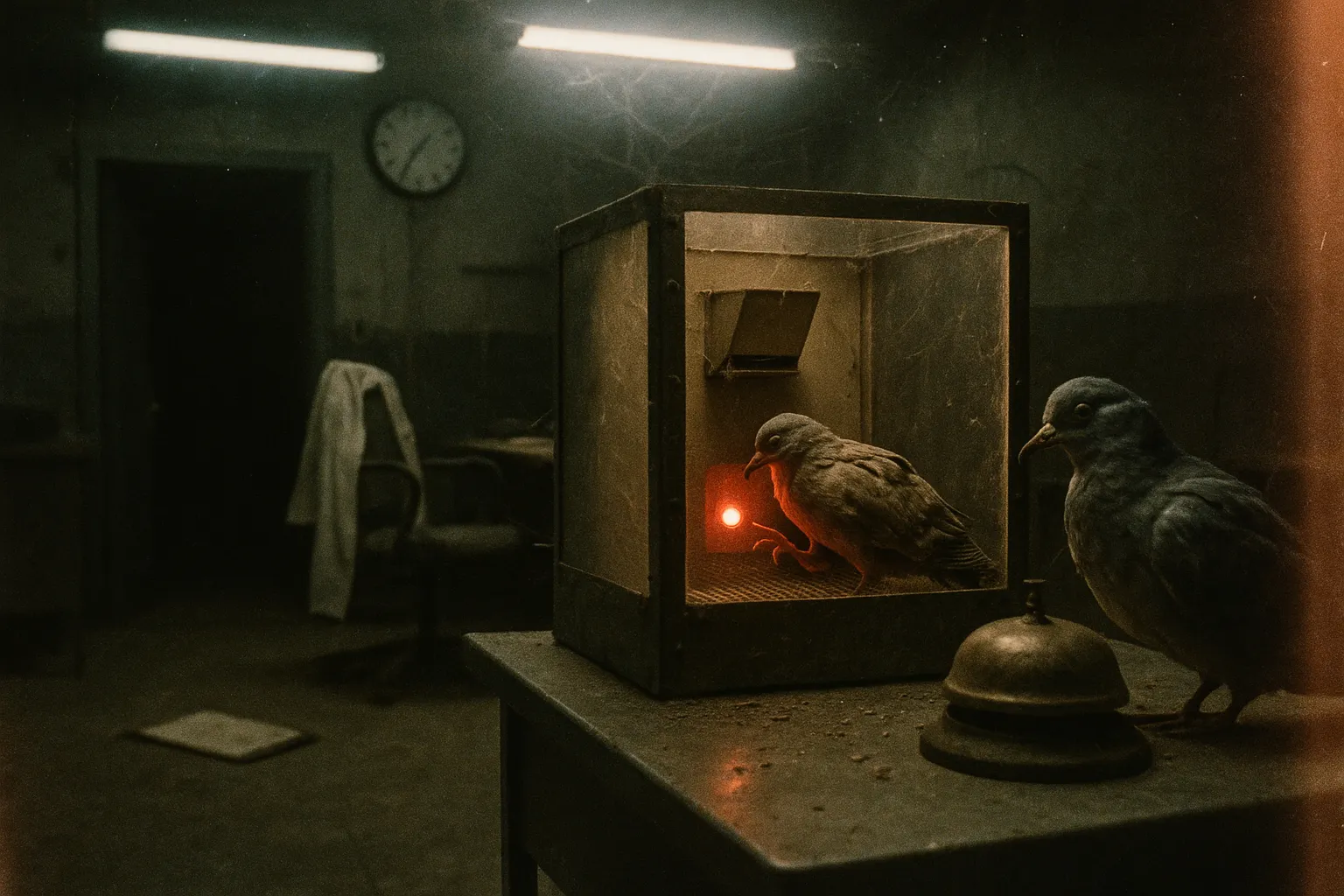
The lab is empty. The dispenser is open, no seed. The pigeon pecks harder than ever in its life — and calls it conviction. The other just watches and pecks nothing. That’s the whole difference.
So the next time you see a red candle and feel your hand reaching to buy more "because it always bounced" — stop on one question. Not "how far did it fall." But: who's standing by the dispenser lever this time — and is he even still in the building? The difference between an investor and a pigeon was never in the action. It's in one thing: the investor lifted his eyes from the button and checked whether the feeder is still in the room.
Frequently asked
What is a variable-ratio reinforcement schedule and why is it harder to break than a regular habit?
It is a reward pattern where payoff arrives after an unpredictable number of actions, like a slot machine. This schedule produces the most extinction-resistant behavior of all: when the reward disappears, the animal pecks faster, not slower. A decade of ZIRP wired the buy-the-dip reflex on exactly this schedule, which is why one painful year does not extinguish it.
If the reflex is flawed, should investors stop buying dips entirely?
No. Buying on a decline can be a strategy when it rests on a thesis about value, a predefined position size, and a named exit condition. Without all three, the action remains a reflex regardless of how rational it feels from the inside.
But everyone who bought every S&P 500 dip over the past decade genuinely made money — why is that not a strategy?
DCA into a broad index works because the index automatically removes failures and retains winners, so survivorship bias is already priced in. The problem starts when the same reflex is applied to individual stocks or sectors, where over a third of all companies fall 70% or more and never recover: there you are betting on one pigeon, not buying the whole laboratory.
Did institutional players know the feeding schedule had changed in 2022 while retail investors were still averaging down?
Hedge funds and algorithms were exiting rate-sensitive positions as early as October 2021 by reading the forward rates market. Retail buyers in 2022 effectively provided the exit liquidity for institutional sellers: every peck at the red button financed someone else's dinner, not theirs.
What is the practical test to run before buying a dip to know if it is a decision or a reflex?
Answer three questions before touching the button: why does this specific asset deserve a higher price than the market is asking right now; what happens to the position if you are wrong and what is the maximum acceptable loss; and at what concrete level or fact will you admit this is a falling knife and exit. If none of the three have a named answer, it is a peck.
Comments
Signed-in readers only — to keep it human, not a bot swamp.