The Five Flags Theory Audited: Who Jurisdictional Diversification Really Works For — and Who Buys a $150k Passport with No Safety Net
Flag theory (Harry Schultz, 1960s; W. G. Hill, 1980s) promises: spread your life across five jurisdictions and you become free and a nobody to the taxman. For the genuinely mobile millionaire some of the benefits are real. For everyone else it's cosplay: you diversify flags and centralize loneliness. A passport for $90k–$250k buys no socialized medicine, no pension, no vote; 'resident nowhere' turns into being deemed a resident anyway; and the CRS (100+ jurisdictions, automatic exchange since 2017) killed the banking secrecy the whole structure rested on. This isn't tax advice — it's an analysis of what happens to a bluff when the dealer turns the cards over.

"I'm a citizen of the world." — a phrase most often said by people who have no world that would mourn them if they vanished. At most — a status that didn't update on LinkedIn, and Instagram followers who lost one more reel about "the office with an ocean view."
I. The freedom salesman who never goes anywhere himself
YouTube, a thumbnail with a yellow arrow. A tanned man around forty against a Dubai skyscraper or a Bali infinity pool, an unbuttoned linen shirt with a budget-airline collar, the gaze of a man who knows a secret your payroll card can't access. "The rich don't pay taxes. I'll show you how to become a citizen of the world." Across nine minutes of video he never once says how much it costs. He does say the word "freedom" three times and "personal sovereignty" twice. The caption under the video: a link to a $2,000–$5,000 consultation where they'll spend another hour selling the dream — not the scheme.
Let's give this character his full name: the Flag Salesman. He sells neither real estate, nor a passport, nor even a tax scheme. He sells the feeling that you belong to no one anymore — and therefore no one has power over you. That feeling is familiar to anyone who has, at least once, dreamed of "leaving this country forever" during the latest news or draft-notice in a Telegram channel. The salesman simply monetizes the fantasy of escape: he packages it into a visa priced like an apartment and a consultation priced like a sole-trader's monthly revenue. A brilliant product, because you can't return it under warranty and it flatters the buyer's most vulnerable spot — the wounded pride of a genius mistreated by the state.
The funniest thing in this scene, which the buyer doesn't notice: the Flag Salesman almost always has one very specific, very stable Western passport in his back pocket — the very citizenship he advises you to "free yourself" from. He preaches statelessness from the safety of citizenship. Like a dietitian filming a salad ad with a mouthful of cheeseburger off-camera.
I didn't come to laugh. I built cross-border businesses for years, held structures in several jurisdictions, and know well the taste of the thought "maybe just untie from everything." And just as many years I comforted myself with the thought that at some point I'd simply vanish from all registries, like a well-optimized corpse: no traces, no estate, no accounts. So this conversation won't be about the idea being stupid. It'll be about something far more uncomfortable: at exactly which stage does the buyer turn from a viewer of an ad into its product — and what does the bill look like that your own "freedom" brings.
Because flag theory isn't a scam. It's a real strategy that genuinely works. It's just that, like business class, it works for precisely those who would have flown comfortably without it. To everyone else they sell a photo of business class, shot from the aisle of economy at the moment the stewardess slides the curtain shut right in front of your nose.
This construction existed before, but in 2025–2026 the price of the bluff rose irreversibly. While the market grew a coat of YouTube videos about "freedom," the operating environment changed structurally: the EU is advancing the ATAD3/SAFE directive aimed precisely at "phantom" structures with no real presence; Spain and Italy ran high-profile criminal cases against mid-tier "PTs" — not billionaire dodgers but freelancers and small entrepreneurs trying to "float"; Caribbean CBI programs, post-2023, check sources of funds harder and refuse registration en masse. The system doesn't just "know" about the scheme — it now actively hunts it where it didn't even look before.
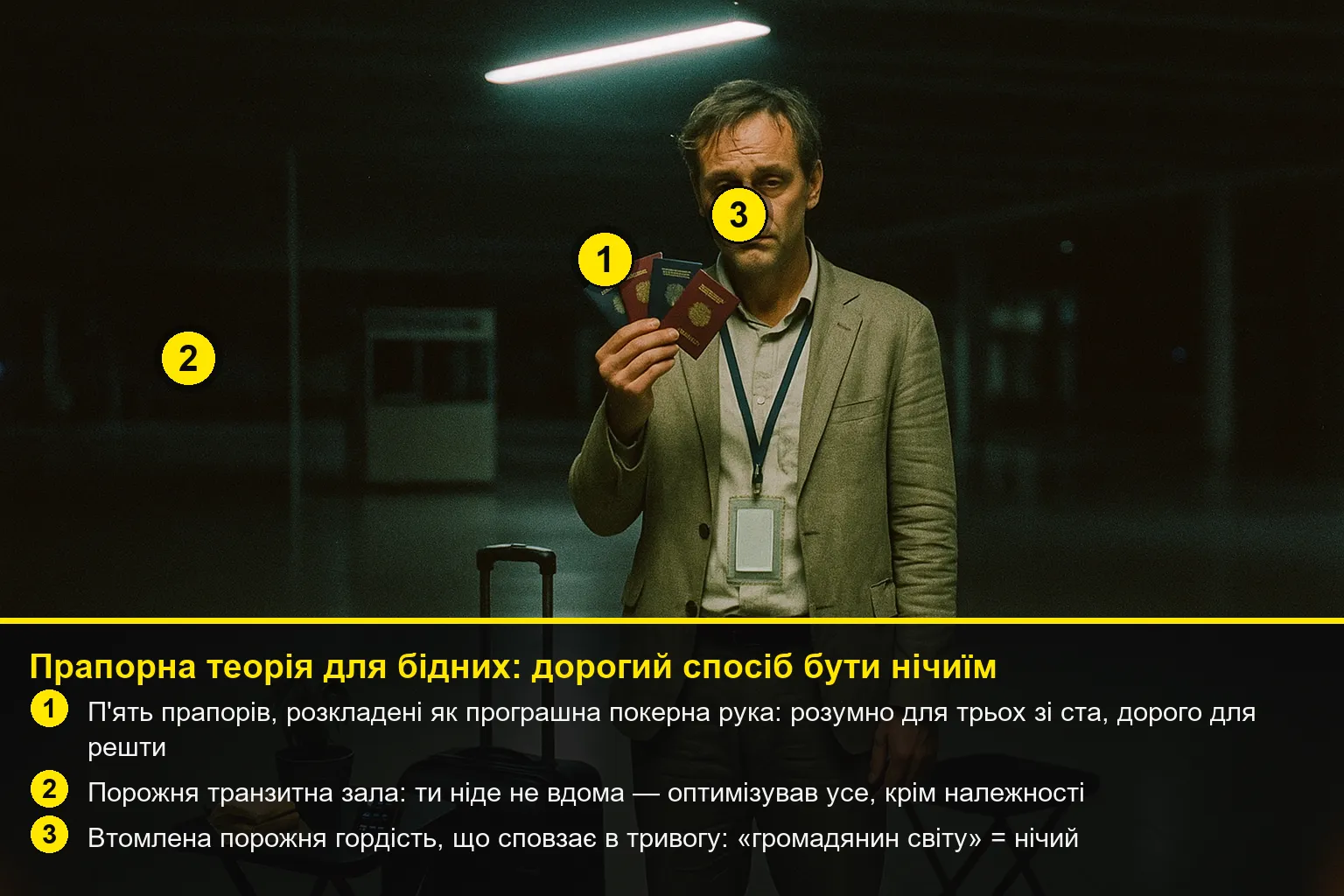
The same frame, broken down into a wager. ① five flags as a losing poker hand — smart for three in a hundred; ② an empty transit hall: you’re nowhere at home; ③ tired empty pride sliding into anxiety — “citizen of the world” = no one’s.
II. What the "5 flags" are — and why the idea is perfectly sound (for three people in a hundred)
Flag theory was formulated by the investment analyst Harry Schultz in the 1960s: three flags — a second citizenship, assets outside the home country, a legal address in a tax haven. In the 1980s W. G. Hill expanded it to five and cemented the image of the "PT" — perpetual traveler, the eternal wanderer who never stays long enough to become anyone's taxpayer.
The five flags in the canonical version sound like this — and, admittedly, there's logic in each:
| Flag | What it means | The promise they sell |
|---|---|---|
| 1. Citizenship | A passport of a country that doesn't tax foreign income and doesn't call you to war | "No draft and no global tax will reach you" |
| 2. Residence | Tax residence in a zero- or low-tax jurisdiction | "You pay taxes where there are almost none" |
| 3. Business | A company registered in a third, business-friendly country | "Profit settles where it isn't touched" |
| 4. Assets | Money and capital in a fourth, banking-reliable haven | "Your wealth under a lock no one has a key to" |
| 5. Playground | A fifth country — where you actually live, spend, and enjoy | "Quality of life without a bill for citizenship" |
Now the most important sentence of the whole section, which the Flag Salesman will never say aloud. This really works for a specific person: mobile capital in the range of $5–10M+ in cash, securities, or an easily-sold business stake; a lawyer on a $3,000–5,000/month retainer in each key jurisdiction; a family ready to live out of suitcases; a business tied to neither an office, nor a warehouse, nor government tenders. A notional founder who sold his company for nine figures quite rationally takes a Caribbean passport, settles in Dubai, and holds assets in Singapore.
If your main asset is time, not a share package or an exit, then you're not that person. You're the one who buys a ticket to a club where you'll sit in the corridor while the real members inside discuss how to optimize one more percent on dividends. A hammer is a wonderful thing. It's just that if you have no nails, only your own fingers, it'll find something to hit anyway.
III. The cross-domain hook: why 30 stocks save you, and 5 flags don't
One line before going further: the financier Meir Statman showed, back in 1987, that genuine portfolio diversification needs on the order of three dozen different stocks. Below that, a single company's risk still hits the whole painfully; above it, more stocks add almost no protection. But the same work contains a trap that motivational videos cut clean out: diversification kills only one type of risk — the specific kind. The bankruptcy of this company. The fire at this plant. It doesn't touch the second — systematic risk: a recession, inflation, a crash that drags everything down at once. Thirty stocks or three hundred — no quantity saves you from the whole market falling. It's gravity acting on all baskets at once. You can spread the eggs across thirty baskets — but if the floor disappears, they all fall in the very same direction.
Now translate that to a person with five passports. Flag theory diversifies only country-specific risks — and completely ignores the systematic risk of being human: you age, fall ill, need a court to protect you and a place where someone will grieve you, all the same; no flag removes this — it merely divides it by zero, spreading it across countries where the human is no one's. A nine-figure founder buys his way out of systematic risk with money: a private clinic, an army of lawyers, managed pension capital. The flag-theory cosplayer throws away the state's net — and can't buy a private one. He sold off insurance against the small to be left naked before the large.
Five flags don't save you from the fact that the body, old age, and loneliness are systematic risk that isn't negotiable. They can't be "spread across jurisdictions." You can only split the moment it goes bad between five places where, to everyone, you're a tourist.
IV. The Stateless Bluff: a wager that no one checks the cards
Let's give the central mechanic an honest name. Call it the Stateless Bluff: a wager that no single state will ever check the cards. The whole "resident nowhere" construction rests not on law but on invisibility. The cosplayer doesn't prove to five governments that he owes them nothing. He's betting that each of them looks the other way — while he's sort of here but sort of not quite, and no one gets around to sorting out whose, exactly, he is.
The Stateless Bluff is when your entire financial future is staked against none of the five governments waking up first. Poker is an exact metaphor, not an ornament. A bluff in poker works right up to the moment someone says "call" and asks to see the cards. The PT holds five bluffs against five tables and prays the games never intersect. This isn't a strategy of freedom — it's a naked call on your own future: unlimited potential losses for a premium of a few years' unpaid taxes.
And here's the bitter detail the salesmen keep quiet about. In poker, if the bluff is exposed, the player loses the chips on the table. In a tax bluff the state assesses tax retroactively — for all the years the person "was no one" — plus interest, plus penalty, plus, sometimes, criminal charges. The stake isn't what's on the table. The stake is everything earned over decades while proudly considering yourself free. A bluff where you don't know the size of your own stake until you're asked to show the cards — that's roulette where you blindfolded yourself and called it sovereignty.

Five bluffs against five tables. The player thinks the dealer is dealing the cards. The dealer in the earpiece is the CRS, and it’s quietly turning the hidden cards face up, one by one. The globe-shaped chips are melting.
V. The dealer with an earpiece: how the CRS turned over the cards everything rested on
The whole of flag theory stands on one load-bearing wall — banking secrecy. Flag number four, "assets in a reliable haven," worked only because the Swiss, Panamanian, or Singaporean bank told no one what lay there. As long as the haven stayed silent, the bluff was bulletproof: the home-country taxman physically couldn't see the player's hand.
In 2014 the OECD adopted the Common Reporting Standard (CRS) — a single standard for automatic exchange of financial information. The mechanics are lethal in their banality: banks in participating countries are obliged, every year, of their own accord and with no request whatsoever, to pass data on non-residents' accounts to their home taxman. Not "by court order." Automatically, every year, by default. The first exchange — 2017. Today over 100 jurisdictions take part in the CRS, including most of the classic "tax havens." The 2016 "Panama Papers" were only the first nightmare trailer — the CRS made the leak automatic and nameless.
Now, when a non-resident opens an account "somewhere in a warm haven," his taxman in the home country simply gets one more row in Excel. No one even to resent: he himself paid the bank a fee for that cell. This is the dealer with the earpiece. And here's the black joke at the very core: an industry selling "privacy and personal sovereignty" trades a product whose load-bearing part was withdrawn from the market back in 2017 — and still charges full price for it, like an antiquarian fobbing off a safe every neighbor already has a duplicate key to, calling it "a time-tested classic."
Tax planning didn't die. A specific version of it died — the one that rested on invisibility. And it's precisely that version they sell to those who can't afford the legal one.
VI. Five flags against five voids: what the non-rich actually gets
Let's take each of the five flags and look at what it promises the cosplayer and what it actually delivers. Not the millionaire with a lawyer. The IT freelancer or small-business owner who watched the video and decided to "free himself from the state."
| Flag | The freedom promise | Reality for the non-ultra-rich |
|---|---|---|
| Citizenship ($90k–$250k+) | "A second passport = an emergency exit and zero obligations" | A second passport isn't an emergency exit. It's one more exit into a corridor that still has no room. A Caribbean passport gives neither medicine, nor pension, nor community — it's a paid fast track into the queue at someone else's consulate and the right to legally drown in one more country's tourism statistics |
| Residence "nowhere" | "Resident nowhere = pay nowhere" | "Nowhere" doesn't exist legally. You fall out of tax treaties — every source country taxes you unilaterally, with no discounts. The home country often deems you a resident anyway. You wanted to become invisible to all — and became defenseless before each |
| Offshore business | "Profit settles where it isn't touched" | Without real presence it's a "mailbox" the CRS, banks, and controlled-company rules see right through. Opening an account is ever harder; compliance costs eat the savings |
| Assets in a haven | "Wealth under a lock with no key" | The haven itself reports the account every year under the CRS. Banking secrecy is dead since 2017. What's left are banks that simply don't want the small-non-resident hassle |
| A playground to live in | "You live in paradise without a bill for citizenship" | A tourist on a long visa. No vote, no access to the system, first in line for deportation when the rules change. A paradise you can be asked to leave by a letter to a mailbox you didn't even have time to forward |
Read the right column top to bottom as a single list and you'll see what happened. Five flags turned into five voids. Five freedoms weren't gathered — a piece of yourself was handed out to five places, none of which is obliged to catch you if you fall. You bought a document instead of belonging. Traded shelter for tourist status. Swapped a secrecy that no longer exists for a loneliness that does. This isn't a portfolio of five assets. It's five exits, none of which leads home.
VII. The residence flag: the "nowhere" trap for those who believed the map
The subtlest lie of flag theory is hidden in one word — "nowhere." The salesman paints it as a neutral space above the map: the person is neither here nor there, he floats, and from below no one can reach him. Sounds like freedom. Legally, "nowhere" isn't an altitude. It's a chasm.
The "183 days" rule is like a child's deal with reality: "if I close my eyes, no one can see me." Reality, alas, is grown-up, with a calculator and access to geotagged Instagram. Each country writes its own rules, and days are only one criterion. The UK finds about a month and a half of presence per year enough, given a certain set of ties — family, home, work. Forty-six, not a hundred and eighty-three. Germany and Spain look at the "center of vital interests": where the family is, where the apartment is, where the bank is — and can recognize you as a resident regardless of the day count.
And then — the most elegant trap. India, for example, introduced the deemed resident rule: if an Indian citizen with substantial India-linked income is, at the same time, formally not a tax resident of any other country — he's automatically treated as an Indian tax resident. Take in the black perfection of this construction. For decades you build the status "I'm no one's," invest in passports and flights — and the law says: "wonderful, since you're no one's, you're ours again." The person fled one country so diligently that it made the one move there's nowhere to run from: it declared that the escape itself is the address.
A citizen of the world is a person you can be fined by three countries at once, and not one of them is obliged to give him a hospital bed. If a non-resident is nowhere, he falls out of the tax-treaty system entirely — and then any country with even some source of income can tax it unilaterally, at the full rate, with no right to ask for leniency. "Resident nowhere" status is like keeping a production database on a free cloud trial: until the "your access has been revoked" letter arrives, it all seems stable.
VIII. The citizenship flag: the passport tray and the price of an empty badge
Let's get down to numbers. The lowest segment of citizenship-by-investment programs starts at roughly ~$90–100K in contribution; the Caribbean mainstream — Dominica, St. Kitts, Grenada — from two hundred thousand and up, not counting attendant fees. The top floor just collapsed instructively: "golden passport" programs effectively wound down after EU court rulings and European Commission pressure, which found the schemes incompatible with the spirit of EU citizenship — the most prestigious entrance to the club was simply closed from the inside.
Now about what's bought for that money. A document is bought. Not belonging. A Caribbean passport in your pocket doesn't mean there's a hospital that'll take you at state expense; a pension system that's waiting; a street where someone knows your name. Citizenship, which people built through birth, language, service, neighborhood, the cemetery where their grandparents lie — the industry pre-packaged into a product with a price list and six-month delivery. The thing people in trenches still lie face-down in the mud for is bought via a link in a bio as an "investment product with enhanced liquidity."
A passport by investment is a badge you buy in the cloakroom of history without entering the building. It's the right to cross a few borders visa-free and stand in line at someone else's consulate. Good news: this time not as a refugee. Bad news: if it comes to it, the difference will be small.
That's why every hero of this text has, around his neck, an empty badge on a conference lanyard. A passport collection isn't a home. It's a badge on a lanyard for a person with no office. A badge creates the appearance of belonging: like an employee, like one admitted, like one of us. But a hologram on plastic doesn't mean there's a desk with your name in the building. You can have five badges from five conferences and not one workplace in the world.
IX. What isn't in the brochure: the net you cut with your own hands
The system isn't evaded — the net is cut, and they called it freedom. The most expensive thing in flag theory isn't what you pay. It's what you silently give up without even seeing it on the bill. The Flag Salesman shows the "tax savings" column in large type. The "what you lose" column he doesn't show at all — because it's longer.
Taxes are like the immune system: unpleasant when it works, but lethal when it's gone. Flag theory proposes removing the white blood cells so there's no fever. Citizenship isn't only the duty to pay. It's also the right to be caught when you fall: socialized medicine, a pension system, a court, a consul, a vote. The PT opts out of the contributions — and, with them, quietly, out of the entire payout.
Let's unfold each void into a concrete scene:
- Medicine. The cosplayer is 52, in a foreign country where he's a tourist on a long visa. Oncology. The state system isn't his — he's not a payer in it. Private insurance with such a diagnosis either won't take him or costs tens of thousands of dollars a year. He optimized the tax on a healthy body and got the bill on a sick one. The state he fled would have treated him for the "extortionate" taxes he never paid.
- Pension. He's 70. He accumulated seniority nowhere, because nowhere was he sufficiently "one of us." A guest doesn't retire — a guest checks out. And that's if there's somewhere to go: Airbnb doesn't accept a pension card as proof of solvency. The "citizen of the world" retirement plan, in its most honest version, sounds like this: die before the money runs out. The only truly tax-efficient exit.
- Vote. The country where the wanderer lives passes a law that hits precisely him — a new visa, a new tax, a new rule for foreigners. He's not a citizen — he's a variable in Excel the parliament can rewrite in one line: "minimum income for the visa ×2." The freedom of the "citizen of the world" turned out to be the freedom to have no voice anywhere.
- Belonging. At three in the morning in a hotel room it goes bad — just bad, in a human way. And suddenly the realization: there's no number someone is obliged to come to; no street where they'd recognize you; no flag under which they'd grieve. Everything was diversified. Including the one thing that couldn't be divided.
This is the central deal the Flag Salesman calls freedom. Flag theory diversifies flags and centralizes loneliness. It spreads the benefits across five countries — and gathers all the defenselessness into one point, and that point is three in the morning, with no state that will pick up the call.

He cut the net himself — it was the taxes. In its place below, five little flags scattered around a circle, and none beneath him. The altitude is diversified. The fall — into a single point.
X. The honest half: when flags really work (and why it's not you)
A text that only strikes is a pamphlet, not a scalpel. Let me mark the line precisely. For a specific, narrow type of person, flag theory is a rational and lawful strategy. The only question is whether you're that type. Almost always — no. And that's not an insult, it's arithmetic.
| Dimension | Flags work (a tool) | Flags are cosplay (they sell you the photo) |
|---|---|---|
| Capital | $5–10M+ mobile, liquid — something to buy out systematic risk with via private substitutes | A salary or small-business income — you cut the net, you can't buy a private one |
| Infrastructure | A lawyer and tax advisor on retainer in each jurisdiction | A YouTube video and a couple-thousand consultation, then you in Google alone |
| Mobility | Real: business not tied to a point, family ready for suitcases | Imaginary: work, language, kids, parents hold you in one specific place |
| Goal | To preserve and grow an already-large capital lawfully | To feel free and "not a sucker who pays taxes" |
| What you actually buy | Optimization of real millions | A rebel identity at a price the identity isn't worth |
See where the line runs? It's not between the smart and the stupid. It's between those who already have a castle worth a moat — and those sold a moat around an empty field and told it's a castle. For the first, flag theory is accounting. For the second, it's the purchase of an identity, an expensive T-shirt reading "I'm free," except instead of the slogan it's a stack of passports and it costs as much as an apartment. The cheapest way to be free of the state is to pay your taxes and not watch YouTube men in linen shirts.
X-bis. A counterargument not to ignore: legitimate middle-class mobility
Not all geographic optimization is cosplay and bluff. There's a strong counterargument here, and it deserves an honest answer. A developer or designer with a $200–500k annual income can genuinely move to Portugal or the UAE, genuinely become a tax resident there in the full legal sense, and it'll be a wholly lawful, rational decision with no bluff and no banking secrecy. He doesn't "float" over jurisdictions — he simply moved. The residence is real, the family moved, the accounts are opened at home. That's exactly why the CRS isn't a problem here: it reports the assets to the new home country every year, and that country — Portugal or the UAE — says "thank you, that's exactly how it should be." This person got a lower rate and didn't lose the net — just a different one. This isn't flag theory. It's migration.
But here's what this argument doesn't explain when it comes to the mass market the Flag Salesman sells video to: a real move costs far more than a price-list line — in language, social capital, integration, schooling for the kids, parents at home, a business tied to the local market. For the vast majority of buyers of courses and consultations, "moving" isn't "moving." It's the intention to move that generates real spending on passports and structures now, and a real "nowhere" — if the intention never becomes an action. The industry sells a diet plan to a person who isn't going to change how they eat — and charges for the plan as if for the result.
XI. A tool for the reader: the "no one's" test before you cut the net
A conclusion must leave a tool in your hands, not a mood. Here's a checklist — a forensic sheet, not a self-esteem quiz. Each "no" isn't "you're a loser," it's "this specific flag is being sold to you as cosplay."
- Systematic risk. Can you privately buy what you're giving up: a clinic at the level of state medicine, managed pension capital, legal protection? If not — the net is cut with no spare.
- Residence, not "nowhere." Are you becoming a real tax resident of a specific better country — or betting on "nowhere," counting on no one checking? The latter is a bluff, not a plan.
- The dealer test. Will the structure hold if all the countries involved see it simultaneously via the CRS? If the scheme works only while no one's looking — it stopped working in 2017.
- Real mobility. Is only tax holding you in place — or also language, kids, parents, your work, a home? If life holds you, not just the fiscal part, then flags will buy not freedom but a suitcase.
- Motive audit. Is a real large capital being optimized — or is the feeling that you're not a tax-paying sucker being bought? If the latter, this isn't a financial decision. It's the purchase of an identity.
- The three-a.m. test. If it goes bad at three in the morning — is there a country obliged to pick up the call? Not a list from Google Maps, but one specific number someone is obliged to come to. If, after all the flags, the answer is "none" — the wrong risk was diversified.
If the honest answers are mostly "no," then what's happening right now isn't liberation from taxes. It's voluntary enrollment in a long-term experiment, "how fast a person ages without a state and without savings." The study's results — at three in the morning, in a foreign city, with an empty contact list.
XII. Instead of a conclusion: the most expensive way to be no one's
Let's return to the man from the thumbnail — tanned, in a linen shirt, against someone else's skyscraper. Now you can see in the frame what the camera carefully hid: the empty badge on a lanyard instead of a tie, a folding chair where a desk should be, and five passports in his hand, folded — if you look closely — not into a winner's fan but a losing poker hand. He isn't lying that he's rich. He's lying that he's free. More precisely — he confuses the absence of obligations with the presence of freedom, and these are different things, and the difference between them is measured by that same three a.m.

Three a.m., a foreign city, a pain in the chest — and a phone with an empty contact list. On the nightstand, five passports in a fan; on the lamp, that same badge on a lanyard. He diversified everything except the one number someone is obliged to come to.
The Stateless Bluff works exactly as long as no state has checked the cards. The CRS already sat down at the table with an earpiece. The net was cut single-handed and called courage. You can diversify assets, jurisdictions, passports, accounts. You can't diversify a home. A person is either "one of us" somewhere — or has temporary Wi-Fi access everywhere.
Flag theory doesn't lie about taxes. For those three in a hundred who already have a castle, it saves real millions, and that's honest accounting. It lies to everyone else about one single thing: as if belonging were a burden to be freed from, rather than a net without which the fall becomes lethal. He's either one — or none.
You can spread your wealth across five flags and feel free. But one evening it goes bad, you reach for the phone — and discover you diversified everything except the one number someone is obliged to come to. A "citizen of the world" isn't the one who's home everywhere. It's the one who paid full price to be home nowhere. Five flags. Not a single pennant on a mast. And it's the most expensive way to be no one's.
Frequently asked
What is CRS, and why did it destroy the core premise of flag theory?
CRS (Common Reporting Standard) is the OECD automatic financial information exchange system adopted in 2014: banks in over 100 countries now report account data on non-residents to their home tax authorities every year, automatically, without any request. Flag theory rested on banking secrecy — the asset-haven flag worked only because the haven stayed silent. Since 2017, havens report automatically, and the entire invisibility structure collapsed.
If flag theory fails for most people, what actually delivers real tax optimization?
Real optimization is full migration: you become a genuine tax resident of a lower-tax country, your family moves, your accounts are local, and CRS is not a problem because it simply notifies your new home country. This is legal, transparent, and requires no bluff about being stateless. The difference from flag theory is fundamental: you live somewhere specific rather than hovering above jurisdictions.
Does a person not have a legitimate moral right to exit a state that oppresses them or runs unjust policies?
The article does not defend any particular state or question the legitimacy of exit. It makes a narrower point: exit must be real, not on paper. Bluffing statelessness while remaining tied to one country through language, children, business, and parents is not an act of independence — it is a bet that no one checks your cards, and since 2017 that bet loses regardless of moral stance.
What share of flag-theory buyers actually fit the profile it was designed for, and what are the rest buying?
The article puts the viable cohort at roughly three in a hundred: you need $5-10M+ in liquid mobile capital, a retained lawyer in each jurisdiction, and a business with no physical anchor. The other ninety-seven pay passport prices equivalent to an apartment and consultation fees equivalent to a month of small-business revenue to purchase a rebel identity, not a strategy. The industry monetizes the fantasy of escape, not the escape itself.
What should someone do if they genuinely want to reduce dependence on one state but do not have ten million dollars?
The article offers a six-point forensic checklist before any decision: verify whether you can privately replace what you are giving up (healthcare, pension, legal protection); confirm you are becoming a resident of a specific better country rather than nowhere; and check whether the structure survives if all involved governments see it simultaneously via CRS. If most answers are negative, the real action is either a genuine move or ordinary tax planning inside your current jurisdiction.
Comments
Signed-in readers only — to keep it human, not a bot swamp.