Precision vs Volume: 50,000 Rounds per Hit in Vietnam vs a Sniper's 1.3 — the Same Math Governs Your Workday
In Vietnam the U.S. Army burned roughly 50,000 rounds per enemy killed; a sniper in the same war averaged about 1.3. The same arithmetic runs your workday. Why machine-gunner mode feels like busyness while it quietly bankrupts you — and how to switch to a sniper's single, aimed shot.
On this page
- I. The Scene: Two Wars in One Trench
- II. “Why Now?”: Ammunition Got Cheap, the Barrel Got Hot
- III. The Named Framework: The Fire Doctrine of Attention (Four Axes)
- IV. Axis #1: Precision — Why 50,000 Rounds and One Hit Feel Identical
- V. Axis #2: Suppression — The Covering Fire That Pins Down Only You
- VI. Axis #3: The Magazine — Capacity 4±1, and You Fire as If It Held a Thousand
- VII. Axis #4: The Target — the Hardest Discipline Is Not Firing
- VIII. Full Counter-Pressure: “Maybe I’m a born machine-gunner, and it works”
- IX. Distributional Lens: Who Gets Paid for Brass, Who Gets Paid for Hits
- X. $/Hour: The Math Where the Sniper Is Always Richer
- XI. Re-plating: The Sniper Is Not Asceticism — He’s Scale
- XII. Hard Kicker
"But I shot all day." — a man who emptied a hundred bursts into the horizon and hit nothing, yet his hands are pleasantly warm, the brass is ankle-deep, and the daily report looks convincing. The machine-gunner isn't lying on the couch either. He has simply confused noise with a result.
I. The Scene: Two Wars in One Trench
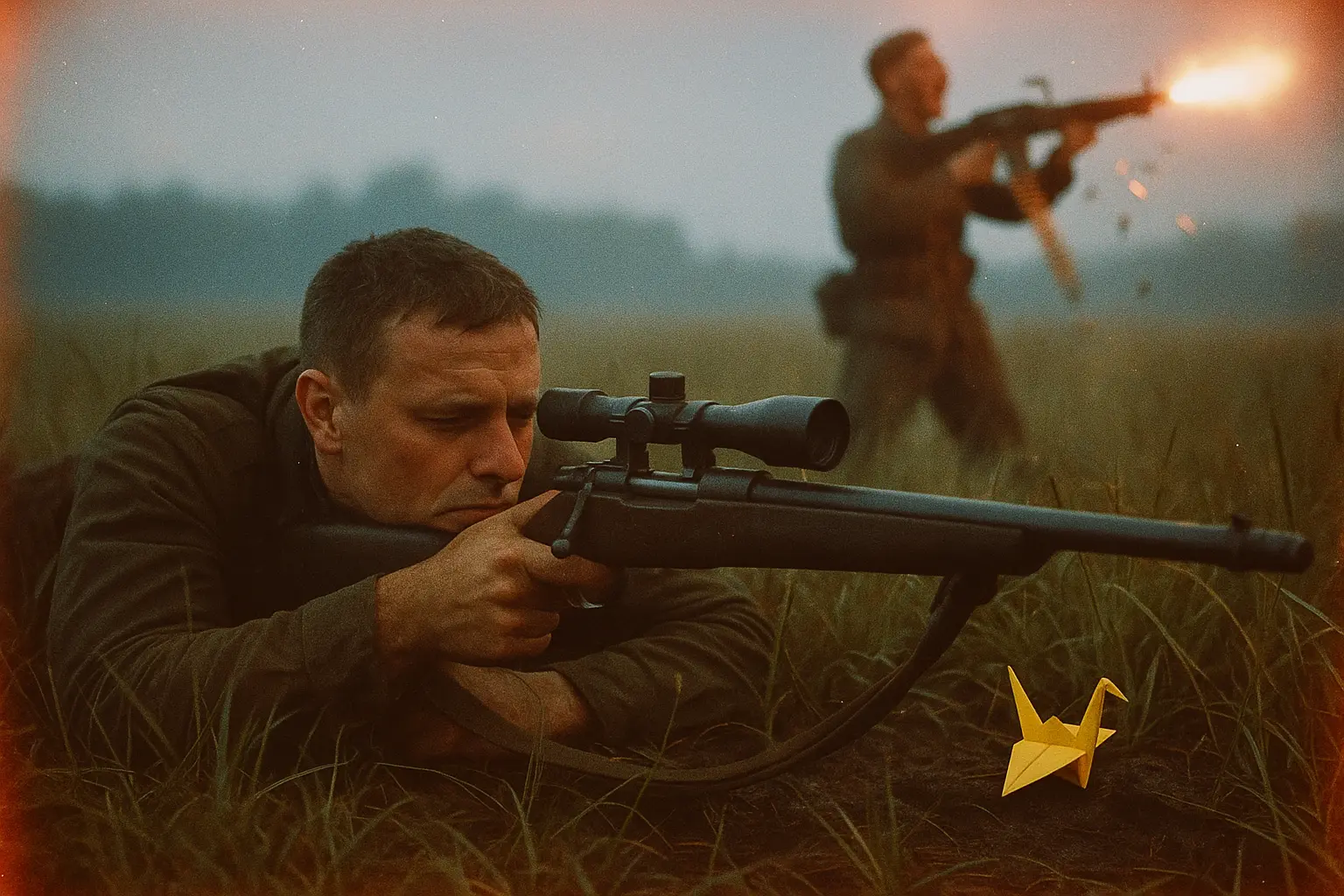
Dawn. A field. Two men two hundred metres apart, in the same army, the same war. The first has been motionless for forty minutes, elbow sunk into the soil, breathing slowed to eight a minute, eye to the scope. He will fire once all morning. Perhaps not at all, if the target isn’t right. The second stands behind a machine gun and hoses the tree line in bursts: chatter, chatter, brass arcing into the grass, barrel smoking, forearms warm. By noon he’ll have spent a thousand rounds. By evening he’ll have composed, in his head, the report: “did a lot today.”
Now the number that settles the argument between them — and it comes from the war, not from a productivity blog. In the Second World War the U.S. military burned roughly 25,000 rounds per enemy killed. In Vietnam, once every infantryman had a full-auto rifle and permission to “rock and roll,” the spend climbed to about 50,000 rounds per body — and in sustained automatic fire, estimates reached 200,000. In that same war, in that same Vietnam, a trained sniper averaged around 1.3 rounds per kill. Not ten percent fewer. Not half. Tens of thousands of times fewer — for the same result.
This isn’t a story about weapons. It’s a story about two modes of attention living inside every head, and about the fact that the modern workday is engineered to reward the machine-gunner and punish the sniper. The machine-gunner leaves behind heaps of brass — visible, tactile, warm proof of effort. The sniper leaves behind silence and a single result. The economy of bonuses, notifications, dashboards and your own dopamine counts shell casings, not hits. And the cruellest part: on the surface, machine-gunner mode looks like a virtue. I wasn’t lying down. I shot all day. That’s exactly why it’s so hard to kill.
II. “Why Now?”: Ammunition Got Cheap, the Barrel Got Hot
The question The Economist demands in the first third: why is this a 2026 diagnosis and not the eternal banality “do less, but better”? Because the economics of the shot changed. To open fire on a new target you once had to physically do something — rent an office, hire a person, write a letter by hand. The shot was expensive, and that alone imposed discipline. Now the shot costs nothing. A Slack message, a new “workspace,” another AI agent, another tab, another “small idea” — all generated in seconds. When every shot is free, the brain defaults to machine-gunner — and mistakes rate of fire for accuracy, because it can feel the rate but has to count the hits.
And here lies the sharpest irony of 2026: the same war that gave us the metaphor also gave us the opposite lesson. Ukraine’s drone doctrine of 2025–2026 is not the machine-gunner. It is the sniper, multiplied by scale. Per Ukraine’s NSDC and CSIS analysis, in 2025 FPV and bomber drones carried out hundreds of thousands of successful strikes, many verified by video; by most estimates, the majority of Russian targets destroyed in combat were taken out by a drone. Each shot is documented. Each drone, around $300–400, flies not “toward the enemy” but at a specific target the operator watches until impact. This is not area suppression. It is hundreds of thousands of separate sniper decisions, each with its own target. An army that would lose by the logic of “who fires more rounds” wins by the logic of “who hits, and counts.”
The contrast with the opposite bank is instructive. Russia’s “meat assault” tactic is the machine-gunner in human form: throw quantity at the line because quantity feels like strength. Colossal expenditure, negligible result per unit. This isn’t a moral judgment (though that’s obvious too) — it’s an operational one: a mode that counts brass instead of hits loses to one that counts hits, even with a smaller magazine. The drone doctrine wins not because it fires more. Because it almost never fires into the void — and every shot knows its target.
Now move the scope from the battlefield to the kitchen table. Because inside the head of a founder, a freelancer, a manager, both soldiers are sitting — and the environment of 2026 hands the machine-gunner a fresh belt of rounds every single day.
III. The Named Framework: The Fire Doctrine of Attention (Four Axes)
Name the mechanism correctly, because without a name it’s just “well, I work a lot.” The Fire Doctrine of Attention is the set of decisions about how you spend a finite magazine of attention: precisely, on one target, or scattered across the whole horizon. It is not about quantity of effort. The two men in the trench burned the same calories. It’s about the ratio of shots to hits — the one metric machine-gunner mode is trained not to notice.
Four axes along which the doctrine breaks into recognizable syndromes:
- Precision. Shots per hit. Sniper: ~1. Machine-gunner: 50,000. At work: how many actions you took to move the one thing that actually matters.
- Suppression (scatter). Fire on the area instead of the target. Feels like control (“I’m holding the front”), is in fact noise that kills no one but heats the barrel and the conscience.
- The magazine (attention as a finite resource). It isn’t bottomless. Working memory holds 4±1 items (Cowan, 2001). Every burst into the void is rounds you won’t have the instant a real target appears.
- Target selection. The hardest and most despised discipline: deciding what NOT to shoot. What makes a sniper a sniper isn’t the shots — it’s the motionless hours of choosing the target.
I’ll unfold each axis with a scene, research, mechanism and an honest counter. No academic distance — because I spent years as a machine-gunner who took pride in a barrel that never cooled.
IV. Axis #1: Precision — Why 50,000 Rounds and One Hit Feel Identical
The scene. Monday, 09:10. Someone opens the laptop and in two hours does seventeen things: answers twelve emails, drags three tasks across a tracker, likes five posts in the work channel, starts (and abandons) a deck, googles a new AI tool, schedules a call, reschedules it, closes four tabs and opens six. At 11:10 the feeling is: “wow, look how much I got done.” By evening, not one of the three things that actually move the business has budged a millimetre. Seventeen shots. Zero hits. But the barrel is hot, and the heat is comforting.
Why do 50,000 rounds into the void and one clean hit produce the same internal sensation of “I worked”? Because the brain registers effort and activity, not result. Activity is brass: visible, tactile, immediate. Result is often silence, deferred for weeks. The machine-gunner gets a dopamine reward for every shot now; the sniper has to wait for one hit someday. Evolution didn’t calibrate us to count hits — it calibrated us to feel movement. So by default we optimize for what’s felt, not for what’s counted.
This is exactly the trap the Vietnam contrast renders in the flesh. The ordinary grunt with an M-16 on full auto felt powerful: the barrel roars, the enemy is “suppressed,” the belt melts away. The sniper two hundred metres off looked almost idle — lying still, not firing. On the day’s report the machine-gunner had an impressive expenditure. The sniper had one line: “target eliminated.” A month on, the commander who counted expenditure praised the machine-gunner. The commander who counted result promoted the sniper. Your inner commander — which of the two is he?
| Mode | What's visible | Shots / day | Hits / day | Inner feeling |
|---|---|---|---|---|
| Machine-gunner | smoke, brass, motion, "busyness" | ~1,000 | 0–1 | "I'm a hero, I was in the fight all day" |
| Sniper | silence, stillness, "doing nothing" | 0–1 | 0–1 | "I barely fired" (target eliminated) |
Counter-pressure mini: “but some days you genuinely need a lot of small actions — clear the inbox, send invoices, reply to everyone.” Honestly, yes. Suppressive fire has its place — cover a withdrawal, pin a direction, buy time. The problem isn’t that small-arms fire is sometimes needed. The problem is that the brain lives in suppression mode by default and passes it off as the main work. Sniper discipline isn’t “never fire in bursts.” It’s knowing when you’re in suppression mode and when you’re pretending suppression is the mission.
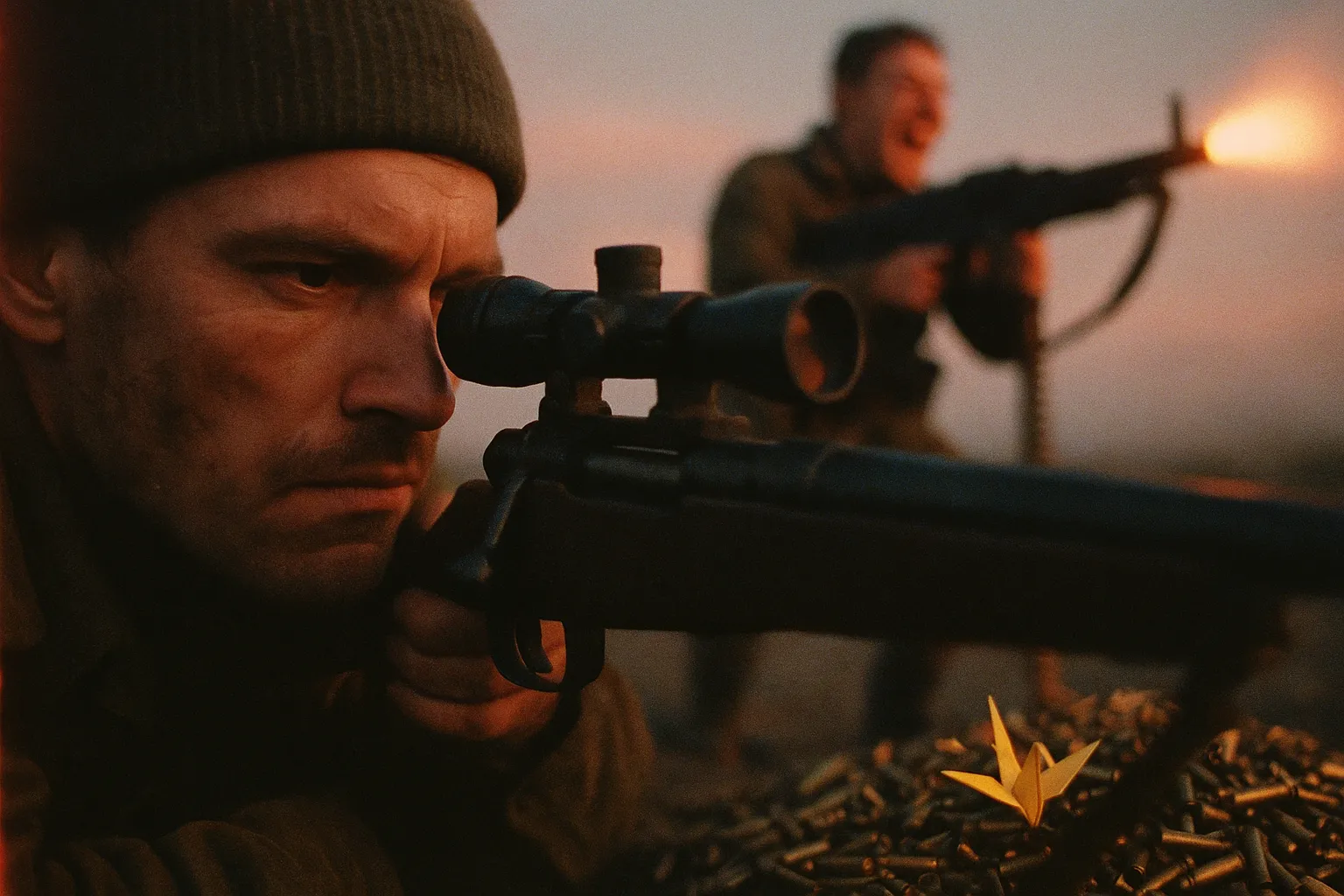
Two men, one war. One lies still for forty minutes and looks lazy. The other has spent a thousand rounds and looks like a hero. The commander who counts brass will decorate the wrong man.
V. Axis #2: Suppression — The Covering Fire That Pins Down Only You
The scene. A manager opens the day intending to write the quarterly strategy — one target, long-range, important. At 09:03 Slack pings. He “quickly replies” (a burst). At 09:11, a client email, another burst. At 09:25, a tag in a channel, another burst. By 10:40 he realizes he’s spent two hours “holding the front” on every direction — and fired not a single shot at the main target. Suppressive fire on his own day. He suppressed no enemy. He suppressed himself.
The mechanism here is sharper than mere “distractibility.” Suppression in war makes sense: you don’t kill the enemy, you keep his head down while someone else runs the maneuver. But at work there is usually no one else running the maneuver — you are the one who was supposed to fire accurately. So your covering fire pins down the only person on the field who could have hit anything. This is what Leroy measured (2009, Organizational Behavior and Human Decision Processes): attention residue — when you switch from A to B, part of your attention physically stays on A even if A is finished. Under dense switching, effective cognitive bandwidth drops — by practitioners’ estimates built on her work, by tens of percent. Every burst into the void leaves soot on the scope for the next shot.
Worse: the people proudest of their ability to “lay down fire in all directions at once” turn out to be the worst marksmen. The Stanford study by Ophir, Nass & Wagner (2009, PNAS, 262 students) went looking for what heavy media multitaskers were better at — and found nothing. They filter noise worse, switch worse, hold working memory worse. The lead author put it coldly: “We kept looking for what they’re better at, and we didn’t find it.” (Honest footnote: some effects later replicated poorly — so a strong intuition, not a law of physics.) The machine-gunner who’s proud of holding ten directions isn’t a super-soldier. He’s a man who confused the racket with combat effectiveness.
Counter-pressure mini: “but responsiveness is service; if I don’t reply fast, clients leave.” Fair, honestly: speed of reply is real value in some businesses. But confusing availability with work is fatal. Availability is sentry duty, a watch on the parapet. Work is a shot at a target. Most people who complain of chaos spent 70% of the day on sentry duty and call it work, because sentry duty is exhausting too. Exhaustion is not proof of a hit. The machine-gunner also comes home wrecked.
VI. Axis #3: The Magazine — Capacity 4±1, and You Fire as If It Held a Thousand
The scene. End of day. Someone looks at the list of what they “need to keep in their head”: sales, hiring, product, two clients on the edge, invoices, the website, a new vertical, health, calling mum, the idea Claude spat out at 14:00. Twelve active tracks. They sincerely believe they’re holding all twelve. The magazine in their head holds four rounds. The other eight “tracks” aren’t ammunition. They’re phantom rounds — the brain inventories them, but they aren’t there when you pull the trigger.
The figure that decides everything here is four. Cowan (2001, Behavioral and Brain Sciences): adult working memory holds 4±1 chunks at once. Not seven (Miller was wrong), not “personally I hold more.” Four — an engineering limit, like magazine capacity. You can feed in a thousand-round belt and squeeze the trigger, but the feeder still pulls them one at a time, and the rest merely overheat the barrel. The machine-gunner fires as if the loadout were infinite. The sniper takes position knowing exactly how many rounds he has — and therefore spends none on noise.
And here hides the costliest mistake of suppression mode: it burns the magazine before the target exists. You torched your attention on twelve “maybes” in the morning — and at 16:00, when the real target arrives (a key client’s crisis, a window of opportunity, a decision that reshapes the quarter), the magazine is empty. You fire at the day’s most important target with the dregs — a tired brain, a residue-coated scope, on autopilot. The sniper keeps his finger off the trigger precisely for this moment. The machine-gunner meets it with a smoking, empty barrel and wonders why he missed.
| What the brain thinks it has | What's actually in the magazine | Consequence when the real target shows |
|---|---|---|
| 12 active tracks, all "under control" | 4±1 working-memory slots | 8 phantom tracks steal attention, give nothing |
| "I'll do it all if I just squeeze faster" | the feeder pulls one chunk at a time | rate climbs, accuracy falls, barrel overheats |
| the loadout is infinite | by 16:00 the magazine is empty | you meet the day's main target with the dregs |
Counter-pressure mini: “but experience gives a wider band — a 20-year operator holds more.” Partly true: expertise compresses several items into one chunk (a grandmaster sees not 16 pieces but three patterns). But that’s not a bigger magazine — it’s better aiming, fewer shots per target. Experience makes you a sniper, not a machine-gunner with a longer belt. Whoever thinks 20 years bought him a thousand-round magazine has merely learned to overheat the barrel more impressively.
VII. Axis #4: The Target — the Hardest Discipline Is Not Firing
The scene. A sniper’s hardest decision isn’t the shot. It’s the four motionless hours during which dozens of objects cross the scope and none may be fired upon, because none is the target. Withstanding the temptation of the easy shot — that’s the discipline. At work it looks like this: at 14:00 Claude produces a brilliant idea for a new product. It’s interesting, feasible, hot. And it is not today’s target. The sniper looks at it through the scope and does not fire. The machine-gunner shoots at everything that moves, because “what if.”
Target discipline is the art of saying no to good targets. Not bad ones — bad ones filter themselves out. Good ones. Steve Jobs at WWDC 1997 put it sharper than any manual: “Focus is about saying no to the hundred other good ideas.” Not “avoid the bad.” “Decline the good.” Because the loadout is finite and good targets are infinite, and that’s exactly what makes them more dangerous than bad ones: a bad target doesn’t tempt you; a good one steals your one shot.
Here you need a tool, because “just focus” is advice at the level of “just hit the target.” So — the sniper’s target check, five questions before any “small yes”:
| # | The sniper's question | If "no" / "don't know" |
|---|---|---|
| 1 | Is this a real target or movement in the grass that caught the eye? | don't fire — vivid bait |
| 2 | Would I shoot at this if it hadn't appeared on its own (email, release, person)? | no → the target chose you, not you it |
| 3 | Does it move the quarter's main thing — or merely "suppress" a feeling of anxiety? | suppression → it's noise |
| 4 | How many rounds does the shot really cost (time + residue + the tail in your head)? | more than it looks ×3–10 |
| 5 | If I fire, what do I pay — which shot at the real target won't happen? | can't name it → don't fire |
Counter-pressure mini: “but if you never fire, you’ll miss the window — speed sometimes is the edge.” True, and snipers know it: there’s a moment when the window is open for two seconds and hesitation equals a miss. But the difference between sniper and machine-gunner isn’t speed of shot — both squeeze instantly. The difference is that the sniper has already laid his aim before the target appeared, so his fast shot is accurate. The machine-gunner is fast too — and that’s exactly why he scatters. Speed without prior aim isn’t reaction. It’s panic at a good tempo.
VIII. Full Counter-Pressure: “Maybe I’m a born machine-gunner, and it works”
Time to walk honestly into the strongest objection to this entire essay. Maybe machine-gunner mode isn’t a bug but my style, and some people really are wired this way: wide fire, high energy, many projects, and somehow it lands. Strayer & Watson (2010, Psychonomic Bulletin & Review) found that ~2.5% of people — “supertaskers” — genuinely don’t degrade on parallel complex tasks. Maybe the reader is one in forty who can truly lay accurate fire across ten directions?
Almost certainly not, for three reasons. First, the supertasker test measured tightly defined, minutes-long tasks with instant feedback — not the months of latency and fuzzy targets of real business; the effect may not scale to that class of load. Second, self-rated multitasking ability correlates negatively with the real thing (Sanbonmatsu et al., 2013, PLOS ONE): those most certain they lay accurate fire across everything shoot worst. The inner “I’m coping” is the weakest possible signal on the field. Third, even a real supertasker, placed in command, teaches the whole company to shoot into the void: when the owner will “cover everyone” anyway, the team learns not to aim.
And the hardest part — even if you were that one in forty, your attention loadout is still finite off the clock. Every burst fired at the work horizon at 22:30 is rounds you won’t have when your child tells you about their day and waits for you to look them in the eye, not through them at the next target. Your partner doesn’t care about your supertasker score. She cares whether you’re here right now — or lying in ambush again for something that isn’t in this room.
IX. Distributional Lens: Who Gets Paid for Brass, Who Gets Paid for Hits
The fire doctrine hits people unevenly — and someone structurally profits from you being a machine-gunner.
Who wins from your suppression mode. Platforms whose revenue is your spent loadout. Slack, counting “activity.” Social feeds, where every burst into the timeline is their engagement metric. Management that measures busyness instead of results, because busyness is easier to see in a dashboard. The productivity-tools market, selling you a bigger magazine when the problem is aiming. All of them benefit from you counting brass: a hot barrel is their KPI, not yours.
Who pays most. People whose personality is wide, curious, high-energy: those who “see opportunity everywhere.” At 25 it’s a superpower; at the head of a team at 35 it’s the chief internal machine-gunner who can’t not fire at the interesting. The bufferless pay too: the freelancer with no assistant who has to be both the sentry and the sniper; the self-employed for whom every distraction is personally his own unfired shot. The quiet teacher who’s hit one target — the class — accurately for thirty years is structurally closer to a sniper than the scattered founder with ten verticals; the irony is the market rewards the second one louder.
Who’s structurally immune. Operator-finishers, whose brains are trained to close rather than to multiply; snipers by temperament. They often don’t become founders — they become the ones beside the machine-gunner-founder who actually take out the targets. That pair works. The lone machine-gunner with no sniper beside him always arrives at a hill of brass and an empty field.
The systemic diagnosis, free of moralizing: the problem isn’t that you’re “undisciplined.” The problem is that the environment pays for rate of fire, not accuracy — and honestly rewards the machine-gunner every minute, while making the sniper wait weeks for his reward. Under those incentives, being a machine-gunner is rational. Which is exactly why it must be broken with architecture, not willpower.

Left — proof of effort: a heap of brass, a hot barrel, seventeen tabs. Right — proof of result: one mark dead centre. The daily report counts the left. The bank counts the right.
X. $/Hour: The Math Where the Sniper Is Always Richer
Translate the doctrine into money and it becomes irrefutable. Picture two people with the same hourly rate — say a notional €100/hr of potential value. The machine-gunner, over an eight-hour day, performs 60 actions; one or two move something important, the rest is suppressive fire. Real value created — say two “hit” hours out of eight. The other six burned on residue, switching and warming the barrel. Effective rate: €200 a day over 8 hours of presence = €25/hr actual. The sniper performs three actions a day. All three are hits. Three hours of deep work create what the machine-gunner couldn’t manage in a week. €100 × the multiplier of deep work — and his effective rate is several times higher, while he fired twenty times fewer shots.
This is the $/hour shift the whole essay is written for: fewer shots → more hits → a higher rate per hour. Not because the sniper works more. Because he doesn’t pay the scatter tax. Newport named the antidote in three words (Slow Productivity, 2024): do fewer things, work at a natural pace, obsess over quality. “Fewer” here isn’t laziness. It’s a WIP limit on the magazine: don’t open more targets than the loadout can service accurately. And Altman put it sharpest (blog.samaltman.com/productivity): it doesn’t matter how fast you move if the direction is worthless; picking the right target is the most important and most neglected element of productivity. The machine-gunner optimizes tempo. The sniper optimizes direction. The first measures the day in shots. The second in hits. Only one of them has something to put on the table at month’s end.
One more thing about metrics, because they’re what makes the machine-gunner rational. When an organization starts measuring “activity” (emails sent, tickets closed, hours on Zoom), activity rises and results fall — a law the anthropologist Marilyn Strathern compressed in 1997: “When a measure becomes a target, it ceases to be a good measure.” Count brass as a KPI and you’ll get heaps of brass. The machine-gunner isn’t stupid. He’s rationally optimizing exactly what you measure.
XI. Re-plating: The Sniper Is Not Asceticism — He’s Scale
Rise back up to altitude. Sniper mode reads easily as a call to “do less, be humbler.” It isn’t. Ukraine’s drone doctrine of 2025–2026 is the best proof of the opposite: hundreds of thousands of strikes is not “less.” It’s an enormous volume. But each one is sniper-grade: a discrete target, confirmed video, minimal spend per unit. Sniper mode doesn’t mean “fire rarely.” It means “every shot knows its target” — and then the volume can be as large as you like, because you’re not burning the loadout into the void.
The same principle on the desk: the goal isn’t to do three things instead of sixty and take pride in the asceticism. The goal is for every action to have a target, rather than be a “just-in-case” burst. Then you can do a great deal — but it will be many hits, not much smoke. Machine-gunner and sniper expend the same calories; the difference isn’t effort, it’s the ratio of shots to hits. The adult shift isn’t “work less.” It’s “stop confusing the racket with the work.”
This, incidentally, is the same geometry as in other essays on a finite resource: two curves compounding in opposite directions. Hits compound upward — every target seen through to the end frees loadout and aiming-clarity for the next. Brass compounds downward — every burst into the void leaves residue that spoils the next shot. A year on, the machine-gunner stands ankle-deep in casings on an empty field. The sniper has silence — and a list of eliminated targets.

The day’s most expensive target isn’t on the screen. The sniper holds his aim on the glow of the monitor while an entire room waits in the kill zone: the drawing, the dinner, the child waiting for you to look into their eyes instead of through them at the next tab.
XII. Hard Kicker
Machine-gunner mode is not a character flaw. It’s a rational response to an environment that hands out rounds for free, counts brass instead of hits, and rewards a hot barrel every minute while paying for the accurate shot once a week. It is curable. Not by motivation. Not by a bigger magazine. Not by the next productivity app promising a thousand-round belt. But by one hard discipline: your loadout is 4±1, like the rest of the primates; your one real edge is not the number of shots but the capacity to keep your finger off the trigger until the right target is in the scope.
Fifty thousand rounds into the void and one clean hit burn with the same warmth in the palms — and that warmth is what costs you most, because the brain mistakes it for a result. Every shot not fired at movement in the grass is a round saved for the moment the real target appears. Every “just-in-case” burst is an empty magazine at the day’s decisive instant. At month’s end the winner isn’t the one who fired more. It’s the one who, while the others hosed the horizon, lay still and waited for the single target worth a shot. And the cruellest thing about machine-gunners is that the honest epitaph would read the same in nine cases out of ten: “fired all day, hit nothing, died with a hot barrel and an empty field.”
Frequently asked
What is attention residue and why does it matter more than ordinary distraction?
Attention residue is the cognitive trace left on a previous task after you switch away from it, even when that task is complete. Unlike ordinary distraction, residue accumulates: each unfocused burst leaves a layer of cognitive noise on the next shot, so by 4pm you are firing at your most important target of the day on nearly empty cognitive reserves.
If sniper mode is superior, why does the 2026 environment systematically reward the machine gunner?
Because platforms, management, and your own dopamine system count shell casings: a visible, instant signal of activity. A sniper's hit registers weeks later and the quiet between shots looks like idleness. When the measure becomes the target (Goodhart's law as formulated by Strathern), the system delivers exactly what it measures: mountains of brass and an empty field.
Some people are genuinely productive in multitasking mode — do supertaskers not disprove the whole argument?
Strayer found supertaskers in roughly 2.5% of the population, but the test used short tasks with immediate feedback, not months of ambiguous business goals. More critically, self-rated multitasking ability negatively correlates with actual performance: the most confident heavy multitaskers score worst. The odds any given reader is that one-in-forty are near zero, and even genuine supertaskers have a finite attention budget outside work.
In Vietnam a sniper used 1.3 rounds per kill and a rifleman used 50,000 — what is the equivalent ratio in a typical founder's workday?
Using the article's simplified model: a machine-gunner mode takes 60 actions per day, with roughly 2 actually moving the business forward, cutting effective output to about a quarter of potential. Sniper mode takes three deliberate actions, all hits, producing a far higher effective rate at the same clock hours. The gap is not effort but six hours out of eight burned on residue and barrel-warming.
How do you practically shift from machine-gunner to sniper mode without sacrificing the responsiveness clients expect?
The article separates availability (standing watch, reactive fire) from work (aimed shot at a real target) as distinct scheduled modes. Before any new commitment, run the five sniper questions: is this a real target or movement in the grass; did the target choose you; does this move the main thing this quarter; what does the shot truly cost in attention; and what will not happen instead. Without an answer to the fifth question, do not fire.
Comments
Signed-in readers only — to keep it human, not a bot swamp.