Bet Size as the Line Between Courage and Recklessness: the Kelly Criterion, Ergodicity, and Two Emigrations Without a Plan B
Twice I leapt into the dark with no floor under my feet: Britain in 2012, Africa in 2019. Between them, the depression of 2014 — which taught the one difference between a daredevil and a disciplined operator: the size of the bet. The Kelly criterion, Peters' ergodicity, survivorship bias, gambler's ruin — and my own documents from Drive.

"The deed of the leap into the night — deciding to go despite a tiny sum of money, betting that Abdul will add money and help with lodging." — my own document, 2018
I. 60% — and why you can't bet it all
In 1956 a Bell Labs physicist named John Kelly derived a formula that answers one simple question: if you know for certain the odds are in your favor, how much should you bet?
Intuition screams: everything. If I'm at 60% to 40%, pile in — it's an obvious robbery in my favor. Kelly's math answers coldly and insultingly: 20%. Not a hundred. Twenty. Because whoever bets it all on a positive edge doesn't get rich — he goes broke. Just with better statistics than a fool.
I didn't learn this formula from a textbook. I learned it by smashing into the asphalt in 2014. And then, five years later, in a dusty jeep between Nairobi and the Tanzanian border, I made the same leap correctly for the first time — and didn't immediately realize it was Kelly's formula, rewritten in sweat and dust.
II. The planes that came back
Before we get to me — about why you believe in leaps at all. Because you believe in them on bad data.
World War II. American bombers return from raids full of holes. The military wants to add armor and studies where the holes cluster most: wings, fuselage, tail. The logic is obvious — armor where it gets hit most. And then the mathematician Abraham Wald, of the Statistical Research Group, asks the question that chills you: where are the holes on the planes that didn't come back?
Because the sample is made only of those that flew home. The engines on the returning machines are nearly clean — not because engines weren't hit, but because the ones hit in the engine are at the bottom of the English Channel. The armor belongs precisely where the survivors have no holes. The data is filtered by survival. What you see isn't the truth about the battle. It's the truth about those who survived for you to see it.
The whole hustle culture — "just leap," "fortune favors the bold," "burn the boats" — is assembled from interviews with those lucky enough to make it home. Founders who bet everything and won give podcasts. Founders who bet everything and lost stay silent — they're not in frame. You calibrate your own courage on a sample with all the dead carefully cut out.
III. One life, not an ensemble
Survivorship bias tells you what you see wrongly. But there's a deeper layer that tells you why it's lethal. It's called ergodicity, and it's the most important idea you were never taught.
In 2019 the physicist Ole Peters published a paper in Nature Physics that quietly undermines half the popular advice about risk. Imagine a game: we flip a coin. Heads — your capital grows 50%. Tails — it falls 40%. Even odds. Will you play?
The classic answer: of course. The expected value is positive — on average you win ~5% per round. But that's the average across an ensemble: if a thousand parallel versions of you played at once, their combined capital would grow. The trouble is, a thousand parallel yous don't exist. There's one of you, playing round after round in time. And the time average for a single trajectory is minus ~5% per round. Almost every individual player slowly slides toward zero while the "ensemble average" proudly climbs.
Here's where ergodicity stitches into Wald's planes. The survivors you see are the lucky paths of the ensemble. The podcast founder who bet it all and won is one trajectory in a thousand, and it's exactly the one they show you. You don't play for the ensemble; you play for the single trajectory you have — and in it ruin is absorbing: so leap big, but never with everything, because from zero no average will ever reach you again.
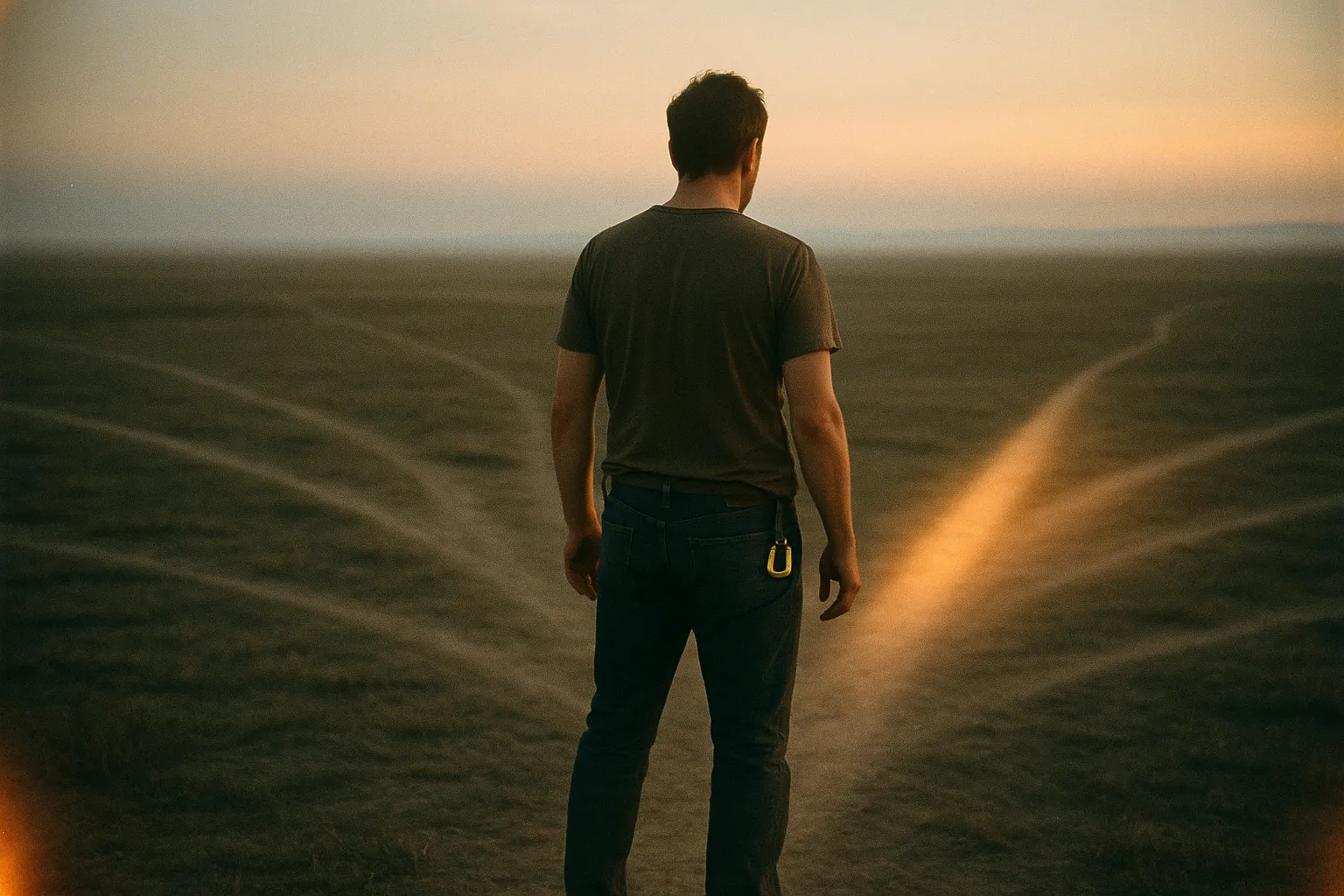
You see the ensemble average — a thousand parallel versions. You live only one trajectory. And in it, zero is absorbing.
And here you can see the difference between the two people I was. The daredevil bets as if he has a thousand lives — he plays for the ensemble. The disciplined operator knows there's one life, and he plays for the time average. Between those two — exactly one broken year.
IV. "The deed of the leap into the night"
"The deed of the leap into the night" isn't a metaphor for beauty. It's an internal term I once wrote down for myself. The structure is always the same: you leap before you have all the resources. You don't wait for the floor to assemble under your feet. You leap into the dark betting the floor will appear mid-flight, or that you'll make it from what you brought.
The Norse berserkers threw themselves into battle without armor — naked, in a trance. Half won so completely that sagas were written about them. The other half simply died, and nothing was written, because there was no one to write it. The difference isn't fury. The fury is the same. The difference is how much each one staked. And that you hear the saga, but not the silence.
V. Britain, 2012: a plane that came back
I was twenty. I packed and left for Great Britain — no visa, no plan B, no return ticket in my head. The pretext: there was a girl I was going for, and her builder father had work for me. The substance: I leapt into a country where I was nobody, an illegal with no status, betting the situation would somehow hold.
And it held. Twenty-two months. Physical labor, sixty-hour weeks, a body that after a shift wanted only to lie down. Not romantic emigration from Instagram — wet concrete, early dark, a foreign language. But over those months I saw fourteen British cities: from Edinburgh and Glasgow to Brighton, Swansea and Loch Ness. I'd never have gone anywhere on my own — she shoved me out, with kicks. And it was that absorbed confidence — that you can just up and be somewhere else — that became the real cargo I brought back. Not money. Optics.
That's what a leap into the night looks like when it works. And here's the trap: twenty-year-old me drew the wrong conclusion. I decided the leap itself was the victory. That the main thing was fury and readiness, and the floor would always appear, because last time it did. I became a bomber that came home and decided it was invulnerable. That's the gambler's error — raising the stake after a win.

Twenty-two months of wet concrete. Britain paid not in money but in optics. And it nearly sent the bill the next year.
VI. 2014: the night with no floor
I came back to Ukraine and fell out. Not metaphorically — clinically. What the archive would later honestly call a depressive episode. The despair was fueled by the absence of effect, of significance, of being needed. The leap was over, the adrenaline burned off, and the floor you can stand on day to day — I hadn't brought it. I knew how to leap. I didn't know how to land.
On 6 October 2014, at 22:41, I created a file in Drive: "100 Days to Death." I declared: I'll write a novel, a hundred days straight, a chapter a day. The epigraph ended in bold: "Otherwise I die unwritten." Of the hundred declared days I wrote five percent. A full Day One, headings for days 2–5 with no text — and that's all.
The hero of that abandoned novel is Plumbum, with a prosthetic arm rusting in the running water of his own apartment. He isn't a literary hero in an extreme state. He was me, covered by a thin layer of the absurd — thin enough not to recognize myself. And the Kipling pastiche I ended not with the promise of becoming a Man, but with the promise of becoming a Madman — amid "stupidity, disability, and numerous suicides."
In 2014 I bet as if I had a thousand lives — I played for the ensemble. The first leap had external structure (work, a foreign country, a girl-as-engine); the second was a pure leap into the void with no valve. The same fury. The same berserker. Just without armor — and my single trajectory came right up against the absorbing wall. I didn't hit the bottom only because I was pulled out — not because I'd calculated the height right. And that's exactly what I'm obliged to remember every time the next leap starts singing in my blood again.
VII. The valve
Four years passed. On 21 December 2018, a week after being fired from the Kyiv Post, wintering in Thailand, I wrote a document: "My Goals to 35." Among them — the formula "Prove to myself I'm a hard, aggressive Berserker," and its last line:
"…go for powerful risk and don't be afraid to start from scratch (stay hungry). But diversify, so the depression doesn't hit hard."
Two sentences that argue on purpose. The first — berserker. The second, in fine print: diversify, so the depression doesn't hit hard. That's a man who has already crashed and remembers exactly how. Twenty-five-year-old me didn't know he was quoting both Kelly and Peters at once. But he was doing exactly what they derived: stake a large fraction, never the whole bankroll, because you play your single trajectory, not the ensemble. "Diversify, so the depression doesn't hit hard" is Kelly's fractional bet, only the unit of measure here isn't dollars but the psyche.
| Player | What he plays for | Fate at a positive edge |
|---|---|---|
| Coward | Doesn't bet — waits for the floor | Doesn't go broke, but doesn't grow. Dies of the plateau |
| Daredevil (me in 2014) | For the ensemble (as if lives are many) | Goes broke almost surely — even with an edge |
| Operator (me since 2018) | For the single trajectory in time | Grows over the long run. Falls hurt but don't kill |
The market confirms this with a number that runs cold in your gut. J.P. Morgan analyzed every company in the Russell 3000 from 1980 to 2014: about 40% of stocks suffered a "catastrophic loss" — a 70%+ decline with no recovery; two-thirds lost to the index itself. Even if you pick winners in a market that rises on average, putting everything on one position is a 40% chance of zeroing out forever. The market itself screams: diversify or die.
VIII. Africa, 2019: the same leap, but with a parachute
Seven years after Britain I did it again. Two months wandering with my brother through the backcountry of Kenya and Tanzania. The formal pretext — combine recreation with work meetings with a client, Abdul. The real structure — the same leap: to go despite a tiny sum of money, betting that Abdul would add to it and help with lodging.
The twenty-five-year-old daredevil would have done it blind, dumping the whole bankroll, and prayed. I in 2019 did it with discipline — the difference isn't the sum but the architecture of the bet. Because this time several nets were strung under the leap:
- Not one bet, but two on one ticket. Recreation plus work meetings. If the business part fails, the trip remains, and vice versa. Diversification right inside the trip.
- Behind me — a company, not a void. In 2012 failure meant zero. In 2019 — a fall onto a working infrastructure that generates money without me. A leap from a foundation is a different leap than one from the edge.
- I didn't stake the whole psyche. The main lesson of 2014: the most fragile asset isn't the wallet but the nervous system. This time I knew where the valve was, and kept my hand on it.
The leap looked just as romantic as at twenty. An Instagram tourist would see the same adventure. But the difference between 2012 and 2019 is the difference between a berserker who runs into battle naked and one who has invisible chainmail under his skin. The fury is the same. The survival is not.

Kenya–Tanzania, 2019. The same dark, the same “tiny sum.” The only difference was the chainmail under the shirt.
IX. Before you step: calculate the height
You almost certainly have your own leap into the night: the moment you threw over the stable for the uncertain. And you remember it one of two ways — either as the best thing that happened to you, or as the thing after which you spent a long time gathering yourself in pieces. The difference is almost never in the size of the dream. It's in the size of the bet. Here's the checklist that cost me one broken year:
| Question | Bad leap (for the ensemble) | Disciplined (for your trajectory) |
|---|---|---|
| What's under the leap? | A void. Failure = zero | A foundation where falling isn't fatal |
| Am I staking the psyche? | All of it, all-in | Nervous system in reserve, untouched |
| How many points of support? | One: "it has to work" | Two or three independent (recreation + client) |
| Where's my Abdul? | All hope on one person | There's a plan if Abdul doesn't come through |
| Whose example inspired me? | A plane that came back | I counted the ones that didn't, too |
Leap. Seriously — leap. The plateau kills more slowly than failure, but more surely: the coward dies of unrealized life as reliably as the daredevil dies of bankruptcy. The operator-by-Kelly is the only one of the three figures that grows over the long run. Just before you step into the dark, calculate the height and pack the parachute — so that after the landing, someone is left to tell the story.
X. In place of a conclusion
The romance is in the leap. The discipline is in the size of the bet. Everyone sees the first. No one sees the second — and it's exactly what decides whether there'll be a saga about you, or silence.
And the last, most unpleasant truth. You've read one more story about a leap that worked — mine. I'm a bomber that came back too. The only reason this story doesn't look like the rest of the hustle-porn is that I showed you the hole in the engine too: 2014, a hundred days, five percent, the Madman. Most narrators cut that part. So remember not my leap but my valve — and what separates a daredevil from an operator: the daredevil plays as if lives are many. The operator knows there's one.
A berserker who didn't calculate the height isn't a hero. He's a corpse with a good story no one's left to tell. A berserker who packed a parachute looks just as reckless at the moment of the leap — and meets the morning. The whole difference between a saga and silence is in how much you staked. And you don't hear the silence only because the dead don't run podcasts — and there's no ensemble left to average your single life back into the black.
Frequently asked
What is ergodicity and why does it break standard risk advice?
Ergodicity describes whether the average across an ensemble (a thousand players simultaneously) equals the average over time (one player across a thousand sequential rounds). In most real-world situations they diverge: a game that enriches the group in expectation can reliably destroy every individual player over time. Ole Peters showed this in Nature Physics in 2019 with a coin that pays +50% on heads and -40% on tails — positive expected value for the group, but every single trajectory drifts toward zero in the long run.
If even disciplined risk offers no survival guarantee, why jump at all?
Because refusing to jump is also a bet: the coward dies from stagnation as reliably as the reckless player dies from ruin, just more slowly. The Kelly criterion does not say do not bet — it says bet a fraction, never the full bank. Growth without risk is mathematically impossible in a multiplicative game; the only question is which bet size leaves you alive after the first failure.
The author is himself a returned bomber — why does showing the 2014 crash protect against survivorship bias?
It does not protect completely, and he says so directly in the final section. The difference is that he shows the engine hit: 100 days declared, five percent written, a clinical episode, the Madman. Most successful narrators cut that part. It does not eliminate selection bias but reduces it — the reader sees at least one bet size that nearly destroyed the trajectory, not only the one that worked.
The J.P. Morgan data shows 40% of Russell 3000 stocks were permanently wiped out — what does that mean for someone who never trades stocks?
The same rule applies to any concentrated bet: one client, one employer, one city, one relationship as the sole source of income or meaning. A 40% chance of irreversible ruin is not a market anomaly — it is the baseline math of concentration in fat-tailed systems. Diversification as a principle applies to the architecture of any decision under uncertainty, not only to investment portfolios.
How do you practically audit the next big leap using the logic of this article before taking it?
Five questions from the checklist: what is under the jump — void or a foundation where a fall is survivable; are you staking your entire nervous system or keeping it in reserve; how many independent anchors does the bet have; is there a plan if the key person does not come through; and whose example inspired you — did you count the ones who never came back. If the first answer is void and the second is all-in, the signal is to reduce bet size, not cancel the jump.
Comments
Signed-in readers only — to keep it human, not a bot swamp.