The Emigration Arbitrage: a Western Salary and Third-World Costs Double Your Capital — the Full Balance Including Social Write-Offs
Emigrant arbitrage looks flawless: a West salary, third-world costs, capital growing twice as fast. It's an honest win — and at the same time a long debit no one writes into the spreadsheet: erosion of identity, children with no homeland, old age in a place that never became home, funerals you fly in for, and friendships thinned to a like under a birthday post. Written from Ukraine 2026, with weight, not with a moral on display.

"I counted everything. Cost of living, taxes, school, insurance. I counted only one thing wrong: which time zone the phone would ring in when they told me my father had died." — from a conversation with an emigrant who flew in for the funeral one day too late: the plane made it, only death came earlier.
I. A deal with only one statement
You've already signed this deal. Or you're thinking it over now. Or someone signed it for you when the plane lifted off the runway — and you stared out the window thinking "temporary, just until I get up to speed." Fine. Then read on, because there's a detail in that contract printed small, in the bottom-left corner.
There's a financial operation traders call arbitrage: you buy cheap in one market, sell dear in another, pocket the difference. A classic, boring, beautiful deal. Now a figure worth holding in your head to the very end. In 2024, officially recorded money transfers to low- and middle-income countries reached about $685 billion — a sum comparable to, and by some estimates larger than, the volume of foreign direct investment and official aid to such countries combined. The largest flow of capital into poor countries is generated by neither corporations nor governments. It's generated by people who left — and who send back, every month, a slice of their arbitrage. If homesickness were listed on an exchange, its ticker would be the most liquid in the world. They'd call it $HMSK and sell it in $685-billion lots a year.
Emigrant arbitrage is the same mechanism, except the commodity in it is you. You earn a first-world salary, live at third-world prices, bank the difference — and capital grows twice as fast as it does for the one who stayed. I've seen the spreadsheets. A year ago — €1,200 a month and a minus on the card by the 28th. Now — €4,500 and "a nine-month financial cushion." Everything green, everything rising, and the "in ten years" column looks like something you'd want to print and hang over the bed of everyone who doubted you.
But every arbitrage has two spreads. The first — monetary — accumulates upward: exchange rate, savings, square meters, school for the kids, insurance. The second — belonging, identity, language, the graves of your dead, friends who've known you longer than a week — accumulates downward. The statement on the first arrives monthly, a pretty PDF, with a green arrow. The statement on the second isn't sent at all. For years you celebrate half the deal.
This isn't a "don't go" text. It's a text about how to read the full statement — both columns, including the one where the bank stays silent.
Why now, not always? Emigrant arbitrage existed before. But in the 2020s it stopped being an individual tactic and became mass infrastructure: per CES data, the share of Ukrainian refugees who firmly planned to return fell from three quarters (2022) to less than half (2025), and without real safety conditions only about 3% are ready to go back. What holds people isn't bad will — it's that the arbitrage has already embedded itself in children's schools, leases, loans, and employment contracts. The difference isn't in emigration itself. The difference is that in 2025–2026 it became an operating system you don't switch off by pressing a "home" button.
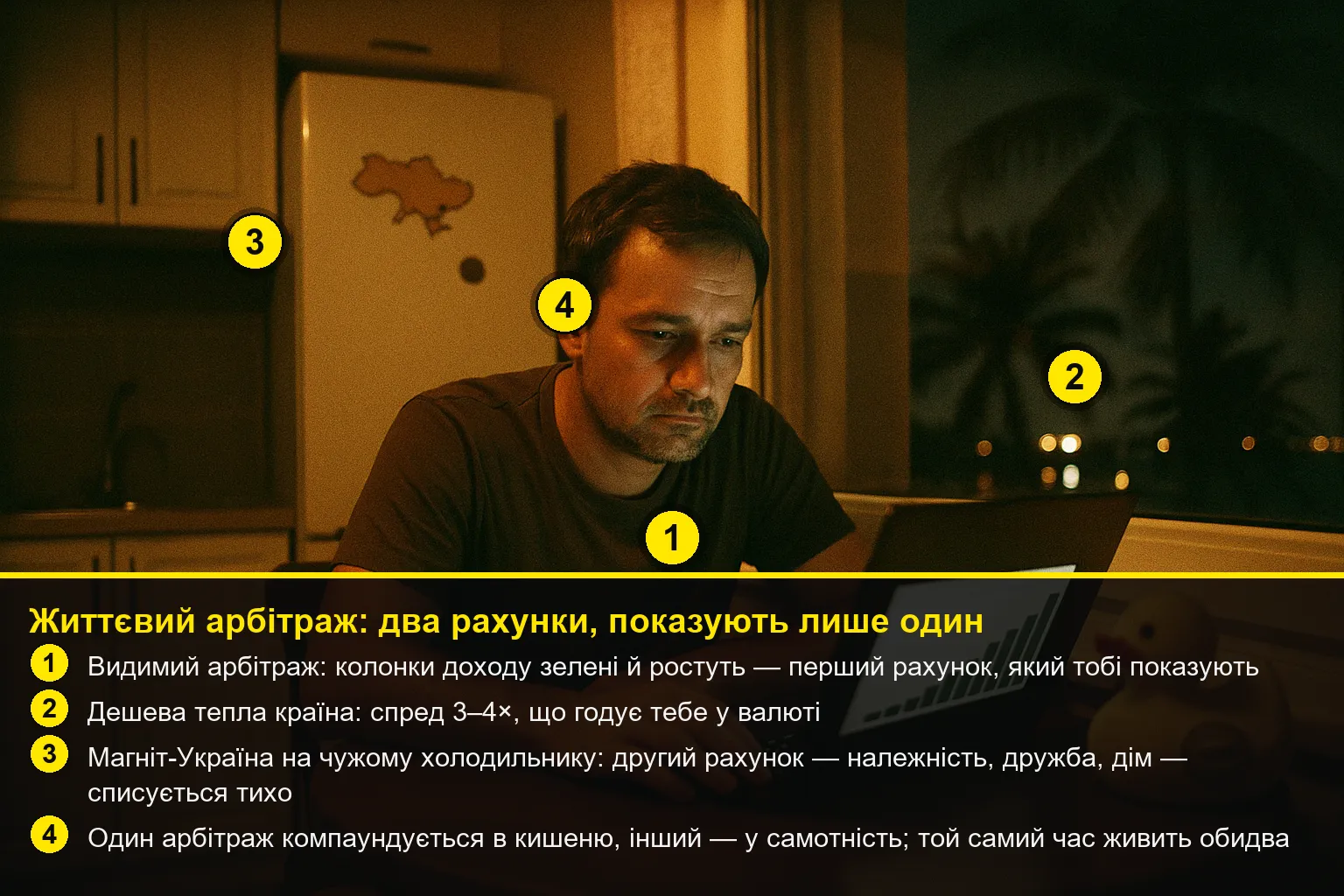
The same table, broken into two accounts. ① the green income columns — the first account, the one they show you; ② a cheap warm country — the spread that feeds you; ③ the Ukraine magnet on someone else’s fridge — the second account (belonging, friendship, home) being debited quietly; ④ the same time feeds both.
II. The spread that feeds you
First, honestly, about the win — because without it the whole text turns into sentimental blackmail. The win is real, large, and legitimate.
The scene is banal to the point of toothache. An engineer left Kyiv, Kharkiv, or Lviv for Berlin, Warsaw, Lisbon. The same profession, the same head, the same code. Only now he's paid in a currency that doesn't depreciate with every front-line report, and he rents a room in a shared flat, because "temporary, just until I get up to speed." The arithmetic that sobers any homeland romantic: West-income minus third-world lifestyle equals a savings rate that neither discipline, nor talent, nor a second job would have given him at home. At home, for that level of savings, he'd have had to sell a kidney or become a deputy minister. Abroad it was enough to change a postal code. He didn't get smarter crossing the border. He just changed the market where he sells the same product. That's arbitrage: not a genius, a price difference.
Ukraine 2026 entered this register not of its own will: per UNHCR, as of early 2026 about 5.9 million Ukrainians hold refugee or similar status abroad, and roughly another 3.7 million remain internally displaced within Ukraine. This isn't a "brain drain." It's a nation the war forced into the very arbitrage others entered voluntarily, one by one.
And here's the first bitter detail. The same spread that feeds the family back home also keeps that family at arm's length. Remittances aren't only money home. They're a tax on your own absence, paid monthly. Every payment is a letter "I'm with you," written in the one language that crosses borders without a visa: the language of money. And the most honest thing to say about this act is that it's both generous and a buy-off. You really are helping. And you really are buying your way out of a presence you can't give. Two things true at once, and adulthood begins where you stop pretending it's only the first.
But there's a third player in this deal that neither of the two columns shows. While the migrant sends, someone else — very attentively — receives. Remitly, Western Union, MoneyGram, and dozens of smaller operators together collect about $50–60 billion a year in fees and FX spread alone — roughly 6–9% of the total flow, depending on the corridor and method. The poorer the corridor, the higher the fee: a transfer from Berlin to Kyiv is cheaper than from Dubai to Manila, where Western Union easily takes 5–7% and more. Alongside this — the host country's labor market: ILO studies find that migrants, even with matching qualifications, earn on average 10–15% less than local equivalents in the first years, because the employer prices in language risk, legal dependence on a permit, and a lack of local references. The arbitrage is real — but between "how much the migrant gets" and "how much a local would have gotten" sits one more invisible spread that doesn't vanish from the green column, it just never makes it there.
III. The first missing column: identity worn down
Identity doesn't vanish from a blow. It wears down like a sole: you don't see the wear in the morning, you see the hole a year later, when you're already getting wet.
The mechanics are simple and merciless. Each year abroad — a little less "from there" and a little less "from here." Home isn't quite yours anymore: you don't know the memes, don't know the prices, don't know the new slang, you read the politics from a feed, not from your skin. And here — all the more not yours: the accent gives you away on the third word, the humor doesn't land, the childhood songs the locals hum, you don't hum. Researchers describe the emigration experience as a feeling of "belonging everywhere and nowhere at once" — for them "home" becomes a circle of people rather than a specific place. Sounds almost poetic. In practice it's a person who, asked "where are you from?", makes a micro-pause and starts calculating how much time the other person has. If it's a taxi driver — you say the name of the passport country. If it's a recruiter — the name of your last company. If it's an old woman at the cemetery — the name of a village that's no longer on the map.
The migrant optimized the cost of living — and unintentionally took a short position against his own identity. He shorted himself. The bet paid off: he became cheaper to service. Only the asset he sold uncovered is the answer to "who am I," and buying it back will cost a price that, when the deal was struck, wasn't visible on the screen. Each year abroad is like a step across the minefield of belonging: going back is already frightening, going forward is unknown, and standing still isn't allowed. The worst part isn't that you lose "that" identity. The worst part is that you don't acquire "this" one. You hang in the spread between the two — and live on that exchange rate for years, convincing yourself it's cosmopolitanism, not homelessness with a decent credit history.
Let's name the antagonist. It's not "nostalgia" — nostalgia is sentimental and free. It's the Cashier of Belonging: a quiet clerk who doesn't call, doesn't write, sends no reminders. He has no KPI on the number of calls — only on the accuracy of the final bill. He just keeps the books. Every missed wedding, every funeral over video, every Christmas where you were "oh, what time is it there for you now?" — all neatly recorded in his ledger. He'll present the bill in one short line, on one specific evening. And the first thing that'll strike you isn't the sum. The first thing that'll strike you is how long, it turns out, that meter has been ticking while you looked only at the green column.
IV. Friendships thinned to a like
Between the big lines there's one small one that accumulates most imperceptibly and therefore cuts deepest. Friendship.
Friendship doesn't die of a quarrel — that would be almost dignified, there'd be a reason, an event. It dies of distance plus time, through the quiet non-deposit of touches. First you call weekly. Then — when "there's something to say." Then — on a birthday. Then a like under the birthday photo, placed for you by a reminder algorithm — your most reliable mutual friend of recent years. Facebook's algorithm remembers your friend's birthday better than you do. It sincerely considers you close.
You learn of your closest childhood friend's divorce from a story. Of his child — from a photo in the feed. Of his mother's illness — third-hand, because "it felt awkward to bother you, you're so far away." This is compound interest in reverse: what grows isn't what's between you, but what's between you and the distance. Friendship moved online is like a limb after amputation: the phantom pains remain, but there's nothing left to scratch.
In a survey among users of the Remitly transfer service, 80% of emigrants miss family most, 62% miss friends, and among the reasons that drive people back, longing for one's own beats most of the "rational" arguments. Homesickness turned out to be reason number one to return — 30.9%, ahead of both work and cost of living. That is, the severed compound of relationships pulls people home harder than money.
A friendship that fits in an emoji is a gravestone with a nice avatar. A like is the sound a relationship makes when nothing's left but the duty to signal you still remember the person exists. The most repulsive part is that you sign this line voluntarily and daily, drop by drop. No one takes your friends away. You yourself, in full comfort and with no pain in the moment, convert living relationships into emojis — because it's convenient, because of the time difference, because "I'll definitely call later." The Cashier records every "later."
V. The arbitrage accumulating against you
Here we need one precise frame, or the text dissolves into sighing. I'll name it plainly: the Arbitrage That Accumulates Against You.
Compound interest is one of the strongest forces in finance, because it works on the accumulated. Not on the sum, but on the sum of the sum. In emigrant arbitrage it works in two directions at once. The monetary spread compounds upward: year over year, savings grow on growth. And the belonging spread compounds downward — and also on the accumulated. Because relationships are compound interest too: they grow not from a single meeting but from a thousand small touches laid one on another over years. Miss the touches — and you lose not them, but the growth from them.
Migration is like a space flight: most of the fuel burns at launch, and then inertia carries you farther from Earth even when you already want to go back. You're not fleeing — you're just being carried.
The monetary spread compounds upward and sends you a statement every month; the belonging spread compounds downward and sends no statement at all — which is why for years you celebrate half a deal in which you’re simultaneously being robbed in a currency you don’t know how to count.
The black humor here is in the bookkeeping itself. It's a diversified portfolio that honestly pays dividends in one currency and just as honestly issues a margin call in another. Only the margin call comes not on the exchange at nine in the morning, when you can still top up. It comes as a call at three a.m., when there's nothing left to top up with, because the asset demanded is your physical presence at a specific bedside, and the market no longer sells that. No sum from the green column closes this margin call. The migrant didn't leave to earn more. He agreed to pay in kind: with family, language, his own funeral.
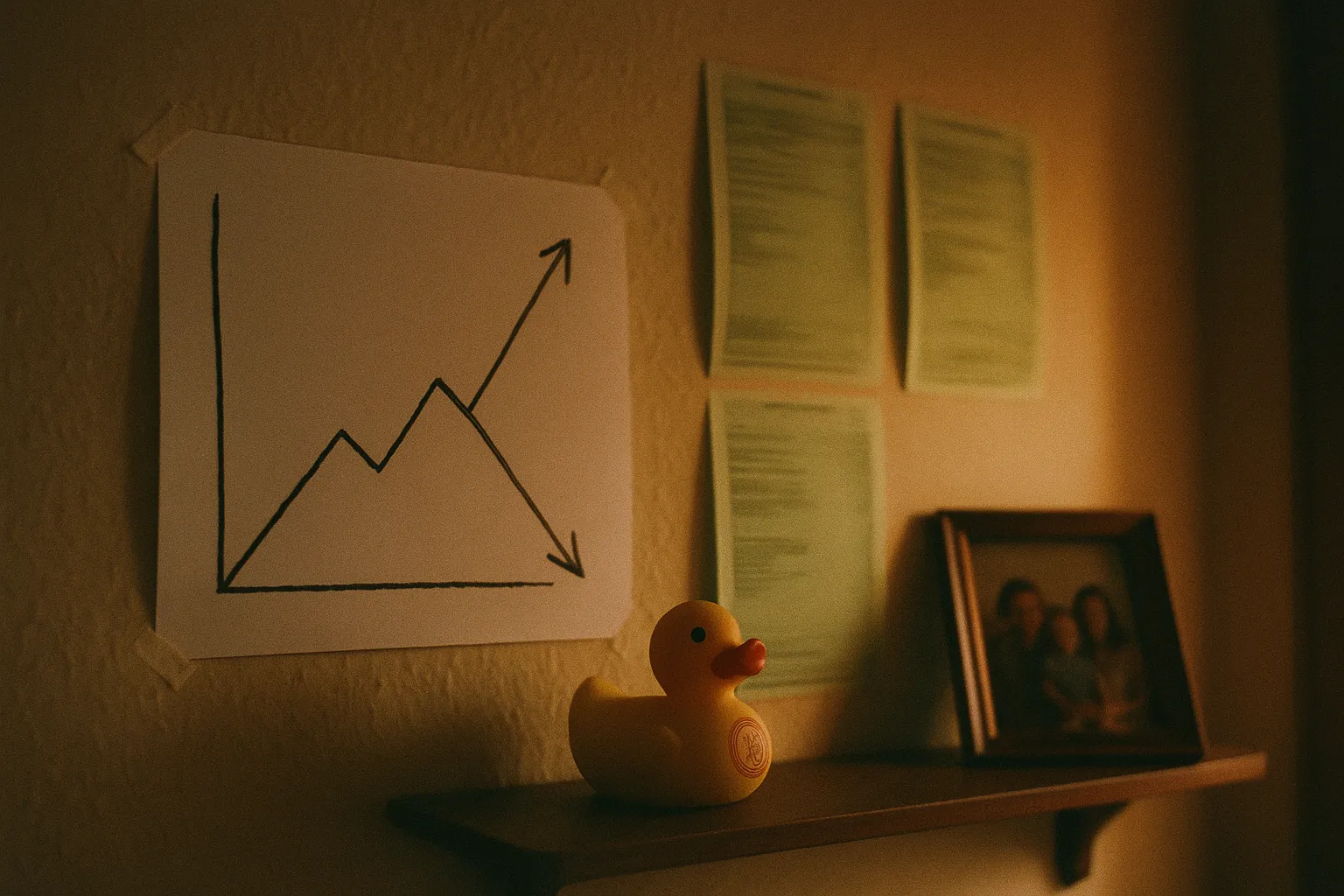
Two curves diverging over years on a single wall. By the one going up — a stack of statements. By the one going down — not a single page. The bank reports on only half your life.
VI. The second column: third-culture kids
The most expensive line in the lower spread you sign not for yourself. Your children sign it for you, before they can even read.
Sociologists named them third culture kids. The definition is dry: a child who spent a significant part of childhood outside the parents' passport country. The reality is different. It's a child for whom "homeland" is a word from your stories, not a place from her memory. She speaks fluently a language you're only just learning to think about a mortgage in, and stumbles over the language you dream in. And toward the "home" you're from, she has a tourist's attitude: nice, grandma, funny candies, strange outlets, let's go back — because there's none of her cartoons and no decent Wi-Fi here, so it's not home, it's a set for your memories. After the third attempt to explain to her what a "toloka" is, you give up and just google the English equivalent. Spoiler: there isn't one.
Researchers show that for third-culture kids "home" is a circle of people rather than a specific place: they attach to other nomads like themselves, for whom too, nowhere is "from there." A third-culture kid is when she has three passports and not one place where she'll want to be laid in the ground. You gave the child the whole world — and forgot to include in the kit even one corner she can call her own without footnotes.
The black joke of parenthood here is especially cold. You emigrated for the children — it's the headline item in any presentation to yourself. "I'm doing this for them." And you did it so well that the children grew into people for whom you yourself are an accent-bearer, a museum exhibit of the old country, a man who confuses the names of their favorite bloggers and asks what the meme they just sent to the family chat means. You invested in their future — and the payment went through your shared homeland. They'll get better universities and cleaner streets. You'll get grandchildren you'll need a translator for, to explain who your parents were. The same as between Evelyn and Joy in "Everything Everywhere All at Once": the mother lived her whole life for the daughter — and ended up in a parallel universe where she understands not a single word. The deal is closed, both sides satisfied, and only in the fine-print footnote does it say which currency the change comes in.
VII. Old age in the no one's
And now the quietest line — the one that doesn't arrive for years, and then arrives all at once.
The young emigrant doesn't see old age. He sees a career, square meters, school, vacations, a chart going up. And it arrives — and reveals what no spreadsheet showed: a place that was ideal to earn in is rarely a place you want to die in. Studies show that with age and declining health, the probability of migrants returning to their home countries rises noticeably — a good place to work and a good place to die rarely coincide. What was optimal for the asset turns out to be foreign to the person.
At the cemetery you recognize only the surnames on the headstones, and at the family doctor's office they recognize you as "the gentleman with the accent," but not as "one of ours." There's mostly nowhere and no one to return to: friends scattered, parents in the ground, the language after thirty years became a little foreign to you, and the country you remember exists only inside you — it was long since rebuilt without your participation. You stand on the threshold of two homes, and neither recognizes you fully as its own. The emigrant's old age is the final frame of "Up in the Air": gold status, a million miles, and complete emptiness on the "Where to next?" board. No one's.
The humor here is the blackest of all, because it's about the last budget. All your life you insured assets — a car, an apartment, even a phone. And you managed not to insure the one event with a hundred-percent probability: your own death in a foreign country. You optimized the cost of living so thoroughly that you accidentally shorted your own attendance at your funeral. You bet you wouldn't be there — and that bet, unlike the others, will definitely pay off. The Cashier of Belonging, silent for forty years, finally rises from behind his window, walks over unhurried, and lays on the table a bill in one line, in a currency on no exchange: on whose grave you'll stand — and who, exactly, will stand at yours.

Two thresholds, neither recognizing him as its own. The same little duck, only faded over forty years. The home you’re pulled to in old age was long since rebuilt without your participation.
VIII. The statement the bank doesn't send
Time to give the reader a tool, not just a diagnosis. Here are both columns in one table.
| Year abroad | Monetary spread (statement sent) | Belonging spread (no statement) |
|---|---|---|
| Year 1 | + salary in hard currency, first savings | – first missed birthdays; still hurts |
| Year 3 | + cushion, renting alone, mortgage plans | – calls rarer; the humor at home isn't all yours anymore |
| Year 5 | + first down payment, a car, kid in a good school | – the child thinks in a foreign language; friends on "like" |
| Year 10 | + capital begets capital, the chart is steep | – first funeral over video; "where are you from?" — a micro-pause |
| Year 20 | + a secure old age, an inheritance for the kids | – no one to return to; the home was rebuilt |
| Total | Green. A PDF every month. | One line. One evening. The Cashier was silent for twenty years. |
In the "Year 10" row — the first funeral over video. In the "Total" — all the rest. When you look at the table the first time, it reads like statistics. When you recognize yourself in it — like a schedule of flights you didn't make in time.
Before moving to the test — it's worth naming one structural detail the table also doesn't show: who wins while the migrant counts his spread. The green column is real, but it doesn't reach the migrant in full. Transfer operators take 6–9% of every dollar sent — over $50 billion a year globally, concentrated in a few large players. The employer in the host country often pays the migrant 10–15% less than a local equivalent, keeping the spread for himself — a "risk premium" that never makes it into the "compare salaries" table. So the arbitrage exists — but it's wider than the difference the migrant sees on his card. Part of the difference is skimmed before it even gets there. Not out of malice, just out of the operational logic of a system that long ago learned to monetize a $685-billion flow.
Here's a simple test you can run tonight:
- The child's language. In what language does your child think — and will you ever be able to explain to her, in that language, who your parents were?
- The last call to a friend. When did you last speak with a friend of your youth by voice, not by a like? If you count in years — the curve has already turned down.
- The funeral. If tomorrow there's a "come now" call — will you make it? And were you at the previous one, or did you watch over video?
- The place of aging. Picture yourself at 75. In which country? And now honestly: who's beside you there, besides those you pay — a caregiver, a family therapist, and food delivery?
- "Where are you from?" How many seconds of pause before the answer? The pause is the spread.
- The return ticket. If this is "temporary" — name the year it ends. The word "temporary" is the anesthesia they inject you with while performing the permanent operation of cutting away belonging. If there's no year, the anesthesia is already working.
This isn't a "leave or return" test. It's a test of whether you see both columns — or celebrate only the left one while the right accrues compound interest in your blind spot.
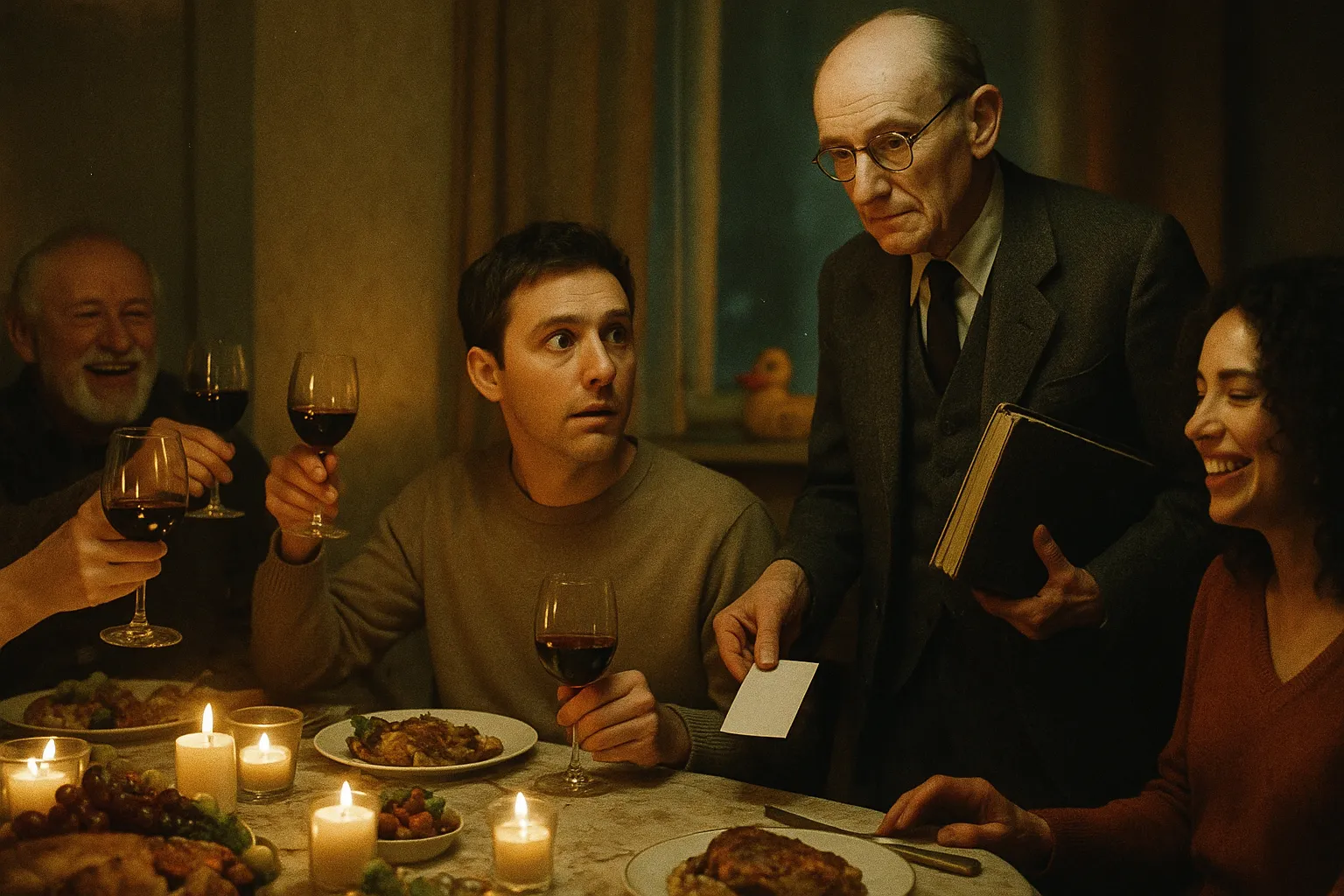
The Cashier of Belonging doesn’t call or write for forty years. He simply walks up to the festive table one evening and lays the bill beside your plate. The rest at the table notice nothing.
IX. When the arbitrage is the right bet
Now the obligatory honesty, or the whole text is the sentimental blackmail of a person who never went anywhere himself.
If you're reading this from a basement under shelling — you don't need this text at all. Your only arbitrage right now is between the morgue and nostalgia, and the answer is obvious. If it's hitting your stairwell — no belonging column outweighs the "child alive" column. Full stop. Ukraine 2026 wrote millions of people into this arbitrage not from a chase after the spread, but because home physically stopped being a safe place for the body.
The arbitrage is likewise the right bet when home lacks not only safety but the very possibility: when the oncologist asks you to buy syringes at the pharmacy, the teacher to print the textbook at her own expense, and the building is officially commissioned but stands without water or heat for a third year. Then to leave isn't betrayal, it's the instinct of self-preservation. Emigration as flight from death is an organ transplant: painful, risky, but without it the patient dies. Emigration as pure arbitrage — for the sake of a price difference, when home wasn't frightening, just cheaper to leave — is liposuction for the sake of an Instagram photo.
Emigration as flight from death, suffocation, or a dead end is almost always the right bet, even with all the debits of the lower spread. Emigration as pure arbitrage — must at least be aware of the full bill. The difference isn't whether you go or not. The difference is whether you saw both columns when you decided — or were shown only the green one and told that's all there is.
X. Instead of a conclusion: read the full statement
Emigrant arbitrage isn't a mistake or a sin. It's a real, powerful, often life-saving financial operation that whole families and whole nations rest on. The money really does grow faster. The children really are safe. Old age really is secured. Everything in the left column is true. I'm not asking you to close the deal. I'm asking one thing: read the second column while the bank sends only the first.
Every month they send you a statement of what you earned, and never of what you pay for it. The emigrant's adulthood isn't in returning (sometimes there's nowhere to return and it's pointless). Adulthood is in keeping the second statement yourself, by hand: not just logging the rent in a notebook, but also, say, the list of funerals you didn't go to, and the birthdays you missed live. Emigration isn't about "where it's better." It's about whose funeral you'll choose to be absent from.
Because compound interest works both ways regardless of whether you look or not. Money grows on the accumulated. Belonging is lost on the accumulated. And the only thing you can do is stop celebrating half a deal.
The spread is green. The statement comes every month. On the fridge a magnet shaped like the country where you no longer live, with an uncertain dot on a city you already confuse. The Cashier of Belonging doesn't call — he's patient, he'll stay silent forty years if need be. He has no KPI on the number of calls, only on the accuracy of the final bill. He just keeps the books. And one evening, when everyone at the table is laughing, he'll quietly stand, walk over, and lay beside your plate a bill in one line — in a currency on no exchange, and one you'll never convert back. The best deal of your life. Just read it in full — before the signature, not at the funeral.
Frequently asked
Who is the Cashier of Belonging and why does the author use that name?
The Cashier of Belonging is the author's metaphor for the silent accumulation of losses: every missed wedding, every funeral watched over video, every deferred call is entered into his ledger without reminders. He is quiet for decades, then one evening lays down a bill in a currency traded on no exchange: who will stand at your grave.
If emigrant arbitrage is real and legitimate, why does keeping a second statement matter at all?
The green column is true but incomplete. Compound interest runs in both directions: while savings grow, belonging degrades, and by the time the margin call arrives there is nothing to pay it with, because what is demanded is physical presence, not money.
The author says this is not a case against emigration, so why does it read like one?
Because most emigrants see only one column: they are shown a green PDF and nothing more. The text is not against emigration as flight from death or dead ends. It is against emigration as pure arbitrage where the person never read the full agreement.
Did anyone actually measure whether homesickness beats money as a reason to return?
Yes. Remitly survey data puts homesickness at 30.9% as the top reason emigrants return, ahead of difficulty finding work (26.6%) and cost of living (25.7%). The severed compound of relationships pulls harder than rational economics.
What should someone do today if they recognized themselves in this article?
The author offers six concrete tests: what language your child thinks in, when you last spoke to a childhood friend by voice, whether you would make it to a funeral called for tomorrow, who is beside you at 75 beyond paid caregivers, how many seconds you pause before answering where you are from, and naming the exact year your temporary stay ends. No year means the anesthesia is already working.
Comments
Signed-in readers only — to keep it human, not a bot swamp.