The Market That Doesn't Sleep: Who Prices Nvidia When Nasdaq Is Closed
Tokenized stocks are worth $3.3 billion, under 0.1% of US volume. Our test on 628 weekends shows who really sets Nvidia's price while Nasdaq is closed.
On this page
- Sunday, 6pm in New York
- First, the scale
- The kiosk, the window and the scoreboard
- First wave: the kiosks that did not survive
- Second wave: the kiosk gets a license
- What is in the box
- How big it really is
- The supermarket opens a night shift
- 48 hours with no owner
- What happens when the market never closes
- Check what you are actually holding
- 2030: three scenarios
- Where we may be wrong
- The kiosk after six
- How we counted
- Sources
Tokenized stocks are worth $3.3 billion, and in a month they trade roughly what the US equity market gets through in a few minutes. Round-the-clock trading of American shares is being built without them. From 6 December five exchanges are due to trade 23 hours a day, five days a week (23/5), on the old infrastructure. Tokens are left with the weekends. But our calculation over 628 weekends of ten tokens shows that weekends are exactly when they are barely traded, and that their price knows little about Monday.
Sunday, 6pm in New York
On Friday, 11 September 2026, at 8pm New York time, the last trade in Nvidia stock went through at $218.26. Then the American stock market fell silent for 48 hours.
The NVDAx token did not have to fall silent. It is issued by a special-purpose company in Jersey that belongs to the group behind the crypto exchange Kraken. On the exchange Bybit the token traded every hour: from Friday evening to 6pm on Sunday it turned over about $736,000. A perp on Nvidia (a perpetual futures contract on the decentralized exchange Hyperliquid, which confers no ownership and offers leverage) turned over about $30 million in the same hours. At 6pm New York time on Sunday the token cost $216.29, which is 1.1% below its own price on Friday evening. In Kyiv it was one o’clock on Monday morning.
At 6pm in Chicago the scoreboard lit up: the CME Globex electronic platform opened, and with it futures on the Nasdaq-100 index. By 4am on Monday NVDAx had lost almost another percentage point. At 9:30am Nasdaq opened trading in Nvidia at $211.24, 3.2% below Friday evening.
So by the time futures opened, the token “knew” a third of the fall. It learned about a quarter more once Chicago began to talk. New York supplied the rest.
We repeated this calculation for the ten most liquid xStocks tokens over all 67 weekends since July 2025: 628 token-weekend pairs. The token’s move before futures opened is only weakly linked to the Monday gap in the share price (the difference between Friday’s price and the opening price). The correlation is 0.24. There is a signal, but it drowns in noise. As a forecast, the token’s Sunday price is even slightly worse than the assumption that nothing happened over the weekend.
First, the scale
On 12 October 2026 all the tokenized stocks in the world are worth $3.34 billion. That is the estimate of the aggregator RWA.xyz, the most complete public source; other aggregators give anything from $2.5 billion to $4.9 billion. In 2025 the US stock market turned over an average of $1.1 trillion a day.
Trading volume in tokens is $15–18 billion a month. CoinDesk Data counted $15.6 billion of onchain trades for September; CoinGecko sees about $0.6 billion a day once centralized exchanges are added. That is roughly 7–8 basis points of the monthly turnover of American shares, less than a tenth of 1%. The clients of Robinhood alone trade about $16 billion of shares in a trading day. The whole US market gets through a month of token volume in five or six minutes.
So tokens cannot take trading away from the NYSE. The question is whether they became the prototype of a new infrastructure and whether they forced the exchanges to change.
The kiosk, the window and the scoreboard
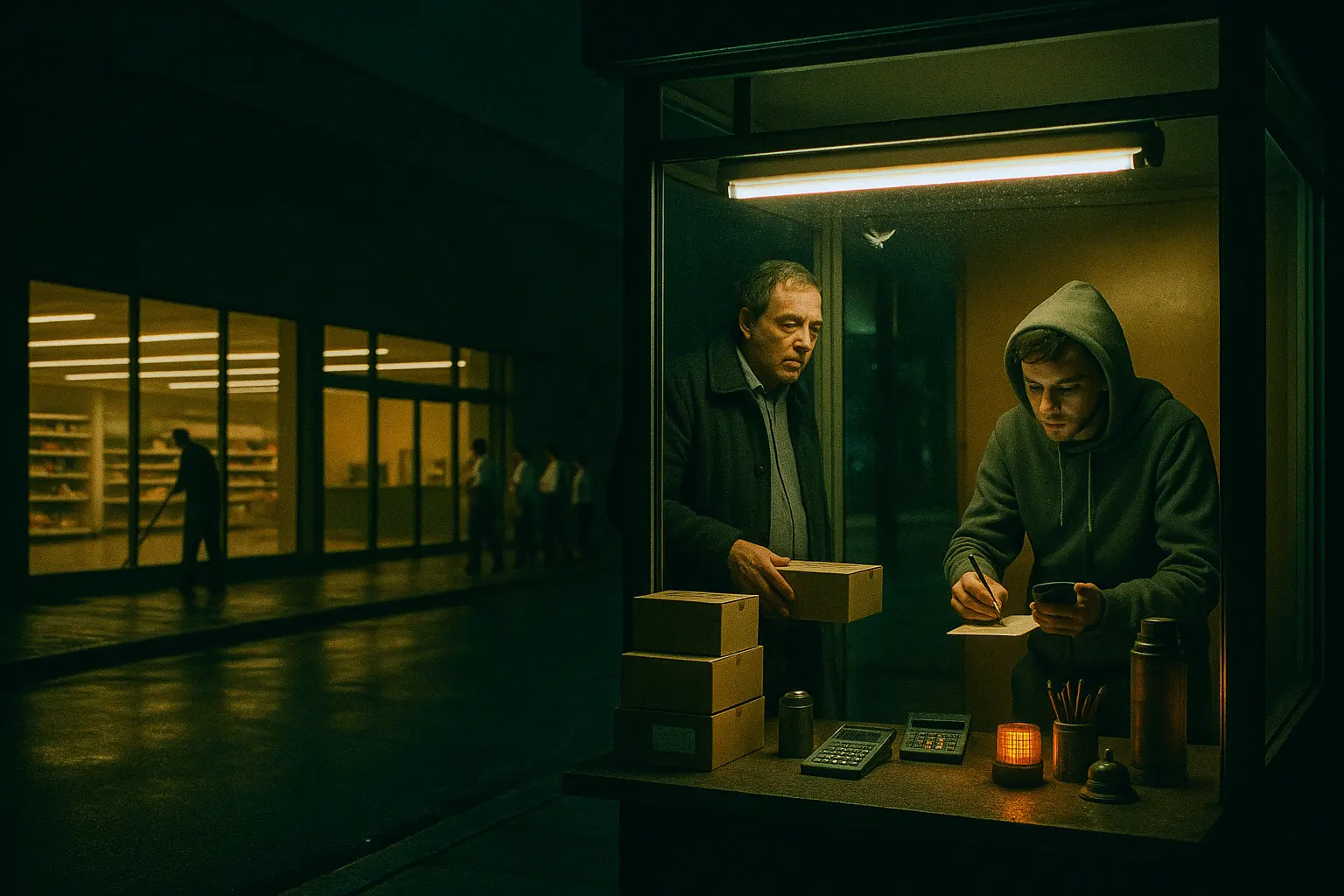
Picture an ordinary residential neighborhood. The supermarket closes at 8pm. Across the road the all-night kiosk glows under a sign that says “Open 24 hours”: the same goods, with prices copied from the supermarket’s price tags and a little higher. Behind the supermarket a night window has been open for years. A contractor runs it, and most night trade goes through it. Farther off, in Chicago, hangs a scoreboard that shows tomorrow’s prices from Sunday evening on.
The kiosk is tokenized stocks. The window is the night alternative trading systems (ATS), such as Blue Ocean: off-exchange venues through which brokers have sold American shares at night for several years. The scoreboard is CME futures. The supermarket is the exchanges.
The kiosk has a detail the customer rarely notices: it sells an IOU, and the goods are somewhere else. The IOU says the goods are lying in a warehouse in Jersey, in the British Virgin Islands or in Abu Dhabi. Every loud question about “stocks on a blockchain” comes down to three plain ones: what is in the box, who writes the price tag, and when the delivery arrives.
Two popular framings fail here. The first is “blockchain democratizes finance”. The second, more fashionable, is “Wall Street is becoming a crypto exchange”. Night trading of American shares has already been built through the window, without a blockchain, for Asian retail investors. The kiosk got the weekends.
First wave: the kiosks that did not survive
In 2019–2021 tokenized stocks were sold by FTX, Bittrex Global and Binance. Custody and issuance for all three were handled by two small firms, CM-Equity of Germany and Digital Assets AG of Switzerland; the exchanges only sold the product.
Binance launched five tokens in April 2021: Tesla, Coinbase, MicroStrategy, Apple and Microsoft. Germany’s regulator BaFin almost immediately said these were securities that needed a prospectus; CM-Equity objected that none was needed, because settlement was in the stablecoin BUSD. On 16 July 2021 Binance halted sales, citing “commercial focus”. The same day Hong Kong’s regulator called the tokens probably securities and reminded everyone that Binance had no license. A coincidence, of course. In three months the tokens turned over about $73 million, less than a million dollars a day.
Other kiosks closed without any police. Mirror Protocol on the Terra blockchain issued “mAssets”, synthetic mirrors of Tesla or Apple backed by crypto collateral. The collateral in the protocol reached about $2.2 billion (May 2021), and the press called it the “size of the market”. In May 2022 the stablecoin UST broke, and Mirror died of its own collateral. Tesla had nothing to do with it. The SEC later classed mAssets as security-based swaps. Synthetix withdrew its synthetic stocks back in September 2021 and explained why itself: low volumes, front-running, and a price that, outside exchange hours, is tied to nothing.
The first wave proved that someone wanted the idea. The product did not exist. What was missing was a licensed link with real custody of the shares and a price outside exchange hours. The Synthetix oracle (a service that feeds a price onto a blockchain) stood still at night. The market maker who was supposed to quote the token had nothing to hedge with.
Second wave: the kiosk gets a license
In 2025 the same ideas came back, anchored differently:
- Stablecoins. In January 2021 there were $27 billion of them in circulation; in October 2026, $311 billion. In July 2025 the US passed the GENIUS Act on dollar stablecoins.
- The regulator. Under Paul Atkins the SEC began to write rules instead of filing lawsuits.
- The legal wrapper. Instead of the argument “settlement is in BUSD, so no prospectus is needed”, there is now an approved prospectus. For xStocks it was approved by Liechtenstein’s regulator, the FMA.
- The sellers. The product is distributed by big venues: Kraken, Robinhood, Binance and, since August 2026, Coinbase.
Since the start of 2026 the value of the “stocks” class on RWA.xyz has grown almost fivefold, from $0.68 billion to $3.34 billion. The series has to be read carefully, because the aggregator rewrites it retroactively. At the end of 2024, 96% of this “market” was a single token: the crypto company Exodus’s own shares, tokenized by Exodus itself. As late as October 2025 it still accounted for $852 million of $1.34 billion. For a long time the kiosk traded one box, its own. The market in wrappers around other companies’ American shares effectively began on 30 June 2025.
Market share goes to whoever has more buyers. In March 2026 Ondo had 58% of the value, and in May it claimed “over 70% of the market” itself. On 12 October it has 27.8%. Ondo has not shrunk: its value has stayed around $0.93–1 billion since May. Binance launched its own bStocks on 11 June and in four months collected 27.6%, almost as much as the leader gathered in a year.
What is in the box
“1:1 backed” is the phrase most often found on tokenized-stock websites. The buyer hears: “I own an Apple share.” Legally the buyer owns something else, and what exactly depends on the seller.
| What is in the box | Examples | Who is liable | Hours | What the owner gets |
|---|---|---|---|---|
| A secured note of a special-purpose company (a debt instrument tied to the share price) | xStocks; Ondo; the new Robinhood Chain tokens; Binance bStocks | a special-purpose company in Jersey (xStocks, Robinhood), in the British Virgin Islands (Ondo), in Abu Dhabi (bStocks) | secondary market around the clock; issuance and redemption 24/5 | a claim on the issuer, secured by collateral; no vote, dividends are reinvested net of tax, no share is delivered |
| A broker's derivative | Robinhood Classic in the EU; Gemini in the EU | Robinhood Europe UAB (Lithuania) | 24/5 | a contract for difference with the broker; the token cannot be withdrawn, risk rating in the KID document: 7 out of 7 |
| An entitlement to a share in the broker's books (security entitlement) | Securitize Stocks; Dinari | a US broker-dealer | at first only extended hours | dividends and, where the share class carries one, a vote; verified investors only |
| The share itself in the register | Galaxy (GLXY) via Superstate | the share registrar | only between approved wallets | full shareholder rights |
| A perpetual future (perp) | trade.xyz on Hyperliquid; Binance | the exchange or the market maker | around the clock | a price bet with leverage; barred to US citizens |
The commonest design is the first row. Legally an xStock is a tracker certificate: a debt certificate under Swiss law that follows the share price. It is issued by Backed Assets (JE) Limited, a special-purpose company in Jersey. The company itself, as the prospectus says in so many words, is “not regulated”: Liechtenstein’s regulator approved only the document. The Apple shares sit with custodian brokers (Alpaca, InCore, GTN), pledged in favor of the token holders, and a separate agent, Security Agent Services AG of Zug, manages that pledge.
What happens if the issuer goes bankrupt is set out in the prospectus as a payment waterfall. The collateral agent, the custodian, the payment provider and those who will realize the assets are paid first from the collateral. Token holders get what is left, pro rata. They get none of the issuer’s other assets. The phrase “bankruptcy-remote”, which turns up in marketing, appears neither in the prospectus nor on the legal page of the documentation (checked on 12 October 2026). Nobody has yet tested this structure in court.
The kiosk’s customer gets an IOU. A good one, with collateral and a notary, but an IOU.

“1:1 backed” is not a share in a box. It is an IOU from a special-purpose company in Jersey, secured by collateral that nobody has yet tested in court.
Ondo is built along similar lines: a structured note of a company in the British Virgin Islands, sold only under Reg S, that is, to non-Americans. Here the warehouse sets the token’s hours. Issuance and redemption run from 8:05pm Sunday to 7:59pm Friday New York time. The reason is that this is when the issuer can buy or sell a real share through the overnight broker sessions. Since 25 June 2026 Ondo has allowed issuance and redemption around the clock, but only for six assets; about thirty work in a weekend mode with separate limits. According to a snapshot of its status page in August, for most tokens the weekend limit was zero.
xStocks and Robinhood Chain tokens trade around the clock in 110–120 countries and carry no rights. Securitize offers dividends and a vote, and on 8 October it started only in extended hours, for verified investors; of twelve announced tickers, seven were live on 12 October. A real Galaxy share on a blockchain carries all the rights and moves only between approved wallets. An owner’s rights are legal obligations, and someone has to perform obligations. At night and at weekends there is nobody to perform them.
Tax matters too. Ondo’s documentation describes a 30% withholding on dividends from American shares before they are reinvested in the token. A European or Ukrainian with a direct brokerage account and a W-8BEN form pays the treaty rate, usually 15%.
Redemption is conditional as well. A retail holder can redeem an xStocks token directly with the issuer only after an identity check (KYC) and from $5,000. The fee is up to 0.5%, and payout comes within five business days. Everyone else gets out through the secondary market, at the same kiosk-keeper’s.
How big it really is
The marketing figures of this market count everything: sales, returns, and carrying the box from shelf to shelf.
xStocks. The company shows “$40B+ transaction volume”. It is a cumulative figure since launch, and the company does not explain what goes into it. In February 2026 the $25 billion milestone explicitly included trading on centralized and decentralized exchanges and primary issuance and redemption. A “$20 billion” component meant trading in March and “settled onchain” in September. The xStocks issuer and its main venue belong to the same group, Kraken (Payward). There is no independent confirmation.
Ondo claims $27 billion in “cumulative trading volume”. About $18 billion of that is exchange trades according to Ondo’s own data, and about $9 billion more is primary issuance and redemption (DefiLlama counted $9.07 billion through 11 October). It is easy to count one position twice here: a market maker first issues a token and then sells it on an exchange.
Binance reported more than $30 billion of bStocks turnover in under 90 days. The issuer, the exchange and the source of the figure belong to one group.
The most serious independent figure is $15.6 billion of onchain volume for September from CoinDesk Data. Robinhood accounted for $6.57 billion of it (42%), Binance bStocks for $5.42 billion, xStocks for $2.11 billion and Coinbase for $0.8 billion. CoinDesk does not disclose its methodology and has already revised earlier months: July was first estimated at $11.3 billion and is now put at $15.4 billion. On the Robinhood Chain DEX about a third of the flow in August went into pairs with memecoins (an estimate by SQD analysts). All Robinhood tokens on the blockchain are worth $136 million, so over a month each one was resold almost 50 times. Savings do not turn over like that.
The “4.35 million holders” on RWA.xyz is the number of wallets with a non-zero balance, an average of $770 each. Binance bStocks gathered 1.5 million such addresses in four months. That is what a prize giveaway usually looks like. According to a FalconX study, 62% of the holders of the ten largest tokens did nothing with them over the month.
Decentralized finance (DeFi), the supposed reason to put a share on a blockchain at all, is barely involved so far. On 12 October, tokenized stocks were pledged as collateral for about $40 million in the Kamino and Jupiter Lend lending protocols, and about $12 million was borrowed against them. That is 1.2% of the market’s value. People buy the boxes, but hardly anyone takes them to the pawnshop.
Our own series, the turnover of ten xStocks on Bybit, shows real if modest growth: from $23 million in July 2025 to $170–215 million a month in summer 2026.
The round-the-clock market in American shares inside crypto is, above all, derivatives. Perpetual futures on stocks produced $34 billion of turnover in May 2026 (CoinGecko, excluding oil and gold). On Hyperliquid, by our snapshot of 12 October, perps on stocks and indices turned over $1.41 billion in a day, with open interest of $2.74 billion. That is 2.4 times the daily turnover of all spot tokens. The night window on ordinary rails averaged $7.4 billion a day in August. Whoever wants Apple at 3am mostly buys it without a blockchain. Whoever does it on a blockchain most often takes leverage instead of a share.
The supermarket opens a night shift
The size of the American night is known from a primary source. According to an SEC staff memo of 10 September 2026, an average of 144.6 million shares traded each day overnight in August, between 8pm and 4am New York time. The value came to $7.4 billion a day. That is 0.9% of total share volume and 0.8% in dollars; over a year, night trading grew by 359%. The ten most popular securities account for 43.4% of night volume (10.3% by day), and the night ten barely overlaps with the day ten. According to CAT, the consolidated audit trail, in the second quarter 37% of overnight share volume came from foreign accounts, against 10% in regular hours.
In summer, 8pm–4am New York time is 9am–5pm in Seoul.
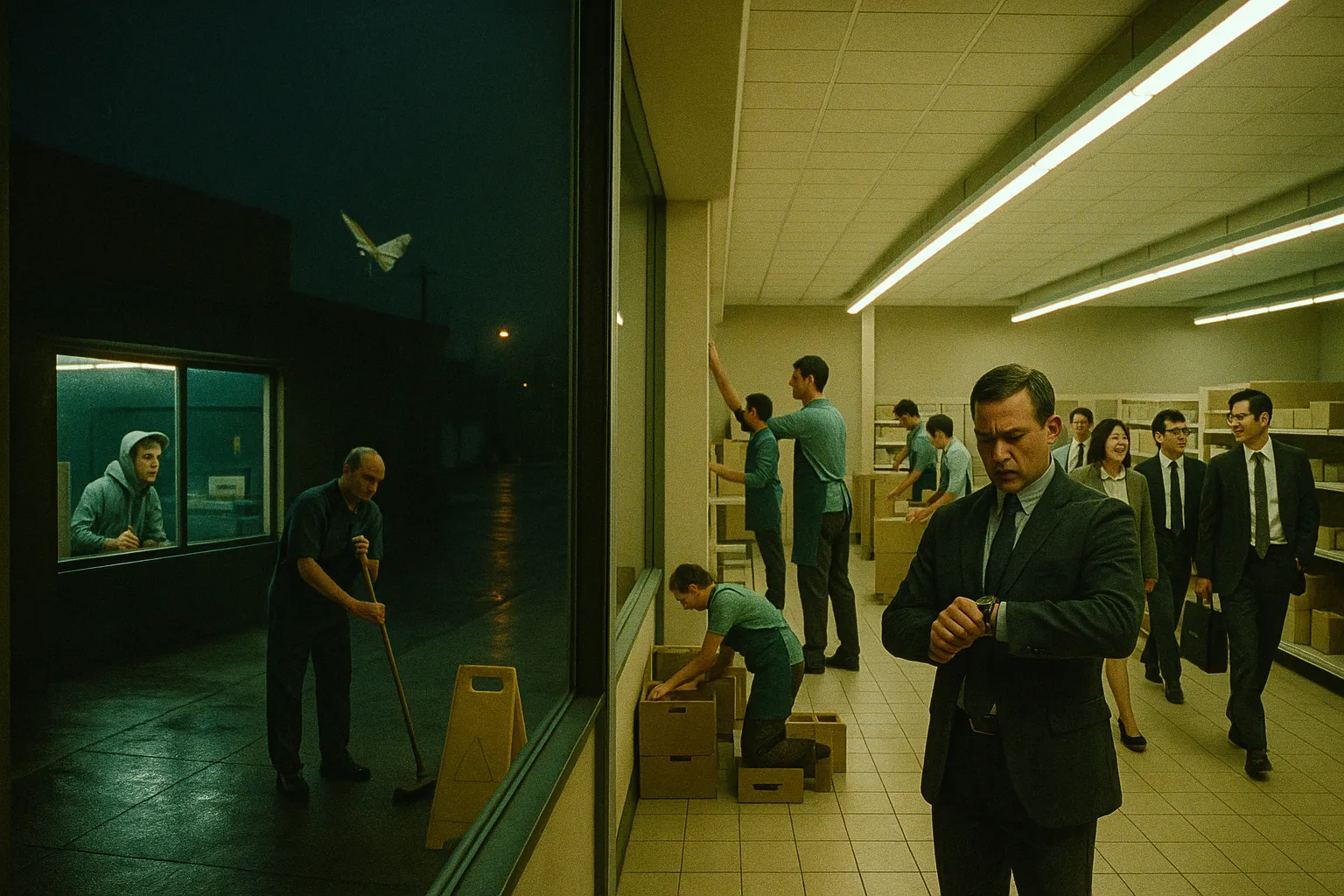
The night shift was not opened because of the kiosk. The queue came from time zones where the American night is the middle of the working day.
The window opened long before the kiosk. Blue Ocean launched night trading of American shares in 2021: the beta in June, the official start on 5 October. Brokers from Korea brought their clients there. In August 2026 Blue Ocean handled 93.7 million shares a night, about 84% of night volume on ATSs. How fragile this trading is showed on 5 August 2024. During the crash of Asian markets Blue Ocean could not take the load and canceled the orders of about 90,000 Korean accounts.
The exchanges took up the night before tokens did, too. On 27 November 2024 the SEC registered the exchange 24X, designed for 23-hour trading. On 11 February 2025 it approved 22-hour trading on NYSE Arca. On 18 March 2025 DTCC announced that its clearing house NSCC would move to 24x5. xStocks and the Robinhood tokens started on 30 June 2025, 3–7 months later.
The supermarket noticed the kiosk, but later. At the end of December 2025 Nasdaq filed for 23/5 trading and gave two reasons. Investors from Asia are going to the night ATSs (Blue Ocean, Bruce, Interactive Brokers, OTC Moon). They are also “increasingly utilizing trading platforms that provide access to markets for digital assets, including cryptocurrencies, tokenized assets, and tokenized securities, on a 24/7 basis”. Longer hours, the exchange said, should help it “compete for order flow from these investors”. The SEC approved the filing on 10 April 2026 but did not mention tokens in its own reasoning. Cboe’s filing cites only retail investors from Hong Kong, Japan, Korea and Singapore. NYSE Arca gives no motive at all.
Tokens barely stirred the exchanges. They appear in one filing as the second-in-line rival for the night customer, after the window. In May Adena Friedman, who heads Nasdaq, gave the main reason in an interview with Barron’s: 23/5 trading is “already happening. It’s just happening in the dark”. By the dark she meant the off-exchange ATSs.
To bring the night from the window into the store, the old systems have to be rebuilt in step:
- Clearing. NSCC has run 24x5 since Sunday, 28 June 2026: from 8pm Sunday to 8pm Friday New York time.
- The consolidated tape (SIP), which shows the trades of all exchanges together. Its operators move to 23x5 on Sunday, 6 December 2026, from 9pm: they will run until 8pm Friday with a one-hour pause each day, 8–9pm. Tests began on 2 October, and the start date depends on their outcome.
- Exchanges. Five venues have night-session rules: Nasdaq (approved 10 April), Cboe EDGX (29 May), NYSE Arca and MEMX (the rules took effect immediately on filing) and 24X.
- Safeguards. At night, static price bands of ±20% will apply with no automatic pauses, and in the night session Nasdaq will accept only limit orders.
The 8–9pm pause hour is currently the busiest for the night ATSs: it accounts for 21.2% of their volume. The supermarket is opening a night shift, but every evening it closes for an hour to mop the floor. That is the hour when the queue at the window is longest right now.
With tokenization itself the exchanges so far work on paper. Nasdaq won the SEC’s approval to trade a tokenized form of shares as early as 18 March 2026. It is the same order book and the same CUSIP (the security’s identifier), with settlement in one day through the pilot of the depository DTC. On 15 July DTCC carried out the first live trades with more than 30 firms. But as of 12 October the service is not fully launched, and no such trade has taken place on Nasdaq. On 19 January the NYSE announced a separate 24/7 platform with stablecoins and fractional shares. There is still no launch date and no filing with the SEC. The old players are tokenizing the books, and trading stays where it is.
On 17 September 2026 the SEC issued Order 34-106402, a temporary exemption for blockchain venues that trade tokenized stocks. The press release called it an “innovation exemption”; the substance is more modest. A token on such a venue must carry the same rights as the share, and the share’s issuer has 30 days to object to someone else’s token. Trading halts whenever it halts on the primary exchange. The limits are:
- up to 75 securities in the first group (shares in the S&P 500 and Russell 1000, liquid ETFs). Each one’s turnover is capped at 0.25% of its average daily volume on exchanges;
- up to 250 securities in the second group, capped at 2.5%.
For an “average” first-group share, 0.25% is roughly 7,600 shares a day. The order runs until 17 September 2031. As of 12 October no such venue is operating. The first to file a notice was OKXICE, a joint project of ICE and OKX, on 4 October.
SEC Commissioner Hester Peirce explained the logic on 23 September. “Tokenization is coming, and I would rather it happen here than have overseas markets offer tokenized exposure to U.S. equities without a domestic alternative”. The regulator fears something different from what the exchanges fear: American shares sold from offshore venues with no American oversight. So it lets a kiosk be placed inside the store, on a leash 0.25% long.
Citadel Securities, the largest market maker in the US, wrote to the SEC in July 2025 that using regulatory arbitrage for “look-a-like securities” does not count as innovation. In form, the 2026 order repeats almost all of that side’s demands: narrow scope, limited term, issuer veto, halts that follow the exchange. The exchanges got their way: tokens received rules under which they depend on the exchange.
48 hours with no owner
Right now the American stock market is silent for 48 hours a week: from 8pm Friday, when the evening session closes, to 8pm Sunday, when the night window opens. After 6 December that hole will last until 9pm Sunday, 49 hours, plus the daily hour of cleaning, plus holidays. In those hours there is no exchange, no clearing (NSCC does not work on Saturday) and no consolidated tape. The Chainlink oracles, from which DeFi takes share prices, return the last Friday value at weekends. Issuance and redemption of xStocks run only on working days; at Robinhood, from 2am Monday to 2am Saturday Central European Time. At weekends the supplier does not drive out to the kiosk.
Only in these hours do tokens have an advantage the exchange lacks. We checked how they use it. The data: hourly and five-minute prices of ten xStocks on Bybit since 30 June 2025, tokens on Kraken, perps on Hyperliquid, Nasdaq-100 futures on CME, and the shares themselves. The method is described at the end.
While New York is working, the kiosk copies the price tag carefully. During the trading session the median deviation of the token’s price from the share’s is 4 basis points (hundredths of a percent). In 90% of cases it is no more than 15. The difference between the buy and sell price of NVDAx on Bybit in the same hour is 2–3 bps.
Tokens trade mostly when the exchange is open. On Bybit 45% of xStocks turnover falls in the main session and another 35% in the American pre-market, 4am–9:30am New York time, when it is daytime in Europe. The weekday night accounts for 8% of turnover and weekends and holidays for 7%, although they take up 23% and 31% of the hours in a week. Kraken looks similar. Volume on Binance’s decentralized exchange is distributed differently. According to Bitquery, in July 91% of bStocks volume passed outside the main US session, with a peak at 07:00 UTC, in the Asian morning. But weekends are marginal everywhere. DefiLlama, on a wider sample (bStocks, xStocks and Ondo, mid-June to early August 2026), counted 5.8% of volume at weekends. Weekends accounted for 0.65% of Ondo’s primary issuance flow since the start of the year.
The kiosk sells access above all. A buyer from outside the US buys an American share in their own working day, and often when New York is open too. They do it simply through a crypto exchange where they already have an account.
At weekends the token’s price knows little. We took 628 token-weekend pairs and compared the token’s move from Friday 8pm to Sunday 6pm (before futures opened) with how the share opened on Monday. The correlation is 0.24. The regression slope is 0.37: if the token rose 1% over the weekend, the share opens on Monday on average 0.37% higher. A working paper by Cong and co-authors, on a wider sample, gives the same order of magnitude for all off-exchange hours together. A 1% token move corresponds to 0.28% at the open. When the token moved by more than a percent, it guessed the direction 70% of the time. But the mean error of a “forecast from the token” is 132 bps, and of the forecast “nothing changed”, 125. There is information in the price, but the token moves roughly three times as much as Monday later justifies.
Perps do not know more. On the same weekends since March 2026, when the Hyperliquid data begins, a perp’s move correlates with the Monday gap at 0.23 and the token’s at 0.24. The two correlate with each other at 0.98. In essence it is one price in two wrappers. The analytics firm Allium, using five shares over 60 days, found that the Sunday perp misses Monday’s open by 80 bps on average. The Friday close, it found, misses it by 113. Researchers at 0xResearch found no signal across 146 weekends (50.7% hits). The vendor Goldsky reports 84% direction hits but does not disclose its method, and it measures the price on Sunday evening, after futures have already opened.
After 6pm on Sunday the picture changes. If the window is extended to 4am Monday, the correlation of the token’s move with the gap rises to 0.69. The five-minute data show where this knowledge comes from. On weekday nights the Nasdaq-100 future moves 5–15 minutes before the token; in the other direction there is no link. At weekends the perp moves before the token. And the perp and the CME future move in step, with no noticeable lag. Until 6pm on Sunday nobody writes the price of an American share. After that, Chicago does.
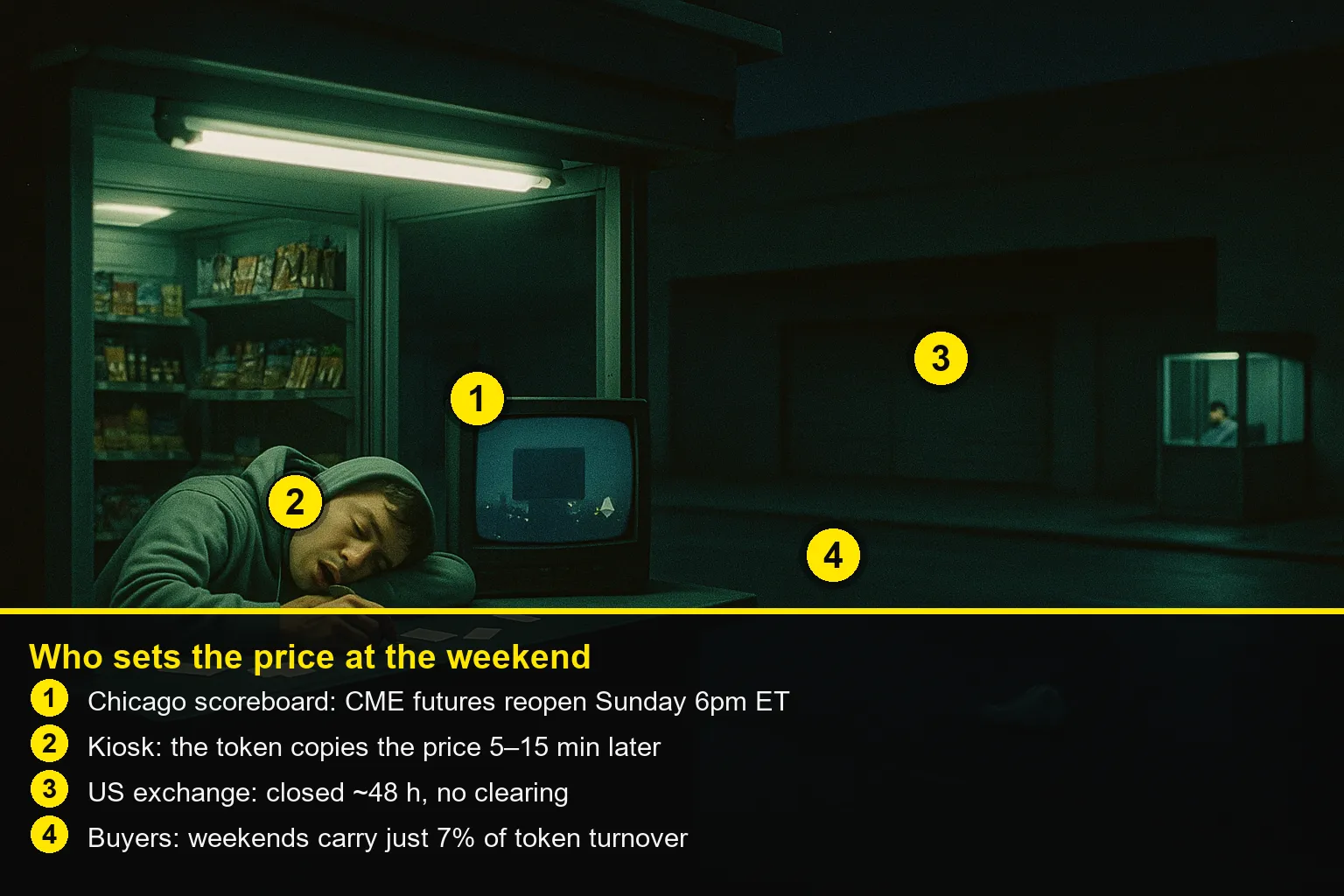
At weekends nobody writes the price. At 6pm on Sunday the scoreboard in Chicago lights up, and five minutes later the kiosk copies the price tag.
In thin hours the price is easy to knock off course. In July 2025, in a Jupiter pool, a purchase of a few hundred dollars printed an AMZNx price of $23,781. The figure was more than a hundred times the price of an Amazon share. It was the priciest box of Amazon ever, delivery not included. Overnight into 30 August 2026 the HIMS token on Robinhood Chain briefly cost $132.64 against a Friday close for the share of $28.84. More than half of the token’s supply was then sitting in a memecoin pool. On 3–4 September the AMC token rose to $23.16 against an NYSE close of $2.54. Perps get hit too. On 28 July 2026 one erroneous SK Hynix trade on the Korean alternative venue Nextrade got into the Hyperliquid oracle. The perp fell 18%, and about 960 positions with a notional value of $57 million were liquidated (the actual losses were about $17 million). The platform compensated the losses “one time”, at its own discretion.
Lenders in DeFi allow for this. Jupiter Lend says outright that at weekends the oracle is frozen and the main risk is the Monday gap. So against NVDAx it lets you borrow no more than 65% of its value.
Tokens extended the hours of access to American shares. The hours in which their price is formed did not change.
What happens when the market never closes
A round-the-clock market keeps its timetable. The timetable stops being a law and becomes a rhythm.
At night liquidity costs more. The economists Eaton, Shkilko and Werner used Blue Ocean data for 2024. They calculated that the quoted spread at night is 1.4 times wider than by day for the most liquid securities. For all of them it is 2.4 times wider. The price impact of a single trade is at least three times higher. Market makers there trade at a loss on average. The night window then accounted for about 9% of the day’s price change: 17% for ETFs and only 4% for individual stocks. For now the night follows the day.
Auctions keep their weight. The closing auction accounts for about 10% of the dollar volume of the American market, and on the day of the Russell index rebalancing for more than a third. Index funds and ETFs compute the value of their shares from the 4pm price, and the night session does not change that. Even in cryptocurrencies, which never close, weekends account for only 13% of bitcoin volume, although an even spread would give 28.6% (Kaiko, 2024). People sleep even when the exchange does not.
Guarantees weaken at night too. There is no consolidated best price across venues (NBBO) at night. In a field experiment by Huang and Schwartz, the quotes of different brokers at night diverged by 160–200 bps. A quarter of trades went through at worse than the best available price. Night price bands are static: ±20%.
Who benefits? Most of all, Asian and European retail investors and the brokers that serve them: Robinhood, Interactive Brokers, Korean firms. Also the exchanges, which move the night flow from the window into the store. Through its own tokenization DTCC is going after the most useful part of the technology, faster movement of collateral between banks and brokers. For now, though, its tokens have no collateral value. The pressure will fall on the night ATSs, whose busiest hour coincides with the pause in the tape. It will also fall on brokers without a night session, and on offshore issuers, once a regulated counter appears next door.
The exchanges behave like the owner of a shopping mall who is wondering whether to open the same kiosk inside. Nasdaq is tokenizing the record-keeping in its own order book. ICE is building a joint venue with OKX and the NYSE’s own 24/7 platform. DTCC is running a pilot with dozens of firms.
Check what you are actually holding
It is 7am in Kyiv, and the coffee is still hot. In New York it is midnight, and you want to “buy Nvidia” now, without waiting for 4:30pm Kyiv time. What exactly you get depends on the counter.
| Counter | What you get | When it works | Who sets the price | Main risk |
|---|---|---|---|---|
| A broker with a night session | the share itself | Sunday 8pm – Friday 8pm New York time | night ATSs, from December the exchanges | wider spread, limit orders only |
| A token note (xStocks, Ondo, bStocks) | a claim on a special-purpose company, secured by collateral | secondary market around the clock, redemption 24/5 | the US exchange; at weekends, the market in tokens and perps itself | issuer and collateral, Monday gap, thin pools |
| A broker's token derivative (Robinhood Classic) | a contract with the broker | 24/5 | the US exchange | the broker as counterparty, 7/7 risk, the token cannot be withdrawn |
| A perp (Hyperliquid, Binance) | a price bet with leverage | around the clock | CME futures; at weekends, the perp market itself | liquidation, oracle, jurisdiction |
| A CFD at a broker | a contract for difference | mostly 24/5 | the broker, from the exchange price | the broker as counterparty, leverage |
Only the first row gives you the share as property. The rest sell access, and you pay for it with spread, rights or leverage.
2030: three scenarios
A. The kiosk beside the supermarket (probability ≈50%). From December 2026 the exchanges run 23/5. Brokers add weekends: Robinhood has already announced trading in selected shares at weekends “early next year”, so far with no date and no SEC approval. Offshore tokens remain a channel for non-Americans and a base for derivatives, and their share of US turnover stays below 0.1%. What would speed this up: the start of the night tape, weekends at brokers. What would hold tokens back: a ban on sales to Americans, taxes, jurisdiction risk.
B. The supermarket with a token checkout (≈35%). The exchanges and the depository move record-keeping onto a blockchain. DTC fully launches the service, and Nasdaq trades a tokenized form of shares in the same order book. The SEC gradually raises the limits for blockchain venues, and stablecoins become an ordinary way to top up an account. The price is formed on the exchanges, and the blockchain becomes a bookkeeping layer and a weekend counter. What would speed this up: the first trades via DTC, the first working venues under the SEC order, the launch of NYSE 24/7. What would hold it back: limits of 0.25–2.5% of volume, issuers’ vetoes, no collateral value for tokens at DTC.
C. The supermarket on a blockchain (≈15%). Companies issue shares straight away as digital securities, settlement is instant, trading runs around the clock, and the exchange, clearing and depository merge. For that the SEC has to lift the limits, DTC has to give tokens collateral value, and big issuers have to repeat Galaxy’s path en masse. There is a hidden price too. Instant settlement of each trade separately cancels the netting that currently cuts participants’ settlement obligations by 98%. Active traders will need more capital than now.
The published forecasts fit this framing badly. Of nine known forecasts for the tokenization market, only two single out stocks. Citi Institute puts tokenized public equities in 2030 at $3.6 trillion (range $1.8–5.4 trillion), Binance Research at $349 billion ($61–987 billion). Citi’s pessimistic scenario is twice Binance’s optimistic one. From today’s $3.34 billion, Citi’s forecast requires growth of roughly fivefold a year for four years running, Binance’s roughly threefold. The other big figures ($16 trillion, $19 trillion, $30 trillion) include deposits, stablecoins and bonds and have little to do with shares.
Where we may be wrong
- Sample. Our quantitative block covers Bybit, Kraken and Hyperliquid. Pools on decentralized exchanges are thinner, and the deviations there are most likely larger.
- News. Most weekends are quiet. On weekends with a gap above 2% the token guessed the direction 69% of the time. If weekends bring more big news, Saturday’s price will count for more.
- The regulator. If the SEC raises the limits and the NYSE launches 24/7, weekend trading could become regulated and liquid within a year. Then the kiosk turns into a department of the supermarket.
- History. In 1999–2000 the NYSE and Nasdaq discussed evening sessions of their own and never opened them. In June 2000 the SEC recorded that only 3% of volume traded after 4pm, and that 73% of that Nasdaq trading came in the first 15 minutes. Today’s night rests on Asian retail demand; if it weakens, the timetable could contract again.
- Depth of demand. According to a Coalition Greenwich survey in March 2026, only 14% of institutional traders support 24/7 trading, and 60% have no interest in trading outside regular hours. For now the night is retail, and it may stay that way.
The kiosk after six
From December the supermarket will work almost around the clock: from Sunday evening to Friday evening, with an hour set aside for cleaning. The queue for it came from Asia, where the American night is the working day, and stood at the night window four years before the kiosk appeared.
The kiosk got the weekends. But by our data weekends account for only 7% of its turnover: buyers come by day, when the supermarket is open too. On Saturday the seller writes price tags by eye, the boxes hold IOUs for goods in a warehouse in Jersey, and the supplier will not arrive before Sunday evening. At six the scoreboard in Chicago lights up, and within five minutes the kiosk copies the price tag.
The blockchain did not keep Wall Street awake. Wall Street was woken by retail investors in Asia. Crypto got the hours in which nobody knows the price, and almost nobody comes to buy.
How we counted
Data. Bybit: hourly candles of ten xStocks (NVDAx, TSLAx, AAPLx, METAx, AMZNx, GOOGLx, COINx, HOODx, CRCLx, MCDx) since 30 June 2025, and five-minute candles for the last 60 days. Kraken: 177 tokenized-stock pairs against the dollar, hourly prices for 30 days, order-book snapshots. Hyperliquid: open interest and daily turnover of all HIP-3 markets (snapshot of 12 October 2026), hourly and five-minute candles of perps on the same shares. Yahoo Finance: hourly and five-minute prices of shares including pre- and post-market, NQ=F (CME) futures. Accessed 12 October 2026.
Tracking. Premium = token price / share price − 1, on matching five-minute timestamps, for bars with trades only. The median premium of the same day’s trading session is subtracted from it, which removes the reinvested-dividend multiplier and the difference between USDT and the dollar.
Weekends. The base is the last share price at 8pm Friday New York time. The token’s move runs from 8pm Friday to 6pm on the day before the open (before CME Globex starts). The gap is the opening price at 9:30am on the next trading day. 628 token-weekends, including long weekends. “Forecast error” is the mean absolute deviation of the gap from the token’s move; it is compared with the forecast “gap = 0”.
Who leads. Correlations of the token’s five-minute log returns with the NQ future (weekday nights, Sunday evening) and with the Hyperliquid perp (weekends) at lags from −15 to +15 minutes, averaged across the six Nasdaq-100 tokens. For bars with no trades the token’s price is carried forward.
Sessions are in New York time: trading session 9:30am–4pm, pre-market 4am–9:30am, post-market 4pm–8pm, night 8pm–4am on weekdays, and “weekends and holidays” from 8pm on the last trading day to 8pm on Sunday.
Limitations. These are centralized exchanges and the most liquid tokens. Onchain pools are thinner, and the deviations there are larger. Aggregators’ estimates of the market differ almost twofold: $2.5 billion (CoinGecko), $3.34 billion (RWA.xyz), $4.9 billion (DefiLlama). We use RWA.xyz as the main source and name the metric. Companies’ marketing figures are marked “according to the company”. The key claims were checked in a separate pass against primary sources: 80 checks, two independent ones for each of the 31 most important claims and one each for 18 secondary ones. The verifier is skeptical by default: without proof, a claim counts as unverified. This text is not investment advice.
Sources
- SEC, Division of Trading and Markets. Staff memo: overnight trading (10 September 2026). sec.gov
- SEC. Notice of filing SR-NASDAQ-2025-109, Release 34-104563 (29 December 2025). sec.gov
- SEC. Order approving Nasdaq 23/5, Release 34-105199 (10 April 2026). sec.gov
- Cboe EDGX. Rule filing SR-CboeEDGX-2026-019 (23x5). cboe.com
- SEC. Order approving NYSE Arca 22-hour trading, Release 34-102400 (11 February 2025). sec.gov
- SEC. Order granting registration of 24X National Exchange, Release 34-101777 (27 November 2024). sec.gov
- SEC. Order granting temporary conditional exemptive relief for Tokenized Securities Venues, Release 34-106402 (17 September 2026). sec.gov
- SEC. Order approving SR-NSCC-2026-006, Release 34-105565 (27 May 2026). federalregister.gov
- DTCC. NSCC now live with clearing hours extended (29 June 2026). dtcc.com
- SIP Operating Committees. SIPs receive SEC approval for extended trading hours initiative. prnewswire.com
- DTCC. Paving the way to tokenized DTC-custodied assets (no-action letter, 11 December 2025). dtcc.com
- ICE. The New York Stock Exchange develops tokenized securities platform (19 January 2026). theice.com
- Backed Assets (JE) Limited. Base Prospectus (FMA, 8 May 2026) and Second Supplement (29 September 2026). prospectus · supplement
- Robinhood Europe UAB. Key Information Document: Stock Tokens. robinhood.com
- Robinhood. Docs: Stock Tokens on Robinhood Chain. docs.robinhood.com
- Ondo Finance. Docs: legal and regulatory; market hours; investing and redeeming. docs.ondo.finance · hours
- Hester M. Peirce. Looking for change in haystacks (SIFMA, 23 September 2026). sec.gov
- Barron's. Nasdaq CEO Adena Friedman on the Future of 23-5 Trading, interview by Andy Serwer (video, 14 May 2026). youtube.com
- Citi Institute. GPS Report: Tokenization 2030 (June 2026). citigroup.com
- Binance Research on the $349 billion forecast, via Crypto Briefing (September 2026). cryptobriefing.com
- CoinDesk Data. Stablecoins & Tokenized Assets Report (September and October 2026). data.coindesk.com · coindesk.com
- RWA.xyz. Tokenized stocks dashboard (accessed 12 October 2026) and the archive of 10 October 2025. rwa.xyz · archive
- CoinGecko. Tokenized Stocks category. coingecko.com
- DefiLlama. RWA: Stocks & Equities; bStocks after hours: who is capturing liquidity when markets close (August 2026). dashboard · study
- Bitquery. bStocks: the 3 a.m. stock market (July 2026). bitquery.io
- Allium. When Wall Street sleeps (May 2026). allium.so
- Blockworks Research (0xResearch). When markets sleep (February 2026). blockworks
- Cong, Landsman, Rabetti, Zhang, Zhao. Tokenized Stocks (working paper, SSRN 5937314; slides, May 2026). slides
- Eaton, Shkilko, Werner. Overnight trading on Blue Ocean (working paper, 2024). utk.edu
- The Block. Binance ceases stock tokens trading (16 July 2021). theblock.co
- Bloomberg Law. Tesla tokens from crypto exchange Binance draw BaFin scrutiny (28 April 2021). bloomberglaw.com
- Reuters via nippon.com. Hong Kong SFC on Binance stock tokens (16 July 2021). nippon.com
- The Block. Citadel Securities letter to SEC on tokenized equities (July 2025). theblock.co
- FalconX. Velocity of value: the ascent of tokenized stocks (June 2026). falconx.io
- SQD. Robinhood stock token volume (August 2026). sqd.dev
- Galaxy Research. Hyperliquid, trade.xyz and oracle liquidations (SK Hynix, July 2026). galaxy.com
- trade[XYZ]. Docs: oracle price; legal disclaimers. docs.trade.xyz
- Jupiter Lend. xStocks risk report. jup.ag
- Robinhood. HOOD Summit 2026 (announcement of weekend trading). robinhood.com
- Securitize. Global onchain trading of US stocks with security entitlements (8 October 2026). prnewswire.com
- SEC. Special Study: Electronic Communication Networks and After-Hours Trading (June 2000). sec.gov
- Kaiko via Decrypt. Bitcoin weekend trading liquidity (2024). decrypt.co
- Crisil Coalition Greenwich via Wealth Professional (26 March 2026). wealthprofessional.ca
- NeuroDrift's own calculations: Bybit, Kraken, Hyperliquid API; Yahoo Finance (12 October 2026).
Frequently asked
Am I buying a real share when I buy xStocks or Ondo?
No. Legally an xStock is a secured tracker certificate issued by a special-purpose company in Jersey, and an Ondo token is a structured note of a company in the British Virgin Islands. You hold a claim on the issuer, secured by shares held at a custodian broker. There is no vote, dividends are reinvested in the token net of tax, and no share is handed over. If the issuer goes bankrupt, the collateral agent, the custodian and the payment provider are paid from the collateral first.
Can I already trade American shares at night without a blockchain?
Yes. Night sessions have run since 2021 on alternative trading systems (the largest is Blue Ocean), which brokers including Robinhood and Interactive Brokers connect to. In August 2026 an average of $7.4 billion a day traded overnight. From 6 December 2026 five exchanges, including Nasdaq and NYSE Arca, are due to launch night sessions.
Who sets the price of a share at the weekend?
Until Sunday evening, almost nobody. In our calculations on 628 token-weekend pairs, the token's move from Friday to 6pm on Sunday is only weakly linked to Monday's open (correlation 0.24) and as a forecast is no better than Friday's price. Perps behave the same way. At 6pm New York time on Sunday CME futures open, and from then on tokens trail them by 5–15 minutes.
Why do the exchanges tokenize shares at all?
To keep the format from going to offshore venues. Nasdaq has won the right to trade a tokenized form of shares in its own order book, DTC is running a tokenization pilot, NYSE is building its own 24/7 platform, and the SEC has allowed blockchain venues with strict limits. The aim is to keep price formation and customers inside the regulated perimeter.
Comments
Signed-in readers only — to keep it human, not a bot swamp.